

Comparative effectiveness of psychological treatments for depressive disorders in primary care: network meta-analysis
Open accessThe DOI matches its Crossref record; 37 of the 40 references it cites were found in a registry or an index.
Abstract
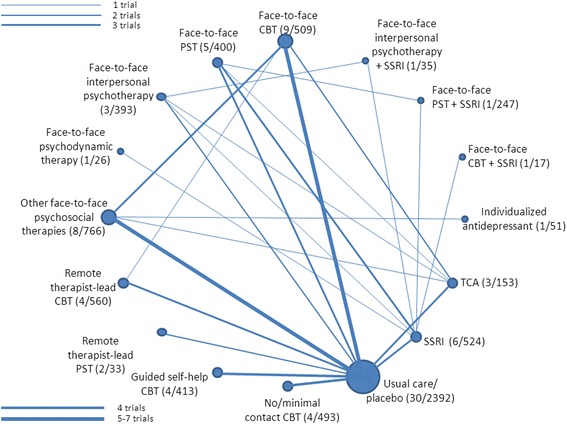
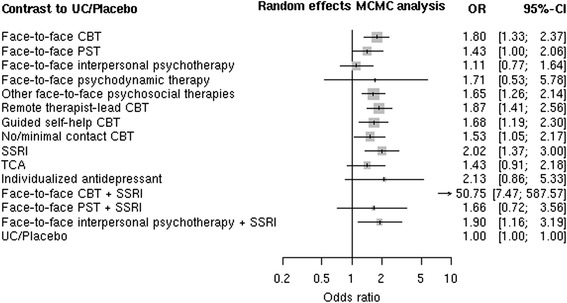
BACKGROUND: A variety of psychological interventions to treat depressive disorders have been developed and are used in primary care. In a systematic review, we compared the effectiveness of psychological treatments grouped by theoretical background, intensity of contact with the health care professional, and delivery mode for depressed patients in this setting. METHODS: Randomized trials comparing a psychological treatment with usual care, placebo, another psychological treatment, pharmacotherapy, or a combination treatment in adult depressed primary care patients were identified by database searches up to December 2013. We performed both conventional pairwise meta-analysis and network meta-analysis combining direct and indirect evidence. Outcome measures were response to treatment (primary outcome), remission of symptoms, post-treatment depression scores and study discontinuation. RESULTS: A total of 37 studies with 7,024 patients met the inclusion criteria. Among the psychological treatments investigated in at least 150 patients face-to-face cognitive behavioral therapy (CBT; OR 1.80; 95 % credible interval 1.35-2.39), face-to-face counselling and psychoeducation (1.65; 1.27-2.13), remote therapist lead CBT (1.87; 1.38-2.53), guided self-help CBT (1.68; 1.22-2.30) and no/minimal contact CBT (1.53; 1.07-2.17) were superior to usual care or placebo, but not face-to-face problem-solving therapy and face-to-face interpersonal therapy. There were no statistical differences between psychological treatments apart from face-to-face interpersonal psychotherapy being inferior to remote therapist-lead CBT (0.60; 0.37-0.95). Remote therapist-led (0.86; 0.21-3.67), guided self-help (0.93; 0.62-1.41) and no/minimal contact CBT (0.85; 0.54-1.36) had similar effects as face-to-face CBT. CONCLUSIONS: The limited available evidence precludes a sufficiently reliable assessment of the comparative effectiveness of psychological treatments in depressed primary care patients. Findings suggest that psychological interventions with a cognitive behavioral approach are promising, and primarily indirect evidence indicates that it applies also when they are delivered with a reduced number of therapist contacts or remotely. SYSTEMATIC REVIEW REGISTRATION: 01KG1012 at http://www.gesundheitsforschung-bmbf.de/de/2852.php.
Overview
The claims and statistics of this paper haven’t been checked yet.
Free: it reads the open-access text and checks the first 5 claims that cite a source we can check. Create a free account to check every claim.
Integrity signals
Registry
Cites
Statistics
Figures
Verification
Claims the paper makes
The claims and statistics of this paper haven’t been checked yet.
Free: it reads the open-access text and checks the first 5 claims that cite a source we can check. Create a free account to check every claim.
Claims other papers make about this one
Each is checked against this paper’s own text: does it say what the citing paper says it does?
The cited source says what the claim attributes to it.
In the citing paper
“Some meta-analytic comparisons between specific models of psychological treatment have shown no significant differences in efficacy, 57 with others showing modest differences.58”
From Canadian Network for Mood and Anxiety Treatments (CANMAT) 2016 Clinical Guidelines for the Management of Adults with Major Depressive Disorder (2016) · cites this paper as [58]
Self-check
Percentages, sums and reported differences re-computed from the paper’s own numbers.
The self-check needs the paper’s full text.
Citations
Cites
Developing and evaluating complex interventions: the new Medical Research Council guidance
Craig, P., Dieppe, P., Macintyre, S., Michie, S., Nazareth, I., & Petticrew, M. (2008) · BMJ · doi:10.1136/bmj.a1655 · Cited by 10,995 · cited 1×
“We classified treatments consistently with our previous work [11] (pages 58–59): “As psychological treatments are considered complex interventions [21], grouping them can be performed along several dimensions and remains controversial [22].”
Method(2008) · Cited by 3,790
Assessing Risk of Bias in Included Studies
Higgins, J. P., & Altman, D. G. (2008) · Cochrane Handbook for Systematic Reviews of Interventions · doi:10.1002/9780470712184.ch8 · Cited by 3,396 · cited 1×
“The Cochrane tool for assessing risk of bias was used to assess internal validity [20].”
MethodSalanti, G. (2012) · Research Synthesis Methods · doi:10.1002/jrsm.1037 · Cited by 1,729
Dias, S., Sutton, A. J., Ades, A. E., & Welton, N. J. (2013) · Medical Decision Making · doi:10.1177/0272989x12458724 · Cited by 1,207
Network meta‐analysis, electrical networks and graph theory
Rücker, G. (2012) · Research Synthesis Methods · doi:10.1002/jrsm.1058 · Cited by 730 · cited 1×
“org/] [27, 28], using the generalized method-of-moments estimator of between-study heterogeneity given in [29].”
MethodSelf-citationDias, S., Welton, N. J., Sutton, A. J., Caldwell, D. M., Lu, G., & Ades, A. E. (2013) · Medical Decision Making · doi:10.1177/0272989x12455847 · Cited by 728
The ESEMeD/MHEDEA 2000 investigators, Alonso, J., Angermeyer, M. C., Bernert, S., Bruffaerts, R., Brugha, T. S., Bryson, H., de Girolamo, G., de Graaf, R., Demyttenaere, K., et al. (2004) · Acta Psychiatrica Scandinavica · doi:10.1111/j.1600-0047.2004.00329.x · Cited by 580 · cited 1×
“First, can we extrapolate the findings from trials in specialized settings to primary care? Patients with depression in primary care sometimes have less severe [6–8] and more somatic symptoms [9, 10] than * Correspondence: Klaus.”
BackgroundQuantifying the impact of between-study heterogeneity in multivariate meta-analyses
Jackson, D., White, I. R., & Riley, R. D. (2012) · Statistics in Medicine · doi:10.1002/sim.5453 · Cited by 577 · cited 1×
“org/] [27, 28], using the generalized method-of-moments estimator of between-study heterogeneity given in [29].”
MethodBarth, J., Munder, T., Gerger, H., Nüesch, E., Trelle, S., Znoj, H., Jüni, P., & Cuijpers, P. (2013) · PLoS Medicine · doi:10.1371/journal.pmed.1001454 · Cited by 569 · cited 5×
“[5] did not find a difference between individualized face-to-face and all other delivery modes.”
BackgroundMethodInfluential
Research works printed but not linked: 2
- National Collaborating Centre for Mental Health (commissioned by the National Institute for Health & Clinical Excellence) Depression: The NICE Guideline on the Treatment and Management of Depression in Adults, updated edition 2004 Leicester & London British Psychological Society and the Royal College of Psychiatrists
- Mitchell J Trangle M Degnan B Gabert T Haight B Kessler D Major depression in adults in primary care 2012 Bloomington (MN) Institute for Clinical Systems Improvement (ICSI
Cited by
Malhi, G. S., & Mann, J. J. (2018) · The Lancet · doi:10.1016/s0140-6736(18)31948-2 · Cited by 4,099
Otte, C., Gold, S. M., Penninx, B. W., Pariante, C. M., Etkin, A., Fava, M., Mohr, D. C., & Schatzberg, A. F. (2016) · Nature Reviews Disease Primers · doi:10.1038/nrdp.2016.65 · Cited by 2,269
The Role of Common Factors in Psychotherapy Outcomes
Cuijpers, P., Reijnders, M., & Huibers, M. J. H. (2019) · Annual Review of Clinical Psychology · doi:10.1146/annurev-clinpsy-050718-095424 · Cited by 748
“Recently, a number of network meta-analyses of the effects of psychotherapies have been published (Barth et al. 2013, Gerger et al. 2014, Kriston et al. 2014, Linde et al. 2015, Mayo-Wilson et al. 2014, Pompoli et al. 2018, Skapinakis et al. 2016, Slade et al. 2018).”
BackgroundParikh, S. V., Quilty, L. C., Ravitz, P., Rosenbluth, M., Pavlova, B., Grigoriadis, S., Velyvis, V., Kennedy, S. H., Lam, R. W., MacQueen, G. M., et al. (2016) · The Canadian Journal of Psychiatry · doi:10.1177/0706743716659418 · Cited by 562
“Some meta-analytic comparisons between specific models of psychological treatment have shown no significant differences in efficacy,(57) with others showing modest differences.(58) When only bona-fide therapies (defined as delivered by trained therapists, based on psychological principles, and designed to be a viable…”
Network meta‐analysis of multicomponent interventions
Rücker, G., Petropoulou, M., & Schwarzer, G. (2020) · Biometrical Journal · doi:10.1002/bimj.201800167 · Cited by 195
“The combination face-to-face CBT + SSRI was only assessed in one small two-arm study (n = 34), compared to SSRI alone, where it showed an implausible large direct effect with a very long uncertainty interval (OR = 18 [2.95–109.66]) (Linde et al., 2015, 2016).”
InfluentialSelf-citationBarry, T. J., Sze, W. Y., & Raes, F. (2019) · Behaviour Research and Therapy · doi:10.1016/j.brat.2019.02.001 · Cited by 143
Zhang, A., Franklin, C., Jing, S., Bornheimer, L. A., Hai, A. H., Himle, J. A., Kong, D., & Ji, Q. (2019) · Journal of Affective Disorders · doi:10.1016/j.jad.2018.12.008 · Cited by 80
Cuijpers, P., Oud, M., Karyotaki, E., Noma, H., Quero, S., Cipriani, A., Arroll, B., & Furukawa, T. A. (2021) · The Annals of Family Medicine · doi:10.1370/afm.2676 · Cited by 67
Morbidity in depressive disorders
Baldessarini, R. J., Forte, A., Selle, V., Sim, K., Tondo, L., Undurraga, J., & Vázquez, G. H. (2017) · Psychotherapy and Psychosomatics · doi:10.1159/000448661 · Cited by 63
Afifi, T. O., MacMillan, H. L., Taillieu, T., Turner, S., Cheung, K., Sareen, J., & Boyle, M. H. (2016) · The Canadian Journal of Psychiatry · doi:10.1177/0706743716651832 · Cited by 59
Fordham, B., Sugavanam, T., Edwards, K., Hemming, K., Howick, J., Copsey, B. J., Lee, H., Kaidesoja, M., Kirtley, S., Hopewell, S., et al. (2021) · Health Technology Assessment · doi:10.3310/hta25090 · Cited by 69
Musyimi, C. W., Mutiso, V., Ndetei, D. M., Henderson, D. C., & Bunders, J. (2017) · Culture Medicine and Psychiatry · doi:10.1007/s11013-017-9527-x · Cited by 43
Mavranezouli, I., Megnin‐Viggars, O., Pedder, H., Welton, N. J., Dias, S., Watkins, E. R., Nixon, N. L., Daly, C., Keeney, E., Eadon, H., et al. (2024) · EClinicalMedicine · doi:10.1016/j.eclinm.2024.102780 · Cited by 46
Sayal, K., Roe, J., Ball, H., Atha, C., Kaylor-Hughes, C., Guo, B., Townsend, E., & Morriss, R. (2019) · BMC Psychiatry · doi:10.1186/s12888-018-2005-3 · Cited by 31
Knox, J., Morgan, P. J., KAY‐LAMBKIN, F. J., Wilson, J. W., Wallis, K., Mallise, C. A., Barclay, B., & Young, M. D. (2022) · Current Psychology · doi:10.1007/s12144-022-04017-7 · Cited by 43
“Psychotherapy is a general term used to describe interventions based on a scientific theoretical background and that use psychological techniques to reduce symptoms through modifying motivational, emotional, cognitive, behavioural, or interpersonal processes (Linde et al., 2015).”
BackgroundLinde, K., Rücker, G., Schneider, A., & Kriston, L. (2016) · Journal of Clinical Epidemiology · doi:10.1016/j.jclinepi.2015.10.010 · Cited by 28
Self-citationBauer‐Staeb, C., Davis, A., Smith, T. R., Wilsher, W., Betts, D., Eldridge, C., Griffith, E., Faraway, J. J., & Button, K. S. (2021) · EClinicalMedicine · doi:10.1016/j.eclinm.2021.100939 · Cited by 29
“Previous research suggests that remote Cognitive Behavioural Therapy is effective and may increase treatment adherence [30-32].”
Brand, S., Rahimi, A., Ahmadpanah, M., Shamsaei, F., Cheraghi, F., Bahmani, D. S., & Holsboer‐Trachsler, E. (2016) · Neuropsychiatric Disease and Treatment · doi:10.2147/ndt.s110978 · Cited by 32
Raya‐Tena, A., Martin, M., Martín‐Royo, J., Casañas, R., Valmaña, G. S., Cols-Sagarra, C., Navas-Méndez, E., Masa-Font, R., Casajuana‐Closas, M., Boreu, Q. F., et al. (2021) · International Journal of Environmental Research and Public Health · doi:10.3390/ijerph18062948 · Cited by 26
Tonta, K. E., Boyes, M. E., Howell, J. A., McEvoy, P. M., Johnson, A. R., & Hasking, P. A. (2022) · Journal of Clinical Psychology · doi:10.1002/jclp.23315 · Cited by 25
Yoga in major depressive disorder: molecular mechanisms and clinical utility
Tolahunase, M., Gautam, S., Sagar, R., Kumar, M., & Dada, R. (2021) · Frontiers in Bioscience-Scholar · doi:10.52586/s553 · Cited by 26
“A large number of randomized controlled trials and meta-analyses consistently show that psychotherapy is effective in treating MDD; no consistent or clinically meaningful differences are evident between different types of psychotherapy [41, 42].”
BackgroundCuijpers, P. J., Miguel, C., Čihařová, M., Harrer, M., Moir, F., Roskvist, R. P., van Straten, A., Karyotaki, E., & Arroll, B. (2023) · Journal of Affective Disorders · doi:10.1016/j.jad.2023.07.011 · Cited by 23
Affective enhancement of working memory is maintained in depression.
Schweizer, S., Navrady, L. B., Breakwell, L., Howard, R. M., Golden, A.-M. J., Werner‐Seidler, A., & Dalgleish, T. (2018) · Emotion · doi:10.1037/emo0000306 · Cited by 18
de Freitas, S. B., Marques, A. A., Bevilaqua, M. C. D. N., de Carvalho, M. R., Ribeiro, P. F. M., Palmer, S., Nardi, A. E., & Dias, G. P. (2016) · Brazilian Journal of Psychiatry · doi:10.1590/1516-4446-2015-1834 · Cited by 26
Langley, E. L., Clark, G., Murray, C., & Wootton, B. M. (2021) · Australian Psychologist · doi:10.1080/00050067.2021.1893598 · Cited by 13
“Meta-analyses have found that these approaches demonstrate moderate effect sizes when compared with treatment as usual and/or waitlist control groups (Cuijpers et al., 2011; Linde et al., 2015).”
PsychOpen CAMA : Publication of community‐augmented meta‐analyses in psychology
Burgard, T., Bošnjak, M., & Studtrucker, R. (2021) · Research Synthesis Methods · doi:10.1002/jrsm.1536 · Cited by 22
Practical pathway for the management of depression in the workplace: a Canadian perspective
Chokka, P. R., Bender, A., Brennan, S., Ahmed, G., Corbière, M., Dozois, D. J. A., Habert, J., Harrison, J., Katzman, M. A., McIntyre, R. S., et al. (2023) · Frontiers in Psychiatry · doi:10.3389/fpsyt.2023.1207653 · Cited by 16
Ferreira, F. G., Gomes, L., Grangeiro, A. F. B., Cintra, T. R., de Mello, J. L. M., Magalhães, P. R. D. M., & Cunha, C. D. S. (2021) · Scientia Medica · doi:10.15448/1980-6108.2021.1.38237 · Cited by 9
“Estudos recentes relatam que inibidores seletivos da recaptação de serotonina e terapia cognitiva comportamental, são medidas terapêuticas com benefício definido em depressão maior para idosos (47, 48).”
Behavioral Health Care in the Military Health System: Access and Quality for Remote Service Members
Hepner, K. A., Brown, R. A., Roth, C. P., Ruder, T., & Pincus, H. A. (2021) · RAND Corporation eBooks · doi:10.7249/rr2788 · Cited by 10
The Role of the Patient-Centered Medical Home in Treating Depression
Bogucki, O. E., Williams, M. D., Solberg, L. I., Rossom, R. C., & Sawchuk, C. N. (2020) · Current Psychiatry Reports · doi:10.1007/s11920-020-01167-y · Cited by 9
Music therapy for depression: A narrative review
Wang, X., Huang, W., Liu, S., He, C., Wu, H. Y., Cheng, L., & Deng, S. (2024) · Brain‐X · doi:10.1002/brx2.72 · Cited by 13
Breznoščáková, D., Pallayová, M., Izáková, Ľ., & Kralova, M. (2024) · Frontiers in Psychiatry · doi:10.3389/fpsyt.2024.1429913 · Cited by 6
“Globally, the present fi ndings correlate favorably with the results of Linde and colleagues (35), who meta-analyzed 37 studies with psychological treatments in 7,024 patients.”
BackgroundResultInfluentialFukumori, M., Kikuchi, T., Zhou, Y., Hattori, S., & Kudo, T. (2024) · Acta Neuropsychiatrica · doi:10.1017/neu.2024.45 · Cited by 8
“Linde (Linde et al ., 2015) attempted to distinguish between different types of psychotherapy and compare psychotherapy alone with the combination of psychotherapy and medication in their network meta-analysis.”
Medical Family Therapy in Family Medicine
Hodgson, J. L., Trump, L. J., Wilson, G., & Garcia‐Huidobro, D. (2018) · Focused issues in family therapy · doi:10.1007/978-3-319-68834-3_2 · Cited by 7
Sebastianski, M., Gates, M., Gates, A., Nuspl, M., Bialy, L. M., Featherstone, R. M., Breault, L. J., Mason-Lai, P., & Hartling, L. (2019) · BMJ Open · doi:10.1136/bmjopen-2018-026847 · Cited by 7
Kelly, M., Kilham, K., Walter, A., Bell-Weinberg, K., Livingston, G., & Dow, B. (2024) · Brain Impairment · doi:10.1071/ib23073 · Cited by 8
“In comparison, carers in the CBT program completed an average of seven sessions, where the standard number of sessions for the treatment of depression (Linde et al. 2015) and anxiety (Kishita and Laidlaw 2017) is 10–12 (Okumura and Ichikura 2014; López-López et al. 2019).”
BackgroundKan, K., Feenstra, T., de Vries, S. O., Visser, E., Schoevers, R. A., & Jörg, F. (2020) · Journal of Affective Disorders · doi:10.1016/j.jad.2020.07.010 · Cited by 5
Degree irregularity and rank probability bias in network meta‐analysis
Davies, A. L., & Galla, T. (2020) · Research Synthesis Methods · doi:10.1002/jrsm.1454 · Cited by 25
“In other scenarios one treatment option outranks all others by a very large margin.(57,58) It is then largely irrelevant whether the SUCRA value of this treatment option can be made more precise as this would unlikely change the overall ranking of the treatment.”
BackgroundPark, N., Oberlin, L. E., Cherestal, S., Castellano, C. B., Dargis, M. A., Wyka, K., Jaywant, A., & Kanellopoulos, D. (2023) · General Hospital Psychiatry · doi:10.1016/j.genhosppsych.2023.01.010 · Cited by 5
“A growing body of evidence supports the efficacy of telepsychotherapy in psychiatric symptom management [7-9].”
BackgroundWang, X., Zhou, X., & Yang, H. (2020) · JMIR Research Protocols · doi:10.2196/18259 · Cited by 7
Terapia cognitiva con entrega virtual en trastorno depresivo persistente: estudio de caso
García, N. B. (2019) · Clínica Contemporánea · doi:10.5093/cc2019a21 · Cited by 5
Ventriglio, A., Castaldelli-Maia, J. M., Torales, J. C., Chumakov, E. M., & Berardis, D. D. (2022) · Oxford University Press eBooks · doi:10.1093/med/9780198861478.003.0038 · Cited by 4
The Role of Technology in the Treatment of Depression
Pedrelli, P., Bentley, K. H., Howe, E. S., & Shapero, B. G. (2018) · Springer eBooks · doi:10.1007/978-3-319-97241-1_14 · Cited by 2
Lorente-Català, R., Díaz‐García, A., Jaén, I., Gili, M., Mayoral, F., García‐Campayo, J., del Hoyo, Y. L., Castro, A., Hurtado, M. M., Planting, C. H. M., et al. (2025) · Journal of Clinical Medicine · doi:10.3390/jcm14176347 · Cited by 3
“To develop the evidence-based criteria, the guidelines of the National Institute for Health and Care Excellence (NICE) together with the literature review of EBPP in the treatment of mental disorders were applied [44].”
Depression management and pharmacoepigenetics
Walker, S. A., Su, A., & Kamath, J. (2022) · Elsevier eBooks · doi:10.1016/b978-0-12-823039-8.00002-2 · Cited by 1
Nusawat, P., & Leelasantitham, A. (2024) · The Open Public Health Journal · doi:10.2174/0118749445318733240513061523 · Cited by 5
Vezmar, M., Čolović, O., Mešković, D., Paunovic, M., & Dukanac, V. (2020) · International Journal of Social Psychiatry · doi:10.1177/0020764020938413
“…psychotherapy in comparison to no treatment (Shedler, 2010; Weisz et al., 1995), confirming the efficacy of psychotherapy across diverse conditions and settings (Cuijpers et al., 2009, 2013; Fansi et al., 2015; Horn et al., 2015; Linde et al., 2015; McMain & Pos, 2007; Verheul & Herbrink, 2007).”
BackgroundLe patient souffrant de pathologies psychiatriques chroniques ou récurrentes prévalentes
Mercier, A. (2022) · Elsevier eBooks · doi:10.1016/b978-2-294-76710-4.00022-x
Virtual Behavioral Health for Army Soldiers: Soldier Perspectives and Patterns of Treatment
Hepner, K. A., Breslau, J. A., Sousa, J., Roth, C. P., Ruder, T., González, I. E., Montemayor, C., & Griffin, B. A. (2023) · Rand health quarterly · doi:10.7249/rhq-11-01-05
Vicente-Escudero, J. L. (2025) · Current Psychology · doi:10.1007/s12144-025-08096-0 · Cited by 1
“…of the samples analyzed, since it has been observed that internet-based therapies are not inferior to face-to-face therapies (Linardon et al., 2019; Linde et al., 2015 ), however, when the symptoms are more severe, face-to-face therapies work better than non-face-to-face therapies (Hammond et al.,…”
Velthuizen, S. L. M., Lutz, M. C., van den Bos, E., Miers, A. C., & Westenberg, P. M. (2025) · Cognitive Behaviour Therapy · doi:10.1080/16506073.2025.2583114 · Cited by 1
“In a more recent meta-analysis, Linde et al. (2015) showed that online therapist contact during iCBT leads to more effective treatment.”
Vaishnavi, V., Kumar, T. P., Valluru, R., Syamala, Y., Siva, C., & Bhavana, R. (2026) · SA pharmaceutical journal. · doi:10.36303/sapj.3549
Metadata
- Authors
- Linde, K., Rücker, G., Sigterman, K., Jamil, S., Meissner, K., Schneider, A., & Kriston, L.
- Affiliations
- Technical University of Munich (DE)
- University of Freiburg (DE)
- Institut für Medizinische Psychologie (DE)
- University Medical Center Hamburg-Eppendorf (DE)
- Corresponding author
- Linde, Klaus
- Venue
- BMC Family Practice
- Published
- 2015-08-19
- Volume
- 16
- Issue
- 1
- Pages
- 103-103
- ISSN
- 1471-2296 (ISSN-L)
- PMC
- PMC4545315
- OpenAlex
- W2103908481
- Cited by
- 56
- References
- 40
- Citations by year
- 2026: 1 · 2025: 3 · 2024: 6 · 2023: 5 · 2022: 5 · 2021: 9 · 2020: 6 · 2019: 6 · 2018: 5 · 2017: 4 · 2016: 5 · 2015: 1
- FWCI
- 8.09
- Type
- journal article
- Language
- en
- Open access
- gold
- doi.org
- Licence
- Locations
- BMC Family Practice (publishedVersion, cc-by)
- Europe PMC (PubMed Central) (publishedVersion, cc-by)
- PubMed Central (publishedVersion, cc-by)
- PubMed (publishedVersion)
- Open access LMU (Ludwid Maxmilian's Universitat Munchen) (submittedVersion)
- FreiDok plus (Universitätsbibliothek Freiburg) (submittedVersion)
- mediaTUM (Technical University of Munich) (submittedVersion, other-oa)
- mediaTUM – the media and publications repository of the Technical University Munich (Technical University Munich) (submittedVersion)
- Topics
- Social Sciences › Psychology › Applied Psychology › Digital Mental Health Interventions
- Social Sciences › Psychology › Clinical Psychology › Psychotherapy Techniques and Applications
- Social Sciences › Psychology › Experimental and Cognitive Psychology › Anxiety, Depression, Psychometrics, Treatment, Cognitive Processes
- Keywords
- depressive disorders, depression, psychological intervention, primary care, cognitive behavioral therapy, guided self-help, interpersonal psychotherapy, problem-solving therapy, treatment response, remission, mode of delivery, comparative effectiveness, usual care, drug therapy comparison, circumstantial evidence
- MeSH terms
- Antidepressive Agents, Combined Modality Therapy, Depressive Disorder, Humans, Primary Health Care, Psychotherapy, Models, Statistical, Treatment Outcome
About these checks
Registry, retraction, Cites and statistics results are computed, not judged, with one exception: a printed reference that no index lists is read once by a model before it counts as a citation error. Claims are extracted by a model and kept only when their quote appears verbatim in the text; each cited source is then checked, with a model’s help, for whether it says what the claim relies on. Those verdicts can be wrong — read the claim’s quote and the cited source before relying on one.
Statistics and arithmetic are recomputed, not judged.
Confidence bands are shown only for fields calibrated on our annotated test set. None is calibrated yet, so no band is shown.
What counts as a claim ›How we measure confidence ›How we check this ›
Are you an author, or do you see a problem with this page? Request a review
Data sources
Bibliographic data: Semantic Scholar, OpenAlex, Crossref.
Contains information from the Semantic Scholar Academic Graph Datasets, made available under the ODC Attribution License (ODC-BY 1.0).
Semantic Scholar’s data is described in: Kinney, R., et al. (2023). The Semantic Scholar Open Data Platform. arXiv:2301.10140.
