

Generalized anxiety disorder in primary care: mental health services use and treatment adequacy
Open accessThe DOI matches its Crossref record; 66 of the 67 references it cites were found in a registry or an index.
Abstract
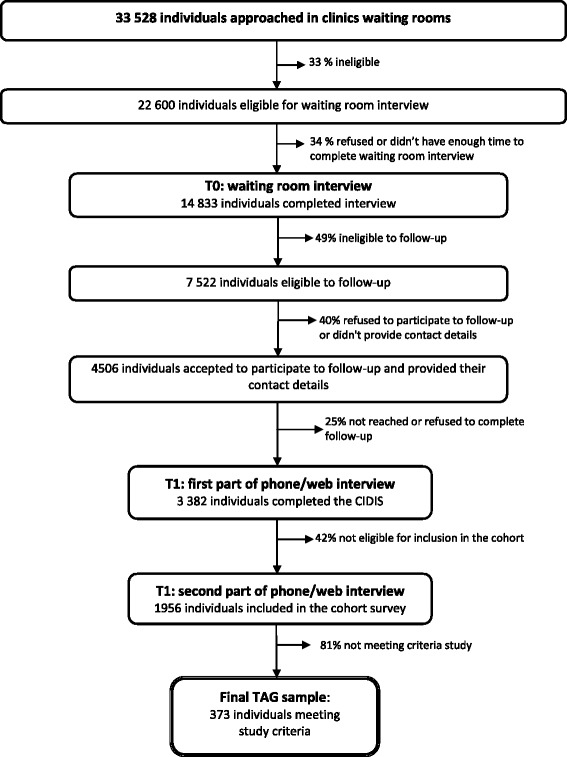
PURPOSE: Generalized Anxiety Disorder (GAD) is a common mental disorder in the primary care setting, marked by persistent anxiety and worries. The aims of this study were to: 1) examine mental health services utilisation in a large sample of primary care patients; 2) explore detection of GAD and minimal standards for pharmacological and psychological treatment adequacy based on recommendation from clinical practice guidelines; 3) examine correlates of treatment adequacy, i.e. predisposing, enabling and needs factors according to the Behavioural Model of Health Care Use. METHODS: A sample of 373 adults meeting DSM-IV criteria for Generalized Anxiety Disorder in the past 12 months took part in this study. Data were drawn from the "Dialogue" project, a large primary care study conducted in 67 primary care clinics in Quebec, Canada. Following a mental health screening in medical clinics (n = 14833), patients at risk of anxiety or depression completed the Composite International Diagnostic Interview-Simplified (CIDIS). Multilevel logistic regression models were developed to examine correlates of treatment adequacy for pharmacological and psychological treatments. RESULTS: Results indicate that 52.5 % of participants were recognized as having GAD by a healthcare professional in the past 12 months, and 36.2 % of the sample received a pharmacological (24.4 %) and/or psychological treatment (19.2 %) meeting indicators based on clinical practice guidelines recommendations. The detection of GAD by a health professional and the presence of comorbid depression were associated with overall treatment adequacy. CONCLUSIONS: This study suggests that further efforts towards GAD detection could lead to an increase in the delivery of evidence-based treatments. Key targets for improvement in treatment adequacy include regular follow up of patients with a GAD medication and access to psychotherapy from the primary care setting.
Overview
The claims and statistics of this paper haven’t been checked yet.
Free: it reads the open-access text and checks the first 5 claims that cite a source we can check. Create a free account to check every claim.
Integrity signals
Registry
Cites
Statistics
Figures
Verification
Claims the paper makes
The claims and statistics of this paper haven’t been checked yet.
Free: it reads the open-access text and checks the first 5 claims that cite a source we can check. Create a free account to check every claim.
Claims other papers make about this one
Each is checked against this paper’s own text: does it say what the citing paper says it does?
The cited source doesn’t support the claim as written.
In the citing paper
“Importantly, the proportion of patients with anxiety disorders who receive adequate treatment is still much lower (Roberge et al., 2015; Kasteenpohja et al., 2016), even in the US, with less than 15% of people with diagnosed anxiety receiving treatment which conforms with evidence-based recommendations (Roberge et al., 2015; Kasteenpohja et al., 2016).”
From Treatment gap for anxiety disorders is global: Results of the World Mental Health Surveys in 21 countries (2018) · cites this paper as Roberge et al., 2015
Checked by a reasoning model — may be wrong.
Experimental — accuracy not yet measuredThe source backs part of the claim, not all of it — or backs it for a different population, condition or comparison.
In the citing paper
“Previous research shows that GAD often goes undetected and thus untreated in primary health care patients [6, 8, 11, 12, 16].”
From Intolerance-of-uncertainty therapy versus metacognitive therapy for generalized anxiety disorder in primary health care: A randomized controlled pilot trial (2023) · cites this paper as [16]
Experimental — accuracy not yet measuredThe cited source says what the claim attributes to it.
In the citing paper
“This finding is similar to international studies that have explored mental health service use and treatment adequacy for GAD (Roberge et al., 2015).”
From Treatment histories, barriers, and preferences for individuals with symptoms of generalized anxiety disorder (2024) · cites this paper as Roberge et al., 2015
Self-check
Percentages, sums and reported differences re-computed from the paper’s own numbers.
The self-check needs the paper’s full text.
Citations
Cites
Diagnostic and Statistical Manual of Mental Disorders
American Psychiatric Association (2013) · doi:10.1176/appi.books.9780890425596 · Cited by 116,369
Diagnostic and Statistical Manual of Mental Disorders
Williams, J. B. W., & First, M. (2013) · Encyclopedia of Social Work · doi:10.1093/acrefore/9780199975839.013.104 · Cited by 109,519
The Hospital Anxiety and Depression Scale
Zigmond, A. S., & Snaith, R. P. (1983) · Acta Psychiatrica Scandinavica · doi:10.1111/j.1600-0447.1983.tb09716.x · Cited by 47,139
Kessler, R. C., Berglund, P., Demler, O., Jin, R., Merikangas, K. R., & Walters, E. E. (2005) · Archives of General Psychiatry · doi:10.1001/archpsyc.62.6.593 · Cited by 20,391 · cited 1×
“GAD often has a chronic course [2–6] with a lifetime prevalence rate for DSM-IV criteria estimated at approximately 6 % [7–10].”
BackgroundDepression and quality of life in older persons: A review
Sivertsen, H., Bjørkløf, G. H., Engedal, K., Selbæk, G., & Helvik, A.-S. (2015) · Dementia and Geriatric Cognitive Disorders · doi:10.1159/000437299 · Cited by 14,152
Revisiting the Behavioral Model and Access to Medical Care: Does it Matter?
Andersen, R. M. (1995) · Journal of Health and Social Behavior · doi:10.2307/2137284 · Cited by 9,831 · cited 4×
“Finally, we also sought to examine individual-level correlates of treatment adequacy using Andersen’s Behavioural Model of Health Care [44] to examine the contribution of conceptually distinct predisposing factors, enabling factors and need for care factors associated with treatment adequacy for GAD.”
MethodInfluentialAnxiety disorders in primary care: prevalence, impairment, comorbidity, and detection
Kroenke, K., Spitzer, R. L., Williams, J. B. W., Monahan, P. O., & Löwe, B. (2007) · Annals of Internal Medicine · doi:10.7326/0003-4819-146-5-200703060-00004 · Cited by 4,741 · cited 2×
“Research has typically shown low rates of recognition of GAD by primary care providers [8–10, 24–28].”
BackgroundLevesque, J.-F., Harris, M. F., & Russell, G. (2013) · International Journal for Equity in Health · doi:10.1186/1475-9276-12-18 · Cited by 3,484 · cited 1×
“Second, our results offer a partial view of the correlates of treatment adequacy from service utilization data that could be complemented by research on perceived needs for care and provider and clinic characteristics [60].”
ResultWang, P. S., Lane, M., Olfson, M., Pincus, H. A., Wells, K. B., & Kessler, R. C. (2005) · Archives of General Psychiatry · doi:10.1001/archpsyc.62.6.629 · Cited by 2,695 · cited 2×
“The primary care perspective, in contrast with epidemiological survey or clinical trials, is important because these patients are in contact with the health care system and anxiety disorders are generally treated in the primary care setting [38, 42, 43].”
BackgroundWang, P. S., Aguilar-Gaxiola, S., Alonso, J., Angermeyer, M. C., Borges, G., Bromet, E. J., Bruffaerts, R., de Girolamo, G., de Graaf, R., Gureje, O., et al. (2007) · The Lancet · doi:10.1016/s0140-6736(07)61414-7 · Cited by 1,655 · cited 1×
“The primary care perspective, in contrast with epidemiological survey or clinical trials, is important because these patients are in contact with the health care system and anxiety disorders are generally treated in the primary care setting [38, 42, 43].”
Research works printed but not linked: 1
- Kovess V Fournier L Lesage AD Lebigre FA Caria A Two validation studies of the CIDIS: a simplified version of the composite international diagnostic interview Psychiatric Networks 2001 4 1–2 10 24
Cited by
Alonso, J., Liu, Z., Evans-Lacko, S., Sadikova, E., Sampson, N., Chatterji, S., Abdulmalik, J., Aguilar-Gaxiola, S., Al-Hamzawi, A., Andrade, L. H., et al. (2018) · Depression and Anxiety · doi:10.1002/da.22711 · Cited by 716
“For minimally adequate psychotherapy, the number of sessions (either 8 or 12) and sometimes the typeof therapy (i.e., cognitivebehavioral treatmentby the samemental health professional) have been proposed (Roberge et al., 2015).”
InfluentialPauley, D., Cuijpers, P., Papola, D., Miguel, C., & Karyotaki, E. (2021) · Psychological Medicine · doi:10.1017/s0033291721001999 · Cited by 170
“It is reported that less than 20% of people facing anxiety disorders receive adequate treatment (Roberge et al., 2015; Teija et al., 2016).”
Biological markers of generalized anxiety disorder
Maron, E., & Nutt, D. (2017) · Dialogues in Clinical Neuroscience · doi:10.31887/dcns.2017.19.2/dnutt · Cited by 164
US Preventive Services Task Force, Barry, M. J., Nicholson, W. K., Silverstein, M., Coker, T. R., Davidson, K. W., Davis, E. M., Donahue, K. E., Jaén, C. R., Li, L., et al. (2023) · JAMA · doi:10.1001/jama.2023.9301 · Cited by 152
Nyongesa, M. K., Mwangi, P. M., Koot, H. M., Cuijpers, P. J., Newton, C. R. J. C., & Abubakar, A. A. (2020) · Annals of General Psychiatry · doi:10.1186/s12991-020-00312-4 · Cited by 116
A Systematic Review of Efficacy, Safety, and Tolerability of Duloxetine
Rodrígues-Amorím, D., Olivares, J. M., Spuch, C., & Baltanás, T. R. (2020) · Frontiers in Psychiatry · doi:10.3389/fpsyt.2020.554899 · Cited by 122
“GAD is a chronic condition that severely affects the quality of life, due to its repercussion on working and social functioning (8).”
BackgroundGeneralized anxiety disorder: Prevalence, predictors, and comorbidity in children and adolescents
Mohammadi, M. R., Pourdehghan, P., Mostafavi, S.-A., Hooshyari, Z., Ahmadi, N., & Khaleghi, A. (2020) · Journal of Anxiety Disorders · doi:10.1016/j.janxdis.2020.102234 · Cited by 81
A review of neuroimaging studies in generalized anxiety disorder: “So where do we stand?”
Goossen, B., van der Starre, J., & van der Heiden, C. (2019) · Journal of Neural Transmission · doi:10.1007/s00702-019-02024-w · Cited by 48
Biological Markers of Generalized Anxiety Disorder
Maron, E., & Nutt, D. (2018) · Focus · doi:10.1176/appi.focus.16205 · Cited by 42
Treatment adequacy for social anxiety disorder in primary care patients
Chapdelaine, A., Carrier, J., Fournier, L., Duhoux, A., & Roberge, P. (2018) · PLoS ONE · doi:10.1371/journal.pone.0206357 · Cited by 43
“Study setting, participants and data collection This cross-sectional study used data drawn from the "Dialogue" project, a large cohort study initiated in 2008 which has been described elsewhere (see Roberge et al., 2015) [18].”
MethodSelf-citationFleury, M., Rochette, L., Grenier, G., Huỳnh, C., Vasiliadis, H., Pelletier, É., & LESAGE, A. D. (2019) · General Hospital Psychiatry · doi:10.1016/j.genhosppsych.2019.07.006 · Cited by 41
Munir, S., & Takov, V. (2021) · StatPearls · Cited by 34
Anxiety symptoms in older Chinese adults in primary care settings: Prevalence and correlates
Xie, Q., Xu, Y., & Zhong, B. (2022) · Frontiers in Public Health · doi:10.3389/fpubh.2022.1009226 · Cited by 33
Butnorienė, J., Steiblienė, V., Saudargienė, A., & Bunevičius, A. (2018) · BMC Psychiatry · doi:10.1186/s12888-017-1576-8 · Cited by 31
Choudhary, S., Thomas, N., Alshamrani, S., Srinivasan, G., Ellenberger, J., Nawaz, U., & Cohen, R. (2022) · JMIR Medical Informatics · doi:10.2196/38943 · Cited by 32
“Despite being one of the leading causes of mental health disability (1 in 4 people according to the World Mental Health Survey [6]), the detection of generalized anxiety disorder (GAD) is very low in primary care settings [7-9].”
BackgroundHaque, M., Das, C., Ara, R., Alam, M., Ullah, S., & Hossain, Z. (2018) · TAJ Journal of Teachers Association · doi:10.3329/taj.v27i1.37603 · Cited by 24
Lyndon, G. J., Prieto, R., Wajsbrot, D., Allgulander, C., & Bandelow, B. (2019) · International Clinical Psychopharmacology · doi:10.1097/yic.0000000000000256 · Cited by 26
“While patients with depression often have periods when they are well, symptoms of GAD are chronic and thus may require maintenance therapy (Bandelow et al., 2013; Roberge et al., 2015).”
Terapi kognitif perilaku untuk mengurangi gejala kecemasan
Haikal, M. (2022) · Procedia Studi Kasus dan Intervensi Psikologi · doi:10.22219/procedia.v10i2.19215 · Cited by 30
Eberle, J. W., Daniel, K. E., Baee, S., Silverman, A. L., Lewis, E., Baglione, A. N., Werntz, A. J., French, N. J., Ji, J. L., Hohensee, N., et al. (2024) · Journal of Consulting and Clinical Psychology · doi:10.1037/ccp0000896 · Cited by 25
Basile, V. T., Newton‐John, T., & Wootton, B. M. (2024) · Journal of Clinical Psychology · doi:10.1002/jclp.23665 · Cited by 15
Hurtado, M. M., Villena, A., Vega, A., Amor, G. G., Gómez, C., & Morales‐Asencio, J. M. (2020) · International Journal of Mental Health Nursing · doi:10.1111/inm.12690 · Cited by 18
Simo, B., Bamvita, J., Caron, J., & Fleury, M. (2018) · Psychiatric Quarterly · doi:10.1007/s11126-018-9568-5 · Cited by 19
Alahmari, K., Duh, H. B., & Skarbez, R. (2022) · Behaviour and Information Technology · doi:10.1080/0144929x.2022.2118078 · Cited by 13
“Furthermore, GAD had a signi fi cant economic burden on health care facilities, consuming considerable primary care resources (Roberge et al. 2015; Hunt, Issakidis, and Andrews 2002).”
BackgroundChoi, H., Ko, H., & Kim, C. (2021) · Journal of Korean Academy of Psychiatric and Mental Health Nursing · doi:10.12934/jkpmhn.2021.30.2.102 · Cited by 11
Bhowmick, S., Parolia, S., Jana, S., Kundu, D., Choudhury, D., Das, N., Ray, K., & KarPurkaysatha, S. (2021) · Journal of Family Medicine and Primary Care · doi:10.4103/jfmpc.jfmpc_1385_20 · Cited by 14
“Thus, a PCP should collaborate with psychiatrists and mental health counsellors, which will also help in lessening of the barriers in access to psychotherapy.[39]”
Backgroundaf Winklerfelt Hammarberg, S., Toth-Pal, E., Jansson-Fröjmark, M., Lundgren, T., Westman, J., & Bohman, B. (2023) · PLoS ONE · doi:10.1371/journal.pone.0287171 · Cited by 9
“Previous research shows that GAD often goes undetected and thus untreated in primary health care patients [6, 8, 11, 12, 16].”
BackgroundHood, S. D., Odufowora-Sita, O., Brière, J., Lucchino, M., Khrouf, F., Olewińska, E., Pierzchała, P., Mezghani, M., Nikodem, M., & Lévy, P. (2024) · International Clinical Psychopharmacology · doi:10.1097/yic.0000000000000551 · Cited by 8
“Generalized anxiety disorder (GAD) is a chronic mental health disorder characterized by persistent and excessive anxiety, worry, and somatic symptoms lasting for months (Roberge et al ., 2015).”
Fleury, M., Rochette, L., Cao, Z., Grenier, G., Massamba, V. K., & LESAGE, A. D. (2025) · BMC Family Practice · doi:10.1186/s12875-024-02674-0 · Cited by 9
Department of Psychology, F. O. E. A. P., Ghaderi, F., Akrami, N., Department of Psychology, F. O. E. A. P., Namdari, K., Department of Psychology, F. O. E. A. P., Abedi, A., & Department of Psychology and Education of Children with Special Needs, F. O. E. A. P. (2022) · Iranian Journal of Psychiatry and Clinical Psychology · doi:10.32598/ijpcp.27.4.3067.3 · Cited by 7
Serowik, K. L., Roemer, L., Suvak, M., Liverant, G., & Orsillo, S. M. (2020) · Cognitive Behaviour Therapy · doi:10.1080/16506073.2020.1765858 · Cited by 7
Probst, G. H., Penedo, J. M. G., & Flückiger, C. (2025) · Behaviour Research and Therapy · doi:10.1016/j.brat.2025.104758 · Cited by 8
The capacity of cognitive tests to detect generalized anxiety disorder (GAD): A pilot study
Baussay, A., Lodovico, L. D., Poupon, D., Doublet, M., Ramoz, N., Duriez, P., & Gorwood, P. A. P. M. (2024) · Journal of Psychiatric Research · doi:10.1016/j.jpsychires.2024.04.006 · Cited by 9
Generalized Anxiety Disorder (Nursing)
Munir, S., Takov, V., & Coletti, V. (2021) · Europe PMC (PubMed Central) · Cited by 7
Bujold, A., Pariseau‐Legault, P., & de Montigny, F. (2020) · Recherche en soins infirmiers · doi:10.3917/rsi.141.0017 · Cited by 7
Obesity, Quality of Sleep and Anxiety in Saudi Arabia
Alhusseini, N. K., Elaasser, B., Alshaar, B., Alyousof, S., Boukhet, S., & Omair, A. A. (2021) · Journal of Contemporary Medical Sciences · doi:10.22317/jcms.v7i4.1039 · Cited by 6
Care trajectories of individuals with anxiety disorders: A retrospective cohort study
Roberge, P., Hudon, C., Courteau, J., Courteau, M., Dufour, I., & Chiu, Y. M. (2023) · Journal of Affective Disorders · doi:10.1016/j.jad.2023.12.043 · Cited by 7
Self-citationSaulnier, K. G., Ganoczy, D. A., Grau, P. P., Sripada, R. K., Zivin, K., Piette, J. D., & Pfeiffer, P. N. (2024) · Journal of Psychiatric Research · doi:10.1016/j.jpsychires.2024.07.003 · Cited by 5
Dai, X., Zhang, Z., Sun, L., Zhu, S., Wu, Y., Lian, J., & Deng, X. (2025) · Journal of Psychiatric Research · doi:10.1016/j.jpsychires.2025.05.010 · Cited by 5
Ramos‐García, V., Perestelo-Pérez, L., Rivero‐Santana, A., Castro, W. P., Duarte‐Díaz, A., Álvarez‐Pérez, Y., Trujillo‐Martín, M. M., del Cura-González, M. I., & Serrano‐Aguilar, P. (2022) · BMC Medical Informatics and Decision Making · doi:10.1186/s12911-022-01899-2 · Cited by 6
“of treatment choices and resources available in the community [30].”
BackgroundMenurunkan gejala kecemasan pada gangguan kecemasan umum dengan cognitive therapy
Rahmawati, R. (2022) · Procedia Studi Kasus dan Intervensi Psikologi · doi:10.22219/procedia.v10i4.19184 · Cited by 5
Vasiliadis, H., Lamoureux‐Lamarche, C., Chapdelaine, A., Provencher, M. D., Norton, P. J., Berbiche, D., & Roberge, P. (2023) · The Canadian Journal of Psychiatry · doi:10.1177/07067437231187459 · Cited by 7
Self-citationSievertsen, S. A., Zhu, J., Fang, A., & Forsyth, J. K. (2025) · Biological Psychiatry Cognitive Neuroscience and Neuroimaging · doi:10.1016/j.bpsc.2025.02.005 · Cited by 7
“Onset of GAD in childhood or adolescence is associated with a high rate of psychiatric comorbidity, perpetuation of symptoms into adulthood, and increased suicidality risk (6-12).”
Alshahrani, M. M. A., Al-Masoudi, M., Alshahrani, E. M., Alshahrani, A., Alshehri, K. M., Asiri, S. A., Asiri, A. M., Asiri, A. A., & Alabdali, A. H. (2021) · World Family Medicine Journal/Middle East Journal of Family Medicine · doi:10.5742/mewfm.2021.94139 · Cited by 4
Pemberian Terapi Penghentian Pikiran (Thought Stopping) Menurunkan Kecemasan Klien Hipertensi
Purnomo, E., & Pulungan, Z. S. A. (2022) · Mando Care Jurnal. · doi:10.55110/mcj.v1i3.103 · Cited by 5
Panday, H., & Jha, A. K. (2024) · Springer eBooks · doi:10.1007/978-3-031-38971-9_43-1 · Cited by 4
Charron, M., Duhoux, A., Contandriopoulos, D., Page, C., & Lessard, L. (2017) · Santé mentale au Québec · doi:10.7202/1040255ar · Cited by 4
Self-citationEficácia clínica de novas abordagens para o tratamento do transtorno de ansiedade generalizada
Rufo, A. L. Z., Marques, C. L., Oliveira, E. A. D., Naves, T. P., Pinto, M. D. S. B., Reginaldi, R. M., Utino, B. M., Filho, A. G. G. M., Paixão, M. C., Gomes, M. M., et al. (2023) · Brazilian Journal of Health Review · doi:10.34119/bjhrv6n2-165 · Cited by 6
Агомелатин в терапии генерализованного тревожного расстройства
Медведев, В. Э. (2024) · Современная терапия психических расстройств · doi:10.21265/psyph.2024.47.73.006 · Cited by 4
Alhebshi, A., Alrebaiee, S. S., & Farahat, J. S. (2021) · World Family Medicine Journal/Middle East Journal of Family Medicine · doi:10.5742/mewfm.2021.94135 · Cited by 3
Help Seeking Behaviors in Anxiety Disorders: A Systematic Scoping Review
HOHN, A. A., & Maricutoiu, L. P. (2024) · Journal of Evidence-Based Psychotherapies · doi:10.24193/jebp.2024.1.4 · Cited by 2
Innovative opportunities of pharmakotherapy of generalized anxiety disorder
DENYSOV, Y., & Putyatin, G. G. (2024) · Ukrains kyi Visnyk Psykhonevrolohii · doi:10.36927/2079-0325-v32-is2-2024-5 · Cited by 2
Shroukh, W. A., Barghouti, F., Yasein, N. A., & FAYOMI, H. (2023) · Family Medicine & Primary Care Review · doi:10.5114/fmpcr.2023.125495 · Cited by 2
Ataei, S., Jahangard, L., Anaraki, S., Dastan, D., & Khazaei, S. (2023) · Current Psychiatry Research and Reviews · doi:10.2174/0126660822258340231025171755 · Cited by 2
Notions et brève évaluation de la qualité des services en santé mentale au Québec
Fleury, M. (2023) · Santé mentale au Québec · doi:10.7202/1109832ar · Cited by 5
Melis, P. M., Perra, A., Nardi, A. E., Zreik, T., Preti, A., & Carta, M. G. (2024) · Journal of Psychiatric Research · doi:10.1016/j.jpsychires.2024.11.049 · Cited by 3
Moslih, S. A., Harbi, A. A., Al-Mousa, A., Asmri, M. A., & Bahaitham, H. (2021) · World Family Medicine Journal/Middle East Journal of Family Medicine · doi:10.5742/mewfm.2021.94131 · Cited by 2
Favacho, V. B. C. (2019) · Digital Library of Theses and Dissertations (Universidade de São Paulo) · doi:10.11606/t.83.2019.tde-22022021-091247 · Cited by 2
Associations Between Mental Health and Social Needs Among Black Patients in Primary Care Settings
Kirk, K. F., Budd, S. G., Splain, A., Parsons, C. L. B., Kini, A., Daniel, G. D., Kim, L., Alexander, K., Rubio, D. S., Warren, J., et al. (2025) · Journal of Primary Care & Community Health · doi:10.1177/21501319251338912 · Cited by 1
Ramos‐García, V., Rivero‐Santana, A., Castro, W. P., Álvarez‐Pérez, Y., Trujillo‐Martín, M. M., González‐Pacheco, H., Santos-Álvarez, A., Duarte‐Díaz, A., Cura-González, M. I. D., & Perestelo‐Pérez, L. (2025) · BMJ Health & Care Informatics · doi:10.1136/bmjhci-2024-101185 · Cited by 1
Fomenko, A., Marrie, R. A., Dümmler, D., Bernstein, C. N., Hitchon, C. A., Tully, P. J., Dawson, S., Schneider, A., Hapfelmeier, A., & Linde, K. (2026) · Journal of Affective Disorders · doi:10.1016/j.jad.2025.121126 · Cited by 1
Bujold, A., Pariseau‐Legault, P., & de Montigny, F. (2021) · Recherche en soins infirmiers · doi:10.3917/rsi.145.0022 · Cited by 1
Continuing Care Needs for Patients with Generalized Anxiety after Hospital Discharge
Yu, J., & Yu, Y. (2017) · Neuropsychiatry · doi:10.4172/neuropsychiatry.1000241 · Cited by 1
Anxiety scale in surgical abortions and drug-induced abortions: A comparative study
Latifi, H., Gashi, A. M., & Latifi, D. (2021) · Romanian Journal of Neurology · doi:10.37897/rjn.2021.4.10 · Cited by 2
Prevalence of dry eye symptoms and risk factors in Saudi Arabia
Alamri, A., Alkorbi, S. M. A., Alqahtani, A. N., Asiri, B. M. M., Alahmari, A. F., & Alotaibi, T. B. (2021) · World Family Medicine Journal/Middle East Journal of Family Medicine · doi:10.5742/mewfm.2021.94144 · Cited by 1
Epley’s Maneuver in Primary Care: A Quality Improvement Project
Hameed, M., Shaheen, S., Malik, M. I., & Qabeel, Y. E. H. (2021) · World Family Medicine Journal/Middle East Journal of Family Medicine · doi:10.5742/mewfm.2021.94142 · Cited by 1
Common mental and substance use disorders among people seeking HIV testing
Saal, W. (2017) · SUNScholar (Stellenbosch University) · Cited by 2
Implementation of an Anxiety Screening and Treatment Protocol in Primary Care
Garcia, D. E. (2020) · NSUWorks (Nova Southeastern University) · Cited by 2
Atalla, A. A., Alrbaiai, G. T., Alharthi, A. H., Alotaib, J. S., Algethami, N. E., & Alshehri, B. (2021) · World Family Medicine Journal/Middle East Journal of Family Medicine · doi:10.5742/mewfm.2021.94146
Geographical accessibility of health care network via GIS in Kastamonu
ÇAKIR, C., Işınkaralar, Ö., & Öztürk, S. (2022) · Kastamonu University Journal of Engineering and Sciences · doi:10.55385/kastamonujes.1099909 · Cited by 1
Awareness of General Population of Saudi Arabia toward Diabetic Complications
Alanazi, M. A., Almutaz, A. I., Aldhwain, S. E., Alasmari, B. A., Alfarhan, S. M., Barakat, M. Y., Almalki, Y. H., & ALmousa, R. A. (2021) · World Family Medicine Journal/Middle East Journal of Family Medicine · doi:10.5742/mewfm.2021.94134 · Cited by 2
El-Gamal, F., Rashid, A., Saeed, H., Alluheibi, H., Qari, R., & Baziyad, R. (2021) · World Family Medicine Journal/Middle East Journal of Family Medicine · doi:10.5742/mewfm.2021.94138
Alsaleh, R. A., Faraj, F. M., Aldcgha, A. A., Omar, B., bin Mahfouz, E. H., & Zaki, A. (2021) · World Family Medicine Journal/Middle East Journal of Family Medicine · doi:10.5742/mewfm.2021.94132
Abdalla, H., Tawfik, H., Alnuaimi, A. S., Elzaki, I., Mohamed, M., Mobayed, T., Alshibani, F., Zain, S., Abdelkarim, E., Alsmady, N., et al. (2021) · World Family Medicine Journal/Middle East Journal of Family Medicine · doi:10.5742/mewfm.2021.94148 · Cited by 1
A Review on the Clinical Potential of Lorcaserin in the Treatment of Obesity
bin Daud, M. D. (2021) · World Family Medicine Journal/Middle East Journal of Family Medicine · doi:10.5742/mewfm.2021.94143
Musallam, W., Abdulmoniem, H., Elnour, S., Elnour, M. E., Alkadi, R., Gadallah, A., Syed, A. A., & Yousuf, W. (2021) · World Family Medicine Journal/Middle East Journal of Family Medicine · doi:10.5742/mewfm.2021.94136
Al‐Hajeili, M., Ujaimi, R. K., Iskanderani, O. F., Attar, M., Ahmed, E. M., Safhi, M. A., Almrzouqi, W. T., & Alsaati, B. A. (2021) · World Family Medicine Journal/Middle East Journal of Family Medicine · doi:10.5742/mewfm.2021.94137
Montero, R. E. D. C. (2023) · Universidad Privada San Juan Bautista · doi:10.59590/upsjb/fcs.med.hum/tesis/4453
Anxiety Disorder in Jordan during the COVID-19 Pandemic: A Cross-Sectional Study
Mari'e, L. O., Aboghazleh, R., Al‐Shatanawi, T. N., Hiasat, D., Damseh, M., Almomani, M., Abuanzah, W., Mugdadi, D., Abualnil, A., Kanaan, A., et al. (2024) · Jordan Medical Journal · doi:10.35516/jmj.v58i3.709
Whitehead, M., Ryan, P. M., Young, M. A., Austin, J. E., Kramer, K. A., Harris, E., & McClure, J. M. (2024) · The Journal of Mental Health Training Education and Practice · doi:10.1108/jmhtep-01-2024-0008
Sankar, K., Ramesh, S., Shanmugasundaram, N., Anbalagan, D., Sivaraman, V., Singaram, V., & Jeyabalan, S. (2025) · Pharmacology Biochemistry and Behavior · doi:10.1016/j.pbb.2025.173959
Zhina, Z. K. Y., ., Z. B., & Zanjani, Z. (2025) · Journal of Health Psychology · doi:10.1177/13591053251386385
“Cognitive-behavioral therapy (CBT) remains a primary treatment for most psychological issues (Roberge et al., 2015).”
Talaei, M., Zare, K., Hashemi, Y., Pahlevani, A. H., Fakhraei, B., Namjooyan, F., Hashempur, M. H., Kouhpaye, A., & Mosavat, S. H. (2025) · Brain and Behavior · doi:10.1002/brb3.70994
Gústavsson, S. M. (2025) · Cambridge University Press eBooks · doi:10.1017/9781009090940.015
Generalized anxiety disorder: diagnosis and therapy issues
Петрова, Н. Н. (2025) · Лечащий врач · doi:10.51793/os.2025.28.11.005
Vanesa, R.-G., Lilisbeth, P.-P., Amado, R.-S., Wenceslao, P. C., Andrea, D.-D., Yolanda, Á.-P., del Mar, M.-T. M., Isabel, D. C.-G. M., & Pedro, S.-A. (2022) · Figshare · doi:10.6084/m9.figshare.20208265
Generalized Anxiety Disorder Symptoms Stratified by Age in Primary Care
McCoy, R. E. (2023) · ScholarWorks (Walden University) · Cited by 2
Генерализованное тревожное расстройство: вопросы диагностики и терапии
Николаевна, П. Н. (2025) · Лечащий врач
Anxiety in Women: Screening Guidelines and Reproductive Stage Considerations
Demmert, K. M. (2026) · Clinical Journal for Nurse Practitioners in Women s Health · doi:10.1891/cjnpwh-2025-0058
Stressful events, childhood adversities, cortisol activity and anxiety in older adults
Bakouni, H. (2021) · Knowledge UdeS (Institutional Deposit of the University of Sherbrooke)
Elkefi, S., Yalamanchili, M., Feiner, S., & Matthews, A. (2026) · npj Health Systems · doi:10.1038/s44401-026-00129-5
Generalized Anxiety Disorder with Somatic Symptom Presentation and Social Avoidance: A Case Report
Arinda, A. S. P., & Prasetya, E. C. (2026) · Journal of Scientific Research Education and Technology (JSRET) · doi:10.58526/jsret.v5i3.1170
COGNITIVE RESTRUCTURING FOR ANXIETY SYMPTOMS: A NARRATIVE REVIEW
Dwiputri, N. O. (2026) · Journal of Psychiatry Psychology and Behavioral Research · doi:10.21776/ub.jppbr.2026.007.02.6
Sharma, S. (2025) · Otago University Research Archive (University of Otago)
Metadata
- Authors
- Roberge, P., Normand-Lauzière, F., Raymond, I., Luc, M., Tanguay-Bernard, M.-M., Duhoux, A., Bocti, C., & Fournier, L.
- Affiliations
- Université de Sherbrooke (CA)
- Université de Montréal (CA)
- Centre Hospitalier de l’Université de Montréal (CA)
- Corresponding author
- Roberge, Pasquale
- Venue
- BMC Family Practice
- Published
- 2015-10-22
- Volume
- 16
- Issue
- 1
- Pages
- 146-146
- ISSN
- 1471-2296 (ISSN-L)
- PMC
- PMC4618956
- OpenAlex
- W2173230887
- Semantic Scholar
- 9b972150976fea6c4130334c4a3ce7c464b263b9
- Cited by
- 85
- References
- 67
- Citations by year
- 2026: 3 · 2025: 10 · 2024: 11 · 2023: 9 · 2022: 9 · 2021: 22 · 2020: 7 · 2019: 4 · 2018: 6 · 2017: 4
- FWCI
- 5.45
- Type
- journal article
- Language
- en
- Open access
- gold
- doi.org
- Locations
- BMC Family Practice (publishedVersion)
- Europe PMC (PubMed Central) (publishedVersion, cc-by)
- PubMed Central (publishedVersion, cc-by)
- PubMed (publishedVersion)
- Funders
- Canadian Health Services Research Foundation (RC2-1270-06)
- Topics
- Health Sciences › Medicine › Psychiatry and Mental health › Mental Health Treatment and Access
- Social Sciences › Psychology › Experimental and Cognitive Psychology › Anxiety, Depression, Psychometrics, Treatment, Cognitive Processes
- Health Sciences › Medicine › Family Practice › Primary Care and Health Outcomes
- Keywords
- generalized anxiety disorder, primary care, mental health service utilization, treatment adequacy, pharmacotherapy, psychological intervention, access to psychotherapy, comorbid depression, mental health screening
- MeSH terms
- Adolescent, Adult, Anxiety Disorders, Female, Humans, Interviews as Topic, Male, Mental Health Services, Middle Aged, Primary Health Care, Quality of Health Care, Quebec, Anti-Anxiety Agents, Treatment Outcome, Guideline Adherence, Young Adult
About these checks
Registry, retraction, Cites and statistics results are computed, not judged, with one exception: a printed reference that no index lists is read once by a model before it counts as a citation error. Claims are extracted by a model and kept only when their quote appears verbatim in the text; each cited source is then checked, with a model’s help, for whether it says what the claim relies on. Those verdicts can be wrong — read the claim’s quote and the cited source before relying on one.
Statistics and arithmetic are recomputed, not judged.
Confidence bands are shown only for fields calibrated on our annotated test set. None is calibrated yet, so no band is shown.
What counts as a claim ›How we measure confidence ›How we check this ›
Are you an author, or do you see a problem with this page? Request a review
Data sources
Bibliographic data: Semantic Scholar, OpenAlex, Crossref.
Contains information from the Semantic Scholar Academic Graph Datasets, made available under the ODC Attribution License (ODC-BY 1.0).
Semantic Scholar’s data is described in: Kinney, R., et al. (2023). The Semantic Scholar Open Data Platform. arXiv:2301.10140.
