

The global prevalence of turnover intention among general practitioners: a systematic review and meta-analysis
Open accessThe DOI matches its Crossref record; 62 of the 64 references it cites were found in a registry or an index.
Abstract
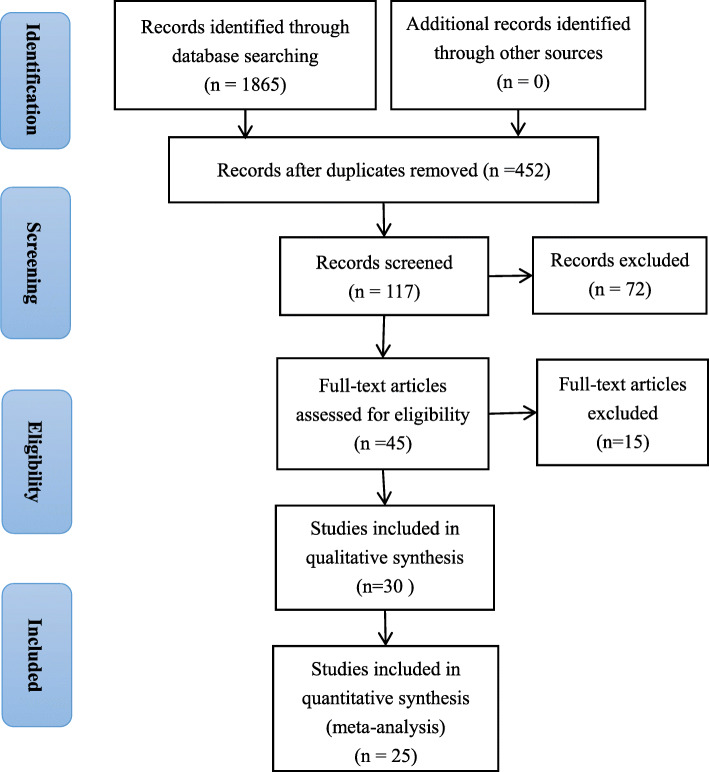
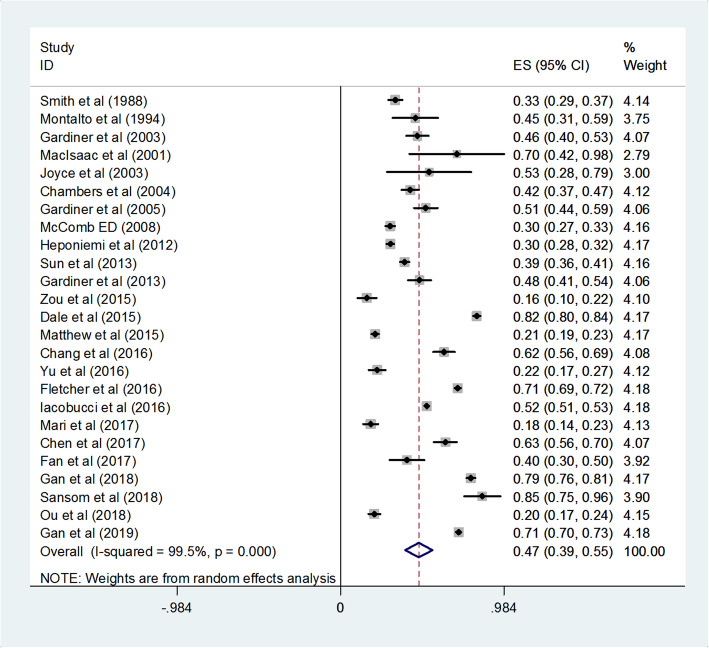
Background: General practitioners (GPs) are the foundation of any primary healthcare system. Their quality and quantity are directly associated with the effectiveness and quality of the health services of a nation. GPs’ shortage and turnover have become an important issue in developed and developing countries. An accurate estimate of turnover intention prevalence among GPs would have important health policy implications, but the overall prevalence is unknown. We aimed to summarize the global prevalence of turnover intention and associated factors among GPs. Methods: We systematically reviewed the PubMed, Embase, Web of Science and China National Knowledge Infrastructure (CNKI) databases from their inception up to May 2020, as well as the reference lists of all included studies. We included observational studies that reported data on turnover intention or their prevalence rate among GPs could be calculated based on the information provided. The prevalence rate of the turnover intentions was estimated using a random-effects meta-analysis. The heterogeneity was evaluated using I 2 statistic. Differences by study level characteristics were estimated via subgroup analysis and meta-regression. Results: A total of 25 cross-sectional studies were included (a total of 27,285 participants). The prevalence of turnover intention was 0.47 (95% CI: 0.39–0.55). Those having a lower level of salary (OR = 1.38, 95% CI: 1.13–1.63) and job satisfaction (OR = 1.35, 95% CI: 1.12–1.70) or having lower level of morale (OR = 2.68, 95% CI: 1.56–3.80) had a higher intention. In contrast, GPs with a lower level of professional title had a lower turnover intention (OR = 0.81, 95% CI: 0.65–0.98). Conclusions: In this systematic review, approximately half of the GPs had the intention to leave their current posts worldwide. The factors associated with turnover intention were higher professional title, lower income level, lower job satisfaction and lower morale.
Overview
The claims and statistics of this paper haven’t been checked yet.
Free: it reads the open-access text and checks the first 5 claims that cite a source we can check. Create a free account to check every claim.
Integrity signals
Registry
Cites
Statistics
Figures
Verification
Claims the paper makes
The claims and statistics of this paper haven’t been checked yet.
Free: it reads the open-access text and checks the first 5 claims that cite a source we can check. Create a free account to check every claim.
Claims other papers make about this one
Each is checked against this paper’s own text: does it say what the citing paper says it does?
The cited source says what the claim attributes to it.
In the citing paper
“A search for systematic reviews published in the last 10 years examining turnover intention among HCWs on PubMed, PROSPERO and Google Scholar produced nine relevant systematic reviews [11–19]”
From A global overview of healthcare workers’ turnover intention amid COVID-19 pandemic: a systematic review with future directions (2022) · cites this paper as [18]
The cited source says what the claim attributes to it.
In the citing paper
“and many of which were known factors prior to the pandemic [11–19].”
From A global overview of healthcare workers’ turnover intention amid COVID-19 pandemic: a systematic review with future directions (2022) · cites this paper as [18]
Self-check
Percentages, sums and reported differences re-computed from the paper’s own numbers.
The self-check needs the paper’s full text.
Citations
Cites
Preferred Reporting Items for Systematic Reviews and Meta-Analyses: the PRISMA statement
Moher, D., Liberati, A., Tetzlaff, J., Altman, D. G., & for the PRISMA Group (2009) · BMJ · doi:10.1136/bmj.b2535 · Cited by 83,823
Preferred Reporting Items for Systematic Reviews and Meta-Analyses: The PRISMA Statement
Moher, D., Liberati, A., Tetzlaff, J., Altman, D. G., & The PRISMA Group (2009) · PLoS Medicine · doi:10.1371/journal.pmed.1000097 · Cited by 64,042 · cited 1×
“A systematic review and meta-analysis following the PRISMA and MOOSE guidelines was performed to assess the status and factors related to GPs turnover intention [25, 26].”
Preferred reporting items for systematic reviews and meta-analyses: the PRISMA Statement.
(2009) · PubMed Central · Cited by 44,859
Quantifying heterogeneity in a meta‐analysis
Higgins, J. P. T., & Thompson, S. G. (2002) · Statistics in Medicine · doi:10.1002/sim.1186 · Cited by 36,763
PRISMA-P Group, Moher, D., Shamseer, L., Clarke, M., Ghersi, D., Liberati, A., Petticrew, M., Shekelle, P., & Stewart, L. A. (2015) · Systematic Reviews · doi:10.1186/2046-4053-4-1 · Cited by 26,223
Assessing Bias in Studies of Prognostic Factors
Hayden, J. A., van der Windt, D. A., Cartwright, J. L., Côté, P., & Bombardier, C. (2013) · Annals of Internal Medicine · doi:10.7326/0003-4819-158-4-201302190-00009 · Cited by 3,287
How should meta‐regression analyses be undertaken and interpreted?
Thompson, S. G., & Higgins, J. P. T. (2002) · Statistics in Medicine · doi:10.1002/sim.1187 · Cited by 3,026
An evaluation of precursors of hospital employee turnover.
Mobley, W. H., Horner, S. O., & Hollingsworth, A. T. (1978) · Journal of Applied Psychology · doi:10.1037//0021-9010.63.4.408 · Cited by 1,765
Undue reliance on I 2 in assessing heterogeneity may mislead
Rücker, G., Schwarzer, G., Carpenter, J. R., & Schumacher, M. (2008) · BMC Medical Research Methodology · doi:10.1186/1471-2288-8-79 · Cited by 1,287
Song, F., & Gilbody, S. M. (1998) · PubMed · Cited by 246
Hann, M., Reeves, D., & Sibbald, B. (2011) · The European Journal of Public Health · doi:10.1093/eurpub/ckq005 · Cited by 152
Getting doctors into the bush: General Practitioners' preferences for rural location
Scott, A., Witt, J. C., Humphreys, J. S., Joyce, C., Kalb, G. R. J., Jeon, S., & McGrail, M. R. (2013) · Social Science & Medicine · doi:10.1016/j.socscimed.2013.07.002 · Cited by 129
Dale, J. R., Potter, R. C., Owen, K., Parsons, N., Realpe, A. X., & Leach, J. (2015) · BMC Family Practice · doi:10.1186/s12875-015-0363-1 · Cited by 121
An, P. G., Rabatin, J. S., Manwell, L. B., Linzer, M., Brown, R., & Schwartz, M. D. (2009) · Archives of Internal Medicine · doi:10.1001/archinternmed.2008.549 · Cited by 116
The development and impact of primary health care in China from 1949 to 2015: A focused review
Li, H., Liu, K., Gu, J., Zhang, Y., Qiao, Y., & Sun, X. (2017) · The International Journal of Health Planning and Management · doi:10.1002/hpm.2435 · Cited by 96
The influence of workload and health behavior on job satisfaction of general practitioners.
Goetz, K., Musselmann, B., Szécsényi, J., & Joos, S. (2013) · PubMed · Cited by 91
Nancarrow, S., Bradbury, J., Pit, S., & Ariss, S. (2014) · Journal of Occupational Health · doi:10.1539/joh.14-0027-oa · Cited by 87
Gan, Y., Gong, Y., Chen, Y., Cao, S., Li, L., Zhou, Y., Herath, C., Li, W., Song, X., Li, J., et al. (2018) · BMC Family Practice · doi:10.1186/s12875-018-0752-3 · Cited by 67
Self-citationGeographical mobility of general practitioners in rural Australia
McGrail, M. R., & Humphreys, J. S. (2015) · The Medical Journal of Australia · doi:10.5694/mja14.01375 · Cited by 66
The role of psychological well‐being in retaining rural general practitioners
Gardiner, M., Sexton, R., Durbridge, M., & Garrard, K. (2005) · Australian Journal of Rural Health · doi:10.1111/j.1440-1854.2005.00677.x · Cited by 59
Gardiner, M., Kearns, H., & Tiggemann, M. (2013) · Australian Journal of Rural Health · doi:10.1111/ajr.12033 · Cited by 52
Sun, Y., Luo, Z., & Fang, P. (2013) · Journal of Community Health · doi:10.1007/s10900-013-9714-9 · Cited by 51
Pit, S., & Hansen, V. (2015) · Archives of Environmental & Occupational Health · doi:10.1080/19338244.2014.998329 · Cited by 51
Fletcher, E., Abel, G., Anderson, R., Richards, S. H., Salisbury, C., Dean, S. G., Sansom, A., Warren, F. C., & Campbell, J. L. (2017) · BMJ Open · doi:10.1136/bmjopen-2017-015853 · Cited by 49
Zou, Y., Zhang, X., Hao, Y., Shi, L., & Hu, R. (2015) · BMC Family Practice · doi:10.1186/s12875-015-0349-z · Cited by 48
A national survey of turnover intention among general practitioners in China
Gan, Y., Jiang, H., Li, L., Yang, Y., Wang, C., Liu, J., Yang, T., Zheng, Y., Zhu, Y., Sampson, O., et al. (2019) · The International Journal of Health Planning and Management · doi:10.1002/hpm.2921 · Cited by 46
Self-citationReducing the use of out-of-hours primary care services: A survey among Dutch general practitioners
Keizer, E., Maassen, I., Smits, M., Wensing, M., & Giesen, P. H. J. (2016) · European Journal of General Practice · doi:10.1080/13814788.2016.1178718 · Cited by 45 · cited 1×
“GPs are important contributors to effective primary care serving [6, 7] as gatekeepers by promoting full primary care coverage [8].”
BackgroundAllen, T., William, W., & Sutton, M. (2016) · Social Science & Medicine · doi:10.1016/j.socscimed.2016.11.028 · Cited by 44
Eneroth, M., Sendén, M. G., Schenck-Gustafsson, K. G., Wall, M., & Fridner, A. (2017) · Scandinavian Journal of Primary Health Care · doi:10.1080/02813432.2017.1333319 · Cited by 42
Impact of support initiatives on retaining rural general practitioners
Gardiner, M., Sexton, R., Kearns, H., & Marshall, K. (2006) · Australian Journal of Rural Health · doi:10.1111/j.1440-1584.2006.00808.x · Cited by 41
Sansom, A., Terry, R. H., Fletcher, E., Salisbury, C., Long, L., Richards, S. H., Aylward, A., Welsman, J. R., Sims, L., Campbell, J. L., et al. (2018) · BMJ Open · doi:10.1136/bmjopen-2017-019849 · Cited by 38
Kuusio, H., Heponiemi, T., Vänskä, J., Aalto, A., Ruskoaho, J., & Elovainio, M. J. (2013) · Scandinavian Journal of Public Health · doi:10.1177/1403494813477248 · Cited by 34
GENERAL PRACTITIONERS LEAVING RURAL PRACTICE IN WESTERN VICTORIA
MacIsaac, P., Snowdon, T., Thompson, R., Crossland, L., & Veitch, C. (2000) · Australian Journal of Rural Health · doi:10.1046/j.1440-1584.2000.00232.x · Cited by 31
Redundant causation from a sufficient cause perspective
Gatto, N. M., & Campbell, U. B. (2010) · Epidemiologic Perspectives & Innovations · doi:10.1186/1742-5573-7-5 · Cited by 24
Canadian family physicians' intentions to migrate: associated factors.
Vanasse, A., Scott, S. E., Courteau, J., & Orzanco, M. G. (2009) · PubMed Central · Cited by 23
Psychosocial factors in GP work: the effects of taking a GP position or leaving GP work
Heponiemi, T., Kouvonen, A. M., Aalto, A., & Elovainio, M. J. (2012) · European Journal of Public Health · doi:10.1093/eurpub/cks112 · Cited by 21
Ammi, M., & Fortier, G. (2017) · Social Science & Medicine · doi:10.1016/j.socscimed.2017.02.019 · Cited by 21 · cited 1×
“ence GPs’ actual turnover, but the research generally lacks comprehensive data analysis [24].”
BackgroundProfessional and social support networks of rural general practitioners
Joyce, C., Veitch, C., & Crossland, L. (2003) · Australian Journal of Rural Health · doi:10.1046/j.1440-1584.2003.00461.x · Cited by 19
Modelling Nonlinearities and Reference Dependence in General Practitioners' Income Preferences
Holte, J. H., Sivey, P. M., Abelsen, B., & Olsen, J. A. (2015) · Health Economics · doi:10.1002/hec.3208 · Cited by 19 · cited 1×
“Limited opportunities for personal development and low salary [62, 63] may influence GPs’ incomes and studies in our sample found that financial factors were important to GPs’ turnover intention.”
BackgroundCHAMBERS, M. A., Colthart, I., & McKinstry, B. (2004) · BMJ · doi:10.1136/bmj.328.7435.329 · Cited by 18
Income inequality among general practitioners in Iran: a decomposition approach
Bayati, M., Rashidian, A., Sarikhani, Y., & Lohivash, S. (2019) · BMC Health Services Research · doi:10.1186/s12913-019-4473-7 · Cited by 17
What is the root cause of the GP workforce crisis?
Simon, C., Forde, E., Fraser, A., Wedderburn, C., & Aylwin, S. (2018) · British Journal of General Practice · doi:10.3399/bjgp18x700145 · Cited by 16
Leung, I., Casalino, E., Pateron, D., Grateau, G., Garandeau, E., & de Stampa, M. (2016) · Santé Publique · doi:10.3917/spub.164.0499 · Cited by 13
Rural competencies in emerging medical practitioners: Beyond clinical skills
Martin, P., Gupta, T. S., Bond, D., Douyere, J., & Mills, K. (2019) · Australian Journal of Rural Health · doi:10.1111/ajr.12531 · Cited by 13
Which psycho-demographic factors predict a doctor's intention to leave New Zealand general practice?
McComb, E. D. (2008) · PubMed · Cited by 12
Should all GPs become NHS employees?
Majeed, A., & Buckman, L. (2016) · BMJ · doi:10.1136/bmj.i5064 · Cited by 11 · cited 1×
“Even in the United Kingdom, where GPs are relatively established, recruitment has been difficult; many job vacancies exist while many GPs consider early retirement or seek employment with lighter clinical burdens [10].”
BackgroundPedersen, A. F., & Vedsted, P. (2015) · Journal of Health Services Research & Policy · doi:10.1177/1355819615601822 · Cited by 10
Community governance in primary health care: towards an international Ideal Type
Meads, G., Russell, G. M., & Lees, A. (2016) · The International Journal of Health Planning and Management · doi:10.1002/hpm.2360 · Cited by 10
Paddison, C. A. M., Abel, G., & Campbell, J. (2018) · British Journal of General Practice · doi:10.3399/bjgp18x695873 · Cited by 10
Leeder, S., Corbett, S. J., & Usherwood, T. P. (2016) · PubMed · Cited by 8
Löffler, C., Höck, J., Hornung, A., Kundt, G., Drewelow, E., Völker, S., Kreiser, B., Riedel, J. G., & Altiner, A. (2014) · Das Gesundheitswesen · doi:10.1055/s-0034-1387743 · Cited by 7 · cited 1×
“Previous studies on GPs’ turnover intention reported that low income [14], poor working conditions [15], low job satisfaction [16, 17], high work-related stress, and frequent workplace violence [18, 19] were associated with turnover [20, 21].”
BackgroundTrue believers? Characteristics of general practitioners in Victorian community health centres
Montalto, M., Dunt, D. R., & Young, D. Y. L. (1994) · Australian Journal of Public Health · doi:10.1111/j.1753-6405.1994.tb00276.x · Cited by 5
The GP Induction and Refresher scheme: reflections from doctors
Bhatti, N., & Waqar, S. (2015) · British Journal of General Practice · doi:10.3399/bjgp15x687157 · Cited by 5
Sigurðsson, H., Sigurðsson, H., Gestsdóttir, S., Guðmundsson, K. G., & Halldórsdóttir, S. (2017) · Læknablaðið · doi:10.17992/lbl.2017.03.127 · Cited by 5 · cited 1×
“GPs are important contributors to effective primary care serving [6, 7] as gatekeepers by promoting full primary care coverage [8].”
BackgroundRetention crisis in general practice must be tackled, says think tank
Iacobucci, G. (2016) · BMJ · doi:10.1136/bmj.i395 · Cited by 4 · cited 1×
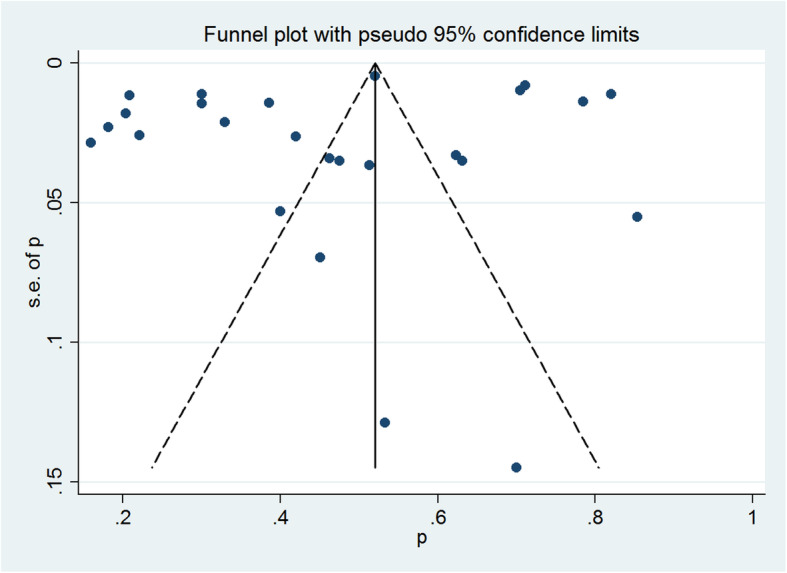
“After excluding this study that included far more participants than any other study (n = 11,500) [40], the pooled rate did not alter (prevalence rate = 0.”
BackgroundGeneral practitioner relocation in an urban area.
Smith, A. G., & Barr, R. (1988) · PubMed · Cited by 3
La atención primaria en Bélgica
Sánchez-Sagrado, T. (2016) · Medicina de Familia SEMERGEN · doi:10.1016/j.semerg.2016.03.002 · Cited by 3
Plan one, do one, see one: learning about appraisal during GP training
Nicol, J. W., & Mhaoileoin, A. N. (2017) · Education for Primary Care · doi:10.1080/14739879.2017.1343651 · Cited by 3
Participation of general practitioners in the management of their “hospital at home” patients
Leung, I., Casalino, E., Pateron, D., Grateau, G., Garandeau, E., & de Stampa, M. (2016) · PubMed · Cited by 3
Fastlegers skjønnsutøvelse er truet
Magelssen, M., & Meland, E. (2013) · Tidsskrift for Den norske legeforening · doi:10.4045/tidsskr.13.0473 · Cited by 2
de Brie, C., Piet, E., & Chariot, P. (2018) · La Presse Médicale · doi:10.1016/j.lpm.2017.11.023 · Cited by 2 · cited 1×
“Previous studies on GPs’ turnover intention reported that low income [14], poor working conditions [15], low job satisfaction [16, 17], high work-related stress, and frequent workplace violence [18, 19] were associated with turnover [20, 21].”
BackgroundWellbeing support for general practitioners
Sage, M. (2018) · BMJ · doi:10.1136/bmj.k4655 · Cited by 2
Research works printed but not linked: 5
- Digital N General practice workforce 30 June 2019 2019
- Lin OW Ping LK Qiong MM Li K Study on fatigue status and turnover intention of primary health care workers in Guangdong Guangdong Med J 2018 39 20 3081 3085
- En-fang F Yan Y Status of job burnout and turnover intention among general practitioners in suburb communities of Pudong District of Shanghai Occup Health. 2017 33 11 1473 1477
- Ming CG Shuo W De Xin M Juan WH Dong LQ Chao F Turnover intention of general practitioners and its influencing factors China Gen Pract 2016 19 25 3008 3012
- Yongli Y Yuejiao Q Yaoqiong Y Investigation on the status quo of general practitioners in the City Community health Service in Zhejiang Province Modern Hosp 2016 16 06 898 902
Cited by
Poon, Y.-S. R., Lin, Y. P., Griffiths, P., Yong, K. K., Seah, B., & Liaw, S. Y. (2022) · Human Resources for Health · doi:10.1186/s12960-022-00764-7 · Cited by 394
de Vries, N., Boone, A., Godderis, L., Bouman, J., Szemik, S., Matranga, D., & de Winter, P. (2023) · INQUIRY: The Journal of Health Care Organization, Provision, and Financing · doi:10.1177/00469580231159318 · Cited by 285
The quiet quitting scale: Development and initial validation
Galanis, P., Katsiroumpa, A., Vraka, I., Siskou, O., Konstantakopoulou, O., Moisoglou, I., Gallos, P., & Kaitelidou, D. (2023) · AIMS Public Health · doi:10.3934/publichealth.2023055 · Cited by 160
Roth, L., Saux, C. L., Gilles, I., & Peytremann‐Bridevaux, I. (2023) · Medical Care Research and Review · doi:10.1177/10775587231204105 · Cited by 60
“These challenges are likely to cause high turnover rates in HPs, creating a precarious situation that may lead to a dissatisfied and unprepared workforce (Halter et al., 2017; Shen et al., 2020).”
BackgroundA systematic review on pharmacists’ turnover and turnover intention
Thin, S. M., Chongmelaxme, B., Watcharadamrongkun, S., Kanjanarach, T., Sorofman, B. A., & Kittisopee, T. (2022) · Research in Social and Administrative Pharmacy · doi:10.1016/j.sapharm.2022.05.014 · Cited by 42
Metadata
- Authors
- Shen, X., Jiang, H., Xu, H., Ye, J., Lv, C., Lu, Z., & Gan, Y.
- Affiliations
- Huazhong University of Science and Technology (CN)
- The University of Melbourne (AU)
- Wenzhou Medical University (CN)
- Chinese Academy of Medical Sciences & Peking Union Medical College (CN)
- Corresponding author
- Lv, Chuanzhu
- Lu, Zuxun
- Gan, Yong
- Venue
- BMC Family Practice
- Published
- 2020-11-30
- Volume
- 21
- Issue
- 1
- Pages
- 246-246
- ISSN
- 1471-2296 (ISSN-L)
- PMC
- PMC7702723
- OpenAlex
- W3107160292
- Cited by
- 65
- References
- 64
- Citations by year
- 2026: 9 · 2025: 6 · 2024: 15 · 2023: 18 · 2022: 13 · 2021: 4
- FWCI
- 1.95
- Type
- journal article
- Language
- en
- Open access
- gold
- doi.org
- Licence
- cc-by
- creativecommons.org/licenses/by/4.0/ (tdm)
- creativecommons.org/licenses/by/4.0/ (vor)
- Locations
- BMC Family Practice (publishedVersion, cc-by)
- PubMed Central (publishedVersion, cc-by)
- PubMed (publishedVersion)
- DOAJ (DOAJ: Directory of Open Access Journals) (submittedVersion, cc-by-sa)
- Funders
- National Natural Science Foundation of China (71804049, 19CGL061)
- Fundamental Research Funds for the Central Universities (2020kfyXJJS059)
- Topics
- Health Sciences › Medicine › Public Health, Environmental and Occupational Health › Global Health Workforce Issues
- Health Sciences › Medicine › Family Practice › Primary Care and Health Outcomes
- Health Sciences › Health Professions › General Health Professions › Healthcare professionals’ stress and burnout
- Keywords
- turnover intention, general practitioners, physician retention, primary care providers, prevalence, job satisfaction, morale, wages, professional titles, health workforce shortage
- MeSH terms
- Cross-Sectional Studies, Humans, Job Satisfaction, Personnel Turnover, Surveys and Questionnaires, Prevalence, Intention, General Practitioners
About these checks
Registry, retraction, Cites and statistics results are computed, not judged, with one exception: a printed reference that no index lists is read once by a model before it counts as a citation error. Claims are extracted by a model and kept only when their quote appears verbatim in the text; each cited source is then checked, with a model’s help, for whether it says what the claim relies on. Those verdicts can be wrong — read the claim’s quote and the cited source before relying on one.
Statistics and arithmetic are recomputed, not judged.
Confidence bands are shown only for fields calibrated on our annotated test set. None is calibrated yet, so no band is shown.
What counts as a claim ›How we measure confidence ›How we check this ›
Are you an author, or do you see a problem with this page? Request a review
Data sources
Bibliographic data: Semantic Scholar, OpenAlex, Crossref.
Contains information from the Semantic Scholar Academic Graph Datasets, made available under the ODC Attribution License (ODC-BY 1.0).
Semantic Scholar’s data is described in: Kinney, R., et al. (2023). The Semantic Scholar Open Data Platform. arXiv:2301.10140.
