

Using a brief web-based 5A intervention to improve weight management in primary care: results of a cluster-randomized controlled trial
Open accessThe DOI matches its Crossref record; 102 of the 103 references it cites were found in a registry or an index.
Abstract
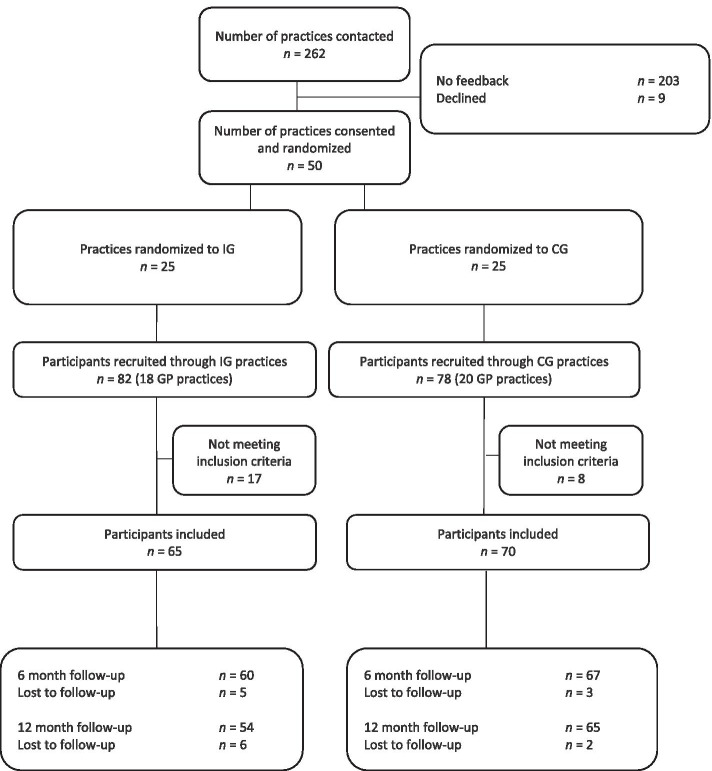
Background: The primary health care setting is considered a major starting point in successful obesity management. However, research indicates insufficient quality of weight counseling in primary care. Aim of the present study was to implement and evaluate a 5A online tutorial aimed at improving weight management and provider-patient-interaction in primary health care. The online tutorial is a stand-alone low-threshold minimal e-health intervention for general practitioners based on the 5As guidance for obesity management by the Canadian Obesity Network. Methods: In a cluster-randomized controlled trial, 50 primary care practices included 160 patients aged 18 to 60 years with obesity (BMI ≥ 30). The intervention practices had continuous access to the 5A online tutorial for the general practitioner. Patients of control practices were treated as usual. Primary outcome was the patients’ perspective of the doctor-patient-interaction regarding obesity management, assessed with the Patient Assessment of Chronic Illness Care before and after (6/12 months) the training. Treatment effects over time (intention-to-treat) were evaluated using mixed-effects linear regression models. Results: More than half of the physicians (57%) wished for more training offers on obesity counseling. The 5A online tutorial was completed by 76% of the physicians in the intervention practices. Results of the mixed-effects regression analysis showed no treatment effect at 6 months and 12 months’ follow-up for the PACIC 5A sum score. Patients with obesity in the intervention group scored lower on self-stigma and readiness for weight management compared to participants in the control group at 6 months’ follow-up. However, there were no significant group differences for weight, quality of life, readiness to engage in weight management, self-stigma and depression at 12 months’ follow-up. Conclusion: To our knowledge, the present study provides the first long-term results for a 5A-based intervention in the context of the German primary care setting. The results suggest that a stand-alone low-threshold minimal e-health intervention for general practitioners does not improve weight management in the long term. To improve weight management in primary care, more comprehensive strategies are needed. However, due to recruitment difficulties the final sample was smaller than intended. This may have contributed to the null results. Trial registration: The study has been registered at the German Clinical Trials Register (Identifier:DRKS00009241, Registered 3 February 2016).
Overview
The claims and statistics of this paper haven’t been checked yet.
Free: it reads the open-access text and checks the first 5 claims that cite a source we can check. Create a free account to check every claim.
Integrity signals
Registry
Cites
Statistics
Figures
Verification
Claims the paper makes
The claims and statistics of this paper haven’t been checked yet.
Free: it reads the open-access text and checks the first 5 claims that cite a source we can check. Create a free account to check every claim.
Claims other papers make about this one
Each is checked against this paper’s own text: does it say what the citing paper says it does?
The source backs part of the claim, not all of it — or backs it for a different population, condition or comparison.
In the citing paper
“study participants in the two interventions that did not show a significant difference in the depression symptoms experienced a limited user acceptance of the eHealth interventions (48, 49) compared to study participants in the other studies included in this review.”
From Efficacy of eHealth interventions to reduce depression symptoms in individuals with obesity: a systematic review of randomized controlled trials (2024) · cites this paper as [49]
Experimental — accuracy not yet measuredThe cited source says what the claim attributes to it.
In the citing paper
“Results from two of the six included studies (48, 49) showed no significant group differences in depression symptoms.”
From Efficacy of eHealth interventions to reduce depression symptoms in individuals with obesity: a systematic review of randomized controlled trials (2024) · cites this paper as [49]
Self-check
Percentages, sums and reported differences re-computed from the paper’s own numbers.
The self-check needs the paper’s full text.
Citations
Cites
The PHQ-9: Validity of a brief depression severity measure
Kroenke, K., Spitzer, R. L., & Williams, J. B. W. (2001) · Journal of General Internal Medicine · doi:10.1046/j.1525-1497.2001.016009606.x · Cited by 44,910
Bundesgesundheitsblatt - Gesundheitsforschung - Gesundheitsschutz
(2013) · Bundesgesundheitsblatt - Gesundheitsforschung - Gesundheitsschutz · doi:10.1007/103.1437-1588 · Cited by 11,796
Cook, R. J., Dickens, B. M., & Fathalla, M. F. (2003) · Reproductive Health and Human Rights · doi:10.1093/acprof:oso/9780199241323.003.0025 · Cited by 10,769
Development and preliminary testing of the new five-level version of EQ-5D (EQ-5D-5L)
Herdman, M., Gudex, C., Lloyd, A., Janssen, M., Kind, P., Parkin, D., Bonsel, G., & Badia, X. (2011) · Quality of Life Research · doi:10.1007/s11136-011-9903-x · Cited by 9,795 · cited 2×
“Patients’ health-related quality of life was measured using the German version of the EQ-5D-5L [45].”
Method‘Small Changes' to Diet and Physical Activity Behaviors for Weight Management
Hills, A. P., Byrne, N. M., Lindstrom, R., & Hill, J. O. (2013) · Obesity Facts · doi:10.1159/000345030 · Cited by 9,493
Stages and processes of self-change of smoking: Toward an integrative model of change.
Prochaska, J. O., & DiClemente, C. C. (1983) · Journal of Consulting and Clinical Psychology · doi:10.1037/0022-006x.51.3.390 · Cited by 9,098
In search of how people change: Applications to addictive behaviors.
Prochaska, J. O., DiClemente, C. C., & Norcross, J. C. (1992) · American Psychologist · doi:10.1037/0003-066x.47.9.1102 · Cited by 8,596
The metabolic phenotype in obesity: Fat mass, body fat distribution, and adipose tissue function
Goossens, G. H. (2017) · Obesity Facts · doi:10.1159/000471488 · Cited by 8,481
The Transtheoretical Model of Health Behavior Change.
Prochaska, J. O., & Velicer, W. F. (1997) · American Journal of Health Promotion · doi:10.4278/0890-1171-12.1.38 · Cited by 7,782
Lippa, N. C., & Sanderson, S. C. (2013) · Human Heredity · doi:10.1159/000353712 · Cited by 6,078
Cited by
Madigan, C. D., Graham, H. E., Sturgiss, E., Kettle, V. E., Gokal, K., Biddle, G., Taylor, G. M. J., & Daley, A. J. (2022) · BMJ · doi:10.1136/bmj-2021-069719 · Cited by 114
Current Implementation of Digital Health in Chronic Disease Management: Scoping Review
Pong, C. Y., Tseng, R. M. W. W., Tham, Y. C., & Lum, E. (2024) · Journal of Medical Internet Research · doi:10.2196/53576 · Cited by 126
Heath, L., Stevens, R., Nicholson, B. D., Wherton, J. P., Gao, M., Callan, C., Haasova, S., & Aveyard, P. N. (2024) · BMC Medicine · doi:10.1186/s12916-024-03588-5 · Cited by 49
“Furthermore, a post hoc sensitivity analysis that excluded three studies that measured the outcome of a health behaviour (weight) rather than the health behaviour (diet) directly, did not change the result of the meta-analysis that there was no evidence of effect [71, 98, 130].”
BackgroundRossi, A. A., Manzoni, G. M., Pietrabissa, G., Pauli, D. D., Mannarini, S., & Castelnuovo, G. (2022) · Eating and Weight Disorders - Studies on Anorexia Bulimia and Obesity · doi:10.1007/s40519-022-01385-8 · Cited by 27
E-Health and M-Health in Obesity Management: A Systematic Review and Meta-Analysis of RCTs
Chiavarini, M., Giacchetta, I., Rosignoli, P., & Fabiani, R. (2025) · Nutrients · doi:10.3390/nu17132200 · Cited by 21
“Two articles involved mixed e-health tools [6,18].”
Research Trends in Motivation and Weight Loss: A Bibliometric-Based Review
Železnik, U., Kokol, P., Štarc, J., Železnik, D., Završnik, J., & Vošner, H. B. (2023) · Healthcare · doi:10.3390/healthcare11233086 · Cited by 14
“Nutritional counseling in a primary care environment is recognized as a starting point in the management of obesity [43], especially if supported by digital technology [44,45].”
BackgroundDagan, S. S., Kessler, Y., Mardy-Tilbor, L., Raziel, A., Sakran, N., Boaz, M., & Shriqui, V. K. (2022) · Obesity Facts · doi:10.1159/000521856 · Cited by 17
Mohamed, R. A., Alhujaily, M. M., Ahmed, F. A., Nouh, W. G., & Almowafy, A. A. (2024) · PLoS ONE · doi:10.1371/journal.pone.0297071 · Cited by 9
Shieh, C., Hardin, H. K., Doerstler, M. D., & Jacobsen, A. L. (2024) · American Journal of Lifestyle Medicine · doi:10.1177/15598276241306351 · Cited by 8
“27,28,45 All 5 studies were conducted in primary care settings (Table 4, TIDieR information).”
Kocol, D., Bäuerle, A., Schadendorf, T., Geiger, S., Krakowczyk, J. B., Skoda, E.-M., & Teufel, M. (2024) · Frontiers in Psychiatry · doi:10.3389/fpsyt.2024.1296433 · Cited by 7
Kemp, E., Aquino, M. R. J., Wilson, R., Vasiljevic, M., McBride, K., Robson, C. N., Faulkner, S., Loraine, M., Harland, J., Haighton, C., et al. (2024) · BMC Public Health · doi:10.1186/s12889-024-20774-5 · Cited by 7
“The bespoke MECC training adopts the ‘3As approach’ to brief interventions (‘Ask’; ‘Assist’; ‘Act’) often used in smoking cessation interventions [25] and which is adapted from the 5As approach [32] (Ask, Assess, Advise, Agree, Assist).”
Rodrigues, A., Kemp, E., Aquino, M. R. J., Wilson, R., Vasiljevic, M., McBride, K., Robson, C. N., Loraine, M., Harland, J., & Haighton, C. (2023) · Health Psychology and Behavioral Medicine · doi:10.1080/21642850.2023.2174698 · Cited by 6
“The bespoke MECC training adopts the ‘3As approach’ to brief interventions (‘Ask’; ‘Assist’; ‘Act’) – a shorter and slightly different approach from the widely used 5As (Welzel et al., 2021).”
Ryan, L., Coleman, S., Zimmermann, T., Coyne, R., Broadbent, E., Browne, A. C., O’Donoghue, G., Quigley, F., Worlikar, H., Connolly, C., et al. (2025) · Obesity Science & Practice · doi:10.1002/osp4.70083 · Cited by 6
Guerra, P. H., Spósito, L. A. C., da Costa, F. F., Fermino, R. C., Papini, C. B., & Rech, C. R. (2023) · Behavioral Sciences · doi:10.3390/bs13060476 · Cited by 3
Quigley, F., Ryan, L., Bond, R., McAloon, T., Zheng, H., & Moorhead, A. (2025) · JMIR Medical Education · doi:10.2196/65949 · Cited by 4
“Similarly, the INTERACT study in Germany [57], which incorporated eLearning and motivational interviewing content, failed to demonstrate sustained improvements in key patient outcomes.”
Lekha, P. P. S., Azeez, E. P. A., & O’Donnell, R. R. (2024) · Journal of Integrated Care · doi:10.1108/jica-11-2023-0083 · Cited by 3
Peniche, P. D. C., Lennon, O. C., Magalhães, J. D. P., Santos, J. M. D., Polese, J. C., & Faria, C. D. C. D. M. (2025) · PLoS ONE · doi:10.1371/journal.pone.0320026 · Cited by 1
Quigley, F., Moorhead, A., Bond, R., McAloon, T., & Zheng, H. (2024) · doi:10.2196/preprints.65949 · Cited by 1
Leawsoong, S., Pongsaengpan, P., Ouppawongsapat, D., & Piboon, K. (2025) · International Journal of Public Health Science (IJPHS) · doi:10.11591/ijphs.v14i2.24241
“This includes providing support from healthcare providers during behavior change [17], which is widely used in modifying health behaviors [18].”
Rodrigues, A., Kemp, E., Faulkner, S., McBride, K., Aquino, M. R. J., Wilson, R., Vasiljevic, M., Robson, C. N., Harland, J., Loraine, M., et al. (2025) · medRxiv · doi:10.64898/2025.12.16.25342378
Chen, X., Duan, J., Duan, R., Wang, Y., & Jiang, H. (2026) · Frontiers in Nutrition · doi:10.3389/fnut.2026.1700808
“However, some studies have also reported that Internet-based remote obesity management mode have no significant advantage over traditional models in terms of maintaining weight loss results (23).”
Brief counseling for better diabetes management: a pilot study on the Modified 5A Approach
Hidayati, T., Trimaylani, R., & Akrom, A. (2026) · Family Medicine & Primary Care Review · doi:10.5114/fmpcr.2026.159146
Serçe, S., ATICI, S., Ovayolu, Ö., & Aytaç, S. (2026) · BMC Public Health · doi:10.1186/s12889-026-27572-1
“This not only shortens the life span of individuals but also increases susceptibility to other chronic diseases [2–4].”
Depression Associated with Other Medical Conditions
Sunzeri, F., & Sunzeri, E. (2026) · Springer eBooks · doi:10.1007/978-3-032-14465-2_12
Abordaje actual del sobrepeso y la obesidad desde Atención Primaria de Salud
Casado, S. G. (2026) · Gredos (University of Salamanca)
Motivational Interviewing and the 5A Model in Primary Care
Sönmez, T. G., & Fidancı, İ. (2026) · Arşiv Kaynak Tarama Dergisi · doi:10.17827/aktd.1817154
Schrader, H., Müller, D., Förster, C., Heyl, L., Heinz, L., Haumann, H., Blaschke, S., Meybohm, P., Joos, S., & Gágyor, I. (2026) · Das Gesundheitswesen · doi:10.1055/a-2939-7615
Leawsoong, S., Pongsaengpan, P., Ouppawongsapat, D., & Piboon, K. (2024) · Journal of Nursing and Health Science Research · Cited by 1
Metadata
- Authors
- Welzel, F. D., Bär, J., Stein, J., Löbner, M., Pabst, A., Luppa, M., Grochtdreis, T., Kersting, A., Blüher, M., Luck-Sikorski, C., König, H.-H., & Riedel-Heller, S. G.
- Affiliations
- University Hospital Leipzig (DE)
- Leipzig University (DE)
- University Medical Center Hamburg-Eppendorf (DE)
- Corresponding author
- Welzel, Franziska D.
- ORCID
- Venue
- BMC Family Practice
- Published
- 2021-04-02
- Volume
- 22
- Issue
- 1
- Pages
- 61-61
- ISSN
- 1471-2296 (ISSN-L)
- PMC
- PMC8017625
- OpenAlex
- W3141691684
- Cited by
- 24
- References
- 103
- Citations by year
- 2026: 5 · 2025: 5 · 2024: 8 · 2023: 3 · 2022: 3
- FWCI
- 5.46
- Type
- journal article
- Language
- en
- Open access
- gold
- doi.org
- Licence
- cc-by
- creativecommons.org/licenses/by/4.0/ (tdm)
- creativecommons.org/licenses/by/4.0/ (vor)
- Locations
- BMC Family Practice (publishedVersion, cc-by)
- PubMed Central (publishedVersion, cc-by)
- PubMed (publishedVersion)
- DOAJ (DOAJ: Directory of Open Access Journals) (submittedVersion, cc-by-sa)
- Funders
- Bundesministerium für Bildung und Forschung (01EO1501)
- Universität Leipzig
- Topics
- Health Sciences › Medicine › Public Health, Environmental and Occupational Health › Obesity and Health Practices
- Health Sciences › Medicine › Public Health, Environmental and Occupational Health › Obesity, Physical Activity, Diet
- Social Sciences › Education › Innovations in Medical Education
- Keywords
- obesity treatment, weight management, online tutorials, digital health interventions, general practitioners, primary care, doctor-patient interaction, obesity counseling, self-stigma, readiness to change, Patient Assessment of Chronic Illness Care
- MeSH terms
- Obesity Management, Internet-Based Intervention, Canada, Humans, Primary Health Care, Quality of Life
About these checks
Registry, retraction, Cites and statistics results are computed, not judged, with one exception: a printed reference that no index lists is read once by a model before it counts as a citation error. Claims are extracted by a model and kept only when their quote appears verbatim in the text; each cited source is then checked, with a model’s help, for whether it says what the claim relies on. Those verdicts can be wrong — read the claim’s quote and the cited source before relying on one.
Statistics and arithmetic are recomputed, not judged.
Confidence bands are shown only for fields calibrated on our annotated test set. None is calibrated yet, so no band is shown.
What counts as a claim ›How we measure confidence ›How we check this ›
Are you an author, or do you see a problem with this page? Request a review
Data sources
Bibliographic data: Semantic Scholar, OpenAlex, Crossref.
Contains information from the Semantic Scholar Academic Graph Datasets, made available under the ODC Attribution License (ODC-BY 1.0).
Semantic Scholar’s data is described in: Kinney, R., et al. (2023). The Semantic Scholar Open Data Platform. arXiv:2301.10140.
