

Experiences of end of life amongst family carers of people with advanced dementia: longitudinal cohort study with mixed methods
Open accessThe DOI matches its Crossref record; 49 of the 51 references it cites were found in a registry or an index.
Abstract
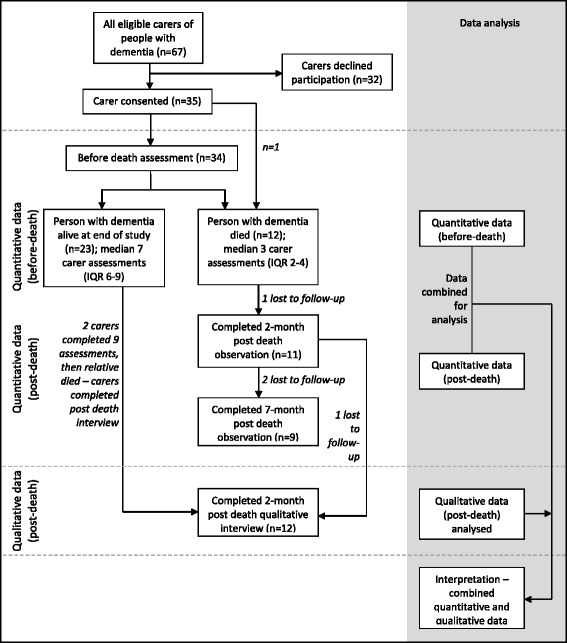
BACKGROUND: Many studies have examined the mental health of carers of people with dementia. Few have examined their experiences in the advanced stages of disease and into bereavement. We aimed to understand the experiences of carers during advanced dementia exploring the links between mental health and experiences of end of life care. METHODS: Mixed methods longitudinal cohort study. Thirty-five family carers of people with advanced dementia (6 at home, 29 in care homes) were recruited and assessed monthly for up to nine months or until the person with dementia died, then at two and seven months into bereavement. Assessments included: Hospital Anxiety and Depression Scale, Short Form 12 health-related quality of life, 22-item Zarit Burden Interview, Brief Coping Orientation to Problems Experienced, Inventory of Complicated Grief and Satisfaction with Care at End of Life in Dementia. Subsequently, 12 carers (34%) were bereaved and 12 undertook a qualitative interview two months after death; these data were analysed thematically. We analysed quantitative and qualitative data independently and then merged findings at the point of interpretation. RESULTS: At study entry psychological distress was high; 26% reached caseness for depression and 41% for anxiety and median complicated grief scores were 27 [IQR 22-37] indicating that on average 11 of the 16 grief symptoms occurred at least monthly. Physical health reflected population norms (mean = 50) and median burden scores were 17 [IQR 9-30]. Three qualitative themes were identified: the importance of relationships with care services, understanding of the progression of dementia, and emotional responses to advanced dementia. An overarching theme tying these together was the carer's ability to control and influence end of life care. CONCLUSIONS: While carers report high levels of psychological distress during advanced dementia, the experience of end of life care in dementia may be amenable to change with the provision of sensitive and timely information about the natural progression of dementia. Regular health status updates and end of life discussions can help families understand dementia progression and prepare for end of life. The extent to which our findings reflect practice across the UK or internationally warrants further investigation.
Overview
The claims and statistics of this paper haven’t been checked yet.
Free: it reads the open-access text and checks the first 5 claims that cite a source we can check. Create a free account to check every claim.
Integrity signals
Registry
Cites
Statistics
Figures
Verification
Claims the paper makes
The claims and statistics of this paper haven’t been checked yet.
Free: it reads the open-access text and checks the first 5 claims that cite a source we can check. Create a free account to check every claim.
Claims other papers make about this one
Each is checked against this paper’s own text: does it say what the citing paper says it does?
The cited source doesn’t support the claim as written.
In the citing paper
“One RCT testing decision-aids about families' and doctors' goals of care for people with advanced dementia led to increased palliative care content in care plans.305, 306”
From Dementia prevention, intervention, and care: 2020 report of the Lancet Commission (2020) · cites this paper as [305]
Checked by a reasoning model — may be wrong.
Experimental — accuracy not yet measured
Self-check
Percentages, sums and reported differences re-computed from the paper’s own numbers.
The self-check needs the paper’s full text.
Citations
Cites
The Hospital Anxiety and Depression Scale
Zigmond, A. S., & Snaith, R. P. (1983) · Acta Psychiatrica Scandinavica · doi:10.1111/j.1600-0447.1983.tb09716.x · Cited by 47,139
Eysenck, H. J. (1985) · Behaviour Research and Therapy · doi:10.1016/0005-7967(85)90087-7 · Cited by 31,975
“Stress: appraisal and coping,”
Folkman, S. (2013) · Encyclopedia of Behavioral Medicine · doi:10.1007/978-1-4419-1005-9_215 · Cited by 27,833
Kok, J. S., Berg, I. J., & Scherder, E. J. A. (2013) · Dementia and Geriatric Cognitive Disorders Extra · doi:10.1159/000353441 · Cited by 20,589
WARE, J. E., KOSINSKI, M., & KELLER, S. D. (1996) · Medical Care · doi:10.1097/00005650-199603000-00003 · Cited by 17,392 · cited 6×
“Short Form 12 health – related quality of life Survey (SF-12) [24] Comprises “ physical ” and “ mental ” health related quality of life.”
InfluentialDepression and quality of life in older persons: A review
Sivertsen, H., Bjørkløf, G. H., Engedal, K., Selbæk, G., & Helvik, A.-S. (2015) · Dementia and Geriatric Cognitive Disorders · doi:10.1159/000437299 · Cited by 14,152
You want to measure coping but your protocol’ too long: Consider the brief cope
Carver, C. S. (1997) · International Journal of Behavioral Medicine · doi:10.1207/s15327558ijbm0401_6 · Cited by 7,361
Bonanno, G. A. (2004) · American Psychologist · doi:10.1037/0003-066x.59.1.20 · Cited by 6,851 · cited 1×
“Although carers were often unaware of available formal grief support, many did not feel they needed this support and were active in seeking support through their social network, consistent with current theories of grief [37, 38].”
ResultRelatives of the Impaired Elderly: Correlates of Feelings of Burden
Zarit, S. H., Reever, K. E., & Bach-Peterson, J. (1980) · The Gerontologist · doi:10.1093/geront/20.6.649 · Cited by 5,810
Caregiving and the stress process: an overview of concepts and their measures
Pearlin, L. I., Mullan, J. T., Semple, S. J., & Skaff, M. M. (1990) · The Gerontologist · doi:10.1093/geront/30.5.583 · Cited by 4,810
Pinquart, M., & Sörensen, S. (2003) · Psychology and Aging · doi:10.1037/0882-7974.18.2.250 · Cited by 2,857 · cited 1×
“Carers may find satisfaction and meaning in the caring role but also experience distress, depression, anxiety and guilt [7 – 9], often when they feel that they no longer have sufficient resources to cope [10].”
The Significance of Saturation
Morse, J. M. (1995) · Qualitative Health Research · doi:10.1177/104973239500500201 · Cited by 2,663 · cited 1×
“After half the transcripts had been reviewed fewer new nodes were identified, suggesting saturation of data was reached [29].”
Background(2015) · HAL · Cited by 2,238
Prolonged grief disorder: psychometric validation of criteria proposed for DSM-V and ICD-11
Prigerson, H. G., Horowitz, M. J., Jacobs, S. C., Parkes, C. M., Aslan, M., Goodkin, K., Raphael, B., Marwit, S. J., Wortman, C., Neimeyer, R. A., et al. (2009) · PLoS Medicine · doi:10.1371/journal.pmed.1000121 · Cited by 1,863 · cited 2×
“” [8] However, for some individuals the grief experience can be persistent and disabling; this has been termed complicated or prolonged grief [12].”
BackgroundThe Clinical Course of Advanced Dementia.
Mitchell, S. L., Teno, J. M., Kiely, D. K., Shaffer, M. L., Jones, R. N., Prigerson, H. G., Volicer, L., Givens, J. L., & Hamel, M. B. (2009) · New England Journal of Medicine · doi:10.1056/nejmoa0902234 · Cited by 1,618
Inventory of complicated grief: a scale to measure maladaptive symptoms of loss.
Prigerson, H. G., Maciejewski, P. K., Reynolds, C. F., Bierhals, A. J., Newsom, J. T., Fasiczka, A., Frank, E., Doman, J., & Miller, M. (1995) · Psychiatry Research · doi:10.1016/0165-1781(95)02757-2 · Cited by 1,582 · cited 2×
“We also used the Inventory of Complicated grief (ICG) [28] modified to be suitable for carers before the death of their relative (ICG Short-Form Pre-Loss) as modified and obtained from the authors Mitchell et al. [22].”
Functional Assessment Staging (FAST)
(2001) · Management of Dementia · doi:10.3109/9780203213896-33 · Cited by 1,023
van der Steen, J. T., Radbruch, L., Hertogh, C. M., de Boer, M. E., Hughes, J. C., Larkin, P., Francke, A. L., Jünger, S., Gove, D., Firth, P., et al. (2014) · Palliative Medicine · doi:10.1177/0269216313493685 · Cited by 997 · cited 2×
“The European Association for Palliative Care published recommendations for optimal palliative care for people with dementia and includes recommendations on meeting the needs of family carers covering burden, grief, and need for information and support throughout dementia [6].”
Ory, M. G., Hoffman, R. R., Yee, J. L., Tennstedt, S., & Schulz, R. (1999) · The Gerontologist · doi:10.1093/geront/39.2.177 · Cited by 991
Designing A Mixed Methods Study In Primary Care
Creswell, J. W. (2004) · The Annals of Family Medicine · doi:10.1370/afm.104 · Cited by 978
Hébert, R., Bravo, G., & Préville, M. (2000) · Canadian Journal on Aging / La Revue canadienne du vieillissement · doi:10.1017/s0714980800012484 · Cited by 539
Validity and Reliability of the Brief COPE in Carers of People With Dementia: The LASER-AD Study
Cooper, C., Katona, C., & Livingston, G. (2008) · Journal of Nervous & Mental Disease · doi:10.1097/nmd.0b013e31818b504c · Cited by 306
A Comprehensive, Stage-Sensitive Model of Grief in Dementia Caregiving
Meuser, T. M., & Marwit, S. J. (2001) · The Gerontologist · doi:10.1093/geront/41.5.658 · Cited by 270
Hebert, R. S., Dang, Q., & Schulz, R. (2006) · Journal of Palliative Medicine · doi:10.1089/jpm.2006.9.683 · Cited by 263
Andrén, S., & Elmståhl, S. (2005) · Scandinavian Journal of Caring Sciences · doi:10.1111/j.1471-6712.2005.00328.x · Cited by 259
Grief reactions in dementia carers: a systematic review
Chan, D., Livingston, G., Jones, L., & Sampson, E. L. (2013) · International Journal of Geriatric Psychiatry · doi:10.1002/gps.3795 · Cited by 243 · cited 1×
“” [8] However, for some individuals the grief experience can be persistent and disabling; this has been termed complicated or prolonged grief [12].”
BackgroundSelf-citationBeyond the global score of the Zarit Burden Interview: useful dimensions for clinicians
Ankri, J., Andrieu, S., Beaufils, B., Grand, A., & Henrard, J. C. (2005) · International Journal of Geriatric Psychiatry · doi:10.1002/gps.1275 · Cited by 217
When Caregiving Ends: The Course of Depressive Symptoms After Bereavement
Aneshensel, C. S., Botticello, A. L., & Yamamoto-Mitani, N. (2004) · Journal of Health and Social Behavior · doi:10.1177/002214650404500405 · Cited by 214
Dementia grief: A theoretical model of a unique grief experience
Blandin, K., & Pepin, R. (2017) · Dementia · doi:10.1177/1471301215581081 · Cited by 171
Reyniers, T., Deliëns, L., Pasman, H. R. W., Morin, L., Addington-Hall, J. M., Frova, L., Cárdenas-Turanzas, M., Onwuteaka-Philipsen, B. D., Naylor, W. A., Ruíz-Ramos, M., et al. (2014) · Journal of the American Medical Directors Association · doi:10.1016/j.jamda.2014.11.003 · Cited by 154
The Validity and Reliability of Scales for the Evaluation of End-of-Life Care in Advanced Dementia
Kiely, D. K., Volicer, L., Teno, J., Jones, R. N., Prigerson, H. G., & Mitchell, S. L. (2006) · Alzheimer Disease & Associated Disorders · doi:10.1097/00002093-200607000-00009 · Cited by 125
Work – life imbalance: Informal care and paid employment in the UK
Carmichael, F., Hulme, C. T., Sheppard, S., & Connell, G. (2008) · Feminist Economics · doi:10.1080/13545700701881005 · Cited by 124
Sleeman, K. E., Ho, Y. K., Verne, J., Gao, W., & Higginson, I. J. (2014) · BMC Neurology · doi:10.1186/1471-2377-14-59 · Cited by 109
Advanced Dementia Research in the Nursing Home: The CASCADE Study
Mitchell, S. L., Kiely, D. K., Jones, R. N., Prigerson, H., Volicer, L., & Teno, J. M. (2006) · Alzheimer Disease & Associated Disorders · doi:10.1097/00002093-200607000-00008 · Cited by 106
Health Care Proxy Grief Symptoms Before the Death of Nursing Home Residents With Advanced Dementia
Kiely, D. K., Prigerson, H., & Mitchell, S. L. (2008) · The American Journal of Geriatric Psychiatry · doi:10.1097/jgp.0b013e3181784143 · Cited by 95
Living through end-stage dementia: The experiences and expressed needs of family carers
Shanley, C., Russell, C., Middleton, H., & Simpson-Young, V. (2011) · Dementia · doi:10.1177/1471301211407794 · Cited by 81
The Meaning of Family Caregiving in Japan and the United States: A Qualitative Comparative Study
Wallhagen, M. I., & Yamamoto-Mitani, N. (2006) · Journal of Transcultural Nursing · doi:10.1177/1043659605281979 · Cited by 79
Admission to care: facilitating role transition amongst family carers
Dellasega, C., & Nolan, M. (1997) · Journal of Clinical Nursing · doi:10.1046/j.1365-2702.1997.00195.x · Cited by 71
Sampson, E. L., Thuné-Boyle, I., Kukkastenvehmas, R., Jones, L., Tookman, A., King, M., & Blanchard, M. R. (2008) · BMC Palliative Care · doi:10.1186/1472-684x-7-8 · Cited by 51
Self-citationThe changing face of grief: Contemporary directions in theory, research, and practice
Neimeyer, R. A. (2014) · Progress in Palliative Care · doi:10.1179/1743291x13y.0000000075 · Cited by 47
Cohen, L. W., van der Steen, J. T., Reed, D., Hodgkinson, J. C., van Soest‐Poortvliet, M. C., Sloane, P. D., & Zimmerman, S. I. (2012) · Journal of the American Geriatrics Society · doi:10.1111/j.1532-5415.2011.03816.x · Cited by 41
Palliative Care in Advanced Dementia
Merel, S. E., DeMers, S. M., & Vig, E. K. (2014) · Clinics in Geriatric Medicine · doi:10.1016/j.cger.2014.04.004 · Cited by 39
Caregivers’ Experiences Seeking Hospice Care for Loved Ones With Dementia
Lewis, L. F. (2014) · Qualitative Health Research · doi:10.1177/1049732314545888 · Cited by 36
Muders, P., Zahrt-Omar, C. A., Bussmann, S., Haberstroh, J., & Weber, M. (2015) · Palliative and Supportive Care · doi:10.1017/s1478951513001107 · Cited by 35
Chang, E. M. L., Easterbrook, S., Hancock, K. M., Johnson, A., & Davidson, P. M. (2009) · Nursing and Health Sciences · doi:10.1111/j.1442-2018.2009.00486.x · Cited by 33
Wawrziczny, É., Pasquier, F., Ducharme, F., Kergoat, M., & Antoine, P. (2016) · Archives of Gerontology and Geriatrics · doi:10.1016/j.archger.2016.12.002 · Cited by 32
Sampson, E. L., Lodwick, R. K., Rait, G., Candy, B., Low, J., King, M., & Petersen, I. (2016) · Journal of Pain and Symptom Management · doi:10.1016/j.jpainsymman.2015.12.319 · Cited by 23
Self-citationJones, L., Harrington, J., Scott, S., Davis, S., Lord, K., Vickerstaff, V., Round, J. A., Candy, B., & Sampson, E. L. (2012) · BMJ Open · doi:10.1136/bmjopen-2012-002265 · Cited by 19
Self-citation(1984) · Medical Entomology and Zoology
Research works printed but not linked: 1
- Society A's Dementia 2014: opportunity for change 2014
Cited by
Dementia prevention, intervention, and care: 2020 report of the Lancet Commission
Livingston, G., Huntley, J., Sommerlad, A., Ames, D., Ballard, C., Banerjee, S., Brayne, C., Burns, A., Cohen-Mansfield, J., Cooper, C., et al. (2020) · The Lancet · doi:10.1016/s0140-6736(20)30367-6 · Cited by 10,430
Self-citationRetractedPalliative Care in Advanced Dementia
Eisenmann, Y., Golla, H., Schmidt, H., Voltz, R., & Perrar, K. M. (2020) · Frontiers in Psychiatry · doi:10.3389/fpsyt.2020.00699 · Cited by 197
Salifu, Y., Almack, K., & Caswell, G. (2020) · Palliative Medicine · doi:10.1177/0269216320951107 · Cited by 104
Grief in family carers of people living with dementia: A systematic review
Crawley, S., Sampson, E. L., Moore, K. J., Kupeli, N., & West, E. (2022) · International Psychogeriatrics · doi:10.1017/s1041610221002787 · Cited by 121
Self-citationYorganci, E., Stewart, R. J., Sampson, E. L., & Sleeman, K. E. (2022) · Age and Ageing · doi:10.1093/ageing/afac098 · Cited by 45
Self-citation
Metadata
- Authors
- Moore, K. J., Davis, S., Gola, A., Harrington, J., Kupeli, N., Vickerstaff, V., King, M., Leavey, G., Nazareth, I., Jones, L., & Sampson, E. L.
- Affiliations
- University College London (GB)
- University of Ulster (GB)
- The Royal Free Hospital (GB)
- Corresponding author
- Moore, Kirsten J
- ORCID
- Venue
- BMC Geriatrics
- Published
- 2017-07-03
- Volume
- 17
- Issue
- 1
- Pages
- 135-135
- ISSN
- 1471-2318 (ISSN-L)
- PMC
- PMC5496359
- OpenAlex
- W2726678427
- Cited by
- 76
- References
- 51
- Citations by year
- 2026: 5 · 2025: 6 · 2024: 10 · 2023: 7 · 2022: 10 · 2021: 12 · 2020: 12 · 2019: 8 · 2018: 6
- FWCI
- 6.67
- Type
- journal article
- Language
- en
- Open access
- gold
- doi.org
- Licence
- cc-by
- Locations
- BMC Geriatrics (publishedVersion, cc-by)
- PubMed Central (publishedVersion, cc-by)
- PubMed (publishedVersion)
- Ulster University Research Portal (Ulster University) (publishedVersion, cc-by)
- DOAJ (DOAJ: Directory of Open Access Journals) (submittedVersion, cc-by-sa)
- UCL Discovery (University College London) (submittedVersion)
- Minerva Access (University of Melbourne) (submittedVersion, cc-by)
- Funders
- Marie Curie Cancer Care (MCCC-FPR-11-U)
- Topics
- Health Sciences › Medicine › Public Health, Environmental and Occupational Health › Palliative Care and End-of-Life Issues
- Social Sciences › Psychology › Clinical Psychology › Grief, Bereavement, and Mental Health
- Health Sciences › Medicine › Psychiatry and Mental health › Dementia and Cognitive Impairment Research
- Keywords
- family caregivers, advanced dementia, end-of-life care, bereavement, complicated grief, psychological distress, depression, anxiety, caregiver burden, coping, dementia progression, end-of-life discussions, care homes, health-related quality of life
- MeSH terms
- Adaptation, Psychological, Adult, Aged, Anxiety, Dementia, Depression, Female, Grief, Humans, Longitudinal Studies, Male, Quality of Life, Terminal Care, Cohort Studies, Caregivers
About these checks
Registry, retraction, Cites and statistics results are computed, not judged, with one exception: a printed reference that no index lists is read once by a model before it counts as a citation error. Claims are extracted by a model and kept only when their quote appears verbatim in the text; each cited source is then checked, with a model’s help, for whether it says what the claim relies on. Those verdicts can be wrong — read the claim’s quote and the cited source before relying on one.
Statistics and arithmetic are recomputed, not judged.
Confidence bands are shown only for fields calibrated on our annotated test set. None is calibrated yet, so no band is shown.
What counts as a claim ›How we measure confidence ›How we check this ›
Are you an author, or do you see a problem with this page? Request a review
Data sources
Bibliographic data: Semantic Scholar, OpenAlex, Crossref.
Contains information from the Semantic Scholar Academic Graph Datasets, made available under the ODC Attribution License (ODC-BY 1.0).
Semantic Scholar’s data is described in: Kinney, R., et al. (2023). The Semantic Scholar Open Data Platform. arXiv:2301.10140.
