

The DOI matches its Crossref record; 75 of the 78 references it cites were found in a registry or an index.
Interventions to address social connectedness and loneliness for older adults: a scoping review
Open accessPublished version of a preprint
Abstract
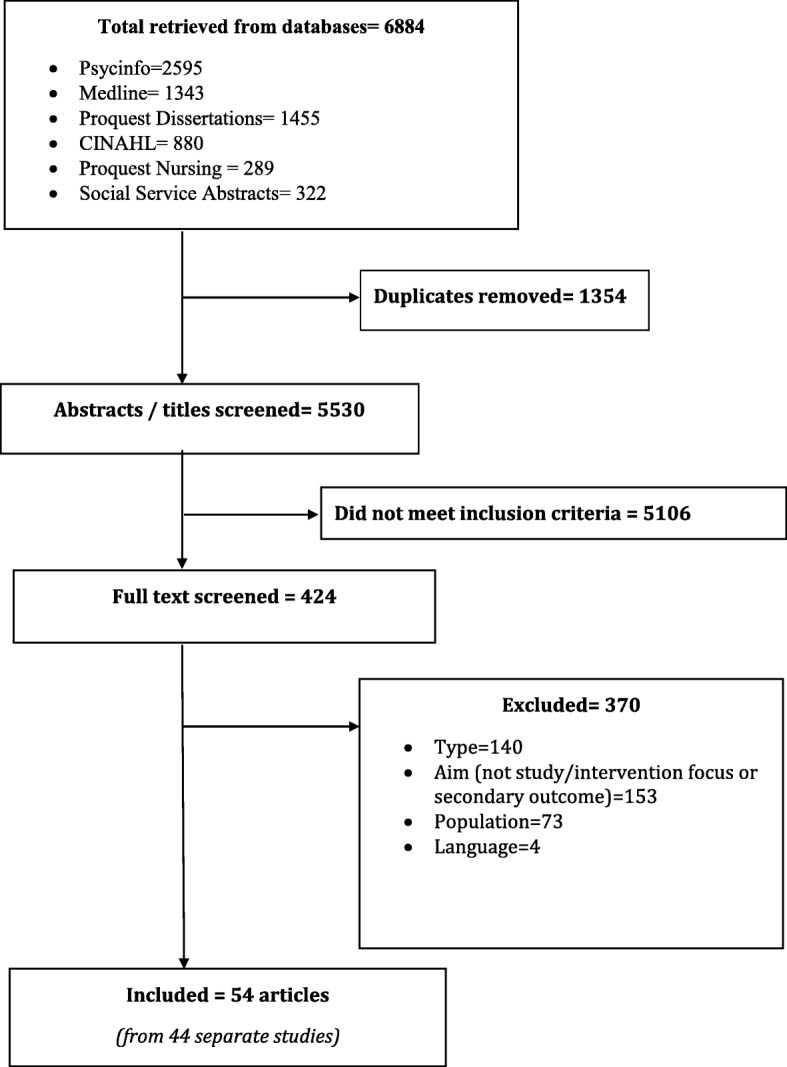
BACKGROUND: Older adults are at risk for loneliness, and interventions to promote social connectedness are needed to directly address this problem. The nature of interventions aimed to affect the distinct, subjective concepts of loneliness/social connectedness has not been clearly described. The purpose of this review was to map the literature on interventions and strategies to affect loneliness/social connectedness for older adults. METHODS: A comprehensive scoping review was conducted. Six electronic databases were searched from inception in July 2015, resulting in 5530 unique records. Standardized inclusion/exclusion criteria were applied, resulting in a set of 44 studies (reported in 54 articles) for further analysis. Data were extracted to describe the interventions and strategies, and the context of the included studies. Analytic techniques included calculating frequencies, manifest content analysis and meta-summary. RESULTS: Interventions were described or evaluated in 39 studies, and five studies described strategies to affect loneliness/social connectedness of older adults or their caregivers in a qualitative descriptive study. The studies were often conducted in the United States (38.6%) among community dwelling (54.5%), cognitively intact (31.8%), and female-majority (86.4%) samples. Few focused on non-white participants (4.5%). Strategies described most often were engaging in purposeful activity and maintaining contact with one's social network. Of nine intervention types identified, the most frequently described were One-to-One Personal Contact and Group Activity. Authors held divergent views of why the same type of intervention might impact social connectedness, but social contact was the most frequently conceptualized influencing factor targeted, both within and across intervention types. CONCLUSIONS: Research to test the divergent theories of why interventions work is needed to advance understanding of intervention mechanisms. Innovative conceptualizations of intervention targets are needed, such as purposeful activity, that move beyond the current focus on the objective social network as a way to promote social connectedness for older adults.
Overview
The claims and statistics of this paper haven’t been checked yet.
Run the check — free, no account needed. It reads the open-access text and checks the sources it cites.
Integrity signals
Registry
Cites
Statistics
Figures
Verification
Claims the paper makes
The claims and statistics of this paper haven’t been checked yet.
Run the check — free, no account needed. It reads the open-access text and checks the sources it cites.
Claims other papers make about this one
Each is checked against this paper’s own text: does it say what the citing paper says it does?
The cited source says what the claim attributes to it.
In the citing paper
“However, most loneliness interventions aimed at older individuals focus rather on other facets, such as social contact (O ' Rourke et al., 2018).”
From Feasibility, acceptability, and preliminary efficacy of an internet-based CBT intervention for loneliness in older adults: A pilot RCT (2024) · cites this paper as O ' Rourke et al., 2018
Self-check
Percentages, sums and reported differences re-computed from the paper’s own numbers.
The self-check needs the paper’s full text.
Citations
Cites
Scoping studies: towards a methodological framework
Arksey, H., & O'Malley, L. (2005) · International Journal of Social Research Methodology · doi:10.1080/1364557032000119616 · Cited by 36,742
Scoping studies: advancing the methodology
Levac, D., Colquhoun, H., & O'Brien, K. K. (2010) · Implementation Science · doi:10.1186/1748-5908-5-69 · Cited by 15,268
Loneliness: the experience of emotional and social isolation
Weiss, R. S. (1974) · Cited by 2,513
A Meta-Analysis of Interventions to Reduce Loneliness
Masi, C. M., Chen, H.-Y., Hawkley, L. C., & Cacioppo, J. T. (2011) · Personality and Social Psychology Review · doi:10.1177/1088868310377394 · Cited by 1,995
Measuring belongingness: The Social Connectedness and the Social Assurance scales.
Lee, R. M., & Robbins, S. B. (1995) · Journal of Counseling Psychology · doi:10.1037/0022-0167.42.2.232 · Cited by 1,484
Handbook for Synthesizing Qualitative Research
Sandelowski, M., & Barroso, J. V. (2006) · Medical Entomology and Zoology · Cited by 1,096
CATTAN, M., WHITE, M., BOND, J., & LEARMOUTH, A. (2005) · Ageing and Society · doi:10.1017/s0144686x04002594 · Cited by 1,038
Haussler, S. C., & Cloutterbuck, J. (2008) · The Journal of Continuing Education in Nursing · doi:10.3928/00220124-20080101-07 · Cited by 941
Interventions targeting social isolation in older people: a systematic review
Dickens, A. P., Richards, S. H., Greaves, C. J., & Campbell, J. L. (2011) · BMC Public Health · doi:10.1186/1471-2458-11-647 · Cited by 767
A review of loneliness: concept and definitions, determinants and consequences
Gierveld, J. D. J. (1998) · Reviews in Clinical Gerontology · doi:10.1017/s0959259898008090 · Cited by 632
Research works printed but not linked: 7
- Pan S. Online communities and older adults: the potential of social networks formed in the online community in enhancing social support, social connectedness and subjective well-being among Chinese older adults. Los Angelas: University of Southern California; 2011.
- Zelenka A. Modeling social participation as predictive of life satisfaction and social connectedness: scale or index? Denver: University of Denver; 2011.
- Marshall G. Predictors associated with late-life depressive symptoms among older black Americans. Washington: University of Washington; 2011.
- Cattan M, Ingold K. Implementing change: the alleviation of social isolation and loneliness among older people in Leeds. J Ment Heal Promot. 2003;2:12–9.
- Centre for Reviews and Dissemination. Systematic reviews: CDR’s guidance for undertaking reviews in health care. York: York Publishing Services; 2009.
- Schwindenhammer TM. Videoconferencing intervention for depressive symptoms. Normal: Illinois State University; 2014.
- Passmore T, Lindenmeier D, Tapps T, Gibson H. Impact of participation in community-based recreation program on reported loneliness and feelings of usefulness of individuals diagnoses with early stage Alzheimer’s disease. Am J Recreat Ther. 2007;6:27–39.
Cited by
Sorted by citations
Holt‐Lunstad, J. (2024) · World Psychiatry · doi:10.1002/wps.21224 · Cited by 541
Loneliness from young adulthood to old age: explaining age differences in loneliness
Hawkley, L. C., Buecker, S., Kaiser, T., & Luhmann, M. (2022) · International Journal of Behavioral Development · doi:10.1177/0165025420971048 · Cited by 281
Cené, C. W., Beckie, T. M., Sims, M., Suglia, S. F., Aggarwal, B., Moise, N., Jiménez, M. C., Gaye, B., & McCullough, L. D. (2022) · Journal of the American Heart Association · doi:10.1161/jaha.122.026493 · Cited by 243
Barriers and Facilitators to Social Participation in Older Adults: A Systematic Literature Review
Townsend, B. G., Chen, J. T.-H., & Wuthrich, V. M. (2021) · Clinical Gerontologist · doi:10.1080/07317115.2020.1863890 · Cited by 236
Social participation and risk of developing dementia
Sommerlad, A., Kivimäki, M., Larson, E. B., Röhr, S., Shirai, K., Singh-Manoux, A., & Livingston, G. (2023) · Nature Aging · doi:10.1038/s43587-023-00387-0 · Cited by 207
Metadata
- Authors
- O’Rourke, H. M., Collins, L., & Sidani, S.
- Affiliations
- University of Alberta (CA)
- Toronto Metropolitan University (CA)
- Corresponding author
- O’Rourke, Hannah M.
- Venue
- BMC Geriatrics
- Published
- 2018-09-15
- Volume
- 18
- Issue
- 1
- Pages
- 214-214
- ISSN
- 1471-2318 (ISSN-L)
- PMC
- PMC6139173
- OpenAlex
- W2891167182
- Cited by
- 362
- References
- 78
- Citations by year
- 2026: 33 · 2025: 54 · 2024: 67 · 2023: 54 · 2022: 45 · 2021: 65 · 2020: 33 · 2019: 11
- FWCI
- 4.53
- Type
- journal article
- Language
- en
- Open access
- gold
- doi.org
- Licence
- Locations
- BMC Geriatrics (publishedVersion, cc-by)
- Europe PMC (PubMed Central) (publishedVersion, other-oa)
- PubMed Central (publishedVersion, cc-by)
- PubMed (publishedVersion)
- DOAJ (DOAJ: Directory of Open Access Journals) (submittedVersion, cc-by-sa)
- Funders
- Canadian Institutes of Health Research (Trainee funding)
- Topics
- Social Sciences › Health › Health disparities and outcomes
- Health Sciences › Medicine › Public Health, Environmental and Occupational Health › Aging, Health, and Disability
- Social Sciences › Psychology › Developmental and Educational Psychology › Aging and Gerontology Research
- Keywords
- loneliness, social connectedness, older adults, intervention, social contact, group activities, purposeful activity, social networks, caregivers, intervention mechanisms
- MeSH terms
- Aged, Aged, 80 and over, Aging, Humans, Interpersonal Relations, Loneliness, Social Behavior, Social Support, Databases, Factual, Caregivers, Qualitative Research
About these checks
Registry, retraction, Cites and statistics results are computed, not judged, with one exception: a printed reference that no index lists is read once by a model before it counts as a citation error. Claims are extracted by a model and kept only when their quote appears verbatim in the text; each cited source is then checked, with a model’s help, for whether it says what the claim relies on. Those verdicts can be wrong — read the claim’s quote and the cited source before relying on one.
Statistics and arithmetic are recomputed, not judged.
Confidence bands are shown only for fields calibrated on our annotated test set. None is calibrated yet, so no band is shown.
What counts as a claim ›How we measure confidence ›How we check this ›
Are you an author, or do you see a problem with this page? Request a review
