

The DOI matches its Crossref record; 54 of the 55 references it cites were found in a registry or an index.
Factors associated with frequent use of emergency-department services in a geriatric population: a systematic review
Open accessAbstract
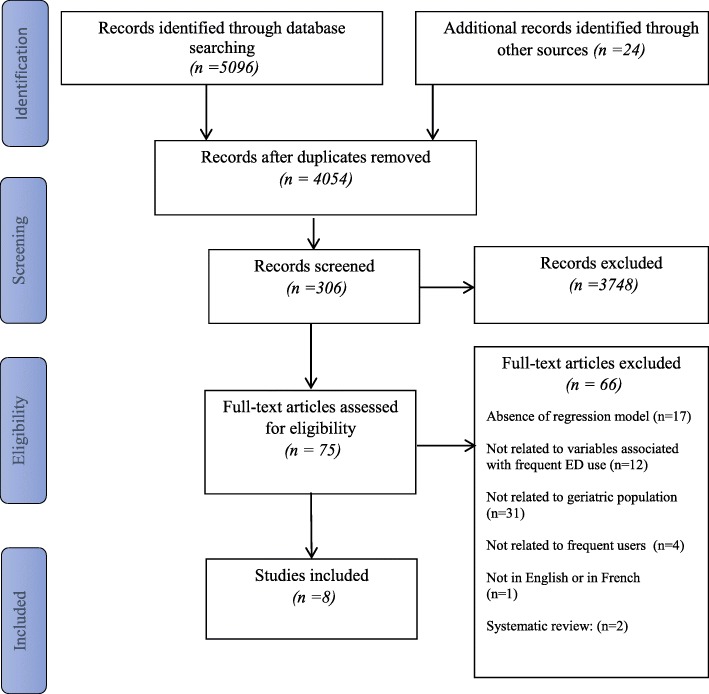
BACKGROUND: Frequent geriatric users of emergency departments (EDs) constitute a small group of individuals accounting for a disproportionately high number of ED visits. In addition to overcrowding, this situation might result in a less appropriate response to health needs and negative health impacts. Geriatric patients turn to EDs for a variety of reasons. A better understanding of the variables associated with frequent ED use will help implement interventions best suited for their needs. OBJECTIVE: This review aimed at identifying variables associated with frequent ED use by older adults. METHODS: For this systematic review, we searched Medline, CINAHL, Healthstar, and PsyINFO (before June 2018). Articles written in English or French meeting these criteria were included: targeting a population aged 65 years or older, reporting on frequent ED use, using an observational study design and multivariate regression analysis. The search was supplemented by manually examining the reference lists of relevant studies. Independent reviewers identified articles for inclusion, extracted data, and assessed quality with the JBI Critical Appraisal Checklist for Studies Reporting Prevalence. A narrative synthesis was done to combine the study results. A sensitivity analysis was performed to evaluate the effect of removing the studies not meeting the quality criteria. RESULTS: Out of 5096 references, 8 met our inclusion criteria. A high number of past hospital and ED admissions, living in a rural area adjacent to an urban center, low income, a high number of prescribed drugs, and a history of heart disease were associated with frequent ED use among older adults. In addition, having a principal-care physician and living in a remote rural area were associated with fewer ED visits. Some variables recognized in the literature as influencing ED use among older adults received scant consideration, such as comorbidity, dementia, and considerations related to primary-care and community settings. CONCLUSION: Further studies should bridge the gap in understanding and give a more global portrait by adding important personal variables such as dementia, organizational variables such as use of community and primary care, and contextual variables such as social and economic frailty.
Overview
The claims and statistics of this paper haven’t been checked yet.
Run the check — free, no account needed. It reads the open-access text and checks the sources it cites.
Integrity signals
Registry
Cites
Statistics
Figures
Verification
Claims the paper makes
The claims and statistics of this paper haven’t been checked yet.
Run the check — free, no account needed. It reads the open-access text and checks the sources it cites.
Claims other papers make about this one
Each is checked against this paper’s own text: does it say what the citing paper says it does?
In the citing paper
“However, history of ED use has not consistently been identified as the strongest risk factor.35”
From Factors associated with recurrent emergency department visits among people living with dementia: A retrospective cohort study (2023) · cites this paper as [35]
Self-check
Percentages, sums and reported differences re-computed from the paper’s own numbers.
The self-check needs the paper’s full text.
Citations
Cites
Preferred Reporting Items for Systematic Reviews and Meta-Analyses: the PRISMA statement
Moher, D., Liberati, A., Tetzlaff, J., Altman, D. G., & for the PRISMA Group (2009) · BMJ · doi:10.1136/bmj.b2535 · Cited by 83,823
Preferred Reporting Items for Systematic Reviews and Meta-Analyses: The PRISMA Statement
Moher, D., Liberati, A., Tetzlaff, J., Altman, D. G., & The PRISMA Group (2009) · PLoS Medicine · doi:10.1371/journal.pmed.1000097 · Cited by 64,042
Preferred reporting items for systematic reviews and meta-analyses: The PRISMA statement
Moher, D., Liberati, A., Tetzlaff, J., Altman, D. G., & the PRISMA Group* (2009) · Annals of Internal Medicine · doi:10.7326/0003-4819-151-4-200908180-00135 · Cited by 37,554
Wang, G., Ma, R., Qiao, G., Wada, K., Aizawa, Y., & Satoh, T. (2015) · Integrative Medicine International · doi:10.1159/000368408 · Cited by 18,762
What is polypharmacy? A systematic review of definitions
Masnoon, N., Shakib, S., Ellett, L. M. K., & Caughey, G. E. (2017) · BMC Geriatrics · doi:10.1186/s12877-017-0621-2 · Cited by 3,444
Aminzadeh, F., & Dalziel, W. B. (2002) · Annals of Emergency Medicine · doi:10.1067/mem.2002.121523 · Cited by 1,119
Babitsch, B., Gohl, D., & Von Lengerke, T. (2012) · German Medical Science GMS Publishing House · doi:10.3205/psm000089 · Cited by 1,011
Guidance on the conduct of narrative synthesis in sytematic reviews
Popay, J., Roberts, H. M., Sowden, A. J., Petticrew, M. P., Arai, L., Rodgers, M., & Britten, N. (2006) · Cited by 690
Frequent Users of Emergency Departments: The Myths, the Data, and the Policy Implications
LaCalle, E., & Rabin, E. (2010) · Annals of Emergency Medicine · doi:10.1016/j.annemergmed.2010.01.032 · Cited by 648
Characteristics of Frequent Users of Emergency Departments
Hunt, K. A., Weber, E. J., Showstack, J. A., Colby, D. C., & Callaham, M. L. (2006) · Annals of Emergency Medicine · doi:10.1016/j.annemergmed.2005.12.030 · Cited by 558
Cited by
Sorted by citations
Items 101–129 of 129
Conneely, M., Leahy, S., Dore, L., Trépel, D., Robinson, K., Jordan, F., & Galvin, R. (2022) · Figshare · doi:10.6084/m9.figshare.19918930
Memedovich, A., Asante, B. O., Khan, M., Eze, N., Holroyd, B. R., Lang, E., Kashuba, S., & Clement, F. (2024) · Figshare · doi:10.6084/m9.figshare.25132122
Arsenault‐Lapierre, G., Bui, T., Berre, M. L., Bergman, H., & Vedel, I. (2024) · Figshare · doi:10.6084/m9.figshare.26565219
Arsenault‐Lapierre, G., Bui, T., Berre, M. L., Bergman, H., & Vedel, I. (2024) · Figshare · doi:10.6084/m9.figshare.26565234
Klunder, J. H., Bordonis, V., Heymans, M. W., van der Roest, H. G., Declercq, A., Smit, J. H., Garms-Homolová, V., Jónsson, P. V., Finne-Soveri, H., Onder, G., et al. (2021) · Figshare · doi:10.6084/m9.figshare.16815644
Conneely, M., Leahy, S., Dore, L., Trépel, D., Robinson, K., Jordan, F., & Galvin, R. (2022) · Figshare · doi:10.6084/m9.figshare.19918939
Conneely, M., Leahy, S., Dore, L., Trépel, D., Robinson, K., Jordan, F., & Galvin, R. (2022) · Figshare · doi:10.6084/m9.figshare.19918945
Conneely, M., Leahy, S., Dore, L., Trépel, D., Robinson, K., Jordan, F., & Galvin, R. (2022) · Figshare · doi:10.6084/m9.figshare.19918942
Arsenault‐Lapierre, G., Bui, T., Berre, M. L., Bergman, H., & Vedel, I. (2024) · Figshare · doi:10.6084/m9.figshare.26565231
Arsenault‐Lapierre, G., Bui, T., Berre, M. L., Bergman, H., & Vedel, I. (2024) · Figshare · doi:10.6084/m9.figshare.26565225
Klunder, J. H., Bordonis, V., Heymans, M. W., van der Roest, H. G., Declercq, A., Smit, J. H., Garms-Homolová, V., Jónsson, P. V., Finne-Soveri, H., Onder, G., et al. (2021) · Figshare · doi:10.6084/m9.figshare.16815647
Conneely, M., Leahy, S., Dore, L., Trépel, D., Robinson, K., Jordan, F., & Galvin, R. (2022) · Figshare · doi:10.6084/m9.figshare.19918933
Hu, Z., Siddiqui, F. J., Fan, Q., Lian, S. W. Q., Liu, N., & Ong, M. E. H. (2021) · Figshare · doi:10.6084/m9.figshare.17126044
de Luca, K. E., McLachlan, A. J., Maher, C. G., & Machado, G. C. (2024) · Figshare · doi:10.6084/m9.figshare.26568364
de Luca, K. E., McLachlan, A. J., Maher, C. G., & Machado, G. C. (2024) · Figshare · doi:10.6084/m9.figshare.26568361
de Luca, K. E., McLachlan, A. J., Maher, C. G., & Machado, G. C. (2024) · Figshare · doi:10.6084/m9.figshare.26568358
Arsenault‐Lapierre, G., Bui, T., Berre, M. L., Bergman, H., & Vedel, I. (2024) · Figshare · doi:10.6084/m9.figshare.26565228
Kurteva, S., Tamblyn, R., & Meguerditchian, A. N. (2024) · Figshare · doi:10.6084/m9.figshare.26612147
Conneely, M., Leahy, S., Dore, L., Trépel, D., Robinson, K., Jordan, F., & Galvin, R. (2022) · Figshare · doi:10.6084/m9.figshare.19918936
Stuckenschneider, T., Schmidt, L., Speckmann, E.-M., Koschate, J., & Zieschang, T. (2023) · Figshare · doi:10.6084/m9.figshare.24892822
Hospital at home for older frequent hospital users: present and future of a healthcare challenge
Mossello, E., Rivasi, G., Giordano, A., Tofalos, S. E., Rafanelli, M., Lorenzi, C., Corsoni, V., D’Ambrosi, M., Gabellini, F., Bulgaresi, M., et al. (2026) · Aging Clinical and Experimental Research · doi:10.1007/s40520-025-03301-3
Griffin, A., Sarier, C., Brennan, E., Bowers, S., Whiston, A., Conneely, M., & Galvin, R. (2026) · Clinical Interventions in Aging · doi:10.2147/cia.s536129
Larkin, E., O’Shaughnessy, Í., Galvin, R., & Robinson, K. (2026) · BMC Medical Research Methodology · doi:10.1186/s12874-025-02749-1
Liew, C. Q., Hsu, S.-H., Cheng, M., Ko, C., Hsieh, P., Lin, H., Lin, Y., Huang, C., Chang, W.-T., & Tsai, C. (2026) · Academic Emergency Medicine · doi:10.1111/acem.70279
Roth, S. E., Marsillo, R., Jones, K., & Cohen‐Cline, H. (2026) · Journal of Primary Care & Community Health · doi:10.1177/21501319261437940
Colitta, A., Mazzarone, T., Corsi, S., Petrozzi, L., Mengozzi, A., Chicca, M. D., Sessa, M. R., Bacciardi, E., Virdis, A., Monzani, F., et al. (2026) · Neurological Sciences · doi:10.1007/s10072-026-09216-9
Dželebdžić, S., Djikanović, B., Bukumirić, Z., Maksimović, N., Micić, D., Rakočević, Z. A., Ćurčin, V., & Medarević, A. (2026) · International Journal of Emergency Medicine · doi:10.1186/s12245-026-01313-y
Methodological approaches to identify frequent emergency department users: a population-based study
Salmaso, L., Zanovello, M., Amidei, C. B., Fedeli, U., & Saïa, M. (2026) · Emergency Care Journal · doi:10.4081/ecj.2026.15635
Impact of frequent emergency department visits on resource utilization
Bas, R. K., & Çakmak, S. (2026) · BMC Emergency Medicine · doi:10.1186/s12873-026-01784-5
Metadata
- Authors
- Dufour, I., Chouinard, M.-C., Dubuc, N., Beaudin, J., Lafontaine, S., & Hudon, C.
- Affiliations
- Université de Sherbrooke (CA)
- Université du Québec à Chicoutimi (CA)
- Corresponding author
- Dufour, Isabelle
- ORCID
- Venue
- BMC Geriatrics
- Published
- 2019-07-05
- Volume
- 19
- Issue
- 1
- Pages
- 185-185
- ISSN
- 1471-2318 (ISSN-L)
- PMC
- PMC6610907
- OpenAlex
- W2953854953
- Cited by
- 128
- References
- 55
- Citations by year
- 2026: 11 · 2025: 15 · 2024: 27 · 2023: 23 · 2022: 21 · 2021: 22 · 2020: 9
- FWCI
- 3.34
- Type
- journal article
- Language
- en
- Open access
- gold
- doi.org
- Locations
- BMC Geriatrics (publishedVersion, cc-by)
- PubMed Central (publishedVersion, cc-by)
- PubMed (publishedVersion)
- Constellation (Université du Québec à Chicoutimi) (submittedVersion)
- DOAJ (DOAJ: Directory of Open Access Journals) (submittedVersion, cc-by-sa)
- Topics
- Health Sciences › Medicine › Emergency Medicine › Emergency and Acute Care Studies
- Health Sciences › Medicine › Epidemiology › Chronic Disease Management Strategies
- Health Sciences › Nursing › Leadership and Management › Hospital Admissions and Outcomes
- Keywords
- emergency department utilization, older adults, elderly patients, risk factors, hospitalization, rural residence, low income, polypharmacy, heart disease, primary care, community-based care, comorbidities, dementia, frailty
- MeSH terms
- Aged, Aged, 80 and over, Emergency Medical Services, Emergency Service, Hospital, Female, Geriatrics, Hospitalization, Humans, Male, Population Surveillance, Primary Health Care, Risk Factors
About these checks
Registry, retraction, Cites and statistics results are computed, not judged, with one exception: a printed reference that no index lists is read once by a model before it counts as a citation error. Claims are extracted by a model and kept only when their quote appears verbatim in the text; each cited source is then checked, with a model’s help, for whether it says what the claim relies on. Those verdicts can be wrong — read the claim’s quote and the cited source before relying on one.
Statistics and arithmetic are recomputed, not judged.
Confidence bands are shown only for fields calibrated on our annotated test set. None is calibrated yet, so no band is shown.
What counts as a claim ›How we measure confidence ›How we check this ›
Are you an author, or do you see a problem with this page? Request a review
