

The DOI matches its Crossref record; 39 of the 40 references it cites were found in a registry or an index.
Tuberculosis case finding using population-based disease surveillance platforms in urban and rural Kenya
Open accessAbstract
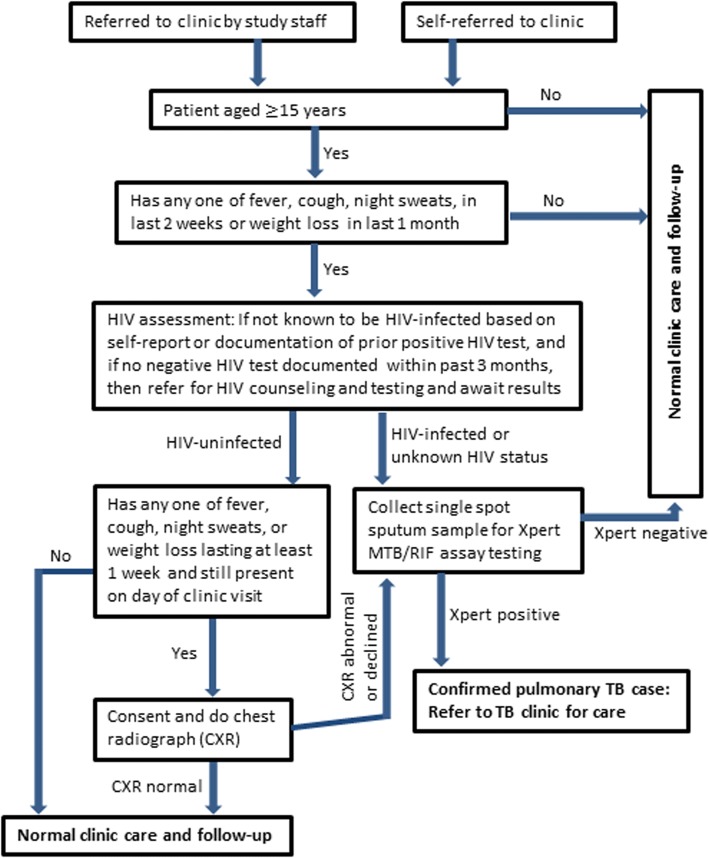
BACKGROUND: Tuberculosis (TB) case finding is an important component of TB control because it can reduce transmission of Mycobacterium tuberculosis (MTB) through prompt detection and treatment of infectious patients. METHODS: Using population-based infectious disease surveillance (PBIDS) platforms with links to health facilities in Kenya we implemented intensified TB case finding in the community and at the health facilities, as an adjunct to routine passive case finding conducted by the national TB program. From 2011 to 2014, PBIDS participants ≥15 years were screened either at home or health facilities for possible TB symptoms which included cough, fever, night sweats or weight loss in the preceding 2 weeks. At home, participants with possible TB symptoms had expectorated sputum collected. At the clinic, HIV-infected participants with possible TB symptoms were invited to produce sputum. Those without HIV but with symptoms lasting 7 days including the visit day had chest radiographs performed, and had sputum collected if the radiographs were abnormal. Sputum samples were tested for the presence of MTB using the Xpert MTB/RIF assay. TB detection rates were calculated per 100,000 persons screened. RESULTS: Of 11,191 participants aged ≥15 years screened at home at both sites, 2695 (23.9%) reported possible TB symptoms, of whom 2258 (83.8%) produced sputum specimens. MTB was detected in 32 (1.4%) of the specimens resulting in a detection rate of 286/100,000 persons screened. At the health facilities, a total of 11,762 person were screened, 7500 (63.8%) had possible TB symptoms of whom 1282 (17.1%) produced sputum samples. MTB was detected in 69 (5.4%) of the samples, resulting in an overall detection rate of 587/100,000 persons screened. The TB detection rate was higher in persons with HIV compared to those without at both home (HIV-infected - 769/100,000, HIV-uninfected 141/100,000, rate ratio (RR) - 5.45, 95% CI 3.25-22.37), and health facilities (HIV-infected 3399/100,000, HIV-uninfected 294/100,000, RR 11.56, 95% CI 6.18-18.44). CONCLUSION: Facility-based intensified TB case finding detected more TB cases per the number of specimens tested and the number of persons screened, including those with HIV, than home-based TB screening and should be further evaluated to determine its potential programmatic impact.
Overview
The claims and statistics of this paper haven’t been checked yet.
Free: it reads the open-access text and checks the first 5 claims that cite a source we can check. Create a free account to check every claim.
Integrity signals
Registry
Cites
Statistics
Figures

Verification
Claims the paper makes
The claims and statistics of this paper haven’t been checked yet.
Free: it reads the open-access text and checks the first 5 claims that cite a source we can check. Create a free account to check every claim.
Claims other papers make about this one
Each is checked against this paper’s own text: does it say what the citing paper says it does?
In the citing paper
“The marked progress in Cameroon44 (30% reduction in incidence) and Kenya45 (23% reduction in incidence; appendix 2 pp 86–149) might also point to the success of intensified tuberculosis case-finding programmes”
Self-check
Percentages, sums and reported differences re-computed from the paper’s own numbers.
The self-check needs the paper’s full text.
Citations
Cites
Global tuberculosis report (2014)
Gabbasova, L. A., & Who, E. R. E. (2014) · Cited by 12,702
Granich, R. M., Gilks, C. F., Dye, C., De Cock, K. M., & Williams, B. G. (2009) · The Lancet · doi:10.1016/s0140-6736(08)61697-9 · Cited by 1,988
A systematic review of delay in the diagnosis and treatment of tuberculosis
Storla, D. G., Yimer, S., & Bjune, G. A. (2008) · BMC Public Health · doi:10.1186/1471-2458-8-15 · Cited by 1,018
Prospects for Tuberculosis Elimination
Dye, C., Glaziou, P., Floyd, K., & Raviglione, M. (2013) · Annual Review of Public Health · doi:10.1146/annurev-publhealth-031912-114431 · Cited by 402
Profile: The KEMRI/CDC Health and Demographic Surveillance System—Western Kenya
Odhiambo, F. O., Laserson, K. F., Sewe, M., Hamel, M. J., Feikin, D. R., Adazu, K., Ogwang, S., Obor, D., Amek, N., Bayoh, N., et al. (2012) · International Journal of Epidemiology · doi:10.1093/ije/dys108 · Cited by 271
Corbett, E. L., Bandason, T., Duong, T., Dauya, E., Makamure, B., Churchyard, G. J., Williams, B. G., Munyati, S. S., Butterworth, A. E., Mason, P. R., et al. (2010) · The Lancet · doi:10.1016/s0140-6736(10)61425-0 · Cited by 247
Feikin, D. R., Olack, B., Bigogo, G. M., Audi, A., Cosmas, L., Aura, B., Burke, H., Njenga, M. K., Williamson, J., & Breiman, R. F. (2011) · PLoS ONE · doi:10.1371/journal.pone.0016085 · Cited by 205
Self-citationBreiman, R. F., Cosmas, L., Njuguna, H., Audi, A., Olack, B., Ochieng, J. B., Wamola, N., Bigogo, G. M., Awiti, G., Tabu, C. W., et al. (2012) · PLoS ONE · doi:10.1371/journal.pone.0029119 · Cited by 204
Self-citationScott, L. E., McCarthy, K., Gous, N., Nduna, M., Van Rie, A., Sanne, I., Venter, W. F., Duse, A., & Stevens, W. (2011) · PLoS Medicine · doi:10.1371/journal.pmed.1001061 · Cited by 171
Kranzer, K., Houben, R. M. G. J., Glynn, J. R., Bekker, L., Wood, R., & Lawn, S. D. (2010) · The Lancet Infectious Diseases · doi:10.1016/s1473-3099(09)70326-3 · Cited by 169
Research works printed but not linked: 3
- WHO, The Global Plan To Stop TB 2011–2015. 2011.
- WHO, Global Tuberculosis Report 2015.
- DLTLD, M.o.H., Kenya, DLTLD Strategic Plan (2011 - 2015). 2010.
Cited by
Potensi Penularan Tuberculosis Paru pada Anggota Keluarga Penderita
Kristini, T. D., & Hamidah, R. (2020) · Jurnal Kesehatan Masyarakat Indonesia · doi:10.26714/jkmi.15.1.2020.24-28 · Cited by 157
Ledesma, J. R., Ma, J., Zhang, M., Basting, A. V. L., Chu, H. T., Vongpradith, A., Novotney, A., LeGrand, K. E., Xu, Y. Y., Dai, X., et al. (2024) · The Lancet Infectious Diseases · doi:10.1016/s1473-3099(24)00007-0 · Cited by 146
Kabia, E., Mbau, R., Muraya, K., Morgan, R., Molyneux, S. C., & Barasa, E. (2018) · International Journal for Equity in Health · doi:10.1186/s12939-018-0853-6 · Cited by 65
Zulu, D. W., Silumbwe, A., Maritim, P., & Zulu, J. M. (2022) · BMC Health Services Research · doi:10.1186/s12913-022-08043-w · Cited by 27
Portable digital X-ray for TB pre-diagnosis screening in rural communities in Nigeria
Odume, B., Chukwu, E., Fawole, T., Nwokoye, N., Ogbudebe, C., Chukwuogo, O., Useni, S., Dim, C., Ubochioma, E., Nongo, D., et al. (2022) · Public Health Action · doi:10.5588/pha.21.0079 · Cited by 22
Metadata
- Authors
- Bigogo, G., Cain, K., Nyole, D., Masyongo, G., Auko, J. A., Wamola, N., Okumu, A., Agaya, J., Montgomery, J., Borgdorff, M., & Burton, D.
- Affiliations
- Kenya Medical Research Institute (KE)
- Centers for Disease Control and Prevention (US)
- Corresponding author
- Bigogo, Godfrey
- Venue
- BMC Infectious Diseases
- Published
- 2018-06-07
- Volume
- 18
- Issue
- 1
- Pages
- 262-262
- ISSN
- 1471-2334 (ISSN-L)
- PMC
- PMC5992751
- OpenAlex
- W2806675070
- Cited by
- 12
- References
- 40
- Citations by year
- 2026: 1 · 2025: 1 · 2024: 1 · 2022: 3 · 2021: 2 · 2020: 2 · 2019: 1 · 2018: 1
- FWCI
- 1.13
- Type
- journal article
- Language
- en
- Open access
- gold
- doi.org
- Licence
- cc-by
- creativecommons.org/licenses/by/4.0/ (tdm)
- Locations
- BMC Infectious Diseases (publishedVersion, cc-by)
- Europe PMC (PubMed Central) (publishedVersion, cc-by)
- PubMed Central (publishedVersion, cc-by)
- PubMed (publishedVersion)
- Pure Amsterdam UMC (acceptedVersion, cc-by)
- Data Archiving and Networked Services (DANS) (submittedVersion, other-oa)
- DOAJ (DOAJ: Directory of Open Access Journals) (submittedVersion)
- Greater South Information System
- Funders
- Centers for Disease Control and Prevention
- Topics
- Health Sciences › Medicine › Infectious Diseases › Tuberculosis Research and Epidemiology
- Health Sciences › Medicine › Infectious Diseases › Infectious Diseases and Tuberculosis
- Health Sciences › Medicine › Public Health, Environmental and Occupational Health › HIV, TB, and STIs Epidemiology
- Keywords
- tuberculosis case detection, HIV coinfection, Xpert MTB/RIF, sputum collection, chest radiography, community-based screening, tuberculosis control, tuberculosis transmission
- MeSH terms
- Adult, Aged, Ambulatory Care Facilities, Female, Humans, Kenya, Male, Mass Screening, Middle Aged, Mycobacterium tuberculosis, Population Surveillance, Rural Population, Sputum, Tuberculosis, Urban Population, HIV Infections, Young Adult
About these checks
Registry, retraction, Cites and statistics results are computed, not judged, with one exception: a printed reference that no index lists is read once by a model before it counts as a citation error. Claims are extracted by a model and kept only when their quote appears verbatim in the text; each cited source is then checked, with a model’s help, for whether it says what the claim relies on. Those verdicts can be wrong — read the claim’s quote and the cited source before relying on one.
Statistics and arithmetic are recomputed, not judged.
Confidence bands are shown only for fields calibrated on our annotated test set. None is calibrated yet, so no band is shown.
What counts as a claim ›How we measure confidence ›How we check this ›
Are you an author, or do you see a problem with this page? Request a review
How to cite
Cite CoChat for the checks on this page, and the paper for its own findings.
- This page
- CoChat. (2026). Citation check: Tuberculosis case finding using population-based disease surveillance platforms in urban and rural Kenya. https://app.cochat.ai/papers/10.1186/s12879-018-3172-z
- The paper
- Bigogo, G., Cain, K., Nyole, D., Masyongo, G., Auko, J. A., Wamola, N., Okumu, A., Agaya, J., Montgomery, J., Borgdorff, M., & Burton, D. (2018). Tuberculosis case finding using population-based disease surveillance platforms in urban and rural Kenya. BMC Infectious Diseases. https://doi.org/10.1186/s12879-018-3172-z
Data sources
Bibliographic data: Semantic Scholar, OpenAlex, Crossref.
Contains information from the Semantic Scholar Academic Graph Datasets, made available under the ODC Attribution License (ODC-BY 1.0).
Semantic Scholar’s data is described in: Kinney, R., et al. (2023). The Semantic Scholar Open Data Platform. arXiv:2301.10140.
