

JAK-inhibitor and type I interferon ability to produce favorable clinical outcomes in COVID-19 patients: a systematic review and meta-analysis
Open accessPublished version of a preprint
The DOI matches its Crossref record; 50 of the 50 references it cites were found in a registry or an index.
Abstract
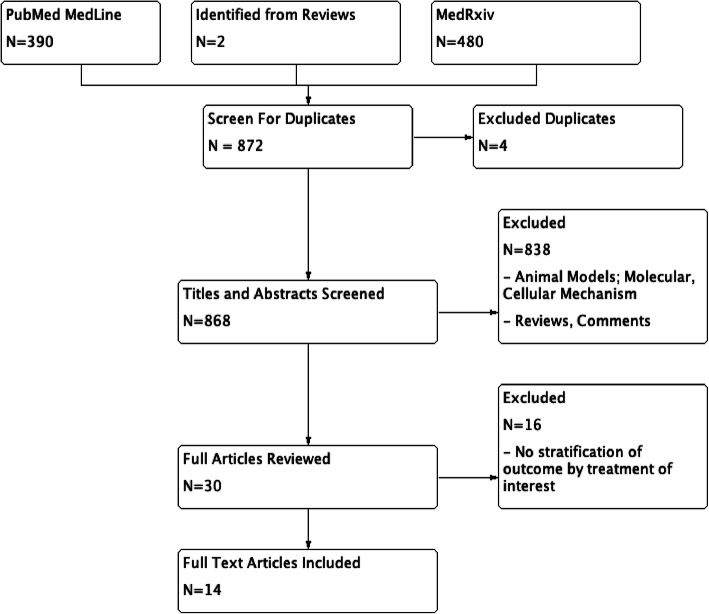
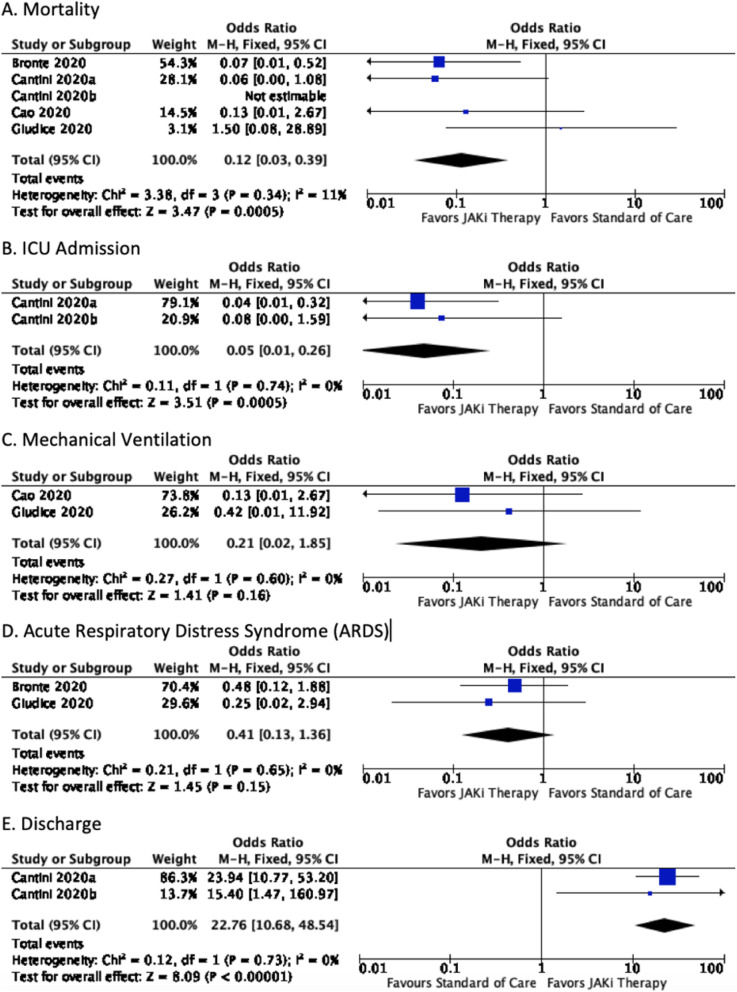
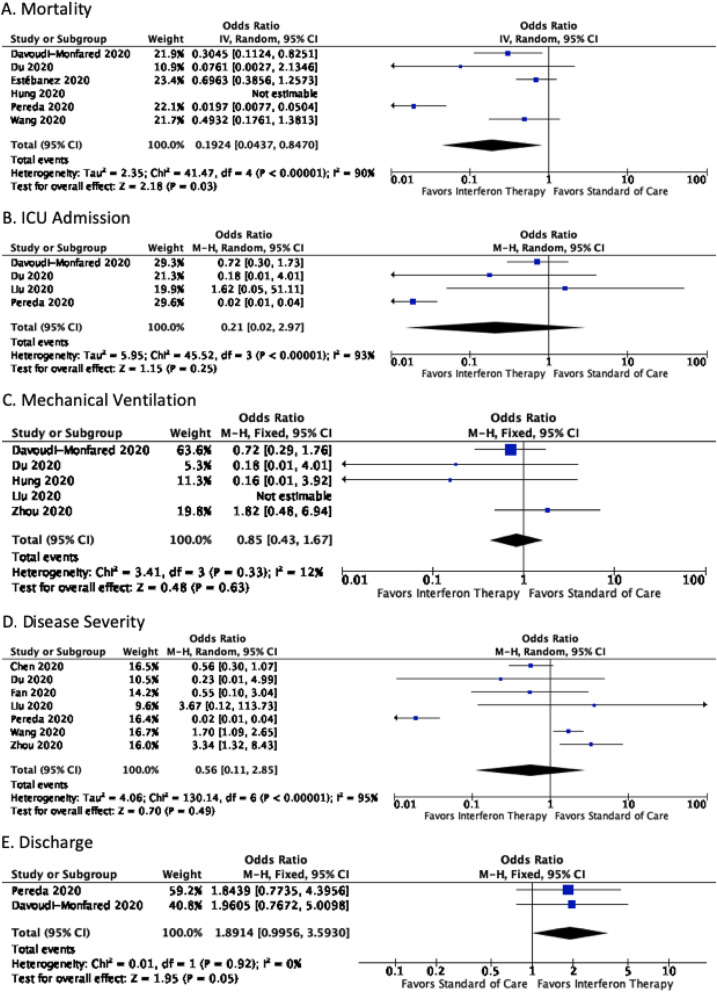
Background: The spread of a highly pathogenic, novel coronavirus (SARS-CoV-2) has emerged as a once-in-a-century pandemic, having already infected over 63 million people worldwide. Novel therapies are urgently needed. Janus kinase-inhibitors and Type I interferons have emerged as potential antiviral candidates for COVID-19 patients due to their proven efficacy against diseases with excessive cytokine release and their direct antiviral ability against viruses including coronaviruses, respectively. Methods: A search of MEDLINE and MedRxiv was conducted by three investigators from inception until July 30th 2020 and included any study type that compared treatment outcomes of humans treated with Janus kinase-inhibitor or Type I interferon against controls. Inclusion necessitated data with clearly indicated risk estimates or those that permitted their back-calculation. Outcomes were synthesized using RevMan. Results: Of 733 searched studies, we included four randomized and eleven non-randomized trials. Five of the studies were unpublished. Those who received Janus kinase-inhibitor had significantly reduced odds of mortality (OR, 0.12; 95% CI, 0.03–0.39, p < 0.001) and ICU admission (OR, 0.05; 95% CI, 0.01–0.26, p< 0.001), and had significantly increased odds of hospital discharge (OR, 22.76; 95% CI, 10.68–48.54, p < 0.00001) when compared to standard treatment group. Type I interferon recipients had significantly reduced odds of mortality (OR, 0.19; 95% CI, 0.04–0.85, p < 0.05), and increased odds of discharge bordering significance (OR, 1.89; 95% CI, 1.00–3.59, p =0.05). Conclusions: Janus kinase-inhibitor treatment is significantly associated with positive clinical outcomes in terms of mortality, ICU admission, and discharge. Type I interferon treatment is associated with positive clinical outcomes in regard to mortality and discharge. While these data show promise, additional well-conducted RCTs are needed to further elucidate the relationship between clinical outcomes and Janus kinase-inhibitors and Type I interferons in COVID-19 patients.
Overview
The claims and statistics of this paper haven’t been checked yet.
Free: it reads the open-access text and checks the first 5 claims that cite a source we can check. Create a free account to check every claim.
Integrity signals
Registry
Cites
Statistics
Figures
Verification
Claims the paper makes
The claims and statistics of this paper haven’t been checked yet.
Free: it reads the open-access text and checks the first 5 claims that cite a source we can check. Create a free account to check every claim.
Claims other papers make about this one
Each is checked against this paper’s own text: does it say what the citing paper says it does?
The source backs part of the claim, not all of it — or backs it for a different population, condition or comparison.
In the citing paper
“Recently, JAKi were used successfully in treating the cytokine storm generated by the SARS-CoV-2 virus217.”
From Atopic dermatitis: an expanding therapeutic pipeline for a complex disease (2022) · cites this paper as [217]
Experimental — accuracy not yet measured
Self-check
Percentages, sums and reported differences re-computed from the paper’s own numbers.
The self-check needs the paper’s full text.
Citations
Cites
RoB 2: a revised tool for assessing risk of bias in randomised trials
Sterne, J. A. C., Savović, J., Page, M. J., Elbers, R. G., Blencowe, N. S., Boutron, I., Cates, C. J., Cheng, H.-Y., Corbett, M. S., Eldridge, S. M., et al. (2019) · BMJ · doi:10.1136/bmj.l4898 · Cited by 34,787
Liberati, A., Altman, D. G., Tetzlaff, J., Mulrow, C., Gøtzsche, P. C., Ioannidis, J. P. A., Clarke, M., Devereaux, P. J., Kleijnen, J., & Moher, D. (2009) · PLoS Medicine · doi:10.1371/journal.pmed.1000100 · Cited by 28,164
Liberati, A., Altman, D. G., Tetzlaff, J., Mulrow, C., Gotzsche, P. C., Ioannidis, J. P. A., Clarke, M., Devereaux, P. J., Kleijnen, J., & Moher, D. (2009) · BMJ · doi:10.1136/bmj.b2700 · Cited by 17,648
Dexamethasone in Hospitalized Patients with Covid-19
The RECOVERY Collaborative Group (2021) · New England Journal of Medicine · doi:10.1056/nejmoa2021436 · Cited by 11,477
Remdesivir for the Treatment of Covid-19 — Final Report
Beigel, J. H., Tomashek, K. M., Dodd, L. E., Mehta, A. K., Zingman, B. S., Kalil, A. C., Hohmann, E., Chu, H. Y., Luetkemeyer, A., Kline, S., et al. (2020) · New England Journal of Medicine · doi:10.1056/nejmoa2007764 · Cited by 7,267
Imbalanced Host Response to SARS-CoV-2 Drives Development of COVID-19
Blanco-Melo, D., Nilsson-Payant, B. E., Liu, W.-C., Uhl, S., Hoagland, D., Møller, R., Jordan, T. X., Oishi, K., Panis, M., Sachs, D., et al. (2020) · Cell · doi:10.1016/j.cell.2020.04.026 · Cited by 4,222
Regulation of type I interferon responses
Ivashkiv, L. B., & Donlin, L. T. (2014) · Nature Reviews Immunology · doi:10.1038/nri3581 · Cited by 3,297
Fair Allocation of Scarce Medical Resources in the Time of Covid-19
Emanuel, E. J., Persad, G., Upshur, R., Thome, B., Parker, M., Glickman, A., Zhang, C., Boyle, C., Smith, M., & Phillips, J. P. (2020) · New England Journal of Medicine · doi:10.1056/nejmsb2005114 · Cited by 3,137
Impaired type I interferon activity and inflammatory responses in severe COVID-19 patients
Hadjadj, J., Yatim, N., Barnabei, L., Corneau, A., Boussier, J., Smith, N., Péré, H., Charbit, B., Bondet, V., Chenevier-Gobeaux, C., et al. (2020) · Science · doi:10.1126/science.abc6027 · Cited by 2,984 · cited 1×
“Additionally, a recent investigation revealed that several severe cases of COVID-19 presented with a rare, X-chromosome lossof-function mutation that impaired Type I interferon response [18], while another demonstrated an association between COVID-19 severity and Type I interferon deficiency [19].”
Clinical Characteristics of Covid-19 in New York City
Goyal, P., Choi, J. J., Pinheiro, L. C., Schenck, E. J., Chen, R., Jabri, A., Satlin, M. J., Campion, T. R., Nahid, M., Ringel, J. B., et al. (2020) · New England Journal of Medicine · doi:10.1056/nejmc2010419 · Cited by 2,234
Cited by
Atopic dermatitis: an expanding therapeutic pipeline for a complex disease
Bieber, T. (2022) · Nature Reviews Drug Discovery · doi:10.1038/s41573-021-00266-6 · Cited by 623
Xiao, N., Nie, M., Pang, H., Wang, B., Hu, J., Meng, X., Li, K., Ran, X., Long, Q., Deng, H., et al. (2021) · Nature Communications · doi:10.1038/s41467-021-21907-9 · Cited by 301
Mucosal immune response in biology, disease prevention and treatment
Zhou, X., Wu, Y., Zhu, Z., Lu, C., Zhang, C., Zeng, L., Xie, F., Zhang, L., & Zhou, F. (2025) · Signal Transduction and Targeted Therapy · doi:10.1038/s41392-024-02043-4 · Cited by 186
Potential therapeutic options for COVID-19: an update on current evidence
Niknam, Z., Jafari, A., Golchin, A., Pouya, F. D., Nemati, M., Rezaei–Tavirani, M., & Rasmi, Y. (2022) · European journal of medical research · doi:10.1186/s40001-021-00626-3 · Cited by 164
COVID-19: Inflammatory Profile
Wang, Y., & Perlman, S. M. (2021) · Annual Review of Medicine · doi:10.1146/annurev-med-042220-012417 · Cited by 102
Metadata
- Authors
- Walz, L., Cohen, A. J., Rebaza, A. P., Vanchieri, J., Slade, M. D., Dela Cruz, C. S., & Sharma, L.
- Affiliations
- Yale University (US)
- Corresponding author
- Sharma, Lokesh
- Venue
- BMC Infectious Diseases
- Published
- 2021-01-11
- Volume
- 21
- Issue
- 1
- Pages
- 47-47
- ISSN
- 1471-2334 (ISSN-L)
- PMC
- PMC7797881
- OpenAlex
- W3081787674
- Cited by
- 82
- References
- 49
- Citations by year
- 2026: 3 · 2025: 6 · 2024: 4 · 2023: 12 · 2022: 18 · 2021: 28
- FWCI
- 1.84
- Type
- journal article
- Language
- en
- Open access
- gold
- doi.org
- Licence
- cc-by
- creativecommons.org/licenses/by/4.0/ (tdm)
- creativecommons.org/licenses/by/4.0/ (vor)
- Locations
- BMC Infectious Diseases (publishedVersion, cc-by)
- medRxiv (acceptedVersion, cc-by-nc-nd)
- PubMed Central (publishedVersion, cc-by)
- PubMed (publishedVersion)
- PubMed Central (submittedVersion, cc-by-nc-nd)
- DOAJ (DOAJ: Directory of Open Access Journals) (submittedVersion, cc-by-sa)
- Funders
- Parker B Francis Fellowship
- U.S. Department of Veterans Affairs (BX004661)
- U.S. Department of Defense (PR181442)
- U19 Supplement (AI089992-09S2)
- Topics
- Health Sciences › Medicine › Infectious Diseases › COVID-19 Clinical Research Studies
- Health Sciences › Medicine › Infectious Diseases › SARS-CoV-2 and COVID-19 Research
- Life Sciences › Immunology and Microbiology › Immunology › interferon and immune responses
- Keywords
- SARS-CoV-2, JAK inhibitors, type I interferon, antiviral therapy, mortality, intensive care unit admission, hospital discharge, cytokine storm, clinical outcomes, treatment efficacy comparison, risk of bias, treatment effect heterogeneity, prognostic factors, prognostic score
About these checks
Registry, retraction, Cites and statistics results are computed, not judged, with one exception: a printed reference that no index lists is read once by a model before it counts as a citation error. Claims are extracted by a model and kept only when their quote appears verbatim in the text; each cited source is then checked, with a model’s help, for whether it says what the claim relies on. Those verdicts can be wrong — read the claim’s quote and the cited source before relying on one.
Statistics and arithmetic are recomputed, not judged.
Confidence bands are shown only for fields calibrated on our annotated test set. None is calibrated yet, so no band is shown.
What counts as a claim ›How we measure confidence ›How we check this ›
Are you an author, or do you see a problem with this page? Request a review
How to cite
Cite CoChat for the checks on this page, and the paper for its own findings.
- This page
- CoChat. (2026). Citation check: JAK-inhibitor and type I interferon ability to produce favorable clinical outcomes in COVID-19 patients: a systematic review and meta-analysis. https://app.cochat.ai/papers/10.1186/s12879-020-05730-z
- The paper
- Walz, L., Cohen, A. J., Rebaza, A. P., Vanchieri, J., Slade, M. D., Dela Cruz, C. S., & Sharma, L. (2021). JAK-inhibitor and type I interferon ability to produce favorable clinical outcomes in COVID-19 patients: a systematic review and meta-analysis. BMC Infectious Diseases. https://doi.org/10.1186/s12879-020-05730-z
Data sources
Bibliographic data: Semantic Scholar, OpenAlex, Crossref.
Contains information from the Semantic Scholar Academic Graph Datasets, made available under the ODC Attribution License (ODC-BY 1.0).
Semantic Scholar’s data is described in: Kinney, R., et al. (2023). The Semantic Scholar Open Data Platform. arXiv:2301.10140.
