

Seroprevalence, spatial distribution, and social determinants of SARS-CoV-2 in three urban centers of Chile
Open accessThe DOI matches its Crossref record; 39 of the 39 references it cites were found in a registry or an index.
Abstract
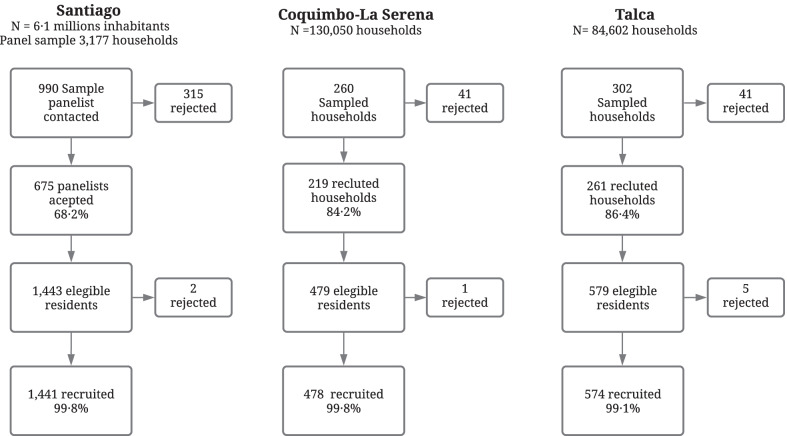
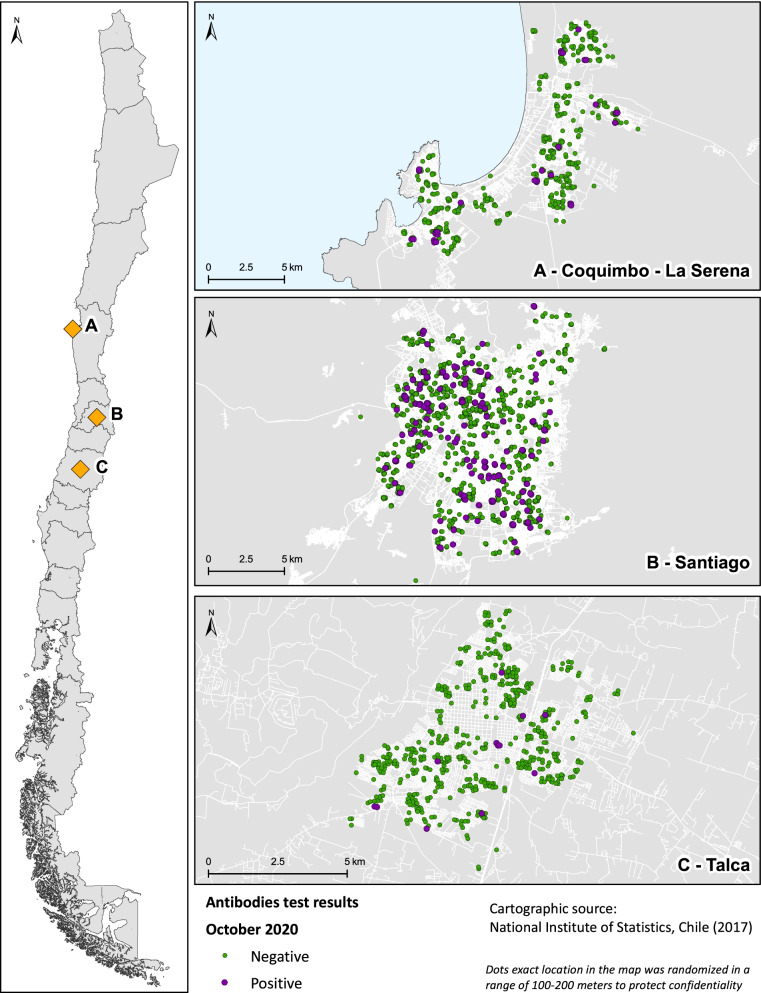
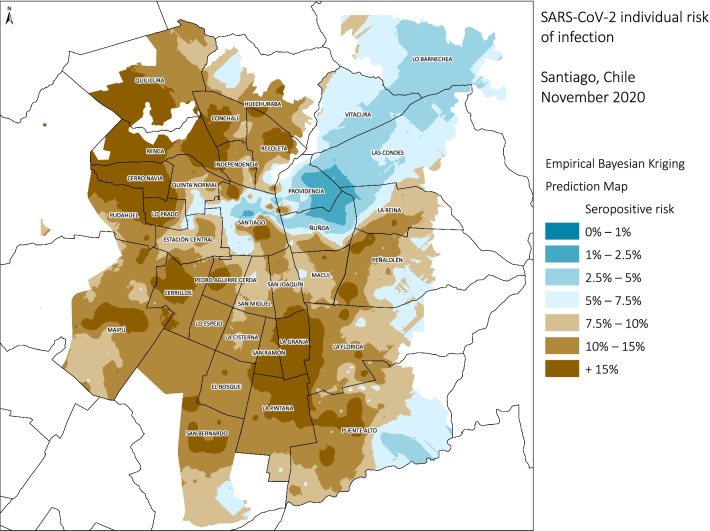
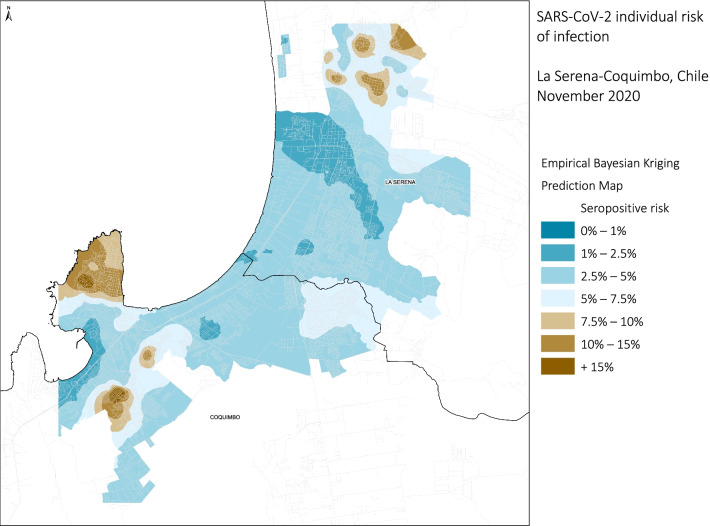
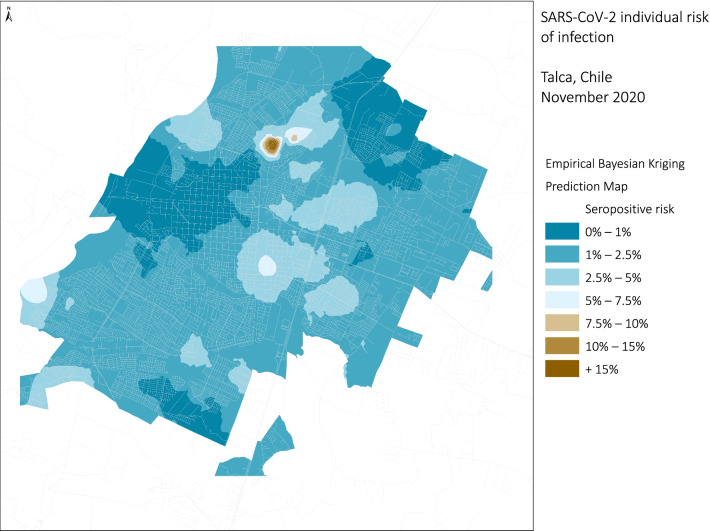
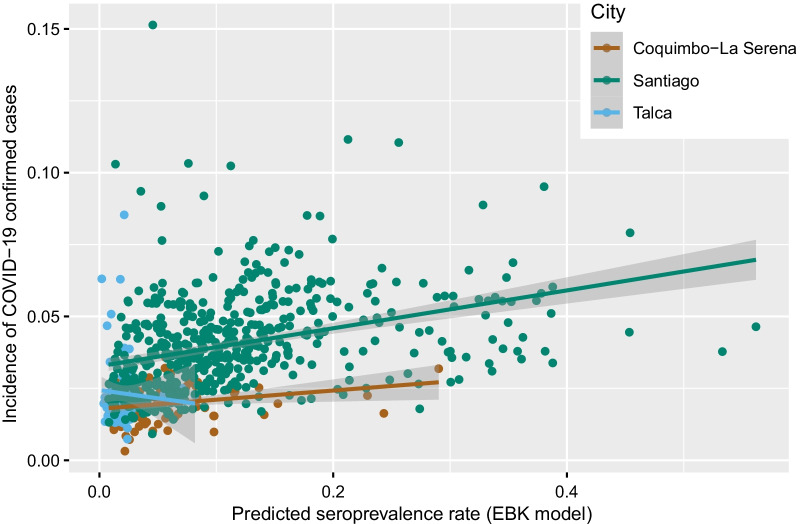
Background: Seroprevalence studies provide an accurate measure of SARS-CoV-2 spread and the presence of asymptomatic cases. They also provide information on the uneven impact of the pandemic, pointing out vulnerable groups to prioritize which is particularly relevant in unequal societies. However, due to their high cost, they provide limited evidence of spatial spread of the pandemic specially in unequal societies. Our objective was to estimate the prevalence of SARS-CoV-2 antibodies in Chile and model its spatial risk distribution. Methods: During Oct–Nov 2020, we conducted a population-based serosurvey in Santiago, Talca, and Coquimbo–La Serena (2493 individuals). We explored the individual association between positive results and socio-economic and health-related variables by logistic regression for complex surveys. Then, using an Empirical Bayesian Kriging model, we estimated the infection risk spatial distribution using individual and census information, and compared these results with official records. Results: Seroprevalence was 10.4% (95% CI 7.8–13.7%), ranging from 2% (Talca) to 11% (Santiago), almost three times the number officially reported. Approximately 36% of these were asymptomatic, reaching 82% below 15 years old. Seroprevalence was associated with the city of residence, previous COVID-19 diagnosis, contact with confirmed cases (especially at household), and foreign nationality. The spatial model accurately interpolated the distribution of disease risk within the cities finding significant differences in the predicted probabilities of SARS-CoV-2 infection by census zone (IQR 2.5–15.0%), related to population density and education. Conclusions: Our results underscore the transmission heterogeneity of SARS-CoV-2 within and across three urban centers of Chile. Socio-economic factors and the outcomes of this seroprevalence study enable us to identify priority areas for intervention. Our methodological approach and results can help guide the design of interdisciplinary strategies for urban contexts, not only for SARS-CoV-2 but also for other communicable diseases.
Overview
The claims and statistics of this paper haven’t been checked yet.
Free: it reads the open-access text and checks the first 5 claims that cite a source we can check. Create a free account to check every claim.
Integrity signals
Registry
Cites
Statistics
Figures
Verification
Claims the paper makes
The claims and statistics of this paper haven’t been checked yet.
Free: it reads the open-access text and checks the first 5 claims that cite a source we can check. Create a free account to check every claim.
Self-check
Percentages, sums and reported differences re-computed from the paper’s own numbers.
The self-check needs the paper’s full text.
Citations
Cites
Pollán, M., Pérez-Gómez, B., Pastor-Barriuso, R., Oteo, J., Hernán, M. A., Pérez-Olmeda, M., Sanmartín, J. L., Fernández-García, A., Cruz, I., Fernández de Larrea, N., et al. (2020) · The Lancet · doi:10.1016/s0140-6736(20)31483-5 · Cited by 1,639 · cited 2×
“7%, which may reflect the variation in expression of COVID-19 worldwide [22, 30].”
BackgroundStringhini, S., Wisniak, A., Piumatti, G., Azman, A. S., Lauer, S. A., Baysson, H., De Ridder, D., Petrovic, D., Schrempft, S., Marcus, K., et al. (2020) · The Lancet · doi:10.1016/s0140-6736(20)31304-0 · Cited by 990 · cited 1×
“At the same time, these studies may highlight risk factors for infection, severity, and lethality [9, 14, 15] .”
BackgroundInfection fatality rate of COVID-19 inferred from seroprevalence data
Ioannidis, J. P. A. (2021) · Bulletin of the World Health Organization · doi:10.2471/blt.20.265892 · Cited by 684 · cited 1×
“63%, in the range of our pooled results [39].”
BackgroundSabatini, F., Cáceres, G., & Cerda, J. (2001) · EURE (Santiago) · doi:10.4067/s0250-71612001008200002 · Cited by 467
Socioeconomic status determines COVID-19 incidence and related mortality in Santiago, Chile
Mena, G. E., Martinez, P. P., Mahmud, A. S., Marquet, P. A., Buckee, C. O., & Santillana, M. (2021) · Science · doi:10.1126/science.abg5298 · Cited by 431 · cited 1×
“Moreover, the residuals (zones with higher deviation) in Santiago pointed out areas that Mena suggested have less access to COVID-19 diagnostic tests [8].”
BackgroundHallal, P. C., Hartwig, F. P., Horta, B. L., Silveira, M. F., Struchiner, C. J., Vidaletti, L. P., Neumann, N. A., Pellanda, L. C., Dellagostin, O. A., Burattini, M. N., et al. (2020) · The Lancet Global Health · doi:10.1016/s2214-109x(20)30387-9 · Cited by 398
SARS-CoV-2 seroprevalence worldwide: a systematic review and meta-analysis
Rostami, A., Sepidarkish, M., Leeflang, M. M. G., Riahi, S. M., Nourollahpour Shiadeh, M., Esfandyari, S., Mokdad, A. H., Hotez, P. J., & Gasser, R. B. (2021) · Clinical Microbiology and Infection · doi:10.1016/j.cmi.2020.10.020 · Cited by 369 · cited 2×
“Comparable results between sexes were reported in several population-based studies [4, 11].”
BackgroundResultA nicotinic hypothesis for Covid-19 with preventive and therapeutic implications
Changeux, J.-P., Amoura, Z., Rey, F. A., & Miyara, M. (2020) · Comptes Rendus. Biologies · doi:10.5802/crbiol.8 · Cited by 289
Why do we need and how should we implement Bayesian kriging methods
Pilz, J., & Spöck, G. (2008) · Stochastic Environmental Research and Risk Assessment · doi:10.1007/s00477-007-0165-7 · Cited by 226
Koh, W. C., Naing, L., Chaw, L., Rosledzana, M. A., Alikhan, M. F., Jamaludin, S. A., Amin, F., Omar, A., Shazli, A., Griffith, M., et al. (2020) · PLOS ONE · doi:10.1371/journal.pone.0240205 · Cited by 215
Cited by
Levin, A. T., Owusu-Boaitey, N., Pugh, S., Fosdick, B. K., Zwi, A. B., Malani, A., Soman, S., Besançon, L., Kashnitsky, I., Ganesh, S., et al. (2022) · BMJ Global Health · doi:10.1136/bmjgh-2022-008477 · Cited by 208
Treatments of Mycobacterium tuberculosis and Toxoplasma gondii with Selenium Nanoparticles
Ifijen, I. H., Atoe, B., Ekun, R. O., Ighodaro, A., & Odiachi, I. J. (2023) · BioNanoScience · doi:10.1007/s12668-023-01059-4 · Cited by 33
Aguilera, X., González, C., Apablaza, M., Rubilar, P. A., Icaza, G., Ramírez-Santana, M., Acuña, C. P., Cortes, L. J., Núñez, L., Quezada-Gaete, R., et al. (2022) · Vaccines · doi:10.3390/vaccines10071002 · Cited by 16
“The overall sample seroprevalence was 97.3%, which was significantly higher in Santiago and Talca than in Coquimbo–La Serena (98.4%, 98.5%, and 93.9%, respectively).”
MethodSelf-citationInverse Association between Omega-3 Index and Severity of COVID-19: A Case–Control Study
Ramírez-Santana, M., Barra, R. Z., González, M. Ñ., Müller, J. M., Vásquez, J. E., Ravera, F., Lago, G., Cañón, E., Castañeda, D., & Pradenas, M. (2022) · International Journal of Environmental Research and Public Health · doi:10.3390/ijerph19116445 · Cited by 14
“This case–control study was conducted in two cities in Chile.”
BackgroundNúñez, L., Ramírez-Santana, M., Rubilar, P. A., Vial, C., Apablaza, M., González, C., Said, M., Olivares, K., Cortés, J., Hormazábal, J., et al. (2023) · Viruses · doi:10.3390/v15010201 · Cited by 13
“The details of the sampling procedures for the first and second phases are described elsewhere [5,11,12].”
BackgroundMethodResultInfluentialSelf-citationCaniza, H., Forriol, F., Pangrazio, O., & Gil-Conesa, M. (2022) · Sports Medicine · doi:10.1007/s40279-022-01763-3 · Cited by 8
Villena, R., Giannina Izquierdo, C., Wilhelm, J., García, C., Acuña, M., Riquelme, P., Alvarado, S., & Torres, J. P. (2024) · Vaccine · doi:10.1016/j.vaccine.2024.05.063 · Cited by 6
SARS-CoV-2 Neutralizing Antibodies in Chile after a Vaccination Campaign with Five Different Schemes
Aguilera, X., Hormazábal, J., Vial, C., Cortés, J., González, C., Rubilar, P. A., Apablaza, M., Ramírez-Santana, M., Icaza, G., Núñez, L., et al. (2022) · Vaccines · doi:10.3390/vaccines10071051 · Cited by 7
Self-citationGünther, F., Einhauser, S., Peterhoff, D., Wiegrebe, S., Niller, H. H., Beileke, S., Steininger, P. A., Burkhardt, R., Küchenhoff, H., Gefeller, O., et al. (2022) · International Journal of Environmental Research and Public Health · doi:10.3390/ijerph192416996 · Cited by 7
Trends in SARS-CoV-2 seroprevalence in Albania during the 2021–2022 pandemic year
Sulcebe, G., Ylli, A., Cenko, F., Kurti-Prifti, M., Shyti, E., Dashi-Pasholli, J., Lazri, E., Seferi-Qendro, I., & Perry, M. J. (2023) · New Microbes and New Infections · doi:10.1016/j.nmni.2023.101208 · Cited by 6
“The seroprevalence of SARS-CoV-2 antibodies in different populations and age groups depends on various geographic, social, and economic factors, the vaccination rate, and other preventive measures within the population [8,9].”
BackgroundSocial epidemiology of urban COVID-19 inequalities in Latin America and Canada
Poirier, M. J., Morales Caceres, A., Dykstra, T. E., Dayrell Ferreira Sales, A., & Caiaffa, W. T. (2024) · International Journal for Equity in Health · doi:10.1186/s12939-024-02301-5 · Cited by 5
“…of the largest metropolitan areas between 2020 to 2022 estimated that the proportion of urban residents that had been exposed to COVID-19 ranged from 1.0% in Toronto, 11.0% in Santiago, 11.4% in Buenos Aires, 19.6% in Mexico City, 21.6% in Lima, 26.0% in São Paulo, and 26.5% in Bogotá [3–6].”
BackgroundInfluentialNúñez, L., Rubilar, P. A., Apablaza, M., Canales, L., Cortés, L. J., Molina, X., Said, M., Olivares, K., Correa, J., & Ramírez-Santana, M. (2025) · BMC Public Health · doi:10.1186/s12889-025-22314-1 · Cited by 6
“Three previous cross-sectional studies were conducted in these two cities [2, 4, 26].”
Self-citationRamírez-Santana, M., Correa-Parra, J., Núñez, L., Apablaza, M., Rubilar, P. A., Vial, C., Cortes, L. J., Hormazábal, J., Canales, L., Vial, P., et al. (2024) · Health Equity · doi:10.1089/heq.2023.0204 · Cited by 4
“4,30,35,40”
InfluentialSelf-citationTran, D. M., Vu, U. T., Hoang, C. N., Nguyen, H. T. T., Nguyen, P. H., Tran, M. C. T., Chu, A. N., & Phúc, P. H. (2022) · Pathogens · doi:10.3390/pathogens11121442 · Cited by 4
“Remarkably, seroprevalence considerably varied among studies, timeframe, and geography [12,14,19,25].”
BackgroundThe 15-minute city and real estate capital: contributions from Chile’s major cities
Correa-Parra, J., Vergara‐Perucich, F., Aguirre, C., & Ulloa-León, F. (2025) · Town Planning Review · doi:10.3828/tpr.2025.8 · Cited by 2
Rubilar, P. A., Hirmas, M., Matute, I., Browne, J., Little, C., Ruz, G. A., Aguilera, X., Ávila, C., Vial, P., & Mackenzie, T. G. (2022) · Medwave · doi:10.5867/medwave.2022.03.002553 · Cited by 2
Self-citationYudha, A. K., Leelawat, N., & Tang, J. (2025) · Results in Engineering · doi:10.1016/j.rineng.2025.105282 · Cited by 5
Torres-Flores, A., Bautista-Sebastián, E., Rivera-Hernández, T., Ferat-Osorio, E. A., Arriaga‐Pizano, L., Cérbulo‐Vázquez, A., Ramírez-Ramírez, D., Bonifaz, L. C., Pelayo, R., & López-Macías, C. I. R. (2026) · Seminars in Immunology · doi:10.1016/j.smim.2026.102025 · Cited by 1
León-Rojas, J. E., Veloz, T., Teran, J., Perez, M., Arias-Erazo, F., Villacis, L., Velez, J., Recalde-Navarrete, R. J., Jiménez, P., Martin, M. L., et al. (2022) · F1000Research · doi:10.12688/f1000research.126577.1 · Cited by 1
León-Rojas, J. E., Arias-Erazo, F., Jiménez, P., Recalde-Navarrete, R. J., Guevara, A. G., Coloma, J., Martin, M. L., Ster, I. C., Cooper, P. J., Romero-Sandoval, N. C., et al. (2024) · PLoS ONE · doi:10.1371/journal.pone.0309466 · Cited by 1
Verdugo, C., Verdugo, C., Fíca, A., Hernández, F., Ramírez‐Reveco, A., Plaza, A., Castro, N., Hernández-Riquelme, M., & Acosta‐Jamett, G. (2025) · Public Health · doi:10.1016/j.puhe.2024.12.033 · Cited by 1
Varón, L. S., Álvarez, H., Casanova, L. C. H., Mora, M. P. D., Cuevas, L. A. M., González-Puelma, J., Espinoza, K., Amarales, L., Henriquez-Luhrd, J., Retamal-Matus, H. F., et al. (2025) · BMJ Open · doi:10.1136/bmjopen-2024-093844 · Cited by 1
Aguilera, X., González, C., Apablaza, M., Rubilar, P. A., Icaza, G., Ramírez-Santana, M., Acuña, C. P., Cortés, J., Núñez, L., Quezada-Gaete, R., et al. (2022) · Research Square · doi:10.21203/rs.3.rs-1548211/v1 · Cited by 1
Self-citationAsymptomatic SARS-CoV-2 infections tend to occur less frequently in developed nationsPreprint
Chowdhury, S., Tiwari, A., James, A., Chatterjee, B., & Dixit, N. M. (2023) · medRxiv · doi:10.1101/2023.12.14.23299954 · Cited by 1
Inchauste, L., Nurtop, E., Machicado, L. B., Roth, Y. L., Gonzales, S. L., Herrera, M. L., Villafan, K. M., Mamani, P. M., Espinoza, M. R., Suarez, J. C. P., et al. (2025) · eLife · doi:10.7554/elife.94475.3
Inchauste, L., Nurtop, E., Machicado, L. B., Roth, Y. L., Gonzales, S. L., Herrera, M. L., Villafan, K. M., Mamani, P. M., Espinoza, M. R., Suarez, J. C. P., et al. (2024) · eLife · doi:10.7554/elife.94475.1
Inchauste, L., Nurtop, E., Machicado, L. B., Roth, Y. L., Gonzales, S. L., Herrera, M. L., Villafan, K. M., Mamani, P. M., Espinoza, M. R., Suarez, J. C. P., et al. (2025) · eLife · doi:10.7554/elife.94475
“…pandemic, a few South American population-based seroprevalence studies were conducted in Colombia, Perú, Chile, and Brazil ( Reyes-Vega et al., 2021 ; Álvarez-Antonio et al., 2021 ; Vial et al., 2022 ; Mercado-Reyes et al., 2022 ; Nicolete et al., 2022 ; Buss et al., 2021 ; Prete et al., 2022 ).”
Tiwari, A., Chowdhury, S., James, A., Chatterjee, B., & Dixit, N. M. (2024) · medRxiv · doi:10.1101/2024.09.11.24313462
Inchauste, L., Nurtop, E., Machicado, L. B., Roth, Y. L., Gonzales, S. L., Herrera, M. L., Villafan, K. M., Mamani, P. M., Espinoza, M. R., Suarez, J. C. P., et al. (2025) · eLife · doi:10.7554/elife.94475.2
Seroepidemiology of emerging viruses in Bolivia
Jordan, L. I. (2023) · theses.fr (ABES) · doi:10.70675/1070f335z49aaz4d85zb796z713dd35bc6fc
Metadata
- Authors
- Vial, P., González, C., Icaza, G., Ramirez-Santana, M., Quezada-Gaete, R., Núñez-Franz, L., Apablaza, M., Vial, C., Rubilar, P., Correa, J., Pérez, C., Florea, A., Guzmán, E., Lavín, M.-E., Concha, P., Nájera, M., & Aguilera, X.
- Affiliations
- Universidad del Desarrollo (CL)
- Clínica Alemana (CL)
- Universidad de Talca (CL)
- Universidad Católica del Norte (CL)
- Corresponding author
- Aguilera, Ximena
- ORCID
- Venue
- BMC Infectious Diseases
- Published
- 2022-01-28
- Volume
- 22
- Issue
- 1
- Pages
- 99-99
- ISSN
- 1471-2334 (ISSN-L)
- PMC
- PMC8795965
- OpenAlex
- W4226150028
- Cited by
- 31
- References
- 39
- Citations by year
- 2026: 1 · 2025: 7 · 2024: 8 · 2023: 5 · 2022: 10
- FWCI
- 4.46
- Type
- journal article
- Language
- en
- Open access
- gold
- doi.org
- Licence
- cc-by
- creativecommons.org/licenses/by/4.0 (tdm)
- creativecommons.org/licenses/by/4.0 (vor)
- Locations
- BMC Infectious Diseases (publishedVersion, cc-by)
- PubMed Central (publishedVersion, cc-by)
- PubMed (publishedVersion)
- DOAJ (DOAJ: Directory of Open Access Journals) (submittedVersion, cc-by-sa)
- Funders
- Agencia Nacional de Investigación y Desarrollo (, ANID COVID 19-0589)
- Topics
- Physical Sciences › Mathematics › Modeling and Simulation › COVID-19 epidemiological studies
- Health Sciences › Medicine › Infectious Diseases › SARS-CoV-2 and COVID-19 Research
- Health Sciences › Medicine › Infectious Diseases › SARS-CoV-2 detection and testing
- Keywords
- SARS-CoV-2, COVID-19 pandemic, seroprevalence, serological survey, spatial distribution of infection, empirical Bayesian kriging, social determinants of health, asymptomatic infection, transmission heterogeneity, urban health disparities, socioeconomic disparities, foreign nationality, household contacts
- MeSH terms
- COVID-19, SARS-CoV-2, COVID-19 Testing, Adolescent, Bayes Theorem, Chile, Humans, Seroepidemiologic Studies, Social Determinants of Health
About these checks
Registry, retraction, Cites and statistics results are computed, not judged, with one exception: a printed reference that no index lists is read once by a model before it counts as a citation error. Claims are extracted by a model and kept only when their quote appears verbatim in the text; each cited source is then checked, with a model’s help, for whether it says what the claim relies on. Those verdicts can be wrong — read the claim’s quote and the cited source before relying on one.
Statistics and arithmetic are recomputed, not judged.
Confidence bands are shown only for fields calibrated on our annotated test set. None is calibrated yet, so no band is shown.
What counts as a claim ›How we measure confidence ›How we check this ›
Are you an author, or do you see a problem with this page? Request a review
Data sources
Bibliographic data: Semantic Scholar, OpenAlex, Crossref.
Contains information from the Semantic Scholar Academic Graph Datasets, made available under the ODC Attribution License (ODC-BY 1.0).
Semantic Scholar’s data is described in: Kinney, R., et al. (2023). The Semantic Scholar Open Data Platform. arXiv:2301.10140.
