

Genome-wide association study identified ATP6V1H locus influencing cerebrospinal fluid BACE activity
Open accessThe DOI matches its Crossref record; 33 of the 33 references it cites were found in a registry or an index; none of the 43 sources its claims cite is checked for support yet.
Abstract
BACKGROUND: The activity of cerebrospinal fluid (CSF) β-site APP cleaving enzyme (BACE) is a potential diagnostic biomarker for Alzheimer disease (AD). METHODS: A total of 340 non-Hispanic Caucasian participants from the Alzheimer's Disease Neuroimaging Initiative cohort (ADNI) database were included in this study with quality-controlled CSF BACE and genotype data. Association of CSF BACE with the genetic variants of single nucleotide polymorphisms (SNPs) was assessed using PLINK under the additive genetic model. The P values of all SNPs for CSF BACE were adjusted for multiple comparisons. RESULTS: One SNP (rs1481950) in the ATP6V1H gene reached genome-wide significance for associations with CSF BACE (P = 4.88 × 10- 9). The minor allele (G) of rs1481950 was associated with higher CSF BACE activity. Although seven SNPs in SNX31, RORA, CDH23, RGS20, LRRC4C, MAPK6PS1 and LOC105378355 did not reach genome-wide significance (P < 10- 8), they were identified as suggestive loci (P < 10- 5). CONCLUSION: This study identified rs1481950 within ATP6V1H influencing human CSF BACE activity, which indicated that ATP6V1H gene may play some roles in the pathogenesis of neurodegenerative diseases such as AD.
Overview
CoChat Summary
TL;DR
This GWAS in 340 non-Hispanic Caucasian ADNI participants identified rs1481950 in ATP6V1H as genome-wide significantly associated with cerebrospinal fluid BACE activity. The minor allele (G) was associated with higher CSF BACE activity, and seven additional loci were suggestive.
Key findings
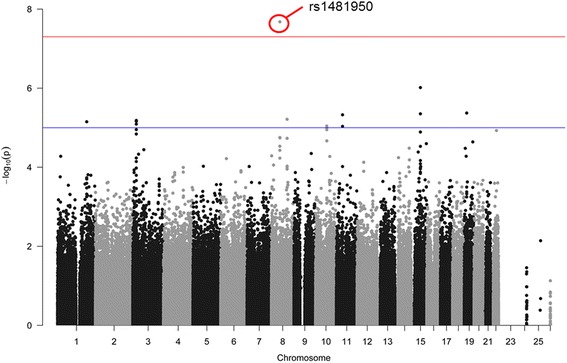
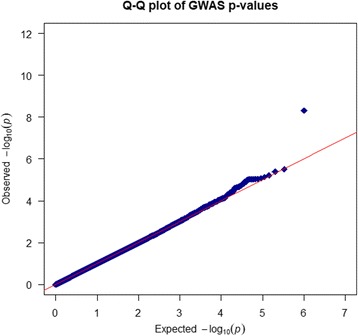
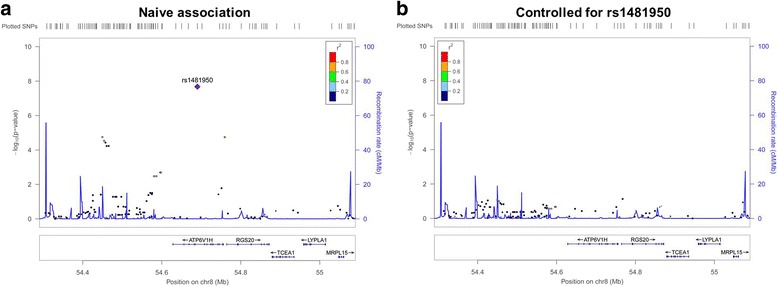
- One SNP, rs1481950 in ATP6V1H, reached genome-wide significance for CSF BACE activity (P = 4.88 × 10⁻⁹); the minor allele (G) was associated with higher CSF BACE activity.
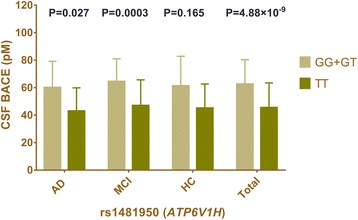
- In the total sample, CSF BACE activity was higher in GG + GT versus TT genotypes (63.86 ± 22.64 pM vs 45.49 ± 17.99 pM; P = 4.88 × 10⁻⁹; Beta 22.48, 95% CI 15.22–29.75).
- The genotype–CSF BACE association was also present in AD (P = 0.02720) and MCI (P = 0.00030) groups, but not in HC (P = 0.16480).
- Seven SNPs in SNX31, RORA, CDH23, RGS20, LRRC4C, MAPK6PS1, and LOC105378355 were suggestive (P < 10−5) but did not reach genome-wide significance; CSF BACE activity did not differ significantly among diagnostic groups (P = 0.2762).
Methods
- Separate GWAS using 340 ADNI participants (AD = 86, MCI = 163, HC = 91) restricted to non-Hispanic Caucasians with quality-controlled baseline CSF BACE and genotype data.
- SNP genotyping was performed on the Human 610-Quad BeadChip; after QC, 519,442 of 620,901 SNPs remained, with 99.5% overall genotyping rate.
- Association analysis used PLINK under an additive genetic model, adjusting for age, gender, and APOEε4 status; thresholds were P < 10−5 for suggestive and P < 10−8 for genome-wide significance. ANOVA/Tukey tests and multiple linear regression were also used.
Limitations
- The paper states the ADNI-1 sample was limited in size, especially when CSF BACE data, genotypes, and diagnostic subgroups were considered, so replication in a larger dataset is needed.
- The paper states the study examined CSF BACE but not plasma BACE, was restricted to Caucasians, and the ADNI database lacked detailed AD classification (sporadic/familial, early/late onset).
- The paper notes that the exact mechanism by which the intronic rs1481950 variant affects ATP6V1H expression has not been established.
Model-written summary. Check it against the paper before relying on it.
Integrity signals
Registry
Cites
Statistics
Figures
Verification
Claims the paper makes
0 Valid · 0 Not valid · 19 Not checked · 40 Own results and interpretations
A result the paper reports from its own data — it cites no other source for it, so there is none to check. The quote shows it is in the paper.
In the paper
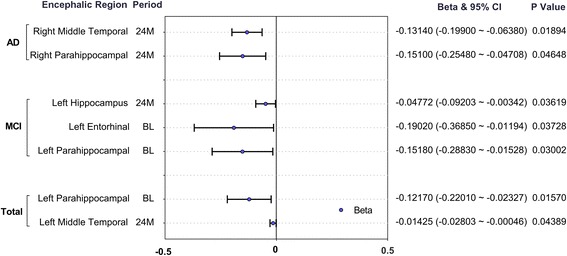
“In MCI patients, results showed that mutations of rs1481950 had correlations with the atrophy of hippocampus (Beta: -0.04772, 95% CI: -0.09203 ~ − 0.00342, P = 0.03619), entorhinal cortex (Beta:-0.19020, 95% CI: -0.36850 ~ − 0.01194, P = 0.03728) and parahippocampal gyrus(Beta: -0.15180, 95% CI: -0.28830 ~ − 0.01528, P = 0.03002) (Fig. 5).”
§ Genome-wide association study identified ATP6V1H locus influencing cerebrospinal fluid BACE activity > Results > Top SNP and AD-related phenotypes
plainstates an association- Asserted: passes — The authors put it forward as true.
- Checkable: passes — It can be checked against evidence.
- Load-bearing: unclear — It is unclear whether the paper’s conclusions depend on it.
- Based: passes — The paper gives a reason why it holds.
A result the paper reports from its own data — it cites no other source for it, so there is none to check. The quote shows it is in the paper.
In the paper
“However, in HC group, results did not show significant differences in CSF BACE activity among three genotype subgroups in both ANOVA (P = 0.06370) and multiple linear regression analysis (P = 0.16480, Beta: 0.14690, 95%CI: -0.06708~ 0.34790).”
§ Genome-wide association study identified ATP6V1H locus influencing cerebrospinal fluid BACE activity > Results > CSF BACE activity and top SNP
plain- Asserted: passes — The authors put it forward as true.
- Checkable: passes — It can be checked against evidence.
- Load-bearing: unclear — It is unclear whether the paper’s conclusions depend on it.
- Based: passes — The paper gives a reason why it holds.
A result the paper reports from its own data — it cites no other source for it, so there is none to check. The quote shows it is in the paper.
In the paper
“One SNP (rs1481950) in the ATP6V1H gene reached genome-wide significance for associations with CSF BACE (P = 4.88 × 10− 9).”
- Also stated in: § Characteristics of SNPs associated with CSF BACE activity · plain
“one SNP (rs1481950) in the region of ATP6V1H gene reached genome-wide significance (P = 4.88 × 10− 9).”
§ Genome-wide association study identified ATP6V1H locus influencing cerebrospinal fluid BACE activity > Abstract > Results
plainstates an association- Asserted: passes — The authors put it forward as true.
- Checkable: passes — It can be checked against evidence.
- Load-bearing: passes — The paper’s conclusions depend on it.
- Based: passes — The paper gives a reason why it holds.
- Also stated in: § Characteristics of SNPs associated with CSF BACE activity · plain
A result the paper reports from its own data — it cites no other source for it, so there is none to check. The quote shows it is in the paper.
In the paper
“Although seven SNPs in SNX31, RORA, CDH23, RGS20, LRRC4C, MAPK6PS1 and LOC105378355 did not reach genome-wide significance (P < 10− 8), they were identified as suggestive loci (P < 10− 5).”
§ Genome-wide association study identified ATP6V1H locus influencing cerebrospinal fluid BACE activity > Abstract > Results
plainstates an association- Asserted: passes — The authors put it forward as true.
- Checkable: passes — It can be checked against evidence.
- Load-bearing: unclear — It is unclear whether the paper’s conclusions depend on it.
- Based: passes — The paper gives a reason why it holds.
A result the paper reports from its own data — it cites no other source for it, so there is none to check. The quote shows it is in the paper.
In the paper
“CSF BACE activity in the whole samples showed positive linear association with the G allele in a multiple linear regression model after adjusting for age, gender, and APOEε4 status (GG + GT: 63.86 ± 22.64pM, TT: 45.49 ± 17.99pM, P = 4.88 × 10− 9, Beta: 22.48, 95% CI: 15.22 ~ 29.75).”
§ Genome-wide association study identified ATP6V1H locus influencing cerebrospinal fluid BACE activity > Results > CSF BACE activity and top SNP
plainstates an association- Asserted: passes — The authors put it forward as true.
- Checkable: passes — It can be checked against evidence.
- Load-bearing: passes — The paper’s conclusions depend on it.
- Based: passes — The paper gives a reason why it holds.
21 more claims
Create a free account to see all 59 claims and to verify the 43 references still open.
- It may state two separate claims as one. 13
- Probably not a substantial claim. 30
Claims other papers make about this one
Each is checked against this paper’s own text: does it say what the citing paper says it does?
In the citing paper
“In this regard, an intronic ATP6V1H variant rs1481950 in humans has been reported to influence BACE1 levels in cerebrospinal fluid, implicating a possible role of ATP6V1H in AD pathogenesis32.”
From TFEB–vacuolar ATPase signaling regulates lysosomal function and microglial activation in tauopathy (2024) · cites this paper as [32]
Self-check
Percentages, sums and reported differences re-computed from the paper’s own numbers.
Each contradiction between two passages listed here was confirmed by an independent check.
Rated minor: it would not touch a result — a value no result rests on, a p-value that stays on the same side of the significance level, or a conflict that is clerical, resolved elsewhere in the paper, or outside its own findings.
In the paper
§ Genome-wide association study identified ATP6V1H locus influencing cerebrospinal fluid BACE activity > Results > CSF BACE activity and top SNP
“AD (GG + GT: 60.14 ± 19.13pM, TT: 43 ± 16.85pM, P = 0.02720 Beta: 0.23820, 95% CI: 0.02137 ~ 0.43360)”
§ Genome-wide association study identified ATP6V1H locus influencing cerebrospinal fluid BACE activity > Discussion
“this statistical differences between gene polymorphism of ATP6V1H and CSF BACE activity existed in both AD (P = 0.0027) and MCI groups (P = 0.0003)”
Rated minor: it would not touch a result — a value no result rests on, a p-value that stays on the same side of the significance level, or a conflict that is clerical, resolved elsewhere in the paper, or outside its own findings.
In the paper
§ Genome-wide association study identified ATP6V1H locus influencing cerebrospinal fluid BACE activity > Methods > Alzheimer’s Disease Neuroimaging Initiative
“ADNI includes more than 800 participants ranging in age from 55 to 90.”
§ Genome-wide association study identified ATP6V1H locus influencing cerebrospinal fluid BACE activity > Results > Demographic, clinical, and cognitive characteristics
“74.2 ± 7.7 (54.4–88.8)”
Rated minor: it would not touch a result — a value no result rests on, a p-value that stays on the same side of the significance level, or a conflict that is clerical, resolved elsewhere in the paper, or outside its own findings.
In the paper
§ Genome-wide association study identified ATP6V1H locus influencing cerebrospinal fluid BACE activity > Methods > Statistical analyses
“The thresholds of P < 10− 5 and P < 10− 8 were used for suggestive and genome-wide significant associations respectively [17].”
§ Genome-wide association study identified ATP6V1H locus influencing cerebrospinal fluid BACE activity > Results > Characteristics of SNPs associated with CSF BACE activity
“In the Manhattan plot, the blue and red lines represent the -log10 (10− 5) and -log10 (3.10 × 10− 8) threshold levels”
Citations
Cites
Scheltens, P., Blennow, K., Breteler, M. M. B., de Strooper, B., Frisoni, G. B., Salloway, S., & Van der Flier, W. M. (2016) · The Lancet · doi:10.1016/s0140-6736(15)01124-1 · Cited by 3,125
Alzheimer's Disease Neuroimaging Initiative (ADNI): Clinical characterization
Petersen, R. C., Aisen, P. S., Beckett, L. A., Donohue, M. C., Gamst, A. C., Harvey, D. J., Jack, C. R., Jagust, W. J., Shaw, L. M., Toga, A. W., et al. (2010) · Neurology · doi:10.1212/wnl.0b013e3181cb3e25 · Cited by 3,060
Cerebrospinal fluid biomarker signature in Alzheimer's disease neuroimaging initiative subjects
Shaw, L. M., Vanderstichele, H., Knapik‐Czajka, M., Clark, C. M., Aisen, P. S., Petersen, R. C., Blennow, K., Soares, H., Simon, A., Lewczuk, P., et al. (2009) · Annals of Neurology · doi:10.1002/ana.21610 · Cited by 2,065
Self-citationElevated β-secretase expression and enzymatic activity detected in sporadic Alzheimer disease
Yang, L.-B., Lindholm, K., Yan, R., Citron, M., Xia, W., Yang, X.-L., Beach, T., Sue, L., Wong, P., Price, D., et al. (2003) · Nature Medicine · doi:10.1038/nm0103-3 · Cited by 729
β-Secretase Protein and Activity Are Increased in the Neocortex in Alzheimer Disease
Fukumoto, H. (2002) · Archives of Neurology · doi:10.1001/archneur.59.9.1381 · Cited by 575
Colacurcio, D. J., & Nixon, R. A. (2016) · Ageing Research Reviews · doi:10.1016/j.arr.2016.05.004 · Cited by 548 · cited 1×
“2 encodes for the V1H subunit of vacuolar ATPase (V-ATPase) [23, 24].”
BackgroundLi, R., Lindholm, K., Yang, L.-B., Yue, X., Citron, M., Yan, R., Beach, T., Sue, L., Sabbagh, M., Cai, H., et al. (2004) · Proceedings of the National Academy of Sciences · doi:10.1073/pnas.0205689101 · Cited by 496
Vassar, R., & Citron, M. (2000) · Neuron · doi:10.1016/s0896-6273(00)00051-9 · Cited by 299
Elevated cerebrospinal fluid BACE1 activity in incipient Alzheimer disease
Zetterberg, H., Andreasson, U., Hansson, O., Wu, G., Sankaranarayanan, S., Andersson, M. E., Buchhave, P., Londos, E., Umek, R. M., Minthon, L., et al. (2008) · Archives of Neurology · doi:10.1001/archneur.65.8.1102 · Cited by 224
Wang, D., Chen, H., Momary, K. M., Cavallari, L. H., Johnson, J. A., & Sadée, W. (2008) · Blood · doi:10.1182/blood-2008-03-144899 · Cited by 215
Cited by
TFEB–vacuolar ATPase signaling regulates lysosomal function and microglial activation in tauopathy
Wang, B., Martini-Stoica, H., Qi, C., Lu, T.-C., Wang, S., Xiong, W., Qi, Y., Xu, Y., Sardiello, M., Li, H., et al. (2024) · Nature Neuroscience · doi:10.1038/s41593-023-01494-2 · Cited by 121
Self-citationPellegrini, C., Pirazzini, C., Sala, C., Sambati, L., Yusipov, I., Kalyakulina, A., Ravaioli, F., Kwiatkowska, K. M., Durso, D. F., Ivanchenko, M., et al. (2021) · Frontiers in Aging Neuroscience · doi:10.3389/fnagi.2021.639428 · Cited by 93
Rajabli, F., Benchek, P. H., Tosto, G., Kushch, N. A., Sha, J., Bazemore, K., Zhu, C., Lee, W., Haut, J., Hamilton‐Nelson, K. L., et al. (2025) · Genome biology · doi:10.1186/s13059-025-03564-z · Cited by 50
Zhang, T., Liu, N., Wei, W., Zhang, Z., & Li, H. (2021) · Oxidative Medicine and Cellular Longevity · doi:10.1155/2021/9918498 · Cited by 40
Self-citationGenetic Variability in Molecular Pathways Implicated in Alzheimer's Disease: A Comprehensive Review
Vogrinc, D., Goričar, K., & Dolžan, V. (2021) · Frontiers in Aging Neuroscience · doi:10.3389/fnagi.2021.646901 · Cited by 36
Metadata
- Authors
- Initiative, A. D. N., Hu, H., Li, H., Li, J., Yu, J., & Tan, L.
- Affiliations
- Qingdao University (CN)
- Corresponding author
- Tan, Lan
- Venue
- BMC Medical Genetics
- Published
- 2018-05-11
- Volume
- 19
- Issue
- 1
- Pages
- 75-75
- ISSN
- 1471-2350 (ISSN-L)
- PMC
- PMC5948839
- OpenAlex
- W2805984164
- Cited by
- 18
- References
- 33
- Citations by year
- 2025: 3 · 2024: 1 · 2023: 3 · 2022: 2 · 2021: 4 · 2020: 4 · 2019: 1
- FWCI
- 0.80
- Type
- journal article
- Language
- en
- Open access
- gold
- doi.org
- Licence
- cc-by
- creativecommons.org/licenses/by/4.0/ (tdm)
- Locations
- BMC Medical Genetics (publishedVersion, cc-by)
- Europe PMC (PubMed Central) (publishedVersion, cc-by)
- PubMed Central (publishedVersion, cc-by)
- PubMed (publishedVersion)
- DOAJ (DOAJ: Directory of Open Access Journals) (submittedVersion)
- Funders
- Alzheimer&2019;s Disease Neuroimaging Initiative
- Taishan Scholars Program of Shandong Province (ts201511109, tsqn20161079)
- Qingdao Key Health Discipline Development Fund
- Qingdao Outstanding Health Professional Development Fund
- Qingdao Innovation and Entrepreneurship Leading Talent Program
- Topics
- Life Sciences › Neuroscience › Cellular and Molecular Neuroscience › Alzheimer's disease research and treatments
- Health Sciences › Medicine › Psychiatry and Mental health › Dementia and Cognitive Impairment Research
- Life Sciences › Biochemistry, Genetics and Molecular Biology › Genetics › Genetic Associations and Epidemiology
- Keywords
- BACE, cerebrospinal fluid, Alzheimer's disease, single nucleotide polymorphisms, genetic susceptibility, biomarkers, neurodegeneration, ADNI cohort
- MeSH terms
- Aged, Aged, 80 and over, Alleles, Alzheimer Disease, Female, Humans, Male, Middle Aged, Aspartic Acid Endopeptidases, Genetic Predisposition to Disease, Polymorphism, Single Nucleotide, Vacuolar Proton-Translocating ATPases, Amyloid Precursor Protein Secretases, Genome-Wide Association Study
About these checks
Registry, retraction, Cites and statistics results are computed, not judged, with one exception: a printed reference that no index lists is read once by a model before it counts as a citation error. Claims are extracted by a model and kept only when their quote appears verbatim in the text; each cited source is then checked, with a model’s help, for whether it says what the claim relies on. Those verdicts can be wrong — read the claim’s quote and the cited source before relying on one.
A language model drew the claims from the paper on 2026-11-26, under version 3 of the claim definition (model deepseek-v4.1-flash, prompt extract-v3).
A second model labelled each claim on 2026-11-26 (model jev-1.13-20260917, definition revision gold-guideline-v0.2).
Statistics and arithmetic are recomputed, not judged.
Confidence bands are shown only for fields calibrated on our annotated test set. None is calibrated yet, so no band is shown.
What counts as a claim ›How we measure confidence ›How we check this ›
Are you an author, or do you see a problem with this page? Request a review
How to cite
Cite CoChat for the checks on this page, and the paper for its own findings.
- This page
- CoChat. (2026). Citation check: Genome-wide association study identified ATP6V1H locus influencing cerebrospinal fluid BACE activity. https://app.cochat.ai/papers/10.1186/s12881-018-0603-z
- The paper
- Initiative, A. D. N., Hu, H., Li, H., Li, J., Yu, J., & Tan, L. (2018). Genome-wide association study identified ATP6V1H locus influencing cerebrospinal fluid BACE activity. BMC Medical Genetics. https://doi.org/10.1186/s12881-018-0603-z
Data sources
Bibliographic data: Semantic Scholar, OpenAlex, Crossref.
Contains information from the Semantic Scholar Academic Graph Datasets, made available under the ODC Attribution License (ODC-BY 1.0).
Semantic Scholar’s data is described in: Kinney, R., et al. (2023). The Semantic Scholar Open Data Platform. arXiv:2301.10140.
