

Chronic kidney disease, atherosclerotic plaque characteristics on carotid magnetic resonance imaging, and cardiovascular outcomes
Open accessThe DOI matches its Crossref record; 32 of the 32 references it cites were found in a registry or an index.
Abstract
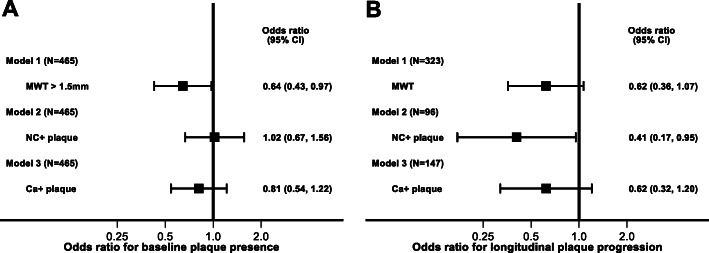
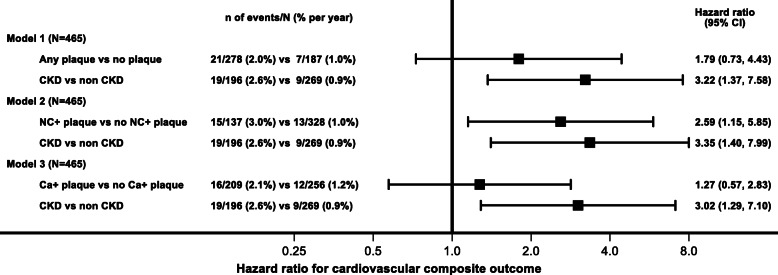
Background: It is unclear whether faster progression of atherosclerosis explains the higher risk of cardiovascular events in CKD. The objectives of this study were to 1. Characterize the associations of CKD with presence and morphology of atherosclerotic plaques on carotid magnetic resonance imaging (MRI) and 2. Examine the associations of baseline CKD and carotid atherosclerotic plaques with subsequent cardiovascular events. Methods: In a subgroup (N = 465) of Systolic Blood Pressure Intervention Trial. (SPRINT) participants, we measured carotid plaque presence and morphology at baseline and after 30-months with MRI. We examined the associations of CKD (baseline eGFR < 60 ml/min/1.73m 2) with progression of carotid plaques and the SPRINT cardiovascular endpoint. Results: One hundred and ninety six (42%) participants had CKD. Baseline eGFR in the non-CKD and CKD subgroups were 77 ± 14 and 49 ± 8 ml/min/1.73 m 2, respectively. Lipid rich necrotic-core plaque was present in 137 (29.5%) participants. In 323 participants with both baseline and follow-up MRI measurements of maximum wall thickness, CKD was not associated with progression of maximum wall thickness (OR 0.62, 95% CI 0.36 to 1.07, p = 0.082). In 96 participants with necrotic core plaque at baseline and with a valid follow-up MRI, CKD was associated with lower odds of progression of necrotic core plaque (OR 0.41, 95% CI 0.17 to 0.95, p = 0.039). There were 28 cardiovascular events over 1764 person-years of follow-up. In separate Cox models, necrotic core plaque (HR 2.59, 95% CI 1.15 to 5.85) but not plaque defined by maximum wall thickness or presence of a plaque component (HR 1.79, 95% CI 0.73 to 4.43) was associated with cardiovascular events. Independent of necrotic core plaque, CKD (HR 3.35, 95% CI 1.40 to 7.99) was associated with cardiovascular events. Conclusions: Presence of necrotic core in carotid plaque rather than the presence of plaque per se was associated with increased risk of cardiovascular events. We did not find CKD to be associated with faster progression of necrotic core plaques, although both were independently associated with cardiovascular events. Thus, CKD may contribute to cardiovascular disease principally via mechanisms other than atherosclerosis such as arterial media calcification or stiffening. Trial Registration: NCT01475747, registered on November 21, 2011.
Overview
The claims and statistics of this paper haven’t been checked yet.
Free: it reads the open-access text and checks the first 5 claims that cite a source we can check. Create a free account to check every claim.
Integrity signals
Registry
Cites
Statistics
Figures
Verification
Claims the paper makes
The claims and statistics of this paper haven’t been checked yet.
Free: it reads the open-access text and checks the first 5 claims that cite a source we can check. Create a free account to check every claim.
Claims other papers make about this one
Each is checked against this paper’s own text: does it say what the citing paper says it does?
The source backs part of the claim, not all of it — or backs it for a different population, condition or comparison.
In the citing paper
“with severity of chronic kidney disease (CKD) acting as a risk multiplier (458,459).”
From Guidelines and Recommendations for Laboratory Analysis in the Diagnosis and Management of Diabetes Mellitus (2023) · cites this paper as [459]
Experimental — accuracy not yet measuredThe source backs part of the claim, not all of it — or backs it for a different population, condition or comparison.
In the citing paper
“they will be at moderately increased risk of cardiovascular mortality, with severity of chronic kidney disease (CKD) acting as a risk multiplier (458,459).”
From Guidelines and Recommendations for Laboratory Analysis in the Diagnosis and Management of Diabetes Mellitus (2023) · cites this paper as [459]
Experimental — accuracy not yet measuredThe check wasn’t confident either way, so it gives no verdict — never disputed.
In the citing paper
“While older individuals (age >75 years) or with life expectancy <20 years may not be at increased risk of kidney failure requiring replacement therapy during their lifetimes”
From Guidelines and Recommendations for Laboratory Analysis in the Diagnosis and Management of Diabetes Mellitus (2023) · cites this paper as [459]
Experimental — accuracy not yet measured
Self-check
Percentages, sums and reported differences re-computed from the paper’s own numbers.
The self-check needs the paper’s full text.
Citations
Cites
Ahmed, A., Jorna, T., & Bhandari, S. (2016) · Nephron · doi:10.1159/000447068 · Cited by 11,717
Chronic kidney disease and the risks of death, cardiovascular events, and hospitalization
Go, A. S., Chertow, G. M., Fan, D., McCulloch, C. E., & Hsu, C.-Y. (2004) · New England Journal of Medicine · doi:10.1056/nejmoa041031 · Cited by 11,369
Self-citationA Randomized Trial of Intensive versus Standard Blood-Pressure Control
The SPRINT Research Group (2015) · New England Journal of Medicine · doi:10.1056/nejmoa1511939 · Cited by 6,325
Goodman, W. G., Goldin, J., Kuizon, B. D., Yoon, C., Gales, B., Sider, D., Wang, Y., Chung, J., Emerick, A., Greaser, L., et al. (2000) · New England Journal of Medicine · doi:10.1056/nejm200005183422003 · Cited by 2,509 · cited 1×
“While vascular calcification as measured by computed tomography (CT) imaging is considered to a strong predictor of CV events in both non-CKD and CKD populations [27, 28], the results of the current study raise the possibility that it might not be the calcification per se but the underlying necrotic core of the plaque…”
BackgroundOodman, W. I. G. G., Oldin, J. O. G., Uizon, D. K., Oon, C. H. Y., Ales, B. A. G., Ider, D. O. S., Ang, W. C., Oanie, J., Hung, C., Merick, A. L. E., et al. (2000) · Cited by 2,191
Accelerated Atherosclerosis in Prolonged Maintenance Hemodialysis
Lindner, A., Charra, B., Sherrard, D. J., & Scribner, B. H. (1974) · New England Journal of Medicine · doi:10.1056/nejm197403282901301 · Cited by 1,776 · cited 1×
“proposed the paradigm of accelerated atherosclerosis in uremia [5].”
Backgroundvan der Velde, M., the Chronic Kidney Disease Prognosis Consortium, Matsushita, K., Coresh, J., Astor, B. C., Woodward, M., Levey, A. S., de Jong, P. E., & Gansevoort, R. T. (2011) · Kidney International · doi:10.1038/ki.2010.536 · Cited by 1,082
Cai, J.-M., Hatsukami, T. S., Ferguson, M. S., Small, R., Polissar, N. L., & Yuan, C. (2002) · Circulation · doi:10.1161/01.cir.0000028591.44554.f9 · Cited by 817
Self-citationYuan, C., Mitsumori, L. M., Ferguson, M. S., Polissar, N. L., Echelard, D., Ortiz, G., Small, R., Davies, J. W., Kerwin, W. S., & Hatsukami, T. S. (2001) · Circulation · doi:10.1161/hc4201.097839 · Cited by 791
Self-citationHatsukami, T. S., Ross, R., Polissar, N. L., & Yuan, C. (2000) · Circulation · doi:10.1161/01.cir.102.9.959 · Cited by 622
Self-citationQuantitative Evaluation of Carotid Plaque Composition by In Vivo MRI
Saam, T., Ferguson, M. S., Yarnykh, V. L., Takaya, N., Xu, D., Polissar, N. L., Hatsukami, T. S., & Yuan, C. (2005) · Arteriosclerosis, Thrombosis, and Vascular Biology · doi:10.1161/01.atv.0000149867.61851.31 · Cited by 616
Self-citationAmbrosius, W. T., Sink, K. M., Foy, C. G., Berlowitz, D. R., Cheung, A. K., Cushman, W. C., Fine, L. J., Goff, D. C., Johnson, K. C., Killeen, A. A., et al. (2014) · Clinical Trials · doi:10.1177/1740774514537404 · Cited by 544 · cited 2×
“Details of SPRINT inclusion and exclusion criteria and study procedures have been published elsewhere [23, 24].”
MethodResultSelf-citationYuan, C., Zhang, S.-X., Polissar, N. L., Echelard, D., Ortiz, G., Davis, J. W., Ellington, E., Ferguson, M. S., & Hatsukami, T. S. (2002) · Circulation · doi:10.1161/hc0202.102121 · Cited by 454
Self-citationCardiovascular complications in chronic kidney disease
Sarnak, M. J. (2003) · American Journal of Kidney Diseases · doi:10.1016/s0272-6386(03)00372-x · Cited by 347
High-resolution B-mode ultrasonography in evaluation of atherosclerosis in uremia
Kawagishi, T., Nishizawa, Y., Konishi, T., Kawasaki, K., Emoto, M., Shoji, T., Tabata, T., Inoue, T., & Morii, H. (1995) · Kidney International · doi:10.1038/ki.1995.356 · Cited by 311 · cited 2×
“5 mg/ dl) [6], and persons on chronic maintenance hemodialysis [6, 7] had higher common carotid artery intima-media thickness.”
BackgroundZhao, X.-Q., Yuan, C., Hatsukami, T. S., Frechette, E. H., Kang, X.-J., Maravilla, K. R., & Brown, B. G. (2001) · Arteriosclerosis, Thrombosis, and Vascular Biology · doi:10.1161/hq1001.098463 · Cited by 284 · cited 1×
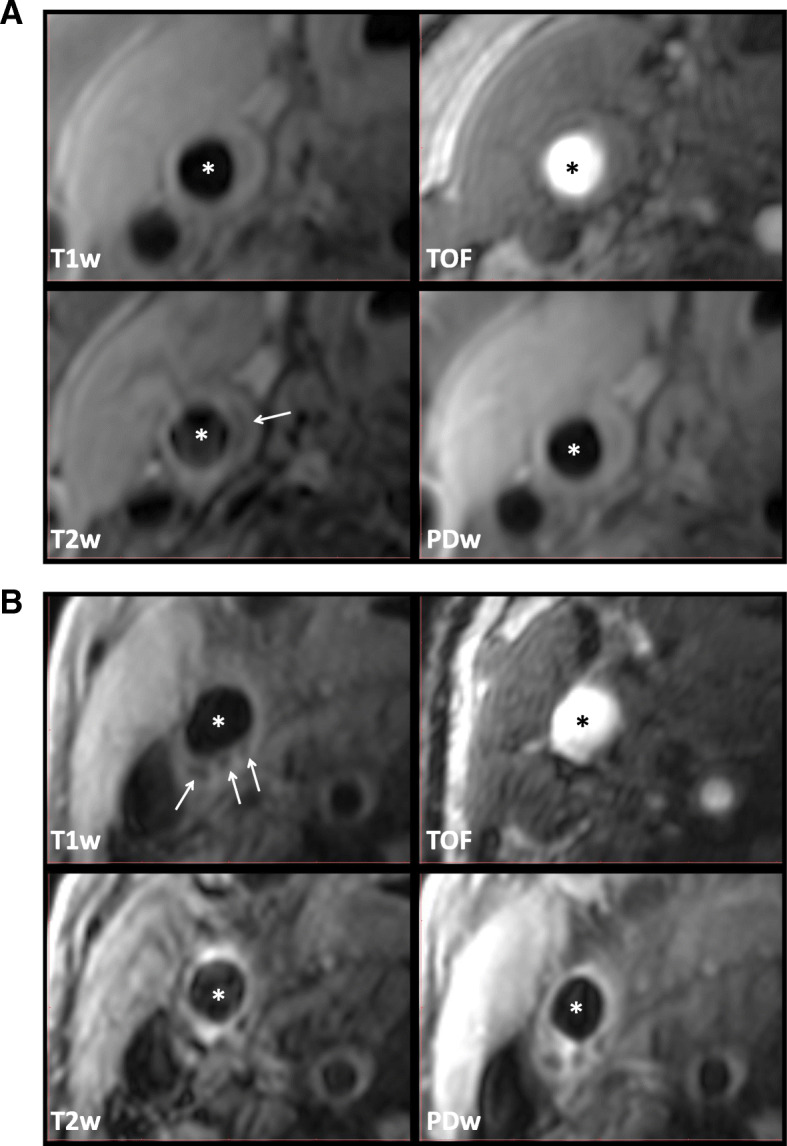
“Thus, multi-contrast (which does not require gadolinium contrast) carotid MRI imaging can be used to accurately measure carotid plaque burden [16, 17] and composition [15], including intraplaque hemorrhage [14, 18], fibrous cap [19–21] and lipid-rich necrotic core [14, 22].”
BackgroundSelf-citationMitsumori, L. M., Hatsukami, T. S., Ferguson, M. S., Kerwin, W. S., Cai, J., & Yuan, C. (2003) · Journal of Magnetic Resonance Imaging · doi:10.1002/jmri.10264 · Cited by 222
Self-citationAdvanced atherosclerosis in predialysis patients with chronic renal failure
Shoji, T., Emoto, M., Tabata, T., Kimoto, E., Shinohara, K., Maekawa, K., Kawagishi, T., Tahara, H., Ishimura, E., & Nishizawa, Y. (2002) · Kidney International · doi:10.1046/j.1523-1755.2002.00372.x · Cited by 180 · cited 2×
“5 mg/ dl) [6], and persons on chronic maintenance hemodialysis [6, 7] had higher common carotid artery intima-media thickness.”
BackgroundCalcification and Cardiovascular Health: New Insights Into an Old Phenomenon
Ketteler, M., Schlieper, G., & Floege, J. (2006) · Hypertension · doi:10.1161/01.hyp.0000219635.51844.da · Cited by 139
Carotid Plaque Lipid Content and Fibrous Cap Status Predict Systemic CV Outcomes
Sun, J., Zhao, X.-Q., Balu, N., Neradilek, M. B., Isquith, D. A., Yamada, K., Cantón, G., Crouse, J. R., Anderson, T. J., Huston, J., et al. (2017) · JACC. Cardiovascular imaging · doi:10.1016/j.jcmg.2016.06.017 · Cited by 132 · cited 1×
“The observation that NC+ plaque rather than Ca + plaque predicted CV events is consistent with the carotid MRI substudy [29] of Atherothrombosis Intervention in Metabolic Syndrome with Low HDL/High Triglycerides: Impact on Global Health Outcomes (AIM-HIGH).”
ResultSelf-citationImaging Cardiovascular Calcification
Wang, Y., Osborne, M. T., Tung, B., Li, M., & Li, Y. (2018) · Journal of the American Heart Association · doi:10.1161/jaha.118.008564 · Cited by 130 · cited 1×
“It should be noted that carotid MRI could measure plaque calcification [14, 15] but not arterial medial calcification [30].”
BackgroundNanayakkara, P. W. B., Teerlink, T., Stehouwer, C. D. A., Allajar, D., Spijkerman, A., Schalkwijk, C., Ter Wee, P. M., & Van Guldener, C. (2005) · Kidney International · doi:10.1111/j.1523-1755.2005.00680.x · Cited by 112
Association Between Carotid Artery Intima-Media Thickness and Cardiovascular Risk Factors in CKD
Preston, E., Ellis, M. R., Kulinskaya, E., Davies, A. H., & Brown, E. A. (2005) · American Journal of Kidney Diseases · doi:10.1053/j.ajkd.2005.07.048 · Cited by 102
Gracia, M., Betriu, À., Martínez‐Alonso, M., Arroyo, D., Abajo, M., Fernández, E., & Valdivielso, J. M. (2015) · Clinical Journal of the American Society of Nephrology · doi:10.2215/cjn.01240215 · Cited by 92 · cited 1×
“In another longitudinal study of carotid and femoral ultrasounds in 1553 participants with stage 3 to 5 CKD [13], baseline CKD stage was associated with neither the baseline prevalence of atherosclerotic plaque nor the progression of atherosclerotic plaques as evaluated by repeat ultrasound evaluation at 24 months.”
BackgroundLi, F., Yarnykh, V. L., Hatsukami, T. S., Chu, B., Balu, N., Wang, J., Underhill, H. R., Zhao, X., Smith, R., & Yuan, C. (2009) · Journal of Magnetic Resonance Imaging · doi:10.1002/jmri.22014 · Cited by 86 · cited 2×
“This standardized protocol included stringent quality control measures [25, 26] (details in supplemental methods).”
MethodSelf-citationCarotid atherosclerosis in chronic renal failure—the central role of increased plaque burden
Leskinen, Y., Lehtimäki, T. J., Loimaala, A., Lautamatti, V., Kallio, T. T., Huhtala, H., Salenius, J., & Saha, H. H. T. (2003) · Atherosclerosis · doi:10.1016/j.atherosclerosis.2003.08.010 · Cited by 86
Sun, J., Zhao, X.-Q., Balu, N., Hippe, D. S., Hatsukami, T. S., Isquith, D. A., Yamada, K., Neradilek, M. B., Cantón, G., Xue, Y., et al. (2014) · International journal of cardiac imaging · doi:10.1007/s10554-014-0532-7 · Cited by 70 · cited 1×
“This standardized protocol included stringent quality control measures [25, 26] (details in supplemental methods).”
MethodSelf-citationLuo, Y., Polissar, N. L., Han, C., Yarnykh, V. L., Kerwin, W. S., Hatsukami, T. S., & Yuan, C. (2003) · Magnetic Resonance in Medicine · doi:10.1002/mrm.10503 · Cited by 67
Self-citationChu, B., Hatsukami, T. S., Polissar, N. L., Zhao, X.-Q., Kraiss, L. W., Parker, D. L., Waterton, J. C., Raichlen, J. S., Hamar, W., & Yuan, C. (2004) · Stroke · doi:10.1161/01.str.0000144686.57135.98 · Cited by 46 · cited 1×
“Thus, multi-contrast (which does not require gadolinium contrast) carotid MRI imaging can be used to accurately measure carotid plaque burden [16, 17] and composition [15], including intraplaque hemorrhage [14, 18], fibrous cap [19–21] and lipid-rich necrotic core [14, 22].”
BackgroundSelf-citationAtheroma Progression in Chronic Kidney Disease
Rigatto, C., Levin, A., House, A. A., Barrett, B. J., Carlisle, E., & Fine, A. (2009) · Clinical Journal of the American Society of Nephrology · doi:10.2215/cjn.01840408 · Cited by 43 · cited 1×
“Paradoxically, the rate of plaque progression appeared lower in patients with the lowest creatinine clearance [11].”
BackgroundNicholls, S. J., Tuzcu, E. M., Hsu, A., Wolski, K., Sipahi, İ., Schoenhagen, P., Crowe, T. D., Kapadia, S. R., Hazen, S. L., & Nissen, S. E. (2007) · The American Journal of Cardiology · doi:10.1016/j.amjcard.2006.10.038 · Cited by 34 · cited 1×
“intravascular ultrasound studies of 989 participants [12], there was no difference in progression rates of total atheroma volume and percent atheroma volume in patients with GFRs lower and higher than 60ml/min/1.”
Background
Cited by
Sacks, D. B., Arnold, M., Bakris, G. L., Bruns, D. E., Horvath, A. R., Lernmark, Å., Metzger, B. E., Nathan, D. M., & Kirkman, M. S. (2023) · Diabetes Care · doi:10.2337/dci23-0036 · Cited by 351
Sacks, D. B., Arnold, M. A., Bakris, G. L., Bruns, D. E., Horvath, A. R., Lernmark, Å., Metzger, B. E., Nathan, D. M., & Kirkman, M. S. (2023) · Clinical Chemistry · doi:10.1093/clinchem/hvad080 · Cited by 208
Kadoglou, N. P. E., Khattab, E., Velidakis, N., Patsourakos, N. G., & Lambadiari, V. (2022) · Kardiologia Polska · doi:10.33963/kp.a2022.0155 · Cited by 26
Zhou, P., Wang, Y., Sun, J., Yu, Y., Mossa‐Basha, M., & Zhu, C. (2021) · Frontiers in Cardiovascular Medicine · doi:10.3389/fcvm.2021.742935 · Cited by 15
Self-citationChronic Kidney Disease and Myocardial Infarction
Николаевна, Р. О., Moiseyeva, A. Y., Esaulenko, A. N., Пинчук, А. В., & Алиджанова, Х. Г. (2022) · Russian Sklifosovsky Journal Emergency Medical Care · doi:10.23934/2223-9022-2022-11-1-104-118 · Cited by 7
Metadata
- Authors
- Beddhu, S., Boucher, R. E., Sun, J., Balu, N., Chonchol, M., Navaneethan, S., Chertow, G. M., Townsend, R., Haley, W., Cheung, A. K., Conroy, M. B., Raj, D. S., Xu, D., George, T., Yunis, R., Wei, G., Canton, G., Bates, J., Chen, J., Papademetriou, V., Punzi, H., Wiggers, A., Wright, J. T., Greene, T., & Yuan, C.
- Affiliations
- University of Utah (US)
- University of Washington (US)
- University of Colorado Anschutz (US)
- Michael E. DeBakey VA Medical Center (US)
- Stanford Medicine (US)
- University of Pennsylvania (US)
- Mayo Clinic in Florida (US)
- George Washington University (US)
- Tulane University (US)
- Washington DC VA Medical Center (US)
- Case Western Reserve University (US)
- Corresponding author
- Beddhu, Srinivasan
- ORCID
- Beddhu, Srinivasan
- Boucher, Robert E.
- Sun, Jie
- Balu, Niranjan
- Chonchol, Michel
- Navaneethan, Sankar
- Chertow, Glenn M.
- Townsend, Raymond
- Haley, William
- Cheung, Alfred K.
- Conroy, Molly B.
- Raj, Dominic S.
- Yunis, Reem
- Bates, Jeffrey
- Chen, Jing
- Papademetriou, Vasilios
- Punzi, Henry
- Wiggers, Alan
- Wright, Jackson T.
- Greene, Tom
- Yuan, Chun
- Venue
- BMC Nephrology
- Published
- 2021-02-24
- Volume
- 22
- Issue
- 1
- Pages
- 69-69
- ISSN
- 1471-2369 (ISSN-L)
- PMC
- PMC7905597
- OpenAlex
- W3130063305
- Semantic Scholar
- 94f8ad6a406012f6f0710bd80249c94fbe586bca
- Cited by
- 10
- References
- 32
- Citations by year
- 2026: 1 · 2025: 1 · 2024: 1 · 2023: 4 · 2022: 2 · 2021: 1
- FWCI
- 1.29
- Type
- journal article
- Language
- en
- Open access
- gold
- doi.org
- Licence
- cc-by
- creativecommons.org/licenses/by/4.0/ (tdm)
- creativecommons.org/licenses/by/4.0/ (vor)
- Locations
- BMC Nephrology (publishedVersion, cc-by)
- PubMed Central (publishedVersion, cc-by)
- PubMed (publishedVersion)
- DOAJ (DOAJ: Directory of Open Access Journals) (submittedVersion, cc-by-sa)
- Funders
- NIDDK (R01 DK091437)
- Topics
- Health Sciences › Medicine › Cardiology and Cardiovascular Medicine › Cerebrovascular and Carotid Artery Diseases
- Health Sciences › Medicine › Cardiology and Cardiovascular Medicine › Cardiovascular Health and Disease Prevention
- Health Sciences › Medicine › Nephrology › Chronic Kidney Disease and Diabetes
- Keywords
- chronic kidney disease, carotid atherosclerosis, atherosclerotic plaque morphology, cardiovascular events, SPRINT trial, EGFR, plaque progression, cardiovascular risk stratification, carotid MRI, hypertension, LDL cholesterol, blood pressure reduction, statins, renin-angiotensin system inhibitors, ACE inhibitors, SGLT2 inhibitors, renin-angiotensin system blockade, stroke, myocardial infarction
- MeSH terms
- Aged, Aged, 80 and over, Cardiovascular Diseases, Carotid Artery Diseases, Female, Humans, Magnetic Resonance Imaging, Male, Renal Insufficiency, Chronic, Plaque, Atherosclerotic
About these checks
Registry, retraction, Cites and statistics results are computed, not judged, with one exception: a printed reference that no index lists is read once by a model before it counts as a citation error. Claims are extracted by a model and kept only when their quote appears verbatim in the text; each cited source is then checked, with a model’s help, for whether it says what the claim relies on. Those verdicts can be wrong — read the claim’s quote and the cited source before relying on one.
Statistics and arithmetic are recomputed, not judged.
Confidence bands are shown only for fields calibrated on our annotated test set. None is calibrated yet, so no band is shown.
What counts as a claim ›How we measure confidence ›How we check this ›
Are you an author, or do you see a problem with this page? Request a review
Data sources
Bibliographic data: Semantic Scholar, OpenAlex, Crossref.
Contains information from the Semantic Scholar Academic Graph Datasets, made available under the ODC Attribution License (ODC-BY 1.0).
Semantic Scholar’s data is described in: Kinney, R., et al. (2023). The Semantic Scholar Open Data Platform. arXiv:2301.10140.
