

The behavioural variant frontotemporal dementia phenocopy syndrome is a distinct entity - evidence from a longitudinal study
Open accessThe DOI matches its Crossref record; 25 of the 25 references it cites were found in a registry or an index.
Abstract
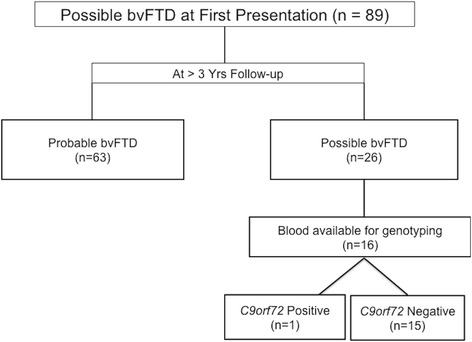
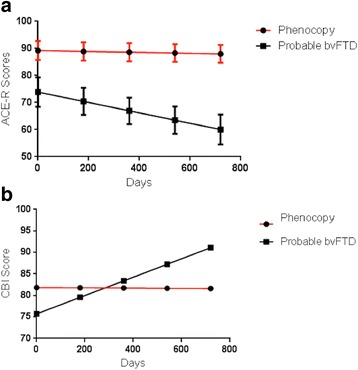
BACKGROUND: This study aimed to i) examine the frequency of C9orf72 expansions in a cohort of patients with the behavioural variant frontotemporal dementia (bvFTD) phenocopy syndrome, ii) observe outcomes in a group of phenocopy syndrome with very long term follow-up and iii) compare progression in a cohort of patients with the phenocopy syndrome to a cohort of patients with probable bvFTD. METHODS: Blood was obtained from 16 phenocopy cases. All met criteria for possible bvFTD and were labeled as phenocopy cases if they showed no functional decline, normal cognitive performance on the Addenbrooke's Cognitive Examination-Revised (ACE-R) and a lack of atrophy on brain imaging, over at least 3 years of follow-up. In addition, we obtained very long term follow-up data in 6 cases. A mixed model analysis approach determined the pattern of change in cognition and behaviour over time in phenocopy cases compared to 27 probable bvFTD cases. RESULTS: All 16 patients were screened for the C9orf72 expansion that was present in only one (6.25%). Of the 6 cases available for very long-term follow-up (13 - 21 years) none showed progression to frank dementia. Moreover, there was a decrease in the caregiver ratings of behavioural symptoms over time. Phenocopy cases showed significantly slower rates of progression compared to probable bvFTD patients (p < 0.006). CONCLUSION: The vast majority of patients with the bvFTD phenocopy syndrome remain stable over many years. An occasional patient can harbor the C9orf72 expansion. The aetiology of the remaining cases remains unknown but it appears very unlikely to reflect a neurodegenerative syndrome due to lack of clinical progression or atrophy on imaging.
Overview
The claims and statistics of this paper haven’t been checked yet.
Free: it reads the open-access text and checks the first 5 claims that cite a source we can check. Create a free account to check every claim.
Integrity signals
Registry
Cites
Statistics
Figures
Verification
Claims the paper makes
The claims and statistics of this paper haven’t been checked yet.
Free: it reads the open-access text and checks the first 5 claims that cite a source we can check. Create a free account to check every claim.
Claims other papers make about this one
Each is checked against this paper’s own text: does it say what the citing paper says it does?
In the citing paper
“Lastly, it is important to acknowledge the bvFTD phenocopy syndrome (phFTD) as a distinct entity from bvFTD. Apart from clinically mimicking bvFTD while lacking clear etiology, phFTD showed to be non-progressive over an extensive period of time (10+ years) (Devenney et al., 2018).”
From The pursuit for markers of disease progression in behavioral variant frontotemporal dementia: a scoping review to optimize outcome measures for clinical trials (2024) · cites this paper as Devenney et al., 2018
Self-check
Percentages, sums and reported differences re-computed from the paper’s own numbers.
The self-check needs the paper’s full text.
Citations
Cites
Hirono, N., Mori, E., Ikejiri, Y., Imamura, T., Shimomura, T., Hashimoto, M., Yamashita, H., & Ikeda, M. (1997) · Brain and nerve · Cited by 21,039
Random-Effects Models for Longitudinal Data
Laird, N. M., & Ware, J. H. (1982) · Biometrics · doi:10.2307/2529876 · Cited by 8,923
Sensitivity of revised diagnostic criteria for the behavioural variant of frontotemporal dementia
Rascovsky, K., Hodges, J. R., Knopman, D., Mendez, M. F., Kramer, J. H., Neuhaus, J., van Swieten, J. C., Seelaar, H., Dopper, E. G. P., Onyike, C. U., et al. (2011) · Brain · doi:10.1093/brain/awr179 · Cited by 5,221 · cited 6×
“Probable bvFTD, criteria was met when patients firstly satisfied possible criteria with additional evidence of functional decline, and frontal or temporal abnormalities on MRI or Fludeoxyglucose (18F)-Positron emission tomography (FDG-PET) [1].”
BackgroundMethodSelf-citationA Hexanucleotide Repeat Expansion in C9ORF72 Is the Cause of Chromosome 9p21-Linked ALS-FTD
Renton, A. E., Majounie, E., Waite, A., Simón-Sánchez, J., Rollinson, S., Gibbs, J. R., Schymick, J. C., Laaksovirta, H., van Swieten, J. C., Myllykangas, L., et al. (2011) · Neuron · doi:10.1016/j.neuron.2011.09.010 · Cited by 4,409 · cited 2×
“Renton AE, Majounie E, Waite A, Simón-Sánchez J, Rollinson S, Gibbs JR, Schymick JC, Laaksovirta H, Van Swieten JC, Myllykangas L.”
MethodAppelhof, B., Bakker, C., Van Duinen-van den Ijssel, J. C. L., Zwijsen, S. A., Smalbrugge, M., Verhey, F. R. J., de Vugt, M. E., Zuidema, S. U., & Koopmans, R. T. C. M. (2017) · Dementia and Geriatric Cognitive Disorders · doi:10.1159/000477087 · Cited by 2,760
Mioshi, E., Dawson, K., Mitchell, J., Arnold, R., & Hodges, J. R. (2006) · International Journal of Geriatric Psychiatry · doi:10.1002/gps.1610 · Cited by 2,016 · cited 1×
“Global cognitive function was measured using the Addenbrooke’s Cognitive Examination-Revised (ACE-R) [13]; a normal”
MethodSelf-citationHappé, F., Booth, R., Charlton, R., & Hughes, C. (2006) · Brain and Cognition · doi:10.1016/j.bandc.2006.03.004 · Cited by 638 · cited 1×
“control and emotion processing [18] as do patients on the Asperger-Autism spectrum [19, 20].”
MethodClinical staging and disease progression in frontotemporal dementia
Mioshi, E., Hsieh, S., Savage, S., Hornberger, M., & Hodges, J. R. (2010) · Neurology · doi:10.1212/wnl.0b013e3181e04070 · Cited by 362
Self-citationBeck, J., Poulter, M., Hensman, D., Rohrer, J. D., Mahoney, C. J., Adamson, G., Campbell, T., Uphill, J., Borg, A., Fratta, P., et al. (2013) · The American Journal of Human Genetics · doi:10.1016/j.ajhg.2013.01.011 · Cited by 345 · cited 2×
“Alzheimer’s disease (AD), although many lacked neuropathological confirmation [22].”
BackgroundSelf-citationImpaired recognition of negative basic emotions in autism: A test of the amygdala theory
Ashwin, C., Chapman, E., Colle, L., & Baron-Cohen, S. (2006) · Social Neuroscience · doi:10.1080/17470910601040772 · Cited by 319 · cited 1×
“control and emotion processing [18] as do patients on the Asperger-Autism spectrum [19, 20].”
Method
Cited by
Ducharme, S., Dols, A., Laforce, R., Devenney, E., Kumfor, F., van den Stock, J., Dallaire-Théroux, C., Seelaar, H., Gossink, F., Vijverberg, E., et al. (2020) · Brain · doi:10.1093/brain/awaa018 · Cited by 320
Self-citationFrontotemporal Dementia: A Clinical Review
Sivasathiaseelan, H., Marshall, C. R., Agustus, J. L., Benhamou, E., Bond, R. L., van Leeuwen, J. E. P., Hardy, C. J. D., Rohrer, J. D., & Warren, J. D. (2019) · Seminars in Neurology · doi:10.1055/s-0039-1683379 · Cited by 112
Illán-Gala, I., Montal, V., Borrego-Écija, S., Vilaplana, E., Pegueroles, J., Alcolea, D., Sánchez-Saudinós, B., Clarimón, J., Turón-Sans, J., Bargalló, N., et al. (2019) · Brain · doi:10.1093/brain/awz031 · Cited by 60
Phenocopy syndrome of behavioral variant frontotemporal dementia: a systematic review
Valente, E. S., Caramelli, P., Gambogi, L. B., Mariano, L. I., Guimarães, H. C., Teixeira, A. L., & de Souza, L. C. (2019) · Alzheimer's Research & Therapy · doi:10.1186/s13195-019-0483-2 · Cited by 54
FTD spectrum: Neuroimaging across the FTD spectrum
Whitwell, J. L. (2019) · Progress in Molecular Biology and Translational Science · doi:10.1016/bs.pmbts.2019.05.009 · Cited by 53
Parkinsonism in frontotemporal dementias
Rowe, J. B. (2019) · International review of neurobiology · doi:10.1016/bs.irn.2019.10.012 · Cited by 41
Self-citationDifferences in Sex Distribution Between Genetic and Sporadic Frontotemporal Dementia
de Boer, S. C. M., Riedl, L., van der Lee, S. J., Otto, M., Anderl‐Straub, S., Landín-Romero, R., Sorrentino, F., Fieldhouse, J. L. P., Reus, L. M., Vacaflor, B., et al. (2021) · Journal of Alzheimer s Disease · doi:10.3233/jad-210688 · Cited by 37
“phenocopy syndrome supports this idea [48, 49] but is highly unlikely to explain a male overrepresentation in our bvFTD group since we excluded possible bvFTD cases.”
BackgroundShiells, H., Schelter, B. O., Bentham, P., Baddeley, T. C., Rubino, C. M., Ganesan, H., Hammel, J., Vuksanović, V., Staff, R. T., Murray, A. D., et al. (2020) · Journal of Alzheimer s Disease · doi:10.3233/jad-191173 · Cited by 35
“study in patients meeting only clinical diagnostic criteria reported a smaller decline [4].”
BackgroundThe Behavioral Variant Frontotemporal Dementia Phenocopy Syndrome: A Review
Power, C., & LAWLOR, B. A. (2020) · Journal of Geriatric Psychiatry and Neurology · doi:10.1177/0891988720924708 · Cited by 24
“A more recent study noted that 6 patients with phenocopy did not progress to dementia during longitudinal follow-up of functioning of between 13 and 21 years.(43)”
BackgroundPlasma Neurofilament Light Chain and Clinical Diagnosis in Frontotemporal Dementia Syndromes
Ooi, S., Patel, S. K., Eratne, D., Kyndt, C., Reidy, N., Lewis, C. C., Lee, S. C. M., Darby, D., & Brodtmann, A. G. (2022) · Journal of Alzheimer s Disease · doi:10.3233/jad-220272 · Cited by 22
“Although there remains controversy regarding the phenocopy syndrome, their features are usually ascribed to late onset psychiatric or personality disorder [12, 13].”
BackgroundEratne, D., Keem, M. H., Lewis, C., Kang, M. J., Walterfang, M., Farrand, S., Loi, S. M., Kelso, W. M., Cadwallader, C. J., Berkovic, S. F., et al. (2022) · Journal of the Neurological Sciences · doi:10.1016/j.jns.2022.120439 · Cited by 22
Frontotemporal Dementia and Late-Onset Bipolar Disorder: The Many Directions of a Busy Road
da Silva, M. N. M., Porto, F. H. D. G., Lopes, P. M. G., Prado, C. S. D. C., Frota, N. A. F., Alves, C. H. L., & Alves, G. S. (2021) · Frontiers in Psychiatry · doi:10.3389/fpsyt.2021.768722 · Cited by 22
“Of note, some studies on bvFTD phenocopy excluded patients with a history of psychiatric disorders (66), preventing a conclusion on a possible interaction.”
BackgroundInfluentialFunctional cognitive disorders: identification and management
Poole, N. A., Cope, S. R., Bailey, C., & Isaacs, J. D. (2019) · BJPsych Advances · doi:10.1192/bja.2019.38 · Cited by 15
Álvarez, J. D., Matías‐Guiu, J. A., Cabrera‐Martín, M. N., Pytel, V., Segovia-Ríos, I., García‐Gutiérrez, F., Hernández‐Lorenzo, L., Matías‐Guiu, J., Carreras, J. L., Ayala, J. L., et al. (2022) · Frontiers in Aging Neuroscience · doi:10.3389/fnagi.2021.708932 · Cited by 16
“First, do memory loss or behavioral symptoms signal the onset of a neurodegenerative disorder? Memory or behavioral symptoms in early stages may be non-specific, and may be normal, or explained by nonneurodegenerative causes such as vascular damage, personality changes or psychiatric disorders, among others (Devenney…”
Webber, T. A., Woods, S. P., Lorkiewicz, S. A., Yazbeck, H. W., Schultz, E. R., & Kiselica, A. M. (2024) · Neuropsychology · doi:10.1037/neu0000969 · Cited by 13
van Engelen, M. E., Louwers, P., Fieldhouse, J. L. P., Gossink, F. T., de Boer, S. C. M., Dols, A., Scheltens, P., Schouws, S. N. T. M., Pijnenburg, Y. A. L., Vijverberg, E. G. B., et al. (2024) · Psychogeriatrics · doi:10.1111/psyg.13107 · Cited by 12
Krishnadas, N., Chew, M., Sutherland, A., Christensen, M., Rogers, K., Kyndt, C., Islam, F., Darby, D., & Brodtmann, A. G. (2024) · Neurology Clinical Practice · doi:10.1212/cpj.0000000000200360 · Cited by 13
Cagnin, A., Pigato, G., Pettenuzzo, I., Zorzi, G., Roiter, B., Anglani, M. G., Bussè, C., Mozzetta, S., Gabelli, C., Campi, C., et al. (2024) · Neurobiology of Aging · doi:10.1016/j.neurobiolaging.2024.01.015 · Cited by 11
“This condition is also known in the literature as bvFTD phenocopy syndrome (Devenney et al., 2018; Gossink et al., 2016; Kipps et al., 2009, 2007; Vijverberg et al., 2017).”
Vuksanović, V., Staff, R. T., Morson, S. M., Ahearn, T. S., Bracoud, L., Murray, A. D., Bentham, P., Kipps, C., Harrington, C. R., & Wischik, C. M. (2021) · Brain Communications · doi:10.1093/braincomms/fcab241 · Cited by 10
“Although it was possible to map functional and behavioural deficits to specific cortical regions (Supplementary Figs 7 and 8), these features did not discriminate between the bvFTD subtypes identified by structural criteria, apart from greater general impairment largely restricted to the FD subtype (see also Supplemen…”
Fieldhouse, J. L. P., van Paassen, D. N., van Engelen, M.-P. E., De Boer, S. C. M., Hartog, W. L., Braak, S., Schoonmade, L. J., Schouws, S. N. T. M., Krudop, W. A., Oudega, M. L., et al. (2024) · Frontiers in Aging Neuroscience · doi:10.3389/fnagi.2024.1382593 · Cited by 8
“Apart from clinically mimicking bvFTD while lacking clear etiology, phFTD showed to be non-progressive over an extensive period of time (10+ years) (Devenney et al., 2018).”
BackgroundAlzheimer’s Disease and Other Dementias
Brugulat‐Serrat, A., Shaaban, C. E., Emrani, S., & Sundermann, E. E. (2025) · Springer eBooks · doi:10.1007/978-3-031-87228-0_5 · Cited by 7
Biofluid biomarkers in distinguishing young-onset dementia from primary psychiatric disorders
Loi, S. M., Eratne, D., Santillo, A. F., & Velakoulis, D. (2025) · Current Opinion in Psychiatry · doi:10.1097/yco.0000000000000979 · Cited by 7
Young-onset frontotemporal dementia with FUS pathology
Gowell, M., Baker, I., Ansorge, O., & Husain, M. (2020) · Practical Neurology · doi:10.1136/practneurol-2020-002730 · Cited by 8
Coulborn, S., Roy, A. R. K., Sokołowski, A., Cryns, N. G., Lago, A. L., Cobigo, Y., Rojas, J. C., Spina, S., Grinberg, L. T., Rankin, K. P., et al. (2025) · Alzheimer s & Dementia · doi:10.1002/alz.70771 · Cited by 6
Qualitative Assessment of Longitudinal Changes in Phenocopy Frontotemporal Dementia
Meijboom, R., Steketee, R. M. E., Jiskoot, L. C., Bron, E. E., van der Lugt, A., Swieten, J. C. V., & Smits, M. (2019) · Frontiers in Neurology · doi:10.3389/fneur.2019.01207 · Cited by 6
“In summary, these studies observed a benign disease course over 3-years follow-up in bvFTD patients without—or borderline—conventional MRI abnormalities at presentation (7); did not observe a reported decline of daily living activities over 12 months in patients with bvFTD symptomatology and without conventional MRI a…”
BackgroundCurrent role of 18F-FDG-PET in the differential diagnosis of the main forms of dementia
Guillén, E. F., Rosales, J. J., Coscia, D. L., Grisanti, F., Riverol, M., & Arbizu, J. (2020) · Clinical and Translational Imaging · doi:10.1007/s40336-020-00366-0 · Cited by 7
Premorbid de novo artistic creativity in frontotemporal dementia (FTD) syndromes
Geser, F., Mitrovics, T. C. G., Haybaeck, J., & Yilmazer‐Hanke, D. (2021) · Journal of Neural Transmission · doi:10.1007/s00702-021-02426-9 · Cited by 8
Overvliet, G. M., van Haandel, Z. P., Hage, S. A. L., van Engelen, M. E., Pijnenburg, Y. A. L., & Krudop, W. A. (2025) · International Review of Psychiatry · doi:10.1080/09540261.2025.2577802 · Cited by 3
“The phenocopy syndrome of behavioural variant frontotemporal dementia (phFTD) has been described in scientific literature since 2008 as a clinical presentation exhibiting a strong resemblance to bvFTD (Devenney et al., 2018).”
Ioannidis, S., Konstantinidou, N., Giannakis, A., Sioka, C., & Ioannidis, P. (2025) · International Journal of Molecular Sciences · doi:10.3390/ijms262010090 · Cited by 1
“A recent study by van Engenel et al. [56] reveals a higher score on facial emotion recognition in phenocopy syndrome of bvFTD (phFTD) patients—a clinically bvFTD-like syndrome lacking neuroimaging abnormalities and clinical progression [57]—compared to bvFTD patients.”
Precision medicine in neurodegenerative diseases: From research to clinical practice
Gunasekaran, B., Arifin, A. H., Yu, W. H., Hanafi, S., Rao, K. D. K., & Salvamani, S. (2025) · Progress in brain research · doi:10.1016/bs.pbr.2025.08.006 · Cited by 2
Diagnosis and management of frontotemporal dementia: a narrative review
Cenacchi, V., Lombardo, T., Palacino, F., Cattaruzza, T., Manganotti, P., & Benussi, A. (2026) · Neurodegenerative Disease Management · doi:10.1080/17582024.2026.2687481 · Cited by 2
Clinical considerations regarding suspected “BvFTD-by-proxy”: a case series
Weinhold, E. R., Vaughan, C. L., O’Hara, M., Bloemen, E. M., Bakeman, D. D., Ducharme, S., & Pressman, P. (2024) · Neurocase · doi:10.1080/13554794.2024.2419177 · Cited by 1
““BvFTD phenocopy” refers to cases in which patients present with symptoms concerning for bvFTD, but do not show fronto-temporal atrophy and do not clearly worsen over time (Devenney et al., 2018; Melillo et al., 2023; Power & Lawlor, 2021; Valente et al., 2019).”
Apathy and Impulsivity in Frontotemporal Lobar Degeneration
Coyle-Gilchrist, I. T. S. (2019) · Apollo (University of Cambridge) · doi:10.17863/cam.49834
Neuropsychiatric Manifestations Across Neurological Conditions
Cetkovich, M., Lischinsky, A. G., Bustin, J., Pessio, J., & Vallejos, F. (2021) · Elsevier eBooks · doi:10.1016/b978-0-12-819641-0.00073-6
The neurology ‐ psychiatry interface: variations on a diagnostic theme
Larner, A. J. (2023) · Progress in Neurology and Psychiatry · doi:10.1002/pnp.776
The Behavioral Variant of Frontotemporal Dementia: Preclinical to Advanced Dementia
Illán‐Gala, I., & Miller, B. L. (2025) · Cambridge University Press eBooks · doi:10.1017/9781108985055.011
Laillier, R. (2019) · theses.fr (ABES) · doi:10.70675/f3f3322dz8127z47daz997fz61e5af74e307
Flavell, J., Shaw, T. B., Logan, B., Ahern, E. G. M., McElligott, C. A. T., & Nestor, P. J. (2026) · European Journal of Radiology · doi:10.1016/j.ejrad.2026.113128
Clinical tools to differentiate behavioral variant frontotemporal dementia from phenocopies
Flavell, J., Lee, S., McElligott, C. A. T., Coleman, F. M., Fazlollahi, A., McCann, E., Nguyen, D. D., & Nestor, P. J. (2026) · Alzheimer s & Dementia Diagnosis Assessment & Disease Monitoring · doi:10.1002/dad2.70452
“51 Some authors reserve the term for individuals with no alternative diagnosis, 49,52 whereas others permit the presence or alternative explanation of a psychiatric disorder.”
Metadata
- Authors
- Devenney, E., Swinn, T., Mioshi, E., Hornberger, M., Dawson, K. E., Mead, S., Rowe, J. B., & Hodges, J. R.
- Affiliations
- The University of Sydney (AU)
- MRC Cognition and Brain Sciences Unit (GB)
- University of East Anglia (GB)
- University of Cambridge (GB)
- MRC Prion Unit (GB)
- Corresponding author
- Devenney, E.
- Venue
- BMC Neurology
- Published
- 2018-04-28
- Volume
- 18
- Issue
- 1
- Pages
- 56-56
- ISSN
- 1471-2377 (ISSN-L)
- PMC
- PMC5923010
- OpenAlex
- W2801399439
- Cited by
- 37
- References
- 25
- Citations by year
- 2026: 2 · 2025: 6 · 2024: 6 · 2023: 1 · 2022: 3 · 2021: 5 · 2020: 5 · 2019: 9
- FWCI
- 3.74
- Type
- journal article
- Language
- en
- Open access
- gold
- doi.org
- Licence
- cc-by
- creativecommons.org/licenses/by/4.0/ (tdm)
- Locations
- BMC Neurology (publishedVersion, cc-by)
- Europe PMC (PubMed Central) (publishedVersion, cc-by)
- PubMed Central (publishedVersion, cc-by)
- PubMed (publishedVersion)
- UEA Digital Repository (University of East Anglia) (acceptedVersion)
- DOAJ (DOAJ: Directory of Open Access Journals) (submittedVersion)
- UCL Discovery (University College London) (submittedVersion)
- Apollo (University of Cambridge) (submittedVersion, cc-by)
- Apollo
- Apollo (cc-by)
- Funders
- National Health and Medical Research Council (#1037746)
- Centre of Excellence in Cognition and its Disorders, Australian Research Council (#CE110001021)
- Motor Neurone Disease Research Institute of Australia
- Alzheimer's Association
- Alzheimer's Society
- Alzheimer’s Research UK
- Medical Research Council
- Wellcome Trust (103838)
- Topics
- Health Sciences › Medicine › Psychiatry and Mental health › Dementia and Cognitive Impairment Research
- Health Sciences › Medicine › Clinical Neurology › Amyotrophic Lateral Sclerosis Research
- Life Sciences › Neuroscience › Cellular and Molecular Neuroscience › Alzheimer's disease research and treatments
- Keywords
- behavioral variant frontotemporal dementia, C9orf72 expansion, disease progression, long-term follow-up, cognitive stability, behavioural symptoms, etiology, neurodegeneration
- MeSH terms
- C9orf72 Protein, Aged, Female, Humans, Longitudinal Studies, Magnetic Resonance Imaging, Male, Middle Aged, Neuropsychological Tests, Phenotype, Syndrome, Disease Progression, Frontotemporal Dementia, Neuroimaging
About these checks
Registry, retraction, Cites and statistics results are computed, not judged, with one exception: a printed reference that no index lists is read once by a model before it counts as a citation error. Claims are extracted by a model and kept only when their quote appears verbatim in the text; each cited source is then checked, with a model’s help, for whether it says what the claim relies on. Those verdicts can be wrong — read the claim’s quote and the cited source before relying on one.
Statistics and arithmetic are recomputed, not judged.
Confidence bands are shown only for fields calibrated on our annotated test set. None is calibrated yet, so no band is shown.
What counts as a claim ›How we measure confidence ›How we check this ›
Are you an author, or do you see a problem with this page? Request a review
Data sources
Bibliographic data: Semantic Scholar, OpenAlex, Crossref.
Contains information from the Semantic Scholar Academic Graph Datasets, made available under the ODC Attribution License (ODC-BY 1.0).
Semantic Scholar’s data is described in: Kinney, R., et al. (2023). The Semantic Scholar Open Data Platform. arXiv:2301.10140.
