

The behavioural variant frontotemporal dementia phenocopy syndrome is a distinct entity - evidence from a longitudinal study
Open accessThe DOI matches its Crossref record; 25 of the 25 references it cites were found in a registry or an index.
Abstract
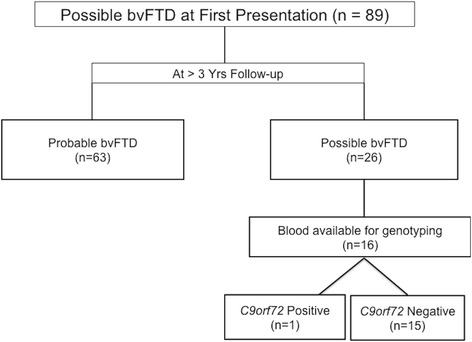
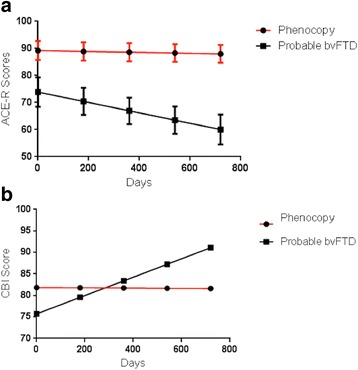
BACKGROUND: This study aimed to i) examine the frequency of C9orf72 expansions in a cohort of patients with the behavioural variant frontotemporal dementia (bvFTD) phenocopy syndrome, ii) observe outcomes in a group of phenocopy syndrome with very long term follow-up and iii) compare progression in a cohort of patients with the phenocopy syndrome to a cohort of patients with probable bvFTD. METHODS: Blood was obtained from 16 phenocopy cases. All met criteria for possible bvFTD and were labeled as phenocopy cases if they showed no functional decline, normal cognitive performance on the Addenbrooke's Cognitive Examination-Revised (ACE-R) and a lack of atrophy on brain imaging, over at least 3 years of follow-up. In addition, we obtained very long term follow-up data in 6 cases. A mixed model analysis approach determined the pattern of change in cognition and behaviour over time in phenocopy cases compared to 27 probable bvFTD cases. RESULTS: All 16 patients were screened for the C9orf72 expansion that was present in only one (6.25%). Of the 6 cases available for very long-term follow-up (13 - 21 years) none showed progression to frank dementia. Moreover, there was a decrease in the caregiver ratings of behavioural symptoms over time. Phenocopy cases showed significantly slower rates of progression compared to probable bvFTD patients (p < 0.006). CONCLUSION: The vast majority of patients with the bvFTD phenocopy syndrome remain stable over many years. An occasional patient can harbor the C9orf72 expansion. The aetiology of the remaining cases remains unknown but it appears very unlikely to reflect a neurodegenerative syndrome due to lack of clinical progression or atrophy on imaging.
Overview
The claims and statistics of this paper haven’t been checked yet.
Free: it reads the open-access text and checks the first 5 claims that cite a source we can check. Create a free account to check every claim.
Integrity signals
Registry
Cites
Statistics
Figures
Verification
Claims the paper makes
The claims and statistics of this paper haven’t been checked yet.
Free: it reads the open-access text and checks the first 5 claims that cite a source we can check. Create a free account to check every claim.
Claims other papers make about this one
Each is checked against this paper’s own text: does it say what the citing paper says it does?
In the citing paper
“Lastly, it is important to acknowledge the bvFTD phenocopy syndrome (phFTD) as a distinct entity from bvFTD. Apart from clinically mimicking bvFTD while lacking clear etiology, phFTD showed to be non-progressive over an extensive period of time (10+ years) (Devenney et al., 2018).”
From The pursuit for markers of disease progression in behavioral variant frontotemporal dementia: a scoping review to optimize outcome measures for clinical trials (2024) · cites this paper as Devenney et al., 2018
Self-check
Percentages, sums and reported differences re-computed from the paper’s own numbers.
The self-check needs the paper’s full text.
Citations
Cites
Hirono, N., Mori, E., Ikejiri, Y., Imamura, T., Shimomura, T., Hashimoto, M., Yamashita, H., & Ikeda, M. (1997) · Brain and nerve · Cited by 21,039
Random-Effects Models for Longitudinal Data
Laird, N. M., & Ware, J. H. (1982) · Biometrics · doi:10.2307/2529876 · Cited by 8,923
Sensitivity of revised diagnostic criteria for the behavioural variant of frontotemporal dementia
Rascovsky, K., Hodges, J. R., Knopman, D., Mendez, M. F., Kramer, J. H., Neuhaus, J., van Swieten, J. C., Seelaar, H., Dopper, E. G. P., Onyike, C. U., et al. (2011) · Brain · doi:10.1093/brain/awr179 · Cited by 5,221 · cited 6×
“Probable bvFTD, criteria was met when patients firstly satisfied possible criteria with additional evidence of functional decline, and frontal or temporal abnormalities on MRI or Fludeoxyglucose (18F)-Positron emission tomography (FDG-PET) [1].”
BackgroundMethodSelf-citationA Hexanucleotide Repeat Expansion in C9ORF72 Is the Cause of Chromosome 9p21-Linked ALS-FTD
Renton, A. E., Majounie, E., Waite, A., Simón-Sánchez, J., Rollinson, S., Gibbs, J. R., Schymick, J. C., Laaksovirta, H., van Swieten, J. C., Myllykangas, L., et al. (2011) · Neuron · doi:10.1016/j.neuron.2011.09.010 · Cited by 4,409 · cited 2×
“Renton AE, Majounie E, Waite A, Simón-Sánchez J, Rollinson S, Gibbs JR, Schymick JC, Laaksovirta H, Van Swieten JC, Myllykangas L.”
MethodAppelhof, B., Bakker, C., Van Duinen-van den Ijssel, J. C. L., Zwijsen, S. A., Smalbrugge, M., Verhey, F. R. J., de Vugt, M. E., Zuidema, S. U., & Koopmans, R. T. C. M. (2017) · Dementia and Geriatric Cognitive Disorders · doi:10.1159/000477087 · Cited by 2,760
Mioshi, E., Dawson, K., Mitchell, J., Arnold, R., & Hodges, J. R. (2006) · International Journal of Geriatric Psychiatry · doi:10.1002/gps.1610 · Cited by 2,016 · cited 1×
“Global cognitive function was measured using the Addenbrooke’s Cognitive Examination-Revised (ACE-R) [13]; a normal”
MethodSelf-citationHappé, F., Booth, R., Charlton, R., & Hughes, C. (2006) · Brain and Cognition · doi:10.1016/j.bandc.2006.03.004 · Cited by 638 · cited 1×
“control and emotion processing [18] as do patients on the Asperger-Autism spectrum [19, 20].”
MethodClinical staging and disease progression in frontotemporal dementia
Mioshi, E., Hsieh, S., Savage, S., Hornberger, M., & Hodges, J. R. (2010) · Neurology · doi:10.1212/wnl.0b013e3181e04070 · Cited by 362
Self-citationBeck, J., Poulter, M., Hensman, D., Rohrer, J. D., Mahoney, C. J., Adamson, G., Campbell, T., Uphill, J., Borg, A., Fratta, P., et al. (2013) · The American Journal of Human Genetics · doi:10.1016/j.ajhg.2013.01.011 · Cited by 345 · cited 2×
“Alzheimer’s disease (AD), although many lacked neuropathological confirmation [22].”
BackgroundSelf-citationImpaired recognition of negative basic emotions in autism: A test of the amygdala theory
Ashwin, C., Chapman, E., Colle, L., & Baron-Cohen, S. (2006) · Social Neuroscience · doi:10.1080/17470910601040772 · Cited by 319 · cited 1×
“control and emotion processing [18] as do patients on the Asperger-Autism spectrum [19, 20].”
MethodChare, L., Hodges, J. R., Leyton, C. E., McGinley, C., Tan, R. H., Kril, J. J., & Halliday, G. M. (2014) · Journal of Neurology, Neurosurgery & Psychiatry · doi:10.1136/jnnp-2013-306948 · Cited by 229 · cited 1×
“Although the accuracy of these criteria has been pathologically validated, controversy still exists regarding the aetiology, progression and prognosis of possible bvFTD [2].”
BackgroundSelf-citationKhan, B. K., Yokoyama, J. S., Takada, L. T., Sha, S. J., Rutherford, N. J., Fong, J. C., Karydas, A. M., Wu, T., Ketelle, R. S., Baker, M. C., et al. (2012) · Journal of Neurology, Neurosurgery & Psychiatry · doi:10.1136/jnnp-2011-301883 · Cited by 185 · cited 2×
“Moreover, cases who have been labeled as the ‘phenocopy syndrome’ have also been reported to carry the C9orf72 expansion [8, 9].”
BackgroundKipps, C. M., Davies, R. R., Mitchell, J., Kril, J. J., Halliday, G. M., & Hodges, J. R. (2007) · Dementia and Geriatric Cognitive Disorders · doi:10.1159/000100973 · Cited by 172 · cited 1×
“In this study MRI scans were performed in all cases and a validated visual rating scale, assessed atrophy of the orbitofrontal cortex, anterior temporal poles and insular cortex, according to previously published data [10, 11].”
MethodSelf-citationThe utility of the Cambridge Behavioural Inventory in neurodegenerative disease
Wedderburn, C., Wear, H., Brown, J., Mason, S. J., Barker, R. A., Hodges, J., & Williams-Gray, C. (2008) · Journal of Neurology, Neurosurgery & Psychiatry · doi:10.1136/jnnp.2007.122028 · Cited by 166 · cited 1×
“Behavioural Inventory), [12]; a higher score indicates greater impairment (maximum score – 316).”
BackgroundSelf-citationExecutive function in progressive and nonprogressive behavioral variant frontotemporal dementia
Hornberger, M., Piguet, O., Kipps, C., & Hodges, J. R. (2008) · Neurology · doi:10.1212/01.wnl.0000334299.72023.c8 · Cited by 151
Self-citationKipps, C. M., Hodges, J. R., & Hornberger, M. (2010) · Current Opinion in Neurology · doi:10.1097/wco.0b013e3283404309 · Cited by 126 · cited 1×
“with cognitive and behavioural changes, that are identical to the deficits seen in probable bvFTD cases, yet do not show significant brain atrophy [6, 16].”
BackgroundSelf-citationKipps, C. M., Hodges, J. R., Fryer, T. D., & Nestor, P. J. (2009) · Brain · doi:10.1093/brain/awp077 · Cited by 120
Self-citationTracking the progression of social cognition in neurodegenerative disorders
Kumfor, F., Irish, M., Leyton, C., Miller, L., Lah, S., Devenney, E., Hodges, J. R., & Piguet, O. (2014) · Journal of Neurology, Neurosurgery & Psychiatry · doi:10.1136/jnnp-2013-307098 · Cited by 97 · cited 1×
“control and emotion processing [18] as do patients on the Asperger-Autism spectrum [19, 20].”
MethodSelf-citationHornberger, M., Shelley, B. P., Kipps, C. M., Piguet, O., & Hodges, J. R. (2009) · Journal of Neurology, Neurosurgery & Psychiatry · doi:10.1136/jnnp.2008.163873 · Cited by 84
Self-citationGossink, F. T., Dols, A., Kerssens, C. J., Krudop, W. A., Kerklaan, B. J., Scheltens, P., Stek, M. L., & Pijnenburg, Y. A. L. (2015) · Journal of Neurology, Neurosurgery & Psychiatry · doi:10.1136/jnnp-2014-308284 · Cited by 64 · cited 1×
“a high rate of adverse life events, relationship problems and cluster C personality traits comprising the avoidant, dependent, and obsessive-compulsive personality traits [21].”
BackgroundProgression in Behavioral Variant Frontotemporal Dementia: A Longitudinal Study
Devenney, E., Bartley, L., Hoon, C., O’Callaghan, C., Kumfor, F., Hornberger, M., Kwok, J. B., Halliday, G. M., Kiernan, M. C., Piguet, O., et al. (2015) · JAMA Neurology · doi:10.1001/jamaneurol.2015.2061 · Cited by 61 · cited 3×
“Patients harboring the C9orf72 expansion may also satisfy criteria for possible, but not probable, bvFTD at first presentation and may be atypical with pervasive psychotic features [3].”
BackgroundSelf-citationAmbikairajah, A., Devenney, E., Flanagan, E., Yew, B., Mioshi, E., Kiernan, M. C., Hodges, J. R., & Hornberger, M. (2014) · Amyotrophic Lateral Sclerosis and Frontotemporal Degeneration · doi:10.3109/21678421.2014.880180 · Cited by 38 · cited 1×
“In this study MRI scans were performed in all cases and a validated visual rating scale, assessed atrophy of the orbitofrontal cortex, anterior temporal poles and insular cortex, according to previously published data [10, 11].”
MethodSelf-citationGalimberti, D., Arosio, B., Fenoglio, C., Serpente, M., Cioffi, S. M. G., Bonsi, R., Rossi, P., Abbate, C., Mari, D., & Scarpini, E. (2014) · Journal of Alzheimer's Disease · doi:10.3233/jad-131172 · Cited by 31
The bvFTD phenocopy syndrome: a clinicopathological report
Devenney, E. M., Forrest, S. L., Xuereb, J. H., Kril, J. J., & Hodges, J. R. (2016) · Journal of Neurology Neurosurgery & Psychiatry · doi:10.1136/jnnp-2015-312826 · Cited by 28 · cited 1×
“vious clinicopathological study found that 2 phenocopy cases did not have FTLD pathology at autopsy [17].”
BackgroundSelf-citationClinical heterogeneity of the C9orf72 genetic mutation in frontotemporal dementia
Devenney, E. M., Foxe, D., Dobson‐Stone, C., Kwok, J. B., Kiernan, M. C., & Hodges, J. R. (2014) · Neurocase · doi:10.1080/13554794.2014.951058 · Cited by 25
Self-citation
Cited by
Ducharme, S., Dols, A., Laforce, R., Devenney, E., Kumfor, F., van den Stock, J., Dallaire-Théroux, C., Seelaar, H., Gossink, F., Vijverberg, E., et al. (2020) · Brain · doi:10.1093/brain/awaa018 · Cited by 320
Self-citationFrontotemporal Dementia: A Clinical Review
Sivasathiaseelan, H., Marshall, C. R., Agustus, J. L., Benhamou, E., Bond, R. L., van Leeuwen, J. E. P., Hardy, C. J. D., Rohrer, J. D., & Warren, J. D. (2019) · Seminars in Neurology · doi:10.1055/s-0039-1683379 · Cited by 112
Illán-Gala, I., Montal, V., Borrego-Écija, S., Vilaplana, E., Pegueroles, J., Alcolea, D., Sánchez-Saudinós, B., Clarimón, J., Turón-Sans, J., Bargalló, N., et al. (2019) · Brain · doi:10.1093/brain/awz031 · Cited by 60
Phenocopy syndrome of behavioral variant frontotemporal dementia: a systematic review
Valente, E. S., Caramelli, P., Gambogi, L. B., Mariano, L. I., Guimarães, H. C., Teixeira, A. L., & de Souza, L. C. (2019) · Alzheimer's Research & Therapy · doi:10.1186/s13195-019-0483-2 · Cited by 54
FTD spectrum: Neuroimaging across the FTD spectrum
Whitwell, J. L. (2019) · Progress in Molecular Biology and Translational Science · doi:10.1016/bs.pmbts.2019.05.009 · Cited by 53
Metadata
- Authors
- Devenney, E., Swinn, T., Mioshi, E., Hornberger, M., Dawson, K. E., Mead, S., Rowe, J. B., & Hodges, J. R.
- Affiliations
- The University of Sydney (AU)
- MRC Cognition and Brain Sciences Unit (GB)
- University of East Anglia (GB)
- University of Cambridge (GB)
- MRC Prion Unit (GB)
- Corresponding author
- Devenney, E.
- Venue
- BMC Neurology
- Published
- 2018-04-28
- Volume
- 18
- Issue
- 1
- Pages
- 56-56
- ISSN
- 1471-2377 (ISSN-L)
- PMC
- PMC5923010
- OpenAlex
- W2801399439
- Cited by
- 37
- References
- 25
- Citations by year
- 2026: 2 · 2025: 6 · 2024: 6 · 2023: 1 · 2022: 3 · 2021: 5 · 2020: 5 · 2019: 9
- FWCI
- 3.74
- Type
- journal article
- Language
- en
- Open access
- gold
- doi.org
- Licence
- cc-by
- creativecommons.org/licenses/by/4.0/ (tdm)
- Locations
- BMC Neurology (publishedVersion, cc-by)
- Europe PMC (PubMed Central) (publishedVersion, cc-by)
- PubMed Central (publishedVersion, cc-by)
- PubMed (publishedVersion)
- UEA Digital Repository (University of East Anglia) (acceptedVersion)
- DOAJ (DOAJ: Directory of Open Access Journals) (submittedVersion)
- UCL Discovery (University College London) (submittedVersion)
- Apollo (University of Cambridge) (submittedVersion, cc-by)
- Apollo
- Apollo (cc-by)
- Funders
- National Health and Medical Research Council (#1037746)
- Centre of Excellence in Cognition and its Disorders, Australian Research Council (#CE110001021)
- Motor Neurone Disease Research Institute of Australia
- Alzheimer's Association
- Alzheimer's Society
- Alzheimer’s Research UK
- Medical Research Council
- Wellcome Trust (103838)
- Topics
- Health Sciences › Medicine › Psychiatry and Mental health › Dementia and Cognitive Impairment Research
- Health Sciences › Medicine › Clinical Neurology › Amyotrophic Lateral Sclerosis Research
- Life Sciences › Neuroscience › Cellular and Molecular Neuroscience › Alzheimer's disease research and treatments
- Keywords
- behavioral variant frontotemporal dementia, C9orf72 expansion, disease progression, long-term follow-up, cognitive stability, behavioural symptoms, etiology, neurodegeneration
- MeSH terms
- C9orf72 Protein, Aged, Female, Humans, Longitudinal Studies, Magnetic Resonance Imaging, Male, Middle Aged, Neuropsychological Tests, Phenotype, Syndrome, Disease Progression, Frontotemporal Dementia, Neuroimaging
About these checks
Registry, retraction, Cites and statistics results are computed, not judged, with one exception: a printed reference that no index lists is read once by a model before it counts as a citation error. Claims are extracted by a model and kept only when their quote appears verbatim in the text; each cited source is then checked, with a model’s help, for whether it says what the claim relies on. Those verdicts can be wrong — read the claim’s quote and the cited source before relying on one.
Statistics and arithmetic are recomputed, not judged.
Confidence bands are shown only for fields calibrated on our annotated test set. None is calibrated yet, so no band is shown.
What counts as a claim ›How we measure confidence ›How we check this ›
Are you an author, or do you see a problem with this page? Request a review
Data sources
Bibliographic data: Semantic Scholar, OpenAlex, Crossref.
Contains information from the Semantic Scholar Academic Graph Datasets, made available under the ODC Attribution License (ODC-BY 1.0).
Semantic Scholar’s data is described in: Kinney, R., et al. (2023). The Semantic Scholar Open Data Platform. arXiv:2301.10140.
