

Web-based interventions for prevention and treatment of perinatal mood disorders: a systematic review
Open accessThe DOI matches its Crossref record; 54 of the 55 references it cites were found in a registry or an index.
Abstract
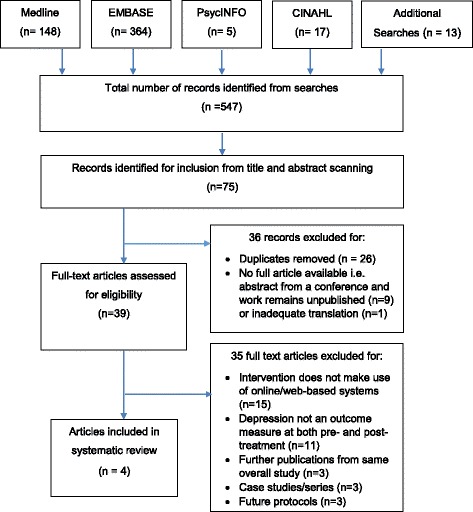
BACKGROUND: Perinatal depression is strikingly common with a prevalence of 10-15%. The adverse effects of perinatal depression on maternal and child health are profound with considerable costs. Despite this, few women seek medical attention. E-health, providing healthcare via the Internet is an accessible and effective solution for the treatment of depression in the general population. We aimed to conduct a systematic review of web-based interventions for the prevention and treatment of mood disorders in the perinatal period, defined as the start of pregnancy to 1 year post-partum. METHODS: Six databases were searched until 26(th) March 2015. Two researchers independently screened articles for eligibility. Of the 547 screened articles, four met the inclusion criteria. These included three randomised-controlled trials and one feasibility trial, with total data from 1274 participants. MOOSE and PRISMA guidelines were adhered to for the conduct and reporting of the systematic review. RESULTS: All studies were conducted in the post-partum period. All reported an improvement in maternal mood following intervention. A significant improvement in depressive symptoms was measured using validated rating scales, such as the Edinburgh Postnatal Depression Scale (EPDS), either at post-treatment or follow-up which ranged from 3 to 12 months post study completion. For the two RCTs utilising the EPDS, the EPDS score reductions were (mean ± SEM) 8.52 ± 0.22 (Range 19.46 to10.94) and 9.19 ± 0.63 (Range, 20.24 to 11.05) for treatment groups and 5.16 ± 0.25 (Range 19.44 to 14.28) and 6.81 ± 0.71 (Range 21.07 to 14.26) for comparator groups. However attrition within studies ranged from 13 to 61%. One study was rated as 'good' quality. CONCLUSIONS: Preliminary data suggests web-based therapies for perinatal depression delivered in the post-partum period may play a role in improving maternalmood but more studies are needed, particularly with interventions delivered antenatally. Further research is needed to address the limitations of the existing evidence base.
Overview
The claims and statistics of this paper haven’t been checked yet.
Free: it reads the open-access text and checks the first 5 claims that cite a source we can check. Create a free account to check every claim.
Integrity signals
Registry
Cites
Statistics
Figures
Verification
Claims the paper makes
The claims and statistics of this paper haven’t been checked yet.
Free: it reads the open-access text and checks the first 5 claims that cite a source we can check. Create a free account to check every claim.
Claims other papers make about this one
Each is checked against this paper’s own text: does it say what the citing paper says it does?
The cited source says what the claim attributes to it.
In the citing paper
“However, most of these interventions cater only to mothers [32,35,37,38] and are only introduced during the postnatal period [28,30,31,33,34,38].”
From Effectiveness of a Technology-Based Supportive Educational Parenting Program on Parental Outcomes (Part 1): Randomized Controlled Trial (2019) · cites this paper as [38]
The cited source says what the claim attributes to it.
In the citing paper
“Although internet-based interventions for PND show promising results, they face adherence problems even when the intervention is guided (O'Mahen et al., 2013a; O'Mahen et al., 2013b; Lee et al., 2016; Lau et al., 2017; Forsell et al., 2017).”
From App-based intervention for reducing depressive symptoms in postpartum women: Protocol for a feasibility randomized controlled trial (2023) · cites this paper as Lee et al., 2016
The cited source says what the claim attributes to it.
In the citing paper
“Existing reviews focused on specific intervention contents like internet-delivered Cognitive Behavioural Therapy (iCBT) [27, 31] on specific diagnoses like depression and anxiety [27, 28, 30, 31] or on specific modalities like internet-delivered interventions [26, 29].”
From Mental health-related telemedicine interventions for pregnant women and new mothers: a systematic literature review (2023) · cites this paper as [26]
The cited source says what the claim attributes to it.
In the citing paper
“To our knowledge, there are currently few systematic reviews and meta-analyses in the literature that have dealt specifically with the topic of mental health and telemedicine interventions for pregnant women or new mothers [26–31].”
From Mental health-related telemedicine interventions for pregnant women and new mothers: a systematic literature review (2023) · cites this paper as [26]
Self-check
Percentages, sums and reported differences re-computed from the paper’s own numbers.
The self-check needs the paper’s full text.
Citations
Cites
Liberati, A., Altman, D. G., Tetzlaff, J., Mulrow, C., Gøtzsche, P. C., Ioannidis, J. P. A., Clarke, M., Devereaux, P. J., Kleijnen, J., & Moher, D. (2009) · PLoS Medicine · doi:10.1371/journal.pmed.1000100 · Cited by 28,164 · cited 1×
“The Meta-analysis of Observational Studies in Epidemiology (MOOSE) guidelines were followed for the conduct [34], and the Preferred Reporting Items for Systematic Reviews and Meta-analyses (PRISMA) guidelines for the reporting [35] of this systematic review.”
MethodDermyshi, E., Wang, Y., Yan, C., Hong, W., Qiu, G., Gong, X., & Zhang, T. (2017) · Neonatology · doi:10.1159/000454668 · Cited by 24,451
Meta-analysis of Observational Studies in Epidemiology<SUBTITLE>A Proposal for Reporting</SUBTITLE>
Stroup, D. F. (2000) · JAMA · doi:10.1001/jama.283.15.2008 · Cited by 20,623
Liberati, A., Altman, D. G., Tetzlaff, J., Mulrow, C., Gotzsche, P. C., Ioannidis, J. P. A., Clarke, M., Devereaux, P. J., Kleijnen, J., & Moher, D. (2009) · BMJ · doi:10.1136/bmj.b2700 · Cited by 17,648
Jacobson, N. S., & Truax, P. (1991) · Journal of Consulting and Clinical Psychology · doi:10.1037/0022-006x.59.1.12 · Cited by 7,770 · cited 1×
“There was reduction in symptom scores in all studies, with the reported reduction in the two RCTs using the EPDS as an outcome measure, considered a clinically significant improvement [46, 47].”
ResultPerinatal Depression: A Systematic Review of Prevalence and Incidence
Gavin, N. I., Gaynes, B. N., Lohr, K. N., Meltzer-Brody, S., Gartlehner, G., & Swinson, T. (2005) · Obstetrics & Gynecology · doi:10.1097/01.aog.0000183597.31630.db · Cited by 3,282 · cited 1×
“curring in 10–15 % of pregnancies [1, 2], with the prevalence of depression peaking at 3 months postpartum.”
BackgroundSaving Mothers’ Lives: Reviewing maternal deaths to make motherhood safer: 2006–2008
(2011) · BJOG: An International Journal of Obstetrics & Gynaecology · doi:10.1111/j.1471-0528.2010.02847.x · Cited by 2,994
Maternal Depression and Child Psychopathology: A Meta-Analytic Review
Goodman, S. H., Rouse, M. H., Connell, A. M., Broth, M. R., Hall, C. M., & Heyward, D. (2011) · Clinical Child and Family Psychology Review · doi:10.1007/s10567-010-0080-1 · Cited by 2,621
Verhagen, A. P., de Vet, H. C. W., de Bie, R. A., Kessels, A. G. H., Boers, M., Bouter, L. M., & Knipschild, P. G. (1998) · Journal of Clinical Epidemiology · doi:10.1016/s0895-4356(98)00131-0 · Cited by 2,379 · cited 1×
“quality, using a modified tool [42] with objective criteria relating to sample population and recruitment, interven-”
MethodInternet-based cognitive behaviour therapy for symptoms of depression and anxiety: A meta-analysis
SPEK, V., CUIJPERS, P., NYKLÍČEK, I., RIPER, H., KEYZER, J., & POP, V. (2007) · Psychological Medicine · doi:10.1017/s0033291706008944 · Cited by 1,586
Research works printed but not linked: 1
- Cochrane Consumers and Communication Review Group. Data Extraction Template for Cochrane Reviews. The Cochrane Collaboration; 2013. http://cccrg.cochrane.org/author-resources. Accessed 23 Feb 2016
Cited by
Items 101–144 of 144
The use of e-mental health tools in the perinatal context
Fonseca, A., Mancinelli, E., & Branquinho, M. (2024) · BJPsych Advances · doi:10.1192/bja.2024.23 · Cited by 5
“The results revealed a signi fi cant decrease in both depressive and anxiety symptoms (Stamou 2021), suggesting the promising use of these tools for treatment and prevention of PMADs.”
InfluentialOnline-Interventionen bei postpartaler Depression
Westerhoff, B., Trösken, A., & Renneberg, B. (2019) · Verhaltenstherapie · doi:10.1159/000496095 · Cited by 3
Mental Health Policy in India: Seven Sets of Questions and Some AnswersPreprint
Mirza, A., & Singh, N. (2018) · SSRN Electronic Journal · doi:10.2139/ssrn.3307898 · Cited by 4
Tang, L., Qing, H., Li, H., Liu, C., Wang, H., Sun, Y., Tan, Q., Wu, Y., Yang, X. Y., Lai, J., et al. (2025) · Frontiers in Psychiatry · doi:10.3389/fpsyt.2025.1544753 · Cited by 3
“However, most studies have focused on its therapeutic applications rather than its preventive potential for antenatal and/or postpartum depression (12), leaving the preventive effects largely inconclusive.”
Allegri, B., Deste, G., Brenna, V., Gritti, E. S., Confalonieri, L., Puzzini, A., Corbani, I. E., Zucchetti, A., Mazza, U., Rabà, T., et al. (2025) · Brain Sciences · doi:10.3390/brainsci15090963 · Cited by 3
“A review by [29] suggested that web-based therapies for perinatal depression administered in the postpartum period improved maternal mood.”
Tecnologias eHealth direcionadas aos pais para o cuidado de bebês prematuros: Revisão integrativa
de Queiroz, M. A. D. S., Brasil, C. C. P., Cabral, C. B. M., Porto, A. C. L., Barbosa, P. M. E., & de Sousa, R. C. (2022) · New Trends in Qualitative Research · doi:10.36367/ntqr.13.2022.e693 · Cited by 4
Franco, P., Olhaberry, M., Muzard, A., Lara, M. A., & Cuijpers, P. J. (2022) · Depression and personality · doi:10.1007/978-3-031-13029-8_8 · Cited by 2
Laird, B., Moyer, S. W., Huberty, J., Bodnar-Deren, S. M., & Kinser, P. A. (2025) · JMIR Pediatrics and Parenting · doi:10.2196/72580 · Cited by 2
“Local active and passive recruitment was used to complement national recruitment efforts, given that online recruitment can have varying success in reaching individuals from historically marginalized populations [11,12].”
Concepts for Improving Perinatal Care in the Modern World
BODYKOV, G. Z., & Kurmanova, А. (2021) · Bulletin of Science and Practice · doi:10.33619/2414-2948/71/22 · Cited by 1
Corno, G., Molinari, G., Espinoza, M., Etchemendy, E., Herrero, R., Carrillo, A., & Baños, R. (2019) · Springer eBooks · doi:10.1007/978-3-030-20311-5_12 · Cited by 1
Leiferman, J. A., Farewell, C. V., Lee‐Winn, A. E., Jewell, J. S., Ulrickson, C., Huberty, J., & Paulson, J. F. (2019) · Journal of Continuing Education in the Health Professions · doi:10.1097/ceh.0000000000000263 · Cited by 2
Perinatal internet-based cognitive behavioural therapy for preventing postnatal depression
Toyomoto, R., Yoshida, K., Sahker, E., Sakata, M., Luo, Y., Tajika, A., & Watanabe, N. (2022) · Cochrane Database of Systematic Reviews · doi:10.1002/14651858.cd014849 · Cited by 2
Mental Health Policy in India: Seven Sets of Questions and Some AnswersPreprint
Mirza, A., & Singh, N. (2017) · SSRN Electronic Journal · doi:10.2139/ssrn.3033286 · Cited by 6
Zarei, M., Kheirkhah, M., Azadi, N. A., saberi, M., & Esmaeeli, N. (2020) · Research Square · doi:10.21203/rs.3.rs-103718/v1 · Cited by 1
“But further researches in this regard is known to be necessary (24).”
BackgroundResultCurrent Resources for Evidence-Based Practice, January/February 2017
Carlson, N. S. (2016) · Journal of Obstetric, Gynecologic & Neonatal Nursing · doi:10.1016/j.jogn.2016.11.002
MyDoula: An Interactive Screening and Support System for the Prevention of Perinatal Mood Disorders
Lewis, M. M. (2019) · RIT Scholar Works (Rochester Institute of Technology)
Utilizing video education to increase knowledge and awareness of perinatal anxiety and depression
Ketterer, M. L. (2020) · UA Campus Repository (The University of Arizona)
The Miscarriage Circle of Care: Towards Leveraging eHealth for Social SupportPreprint
Alqassim, M. Y., Kresnye, K. C., Siek, K. A., Lee, J. R., & Wolters, M. K. (2021) · Research Square · doi:10.21203/rs.3.rs-564669/v1
“Recent relevant systematic reviews [63, 64] show that Kersting et al.”
BackgroundCanfield, S. M. (2021) · MOspace Institutional Repository (University of Missouri) · doi:10.32469/10355/85766 · Cited by 1
Andrejek, N., Hossain, S., Schoueri‐Mychasiw, N., Saeed, G., Zibaman, M., Niño, A. P., Meltzer-Brody, S. E., Silver, R. K., Vigod, S. N., & Singla, D. R. (2021) · Research Square · doi:10.21203/rs.3.rs-675643/v1
Digital health in obstetric care
van den Heuvel, J. F. M. (2021) · Utrecht University Repository (Utrecht University) · doi:10.33540/605 · Cited by 3
Leiferman, J. A., Lee‐Winn, A. E., Lacy, R., & Paulson, J. F. (2022) · Women s Health Issues · doi:10.1016/j.whi.2022.08.009 · Cited by 1
Case study: Cognitive behavioral therapy for postnatal depression
Branquinho, M., Martínez‐Borba, V., & Fonseca, A. (2023) · Elsevier eBooks · doi:10.1016/b978-0-323-85757-4.00036-5
Valla, L., Haga, S. M., Garthus‐Niegel, S., & Drozd, F. (2023) · doi:10.2196/preprints.46982
The Effects of COVID-19 on Choosing to Have Children in the State of Hawai‘i
Maxwell, D., Seo, J. Y., & Stotzer, R. L. (2023) · Hawai‘i Journal of Health & Social Welfare · doi:10.62547/busb6316 · Cited by 1
Premji, S., Dobson, K. S., Prashad, A., Yamamoto, S. S., Tao, F., Zhu, B., Wu, X., Lu, M., & Shao, S. (2021) · Figshare · doi:10.6084/m9.figshare.13535321
Perinatal Depression Research Trends in Canada: A Bibliometric Analysis
Wolak, J. E., Letourneau, N. L., & Hayden, A. (2025) · Psychiatry International · doi:10.3390/psychiatryint6030086 · Cited by 1
Ajayi, K. V., Page, R. L., Wilson, K. L., McCord, C., & Garney, W. R. (2025) · International Journal of Environmental Research and Public Health · doi:10.3390/ijerph22081304
“With express permission from the developer, this study utilizes the eMB owing to the flexibility and anonymity offered by online-based psychosocial interventions, which have proven effective in reducing perinatal mental health symptoms [26].”
Ladekarl, M., Specht, I. O., Adegboye, A. R. A., Brødsgaard, A., Nohr, E. A., Olsen, N. J., & Heitmann, B. L. (2025) · PLOS mental health. · doi:10.1371/journal.pmen.0000294 · Cited by 1
“A higher number of drop-outs in the intervention group compared to the control group has also been found in other similar studies, suggesting that it can be challenging to retain participants in an intervention group [48–50].”
Singla, D. R., Meltzer-Brody, S. E., Silver, R. K., Vigod, S. N., Kim, J. J., La Porte, L. M., Ravitz, P., Schiller, C. E., Schoueri‐Mychasiw, N., Hollon, S. D., et al. (2021) · Figshare · doi:10.6084/m9.figshare.14173932
Jimènez-Barragan, M., del Pino‐Gutiérrez, A., Garcia, J. C., Monistrol-Ruano, O., Coll-Navarro, E., Porta, O., & Falguera‐Puig, G. (2024) · Figshare · doi:10.6084/m9.figshare.26615518
Haeken, S. V., Braeken, M. A. K. A., Horsch, A., Oosterman, M., & Bogaerts, A. (2024) · Figshare · doi:10.6084/m9.figshare.26615353
Singla, D. R., Meltzer-Brody, S. E., Silver, R. K., Vigod, S. N., Kim, J. J., La Porte, L. M., Ravitz, P., Schiller, C. E., Schoueri‐Mychasiw, N., Hollon, S. D., et al. (2021) · Figshare · doi:10.6084/m9.figshare.14173929
Stentzel, U., Grabe, H. J., Schmidt, S., Tomczyk, S., van den Berg, N., & Beyer, A. (2023) · Figshare · doi:10.6084/m9.figshare.22721507
Stentzel, U., Grabe, H. J., Schmidt, S., Tomczyk, S., van den Berg, N., & Beyer, A. (2023) · Figshare · doi:10.6084/m9.figshare.22721498
Stentzel, U., Grabe, H. J., Schmidt, S., Tomczyk, S., van den Berg, N., & Beyer, A. (2023) · Figshare · doi:10.6084/m9.figshare.22721495
Haeken, S. V., Braeken, M. A. K. A., Horsch, A., Oosterman, M., & Bogaerts, A. (2024) · Figshare · doi:10.6084/m9.figshare.26615347
Stentzel, U., Grabe, H. J., Schmidt, S., Tomczyk, S., van den Berg, N., & Beyer, A. (2023) · Figshare · doi:10.6084/m9.figshare.22721501
Haeken, S. V., Braeken, M. A. K. A., Horsch, A., Oosterman, M., & Bogaerts, A. (2024) · Figshare · doi:10.6084/m9.figshare.26615350
Stentzel, U., Grabe, H. J., Schmidt, S., Tomczyk, S., van den Berg, N., & Beyer, A. (2023) · Figshare · doi:10.6084/m9.figshare.22721504
Singla, D. R., de Oliveira, C., Murphy, S. M., Patel, V., Charlebois, J., Davis, W. N., Dennis, C.-L., Kim, J. J., Kurdyak, P., Lawson, A., et al. (2024) · Figshare · doi:10.6084/m9.figshare.26637432
‘No lu’au for baby's 1st birthday’: becoming a mother during the COVID-19 pandemic in Hawai’i
Maxwell, D., Hulama, K., Praetorius, R. T., Williams, J., Tamura, A., Arakaki-Mineshima, K., Reinhofer, C. J., Kameda, K., Wong, M., Garrett, B., et al. (2026) · Ethnicity and Health · doi:10.1080/13557858.2026.2655615
“PMADs often include depression, anxiety, obsessive-compulsive disorder, post-traumatic stress disorder, and bipolar mood disorders and psychosis (Lee et al. 2016).”
Xiang, T., Zou, S., Huang, W., Huang, M., Gao, Z., Zhang, R., & Huang, L. (2026) · Frontiers in Psychiatry · doi:10.3389/fpsyt.2026.1933085
Well-Being Beyond the Binary in Perinatal Healthcare: An Application of Reproductive Justice
Wright, O. (2026) · Digital Commons - DU (University of Denver) · doi:10.56902/etdcrp.2026.199
Metadata
- Authors
- Lee, E. W., Denison, F. C., Hor, K., & Reynolds, R. M.
- Affiliations
- The Queen's Medical Research Institute (GB)
- Queen Elizabeth University Hospital (GB)
- British Heart Foundation Centre for Cardiovascular Science (GB)
- Corresponding author
- Reynolds, Rebecca M.
- Venue
- BMC Pregnancy and Childbirth
- Published
- 2016-02-29
- Volume
- 16
- Issue
- 1
- Pages
- 38-38
- ISSN
- 1471-2393 (ISSN-L)
- PMC
- PMC4770541
- OpenAlex
- W2290323451
- Semantic Scholar
- ca9677c1b07d3b4bcd1bb2b3aebf1d8494974d25
- Cited by
- 143
- References
- 55
- Citations by year
- 2026: 3 · 2025: 11 · 2024: 9 · 2023: 25 · 2022: 19 · 2021: 27 · 2020: 16 · 2019: 16 · 2018: 10 · 2017: 6 · 2016: 1
- FWCI
- 1.63
- Type
- journal article
- Language
- en
- Open access
- gold
- doi.org
- Licence
- cc-by
- Locations
- BMC Pregnancy and Childbirth (publishedVersion, cc-by)
- PubMed Central (publishedVersion, cc-by)
- PubMed (publishedVersion)
- Edinburgh Research Explorer (University of Edinburgh) (submittedVersion, cc-by)
- Funders
- British Heart Foundation
- Topics
- Health Sciences › Medicine › Public Health, Environmental and Occupational Health › Maternal Mental Health During Pregnancy and Postpartum
- Social Sciences › Psychology › Applied Psychology › Digital Mental Health Interventions
- Health Sciences › Health Professions › General Health Professions › Mobile Health and mHealth Applications
- Keywords
- perinatal depression, online intervention, e-health, postpartum period, perinatal mood disorders, maternal mental health, Edinburgh Postnatal Depression Scale, depression prevention, antenatal depression, attrition
- MeSH terms
- Adult, Depressive Disorder, Female, Humans, Pregnancy, Pregnancy Complications, Telemedicine, Depression, Postpartum, Internet, Postpartum Period, Young Adult
About these checks
Registry, retraction, Cites and statistics results are computed, not judged, with one exception: a printed reference that no index lists is read once by a model before it counts as a citation error. Claims are extracted by a model and kept only when their quote appears verbatim in the text; each cited source is then checked, with a model’s help, for whether it says what the claim relies on. Those verdicts can be wrong — read the claim’s quote and the cited source before relying on one.
Statistics and arithmetic are recomputed, not judged.
Confidence bands are shown only for fields calibrated on our annotated test set. None is calibrated yet, so no band is shown.
What counts as a claim ›How we measure confidence ›How we check this ›
Are you an author, or do you see a problem with this page? Request a review
Data sources
Bibliographic data: Semantic Scholar, OpenAlex, Crossref.
Contains information from the Semantic Scholar Academic Graph Datasets, made available under the ODC Attribution License (ODC-BY 1.0).
Semantic Scholar’s data is described in: Kinney, R., et al. (2023). The Semantic Scholar Open Data Platform. arXiv:2301.10140.
