

Web-based interventions for prevention and treatment of perinatal mood disorders: a systematic review
Open accessThe DOI matches its Crossref record; 54 of the 55 references it cites were found in a registry or an index.
Abstract
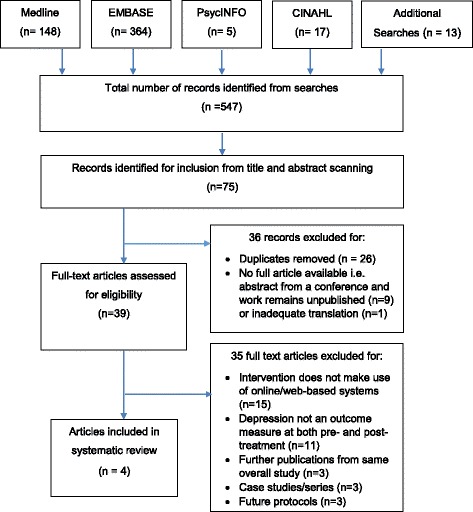
BACKGROUND: Perinatal depression is strikingly common with a prevalence of 10-15%. The adverse effects of perinatal depression on maternal and child health are profound with considerable costs. Despite this, few women seek medical attention. E-health, providing healthcare via the Internet is an accessible and effective solution for the treatment of depression in the general population. We aimed to conduct a systematic review of web-based interventions for the prevention and treatment of mood disorders in the perinatal period, defined as the start of pregnancy to 1 year post-partum. METHODS: Six databases were searched until 26(th) March 2015. Two researchers independently screened articles for eligibility. Of the 547 screened articles, four met the inclusion criteria. These included three randomised-controlled trials and one feasibility trial, with total data from 1274 participants. MOOSE and PRISMA guidelines were adhered to for the conduct and reporting of the systematic review. RESULTS: All studies were conducted in the post-partum period. All reported an improvement in maternal mood following intervention. A significant improvement in depressive symptoms was measured using validated rating scales, such as the Edinburgh Postnatal Depression Scale (EPDS), either at post-treatment or follow-up which ranged from 3 to 12 months post study completion. For the two RCTs utilising the EPDS, the EPDS score reductions were (mean ± SEM) 8.52 ± 0.22 (Range 19.46 to10.94) and 9.19 ± 0.63 (Range, 20.24 to 11.05) for treatment groups and 5.16 ± 0.25 (Range 19.44 to 14.28) and 6.81 ± 0.71 (Range 21.07 to 14.26) for comparator groups. However attrition within studies ranged from 13 to 61%. One study was rated as 'good' quality. CONCLUSIONS: Preliminary data suggests web-based therapies for perinatal depression delivered in the post-partum period may play a role in improving maternalmood but more studies are needed, particularly with interventions delivered antenatally. Further research is needed to address the limitations of the existing evidence base.
Overview
The claims and statistics of this paper haven’t been checked yet.
Free: it reads the open-access text and checks the first 5 claims that cite a source we can check. Create a free account to check every claim.
Integrity signals
Registry
Cites
Statistics
Figures
Verification
Claims the paper makes
The claims and statistics of this paper haven’t been checked yet.
Free: it reads the open-access text and checks the first 5 claims that cite a source we can check. Create a free account to check every claim.
Claims other papers make about this one
Each is checked against this paper’s own text: does it say what the citing paper says it does?
The cited source says what the claim attributes to it.
In the citing paper
“However, most of these interventions cater only to mothers [32,35,37,38] and are only introduced during the postnatal period [28,30,31,33,34,38].”
From Effectiveness of a Technology-Based Supportive Educational Parenting Program on Parental Outcomes (Part 1): Randomized Controlled Trial (2019) · cites this paper as [38]
The cited source says what the claim attributes to it.
In the citing paper
“Although internet-based interventions for PND show promising results, they face adherence problems even when the intervention is guided (O'Mahen et al., 2013a; O'Mahen et al., 2013b; Lee et al., 2016; Lau et al., 2017; Forsell et al., 2017).”
From App-based intervention for reducing depressive symptoms in postpartum women: Protocol for a feasibility randomized controlled trial (2023) · cites this paper as Lee et al., 2016
The cited source says what the claim attributes to it.
In the citing paper
“Existing reviews focused on specific intervention contents like internet-delivered Cognitive Behavioural Therapy (iCBT) [27, 31] on specific diagnoses like depression and anxiety [27, 28, 30, 31] or on specific modalities like internet-delivered interventions [26, 29].”
From Mental health-related telemedicine interventions for pregnant women and new mothers: a systematic literature review (2023) · cites this paper as [26]
The cited source says what the claim attributes to it.
In the citing paper
“To our knowledge, there are currently few systematic reviews and meta-analyses in the literature that have dealt specifically with the topic of mental health and telemedicine interventions for pregnant women or new mothers [26–31].”
From Mental health-related telemedicine interventions for pregnant women and new mothers: a systematic literature review (2023) · cites this paper as [26]
Self-check
Percentages, sums and reported differences re-computed from the paper’s own numbers.
The self-check needs the paper’s full text.
Citations
Cites
Liberati, A., Altman, D. G., Tetzlaff, J., Mulrow, C., Gøtzsche, P. C., Ioannidis, J. P. A., Clarke, M., Devereaux, P. J., Kleijnen, J., & Moher, D. (2009) · PLoS Medicine · doi:10.1371/journal.pmed.1000100 · Cited by 28,164 · cited 1×
“The Meta-analysis of Observational Studies in Epidemiology (MOOSE) guidelines were followed for the conduct [34], and the Preferred Reporting Items for Systematic Reviews and Meta-analyses (PRISMA) guidelines for the reporting [35] of this systematic review.”
MethodDermyshi, E., Wang, Y., Yan, C., Hong, W., Qiu, G., Gong, X., & Zhang, T. (2017) · Neonatology · doi:10.1159/000454668 · Cited by 24,451
Meta-analysis of Observational Studies in Epidemiology<SUBTITLE>A Proposal for Reporting</SUBTITLE>
Stroup, D. F. (2000) · JAMA · doi:10.1001/jama.283.15.2008 · Cited by 20,623
Liberati, A., Altman, D. G., Tetzlaff, J., Mulrow, C., Gotzsche, P. C., Ioannidis, J. P. A., Clarke, M., Devereaux, P. J., Kleijnen, J., & Moher, D. (2009) · BMJ · doi:10.1136/bmj.b2700 · Cited by 17,648
Jacobson, N. S., & Truax, P. (1991) · Journal of Consulting and Clinical Psychology · doi:10.1037/0022-006x.59.1.12 · Cited by 7,770 · cited 1×
“There was reduction in symptom scores in all studies, with the reported reduction in the two RCTs using the EPDS as an outcome measure, considered a clinically significant improvement [46, 47].”
ResultPerinatal Depression: A Systematic Review of Prevalence and Incidence
Gavin, N. I., Gaynes, B. N., Lohr, K. N., Meltzer-Brody, S., Gartlehner, G., & Swinson, T. (2005) · Obstetrics & Gynecology · doi:10.1097/01.aog.0000183597.31630.db · Cited by 3,282 · cited 1×
“curring in 10–15 % of pregnancies [1, 2], with the prevalence of depression peaking at 3 months postpartum.”
BackgroundSaving Mothers’ Lives: Reviewing maternal deaths to make motherhood safer: 2006–2008
(2011) · BJOG: An International Journal of Obstetrics & Gynaecology · doi:10.1111/j.1471-0528.2010.02847.x · Cited by 2,994
Maternal Depression and Child Psychopathology: A Meta-Analytic Review
Goodman, S. H., Rouse, M. H., Connell, A. M., Broth, M. R., Hall, C. M., & Heyward, D. (2011) · Clinical Child and Family Psychology Review · doi:10.1007/s10567-010-0080-1 · Cited by 2,621
Verhagen, A. P., de Vet, H. C. W., de Bie, R. A., Kessels, A. G. H., Boers, M., Bouter, L. M., & Knipschild, P. G. (1998) · Journal of Clinical Epidemiology · doi:10.1016/s0895-4356(98)00131-0 · Cited by 2,379 · cited 1×
“quality, using a modified tool [42] with objective criteria relating to sample population and recruitment, interven-”
MethodInternet-based cognitive behaviour therapy for symptoms of depression and anxiety: A meta-analysis
SPEK, V., CUIJPERS, P., NYKLÍČEK, I., RIPER, H., KEYZER, J., & POP, V. (2007) · Psychological Medicine · doi:10.1017/s0033291706008944 · Cited by 1,586
Computer-based psychological treatments for depression: A systematic review and meta-analysis
Richards, D., & Richardson, T. (2012) · Clinical Psychology Review · doi:10.1016/j.cpr.2012.02.004 · Cited by 1,442 · cited 1×
“has proved an acceptable and effective treatment for depression in non-pregnant individuals [17–26] with a”
BackgroundAndrews, G., Cuijpers, P., Craske, M. G., McEvoy, P., & Titov, N. (2010) · PLoS ONE · doi:10.1371/journal.pone.0013196 · Cited by 1,311 · cited 1×
“superiority compared to comparator therapies in the general population [18].”
BackgroundPersuasive System Design Does Matter: a Systematic Review of Adherence to Web-based Interventions
Kelders, S. M., Kok, R. N., Ossebaard, H. C., & Van Gemert-Pijnen, J. E. (2012) · Journal of Medical Internet Research · doi:10.2196/jmir.2104 · Cited by 1,308 · cited 1×
“Attrition rates are often high and problematic in other studies of online therapies [48, 49].”
BackgroundAdherence in Internet Interventions for Anxiety and Depression
Christensen, H., Griffiths, K. M., & Farrer, L. (2009) · Journal of Medical Internet Research · doi:10.2196/jmir.1194 · Cited by 1,133 · cited 1×
“Attrition rates are often high and problematic in other studies of online therapies [48, 49].”
BackgroundCognitive Therapy vs Medications in the Treatment of Moderate to Severe Depression
DeRubeis, R. J., Hollon, S. D., Amsterdam, J. D., Shelton, R. C., Young, P. R., Salomon, R. M., O’Reardon, J. P., Lovett, M. L., Gladis, M. M., Brown, L. L., et al. (2005) · Archives of General Psychiatry · doi:10.1001/archpsyc.62.4.409 · Cited by 989 · cited 1×
“Despite this, few women seek professional advice due to physical and attitudinal barriers, long-waiting times for face-to-face psy-chotherapies, social stigma [9 – 13] and uncertainties about the potential risks of pharmacological therapies during pregnancy [14 – 16].”
BackgroundDennis, C., & Chung‐Lee, L. (2006) · Birth · doi:10.1111/j.1523-536x.2006.00130.x · Cited by 881
Prenatal depression effects on early development: A review
Field, T. (2011) · Infant Behavior and Development · doi:10.1016/j.infbeh.2010.09.008 · Cited by 592 · cited 1×
“The adverse effects of perinatal depression on maternal and child health are profound [3 – 6] with estimated costs to the UK of £8.1 billion per year [7].”
BackgroundInfluentialProudfoot, J., Ryden, C., Everitt, B., Shapiro, D. A., Goldberg, D., Mann, A., Tylee, A., Marks, I., & Gray, J. A. (2004) · British Journal of Psychiatry · doi:10.1192/bjp.185.1.46 · Cited by 516 · cited 1×
“has proved an acceptable and effective treatment for depression in non-pregnant individuals [17–26] with a”
BackgroundInternet Use in Pregnancy Informs Women’s Decision Making: A Web‐Based Survey
Lagan, B. M., Sinclair, M., & George Kernohan, W. (2010) · Birth · doi:10.1111/j.1523-536x.2010.00390.x · Cited by 443 · cited 1×
“For example, in a study of 613 women, almost 50 % used the Internet to enhance their involvement in pregnancy-related decisionmaking [31] and 90 % felt that health professionals should actively suggest suitable Internet sites to guide their further reading during pregnancy [31].”
BackgroundWaller, R., & Gilbody, S. (2009) · Psychological Medicine · doi:10.1017/s0033291708004224 · Cited by 393 · cited 12×
“Further work is needed to understand the reason for this in order to gain a comprehensive understanding of the true acceptability of CCBT [50].”
BackgroundInfluentialDepressive Disorders During Pregnancy: Prevalence and Risk Factors in a Large Urban Sample
Melville, J. L., Gavin, A., Guo, Y., Fan, M.-Y., & Katon, W. J. (2010) · Obstetrics & Gynecology · doi:10.1097/aog.0b013e3181f60b0a · Cited by 329 · cited 1×
“curring in 10–15 % of pregnancies [1, 2], with the prevalence of depression peaking at 3 months postpartum.”
BackgroundThe London School of Economics and Political Science: LAKATOS AWARD IN PHILOSOPHY OF SCIENCE
(1989) · The British Journal for the Philosophy of Science · doi:10.1093/bjps/40.4.569 · Cited by 304
Preferences and perceived barriers to treatment for depression during the perinatal period
O'Mahen, H. A., & Flynn, H. A. (2008) · Journal of Women s Health · doi:10.1089/jwh.2007.0631 · Cited by 277 · cited 1×
“chotherapies, social stigma [9–13] and uncertainties about the potential risks of pharmacological therapies during pregnancy [14–16].”
BackgroundRoss, L. E., Grigoriadis, S., Mamisashvili, L., VonderPorten, E. H., Roerecke, M., Rehm, J., Dennis, C.-L., Koren, G., Steiner, M., Mousmanis, P., et al. (2013) · JAMA Psychiatry · doi:10.1001/jamapsychiatry.2013.684 · Cited by 268 · cited 1×
“Despite this, few women seek professional advice due to physical and attitudinal barriers, long-waiting times for face-to-face psy-chotherapies, social stigma [9 – 13] and uncertainties about the potential risks of pharmacological therapies during pregnancy [14 – 16].”
BackgroundKaltenthaler, E., Sutcliffe, P., Parry, G., Beverley, C., Rees, A., & Ferriter, M. (2008) · Psychological Medicine · doi:10.1017/s0033291707002607 · Cited by 267 · cited 1×
“has proved an acceptable and effective treatment for depression in non-pregnant individuals [17–26] with a”
BackgroundAbrams, L. S., Dornig, K., & Curran, L. (2009) · Qualitative Health Research · doi:10.1177/1049732309332794 · Cited by 224 · cited 1×
“Despite this, few women seek professional advice due to physical and attitudinal barriers, long-waiting times for face-to-face psy-chotherapies, social stigma [9 – 13] and uncertainties about the potential risks of pharmacological therapies during pregnancy [14 – 16].”
BackgroundLoomans, E. M., van Dijk, A. E., Vrijkotte, T. G. M., van Eijsden, M., Stronks, K., Gemke, R. J. B. J., & Van den Bergh, B. R. H. (2013) · European Journal of Public Health · doi:10.1093/eurpub/cks097 · Cited by 212 · cited 1×
“The adverse effects of perinatal depression on maternal and child health are profound [3–6] with estimated costs to the UK of £8.”
BackgroundKersting, A., Dölemeyer, R., Steinig, J., Walter, F., Kroker, K., Baust, K., & Wagner, B. (2013) · Psychotherapy and Psychosomatics · doi:10.1159/000348713 · Cited by 210 · cited 8×
“The four eligible studies included three randomised controlled trials (RCTs) [40, 43, 44] and one feasibility trial [45] (Tables 1 and 2) with data on 1274 participants from four countries.”
BackgroundMethodResultInfluentialO'Mahen, H. A., Woodford, J., McGinley, J., Warren, F. C., Richards, D. A., Lynch, T. R., & Taylor, R. S. (2013) · Journal of Affective Disorders · doi:10.1016/j.jad.2013.03.005 · Cited by 202
O'Mahen, H. A., Richards, D. A., Woodford, J., Wilkinson, E., McGinley, J., Taylor, R. S., & Warren, F. C. (2014) · Psychological Medicine · doi:10.1017/s0033291713002092 · Cited by 201 · cited 9×
“The four eligible studies included three randomised controlled trials (RCTs) [40, 43, 44] and one feasibility trial [45] (Tables 1 and 2) with data on 1274 participants from four countries.”
BackgroundInfluentialAndersson, G., Hesser, H., Veilord, A., Svedling, L., Andersson, F., Sleman, O., Mauritzson, L., Sarkohi, A., Claesson, E., Zetterqvist, V., et al. (2013) · Journal of Affective Disorders · doi:10.1016/j.jad.2013.08.022 · Cited by 195 · cited 1×
“Computerised Cognitive Behavioural Therapy (CCBT) has proved an acceptable and effective treatment for depression in non-pregnant individuals [17 – 26] with a comprehensive meta-analysis demonstrating significant superiority compared to comparator therapies in the general population [18].”
MethodPerinatal Depression: An Update and Overview
Stuart-Parrigon, K., & Stuart, S. (2014) · Current Psychiatry Reports · doi:10.1007/s11920-014-0468-6 · Cited by 175 · cited 1×
“This is despite the scarcity of psychosocial interventions specifically designed to treat perinatal depression (particularly that originating antenatally) and the changing and specific psychosocial needs of women during pregnancy and post-partum [29, 30].”
BackgroundAcceptability of Internet Treatment of Anxiety and Depression
Gun, S. Y., Titov, N., & Andrews, G. (2011) · Australasian Psychiatry · doi:10.3109/10398562.2011.562295 · Cited by 174 · cited 1×
“has proved an acceptable and effective treatment for depression in non-pregnant individuals [17–26] with a”
BackgroundMatthey, S. (2004) · Journal of Affective Disorders · doi:10.1016/s0165-0327(02)00313-0 · Cited by 168 · cited 1×
“There was reduction in symptom scores in all studies, with the reported reduction in the two RCTs using the EPDS as an outcome measure, considered a clinically significant improvement [46, 47].”
ResultGerhards, S. A. H., de Graaf, L. E., Jacobs, L. E., Severens, J. L., Huibers, M. J. H., Arntz, A., Riper, H., Widdershoven, G., Metsemakers, J. F. M., & Evers, S. M. A. A. (2010) · British Journal of Psychiatry · doi:10.1192/bjp.bp.109.065748 · Cited by 135 · cited 1×
“A CCBT resource for the self-management of perinatal depression could therefore represent an efficacious, accessible and economically sound resource [32].”
BackgroundMomMoodBooster Web-Based Intervention for Postpartum Depression: Feasibility Trial Results
Danaher, B. G., Milgrom, J., Seeley, J. R., Stuart, S., Schembri, C., Tyler, M. S., Ericksen, J., Lester, W., Gemmill, A. W., Kosty, D. B., et al. (2013) · Journal of Medical Internet Research · doi:10.2196/jmir.2876 · Cited by 124 · cited 4×
“However, the feasibility study [45] had extremely high attrition rates, with many women struggling to complete the intervention; excluding this study the early attrition ranged from 11 to 13 %.”
BackgroundMethodInfluentialKersting, A., Kroker, K., Schlicht, S., Baust, K., & Wagner, B. (2011) · Archives of Women's Mental Health · doi:10.1007/s00737-011-0240-4 · Cited by 118
Phillips, R., Schneider, J., Molosankwe, I., Leese, M., Foroushani, P. S., Grime, P., McCrone, P., Morriss, R., & Thornicroft, G. (2014) · Psychological Medicine · doi:10.1017/s0033291713001323 · Cited by 110 · cited 1×
“has proved an acceptable and effective treatment for depression in non-pregnant individuals [17–26] with a”
BackgroundBarriers to mental health treatment among obstetric patients at risk for depression
Kim, J., Porte, L. M. L., Corcoran, M., Magasi, S., Batza, J., & Silver, R. K. (2010) · American Journal of Obstetrics and Gynecology · doi:10.1016/j.ajog.2010.01.004 · Cited by 108 · cited 1×
“chotherapies, social stigma [9–13] and uncertainties about the potential risks of pharmacological therapies during pregnancy [14–16].”
BackgroundPinto, M. D., & Logsdon, M. C. (2008) · Archives of Psychiatric Nursing · doi:10.1016/j.apnu.2008.02.010 · Cited by 98 · cited 1×
“Despite this, few women seek professional advice due to physical and attitudinal barriers, long-waiting times for face-to-face psy-chotherapies, social stigma [9 – 13] and uncertainties about the potential risks of pharmacological therapies during pregnancy [14 – 16].”
Haga, S. M., Drozd, F., Brendryen, H., & Slinning, K. (2013) · JMIR Research Protocols · doi:10.2196/resprot.2659 · Cited by 84 · cited 2×
“assessment of reasons for completing the intervention or not, as well as acceptability of the intervention [51],”
BackgroundModifying CBT for perinatal depression: what do women want?
O'Mahen, H., Fedock, G., Henshaw, E., Himle, J. A., Forman, J., & Flynn, H. A. (2012) · Cognitive and Behavioral Practice · doi:10.1016/j.cbpra.2011.05.005 · Cited by 83 · cited 1×
“This is despite the scarcity of psychosocial interventions specifically designed to treat perinatal depression (particularly that originating antenatally) and the changing and specific psychosocial needs of women during pregnancy and post-partum [29, 30].”
BackgroundSchneider, J., Sarrami Foroushani, P., Grime, P., & Thornicroft, G. (2014) · Journal of Medical Internet Research · doi:10.2196/jmir.2871 · Cited by 67 · cited 1×
“has proved an acceptable and effective treatment for depression in non-pregnant individuals [17–26] with a”
BackgroundPilling, S., Adams, H., Barlow, J., Bavetta, M., Clarke, S. D., Day, A., Demilew, J., Grayson, K., Grégoire, A., Jones, I. R., et al. (2014) · Cited by 62
The acceptability of computer-aided cognitive behavioural therapy: A pragmatic study
Cavanagh, K., Shapiro, D. A., Van Den Berg, S., Swain, S., Barkham, M., & Proudfoot, J. (2009) · Cognitive Behaviour Therapy · doi:10.1080/16506070802561256 · Cited by 51 · cited 1×
“has proved an acceptable and effective treatment for depression in non-pregnant individuals [17–26] with a”
BackgroundInternet-based treatment after pregnancy loss: concept and case study
Kersting, A., Kroker, K., Schlicht, S., & Wagner, B. (2011) · Journal of Psychosomatic Obstetrics & Gynecology · doi:10.3109/0167482x.2011.553974 · Cited by 43 · cited 1×
“In addition, the corresponding author of three articles written by the same author [38 – 40] was contacted who confirmed that all three publications included data collected from one single study.”
BackgroundComputer-assisted cognitive behavioral therapy for pregnant women with major depressive disorder
Kim, D. R., Hantsoo, L., Thase, M. E., Sammel, M., & Epperson, C. N. (2014) · Journal of Women's Health · doi:10.1089/jwh.2014.4867 · Cited by 42 · cited 1×
“The corresponding author was contacted and confirmed that the data within the letter were also included in a further publication identified in the literature search [37].”
BackgroundKingston, D., Janes-Kelley, S., Tyrrell, J., Clark, L., Hamza, D., Holmes, P., Parkes, C., Moyo, N., McDonald, S., & Austin, M.-P. (2015) · JMIR Research Protocols · doi:10.2196/resprot.4037 · Cited by 42 · cited 2×
“Whilst there is preliminary evidence that CCBT interventions are acceptable during pregnancy [51], further studies are needed to investigate the impact of such an intervention during pregnancy [33, 52, 53].”
Kingston, D., Austin, M.-P., Hegadoren, K., McDonald, S., Lasiuk, G., McDonald, S., Heaman, M., Biringer, A., Sword, W., Giallo, R., et al. (2014) · Trials · doi:10.1186/1745-6215-15-72 · Cited by 39
Mechanisms Linking In Utero Stress to Altered Offspring Behaviour
Mina, T. H., & Reynolds, R. M. (2014) · Current topics in behavioral neurosciences · doi:10.1007/7854_2014_291 · Cited by 35 · cited 1×
“The adverse effects of perinatal depression on maternal and child health are profound [3 – 6] with estimated costs to the UK of £8.1 billion per year [7].”
BackgroundInfluentialSelf-citationGalbally, M., Gentile, S., & Lewis, A. J. (2012) · CNS Drugs · doi:10.2165/11630310-000000000-00000 · Cited by 16 · cited 1×
“chotherapies, social stigma [9–13] and uncertainties about the potential risks of pharmacological therapies during pregnancy [14–16].”
BackgroundDeaths from psychiatric causes
Oates, M. L. B., Cantwell, R., & Cmc., E. (2011) · British Journal of Obstetrics and Gynaecology · Cited by 14
Antepartum Depression: Treatment With Computer-Assisted Cognitive-Behavioral Therapy
Hantsoo, L. V., Epperson, C. N., Thase, M. E., & Kim, D. R. (2013) · American Journal of Psychiatry · doi:10.1176/appi.ajp.2013.13020254 · Cited by 9 · cited 1×
“One identified record was a ‘letter to the editor’ [36].”
BackgroundHeller, H. M., van Straten, A., de Groot, C. J. M., & Honig, A. (2014) · BMC Pregnancy and Childbirth · doi:10.1186/1471-2393-14-273 · Cited by 9 · cited 1×
“Whilst there is preliminary evidence that CCBT interventions are acceptable during pregnancy [51], further studies are needed to investigate the impact of such an intervention during pregnancy [33, 52, 53].”
Background
Research works printed but not linked: 1
- Cochrane Consumers and Communication Review Group. Data Extraction Template for Cochrane Reviews. The Cochrane Collaboration; 2013. http://cccrg.cochrane.org/author-resources. Accessed 23 Feb 2016
Cited by
Postpartum depression: pathophysiology, treatment, and emerging therapeutics
Stewart, D. E., & Vigod, S. N. (2019) · Annual Review of Medicine · doi:10.1146/annurev-med-041217-011106 · Cited by 445
Philippe, T. J., Sikder, N., Jackson, A., Koblanski, M. E., Liow, E., Pilarinos, A., & Vasarhelyi, K. (2022) · JMIR Mental Health · doi:10.2196/35159 · Cited by 436
eHealth as the Next-Generation Perinatal Care: An Overview of the Literature
van den Heuvel, J. F., Groenhof, T. K., Veerbeek, J. H., van Solinge, W. W., Lely, A. T., Franx, A., & Bekker, M. N. (2018) · Journal of Medical Internet Research · doi:10.2196/jmir.9262 · Cited by 318
“eHealth programs (eg, online sessions based on cognitive behavior therapy) effectuate significant reductions in the depression scales and on symptom scores compared with treatment as usual [61-64].”
Perinatal depression and infant mental health
Goodman, J. H. (2019) · Archives of Psychiatric Nursing · doi:10.1016/j.apnu.2019.01.010 · Cited by 154
Lau, Y., Htun, T. P., Wong, S. N., Tam, W. S. W., & Klainin-Yobas, P. (2017) · Journal of Medical Internet Research · doi:10.2196/jmir.6712 · Cited by 149
“However, the two reviews have been limited in using heterogeneous study designs [38,39], different therapeutic approaches [38], nonspecific outcomes [38,39], and a few eligible studies (n=4) [39].”
Influential
Metadata
- Authors
- Lee, E. W., Denison, F. C., Hor, K., & Reynolds, R. M.
- Affiliations
- The Queen's Medical Research Institute (GB)
- Queen Elizabeth University Hospital (GB)
- British Heart Foundation Centre for Cardiovascular Science (GB)
- Corresponding author
- Reynolds, Rebecca M.
- Venue
- BMC Pregnancy and Childbirth
- Published
- 2016-02-29
- Volume
- 16
- Issue
- 1
- Pages
- 38-38
- ISSN
- 1471-2393 (ISSN-L)
- PMC
- PMC4770541
- OpenAlex
- W2290323451
- Cited by
- 143
- References
- 55
- Citations by year
- 2026: 3 · 2025: 11 · 2024: 9 · 2023: 25 · 2022: 19 · 2021: 27 · 2020: 16 · 2019: 16 · 2018: 10 · 2017: 6 · 2016: 1
- FWCI
- 1.63
- Type
- journal article
- Language
- en
- Open access
- gold
- doi.org
- Licence
- cc-by
- Locations
- BMC Pregnancy and Childbirth (publishedVersion, cc-by)
- PubMed Central (publishedVersion, cc-by)
- PubMed (publishedVersion)
- Edinburgh Research Explorer (University of Edinburgh) (submittedVersion, cc-by)
- Funders
- British Heart Foundation
- Topics
- Health Sciences › Medicine › Public Health, Environmental and Occupational Health › Maternal Mental Health During Pregnancy and Postpartum
- Social Sciences › Psychology › Applied Psychology › Digital Mental Health Interventions
- Health Sciences › Health Professions › General Health Professions › Mobile Health and mHealth Applications
- Keywords
- perinatal depression, online intervention, e-health, postpartum period, perinatal mood disorders, maternal mental health, Edinburgh Postnatal Depression Scale, depression prevention, antenatal depression, attrition
- MeSH terms
- Adult, Depressive Disorder, Female, Humans, Pregnancy, Pregnancy Complications, Telemedicine, Depression, Postpartum, Internet, Postpartum Period, Young Adult
About these checks
Registry, retraction, Cites and statistics results are computed, not judged, with one exception: a printed reference that no index lists is read once by a model before it counts as a citation error. Claims are extracted by a model and kept only when their quote appears verbatim in the text; each cited source is then checked, with a model’s help, for whether it says what the claim relies on. Those verdicts can be wrong — read the claim’s quote and the cited source before relying on one.
Statistics and arithmetic are recomputed, not judged.
Confidence bands are shown only for fields calibrated on our annotated test set. None is calibrated yet, so no band is shown.
What counts as a claim ›How we measure confidence ›How we check this ›
Are you an author, or do you see a problem with this page? Request a review
Data sources
Bibliographic data: Semantic Scholar, OpenAlex, Crossref.
Contains information from the Semantic Scholar Academic Graph Datasets, made available under the ODC Attribution License (ODC-BY 1.0).
Semantic Scholar’s data is described in: Kinney, R., et al. (2023). The Semantic Scholar Open Data Platform. arXiv:2301.10140.
