

Are hypertensive disorders in pregnancy associated with congenital malformations in offspring? Evidence from the WHO Multicountry cross sectional survey on maternal and newborn health
Open accessThe DOI matches its Crossref record; 40 of the 44 references it cites were found in a registry or an index.
Abstract
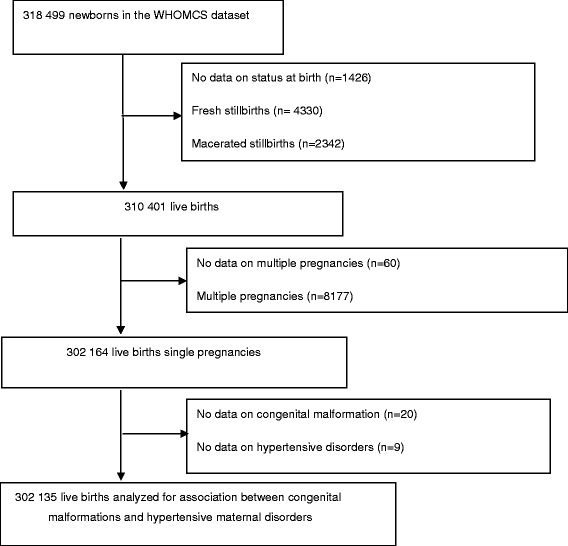
BACKGROUND: Annually, around 7.9 million children are born with birth defects and the contribution of congenital malformations to neonatal mortality is generally high. Congenital malformations in children born to mothers with hypertensive disorders during pregnancy has marginally been explored. METHODS: Country incidence of congenital malformations was estimated using data on the 310 401 livebirths of the WHO Multicountry Survey which reported information from 359 facilities across 29 countries. A random-effect logistic regression model was utilized to explore the associations between six broad categories of congenital malformations and the four maternal hypertensive disorders "Chronic Hypertension", "Preeclampsia" and "Eclampsia" and "Chronic hypertension with superimposed preeclampsia". RESULTS: The occupied territories of Palestine presented the highest rates in all groups of malformation except for the "Lip/Cleft/Palate" category. Newborns of women with chronic maternal hypertension were associated with a 3.7 (95 % CI 1.3-10.7), 3.9 (95 % CI 1.7-9.0) and 4.2 (95 % CI 1.5-11.6) times increase in odds of renal, limb and lip/cleft/palate malformations respectively. Chronic hypertension with superimposed preeclampsia was associated with a 4.3 (95 % CI 1.3-14.4), 8.7 (95 % CI 2.5-30.2), 7.1 (95 % CI 2.1-23.5) and 8.2 (95 % CI 2.0-34.3) times increase in odds of neural tube/central nervous system, renal, limb and Lip/Cleft/Palate malformations. CONCLUSIONS: This study shows that chronic hypertension in the maternal period exposes newborns to a significant risk of developing renal, limb and lip/cleft/palate congenital malformations, and the risk is further exacerbate by superimposing eclampsia. Additional research is needed to identify shared pathways of maternal hypertensive disorders and congenital malformations.
Overview
The claims and statistics of this paper haven’t been checked yet.
Free: it reads the open-access text and checks the first 5 claims that cite a source we can check. Create a free account to check every claim.
Integrity signals
Registry
Cites
Statistics
Figures
Verification
Claims the paper makes
The claims and statistics of this paper haven’t been checked yet.
Free: it reads the open-access text and checks the first 5 claims that cite a source we can check. Create a free account to check every claim.
Claims other papers make about this one
Each is checked against this paper’s own text: does it say what the citing paper says it does?
The cited source says what the claim attributes to it.
In the citing paper
“Furthermore, they can have negative perinatal outcomes for both the mother and the fetus or neonate, such as maternal end-organ injuries, maternal death, IUGR, large for gestational age, shoulder dystocia, hypoglycaemia, birth asphyxia, respiratory distress syndrome33,171,172, congenital malformations in neonates173,174, stillbirth and neonatal death.”
From A global view of hypertensive disorders and diabetes mellitus during pregnancy (2022) · cites this paper as [173]
Self-check
Percentages, sums and reported differences re-computed from the paper’s own numbers.
The self-check needs the paper’s full text.
Citations
Cites
Prevention of neural tube defects: Results of the Medical Research Council Vitamin Study
(1991) · The Lancet · doi:10.1016/0140-6736(91)90133-a · Cited by 3,472
Birth prevalence of congenital heart disease worldwide
van der Linde, D., Konings, E. E. M., Slager, M. A., Witsenburg, M., Helbing, W. A., Takkenberg, J. J. M., & Roos-Hesselink, J. W. (2011) · Journal of the American College of Cardiology · doi:10.1016/j.jacc.2011.08.025 · Cited by 3,452
The Global Impact of Pre-eclampsia and Eclampsia
Duley, L. (2009) · Seminars in Perinatology · doi:10.1053/j.semperi.2009.02.010 · Cited by 2,866
Steegers, E. A., von Dadelszen, P., Duvekot, J. J., & Pijnenborg, R. (2010) · The Lancet · doi:10.1016/s0140-6736(10)60279-6 · Cited by 2,850
Prevention of neural tube defects: Results of the Medical Research Council vitamin study
Wald, N., Sneddon, J., Densem, J., Frost, C., & Stone, R. (1992) · International Journal of Gynecology & Obstetrics · doi:10.1016/0020-7292(92)90076-u · Cited by 2,364
Sneddon, J., Densem, J. W., Wald, N. J., Frost, C., Stone, R., & Gnant, M. (1991) · PubMed · Cited by 1,812
Global and regional estimates of preeclampsia and eclampsia: a systematic review
Abalos, E., Cuesta, C., Grosso, A. L., Chou, D., & Say, L. (2013) · European Journal of Obstetrics & Gynecology and Reproductive Biology · doi:10.1016/j.ejogrb.2013.05.005 · Cited by 1,574
Self-citationMajor congenital malformations after first-trimester exposure to ACE inhibitors
Cooper, W. O., Hernandez-Diaz, S., Arbogast, P. G., Dudley, J. A., Dyer, S., Gideon, P. S., Hall, K., & Ray, W. A. (2006) · New England Journal of Medicine · doi:10.1056/nejmoa055202 · Cited by 1,192 · cited 1×
“The association between chronic hypertension with superimposed preeclampsia with renal dysgenesis has been reported by a previous case–control study [12]; however we should address the lack of information in our datasets concerning use of angiotensin-converting enzyme inhibitors and angiotensin II receptor inhibitors/…”
BackgroundDiagnosis and Management of Gestational Hypertension and Preeclampsia
Sibai, B. (2003) · Obstetrics & Gynecology · doi:10.1016/s0029-7844(03)00475-7 · Cited by 1,146
Vogel, J. P., Betrán, A. P., Vindevoghel, N., Souza, J. P., Torloni, M. R., Zhang, J., Tunçalp, Ö., Mori, R., Morisaki, N., Ortiz-Panozo, E., et al. (2015) · The Lancet Global Health · doi:10.1016/s2214-109x(15)70094-x · Cited by 1,037
Self-citationSouza, J. P., Gülmezoglu, A. M., Vogel, J., Carroli, G., Lumbiganon, P., Qureshi, Z., Costa, M. J., Fawole, B., Mugerwa, Y., Nafiou, I., et al. (2013) · The Lancet · doi:10.1016/s0140-6736(13)60686-8 · Cited by 757 · cited 1×
“Data were collected from hospital medical records through daily visits to the obstetrical/postpartum ward, gynecologic/abortion care unit, delivery room and intensive care unit for the duration of 2 months if the hospital had 6000 deliveries/year or and three months if the health facility had less than 6000 deliveries…”
MethodSelf-citationWorld Development Indicators 2009
Bank, W. (2009) · World Bank, Washington, DC eBooks · doi:10.1596/978-0-8213-7829-8 · Cited by 637
Abalos, E., Cuesta, C., Carroli, G., Qureshi, Z., Widmer, M., Vogel, J., Souza, J., & on behalf of the WHO Multicountry Survey on Maternal and Newborn Health Research Network (2014) · BJOG: An International Journal of Obstetrics & Gynaecology · doi:10.1111/1471-0528.12629 · Cited by 528
Self-citation(1989) · Annals of Internal Medicine · doi:10.7326/0003-4819-111-6-548_1 · Cited by 489
Ye, J., Zhang, J., Mikolajczyk, R., Torloni, M., Gülmezoglu, A., & Betran, A. (2016) · BJOG: An International Journal of Obstetrics & Gynaecology · doi:10.1111/1471-0528.13592 · Cited by 402
Roberts, J. M., Taylor, R. N., & Goldfien, A. (1991) · American Journal of Hypertension · doi:10.1093/ajh/4.8.700 · Cited by 387 · cited 1×
“The syndrome affects both the mother and her fetus and the pathogenesis features an impaired placental perfusion and widespread endothelial cell dysfunction [8, 9].”
BackgroundReproductive Behavior and Health in Consanguineous Marriages
Bittles, A. H., Mason, W. M., Greene, J., & Rao, N. A. (1991) · Science · doi:10.1126/science.2028254 · Cited by 331
The prognosis of pregnancy in women with chronic hypertension
Rey, E., & Couturier, A. (1994) · American Journal of Obstetrics and Gynecology · doi:10.1016/0002-9378(94)90276-3 · Cited by 292 · cited 1×
“Other studies found similar effects of beta-blockers [33] and suggested that the general effect of antihypertensives could be an effect of drug-induced fetal hypotension or an effect of the underlying disease [34].”
ResultMethods for Comparing Event Rates in Intervention Studies When the Unit of Allocation is a Cluster
Donner, A., & Klar, N. (1994) · American Journal of Epidemiology · doi:10.1093/oxfordjournals.aje.a117247 · Cited by 241 · cited 1×
“Because of the possible cluster effect of individual analysis [24] we generated the OR adjusted for the random mixed effect of facilities nested within countries and took into account the sampling selection of the additional provinces into account.”
MethodHypertension: Physiology and Pathophysiology
Hall, J. E., Granger, J. P., do Carmo, J. M., da Silva, A. A., Dubinion, J., George, E., Hamza, S., Speed, J., & Hall, M. E. (2012) · Comprehensive Physiology · doi:10.1002/cphy.c110058 · Cited by 232 · cited 1×
“The syndrome affects both the mother and her fetus and the pathogenesis features an impaired placental perfusion and widespread endothelial cell dysfunction [8, 9].”
BackgroundWorld development indicators 2009
Patel, S. (2009) · Cited by 209
Perinatal Mortality in Developing Countries
Zupan, J. (2005) · New England Journal of Medicine · doi:10.1056/nejmp058032 · Cited by 186 · cited 1×
“adverse perinatal outcomes, such as prematurity and intrauterine growth restriction [10].”
BackgroundMEDICAL GENETICS IN DEVELOPING COUNTRIES
Christianson, A., & Modell, B. (2004) · Annual Review of Genomics and Human Genetics · doi:10.1146/annurev.genom.5.061903.175935 · Cited by 161
Shepard, T. H. (2001) · Johns Hopkins University Press eBooks · doi:10.56021/9780801867224 · Cited by 146
Lennestål, R., Olausson, P. O., & Källén, B. A. J. (2009) · European Journal of Clinical Pharmacology · doi:10.1007/s00228-009-0620-0 · Cited by 143 · cited 1×
“Other studies found similar effects of beta-blockers [33] and suggested that the general effect of antihypertensives could be an effect of drug-induced fetal hypotension or an effect of the underlying disease [34].”
ResultAntihypertensive Medication Use During Pregnancy and the Risk of Cardiovascular Malformations
Caton, A. R., Bell, E. M., Druschel, C. M., Werler, M. M., Lin, A. E., Browne, M. L., McNutt, L.-A., Romitti, P. A., Mitchell, A. A., Olney, R. S., et al. (2009) · Hypertension · doi:10.1161/hypertensionaha.109.129098 · Cited by 131
The world health organization multicountry survey on maternal and newborn health: study protocol
WHOMCS Research Group, Souza, J. P., Gülmezoglu, A. M., Carroli, G., Lumbiganon, P., & Qureshi, Z. (2011) · BMC Health Services Research · doi:10.1186/1472-6963-11-286 · Cited by 118
Li, Z., Ye, R., Zhang, L., Li, H., Liu, J., & Ren, A. (2013) · Hypertension · doi:10.1161/hypertensionaha.111.00230 · Cited by 102
Development and applicability of Hospital Survey on Patient Safety Culture (HSOPS) in Japan
Ito, S., Seto, K., Kigawa, M., Fujita, S., Hasegawa, T., & Hasegawa, T. (2011) · BMC Health Services Research · doi:10.1186/1472-6963-11-28 · Cited by 80
Consanguinity and early mortality in the muslim populations of India and Pakistan
Hussain, R., Bittles, A. H., & Sullivan, S. (2001) · American Journal of Human Biology · doi:10.1002/ajhb.1124 · Cited by 77
van Gelder, M., Van Bennekom, C., Louik, C., Werler, M., Roeleveld, N., & Mitchell, A. (2015) · BJOG: An International Journal of Obstetrics & Gynaecology · doi:10.1111/1471-0528.13138 · Cited by 70
Czeizel, A. E. (2008) · Congenital Anomalies · doi:10.1111/j.1741-4520.2008.00189.x · Cited by 60 · cited 2×
“Some birth defects like several cardiac lesions appear late (there may be delayed appearance/capture even up to 5 years) [17].”
BackgroundPrevention of neural-tube-defect recurrences
Nevin, N. C., & Seller, M. (1990) · The Lancet · doi:10.1016/0140-6736(90)90060-i · Cited by 52 · cited 1×
“It also not obvious to argue a causal effect of chronic hypertension with superimposed preeclampsia on the insurgence of neural tube defects; however a recent article put the evidence on the effect of the folic acid supplementation, well known for protecting from the risk of neural tube/spina bifida [36, 37], in reduc…”
BackgroundMaternal hypertension, antihypertensive medication use, and the risk of severe hypospadias
Caton, A. R., Bell, E. M., Druschel, C. M., Werler, M. M., Mitchell, A. A., Browne, M. L., McNutt, L., Romitti, P. A., Olney, R. S., & Correa, A. (2007) · Birth Defects Research Part A Clinical and Molecular Teratology · doi:10.1002/bdra.20415 · Cited by 52
Sliwa, K. S., & Mebazaa, A. (2013) · European Heart Journal · doi:10.1093/eurheartj/eht485 · Cited by 49 · cited 1×
“The lack of association between preeclampsia and most of congenital malformations can be explained by the onset of this hypertensive disorder after the first trimester; nevertheless the association of preeclampsia with cardiac defects might be explained in line with a common genetic predisposition for angiogenic/anti-…”
BackgroundGlidewell, J., Olney, R. S., Hinton, C. F., Pawelski, J., Sontag, M. K., Wood, T., Kucik, J. E., Daskalov, R., & Hudson, J. (2015) · PubMed Central · Cited by 43
Bánhidy, F. G., Ács, N., Horváth–Puhó, E., & Czeizel, A. E. (2010) · Hypertension Research · doi:10.1038/hr.2010.227 · Cited by 42 · cited 1×
“5) in the offspring of pregnant women who developed preeclampsia with superimposed chronic hypertension [11] whilst another found that esophageal atresia/stenosis was a greater risk in pregnant women with chronic hypertension (OR 3.”
BackgroundSevere hypospadias and its association with maternal‐placental factors
Huisma, F. F., Thomas, M., & Armstrong, L. (2013) · American Journal of Medical Genetics Part A · doi:10.1002/ajmg.a.36050 · Cited by 39
Impact of public health on human genetics.
Modell, B., & Kuliev, A. (1989) · PubMed · Cited by 29
Bánhidy, F. G., Szilasi, M., & Czeizel, A. E. (2012) · European Journal of Obstetrics & Gynecology and Reproductive Biology · doi:10.1016/j.ejogrb.2012.03.015 · Cited by 21 · cited 1×
“The association between chronic hypertension with superimposed preeclampsia with renal dysgenesis has been reported by a previous case–control study [12]; however we should address the lack of information in our datasets concerning use of angiotensin-converting enzyme inhibitors and angiotensin II receptor inhibitors/…”
BackgroundMutation screening in theDHCR7 gene of patients with attention deficit and hyperactivity disorder
Witsch‐Baumgartner, M., Loeffler, J., Menzel, H.-J., Utermann, G., & Neuhaus, C. (2001) · American Journal of Medical Genetics · doi:10.1002/1096-8628(20010722)102:1<36::aid-ajmg1394>3.0.co;2-m
Research works printed but not linked: 3
- Christianson A Howson CP Modell B March of Dimes, Global Report on birth defects 2006 White Plains March of Dimes Birth Defects Foundation
- Villar K Critchley H Eclampsia and pre-eclampsia: a health problem for 2000 years Preeclampsia, 189–207 2003 London RCOG Press
- WHO/CDC/ICBDSR Birth defects surveillance: a manual for programme managers 2014 Geneva World Health Organization
Cited by
A global view of hypertensive disorders and diabetes mellitus during pregnancy
Jiang, L., Tang, K., Magee, L. A., von Dadelszen, P., Ekeroma, A., Li, X., Zhang, E., & Bhutta, Z. A. (2022) · Nature Reviews Endocrinology · doi:10.1038/s41574-022-00734-y · Cited by 314
The complex aetiology of cerebral palsy
Korzeniewski, S. J., Slaughter, J., Lenski, M., Haak, P., & Paneth, N. (2018) · Nature Reviews Neurology · doi:10.1038/s41582-018-0043-6 · Cited by 264
“Hypertensive disorders of pregnancy are associated with congenital malformations, in particular congenital heart defects 217,218 , as are indicators of thyroid dysfunction 219–221 ; each of these factors are associated with FGR, CP and other neurodevelopmental disorders (possibly reflecting…”
Increased pregnancy complications following frozen-thawed embryo transfer during an artificial cycle
Jing, S., Li, X. F., Zhang, S., Gong, F., Lu, G., & Lin, G. (2019) · Journal of Assisted Reproduction and Genetics · doi:10.1007/s10815-019-01420-1 · Cited by 91
Ohya, Y., Arakawa, K., Arata, N., Arima, S., Arima, H., Asayama, K., Dohi, Y., Fukami, A., Furuhashi, M., Goto, K., et al. (2026) · Hypertension Research · doi:10.1038/s41440-025-02462-y · Cited by 107
Buawangpong, N., Teekachunhatean, S., & Koonrungsesomboon, N. (2020) · Pharmacology Research & Perspectives · doi:10.1002/prp2.644 · Cited by 65
Metadata
- Authors
- Bellizzi, S., Ali, M. M., Abalos, E., Betran, A. P., Kapila, J., Pileggi-Castro, C., Vogel, J. P., & Merialdi, M.
- Affiliations
- World Health Organization (CH)
- Centro Rosarino de Estudios Perinatales (AR)
- Becton Dickinson (United States) (US)
- Corresponding author
- Ali, M. M.
- Venue
- BMC Pregnancy and Childbirth
- Published
- 2016-07-29
- Volume
- 16
- Issue
- 1
- Pages
- 198-198
- ISSN
- 1471-2393 (ISSN-L)
- PMC
- PMC4966715
- OpenAlex
- W2484161343
- Cited by
- 54
- References
- 44
- Citations by year
- 2026: 5 · 2025: 5 · 2024: 11 · 2023: 5 · 2022: 8 · 2021: 7 · 2020: 5 · 2019: 3 · 2018: 3 · 2017: 2
- FWCI
- 3.44
- Type
- journal article
- Language
- en
- Open access
- gold
- doi.org
- Licence
- cc-by
- Locations
- BMC Pregnancy and Childbirth (publishedVersion, cc-by)
- Europe PMC (PubMed Central) (publishedVersion, cc-by)
- PubMed Central (publishedVersion, cc-by)
- PubMed (publishedVersion)
- Minerva Access (University of Melbourne) (submittedVersion, cc-by)
- Funders
- World Health Organization
- Topics
- Health Sciences › Medicine › Obstetrics and Gynecology › Pregnancy and preeclampsia studies
- Health Sciences › Medicine › Pediatrics, Perinatology and Child Health › Birth, Development, and Health
- Health Sciences › Medicine › Pediatrics, Perinatology and Child Health › Maternal and Neonatal Healthcare
- Keywords
- hypertensive disorders of pregnancy, congenital malformations, chronic hypertension in pregnancy, preeclampsia, eclampsia, superimposed preeclampsia, renal anomalies, limb malformations, cleft lip and palate, neural tube defects, maternal health
- MeSH terms
- Congenital Abnormalities, Adult, Cross-Sectional Studies, Eclampsia, Female, Humans, Infant, Newborn, Male, Pre-Eclampsia, Pregnancy, Risk Factors, Incidence, Logistic Models, Hypertension, Pregnancy-Induced
About these checks
Registry, retraction, Cites and statistics results are computed, not judged, with one exception: a printed reference that no index lists is read once by a model before it counts as a citation error. Claims are extracted by a model and kept only when their quote appears verbatim in the text; each cited source is then checked, with a model’s help, for whether it says what the claim relies on. Those verdicts can be wrong — read the claim’s quote and the cited source before relying on one.
Statistics and arithmetic are recomputed, not judged.
Confidence bands are shown only for fields calibrated on our annotated test set. None is calibrated yet, so no band is shown.
What counts as a claim ›How we measure confidence ›How we check this ›
Are you an author, or do you see a problem with this page? Request a review
Data sources
Bibliographic data: Semantic Scholar, OpenAlex, Crossref.
Contains information from the Semantic Scholar Academic Graph Datasets, made available under the ODC Attribution License (ODC-BY 1.0).
Semantic Scholar’s data is described in: Kinney, R., et al. (2023). The Semantic Scholar Open Data Platform. arXiv:2301.10140.
