

Vaginal delivery: how does early hospital discharge affect mother and child outcomes? A systematic literature review
Open accessThe DOI matches its Crossref record; 43 of the 43 references it cites were found in a registry or an index.
Abstract
There is an international trend to shorten the postpartum length of stay in hospitals, driven by cost containment, hospital bed availability and a movement toward the ‘demedicalization’ of birth. The aim of this systematic literature review is to determine how early postnatal discharge policies from hospitals could affect health outcomes after vaginal delivery for healthy mothers and term newborns. A search for systematic reviews, meta-analyses, and primary studies was carried out in OVID MEDLINE, Embase, CINAHL, Econlit and the Cochrane Library (Cochrane Database of Systematic Reviews, DARE and HTA databases). The AMSTAR checklist was used for the quality appraisal of systematic reviews. The quality of the retrieved studies was assessed by the Cochrane Collaboration’s tools. The level of evidence was appraised using the GRADE system. Seven RCTs and two additional observational studies were found but no comprehensive economic evaluation. Despite variation in the definition of early discharge, the authors of the included studies, concerning early discharge and conventional length of stay, reported no statistical difference in maternal and neonatal morbidity, maternal and neonatal readmission rates, infant mortality, newborn weight gain, neonatal hyperbilirubinemia, or breastfeeding rates. The authors reported conflicting results regarding postpartum depression and competence of mothering, ranging from no difference according to length of stay to better results for early discharge. The level of evidence of the vast majority of outcomes was rated as low to very low. Because of the lack of robust clinical evidence and full economic evaluations, the current data neither support nor discourage the widespread use of early postpartum discharge. Before implementing an early discharge policy, Western countries with longer length of hospital stay may benefit from testing shorter length of stay in studies with an appropriate design. The issue of cost containment in implementing early discharge and the potential impact on the current and future health of the population exemplifies the need for publicly funded clinical trials in such public health area. Finally, trials testing the range of out-patient interventions supporting early discharge are needed in Western countries which implemented early discharge policies in the past.
Overview
The claims and statistics of this paper haven’t been checked yet.
Free: it reads the open-access text and checks the first 5 claims that cite a source we can check. Create a free account to check every claim.
Integrity signals
Registry
Cites
Statistics
Figures
Verification
Claims the paper makes
The claims and statistics of this paper haven’t been checked yet.
Free: it reads the open-access text and checks the first 5 claims that cite a source we can check. Create a free account to check every claim.
Claims other papers make about this one
Each is checked against this paper’s own text: does it say what the citing paper says it does?
The source backs part of the claim, not all of it — or backs it for a different population, condition or comparison.
In the citing paper
“Research on postnatal care has primarily focused on the immediate postnatal period while still on the maternity ward and outcomes such as maternal and neonatal morbidity or mortality [16] and mothers' satisfaction with that care [17]”
From Support during the postnatal period: Evaluating new mothers' and midwives' experiences of a new, coordinated postnatal care model in a midwifery clinic in Sweden (2023) · cites this paper as [16]
Experimental — accuracy not yet measured
Self-check
Percentages, sums and reported differences re-computed from the paper’s own numbers.
The self-check needs the paper’s full text.
Citations
Cites
Preferred Reporting Items for Systematic Reviews and Meta-Analyses: the PRISMA statement
Moher, D., Liberati, A., Tetzlaff, J., Altman, D. G., & for the PRISMA Group (2009) · BMJ · doi:10.1136/bmj.b2535 · Cited by 83,823
Preferred Reporting Items for Systematic Reviews and Meta-Analyses: The PRISMA Statement
Moher, D., Liberati, A., Tetzlaff, J., Altman, D. G., & The PRISMA Group (2009) · PLoS Medicine · doi:10.1371/journal.pmed.1000097 · Cited by 64,042
Preferred reporting items for systematic reviews and meta-analyses: The PRISMA statement
Moher, D., Liberati, A., Tetzlaff, J., Altman, D. G., & the PRISMA Group* (2009) · Annals of Internal Medicine · doi:10.7326/0003-4819-151-4-200908180-00135 · Cited by 37,554
Wang, G., Ma, R., Qiao, G., Wada, K., Aizawa, Y., & Satoh, T. (2015) · Integrative Medicine International · doi:10.1159/000368408 · Cited by 18,657
GRADE guidelines: 3. Rating the quality of evidence
Balshem, H., Helfand, M., Schünemann, H. J., Oxman, A. D., Kunz, R., Brozek, J., Vist, G. E., Falck-Ytter, Y., Meerpohl, J., & Norris, S. (2011) · Journal of Clinical Epidemiology · doi:10.1016/j.jclinepi.2010.07.015 · Cited by 8,285 · cited 1×
“Level of evidence was categorized in 4 levels (high, moderate, low and very low) according to the GRADE system [12].”
MethodDevelopment of AMSTAR: A measurement tool to assess the methodological quality of systematic reviews
Shea, B. J., Grimshaw, J. M., Wells, G. A., Boers, M., Andersson, N., Hamel, C., Porter, A. C., Tugwell, P., Moher, D., & Bouter, L. M. (2007) · BMC Medical Research Methodology · doi:10.1186/1471-2288-7-10 · Cited by 4,374
Early postnatal discharge from hospital for healthy mothers and term infants
Brown, S., Small, R., Argus, B., Davis, P. G., & Krastev, A. (2002) · Cochrane Database of Systematic Reviews · doi:10.1002/14651858.cd002958 · Cited by 253 · cited 6×
“Therefore, relevant evidence was extracted from this review [5] to focus on our specific research question.”
BackgroundResultInfluentialA randomized trial of early hospital discharge and home follow-up of women having cesarean birth.
Brooten, D. A., Roncoli, M., Finkler, S. A., Arnold, L. D., Cohen, A., & Mennuti, M. T. (1994) · PubMed · Cited by 159
Schedules for home visits in the early postpartum period
Yonemoto, N., Dowswell, T., Nagai, S., & Mori, R. (2013) · Cochrane Database of Systematic Reviews · doi:10.1002/14651858.cd009326.pub2 · Cited by 144
A Randomized, Controlled Evaluation of Early Postpartum Hospital Discharge
Carty, E. M., & Bradley, C. F. (1990) · Birth · doi:10.1111/j.1523-536x.1990.tb00021.x · Cited by 142 · cited 2×
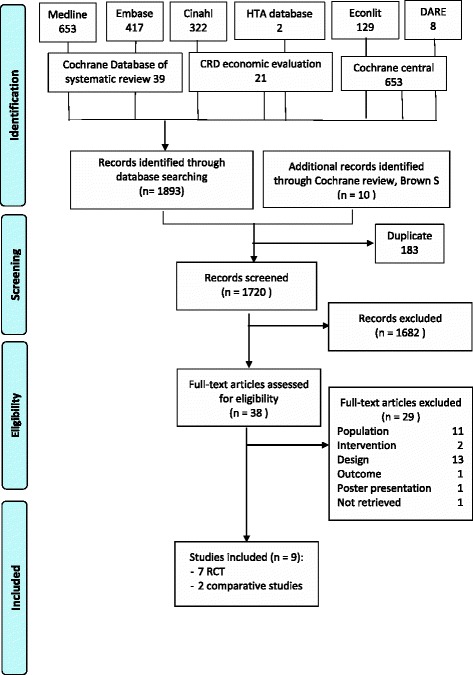
“1 PRISMA flow diagram Table 1 Characteristics of included studies Study Design Inclusion criteria Intervention (n) Control (n) Age Findings Carty 1990 [29], Canada RCT Vaginal birth, prenatal classes attendance, stable relationship with partners Group 1: discharge from 12 h to 24 h + nurse home visit on days 1, 2, 3,…”
BackgroundInfluential
Research works printed but not linked: 2
- Chanot A, Semet JC, Arnaud C, Dali-Youcef A, Abada K, Gayzard B, Lancelin F, Pax-Chochois S, Alves N, Curat AM et al: L'hospitalisation a domicile apres une sortie precoce de maternite. Soins 2009, Pediatrie, Puericulture.(246):24–26. 19202982
- Ghedin BS Cancelier ACL Feuerschuette OHM Silveira SK Healthy newborn length of hospital stay: influence on breastfeeding and neonatal morbidity J Perinat Med 2011 39 S1 159
Cited by
Early postnatal discharge from hospital for healthy mothers and term infants
Jones, E., Stewart, F., Taylor, B., Davis, P. G., & Brown, S. J. (2021) · Cochrane Database of Systematic Reviews · doi:10.1002/14651858.cd002958.pub2 · Cited by 121
Early postpartum discharge during the COVID-19 pandemic
Bornstein, E., Gulersen, M., Husk, G. A., Grunebaum, A. N., Blitz, M. J., Rafael, T. J., Rochelson, B. L., Schwartz, B., Nimaroff, M. L., & Chervenak, F. A. (2020) · Journal of Perinatal Medicine · doi:10.1515/jpm-2020-0337 · Cited by 56
“A recent systematic review investigating the impact of early postpartum discharge after vaginal delivery demonstrated the lack of support or evidence against the widespread use of early discharge [11].”
BackgroundLindblad, V., Melgaard, D., Jensen, K., Eidhammer, A., Westmark, S., Kragholm, K. H., & Gommesen, D. (2022) · European Journal of Midwifery · doi:10.18332/ejm/146897 · Cited by 80
Measures to assess quality of postnatal care: A scoping review
Galle, A., Moran, A. C., Bonet, M., Graham, K., Muzigaba, M., Portela, A. G., Day, L. T., Tuabu, G. K., Silva, B., & Moller, A. (2023) · PLOS Global Public Health · doi:10.1371/journal.pgph.0001384 · Cited by 29
Goodwin, L. D., Taylor, B., Kokab, F., & Kenyon, S. L. (2018) · Midwifery · doi:10.1016/j.midw.2018.02.006 · Cited by 19
Quality improvement in postnatal care: Findings from two cohorts of women in Sweden
Öhrn, U., Parment, H., & Hildingsson, I. (2020) · European Journal of Midwifery · doi:10.18332/ejm/128737 · Cited by 20
Quality of emergency obstetric and newborn care services in Wolaita Zone, Southern Ethiopia
Alemayehu, M. A., Yakob, B., & Khuzwayo, N. (2022) · BMC Pregnancy and Childbirth · doi:10.1186/s12884-022-05019-w · Cited by 16
Community midwives views of postnatal care in the UK; A descriptive qualitative study
Kokab, F., Jones, E., Goodwin, L., Taylor, B., & Kenyon, S. (2022) · Midwifery · doi:10.1016/j.midw.2021.103183 · Cited by 15
Eikemo, R., Vikström, A., Nyman, V., Jonas, W., & Barimani, M. (2023) · Scandinavian Journal of Caring Sciences · doi:10.1111/scs.13103 · Cited by 13
Risk factors associated with 31-day unplanned hospital readmission in newborns: a systematic review
Della, P. R., Huang, H., Roberts, P. A., Porter, P., Adams, E., & Zhou, H. (2023) · European Journal of Pediatrics · doi:10.1007/s00431-023-04819-2 · Cited by 13
Pádua, A., Melo, E., & Alvarelhão, J. (2022) · Maternal and Child Health Journal · doi:10.1007/s10995-021-03361-7 · Cited by 13
“At present, given the rationalization of costs and the prevention of hospital infections, hospitalization of the puerperal women and the newborn after delivery tends to be reduced (Benahmed et al., 2017), and therefore, breastfeeding may not be properly established at the time of maternity discharge.”
BackgroundStakeholder’s perspectives of postnatal discharge: a qualitative evidence synthesis
Harvey, C. M., Smith, H. J. J., Portela, A. G., & Movsisyan, A. (2023) · BMJ Global Health · doi:10.1136/bmjgh-2023-011766 · Cited by 15
Expedited postpartum discharge during the COVID-19 pandemic and acute postpartum care utilization
Panzer, A., Reed-Weston, A. E., Friedman, A. M., Goffman, D., & Wen, T. (2022) · The Journal of Maternal-Fetal & Neonatal Medicine · doi:10.1080/14767058.2022.2048815 · Cited by 11
“However, other recent studies have also shown that among healthy women there is no difference in maternal readmission rates between expedited and routine postpartum discharge [6,7].”
BackgroundEarly discharge of first-time parents and their newborn: A scoping review
Lindblad, V., Gaardsted, P. S., & Melgaard, D. (2021) · European Journal of Midwifery · doi:10.18332/ejm/140792 · Cited by 13
Significant Reduction in Pediatric, Population-Based Hospital Admissions Due To COVID-19 in Malta
Degiorgio, S., Grech, N., Dimech, Y. M., Xuereb, J., & Grech, V. (2021) · Turkish Archives of Pediatrics · doi:10.5152/turkarchpediatr.2022.21145 · Cited by 11
Digital solutions to follow up on discharged new parents—A systematic literature review
Pajalić, Z., Rauckienė, A., Savosnick, G., Bartels, I., Calleja‐Agius, J., Saplacan, D., Jónsdóttir, S. S., & Asadi‐Azarbaijani, B. (2023) · PLOS Digital Health · doi:10.1371/journal.pdig.0000317 · Cited by 12
“There is an international trend in welfare countries to shorten the postpartum length of stay in hospitals, driven by cost containment and hospital bed availability [12].”
BackgroundCegolon, L., Maso, G., Heymann, W. C., Bortolotto, M., Cegolon, A., & Mastrangelo, G. (2020) · Scientific Reports · doi:10.1038/s41598-020-62774-6 · Cited by 13
Postnatal quality of care measures for mothers and newborns at home: A scoping review
Mespreuve, A.-S., Apers, L., Moller, A., & Galle, A. (2024) · PLOS Global Public Health · doi:10.1371/journal.pgph.0003498 · Cited by 10
Yui, Y., & October, T. W. (2020) · American Journal of Perinatology · doi:10.1055/s-0040-1712963 · Cited by 9
Weerasinghe, K., Rishard, M., Brabaharan, S., & Walpita, Y. N. (2023) · BMC Research Notes · doi:10.1186/s13104-023-06550-5 · Cited by 8
“Poor quality of care around the time of childbirth is associated with a longer hospital stay, poor maternal satisfaction, increased readmission rates, increased cost and poor reputation of the hospital [16, 17].”
BackgroundA Narrative Review of Maternal Sleep Issues with a Focus on Mental Health in the Postpartum Period
Smith, A. M., & Saleh, L. (2021) · SN Comprehensive Clinical Medicine · doi:10.1007/s42399-021-00840-4 · Cited by 8
“In the USA, concerns regarding potential adverse maternal and newborn outcomes led to the Newborns’ and Mothers’ Health Protection Act in 1996 making it mandatory for health insurers to cover postpartum hospitalization for a minimum of 48 h after vaginal delivery and 96 h after a cesarean section [40].”
BackgroundLength of stay in the ward following a preeclamptic pregnancy
Li, C., Gou, W., Liu, J., Liu, D., Li, X., & Chen, Q. (2021) · Journal of Human Hypertension · doi:10.1038/s41371-021-00484-w · Cited by 8
“been raised by maternal care providers: (1) how long should the preeclamptic women be in the ward for after the birth, as pregnant women without complications are normally discharged within 48 h after vaginal delivery in many countries [13] ? (2) whether is it appropriate for preeclamptic woman to be discharged when h…”
BackgroundEarly postnatal discharge during COVID-19: A cross-sectional study
Tesfaye, W. Y., & Worku, B. T. (2021) · Women s Health · doi:10.1177/17455065211042177 · Cited by 9
The Risk of Readmission after Early Postpartum Discharge during the COVID-19 Pandemic
Gulersen, M., Husk, G. A., Lenchner, E., Blitz, M. J., Rafael, T. J., Rochelson, B. L., Chakravarthy, S., Grunebaum, A. N., Chervenak, F. A., Fruhman, G., et al. (2021) · American Journal of Perinatology · doi:10.1055/s-0041-1740061 · Cited by 7
Lai, M., August, D. L., Sharfuddin, Z., Palmer-Field, K., Johnston, L., Main, E., Smith, P., Kilgour, C., & Kearney, L. N. (2023) · Women and Birth · doi:10.1016/j.wombi.2023.10.007 · Cited by 6
Bitew, D. A., Diress, M., Gela, Y. Y., Belay, D. G., Kibret, A. A., Chilot, D., Sinamaw, D., Seid, M. A., Seid, A. M., Simegn, W., et al. (2023) · BMC Public Health · doi:10.1186/s12889-023-16922-y · Cited by 6
Semaan, A. T., Grovogui, F. M., Delvaux, T., Housseine, N., van den Akker, T., Délamou, A., & Beňová, L. (2024) · PLOS Global Public Health · doi:10.1371/journal.pgph.0003786 · Cited by 6
Discharge time after birth is associated with parity – A retrospective cohort study
Lindblad, V., Kragholm, K. H., Eidhammer, A., & Melgaard, D. (2023) · Heliyon · doi:10.1016/j.heliyon.2023.e14004 · Cited by 6
“In 2017 and 2021, two systematic reviews could not conclude the impact of early discharge on the outcome for mothers and newborns because of low evidence [4,5].”
BackgroundDarling, E., Babe, G., Sorbara, C., & Perez, R. (2020) · CMAJ Open · doi:10.9778/cmajo.20190165 · Cited by 6
Murray‐Davis, B., Grenier, L. N., Mattison, C. A., Malott, A. M., Cameron, C., Li, J., Darling, E., & Hutton, E. K. (2023) · Birth · doi:10.1111/birt.12744 · Cited by 5
Mukantwari, J., Gatete, J. D. D., Niyigena, A., Alayande, B. T., Nkurunziza, T., Mazimpaka, C., Boatin, A. A., Kateera, F., Hedt‐Gauthier, B., & Riviello, R. R. (2023) · Surgical Infections · doi:10.1089/sur.2023.100 · Cited by 5
Kerkez, M., & Kaplan, M. (2025) · BMC Nursing · doi:10.1186/s12912-025-02966-5 · Cited by 8
“Furthermore, one study concluded that there was no way to prove or exclude a link between early discharge and maternal and neonatal morbidity [11].”
Gidaszewski, B., Tan, L., King, J., Chua, S. C., Pasupathy, D., Steen, M., & Khajehei, M. (2025) · Midwifery · doi:10.1016/j.midw.2025.104590 · Cited by 4
Primiparous women's narratives of confidence in the perinatal period
Khajehei, M., Swain, J. A., & Wen, Y. (2020) · British Journal of Midwifery · doi:10.12968/bjom.2020.28.1.42 · Cited by 4
Challenges and Feasibility of Co-Design Methods for Improving Parent Information in Maternity Care
Kynoch, K., Tuckett, A. G., McArdle, A., & Ramis, M. (2022) · International Journal of Environmental Research and Public Health · doi:10.3390/ijerph19073764 · Cited by 4
“Regardless, it has been reported that mothers who are discharged early following vaginal delivery may seek advice after discharge on topics such as breast-feeding and newborn feeding, baby hygiene and umbilical care, in addition to information on how to care for themselves postnatally [4].”
BackgroundStas, A., Breugelmans, M., Geerinck, L., Spinnoy, A., Laere, S. V., Gucciardo, L., Laubach, M., Faron, G., & Beeckman, K. (2023) · BMC Pregnancy and Childbirth · doi:10.1186/s12884-023-05740-0 · Cited by 3
“In Belgium the standard LOS after childbirth is four days [6, 7].”
BackgroundTekeba, B., Dessie, M. T., Tamir, T. T., & Zegeye, A. F. (2024) · BMJ Open · doi:10.1136/bmjopen-2024-086576 · Cited by 4
Rahman, M. M., Pallikadavath, S., & Khatoon, R. (2019) · Journal of International Development · doi:10.1002/jid.3412 · Cited by 3
“Besides, it was always not possible to choose early and late discharge women (treatment and control groups) randomly, as women with delivery time complications tend to stay longer and vice versa (Benahmed et al., 2017).”
BackgroundResultPredporodna in poporodna obravnava žensk v Sloveniji: presečna raziskava
Došler, A. J., Mivšek, A. P., Prelec, A., Zidarič, T. S., & Skubic, M. (2023) · Slovenian Nursing Review · doi:10.14528/snr.2023.57.3.3195 · Cited by 5
Stas, A., Breugelmans, M., Geerinck, L., Laats, J., Spinnoy, A., Laere, S. V., Gucciardo, L., Laubach, M., Faron, G., & Beeckman, K. (2023) · Maternal and Child Health Journal · doi:10.1007/s10995-023-03667-8 · Cited by 2
Universal versus Risk-Based Management of Unknown Group B Streptococcus Status at Term
Jones, D. M., Haikal, S. O., Whitham, M. D., & Howard, D. L. (2019) · American Journal of Perinatology Reports · doi:10.1055/s-0039-1695744 · Cited by 2
Review of Maternal Deaths in Lofa County, Liberia, 2015-2017
Alpha, T., Dolopei, D., Argbah, E., Ballah, N. J., Kortimai, L. B., Frimgpong, J. A., Amo-Addae, M. P., Adewuyi, P. A., Ilesanmi, O. S., Shannon, F., et al. (2021) · Journal of Interventional Epidemiology and Public Health · doi:10.37432/jieph.supp.2021.4.1.01.6 · Cited by 2
Decreasing the Newborn Birth Hospitalization Length of Stay
Groening, P., Silver, E. J., & Nemerofsky, S. L. (2023) · American Journal of Perinatology · doi:10.1055/a-2024-1145 · Cited by 1
Bitew, D. A., Getnet, M., Maru, L., Adugna, D. G., & Tesfaye, E. (2024) · BMJ Public Health · doi:10.1136/bmjph-2024-001060 · Cited by 1
Höhn, I., Hernadi, A., Zihlmann, R., Coelius, C., Walter, K., Hamza, A., Ochsenbein‐Kölble, N., & Schäffer, L. (2025) · Swiss Medical Weekly · doi:10.57187/s.3894 · Cited by 1
Nakai, K., Saito, I., & Osawa, K. (2020) · PubMed · doi:10.24546/81012030 · Cited by 1
Bashar, M., Aggarwal, A., & Pilania, M. (2020) · Journal of Education and Health Promotion · doi:10.4103/jehp.jehp_275_20 · Cited by 1
Early Hospital Discharge and Early Puerperal Complications
Elghazal, Z., Emtawel, F. A., & Sauod, E. B. B. (2020) · AL-MUKHTAR JOURNAL OF SCIENCES · doi:10.54172/mjsc.v35i4.333 · Cited by 1
“The more recent evidence is based only on two very poor quality non-randomized studies (Benahmed et al., 2017) Moreover, the concept of the early discharge itself is very variable across studies, leading to health outcomes being measured at variable times after delivery.”
BackgroundKirkegaard, A. M., Breckling, M., Nielsen, D. G., Tolstrup, J. S., Johnsen, S. P., Ersbøll, A. K., & Kloster, S. (2021) · BMC Pregnancy and Childbirth · doi:10.1186/s12884-021-04286-3 · Cited by 1
“postpartum depression, readmission and neonatal mortality rate [37, 38].”
BackgroundAndaya, E., & Bhatia, R. (2023) · Social Science & Medicine · doi:10.1016/j.socscimed.2023.116389 · Cited by 1
Evaluation Familystart Zürich : Abschlussbericht
Grylka, S., Hollenstein, E., Angerer, A., Springer, R. E., & Pehlke‐Milde, J. (2018) · Zürcher Hochschule für Angewandte Wissenschaften digital collection (Zurich University of Applied Sciences) · doi:10.21256/zhaw-3650 · Cited by 2
An investigation of postnatal length of stay in hospital and infant readmission to hospital
Jones, E. (2019) · University of Birmingham Institutional Research Archive (University of Birmingham)
DOĞUM SONRASI BAKIM VE EV ZİYARETLERİNİN ÖNEMİ
Bay, F., & Özerdoğan, N. (2021) · KTO Karatay University Institutional Archive · Cited by 3
Zuluaga, J. S. P., Palacios, D. A. B., Vargas, Y. A. C., Socha, N., Gómez, J. G. B., & Pena, A. (2021) · Colombian Journal of Anesthesiology · doi:10.5554/22562087.e1005
Breastfeeding Initiation and Support: Literature Review on Women’s Value and Early Discharge Impact
(2022) · Journal of Contemporary Medical Practice · doi:10.53469/jcmp.2022.04(06).10
Lin, T., Chen, Y., Wang, H., Li, C., Zhang, T., Fan, L.-C., Huang, H., Wu, Y., & Wen, Y. (2022) · Research Square · doi:10.21203/rs.3.rs-2039885/v1
Impact of early discharge on the newborn
Costa, A., Horta, A., Sanches, B. F., Matos, D., Foz, I., Calhau, P., Sousa, R., & Marcelino, S. (2023) · Portuguese Journal of Pediatrics · doi:10.24875/pjp.m23000048
Early Versus Late Discharge in Postpartum Care: Outcomes after Normal Delivery
Tuhin, T. B., Ara, G., Afrin, S., Begum, M., & Ara, I. (2024) · Scholars International Journal of Obstetrics and Gynecology · doi:10.36348/sijog.2024.v07i04.005
Wainaina, G. M., Kaura, D., & Jordan, P. J. (2024) · African Journal of Midwifery and Women s Health · doi:10.12968/ajmw.2023.0027
Kassie, A. T., Wondie, K. Y., & Seyoum, T. (2025) · Frontiers in Global Women s Health · doi:10.3389/fgwh.2025.1442897
Kirkegaard, A. M., Breckling, M., Nielsen, D. G., Tolstrup, J. S., Johnsen, S. P., Ersbøll, A. K., & Kloster, S. (2021) · Figshare · doi:10.6084/m9.figshare.17140864
Lojander, J. (2025) · UTUPub (University of Turku) · Cited by 4
Sezaryen Doğumda ERAC Protokolü: Güncel Kanıtlar ve Öneriler
Keskin, E., & Satılmış, İ. G. (2026) · Ordu Üniversitesi Hemşirelik Çalışmaları Dergisi · doi:10.38108/ouhcd.1460077
Intervenções pós-parto para mulheres e famílias: contribuições para a prática em saúde materna
Mendes, I. A., & Carteiro, D. (2026) · Salutis Scientia · doi:10.67012/fuky2371
META-ANALISIS PENGARUH PERSALINAN SECARA PERVAGINAM TERHADAP KEPUASAN IBU DI PELAYANAN KESEHATAN
Nurhadi, N., Djuwita, R., Simatupang, N. A., & Azhary, M. R. (2023) · Jurnal Cahaya Mandalika · doi:10.36312/jcm.v3i2.1864
Blumenfeld, S., Shaham, L., Brenner, N., Segal, G., Simchen, M. J., Zloto, K., Dulitzky, M., Sivan, E., Agay, N., & Weissmann‐Brenner, A. (2026) · PLoS ONE · doi:10.1371/journal.pone.0335688
“…uncomplicated vaginal and cesarean deliveries, in order to optimize their care, accommodate the high influx of non-obstetrical COVID-19 admissions that required increased hospital resources, as well as to decrease the potential exposure of both patients and medical staff in the hospital [25–30].”
The postpartum return-to-home transition: A narrative review
da Silva, M. A. P., Cubas, M. R., & Cardoso, A. (2026) · European Journal of Midwifery · doi:10.18332/ejm/241927
Metadata
- Authors
- Benahmed, N., San Miguel, L., Devos, C., Fairon, N., & Christiaens, W.
- Affiliations
- Belgian Health Care Knowledge Centre (KCE) (BE)
- Corresponding author
- Benahmed, Nadia
- Venue
- BMC Pregnancy and Childbirth
- Published
- 2017-09-06
- Volume
- 17
- Issue
- 1
- Pages
- 289-289
- ISSN
- 1471-2393 (ISSN-L)
- PMC
- PMC5588709
- OpenAlex
- W2752909151
- Semantic Scholar
- 684f5f4df2762de90808340359adc9525f0e5b35
- Cited by
- 59
- References
- 42
- Citations by year
- 2026: 3 · 2025: 4 · 2024: 6 · 2023: 16 · 2022: 8 · 2021: 10 · 2020: 9 · 2019: 2 · 2018: 1
- FWCI
- 0.56
- Type
- journal article
- Language
- en
- Open access
- gold
- doi.org
- Licence
- cc-by
- Locations
- BMC Pregnancy and Childbirth (publishedVersion, cc-by)
- PubMed Central (publishedVersion, cc-by)
- PubMed (publishedVersion)
- DOAJ (DOAJ: Directory of Open Access Journals) (submittedVersion, cc-by-sa)
- KCE repository (Belgian Health Care Knowledge Centre) (submittedVersion)
- Topics
- Health Sciences › Medicine › Obstetrics and Gynecology › Maternal and Perinatal Health Interventions
- Health Sciences › Medicine › Pediatrics, Perinatology and Child Health › Maternal and Neonatal Healthcare
- Health Sciences › Medicine › Pediatrics, Perinatology and Child Health › Infant Development and Preterm Care
- Keywords
- early postpartum discharge, postpartum length of stay, vaginal delivery, maternal outcomes, neonatal outcomes, postpartum depression, neonatal hyperbilirubinemia, breastfeeding, cost containment
- MeSH terms
- Adult, Female, Humans, Infant, Newborn, Length of Stay, Mothers, Patient Discharge, Pregnancy, Vagina, Delivery, Obstetric, Postpartum Period
About these checks
Registry, retraction, Cites and statistics results are computed, not judged, with one exception: a printed reference that no index lists is read once by a model before it counts as a citation error. Claims are extracted by a model and kept only when their quote appears verbatim in the text; each cited source is then checked, with a model’s help, for whether it says what the claim relies on. Those verdicts can be wrong — read the claim’s quote and the cited source before relying on one.
Statistics and arithmetic are recomputed, not judged.
Confidence bands are shown only for fields calibrated on our annotated test set. None is calibrated yet, so no band is shown.
What counts as a claim ›How we measure confidence ›How we check this ›
Are you an author, or do you see a problem with this page? Request a review
Data sources
Bibliographic data: Semantic Scholar, OpenAlex, Crossref.
Contains information from the Semantic Scholar Academic Graph Datasets, made available under the ODC Attribution License (ODC-BY 1.0).
Semantic Scholar’s data is described in: Kinney, R., et al. (2023). The Semantic Scholar Open Data Platform. arXiv:2301.10140.
