

Vaginal delivery: how does early hospital discharge affect mother and child outcomes? A systematic literature review
Open accessThe DOI matches its Crossref record; 42 of the 42 references it cites were found in a registry or an index.
Abstract
There is an international trend to shorten the postpartum length of stay in hospitals, driven by cost containment, hospital bed availability and a movement toward the ‘demedicalization’ of birth. The aim of this systematic literature review is to determine how early postnatal discharge policies from hospitals could affect health outcomes after vaginal delivery for healthy mothers and term newborns. A search for systematic reviews, meta-analyses, and primary studies was carried out in OVID MEDLINE, Embase, CINAHL, Econlit and the Cochrane Library (Cochrane Database of Systematic Reviews, DARE and HTA databases). The AMSTAR checklist was used for the quality appraisal of systematic reviews. The quality of the retrieved studies was assessed by the Cochrane Collaboration’s tools. The level of evidence was appraised using the GRADE system. Seven RCTs and two additional observational studies were found but no comprehensive economic evaluation. Despite variation in the definition of early discharge, the authors of the included studies, concerning early discharge and conventional length of stay, reported no statistical difference in maternal and neonatal morbidity, maternal and neonatal readmission rates, infant mortality, newborn weight gain, neonatal hyperbilirubinemia, or breastfeeding rates. The authors reported conflicting results regarding postpartum depression and competence of mothering, ranging from no difference according to length of stay to better results for early discharge. The level of evidence of the vast majority of outcomes was rated as low to very low. Because of the lack of robust clinical evidence and full economic evaluations, the current data neither support nor discourage the widespread use of early postpartum discharge. Before implementing an early discharge policy, Western countries with longer length of hospital stay may benefit from testing shorter length of stay in studies with an appropriate design. The issue of cost containment in implementing early discharge and the potential impact on the current and future health of the population exemplifies the need for publicly funded clinical trials in such public health area. Finally, trials testing the range of out-patient interventions supporting early discharge are needed in Western countries which implemented early discharge policies in the past.
Overview
The claims and statistics of this paper haven’t been checked yet.
Free: it reads the open-access text and checks the first 5 claims that cite a source we can check. Create a free account to check every claim.
Integrity signals
Registry
Cites
Statistics
Figures
Verification
Claims the paper makes
The claims and statistics of this paper haven’t been checked yet.
Free: it reads the open-access text and checks the first 5 claims that cite a source we can check. Create a free account to check every claim.
Claims other papers make about this one
Each is checked against this paper’s own text: does it say what the citing paper says it does?
The source backs part of the claim, not all of it — or backs it for a different population, condition or comparison.
In the citing paper
“Research on postnatal care has primarily focused on the immediate postnatal period while still on the maternity ward and outcomes such as maternal and neonatal morbidity or mortality [16] and mothers' satisfaction with that care [17]”
From Support during the postnatal period: Evaluating new mothers' and midwives' experiences of a new, coordinated postnatal care model in a midwifery clinic in Sweden (2023) · cites this paper as [16]
Experimental — accuracy not yet measured
Self-check
Percentages, sums and reported differences re-computed from the paper’s own numbers.
The self-check needs the paper’s full text.
Citations
Cites
Preferred Reporting Items for Systematic Reviews and Meta-Analyses: the PRISMA statement
Moher, D., Liberati, A., Tetzlaff, J., Altman, D. G., & for the PRISMA Group (2009) · BMJ · doi:10.1136/bmj.b2535 · Cited by 83,823
Preferred Reporting Items for Systematic Reviews and Meta-Analyses: The PRISMA Statement
Moher, D., Liberati, A., Tetzlaff, J., Altman, D. G., & The PRISMA Group (2009) · PLoS Medicine · doi:10.1371/journal.pmed.1000097 · Cited by 64,042
Preferred reporting items for systematic reviews and meta-analyses: The PRISMA statement
Moher, D., Liberati, A., Tetzlaff, J., Altman, D. G., & the PRISMA Group* (2009) · Annals of Internal Medicine · doi:10.7326/0003-4819-151-4-200908180-00135 · Cited by 37,554
Wang, G., Ma, R., Qiao, G., Wada, K., Aizawa, Y., & Satoh, T. (2015) · Integrative Medicine International · doi:10.1159/000368408 · Cited by 18,657
GRADE guidelines: 3. Rating the quality of evidence
Balshem, H., Helfand, M., Schünemann, H. J., Oxman, A. D., Kunz, R., Brozek, J., Vist, G. E., Falck-Ytter, Y., Meerpohl, J., & Norris, S. (2011) · Journal of Clinical Epidemiology · doi:10.1016/j.jclinepi.2010.07.015 · Cited by 8,285 · cited 1×
“Level of evidence was categorized in 4 levels (high, moderate, low and very low) according to the GRADE system [12].”
MethodDevelopment of AMSTAR: A measurement tool to assess the methodological quality of systematic reviews
Shea, B. J., Grimshaw, J. M., Wells, G. A., Boers, M., Andersson, N., Hamel, C., Porter, A. C., Tugwell, P., Moher, D., & Bouter, L. M. (2007) · BMC Medical Research Methodology · doi:10.1186/1471-2288-7-10 · Cited by 4,374
Early postnatal discharge from hospital for healthy mothers and term infants
Brown, S., Small, R., Argus, B., Davis, P. G., & Krastev, A. (2002) · Cochrane Database of Systematic Reviews · doi:10.1002/14651858.cd002958 · Cited by 253 · cited 6×
“Therefore, relevant evidence was extracted from this review [5] to focus on our specific research question.”
BackgroundResultInfluentialA randomized trial of early hospital discharge and home follow-up of women having cesarean birth.
Brooten, D. A., Roncoli, M., Finkler, S. A., Arnold, L. D., Cohen, A., & Mennuti, M. T. (1994) · PubMed · Cited by 159
Schedules for home visits in the early postpartum period
Yonemoto, N., Dowswell, T., Nagai, S., & Mori, R. (2013) · Cochrane Database of Systematic Reviews · doi:10.1002/14651858.cd009326.pub2 · Cited by 144
A Randomized, Controlled Evaluation of Early Postpartum Hospital Discharge
Carty, E. M., & Bradley, C. F. (1990) · Birth · doi:10.1111/j.1523-536x.1990.tb00021.x · Cited by 142 · cited 2×
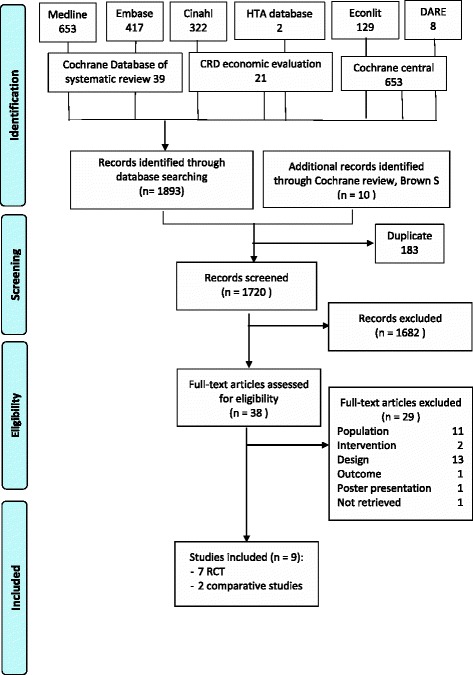
“1 PRISMA flow diagram Table 1 Characteristics of included studies Study Design Inclusion criteria Intervention (n) Control (n) Age Findings Carty 1990 [29], Canada RCT Vaginal birth, prenatal classes attendance, stable relationship with partners Group 1: discharge from 12 h to 24 h + nurse home visit on days 1, 2, 3,…”
BackgroundInfluentialPerinatal Care of Low-Risk Mothers and Infants: Early Discharge with Home Care
Yanover, M. J., Jones, D., & Miller, M. D. (1976) · New England Journal of Medicine · doi:10.1056/nejm197603252941306 · Cited by 116 · cited 7×
“The authors used the readiness of the family as a necessary condition for discharge [32].”
BackgroundMethodInfluentialEARLY HOSPITAL DISCHARGE IN OBSTETRICS
Hellman, L. M., Kohl, S. G., & Palmer, J. H. (1962) · The Lancet · doi:10.1016/s0140-6736(62)91185-6 · Cited by 96 · cited 7×
“Only one trial assessed the mortality rate in newborns at 3 weeks of life [30].”
BackgroundInfluentialHome‐based versus hospital‐based postnatal care: a randomised trial
Boulvain, M., Perneger, T. V., Othenin‐Girard, V., Petrou, S., Berner, M., & Irion, O. (2004) · BJOG: An International Journal of Obstetrics & Gynaecology · doi:10.1111/j.1471-0528.2004.00227.x · Cited by 90
International comparisons of patients’ views on quality of care
Wilde‐Larsson, B., Larsson, G., Chantereau, M. W., & Holstein, K. (2005) · International Journal of Health Care Quality Assurance · doi:10.1108/09526860510576974 · Cited by 88 · cited 1×
“[8] and because of the lack of information regarding these confounders in the publications, the adjustment is challenging and will not be reviewed here.”
BackgroundDanbjørg, D. B., Wagner, L., Kristensen, B. R., & Clemensen, J. (2015) · Midwifery · doi:10.1016/j.midw.2015.02.007 · Cited by 88
Early Discharge of Infants and Risk of Readmission for Jaundice
Lain, S. J., Roberts, C. L., Bowen, J. R., & Nassar, N. (2015) · Pediatrics · doi:10.1542/peds.2014-2388 · Cited by 84
Early discharge from obstetrics-pediatrics at the Hospital de Valme, with domiciliary follow-up
Sainz‐Bueno, J. A., Romano, M. R., Teruel, R. G., Benjumea, A. G., Fernández-Palacín, A., Almeida, C., & Manzano, M. C. (2005) · American Journal of Obstetrics and Gynecology · doi:10.1016/j.ajog.2005.01.015 · Cited by 78 · cited 7×
“In the second study performing a cost calculation from a payer perspective in Spain [31], the implementation of an early discharge programme provided savings ranging from 18 to 20% in comparison with convention hospital length of hospital stay.”
BackgroundMethodInfluentialFirst-time parents’ experiences of home-based postnatal care in Sweden
Johansson, K., Aarts, C., & Darj, E. (2010) · Upsala Journal of Medical Sciences · doi:10.3109/03009730903431809 · Cited by 76 · cited 1×
“In Sweden, early discharge corresponds to a length of stay of 6 h after birth [3, 37], while in France, a discharge after a length of stay of less than 72 h is considered as early [19].”
BackgroundA randomized trial of a program of early postpartum discharge with nurse visitation
Gagnon, A. J., Edgar, L., Kramer, M. S., Papageorgiou, A. N., Waghorn, K., & Klein, M. C. (1997) · American Journal of Obstetrics and Gynecology · doi:10.1016/s0002-9378(97)80037-3 · Cited by 74 · cited 6×
“Two trials analysed the difference in weight gain of newborns with early discharge and conventional length of stay [30, 36].”
BackgroundMethodInfluentialFarhat, R., & Rajab, M. (2011) · North American Journal of Medical Sciences · doi:10.4297/najms.2011.3146 · Cited by 74
Danbjørg, D. B., Wagner, L., & Clemensen, J. (2013) · Midwifery · doi:10.1016/j.midw.2013.06.006 · Cited by 68 · cited 1×
“Consequently, early postpartum discharge varies from 12 to 72 h depending on the country [7].”
BackgroundParents’ experiences of using videoconferencing as a support in early discharge after childbirth
Lindberg, I., Christensson, K., & Öhrling, K. (2009) · Midwifery · doi:10.1016/j.midw.2007.06.002 · Cited by 56 · cited 1×
“In Sweden, early discharge corresponds to a length of stay of 6 h after birth [3, 37], while in France, a discharge after a length of stay of less than 72 h is considered as early [19].”
BackgroundHome care after early discharge: Impact on healthy mothers and newborns
Áskelsdóttir, B., Jonge, W. L.-D., Edman, G., & Wiklund, I. E. (2013) · Midwifery · doi:10.1016/j.midw.2012.11.001 · Cited by 54 · cited 2×
“Finally, 2 non-randomised studies were included in our review [16, 27].”
Backgroundand EU COST Action IS0907. ‘Childbirth Cultures, C., Escuriet, R., White, J. L., Beeckman, K., Frith, L., León-Larios, F., Loytved, C., Luyben, A. G., Sinclair, M., & van Teijlingen, E. (2015) · BMC Health Services Research · doi:10.1186/s12913-015-1151-2 · Cited by 53
Bernstein, H. H., Spino, C., Lalama, C. M., Finch, S. A., Wasserman, R. C., & McCormick, M. C. (2013) · Academic Pediatrics · doi:10.1016/j.acap.2012.08.005 · Cited by 52 · cited 2×
“This criterion is indeed crucial for a successful early discharge programme because of a positive association between unreadiness at postpartum discharge and, on the one hand, health care use and, on the other hand, poorer health outcomes within 4 weeks after discharge [18].”
BackgroundEarly hospital discharge in maternal and newborn care
Fink, A. M. (2011) · Journal of Obstetric, Gynecologic & Neonatal Nursing · doi:10.1111/j.1552-6909.2011.01225.x · Cited by 50 · cited 6×
“Therefore, early discharge after vaginal birth is considered as less than 48 h in the United States.”
BackgroundInfluentialPostpartum Early Discharge: Impact on Maternal Fatigue and Functional Ability
Smith-Hanrahan, C., & Deblois, D. (1995) · Clinical Nursing Research · doi:10.1177/105477389500400106 · Cited by 48
Severe Neonatal Hyperbilirubinemia in the Netherlands
Gotink, M. J., Benders, M. J. N. L., Lavrijsen, S. W., Pereira, R. R., Hulzebos, C. V., & Dijk, P. H. (2013) · Neonatology · doi:10.1159/000351274 · Cited by 46
The impact of early discharge laws on the health of newborns
Evans, W. N., Garthwaite, C., & Wei, H. (2008) · Journal of Health Economics · doi:10.1016/j.jhealeco.2007.12.003 · Cited by 38 · cited 3×
“[1] demonstrated that the extension of the postpartum length of stay to 48 h had little impact on readmission rates for vaginally delivered newborns and was not cost saving.”
BackgroundNeonatal hyperbilirubinemia and early discharge from the maternity ward
Luca, D. D., Carnielli, V. P., & Paolillo, P. (2009) · European Journal of Pediatrics · doi:10.1007/s00431-009-0969-1 · Cited by 37 · cited 1×
“However, concerns about early discharge arose regarding potential adverse outcomes such as delays in detecting and preventing maternal morbidities and neonatal pathologies [6], earlier weaning, lack of professional support, higher prevalence of postpartum depression and increased hospital readmissions for both mothers…”
BackgroundWinterburn, S., & Fraser, R. (2000) · Journal of Advanced Nursing · doi:10.1046/j.1365-2648.2000.01586.x · Cited by 36
Waldenström, U., & Lindmark, G. (1987) · Scandinavian Journal of Social Medicine · doi:10.1177/140349488701500307 · Cited by 31
Privatisation & marketisation of post-birth care: the hidden costs for new mothers
Benoit, C., Stengel, C., Phillips, R., Zadoroznyj, M., & Berry, S. (2012) · International Journal for Equity in Health · doi:10.1186/1475-9276-11-61 · Cited by 24 · cited 2×
“for other conditions [41], creating unmet needs, or using informal support workers as doulas [42].”
BackgroundSorties précoces de maternité: quels problèmes anticiper?
Straczek, H., Vieux, R., Hubert, C., Miton, A., & Hascoet, J.-M. (2008) · Archives de Pédiatrie · doi:10.1016/j.arcped.2008.02.022 · Cited by 23
Early postpartum discharge and breastfeeding: An observational study from France
Cambonie, G., Rey, V., Sabarros, S., Baum, T., Fournier-Favre, S., Mazurier, E., Boulot, P., & Picaud, J. (2010) · Pediatrics International · doi:10.1111/j.1442-200x.2009.02942.x · Cited by 16 · cited 1×
“In Sweden, early discharge corresponds to a length of stay of 6 h after birth [3, 37], while in France, a discharge after a length of stay of less than 72 h is considered as early [19].”
BackgroundHascoët, J., & Petitprez, K. (2014) · Archives de Pédiatrie · doi:10.1016/j.arcped.2014.06.017 · Cited by 15
Individualized follow up programme and early discharge in term neonates
Carolis, M. P. D., Cocca, C., Valente, E., Lacerenza, S., Rubortone, S. A., Zuppa, A. A., & Romagnoli, C. (2014) · The Italian Journal of Pediatrics/Italian journal of pediatrics · doi:10.1186/1824-7288-40-70 · Cited by 13
Cinderella of the services – ‘the pantomime of postnatal care’
Barker, K. (2013) · British Journal of Midwifery · doi:10.12968/bjom.2013.21.12.842 · Cited by 7
Early hospital discharge and early puerperal complications
Ramírez-Villalobos, D., Hernández-Garduño, A. G., Salinas‐Rodríguez, A., González, D., Walker, D. M., Herrera, G. R., & Hernández, B. (2009) · Salud Pública de México · doi:10.1590/s0036-36342009000300011 · Cited by 7 · cited 2×
“Finally, 2 non-randomised studies were included in our review [16, 27].”
BackgroundPublic Health Nurses’ (PHNs) Perceptions of their Role in Early Postpartum Discharge
Cusack, C., Hall, W. A., Scruby, L. S., & Wong, S. T. (2008) · Canadian Journal of Public Health · doi:10.1007/bf03405475 · Cited by 6
[Home-based care after an early newborn discharge].
A, A. C., Semet, J.-C., Arnaud, C., Dali-Youcef, A., Abada, K., Gayzard, B., Lancelin, F., Pax-Chochois, S., Alves, N., Curat, A.-M., et al. (2009) · PubMed · Cited by 2
Sorties précoces de maternité et hospitalisation à domicile : expérience ariégeoise
A, A. C., Semet, J.-C., Arnaud, C., Dali-Youcef, A., Abada, K., Gayzard, B., Lancelin, F., Pax-Chochois, S., Alves, N., Curat, A.-M., et al. (2009) · Archives de Pédiatrie · doi:10.1016/s0929-693x(09)74120-x · Cited by 1
Research works printed but not linked: 3
- OECD. Average length of stay: childbirth. Health: Key Tables from OECD, No. 51. 2014. doi:10.1787/l-o-s-childbirth-table-2014-1-en. · DOI
- Chanot A, Semet JC, Arnaud C, Dali-Youcef A, Abada K, Gayzard B, Lancelin F, Pax-Chochois S, Alves N, Curat AM et al: L'hospitalisation a domicile apres une sortie precoce de maternite. Soins 2009, Pediatrie, Puericulture.(246):24–26. 19202982
- Ghedin BS Cancelier ACL Feuerschuette OHM Silveira SK Healthy newborn length of hospital stay: influence on breastfeeding and neonatal morbidity J Perinat Med 2011 39 S1 159
Cited by
Early postnatal discharge from hospital for healthy mothers and term infants
Jones, E., Stewart, F., Taylor, B., Davis, P. G., & Brown, S. J. (2021) · Cochrane Database of Systematic Reviews · doi:10.1002/14651858.cd002958.pub2 · Cited by 121
Early postpartum discharge during the COVID-19 pandemic
Bornstein, E., Gulersen, M., Husk, G. A., Grunebaum, A. N., Blitz, M. J., Rafael, T. J., Rochelson, B. L., Schwartz, B., Nimaroff, M. L., & Chervenak, F. A. (2020) · Journal of Perinatal Medicine · doi:10.1515/jpm-2020-0337 · Cited by 56
“A recent systematic review investigating the impact of early postpartum discharge after vaginal delivery demonstrated the lack of support or evidence against the widespread use of early discharge [11].”
BackgroundLindblad, V., Melgaard, D., Jensen, K., Eidhammer, A., Westmark, S., Kragholm, K. H., & Gommesen, D. (2022) · European Journal of Midwifery · doi:10.18332/ejm/146897 · Cited by 80
Measures to assess quality of postnatal care: A scoping review
Galle, A., Moran, A. C., Bonet, M., Graham, K., Muzigaba, M., Portela, A. G., Day, L. T., Tuabu, G. K., Silva, B., & Moller, A. (2023) · PLOS Global Public Health · doi:10.1371/journal.pgph.0001384 · Cited by 29
Goodwin, L. D., Taylor, B., Kokab, F., & Kenyon, S. L. (2018) · Midwifery · doi:10.1016/j.midw.2018.02.006 · Cited by 19
Metadata
- Authors
- Benahmed, N., San Miguel, L., Devos, C., Fairon, N., & Christiaens, W.
- Affiliations
- Belgian Health Care Knowledge Centre (KCE) (BE)
- Corresponding author
- Benahmed, Nadia
- Venue
- BMC Pregnancy and Childbirth
- Published
- 2017-09-06
- Volume
- 17
- Issue
- 1
- Pages
- 289-289
- ISSN
- 1471-2393 (ISSN-L)
- PMC
- PMC5588709
- OpenAlex
- W2752909151
- Cited by
- 59
- References
- 42
- Citations by year
- 2026: 3 · 2025: 4 · 2024: 6 · 2023: 16 · 2022: 8 · 2021: 10 · 2020: 9 · 2019: 2 · 2018: 1
- FWCI
- 0.56
- Type
- journal article
- Language
- en
- Open access
- gold
- doi.org
- Licence
- cc-by
- Locations
- BMC Pregnancy and Childbirth (publishedVersion, cc-by)
- PubMed Central (publishedVersion, cc-by)
- PubMed (publishedVersion)
- DOAJ (DOAJ: Directory of Open Access Journals) (submittedVersion, cc-by-sa)
- KCE repository (Belgian Health Care Knowledge Centre) (submittedVersion)
- Topics
- Health Sciences › Medicine › Obstetrics and Gynecology › Maternal and Perinatal Health Interventions
- Health Sciences › Medicine › Pediatrics, Perinatology and Child Health › Maternal and Neonatal Healthcare
- Health Sciences › Medicine › Pediatrics, Perinatology and Child Health › Infant Development and Preterm Care
- Keywords
- early postpartum discharge, postpartum length of stay, vaginal delivery, maternal outcomes, neonatal outcomes, postpartum depression, neonatal hyperbilirubinemia, breastfeeding, cost containment
- MeSH terms
- Adult, Female, Humans, Infant, Newborn, Length of Stay, Mothers, Patient Discharge, Pregnancy, Vagina, Delivery, Obstetric, Postpartum Period
About these checks
Registry, retraction, Cites and statistics results are computed, not judged, with one exception: a printed reference that no index lists is read once by a model before it counts as a citation error. Claims are extracted by a model and kept only when their quote appears verbatim in the text; each cited source is then checked, with a model’s help, for whether it says what the claim relies on. Those verdicts can be wrong — read the claim’s quote and the cited source before relying on one.
Statistics and arithmetic are recomputed, not judged.
Confidence bands are shown only for fields calibrated on our annotated test set. None is calibrated yet, so no band is shown.
What counts as a claim ›How we measure confidence ›How we check this ›
Are you an author, or do you see a problem with this page? Request a review
Data sources
Bibliographic data: Semantic Scholar, OpenAlex, Crossref.
Contains information from the Semantic Scholar Academic Graph Datasets, made available under the ODC Attribution License (ODC-BY 1.0).
Semantic Scholar’s data is described in: Kinney, R., et al. (2023). The Semantic Scholar Open Data Platform. arXiv:2301.10140.
