

Validation of the Iranian version of the childbirth experience questionnaire 2.0
Open accessThe DOI matches its Crossref record; 51 of the 51 references it cites were found in a registry or an index.
Abstract
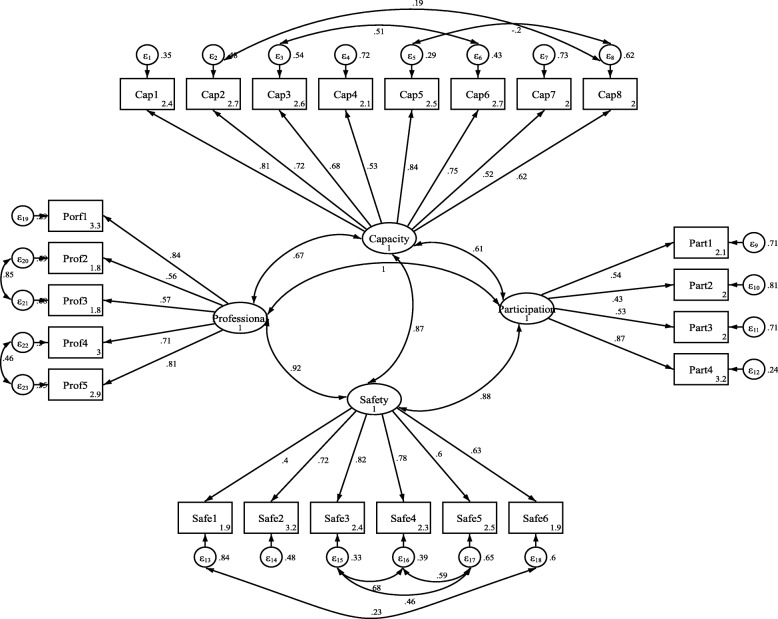
Background: Assessing women’s childbirth experiences is a crucial indicator in maternity services because negative childbirth experiences are associated with maternal mortalities and morbidities. Due to the high caesarean birth rate in Iran, measuring childbirth experience is a top priority, however, there is no standard tool to measure this key indicator in Iran. The aim of present study is to adapt the “Childbirth Experience Questionnaire 2.0” to the Iranian context and determine its psychometric characteristics. Methods: Childbirth Experience Questionnaire 2.0 was translated into Farsi. A total of 500 primiparous women, at 4 to 16 weeks postpartum, were randomly selected from 54 healthcare centres in Tabriz. Internal consistency and reliability was calculated using the Cronbach’s Coefficient alpha and Intraclass Correlation Coefficient, respectively. Construct validity was assessed using exploratory and confirmatory factor analysis and discriminant validity using the known-group method and the Mann-Whitney U-test. Results: The internal consistency and reliability for the total tool were high (Cronbach’s alpha = 0.93; Intraclass Correlation Coefficient = 0.97). Explanatory factor analysis demonstrated the adequacy of the sampling (Kaiser-Meyer-Olkin = 0.923) and significant factorable sphericity (p < 0.001). Confirmation factor analysis demonstrated acceptable values of fitness (RMSEA = 0.07, SRMSEA = 0.06, TLI = 0.97, CFI > 0.91, x2/ df = 4.23). Discriminatory validity of the tool was confirmed where the CEQ score and its subdomains were significantly higher in women who reported having control over their childbirth than women who did not. Conclusion: The Farsi version of the Childbirth Experience Questionnaire 2.0 tool is a valid and reliable tool and can be used to measure the childbirth experience in Iranian women.
Overview
The claims and statistics of this paper haven’t been checked yet.
Free: it reads the open-access text and checks the first 5 claims that cite a source we can check. Create a free account to check every claim.
Integrity signals
Registry
Cites
Statistics
Figures
Verification
Claims the paper makes
The claims and statistics of this paper haven’t been checked yet.
Free: it reads the open-access text and checks the first 5 claims that cite a source we can check. Create a free account to check every claim.
Claims other papers make about this one
Each is checked against this paper’s own text: does it say what the citing paper says it does?
The cited source says what the claim attributes to it.
In the citing paper
“This scale has been validated for the Iranian population, showing a Cronbach’s alpha of 0.93 and an intraclass correlation coefficient (ICC) of 0.97 [34]. In our study, the Cronbach’s alpha coefficient was 0.96, with subscale values ranging from 0.74 to 0.91.”
From Effect of midwifery students’ continuity of care program on women’s experiences of maternity care: A randomised controlled trial (2026) · cites this paper as [34]
Self-check
Percentages, sums and reported differences re-computed from the paper’s own numbers.
The self-check needs the paper’s full text.
Citations
Cites
Statistical Power Analysis for the Behavioral Sciences
Muller, K. (1989) · Technometrics · doi:10.1080/00401706.1989.10488618 · Cited by 99,167
Statistical power analysis for the behavioral sciences
(1990) · Computers, Environment and Urban Systems · doi:10.1016/0198-9715(90)90050-4 · Cited by 65,269
Significance tests and goodness of fit in the analysis of covariance structures.
Bentler, P. M., & Bonett, D. G. (1980) · Psychological Bulletin · doi:10.1037//0033-2909.88.3.588 · Cited by 19,023
Statistical methods for health care research
Munro, B. H. (1986) · Medical Entomology and Zoology · Cited by 2,265
Bohren, M. A., Vogel, J. P., Hunter, E. C., Lutsiv, O., Makh, S. K., Souza, J. P., Aguiar, C., Saraiva Coneglian, F., Diniz, A. L. A., Tunçalp, Ö., et al. (2015) · PLOS Medicine · doi:10.1371/journal.pmed.1001847 · Cited by 1,656
Quality of Life: Assessment, Analysis, and Interpretation
Fayers, P. M. (2000) · Medical Entomology and Zoology · Cited by 1,490
Statistical Methods for Health Care Research
Wegner, G. D. (1995) · Journal of Gerontological Nursing · doi:10.3928/0098-9134-19950701-15 · Cited by 1,412
Interventions for providers to promote a patient-centred approach in clinical consultations
Dwamena, F., Holmes-Rovner, M., Gaulden, C. M., Jorgenson, S., Sadigh, G., Sikorskii, A., Lewin, S., Smith, R. C., Coffey, J., Olomu, A., et al. (2012) · Cochrane Database of Systematic Reviews · doi:10.1002/14651858.cd003267.pub2 · Cited by 1,227
Predictors of patient satisfaction
Jackson, J. L., Chamberlin, J., & Kroenke, K. (2001) · Social Science & Medicine · doi:10.1016/s0277-9536(00)00164-7 · Cited by 861
Handbook of Applied Multivariate Statistics and Mathematical Modeling
(2000) · Elsevier eBooks · doi:10.1016/b978-0-12-691360-6.x5000-9 · Cited by 838 · cited 1×
“3, it is poorly correlated with the extracted set of factors and may be removed [34].”
Background
Research works printed but not linked: 2
- Seyf AA Measurement, test and educational evaluation 2016 7 Tehran Douran
- Hajizadeh E Asghari M Statistical methods and analysis in health and biosciences a research methodological approach using SPSS practical guide 2011 Tehran Jahad daneshgahi
Cited by
Respectful Maternity Care: A Systematic Review
Cantor, A. G., Jungbauer, R. M., Skelly, A. C., Hart, E. L., Jorda, K., Davis-O’Reilly, C., Caughey, A. B., & Tilden, E. L. (2024) · Annals of Internal Medicine · doi:10.7326/m23-2676 · Cited by 118
“Twelve studies were done in low-or middle-income countries (39 – 43, 47 – 49, 52, 53, 55) and 12 in higher-income countries (32, 34 – 38, 44, 46, 50, 51, 54, 56).”
Ahmadpour, P., Faroughi, F., & Mirghafourvand, M. (2023) · BMC Psychology · doi:10.1186/s40359-023-01105-6 · Cited by 91
Self-citationDencker, A., Bergqvist, L., Berg, M., Greenbrook, J. T. V., Nilsson, C., & Lundgren, I. (2020) · BMC Pregnancy and Childbirth · doi:10.1186/s12884-020-02869-0 · Cited by 80
Self-citationHajizadeh, K., Vaezi, M., Meedya, S., Mohammad Alizadeh Charandabi, S., & Mirghafourvand, M. (2020) · BMC Pregnancy and Childbirth · doi:10.1186/s12884-020-03118-0 · Cited by 71
Self-citationEffect of implementing a birth plan on maternal and neonatal outcomes: a randomized controlled trial
Ahmadpour, P., Moosavi, S., Mohammad‐Alizadeh‐Charandabi, S., Jahanfar, S., & Mirghafourvand, M. (2022) · BMC Pregnancy and Childbirth · doi:10.1186/s12884-022-05199-5 · Cited by 70
Self-citationGhanbari-Homaie, S., Meedya, S., Mohammad-Alizadeh-Charandabi, S., Jafarabadi, M. A., Mohammadi, E., & Mirghafourvand, M. (2021) · Reproductive Health · doi:10.1186/s12978-021-01196-7 · Cited by 50
“0) [28, 29] and Support and Control in Birth (SCIB) [30] questionnaires.”
BackgroundSelf-citationPan, H., Lin, C., Chen, L., Qiao, Y., Huang, P., Liu, B., Zhu, Y., Su, J., & Liu, J. (2021) · Frontiers in Neurology · doi:10.3389/fneur.2021.704088 · Cited by 53
Nahaee, J., Rezaie, M., Abdoli, E., Mirghafourvand, M., Ghanbari-Homaie, S., & Jafarzadeh, M. (2024) · Reproductive Health · doi:10.1186/s12978-024-01819-9 · Cited by 45
“Ghan-bari et al. assessed the psychometric properties of the CEQ in Iran [35].”
BackgroundSelf-citationAdebiyi, O. O., Olabanji, S. O., & Olaniyi, O. O. (2023) · Asian Journal of Education and Social Studies · doi:10.9734/ajess/2023/v49i41196 · Cited by 44
Peters, L. L., van der Pijl, M. S. G., Vedam, S., Barkema, W., van Lohuizen, M. T., Jansen, D. E. M. C., & Jong, E. F. (2022) · BMC Pregnancy and Childbirth · doi:10.1186/s12884-022-04445-0 · Cited by 38
Psychometric properties of the Persian version of the Physical Activity Scale for the Elderly (PASE)
Hatami, O., Aghabagheri, M., Kahdouei, S., & Nasiriani, K. (2021) · BMC Geriatrics · doi:10.1186/s12877-021-02337-0 · Cited by 31
Evaluation of the birth plan implementation: a parallel convergent mixed study
Ahmadpour, P., Moosavi, S., Mohammad‐Alizadeh‐Charandabi, S., Jahanfar, S., & Mirghafourvand, M. (2020) · Reproductive Health · doi:10.1186/s12978-020-00989-6 · Cited by 26
“97, respectively [23], this instrument will be completed 6 weeks postpartum via interview.”
BackgroundSelf-citationBull, C. F., Carrandi, A., Slavin, V., Teede, H. J., & Callander, E. J. (2023) · American Journal of Obstetrics & Gynecology MFM · doi:10.1016/j.ajogmf.2023.101102 · Cited by 25
Measuring Women’s Satisfaction with Childbirth: A Literature Review of Measurement Properties
Ratislavová, K., Horová, J., & Marek, P. (2024) · Slovenian Journal of Public Health · doi:10.2478/sjph-2024-0014 · Cited by 24
Hosaini, S., Yazdkhasti, M., Ghafari, F., Mohamadi, F., Rad, S. H. R. K., & Mahmoodi, Z. (2023) · PLoS ONE · doi:10.1371/journal.pone.0294910 · Cited by 23
Oskoui, B. S., Mehrabi, E., Nourizadeh, R., & Esmaeilpour, K. (2023) · BMC Pregnancy and Childbirth · doi:10.1186/s12884-023-05607-4 · Cited by 23
Hassanzadeh, R., Abbasalizadeh, F., Meedya, S., Mohammad‐Alizadeh‐Charandabi, S., & Mirghafourvand, M. (2020) · The Journal of Maternal-Fetal & Neonatal Medicine · doi:10.1080/14767058.2020.1834531 · Cited by 20
Self-citationIranian women’s perception on the determinants of birth experience: a qualitative study
Mirghafourvand, M., Meedya, S., Mohammadi, E., Mohammad‐Alizadeh‐Charandabi, S., Jafarabadi, M. A., & Ghanbari-Homaie, S. (2022) · BMC Pregnancy and Childbirth · doi:10.1186/s12884-022-05078-z · Cited by 20
Self-citationAbdolalipour, S., Abbasalizadeh, S., Mohammad-Alizadeh-Charandabi, S., Abbasalizadeh, F., Jahanfar, S., Raphi, F., & Mirghafourvand, M. (2024) · BMC Pregnancy and Childbirth · doi:10.1186/s12884-024-06449-4 · Cited by 19
“Psychometrics properties of all the tools used in this study, except for PCQ, including childbirth experience [29], fear of childbirth [30], postpartum depression [31], and PTSD symptoms [26] questionnaires, have been tested and confirmed in Iran.”
MethodSelf-citationVahidi, F., Mirghafourvand, M., Naseri, E., & Ghanbari-Homaie, S. (2023) · BMC Pregnancy and Childbirth · doi:10.1186/s12884-023-05717-z · Cited by 19
“81 and above for the sub-scales, which indicates an acceptable agreement [21].”
BackgroundSelf-citationMoniri, M., Rashidi, F., Mirghafourvand, M., Rezaei, M., & Ghanbari-Homaie, S. (2023) · BMC Psychology · doi:10.1186/s40359-023-01475-x · Cited by 17
“The validation of the Persian version of CEQ 2.0 has been confirmed by Ghanbari et al. The internal consistency and reliability of the tool have bee reported as 0.93 and 0.97, respectively [24].”
MethodInfluentialSelf-citationValidating the use of the revised childbirth experience questionnaire in Hong Kong
Lok, K. Y. W., Fan, H. S. L., Ko, R. W. T., Kwok, J. Y. Y., Wong, J. Y. H., Fong, D., Shek, N. W. M., Ngan, H., & Choi, E. P. H. (2022) · BMC Pregnancy and Childbirth · doi:10.1186/s12884-022-04456-x · Cited by 17
Preterm Birth and Maternal Mood States: What Is the Impact on Bonding?
Ionio, C., Ciuffo, G., Colombo, C., Melani, O., Figlino, M. F., Landoni, M., Castoldi, F. M., Cavigioli, F., & Lista, G. (2024) · Pediatric Reports · doi:10.3390/pediatric16010004 · Cited by 16
“Lastly, longitudinal studies are needed to generalize the results.”
BackgroundDesign and validation of brucellosis prevention questionnaire focused on animal vaccination
Bahadori, F., Ghofranipour, F. F., Ghaffarifar, S., & Ziaei, R. (2021) · BMC Public Health · doi:10.1186/s12889-020-10014-x · Cited by 16
Najafi, Z., Mirghafourvand, M., & Ghanbari-Homaie, S. (2023) · BMC Pregnancy and Childbirth · doi:10.1186/s12884-023-05575-9 · Cited by 12
“It is possiblethat the assessment of childbirth experience, especially regarding thesemothers, could be more realistic and yield more reliable results when it isdone after a period of time to provide an opportunity for the women to evaluatetheir experiences in retrospect [27].”
BackgroundSelf-citationPredictors of a positive birth experience in childbirth: A cross-sectional study
Roqueta-Vall-llosera, M., Cámara-Liebana, D., Serrat-Graboleda, E., Salleras-Duran, L., Buxó, M., Fuentes‐Pumarola, C., & Ferrando, D. B. (2024) · Heliyon · doi:10.1016/j.heliyon.2024.e38262 · Cited by 9
Maternal performance after childbirth and its predictors: a cross sectional study
Choobdarnezhad, M., Amiri‐Farahani, L., & Pezaro, S. (2024) · BMC Pregnancy and Childbirth · doi:10.1186/s12884-024-06412-3 · Cited by 8
Alivand, Z., Nourizadeh, R., Hakimi, S., Esmaeilpour, K., & Mehrabi, E. (2024) · Journal of Education and Health Promotion · doi:10.4103/jehp.jehp_1075_23 · Cited by 7
“[39] The reliability of the questionnaire was estimated by Cronbach’s alpha of 0.93 and intraclass correlation coefficient of 0.97.”
InfluentialAlizadeh-Dibazari, Z., Abbasalizadeh, F., Mohammad‐Alizadeh‐Charandabi, S., & Mirghafourvand, M. (2024) · BMJ Open · doi:10.1136/bmjopen-2024-087038 · Cited by 7
Self-citationAzarkish, M., Malakouti, J., & Mirghafourvand, M. (2022) · Journal of Psychosocial Nursing and Mental Health Services · doi:10.3928/02793695-20220705-03 · Cited by 7
Self-citationWaldum, Å. H., Lukasse, M., Staff, A. C., Falk, R. S., Sørbye, I. K., & Jacobsen, A. F. (2022) · Birth · doi:10.1111/birt.12697 · Cited by 7
Ghanbari‐Homayi, S., Naseri, E., Mirghafourvand, M., & Vahidi, F. (2024) · Payesh (Health Monitor) Journal · doi:10.61186/payesh.23.2.199 · Cited by 5
Self-citationRouhzendeh, S., Mousavi, S., Mirghafourvand, M., & Mohammad‐Alizadeh‐Charandabi, S. (2024) · BMC Pregnancy and Childbirth · doi:10.1186/s12884-024-06831-2 · Cited by 4
“Its internal consistency using Cronbach’s alpha for the total score in that study was 0.93 [25].”
MethodInfluentialSelf-citationAzarkish, M., Malakouti, J., & Mirghafourvand, M. (2022) · Journal of Holistic Nursing and Midwifery · doi:10.32598/jhnm.32.4.2312 · Cited by 4
Self-citationShahhosseini, Z., Nikbakht, R., Motaghi, Z., & Tabaghdehi, M. H. (2023) · BMC Pregnancy and Childbirth · doi:10.1186/s12884-023-05378-y · Cited by 4
“[11], has been validated in a sample of Iranian primiparous women [12].”
BackgroundPsychometric properties of the experiences of maternity care scale among Iranian women
Jafari, E., Asghari-Jafarabadi, M., Mirghafourvand, M., & Mohammad-Alizadeh-Charandabi, S. (2024) · BMC Health Services Research · doi:10.1186/s12913-024-11065-1 · Cited by 3
Self-citationAbdolalipour, S., Abbasalizadeh, S., Mohammad‐Alizadeh‐Charandabi, S., Abbasalizadeh, F., Jahanfar, S., & Mirghafourvand, M. (2024) · Frontiers in Global Women s Health · doi:10.3389/fgwh.2024.1309886 · Cited by 5
Self-citationShabani, F., Homaie, S. G., Tabaei, F. Y., Montazeri, M., Raphi, F., Lalezari, E., & Mirghafourvand, M. (2024) · Reproductive Health · doi:10.1186/s12978-024-01921-y · Cited by 3
Self-citationTranslation and Validation of the Mongolian Version of the Childbirth Experience Questionnaire
Parchaa, T., Ganchimeg, T., Fukuzawa, R. K., Chunagsuren, B., Tseleejav, B., Nyam, N., & Katsumata, A. T. (2021) · Journal of Patient Experience · doi:10.1177/23743735211060636 · Cited by 3
“Moreover, the internal consistency of the subdomains was in line with previous studies where professional support and participation had the highest and lowest coefficient, respectively (22,23,26,39).”
BackgroundResultMachín-Martín, E., la Torre, H. G., Bordón-Reyes, H., Jeppesen-Gutiérrez, J., & Martínez, A. M. (2024) · BMC Pregnancy and Childbirth · doi:10.1186/s12884-024-06400-7 · Cited by 3
“Most published models for CEQ and CEQ 2.0 advocate for the existence of 4 fac-tors-domains [30, 31, 34, 36, 41–43, 45 ], What seems clear is the confirmation of the instru-ment’s multidimensionality, something that was already reported in the validation study of CEQ-E, where very poor fit was…”
MethodResultInfluentialRodríguez-Mireles, S., López‐Valcárcel, B. G., Galdos-Arias, P., Perez-Diaz, E., & Serra‐Majem, L. (2024) · Journal of Epidemiology & Community Health · doi:10.1136/jech-2023-220335 · Cited by 2
Zhang, Y., Li, C. L., Zhu, Y., Contento, I. R., Koch, P. A., Yang, Q., Dang, Q., Hu, Z., Wei, Y., Chen, Z., et al. (2024) · Journal of Nutrition Education and Behavior · doi:10.1016/j.jneb.2024.03.005 · Cited by 2
Ebrahimian, A., Abedi, P., Cheraghian, B., & Iravani, M. (2025) · Iranian Journal of Nursing and Midwifery Research · doi:10.4103/ijnmr.ijnmr_297_24 · Cited by 2
“[19,20] Data were analyzed using SPSS software version 22 (IBM Corporation, Armonk, NY, USA).”
Ghanbari-Homaie, S., Meedya, S., Mohammad‐Alizadeh‐Charandabi, S., Jafarabadi, M. A., Mohammadi, E., & Mirghafourvand, M. (2022) · International Journal of Childbirth · doi:10.1891/ijc-2021-0040 · Cited by 2
Self-citationMohebbi-Dehanvi, Z., Hajihashemy, M., & Kohan, S. (2023) · Journal of Education and Health Promotion · doi:10.4103/jehp.jehp_1039_22 · Cited by 2
“of this questionnaire have been confirmed in the study of Ghanbari‐Homayi et al.[25] In the present study,”
MethodResultInfluentialSoleimani, N., Refaei, M., & Kazemi, F. (2023) · Current Women s Health Reviews · doi:10.2174/1573404820666230519123920 · Cited by 2
Beato, A. F., Alves, S., Akik, B. K., & Albuquerque, S. (2024) · Midwifery · doi:10.1016/j.midw.2024.104236 · Cited by 2
Jorbijarkali, F. S., Ghanbari‐Homayi, S., Mirghafourvand, M., Rezaei, M., & Malakouti, J. (2025) · BMC Pregnancy and Childbirth · doi:10.1186/s12884-025-07704-y · Cited by 2
“In a study by Ghanbari-Homayi et al. (2019) aimed at determining predictors of childbirth experience, it was reported that the likelihood of a negative childbirth experience in the absence of pain relief, whether pharmacological or non-pharmacological, was 4.24 times higher than when any form of…”
InfluentialSelf-citationZeinolabedini, M., Motlagh, M. E., Hidarnia, A. A., Shakerinejad, G., & Zeidi, I. M. (2025) · Scientific Reports · doi:10.1038/s41598-025-30714-x · Cited by 2
“Impact scores higher than 1.5 were considered desirable 20 .”
InfluentialJafari, E., Mirghafourvand, M., Abbasalizadeh, S., Meedya, S., Doshmangir, L., & Mohammad-Alizadeh-Charandabi, S. (2026) · PLOS One · doi:10.1371/journal.pone.0353118 · Cited by 1
“This scale has been validated for the Iranian population, showing a Cronbach’s alpha of 0.93 and an intraclass correlation coefficient (ICC) of 0.97 [34].”
InfluentialSelf-citationAlizadeh-Dibazari, Z., Abbasalizadeh, F., Mohammad‐Alizadeh‐Charandabi, S., Jahanfar, S., & Mirghafourvand, M. (2026) · Scientific Reports · doi:10.1038/s41598-026-49406-1 · Cited by 1
“The Persian version, containing 23 items, was validated by Ghanbari-Homayi et al., showing a Cronbach’s alpha of 0.93 and an intra-class correlation coefficient of 0.97 36 .”
InfluentialSelf-citationWomen’s experience during the perinatal period
Govsieiev, D. O., & Romanenko, A. (2023) · Ukrainian journal of Perinatology and Pediatrics · doi:10.15574/pp.2023.94.51 · Cited by 1
van der Pijl, M. S. G. (2023) · doi:10.5463/thesis.36 · Cited by 1
Uwimana, M. C. (2020) · University of the Witwatersrand, Johannesburg Institutional Repository on DSpace (University of the Witwatersrand, Johannesburg)
Hassanzadeh, R., Abbas-Alizadeh, F., Meedya, S., Mohammad‐Alizadeh‐Charandabi, S., & Mirghafourvand, M. (2020) · doi:10.21203/rs.2.24757/v1
Self-citationBirthing Experience and Perinatal Outcomes with COVID-19: A Prospective Study
Arjun, R., Navakumar, N., Ahmed, T., Ranganayaki, V., Sabu, B., Mohan, S., & Niyas, M. (2022) · Journal of South Asian Federation of Obstetrics and Gynaecology · doi:10.5005/jp-journals-10006-2057
Childbirth Experience during COVID-19 Pandemic: A Cross-Sectional Study
K, T. N. E., Taumberger, N., Sagmeister, H., Greimel, E., & Schöll, W. (2023) · Obstetrics & Gynecology Open Access · doi:10.29011/2577-2236.100160
“Gynecol Obstet, an open access journal ISSN: 2577-2236 The original childbirth experience questionnaire (CEQ) was developed and validated in Sweden in 2010 [7] measuring four main columns of the childbirth experience: Own capacity, Professional support, Perceived safety and Participation.”
MethodInfluentialCorrelation between respectful maternity care and childbirth experience in a tertiary care centre
Anand, M., Mishra, M., & Modi, D. (2025) · International Journal of Reproduction Contraception Obstetrics and Gynecology · doi:10.18203/2320-1770.ijrcog20253093
Jafari, E., Asghari-Jafarabadi, M., Mirghafourvand, M., & Mohammad‐Alizadeh‐Charandabi, S. (2024) · Figshare · doi:10.6084/m9.figshare.26719206
Self-citationShahhosseini, Z., Nikbakht, R., Motaghi, Z., & Tabaghdehi, M. H. (2023) · Figshare · doi:10.6084/m9.figshare.22607882
Bahadori, F., Ghofranipour, F. F., Ghaffarifar, S., & Ziaei, R. (2021) · Figshare · doi:10.6084/m9.figshare.13514536
Ahmadpour, P., Moosavi, S., Mohammad‐Alizadeh‐Charandabi, S., Jahanfar, S., & Mirghafourvand, M. (2022) · Figshare · doi:10.6084/m9.figshare.21621996
Self-citationPeters, L. L., van der Pijl, M., Vedam, S., Barkema, W. S., van Lohuizen, M. T., Jansen, D. E. M. C., & Feijen-de Jong, E. I. (2022) · Figshare · doi:10.6084/m9.figshare.19200177
Ahmadpour, P., Moosavi, S., Mohammad‐Alizadeh‐Charandabi, S., Jahanfar, S., & Mirghafourvand, M. (2022) · Figshare · doi:10.6084/m9.figshare.21621993
Self-citationMachín-Martín, E., la Torre, H. G., Bordón-Reyes, H., Jeppesen-Gutiérrez, J., & Martín-Martínez, A. (2024) · Figshare · doi:10.6084/m9.figshare.25441037
Machín-Martín, E., la Torre, H. G., Bordón-Reyes, H., Jeppesen-Gutiérrez, J., & Martín-Martínez, A. (2024) · Figshare · doi:10.6084/m9.figshare.26695416
Machín-Martín, E., la Torre, H. G., Bordón-Reyes, H., Jeppesen-Gutiérrez, J., & Martín-Martínez, A. (2024) · Figshare · doi:10.6084/m9.figshare.25440931
Jafari, E., Asghari-Jafarabadi, M., Mirghafourvand, M., & Mohammad‐Alizadeh‐Charandabi, S. (2024) · Figshare · doi:10.6084/m9.figshare.25802856
Self-citationJafari, E., Asghari-Jafarabadi, M., Mirghafourvand, M., & Mohammad‐Alizadeh‐Charandabi, S. (2024) · Figshare · doi:10.6084/m9.figshare.25802810
Self-citationAhmadpour, P., Faroughi, F., & Mirghafourvand, M. (2024) · Figshare · doi:10.6084/m9.figshare.26572768
Self-citationPeters, L. L., van der Pijl, M., Vedam, S., Barkema, W. S., van Lohuizen, M. T., Jansen, D. E. M. C., & Feijen-de Jong, E. I. (2022) · Figshare · doi:10.6084/m9.figshare.19200174
Shahhosseini, Z., Nikbakht, R., Motaghi, Z., & Tabaghdehi, M. H. (2023) · Figshare · doi:10.6084/m9.figshare.22607879
Machín-Martín, E., la Torre, H. G., Bordón-Reyes, H., Jeppesen-Gutiérrez, J., & Martín-Martínez, A. (2024) · Figshare · doi:10.6084/m9.figshare.26695413
Alizadeh-Dibazari, Z., Abbasalizadeh, F., Mohammad‐Alizadeh‐Charandabi, S., & Mirghafourvand, M. (2026) · BMJ Open · doi:10.1136/bmjopen-2025-112218
Self-citationRanjbar, M., Shahnazi, M., Mohammad‐Alizadeh‐Charandabi, S., Abbasalizadeh, F., Shafiee, A. R., & Mirghafourvand, M. (2026) · Discover Psychology · doi:10.1007/s44202-026-00661-3
Self-citationChildbirth experience among different Iranian ethnic groups: a cross-sectional study
Abdolalipour, S., Tavananezhad, N., Iravani, M., Bakouei, F., Janani, F., Mohammadi, A., Ghanbari-Homaie, S., & Mirghafourvand, M. (2026) · BMJ Open · doi:10.1136/bmjopen-2025-110853
Self-citationRajagopal, N., & Sujani, B. K. (2026) · International Journal of Reproduction Contraception Obstetrics and Gynecology · doi:10.18203/2320-1770.ijrcog20261479
Yulghunlu, F. A., Mohammad‐Alizadeh‐Charandabi, S., Abbasalizadeh, F., Hajizadeh, K., & Mirghafourvand, M. (2026) · Journal of Health Population and Nutrition · doi:10.1186/s41043-026-01364-0
“The Persian version underwent validation in Iran (Tabriz) involving 500 women, demonstrating an internal consistency of 0.97 [35].”
InfluentialSelf-citationRouhzendeh, S., Shahnazi, M., Abbasalizadeh, F., & Mirghafourvand, M. (2026) · Reproductive Health · doi:10.1186/s12978-026-02405-x
“The Persian translation of the Childbirth Experience Questionnaire version 2 (CEQ-2) will be employed to evaluate women’s childbirth experiences [80, 81].”
InfluentialSelf-citationMoridi, A., Abedi, P., Iravani, M., & Khosravi, S. (2026) · Research Square · doi:10.21203/rs.3.rs-10413340/v1
Kamrani, A., Iravani, M., Abedi, P., Mahin, N., Khosravi, S., Alianmoghaddam, N., & Cheraghian, B. (2026) · Journal of Education and Health Promotion · doi:10.4103/jehp.jehp_861_25
“(2019), [43] which aimed to develop and implement supportive guidelines to improve childbirth experiences in primiparous women, are consistent with the results of the present study.”
InfluentialPsychometric evaluation of the Birth Trauma Scale among Iranian women
Ranjbar, M., Shahnazi, M., Mohammad‐Alizadeh‐Charandabi, S., Abbasalizadeh, F., Shafiee, A. R., & Mirghafourvand, M. (2026) · International Journal of Nursing Studies Advances · doi:10.1016/j.ijnsa.2026.100695
Self-citation
Metadata
- Authors
- Ghanbari-Homayi, S., Dencker, A., Fardiazar, Z., Jafarabadi, M. A., Mohammad-Alizadeh-Charandabi, S., Meedya, S., Mohammadi, E., & Mirghafourvand, M.
- Affiliations
- University of Gothenburg (SE)
- Tabriz University of Medical Sciences (IR)
- University of Wollongong (AU)
- Tarbiat Modares University (IR)
- Venue
- BMC Pregnancy and Childbirth
- Published
- 2019-12
- Volume
- 19
- Issue
- 1
- Pages
- 465-465
- ISSN
- 1471-2393 (ISSN-L)
- PMC
- PMC6894263
- OpenAlex
- W2993523399
- Cited by
- 81
- References
- 50
- Citations by year
- 2026: 9 · 2025: 4 · 2024: 25 · 2023: 17 · 2022: 13 · 2021: 7 · 2020: 6
- FWCI
- 7.07
- Type
- journal article
- Language
- en
- Open access
- gold
- doi.org
- Licence
- cc-by
- creativecommons.org/licenses/by/4.0/ (tdm)
- creativecommons.org/licenses/by/4.0/ (vor, 3 d)
- Locations
- BMC Pregnancy and Childbirth (publishedVersion, cc-by)
- PubMed Central (publishedVersion, cc-by)
- PubMed (publishedVersion)
- Research Online (University of Wollongong) (submittedVersion)
- DOAJ (DOAJ: Directory of Open Access Journals) (submittedVersion, cc-by-sa)
- Figshare (submittedVersion)
- Funders
- Tabriz University of Medical Sciences (IR.TBZMED.REC.1396.786)
- Topics
- Health Sciences › Medicine › Obstetrics and Gynecology › Maternal and Perinatal Health Interventions
- Health Sciences › Nursing › Research and Theory › Health Education and Validation
- Health Sciences › Medicine › Public Health, Environmental and Occupational Health › Maternal Mental Health During Pregnancy and Postpartum
- Keywords
- childbirth experience, Persian translation, cross-cultural adaptation, psychometric validation, primiparous women, postpartum women, caesarean birth, Iranian women
- MeSH terms
- Adult, Female, Humans, Iran, Patient Acceptance of Health Care, Pregnancy, Psychometrics, Surveys and Questionnaires, Translations, Reproducibility of Results, Parturition, Delivery, Obstetric
About these checks
Registry, retraction, Cites and statistics results are computed, not judged, with one exception: a printed reference that no index lists is read once by a model before it counts as a citation error. Claims are extracted by a model and kept only when their quote appears verbatim in the text; each cited source is then checked, with a model’s help, for whether it says what the claim relies on. Those verdicts can be wrong — read the claim’s quote and the cited source before relying on one.
Statistics and arithmetic are recomputed, not judged.
Confidence bands are shown only for fields calibrated on our annotated test set. None is calibrated yet, so no band is shown.
What counts as a claim ›How we measure confidence ›How we check this ›
Are you an author, or do you see a problem with this page? Request a review
Data sources
Bibliographic data: Semantic Scholar, OpenAlex, Crossref.
Contains information from the Semantic Scholar Academic Graph Datasets, made available under the ODC Attribution License (ODC-BY 1.0).
Semantic Scholar’s data is described in: Kinney, R., et al. (2023). The Semantic Scholar Open Data Platform. arXiv:2301.10140.
