

Electronic cigarettes may not be a "safer alternative" of conventional cigarettes during pregnancy: evidence from the nationally representative PRAMS data
Open accessThe DOI matches its Crossref record; 57 of the 57 references it cites were found in a registry or an index.
Abstract
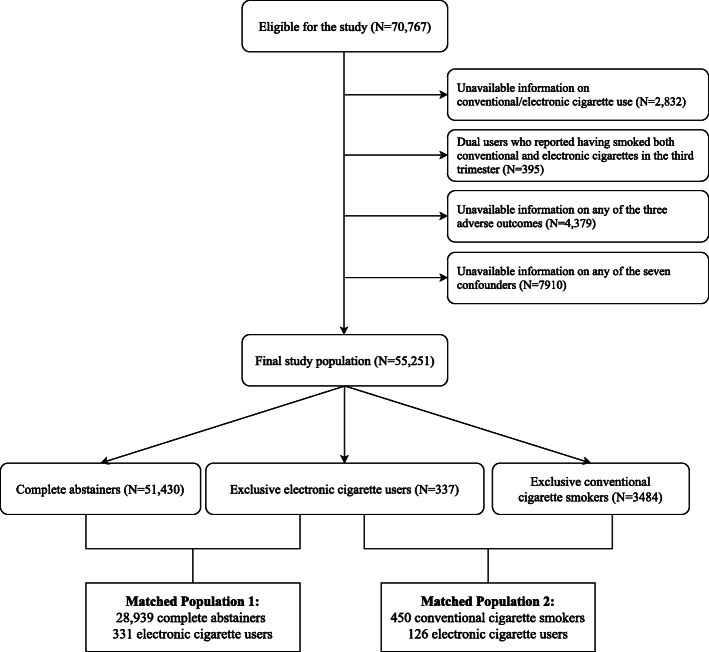
Background: Conventional cigarette (CC) smoking is one of the most preventable causes of adverse birth outcomes. Although electronic cigarettes (ECs) are considered to be safer than CCs during pregnancy, the evidence is yet to be presented. This study examines the effects of prenatal EC use on neonatal birth outcomes compared to those of CC smokers and complete tobacco abstainers. Methods: Data was extracted from 55,251 pregnant women who participated in the Phase 8 survey of the Pregnancy Risk Assessment Monitoring System between 2016 and 2018. Participants were classified into three groups based on their smoking behaviors in the third trimester: complete tobacco abstinence, exclusive CC smoking, or exclusive EC use. Adverse outcomes included infants being small-for-gestational-age (SGA), having low birthweight (LBW), and being born at preterm. EC users were matched to complete abstainers and CC smokers who share the same baseline characteristics in race/ethnicity, age, educational attainment, income, prenatal care adequacy, and first- and second-trimester CC smoking statuses. The association between EC use and adverse birth outcomes were examined by survey-weighted logistic regression analyses in the matched population. Results: Among participants, 1.0% of women reported having used ECs during the third trimester, 60% of which reported using ECs exclusively. Neonates of EC users were significantly more likely to be SGA (OR 1.76; 95% CI 1.04, 2.96), have LBW (OR 1.53; 95% CI 1.06, 2.22), or be born preterm (OR 1.86; 95% CI 1.11, 3.12) compared to tobacco abstainers. However, odds of EC users’ pregnancies resulting in SGA (OR 0.67; 95% CI 0.30, 1.47), LBW (OR 0.71; 95% CI 0.37, 1.37), or preterm birth (OR 1.06; 95% CI 0.46, 2.48) were not significantly lower than those of CC smokers. Conclusions: Even after accounting for shared risk factors between prenatal tobacco use and adverse birth outcomes, EC use remains an independent risk factor for neonatal complications and is not a safer alternative to CC smoking during pregnancy. Until further research is completed, all pregnant women are encouraged to abstain from all tobacco products including ECs.
Overview
The claims and statistics of this paper haven’t been checked yet.
Free: it reads the open-access text and checks the first 5 claims that cite a source we can check. Create a free account to check every claim.
Integrity signals
Registry
Cites
Statistics
Figures
Verification
Claims the paper makes
The claims and statistics of this paper haven’t been checked yet.
Free: it reads the open-access text and checks the first 5 claims that cite a source we can check. Create a free account to check every claim.
Claims other papers make about this one
Each is checked against this paper’s own text: does it say what the citing paper says it does?
The source backs part of the claim, not all of it — or backs it for a different population, condition or comparison.
In the citing paper
“Conversely, two studies observed significantly greater PTB rates for exclusive-vapers than for non-users [43, 49].”
From Vaping during pregnancy: a systematic review of health outcomes. (2024) · cites this paper as [43]
Experimental — accuracy not yet measuredThe source backs part of the claim, not all of it — or backs it for a different population, condition or comparison.
In the citing paper
“and two reported no significant difference for these two groups [43, 50].”
From Vaping during pregnancy: a systematic review of health outcomes. (2024) · cites this paper as [43]
Experimental — accuracy not yet measuredThe source backs part of the claim, not all of it — or backs it for a different population, condition or comparison.
In the citing paper
“Widespread use of either noncombustible delivery systems is of great concern since these are not completely safe alternatives and result in detrimental health outcomes in the mother and children [9,10].”
From Nicotine on the developing brain. (2023) · cites this paper as [9]
Experimental — accuracy not yet measuredThe source backs part of the claim, not all of it — or backs it for a different population, condition or comparison.
In the citing paper
“In humans, studies have reported inconsistent results ranging from a significantly increased risk to no association with preterm birth, low birth weight, and/or SGA [24–30].”
From Electronic cigarette use during pregnancy and the risk of adverse birth outcomes: A cross-sectional surveillance study of the US Pregnancy Risk Assessment Monitoring System (PRAMS) population (2023) · cites this paper as [25]
Experimental — accuracy not yet measuredThe cited source says what the claim attributes to it.
In the citing paper
“and in 17 studies it was not assessed whether any of those counted as vaping used non-nicotine vapes [32, 35, 36, 38, 42, 43, 45, 46, 48–56].”
From Vaping during pregnancy: a systematic review of health outcomes. (2024) · cites this paper as [43]
17 more claims about this paper
Create a free account to see every claim other papers make about this one.
Self-check
Percentages, sums and reported differences re-computed from the paper’s own numbers.
The self-check needs the paper’s full text.
Citations
Cites
MatchIt : Nonparametric Preprocessing for Parametric Causal Inference
Ho, D. E., Imai, K., King, G., & Stuart, E. A. (2011) · Journal of Statistical Software · doi:10.18637/jss.v042.i08 · Cited by 4,385 · cited 1×
“Exact propensity matching was conducted using the “MatchIt” package [50] to match each observation in the treatment group (an EC user) to all possible observations in the control group (complete abstainers or CC smokers) that share exact characteristics of seven covariates.”
MethodAnalysis of Complex Survey Samples
Lumley, T. (2004) · Journal of Statistical Software · doi:10.18637/jss.v009.i08 · Cited by 2,425
Rosenbaum, P. R. (2002) · Springer Series in Statistics · doi:10.1007/978-1-4757-3692-2 · Cited by 2,394
A practical classification of newborn infants by weight and gestational age
Battaglia, F. C., & Lubchenco, L. O. (1967) · The Journal of Pediatrics · doi:10.1016/s0022-3476(67)80066-0 · Cited by 1,292
Kotelchuck, M. (1994) · American Journal of Public Health · doi:10.2105/ajph.84.9.1414 · Cited by 1,175
Cnattingius, S. (2004) · Nicotine & Tobacco Research · doi:10.1080/14622200410001669187 · Cited by 1,126 · cited 1×
“Background Prenatal smoking is one of the most important preventable causes of neonatal morbidity and mortality [1].”
BackgroundInterventions for promoting smoking cessation during pregnancy
Lumley, J., Chamberlain, C., Dowswell, T., Oliver, S., Oakley, L., & Watson, L. (2009) · Cochrane Database of Systematic Reviews · doi:10.1002/14651858.cd001055.pub3 · Cited by 890 · cited 1×
“Due to prenatal smoking’s detrimental effects and modifiable nature of the behavior, smoking cessation in pregnant women has been a major focus of intervention in the field of maternal-child health [14].”
BackgroundVital Signs: Tobacco Product Use Among Middle and High School Students — United States, 2011–2018
Gentzke, A. S., Creamer, M., Cullen, K. A., Ambrose, B. K., Willis, G., Jamal, A., & King, B. A. (2019) · MMWR. Morbidity and Mortality Weekly Report · doi:10.15585/mmwr.mm6806e1 · Cited by 766
The Pregnancy Risk Assessment Monitoring System (PRAMS): overview of design and methodology
Shulman, H. B., D’Angelo, D. V., Harrison, L., Smith, R. A., & Warner, L. (2018) · American Journal of Public Health · doi:10.2105/ajph.2018.304563 · Cited by 574
Chemical evaluation of electronic cigarettes
Cheng, T. (2014) · Tobacco Control · doi:10.1136/tobaccocontrol-2013-051482 · Cited by 555
A systematic review of health effects of electronic cigarettes
Pisinger, C., & Døssing, M. (2014) · Preventive Medicine · doi:10.1016/j.ypmed.2014.10.009 · Cited by 484
Effects of smoking during pregnancy
Castles, A., Adams, E. K., Melvin, C. L., Kelsch, C., & Boulton, M. L. (1999) · American Journal of Preventive Medicine · doi:10.1016/s0749-3797(98)00089-0 · Cited by 425
Cigarette Smoking in Pregnancy: Its Influence on Birth Weight and Perinatal Mortality
Butler, N. R., Goldstein, H., & Ross, E. M. (1972) · BMJ · doi:10.1136/bmj.2.5806.127 · Cited by 412
Maternal Smoking during Pregnancy and Childhood Obesity
von Kries, R. (2002) · American Journal of Epidemiology · doi:10.1093/aje/kwf128 · Cited by 390
Low birthweight, preterm births and intrauterine growth retardation in relation to maternal smoking
Horta, B. L., Victora, C. G., Menezes, A. M., Halpern, R., & Barros, F. C. (1997) · Paediatric and Perinatal Epidemiology · doi:10.1046/j.1365-3016.1997.d01-17.x · Cited by 347
Nicotine and the Developing Human
England, L. J., Bunnell, R. E., Pechacek, T. F., Tong, V. T., & McAfee, T. A. (2015) · American Journal of Preventive Medicine · doi:10.1016/j.amepre.2015.01.015 · Cited by 320 · cited 1×
“Although most of the current evidence on ECs’ effects on developing fetuses is either extrapolated from the previous research on nicotine exposure in utero [31, 54, 55] or drawn from on animal experiments in the lab settings [56–59], transplacental delivery of nicotine is considered key to the pathophysiology of ECs’…”
BackgroundHealthy Lifestyle Characteristics Among Adults in the United States, 2000
Reeves, M. J., & Rafferty, A. P. (2005) · Archives of Internal Medicine · doi:10.1001/archinte.165.8.854 · Cited by 293
Low birthweight at term and the timing of fetal exposure to maternal smoking.
Lieberman, E., Gremy, I., Lang, J. M., & Cohen, A. P. (1994) · American Journal of Public Health · doi:10.2105/ajph.84.7.1127 · Cited by 262
(2018) · PubMed · Cited by 211
Davidson, K., Brancato, A., Heetderks, P., Mansour, W., Matheis, E., Nario, M., Rajagopalan, S., Underhill, B., Wininger, J., & Fox, D. (2019) · MMWR. Morbidity and Mortality Weekly Report · doi:10.15585/mmwr.mm6836e1 · Cited by 186
The effects of nicotine on human fetal development
Holbrook, B. D. (2016) · Birth Defects Research Part C: Embryo Today: Reviews · doi:10.1002/bdrc.21128 · Cited by 173
Prevalence and Perceptions of Electronic Cigarette Use during Pregnancy
Wagner, N. J., Camerota, M., & Propper, C. (2017) · Maternal and Child Health Journal · doi:10.1007/s10995-016-2257-9 · Cited by 169 · cited 1×
“With early EC adopters reaching reproductive age and “harm reduction” advertising strategies changing the perceptions more favorably [25, 27], 1.”
BackgroundSalomon, L. J., Bernard, J. P., & Ville, Y. (2007) · Ultrasound in Obstetrics & Gynecology · doi:10.1002/uog.4019 · Cited by 160
The use of electronic cigarettes in pregnancy: a review of the literature
Whittington, J. R., Simmons, P. M., Phillips, A. M., Gammill, S. K., Cen, R., Magann, E. F., & Cardenas, V. M. (2018) · Obstetrical & Gynecological Survey · doi:10.1097/ogx.0000000000000595 · Cited by 158 · cited 1×
“Although most of the current evidence on ECs’ effects on developing fetuses is either extrapolated from the previous research on nicotine exposure in utero [31, 54, 55] or drawn from on animal experiments in the lab settings [56–59], transplacental delivery of nicotine is considered key to the pathophysiology of ECs’…”
BackgroundSteyn, K., De Wet, T., Saloojee, Y., Nel, H., & Yach, D. (2006) · Paediatric and Perinatal Epidemiology · doi:10.1111/j.1365-3016.2006.00707.x · Cited by 157
Effects of pre- and postnatal exposure to parental smoking on early childhood respiratory health
Haberg, S. E., Stigum, H., Nystad, W., & Nafstad, P. (2007) · American Journal of Epidemiology · doi:10.1093/aje/kwm134 · Cited by 157
Ramôa, C. P., Hiler, M. M., Spindle, T. R., Lopez, A. A., Karaoghlanian, N., Lipato, T., Breland, A. B., Shihadeh, A., & Eissenberg, T. (2016) · Tobacco Control · doi:10.1136/tobaccocontrol-2015-052447 · Cited by 157 · cited 1×
“Although the nicotine delivery of ECs depends on a number of factors, such as the make of the device, the level of nicotine in the liquid, and the puffing behavior of individuals, the plasma concentration of nicotine after EC use can be as high as that after CC smoking [61].”
BackgroundSpindel, E. R., & McEvoy, C. T. (2016) · American Journal of Respiratory and Critical Care Medicine · doi:10.1164/rccm.201510-2013pp · Cited by 154 · cited 1×
“Although most of the current evidence on ECs’ effects on developing fetuses is either extrapolated from the previous research on nicotine exposure in utero [31, 54, 55] or drawn from on animal experiments in the lab settings [56–59], transplacental delivery of nicotine is considered key to the pathophysiology of ECs’…”
BackgroundTobacco and nicotine delivery product use in a national sample of pregnant women
Kurti, A. N., Redner, R., Lopez, A. A., Keith, D. R., Villanti, A. C., Stanton, C. A., Gaalema, D. E., Bunn, J. Y., Doogan, N. J., Cepeda-Benito, A., et al. (2017) · Preventive Medicine · doi:10.1016/j.ypmed.2017.07.030 · Cited by 140
Knowledge, Attitudes, and Practice of Electronic Cigarette Use Among Pregnant Women
Mark, K. S., Farquhar, B., Chisolm, M. S., Coleman-Cowger, V. H., & Terplan, M. (2015) · Journal of Addiction Medicine · doi:10.1097/adm.0000000000000128 · Cited by 138
The impact of maternal smoking during pregnancy on delivery outcome
Kallen, K. (2001) · The European Journal of Public Health · doi:10.1093/eurpub/11.3.329 · Cited by 136
Highly Reactive Free Radicals in Electronic Cigarette Aerosols
Goel, R., Durand, E., Trushin, N., Prokopczyk, B., Foulds, J., Elias, R. J., & Richie, J. P. (2015) · Chemical Research in Toxicology · doi:10.1021/acs.chemrestox.5b00220 · Cited by 126
Ashford, J., van Lier, P. A. C., Timmermans, M., Cuijpers, P. J., & Koot, H. M. (2008) · Journal of the American Academy of Child & Adolescent Psychiatry · doi:10.1097/chi.0b013e318172eefb · Cited by 119
Albuquerque, C. A., Smith, K. R., Johnson, C., Chao, R., & Harding, R. (2004) · Early Human Development · doi:10.1016/j.earlhumdev.2004.05.004 · Cited by 116 · cited 1×
“This hypothesis is based on current evidence that ECs also contain a considerable amount of nicotine [38] and produce highly oxidizing free radicals [39], which are the components of CCs that are responsible for its adverse birth effects [40, 41].”
BackgroundPalpant, N. J., Hofsteen, P., Pabon, L., Reinecke, H., & Murry, C. E. (2015) · PLOS ONE · doi:10.1371/journal.pone.0126259 · Cited by 114
Nicotine and Cotinine Levels With Electronic Cigarette: A Review
Marsot, A., & Simon, N. (2016) · International Journal of Toxicology · doi:10.1177/1091581815618935 · Cited by 113
Sales of Nicotine-Containing Electronic Cigarette Products: United States, 2015
Marynak, K. L., Gammon, D. G., Rogers, T., Coats, E. M., Singh, T., & King, B. A. (2017) · American Journal of Public Health · doi:10.2105/ajph.2017.303660 · Cited by 113
Perceptions about e-cigarette safety may lead to e-smoking during pregnancy
Baeza-Loya, S., Viswanath, H., Carter, A., Molfese, D. L., Velasquez, K. M., Baldwin, P. R., Thompson-Lake, D. G. Y., Sharp, C., Fowler, J. C., De La Garza, R., et al. (2014) · Bulletin of the Menninger Clinic · doi:10.1521/bumc.2014.78.3.243 · Cited by 105
Association of Reported Trimester-Specific Smoking Cessation With Fetal Growth Restriction
Blatt, K., Moore, E., Chen, A., Van Hook, J., & DeFranco, E. A. (2015) · Obstetrics & Gynecology · doi:10.1097/aog.0000000000000679 · Cited by 94
Orzabal, M. R., Lunde-Young, E. R., Ramirez, J. I., Howe, S. Y. F., Naik, V. D., Lee, J., Heaps, C. L., Threadgill, D. W., & Ramadoss, J. (2019) · Translational Research · doi:10.1016/j.trsl.2019.01.001 · Cited by 91
Wang, X., Lee, N. L., & Burstyn, I. (2020) · Preventive Medicine · doi:10.1016/j.ypmed.2020.106041 · Cited by 86
Huijbregts, S. C. J., Séguin, J. R., Zoccolillo, M., Boivin, M., & Tremblay, R. E. (2007) · Journal of Abnormal Child Psychology · doi:10.1007/s10802-006-9073-4 · Cited by 84
D'Souza, S. W., Black, P., & Richards, B. (1981) · BMJ · doi:10.1136/bmj.282.6277.1661 · Cited by 81
Kapaya, M., D’Angelo, D. V., Tong, V. T., England, L., Ruffo, N., Cox, S., Warner, L., Bombard, J., Guthrie, T., Lampkins, A., et al. (2019) · MMWR. Morbidity and Mortality Weekly Report · doi:10.15585/mmwr.mm6808a1 · Cited by 81
Is There Evidence for Potential Harm of Electronic Cigarette Use in Pregnancy?
Suter, M. A., Mastrobattista, J., Sachs, M., & Aagaard, K. (2015) · Birth Defects Research Part A: Clinical and Molecular Teratology · doi:10.1002/bdra.23333 · Cited by 80
A qualitative assessment of the perceived risks of electronic cigarette and hookah use in pregnancy
Kahr, M. K., Padgett, S., Shope, C. D., Griffin, E. N., Xie, S. S., Gonzalez, P. J., Levison, J., Mastrobattista, J., Abramovici, A. R., Northrup, T. F., et al. (2015) · BMC Public Health · doi:10.1186/s12889-015-2586-4 · Cited by 79
Effect of Maternal Smoking Cessation Before and During Early Pregnancy on Fetal and Childhood Growth
Suzuki, K., Sato, M., Zheng, W., Shinohara, R., Yokomichi, H., & Yamagata, Z. (2013) · Journal of Epidemiology · doi:10.2188/jea.je20130083 · Cited by 61
Barriers to smoking cessation in pregnancy: a qualitative study
Tod, A. (2003) · British Journal of Community Nursing · doi:10.12968/bjcn.2003.8.2.11088 · Cited by 58
Laube, B. L., Afshar‐Mohajer, N., Koehler, K. A., Chen, G., Lazarus, P. J., Collaco, J. M., & McGrath‐Morrow, S. A. (2017) · Inhalation Toxicology · doi:10.1080/08958378.2017.1336585 · Cited by 57
The pathophysiology of smoking during pregnancy a systems biology approach
Stone, W. L. (2014) · Frontiers in Bioscience-Elite · doi:10.2741/e708 · Cited by 52
MOTHERISK ROUNDS: Nicotine Replacement Therapy During Pregnancy: Recommended or Not Recommended?
Osadchy, A., Kazmin, A., & Koren, G. (2009) · Journal of Obstetrics and Gynaecology Canada · doi:10.1016/s1701-2163(16)34281-5 · Cited by 50
Ashford, K., Wiggins, A., Butler, K., Ickes, M., Rayens, M. K., & Hahn, E. (2016) · Nursing Research · doi:10.1097/nnr.0000000000000176 · Cited by 48
The Surgeon General's 1990 Report on The Health Benefits of Smoking Cessation. Executive Summary.
(1990) · PubMed · Cited by 43
Kypriotakis, G., Robinson, J. D., Green, C. E., & Cinciripini, P. M. (2018) · Nicotine & Tobacco Research · doi:10.1093/ntr/nty025 · Cited by 37
Impact of electronic cigarette aerosols on pregnancy and early development
Orzabal, M., & Ramadoss, J. (2019) · Current Opinion in Toxicology · doi:10.1016/j.cotox.2019.05.001 · Cited by 31
Associations Between Early Low-Level Tobacco Smoke Exposure and Executive Function at Age 8 Years
Karin, O., Xu, Y. Y., Terrizzi, B. F., Lanphear, B. P., Chen, A., Kalkbrenner, A. E., & Yolton, K. A. (2020) · The Journal of Pediatrics · doi:10.1016/j.jpeds.2019.11.032 · Cited by 24
E cigarettes: Tar Wars: The (Tobacco) Empire Strikes Back
Bush, A., Bhatt, J., & Grigg, J. (2018) · Archives of Disease in Childhood · doi:10.1136/archdischild-2018-315820 · Cited by 17
Research works printed but not linked: 2
- U.S. Department of Health and Human Services The Health Consequences of Smoking – 50 Years of Progress A Report of the Surgeon General 2014 Atlanta U.S Department of Health and Human Services, Centers for Disease Control and Prevention, National Center for Chronic Disease Prevention and Health Promotion, Office on Smoking and Health
- Cunningham FG, Leveno JK, Bloom LS, Dash SJ, Hoffman LB, Casey MB, Spong YC,: Williams obstetrics, 25th edition. edn. New York: McGraw-Hill; 2018.
Cited by
Nicotine on the developing brain.
Castro, E. M., Lotfipour, S., & Leslie, F. M. (2023) · Pharmacological research · doi:10.1016/j.phrs.2023.106716 · Cited by 157
Unique effects of nicotine across the lifespan
Ren, M., Lotfipour, S., & Leslie, F. (2022) · Pharmacology Biochemistry and Behavior · doi:10.1016/j.pbb.2022.173343 · Cited by 40
E-cigarette use during pregnancy and its association with adverse birth outcomes in the US
Lin, S.-Y., Wang, L., Zhou, W., Kitsantas, P., Wen, X., & Xue, H. (2023) · Preventive Medicine · doi:10.1016/j.ypmed.2022.107375 · Cited by 34
Noël, A., Yilmaz, S., Farrow, T., Schexnayder, M., Eickelberg, O., & Jelesijevic, T. P. (2023) · International Journal of Environmental Research and Public Health · doi:10.3390/ijerph20043710 · Cited by 34
Shittu, A. A. T., Kumar, B. P., Okafor, U., Berkelhamer, S. K., Goniewicz, M. L., & Wen, X. (2022) · American Journal of Obstetrics and Gynecology · doi:10.1016/j.ajog.2021.11.1354 · Cited by 32
Metadata
- Authors
- Kim, S., & Oancea, S. C.
- Affiliations
- Sanford Research (US)
- University of North Dakota (US)
- Corresponding author
- Kim, Sooyong
- Venue
- BMC Pregnancy and Childbirth
- Published
- 2020-09-23
- Volume
- 20
- Issue
- 1
- Pages
- 557-557
- ISSN
- 1471-2393 (ISSN-L)
- PMC
- PMC7510270
- OpenAlex
- W3088729286
- Semantic Scholar
- 60668a0f6472e73131e5545e84a1d79546c17c11
- Cited by
- 74
- References
- 57
- Citations by year
- 2026: 10 · 2025: 14 · 2024: 15 · 2023: 12 · 2022: 14 · 2021: 8 · 2020: 1
- FWCI
- 5.26
- Type
- journal article
- Language
- en
- Open access
- gold
- doi.org
- Licence
- cc-by
- creativecommons.org/licenses/by/4.0 (tdm)
- creativecommons.org/licenses/by/4.0 (vor)
- Locations
- BMC Pregnancy and Childbirth (publishedVersion, cc-by)
- PubMed Central (publishedVersion, cc-by)
- PubMed (publishedVersion)
- DOAJ (DOAJ: Directory of Open Access Journals) (submittedVersion, cc-by-sa)
- Funders
- National Institute for General Medical Sciences (5P20GM121341)
- Topics
- Health Sciences › Medicine › Public Health, Environmental and Occupational Health › Smoking Behavior and Cessation
- Health Sciences › Medicine › Pediatrics, Perinatology and Child Health › Prenatal Substance Exposure Effects
- Health Sciences › Medicine › Pediatrics, Perinatology and Child Health › Maternal and Neonatal Healthcare
- Keywords
- electronic cigarettes, prenatal tobacco use, pregnancy, birth outcomes, small for gestational age, low birth weight, preterm birth, conventional cigarette smoking, neonatal complications, third trimester, Pregnancy Risk Assessment Monitoring System, smoking abstinence, harm reduction, tobacco control
- MeSH terms
- Vaping, Cigarette Smoking, Adult, Cross-Sectional Studies, Female, Humans, Infant, Low Birth Weight, Infant, Newborn, Pregnancy, Pregnancy Complications, Pregnancy Outcome, Premature Birth, Young Adult, Electronic Nicotine Delivery Systems
About these checks
Registry, retraction, Cites and statistics results are computed, not judged, with one exception: a printed reference that no index lists is read once by a model before it counts as a citation error. Claims are extracted by a model and kept only when their quote appears verbatim in the text; each cited source is then checked, with a model’s help, for whether it says what the claim relies on. Those verdicts can be wrong — read the claim’s quote and the cited source before relying on one.
Statistics and arithmetic are recomputed, not judged.
Confidence bands are shown only for fields calibrated on our annotated test set. None is calibrated yet, so no band is shown.
What counts as a claim ›How we measure confidence ›How we check this ›
Are you an author, or do you see a problem with this page? Request a review
Data sources
Bibliographic data: Semantic Scholar, OpenAlex, Crossref.
Contains information from the Semantic Scholar Academic Graph Datasets, made available under the ODC Attribution License (ODC-BY 1.0).
Semantic Scholar’s data is described in: Kinney, R., et al. (2023). The Semantic Scholar Open Data Platform. arXiv:2301.10140.
