

Comprehensively addressing postpartum maternal health: a content and image review of commercially available mobile health apps
Open accessPublished version of a preprint
The DOI matches its Crossref record; 62 of the 64 references it cites were found in a registry or an index.
Abstract
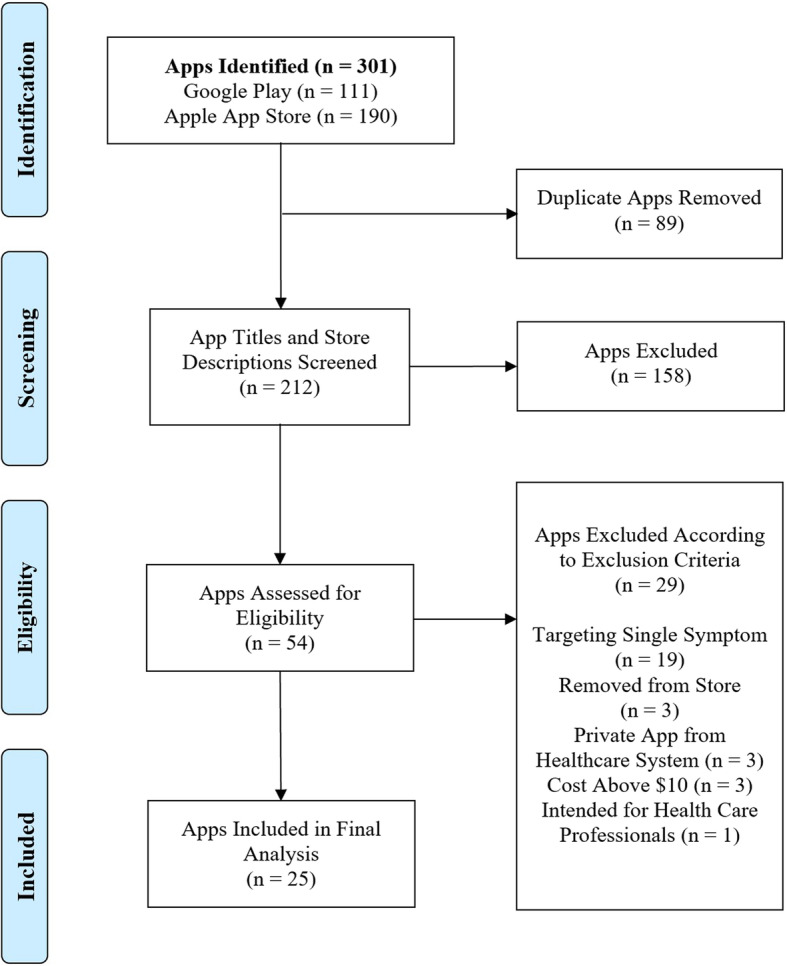
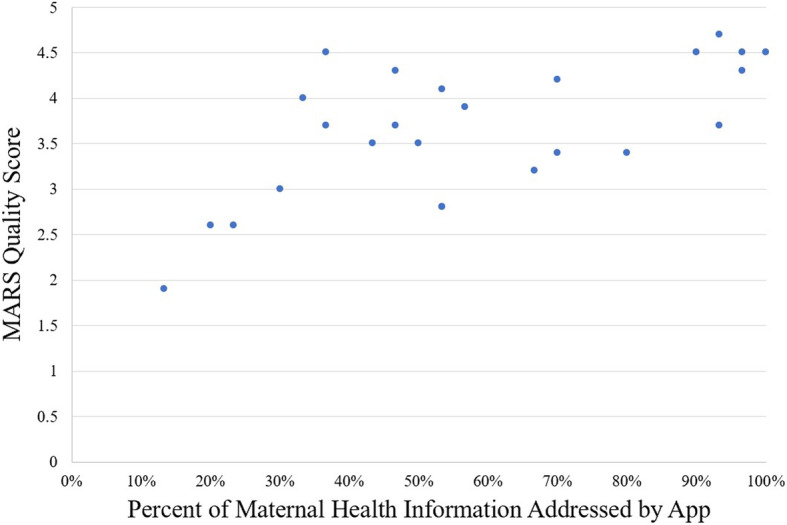
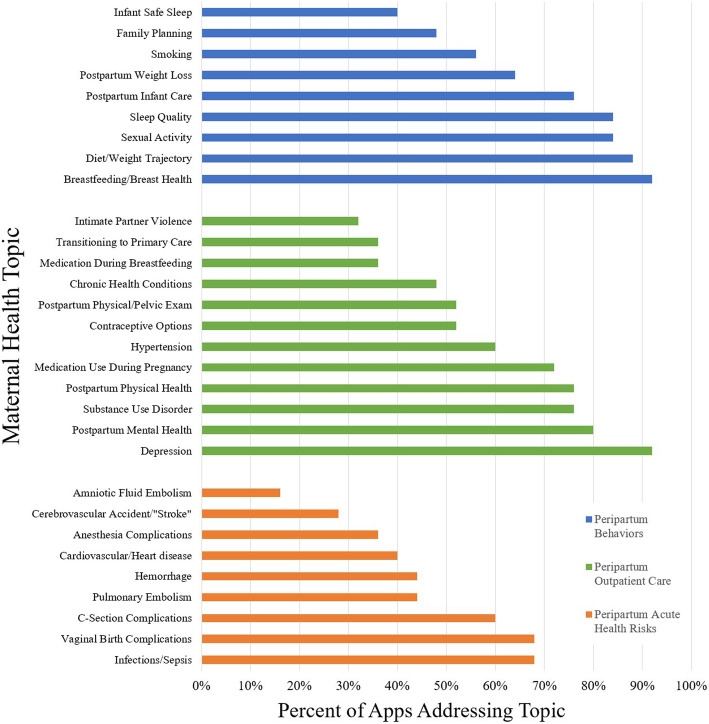
Background: The United States is currently facing a maternal morbidity and mortality crisis, with the highest rates of any resource-rich nation. In efforts to address this, new guidelines for postpartum care suggest that mobile health (mHealth) apps can help provide complementary clinical support for new mothers during the postpartum period. However, to date no study has evaluated the quality of existing mHealth tools targeted to this time period in terms of sufficiency of maternal health information, inclusivity of people of color, and app usability. Methods: Preferred Reporting Items for Systematic Reviews and Meta-Analyses (PRISMA) standards were used to review the peripartum apps from the Apple and Google Play stores in either the Health/Fitness, Medical, or Education categories. Apps were evaluated for extent and quality of maternal health information and inclusivity of people of color using an a priori coding scheme. App usability was evaluated using the Mobile Application Rating Scale (MARS) score. Results: Of the 301 apps from the Apple and Google Play stores, 25 met criteria for final evaluation. Of the 30 maternal health topics coded for, the median number addressed by apps was 19.5 (65%). Peripartum behaviors were more frequently addressed than peripartum outpatient care topics and peripartum acute health risks. The coverage of maternal health information and inclusivity of people of color in app imagery both correlated positively with the MARS usability score of the app. Only 8 apps (32%) portrayed greater than 24% images of people of color- the percent of non-white Americans according to 2019 census estimates. There was no correlation between MARS usability score and number of app users, as estimated by number of ratings for the app available on the app store. In addition, apps with evidence-based maternal health information had greater MARS engagement, information, and aesthetics scores. However, presence of evidence-based information did not correlate with greater numbers of app users. Conclusions: Current commercially available peripartum apps range widely in quality. Overall current app offerings generally do not provide adequate maternal health information and are not optimally accessible to the target users in terms of inclusivity of women of color or app usability. Apps delivering evidence-based information and more usable design are more likely to meet these standards but are not more likely to be downloaded by users.
Overview
The claims and statistics of this paper haven’t been checked yet.
Free: it reads the open-access text and checks the first 5 claims that cite a source we can check. Create a free account to check every claim.
Integrity signals
Registry
Cites
Statistics
Figures
Verification
Claims the paper makes
The claims and statistics of this paper haven’t been checked yet.
Free: it reads the open-access text and checks the first 5 claims that cite a source we can check. Create a free account to check every claim.
Claims other papers make about this one
Each is checked against this paper’s own text: does it say what the citing paper says it does?
The cited source says what the claim attributes to it.
In the citing paper
“Further still, many currently available mobile peripartum apps suffer a number of significant limitations, including lack of accessibility, limited usability, lack of inclusivity of women of color, and inadequate evidence-based maternal health information, all of which may contribute to suboptimal use and engagement [12, 30, 31].”
From Technology-Based Approaches for Supporting Perinatal Mental Health (2022) · cites this paper as [30]
Self-check
Percentages, sums and reported differences re-computed from the paper’s own numbers.
The self-check needs the paper’s full text.
Citations
Cites
Preferred Reporting Items for Systematic Reviews and Meta-Analyses: the PRISMA statement
Moher, D., Liberati, A., Tetzlaff, J., Altman, D. G., & for the PRISMA Group (2009) · BMJ · doi:10.1136/bmj.b2535 · Cited by 83,823
Preferred Reporting Items for Systematic Reviews and Meta-Analyses: The PRISMA Statement
Moher, D., Liberati, A., Tetzlaff, J., Altman, D. G., & The PRISMA Group (2009) · PLoS Medicine · doi:10.1371/journal.pmed.1000097 · Cited by 64,042
Preferred reporting items for systematic reviews and meta-analyses: the PRISMA Statement.
(2009) · PubMed Central · Cited by 44,859
Preferred reporting items for systematic reviews and meta-analyses: The PRISMA statement
Moher, D., Liberati, A., Tetzlaff, J., Altman, D. G., & the PRISMA Group* (2009) · Annals of Internal Medicine · doi:10.7326/0003-4819-151-4-200908180-00135 · Cited by 37,554
Wang, G., Ma, R., Qiao, G., Wada, K., Aizawa, Y., & Satoh, T. (2015) · Integrative Medicine International · doi:10.1159/000368408 · Cited by 18,657
Morbidity and Mortality Weekly Report
(2011) · Wilderness & Environmental Medicine · doi:10.1016/j.wem.2010.11.007 · Cited by 3,423
Mobile app rating scale: a new tool for assessing the quality of health mobile apps
Stoyanov, S. R., Hides, L., Kavanagh, D. J., Zelenko, O., Tjondronegoro, D., & Mani, M. (2015) · JMIR mHealth and uHealth · doi:10.2196/mhealth.3422 · Cited by 2,233 · cited 2×
“MARS scores from only the primary rater were used, as this scale has not been validated to incorporate ratings from multiple users in the same score [35].”
BackgroundMethod2005 American Community Survey 1-Year Estimates
(2016) · Cited by 1,242
Wisner, K. L., Sit, D. K. Y., McShea, M. C., Rizzo, D. M., Zoretich, R. A., Hughes, C. L., Eng, H. F., Luther, J. F., Wisniewski, S. R., Costantino, M. L., et al. (2013) · JAMA Psychiatry · doi:10.1001/jamapsychiatry.2013.87 · Cited by 1,091 · cited 1×
“Newly emerging data also suggests that psychosocial risks, such as intimate partner violence (IPV) and depression-induced suicide, may also play a key role in maternal mortality and morbidity occurring up to a year postpartum [3,4].”
BackgroundACOG Committee Opinion No. 736: Optimizing Postpartum Care
(2018) · Obstetrics & Gynecology · doi:10.1097/aog.0000000000002633 · Cited by 1,090
Research works printed but not linked: 4
- Building U.S. Capacity to Review and Prevent Maternal Deaths. (2018). Report from nine maternal mortality review committees. Retrieved from http://reviewtoaction.org/Report_from_Nine_MMRCs. Accessed 21 May 2020.
- Pew Research Center Who owns cellphones and smartphones 2019
- Perrin A Pew Research Center Smartphones help blacks, Hispanics bridge some – but not all – digital gaps with whites 2019
- U.S. Census Bureau U.S. Census Bureau QuickFacts American Community Survey 5-year estimates 2019
Cited by
A Review of the Quality and Impact of Mobile Health Apps
Grundy, Q. (2022) · Annual Review of Public Health · doi:10.1146/annurev-publhealth-052020-103738 · Cited by 143
Tsai, Z., Kiss, A., Nadeem, S., Sidhom, K., Owais, S., Faltyn, M., & Lieshout, R. J. V. (2021) · Journal of Affective Disorders · doi:10.1016/j.jad.2021.09.106 · Cited by 74
Technology-Based Approaches for Supporting Perinatal Mental Health
Novick, A. M., Kwitowski, M., Dempsey, J., Cooke, D. L., & Dempsey, A. G. (2022) · Current Psychiatry Reports · doi:10.1007/s11920-022-01349-w · Cited by 35
“…mobile peripartum apps suffer a number of significant limitations, including lack of accessibility, limited usability, lack of inclusivity of women of color, and inadequate evidence-based maternal health information, all of which may contribute to suboptimal use and engagement [12, 30, 31].”
BackgroundBuchanan, L., Anderson, E., MBiostat, H. X., Phongsavan, P., Rissel, C. E., & Wen, L. M. (2021) · Health Informatics Journal · doi:10.1177/14604582211043146 · Cited by 15
“272 <30 years 285 (50) 184 (50) 279 (76) 90 (24) ⩾30 years 279 (48) 407 (52) 617 (79) 169 (22) Country of birth <0.”
Lee, Y., Huang, L., Chen, S., Shao, J., Lai, C., & Yang, N. (2021) · International Journal of Environmental Research and Public Health · doi:10.3390/ijerph182111603 · Cited by 20
“Moreover, using mHealth Apps as a widespread form of supplementary clinical support showed promise with regards to increasing patient education, narrowing the knowledge gap in health-disparate communities, and even reducing the burden on the care partner [37,38].”
MethodTang, A., Woldemariam, S. R., Roger, J. M., & Sirota, M. (2022) · Yearbook of Medical Informatics · doi:10.1055/s-0042-1742513 · Cited by 19
“There has been an increase in the availability of apps for a variety of diseases, such as for vital sign monitoring, glucose monitoring for diabetes, weight management [90], mental health [91], and even for managing postpartum maternal health [92].”
BackgroundTelemedicine and eHealth Solutions in Clinical Practice
Delgado, F. D. C., Bernedo-Moreira, D. H., Espíritu-Martínez, A. P., Aguilar-Cruzado, J. L., García, C. E. J., Mamani-Laura, M. R., & Romero-Carazas, R. (2023) · EAI Endorsed Transactions on Pervasive Health and Technology · doi:10.4108/eetpht.9.4272 · Cited by 23
Validation and usability study of the framework for a user needs-centered mHealth app selection
Lee, J., & Lee, M. A. (2022) · International Journal of Medical Informatics · doi:10.1016/j.ijmedinf.2022.104877 · Cited by 19
The Power and Promise of Postpartum Self Care: Evaluation of a Web-Based Tool for Underserved Women
Bryant, A., Coleman, J., Shi, X., Rodriguez, M., Papadopoulos, A. S., Merz, K., Leonard, J., Samia, N., & Marceau, L. D. (2023) · Maternal and Child Health Journal · doi:10.1007/s10995-023-03605-8 · Cited by 22
“More needs to be done to ensure the mHealth efforts are accessible, comprehensive and evidence-based (Tucker et al., 2021).”
BackgroundConsumer acceptance of using a digital technology to manage postpartum depression
Tang, J. J., Malladi, I., Covington, M. T., Ng, E., Dixit, S., Shankar, S., & Kachnowski, S. (2022) · Frontiers in Global Women s Health · doi:10.3389/fgwh.2022.844172 · Cited by 17
“Some studies indicate that Black and Latino women are more likely to use smartphones to research health conditions than White women who use smartphones for the same purpose (40).”
BackgroundExploring Asian maternal experiences and mHealth needs for postpartum mental health care
Kamarudin, S. S., Idris, I. B., Ahmad, N., & Sharip, S. (2024) · Digital Health · doi:10.1177/20552076241292679 · Cited by 20
Hernandez, N., Davis, M. V., Farinu, O., Hernandez-Spalding, K., Lewis, K., Beshara, M. S., Francis, S., Baker, L. J., Byrd, S., Parker, A. G., et al. (2024) · Women s Health · doi:10.1177/17455057241239769 · Cited by 24
“A vast majority of pregnancy apps focus on prenatal support rather than postpartum support, 35,36 and to our knowledge, there is little to no research centering mHealth use during the postpartum period among rural Black women.”
BackgroundLi, K., Magnuson, K. I., Beuley, G., Davis, L., & Ryan-Pettes, S. R. (2023) · JMIR Pediatrics and Parenting · doi:10.2196/43626 · Cited by 8
“Regarding commercially available parent-targeted mHealth apps, the vast majority of previous reviews have focused on evaluating apps that provide information or interventions for medical or health concerns such as pregnancy; prenatal, postnatal, and infant care [18,22-28]; nutrition, physical activity, weight manageme…”
BackgroundAmore, A. D., Britt, A. J., Alvarez, S. J. A., & Greenleaf, M. N. (2023) · JMIR Pediatrics and Parenting · doi:10.2196/44615 · Cited by 5
do Nascimento, V. S., Rodrigues, A. T., Rotta, I., Lima, T. D. M., & Aguiar, P. M. (2023) · International Journal of Medical Informatics · doi:10.1016/j.ijmedinf.2023.105087 · Cited by 7
I am Lifted Above the World: utilizing VR for stress reduction among perinatal women of color
Blanc, J., Scaramutti, C., Carrasco, M., Dimanche, S., Hollimon, L. A., Moore, J., Moise, R. K., Gabbay, V., & Seixas, A. A. (2024) · Frontiers in Psychiatry · doi:10.3389/fpsyt.2024.1377978 · Cited by 7
Liang, Y., Wang, S., Tao, J., Yao, Z., Yao, Y., & Zhai, J. (2025) · BMC Nursing · doi:10.1186/s12912-025-03379-0 · Cited by 5
Nkwo, M. S., Orji, R., Ajah, I. A., Igwe, J., Ogbaga, I. N., & Chigozie-Okwum, C. C. (2021) · African Human Computer Interaction Conference (AfriCHI) · doi:10.1145/3448696.3448707 · Cited by 7
Hernandez, N., Davis, M. V., Beshara, M. S., Hernandez-Spalding, K., Francis, S., Parker, A. G., Farinu, O., & Chandler, R. D. (2024) · Health Promotion Practice · doi:10.1177/15248399241234636 · Cited by 4
“This decreases the effectiveness of information provided in mHealth applications and further marginalizes minority populations who already experience the effects of the digital divide (Tucker et al., 2021).”
BackgroundAre Mobile Applications in Laryngology Designed for All Patients?
Odigie, E., Andreadis, K., Chandra, I., Mocchetti, V., Rives, H., Cox, S., & Rameau, A. (2022) · The Laryngoscope · doi:10.1002/lary.30465 · Cited by 5
Reducing Maternal Mortality Rates in Alabama Through Patient Education: A Scoping Review
Telese, R., Vogel, A. D., Azam, M. T., Dickinson, P. G., Zakala, A., & Heersink, J. T. (2023) · Cureus · doi:10.7759/cureus.43172 · Cited by 3
“These applications provide information on maternal mortality risk factors as well as other helpful general maternal healthcare knowledge [20].”
BackgroundTzitiridou‐Chatzopoulou, M., & Ζουρνατζίδου, Γ. (2024) · Journal of Clinical Medicine · doi:10.3390/jcm13196013 · Cited by 3
“Mobile phone applications are an effective aid in the continuous and frequent surveillance of mood states in women who are at a high risk of postpartum depression due to their broad appeal and immediate accessibility [17].”
BackgroundApplying authoritative knowledge to better understand preparation for breastfeeding
Butler, M. S., Young, S. L., & Keenan‐Devlin, L. S. (2025) · Frontiers in Global Women s Health · doi:10.3389/fgwh.2025.1540376 · Cited by 4
Sheen, F., Porter, L., Papakonstantinou, T., Ceka, M., & Bondaronek, P. (2025) · British Journal of Health Psychology · doi:10.1111/bjhp.70026 · Cited by 7
“However, many apps do not appear to use evidence-or theory-based approaches for supporting health behaviour change (Mangone et al., 2016; Portenhauser et al., 2021; Tofighi et al., 2019; Tucker et al., 2021; Zhou et al., 2024).”
Ghaheri, S. Z., Hazbenejad, A., Maghsoudi, F., & Radmanesh, E. (2021) · Journal of Medical Education · doi:10.5812/jme.114908 · Cited by 2
CONNECTED PUERPERIUM IN PORTUGAL: A DIGITAL SYSTEM FOR AN INTEGRATIVE POSTPARTUM CARE
Leite, C. V., Shrbaji, T. A., Niela‐Vilén, H., & Oliveira, A. P. (2023) · IADIS International Conferences on ICT, Society and Human Beings, e-Health, Connected Smart Cities and Big Data Analytics, Data Mining and Computational Intelligence (ICT/EH/CSC/BigDaCI) · doi:10.33965/mccsis2023_202305l023 · Cited by 1
Rahimi, R., Shahali, S., & Shahali, S. (2022) · doi:10.2196/preprints.42929
Mobile phone-based postnatal follow up and maternal health outcomes for low risk mothers
Ghani, R. M. A., & Khalaf, A. (2022) · British Journal of Midwifery · doi:10.12968/bjom.2022.30.11.636
Avaliação da qualidade de aplicativos móveis sobre o manejo da hemorragia pós-parto
da Silva, É. M. A., de Oliveira, S. C., & Alves, D. S. (2023) · Revista da Escola de Enfermagem da USP · doi:10.1590/1980-220x-reeusp-2023-0263pt · Cited by 2
Quality assessment of mobile applications on postpartum hemorrhage management
da Silva, É. M. A., de Oliveira, S. C., & Alves, D. S. (2023) · Revista da Escola de Enfermagem da USP · doi:10.1590/1980-220x-reeusp-2023-0263en · Cited by 1
“…in the app description, the presence of goals/objectives, the quality and scope of the information covered, presence of visual information, credibility and evidence base used, the apps assessed in this study obtained quality means between 3.62 and 4.67, similar to those of other studies (25) .”
BackgroundResultInfluentialTan, Y. S. A., Tsang, L. P. M., Lock, S. H. S., Vijakumar, K., Ho, X. Y. C., Seah, A. C., Gong, P. P., Koh, Y. L. E., & Tan, N. C. (2024) · Singapore Medical Journal · doi:10.4103/singaporemedj.smj-2023-136
Wang, Z., Wang, Z., Deng, R., Xia, M., & Huang, L. (2025) · Frontiers in Psychology · doi:10.3389/fpsyg.2025.1575049
Gohar, U., Bonacina, S., & Davoody, N. (2025) · doi:10.2196/preprints.79586
Enhancing maternal nutrition: The development of Doojan, a gamified mHealth app for pregnant women
Moghaddam‐Banaem, L., Rahimi, R., Ahmadi, S., & Hossainpour, S. (2025) · Health Informatics Journal · doi:10.1177/14604582251335182
Duizer, L., Geusens, F., Geerits, E., Devlieger, R., & Bogaerts, A. (2026) · Mayo Clinic Proceedings Digital Health · doi:10.1016/j.mcpdig.2026.100381
Smart Assistance to Facilitate Postpartum Maternal Health Care for Limited Literate Mothers
Anannya, T. T., Mahmud, S. R., Sultana, Z., & Sharmin, S. (2026) · Journal of Consumer Health on the Internet · doi:10.1080/15398285.2026.2643813
“Tucker, Villagomez, and Krishnamurti (2021) reviewed many postpartum applications from the Apple and Google Play stores in the categories of health, medicine, and education to provide the systematic reviews and meta-analyses (PRISMA) requirements.”
Burns, S. K., Deal, A., O’Leary, R., Ray, K. N., Simhan, H. N., Binstock, A., & Krishnamurti, T. (2026) · Health Equity · doi:10.1177/24731242261435334
“24,25,36 Therefore, those using them, whether individuals or health care systems, may have to make adoption decisions without adequate knowledge of how well the tools serve the needs of the end users.”
Self-citationNorell, E. M., Doig, A. C., Jasczyński, M., Hunter, A. S., Gutierrez, F. X. M., Mane, H., Mane, S., Yue, X., & Nguyen, Q. C. (2026) · Prevention Science · doi:10.1007/s11121-026-01901-7 · Cited by 2
“These requests highlight the lack of mobile apps that are inclusive both in visually representing people of color and including culturally appropriate information (Cheng et al., 2020; Tucker et al., 2021).”
Guerrero, M., Picón-Jaimes, Y. A., Orozco-Chinome, J. E., Marin-Hamburger, Y., Barceló-Martinez, E., Kalokoh, S., & Visconti-Lopez, F. J. (2026) · Digital Health · doi:10.1177/20552076261450415
“It 34–36”
Borja, T. N., Zuccolo, P. F., Seda, L., Matijasevich, A., Polanczyk, G. V., & Fatori, D. (2026) · Archives of Women s Mental Health · doi:10.1007/s00737-026-01705-2
Maternal mHealth usability strengthened by trust, governance, and navigation
Azugbene, E. A. (2026) · Frontiers in Digital Health · doi:10.3389/fdgth.2026.1825544
“Reminders, goal-setting prompts, educational modules, and feedback dashboards aim to increase adherence to recommended care practices (8).”
Abdelgader, A. A. M., Hamid, H. I. A., Eltaher, N. S. Y., Bashir, W. A. H., Ali, M. A. A., Mousa, S. A., Farg, S. J. A., Salih, S. A. A., Ahmed, S. O. M., Mustafa, A. M. A., et al. (2026) · IntechOpen eBooks · doi:10.5772/intechopen.1018103
Postpartum fatigue: a concept analysis
Haniyah, S., Anggraeni, M. D., & Nani, D. (2026) · British Journal of Midwifery · doi:10.12968/bjom.2025.0150
Metadata
- Authors
- Tucker, L., Villagomez, A. C., & Krishnamurti, T.
- Affiliations
- University of Pittsburgh (US)
- Corresponding author
- Tucker, Laura
- Venue
- BMC Pregnancy and Childbirth
- Published
- 2021-04-20
- Volume
- 21
- Issue
- 1
- Pages
- 311-311
- ISSN
- 1471-2393 (ISSN-L)
- PMC
- PMC8059182
- OpenAlex
- W3138840164
- Cited by
- 43
- References
- 64
- Citations by year
- 2026: 9 · 2025: 6 · 2024: 6 · 2023: 9 · 2022: 7 · 2021: 6
- FWCI
- 1.45
- Type
- journal article
- Language
- en
- Open access
- gold
- doi.org
- Licence
- cc-by
- creativecommons.org/licenses/by/4.0/ (tdm)
- creativecommons.org/licenses/by/4.0/ (vor)
- Locations
- BMC Pregnancy and Childbirth (publishedVersion, cc-by)
- Research Square (acceptedVersion, cc-by)
- PubMed Central (publishedVersion, cc-by)
- PubMed (publishedVersion)
- DOAJ (DOAJ: Directory of Open Access Journals) (submittedVersion, cc-by-sa)
- Funders
- National Institutes of Health (TR001856)
- Topics
- Health Sciences › Health Professions › General Health Professions › Mobile Health and mHealth Applications
- Social Sciences › Psychology › Applied Psychology › Digital Mental Health Interventions
- Social Sciences › Health › Social Media in Health Education
- Keywords
- postpartum health, mobile health apps, peripartum care, app usability, health information quality, evidence-based content, app reviews, maternal morbidity and mortality
- MeSH terms
- Maternal Health, Delivery of Health Care, Female, Humans, Pregnancy, United States, Telemedicine, Postpartum Period, Consumer Health Information, Mobile Applications
About these checks
Registry, retraction, Cites and statistics results are computed, not judged, with one exception: a printed reference that no index lists is read once by a model before it counts as a citation error. Claims are extracted by a model and kept only when their quote appears verbatim in the text; each cited source is then checked, with a model’s help, for whether it says what the claim relies on. Those verdicts can be wrong — read the claim’s quote and the cited source before relying on one.
Statistics and arithmetic are recomputed, not judged.
Confidence bands are shown only for fields calibrated on our annotated test set. None is calibrated yet, so no band is shown.
What counts as a claim ›How we measure confidence ›How we check this ›
Are you an author, or do you see a problem with this page? Request a review
Data sources
Bibliographic data: Semantic Scholar, OpenAlex, Crossref.
Contains information from the Semantic Scholar Academic Graph Datasets, made available under the ODC Attribution License (ODC-BY 1.0).
Semantic Scholar’s data is described in: Kinney, R., et al. (2023). The Semantic Scholar Open Data Platform. arXiv:2301.10140.
