

Comprehensively addressing postpartum maternal health: a content and image review of commercially available mobile health apps
Open accessPublished version of a preprint
The DOI matches its Crossref record; 62 of the 64 references it cites were found in a registry or an index.
Abstract
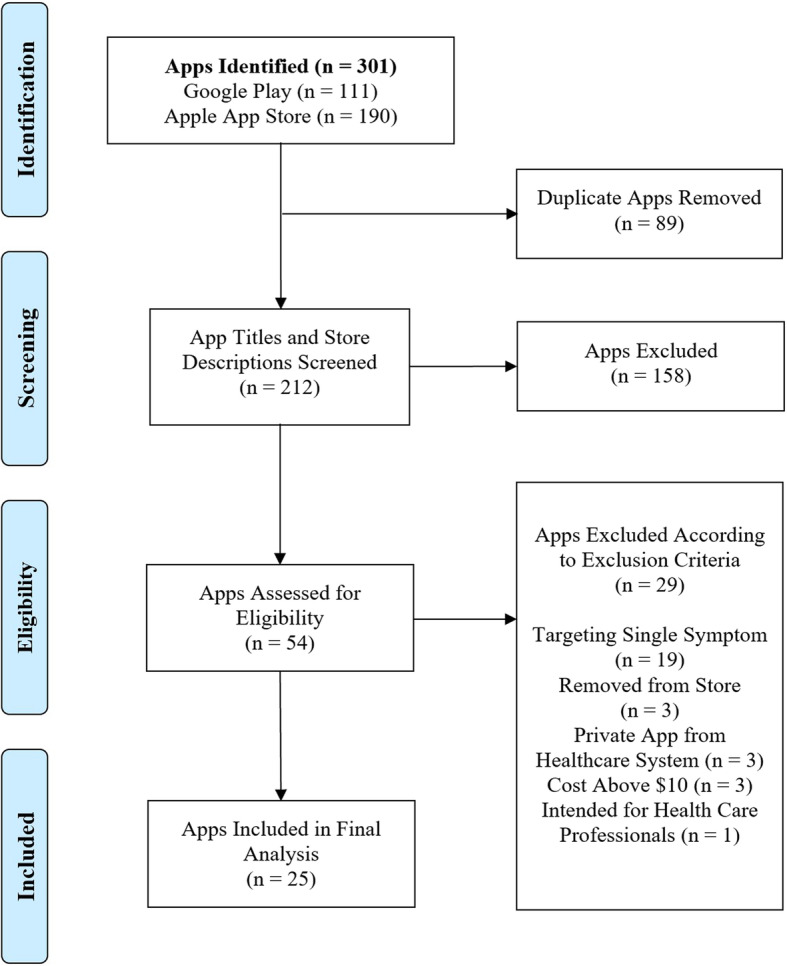
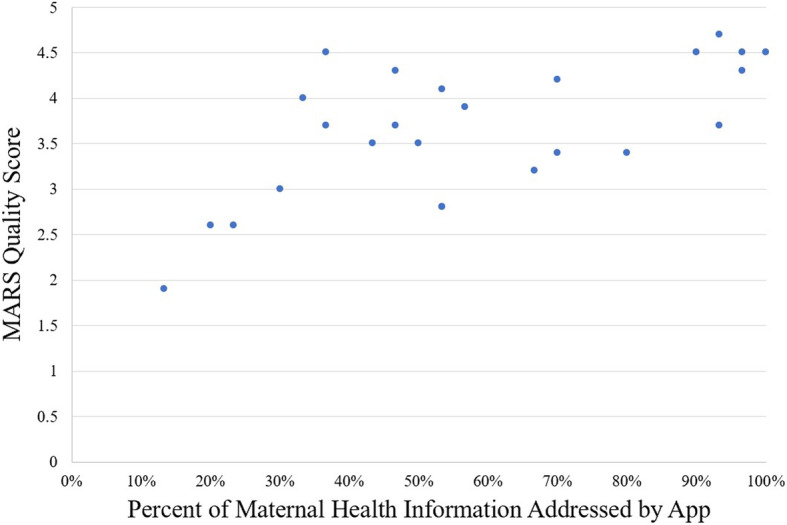
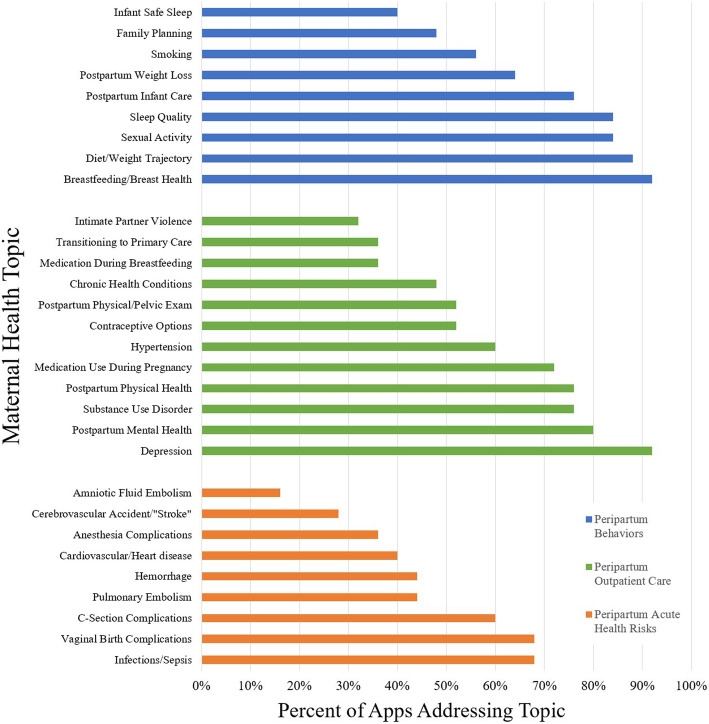
Background: The United States is currently facing a maternal morbidity and mortality crisis, with the highest rates of any resource-rich nation. In efforts to address this, new guidelines for postpartum care suggest that mobile health (mHealth) apps can help provide complementary clinical support for new mothers during the postpartum period. However, to date no study has evaluated the quality of existing mHealth tools targeted to this time period in terms of sufficiency of maternal health information, inclusivity of people of color, and app usability. Methods: Preferred Reporting Items for Systematic Reviews and Meta-Analyses (PRISMA) standards were used to review the peripartum apps from the Apple and Google Play stores in either the Health/Fitness, Medical, or Education categories. Apps were evaluated for extent and quality of maternal health information and inclusivity of people of color using an a priori coding scheme. App usability was evaluated using the Mobile Application Rating Scale (MARS) score. Results: Of the 301 apps from the Apple and Google Play stores, 25 met criteria for final evaluation. Of the 30 maternal health topics coded for, the median number addressed by apps was 19.5 (65%). Peripartum behaviors were more frequently addressed than peripartum outpatient care topics and peripartum acute health risks. The coverage of maternal health information and inclusivity of people of color in app imagery both correlated positively with the MARS usability score of the app. Only 8 apps (32%) portrayed greater than 24% images of people of color- the percent of non-white Americans according to 2019 census estimates. There was no correlation between MARS usability score and number of app users, as estimated by number of ratings for the app available on the app store. In addition, apps with evidence-based maternal health information had greater MARS engagement, information, and aesthetics scores. However, presence of evidence-based information did not correlate with greater numbers of app users. Conclusions: Current commercially available peripartum apps range widely in quality. Overall current app offerings generally do not provide adequate maternal health information and are not optimally accessible to the target users in terms of inclusivity of women of color or app usability. Apps delivering evidence-based information and more usable design are more likely to meet these standards but are not more likely to be downloaded by users.
Overview
The claims and statistics of this paper haven’t been checked yet.
Free: it reads the open-access text and checks the first 5 claims that cite a source we can check. Create a free account to check every claim.
Integrity signals
Registry
Cites
Statistics
Figures
Verification
Claims the paper makes
The claims and statistics of this paper haven’t been checked yet.
Free: it reads the open-access text and checks the first 5 claims that cite a source we can check. Create a free account to check every claim.
Claims other papers make about this one
Each is checked against this paper’s own text: does it say what the citing paper says it does?
The cited source says what the claim attributes to it.
In the citing paper
“Further still, many currently available mobile peripartum apps suffer a number of significant limitations, including lack of accessibility, limited usability, lack of inclusivity of women of color, and inadequate evidence-based maternal health information, all of which may contribute to suboptimal use and engagement [12, 30, 31].”
From Technology-Based Approaches for Supporting Perinatal Mental Health (2022) · cites this paper as [30]
Self-check
Percentages, sums and reported differences re-computed from the paper’s own numbers.
The self-check needs the paper’s full text.
Citations
Cites
Preferred Reporting Items for Systematic Reviews and Meta-Analyses: the PRISMA statement
Moher, D., Liberati, A., Tetzlaff, J., Altman, D. G., & for the PRISMA Group (2009) · BMJ · doi:10.1136/bmj.b2535 · Cited by 83,823
Preferred Reporting Items for Systematic Reviews and Meta-Analyses: The PRISMA Statement
Moher, D., Liberati, A., Tetzlaff, J., Altman, D. G., & The PRISMA Group (2009) · PLoS Medicine · doi:10.1371/journal.pmed.1000097 · Cited by 64,042
Preferred reporting items for systematic reviews and meta-analyses: the PRISMA Statement.
(2009) · PubMed Central · Cited by 44,859
Preferred reporting items for systematic reviews and meta-analyses: The PRISMA statement
Moher, D., Liberati, A., Tetzlaff, J., Altman, D. G., & the PRISMA Group* (2009) · Annals of Internal Medicine · doi:10.7326/0003-4819-151-4-200908180-00135 · Cited by 37,554
Wang, G., Ma, R., Qiao, G., Wada, K., Aizawa, Y., & Satoh, T. (2015) · Integrative Medicine International · doi:10.1159/000368408 · Cited by 18,657
Morbidity and Mortality Weekly Report
(2011) · Wilderness & Environmental Medicine · doi:10.1016/j.wem.2010.11.007 · Cited by 3,423
Mobile app rating scale: a new tool for assessing the quality of health mobile apps
Stoyanov, S. R., Hides, L., Kavanagh, D. J., Zelenko, O., Tjondronegoro, D., & Mani, M. (2015) · JMIR mHealth and uHealth · doi:10.2196/mhealth.3422 · Cited by 2,233 · cited 2×
“MARS scores from only the primary rater were used, as this scale has not been validated to incorporate ratings from multiple users in the same score [35].”
BackgroundMethod2005 American Community Survey 1-Year Estimates
(2016) · Cited by 1,242
Wisner, K. L., Sit, D. K. Y., McShea, M. C., Rizzo, D. M., Zoretich, R. A., Hughes, C. L., Eng, H. F., Luther, J. F., Wisniewski, S. R., Costantino, M. L., et al. (2013) · JAMA Psychiatry · doi:10.1001/jamapsychiatry.2013.87 · Cited by 1,091 · cited 1×
“Newly emerging data also suggests that psychosocial risks, such as intimate partner violence (IPV) and depression-induced suicide, may also play a key role in maternal mortality and morbidity occurring up to a year postpartum [3,4].”
BackgroundACOG Committee Opinion No. 736: Optimizing Postpartum Care
(2018) · Obstetrics & Gynecology · doi:10.1097/aog.0000000000002633 · Cited by 1,090
Pregnancy-Related Mortality in the United States, 2011–2013
Creanga, A. A., Syverson, C., Seed, K., & Callaghan, W. M. (2017) · Obstetrics & Gynecology · doi:10.1097/aog.0000000000002114 · Cited by 1,044
Racial/ethnic disparities in pregnancy-related deaths — United States, 2007–2016
Petersen, E. E., Davis, N. L., Goodman, D., Cox, S., Syverson, C., Seed, K., Shapiro-Mendoza, C., Callaghan, W. M., & Barfield, W. (2019) · MMWR Morbidity and Mortality Weekly Report · doi:10.15585/mmwr.mm6835a3 · Cited by 880 · cited 1×
“There are also disparities in cause of death, with Black women being more likely to suffer from pregnancy-related cardiomyopathy, pulmonary embolism, and hypertensive disorders [9].”
BackgroundPetersen, E. E., Davis, N. L., Goodman, D., Cox, S., Mayes, N., Johnston, E., Syverson, C., Seed, K., Shapiro-Mendoza, C. K., Callaghan, W. M., et al. (2019) · MMWR. Morbidity and Mortality Weekly Report · doi:10.15585/mmwr.mm6818e1 · Cited by 797
Torous, J., Nicholas, J., Larsen, M. E., Firth, J., & Christensen, H. (2018) · Evidence Based Mental Health · doi:10.1136/eb-2018-102891 · Cited by 790
Empirical Studies on Usability of mHealth Apps: A Systematic Literature Review
Zapata, B. C., Fernández-Alemán, J. L., Idri, A., & Toval, A. (2015) · Journal of Medical Systems · doi:10.1007/s10916-014-0182-2 · Cited by 585
Intimate Partner Violence During Pregnancy: Maternal and Neonatal Outcomes
Alhusen, J. L., Ray, E., Sharps, P., & Bullock, L. (2015) · Journal of Women's Health · doi:10.1089/jwh.2014.4872 · Cited by 481
ACOG Committee Opinion No. 736: Optimizing Postpartum Care
McKinney, J., Keyser, L., Clinton, S., & Pagliano, C. (2018) · Obstetrics & Gynecology · doi:10.1097/aog.0000000000002849 · Cited by 417
Prather, C., Fuller, T. R., Jeffries, W. L., Marshall, K. J., Howell, A. V., Belyue-Umole, A., & King, W. (2018) · Health Equity · doi:10.1089/heq.2017.0045 · Cited by 407
Maternal mortality and morbidity in the United States: where are we now?
Creanga, A. A., Berg, C. J., Ko, J. Y., Farr, S. L., Tong, V. T., Bruce, F. C., & Callaghan, W. M. (2014) · Journal of Women's Health · doi:10.1089/jwh.2013.4617 · Cited by 397 · cited 1×
“women experience severe maternal morbidity each year [5].”
BackgroundConsumer Mobile Health Apps: Current State, Barriers, and Future Directions
Kao, C., & Liebovitz, D. M. (2017) · PM&R · doi:10.1016/j.pmrj.2017.02.018 · Cited by 350
The fourth trimester: A critical transition period with unmet maternal health needs
Tully, K. P., Stuebe, A. M., & Verbiest, S. B. (2017) · American Journal of Obstetrics and Gynecology · doi:10.1016/j.ajog.2017.03.032 · Cited by 338 · cited 1×
“The content covered may be in response to market demand from app users, given that peripartum women have also expressed desire for additional education regarding postpartum depression, contraception, and physical well-being [46], each of which were addressed in a majority of the apps.”
BackgroundBlack-white differences in severe maternal morbidity and site of care
Howell, E. A., Egorova, N., Balbierz, A., Zeitlin, J., & Hebert, P. L. (2016) · American Journal of Obstetrics and Gynecology · doi:10.1016/j.ajog.2015.08.019 · Cited by 317
There’s an App for That: Content Analysis of Paid Health and Fitness Apps
West, J. H., Hall, P. C., Hanson, C. L., Barnes, M. D., Giraud-Carrier, C., & Barrett, J. (2012) · Journal of Medical Internet Research · doi:10.2196/jmir.1977 · Cited by 314 · cited 1×
“Even when apps are adequately addressing important health information, their use can be impeded by a failure to tailor them to the specific needs of their audience [28, 29].”
Weight loss—there is an app for that! But does it adhere to evidence-informed practices?
Breton, E. R., Fuemmeler, B. F., & Abroms, L. C. (2011) · Translational Behavioral Medicine · doi:10.1007/s13142-011-0076-5 · Cited by 276 · cited 1×
“Even when apps are adequately addressing important health information, their use can be impeded by a failure to tailor them to the specific needs of their audience [28, 29].”
Background(2018) · doi:10.2196/mhealth.8383 · Cited by 266
Peripartum cardiomyopathy: current management and future perspectives
Hilfiker-Kleiner, D., Haghikia, A., Nonhoff, J., & Bauersachs, J. (2015) · European Heart Journal · doi:10.1093/eurheartj/ehv009 · Cited by 263
Privacy concerns for mobile app download: An elaboration likelihood model perspective
Gu, J., Xu, Y. (., Xu, H., Zhang, C., & Ling, H. (2017) · Decision Support Systems · doi:10.1016/j.dss.2016.10.002 · Cited by 261
Social support and online postpartum depression discussion groups: A content analysis
Evans, M., Donelle, L., & Hume-Loveland, L. (2012) · Patient Education and Counseling · doi:10.1016/j.pec.2011.09.011 · Cited by 259
Usability of Commercially Available Mobile Applications for Diverse Patients
Sarkar, U., Gourley, G. I., Lyles, C. R., Tieu, L., Clarity, C., Newmark, L., Singh, K., & Bates, D. W. (2016) · Journal of General Internal Medicine · doi:10.1007/s11606-016-3771-6 · Cited by 257
Masterson Creber, R. M., Maurer, M. S., Reading, M., Hiraldo, G., Hickey, K. T., & Iribarren, S. (2016) · JMIR mHealth and uHealth · doi:10.2196/mhealth.5882 · Cited by 249
A Selective Review of Maternal Sleep Characteristics in the Postpartum Period
Hunter, L. P., Rychnovsky, J. D., & Yount, S. M. (2009) · Journal of Obstetric, Gynecologic & Neonatal Nursing · doi:10.1111/j.1552-6909.2008.00309.x · Cited by 247
Breastfeeding Concerns at 3 and 7 Days Postpartum and Feeding Status at 2 Months
Wagner, E. A., Chantry, C. J., Dewey, K. G., & Nommsen-Rivers, L. A. (2013) · Pediatrics · doi:10.1542/peds.2013-0724 · Cited by 232
Patients' Beliefs About Racism, Preferences for Physician Race, and Satisfaction With Care
Chen, F. M. (2005) · The Annals of Family Medicine · doi:10.1370/afm.282 · Cited by 217
An emerging model of maternity care: Smartphone, midwife, doctor?
Tripp, N., Hainey, K., Liu, A., Poulton, A., Peek, M., Kim, J., & Nanan, R. (2014) · Women and Birth · doi:10.1016/j.wombi.2013.11.001 · Cited by 208
Psychological treatment of postpartum depression: a meta‐analysis
Cuijpers, P., Brännmark, J. G., & van Straten, A. (2008) · Journal of Clinical Psychology · doi:10.1002/jclp.20432 · Cited by 204
Intimate Partner Violence and the Childbearing Year: Maternal and Infant Health Consequences
Sharps, P. W., Laughon, K., & Giangrande, S. K. (2007) · Trauma, Violence, & Abuse · doi:10.1177/1524838007302594 · Cited by 200
Overdijkink, S. B., Velu, A. V., Rosman, A. N., van Beukering, M. D., Kok, M., & Steegers-Theunissen, R. P. (2018) · JMIR mHealth and uHealth · doi:10.2196/mhealth.8834 · Cited by 197
Kim, T. H., Connolly, J. A., & Tamim, H. (2014) · BMC Pregnancy and Childbirth · doi:10.1186/1471-2393-14-162 · Cited by 182
Hughson, J.-A. P., Daly, J. O., Woodward-Kron, R., Hajek, J., & Story, D. (2018) · JMIR mhealth and uhealth · doi:10.2196/mhealth.9119 · Cited by 170 · cited 2×
“Several studies have critically reviewed the content of pregnancy apps [20, 30, 31], with Thomas & Lupton (2016) finding that pregnancy and other reproductive health apps fail to be inclusive of diverse pregnant people.”
BackgroundKnitza, J., Tascilar, K., Messner, E.-M., Meyer, M., Vossen, D., Pulla, A., Bosch, P., Kittler, J., Kleyer, A., Sewerin, P., et al. (2019) · JMIR mHealth and uHealth · doi:10.2196/14991 · Cited by 169
Committee Opinion No. 586: Health Disparities in Rural Women
(2014) · Obstetrics & Gynecology · doi:10.1097/01.aog.0000443278.06393.d6 · Cited by 154
Threats and thrills: pregnancy apps, risk and consumption
Thomas, G. M., & Lupton, D. (2016) · Health, Risk & Society · doi:10.1080/13698575.2015.1127333 · Cited by 142
Pregnancy hormones in cardiovascular disease.
Hilfiker‐Kleiner, D. (2015) · PubMed · Cited by 113
Usability Evaluations of Mobile Mental Health Technologies: Systematic Review
Inal, Y., Wake, J. D., Guribye, F., & Nordgreen, T. (2020) · Journal of Medical Internet Research · doi:10.2196/15337 · Cited by 107
Intimate-Partner Homicide Among Pregnant and Postpartum Women
Cheng, D., & Horon, I. L. (2010) · Obstetrics & Gynecology · doi:10.1097/aog.0b013e3181de0194 · Cited by 104
Postpartum fatigue and depression: A systematic review and meta-analysis
Wilson, N., Lee, J. J., & Bei, B. (2019) · Journal of Affective Disorders · doi:10.1016/j.jad.2018.12.032 · Cited by 104 · cited 1×
“For example, while fatigue is a common consequence of postpartum sleep disturbance [14], it may also be an indicator of postpartum depression [15] or cardiomyopathy [16].”
BackgroundMalat, J., & Hamilton, M. A. (2006) · Journal of Health and Social Behavior · doi:10.1177/002214650604700206 · Cited by 100
Richardson, B., Dol, J., Rutledge, K., Monaghan, J., Orovec, A., Howie, K., Boates, T., Smit, M., & Campbell-Yeo, M. (2019) · JMIR mHealth and uHealth · doi:10.2196/11620 · Cited by 86
Krishnamurti, T., Davis, A. L., Wong‐Parodi, G., Fischhoff, B., Sadovsky, Y., & Simhan, H. N. (2017) · JMIR mhealth and uhealth · doi:10.2196/mhealth.7036 · Cited by 77
Self-citationIncome inequality and racial disparities in pregnancy-related mortality in the US
Vilda, D., Wallace, M., Dyer, L., Harville, E., & Theall, K. (2019) · SSM - Population Health · doi:10.1016/j.ssmph.2019.100477 · Cited by 76
Structural Racism and Severe Maternal Morbidity in New York State
Liu, S. Y., Fiorentini, C., Bailey, Z., Huynh, M., McVeigh, K. H., & Kaplan, D. (2019) · Clinical Medicine Insights Women s Health · doi:10.1177/1179562x19854778 · Cited by 74
Usability of a Novel Mobile Health iPad App by Vulnerable Populations
Miller Jr, D. P., Weaver, K. E., Case, L. D., Babcock, D., Lawler, D., Denizard-Thompson, N., Pignone, M. P., & Spangler, J. G. (2017) · JMIR mHealth and uHealth · doi:10.2196/mhealth.7268 · Cited by 63
Thomas, J. L., Lewis, J. B., Martinez, I., Cunningham, S. D., Siddique, M., Tobin, J. N., & Ickovics, J. R. (2019) · BMC Pregnancy and Childbirth · doi:10.1186/s12884-019-2256-0 · Cited by 53
The Consequences of Maternal Morbidity and Maternal Mortality: Report of a Workshop
He, R., Ma, K., & Wh, M. (2000) · Cited by 51
Evaluation of the Pregnancy Status Checkbox on the Identification of Maternal Deaths.
Hoyert, D. L., Uddin, S. F. G., & Miniño, A. (2020) · PubMed · Cited by 49
Predicting Breast-Feeding Duration during the Postpartum Hospitalization
Duckett, L., Henly, S. J., Garvis, M. S., Weiss, J. R., & Humenick, S. S. (1993) · Western Journal of Nursing Research · doi:10.1177/019394599301500204 · Cited by 35
Myers, T. K., Richardson, F., & Chung, J. E. (2019) · Journal of Health Communication · doi:10.1080/10810730.2019.1617807 · Cited by 34
Cawley, C. L., Buckenmeyer, H., Jellison, T., Rinaldi, J. B., & Vartanian, K. B. (2020) · JMIR mhealth and uhealth · doi:10.2196/17183 · Cited by 30
Clinical Medicine Insights: Women's Health
(2016) · Clinical Medicine Insights Women s Health · doi:10.4137/cmwh · Cited by 30
Increasing Minority Representation in the Health Professions
Fleming, R., Berkowitz, B., & Cheadle, A. D. (2005) · The Journal of School Nursing · doi:10.1177/10598405050210010701 · Cited by 18
Increasing Minority Representation in the Health Professions
Fleming, R., Berkowitz, B., & Cheadle, A. D. (2005) · The Journal of School Nursing · doi:10.1177/10598405050210010801 · Cited by 13
Effect of a Health System Sponsored Mobile App on Perinatal Health Behaviors [13E]
Vartanian, K. B., Rinaldi, J., Pieper, K., & Jellison, T. (2020) · Obstetrics and Gynecology · doi:10.1097/01.aog.0000663584.13575.df · Cited by 2
Research works printed but not linked: 4
- Building U.S. Capacity to Review and Prevent Maternal Deaths. (2018). Report from nine maternal mortality review committees. Retrieved from http://reviewtoaction.org/Report_from_Nine_MMRCs. Accessed 21 May 2020.
- Pew Research Center Who owns cellphones and smartphones 2019
- Perrin A Pew Research Center Smartphones help blacks, Hispanics bridge some – but not all – digital gaps with whites 2019
- U.S. Census Bureau U.S. Census Bureau QuickFacts American Community Survey 5-year estimates 2019
Cited by
A Review of the Quality and Impact of Mobile Health Apps
Grundy, Q. (2022) · Annual Review of Public Health · doi:10.1146/annurev-publhealth-052020-103738 · Cited by 143
Tsai, Z., Kiss, A., Nadeem, S., Sidhom, K., Owais, S., Faltyn, M., & Lieshout, R. J. V. (2021) · Journal of Affective Disorders · doi:10.1016/j.jad.2021.09.106 · Cited by 74
Technology-Based Approaches for Supporting Perinatal Mental Health
Novick, A. M., Kwitowski, M., Dempsey, J., Cooke, D. L., & Dempsey, A. G. (2022) · Current Psychiatry Reports · doi:10.1007/s11920-022-01349-w · Cited by 35
“…mobile peripartum apps suffer a number of significant limitations, including lack of accessibility, limited usability, lack of inclusivity of women of color, and inadequate evidence-based maternal health information, all of which may contribute to suboptimal use and engagement [12, 30, 31].”
BackgroundBuchanan, L., Anderson, E., MBiostat, H. X., Phongsavan, P., Rissel, C. E., & Wen, L. M. (2021) · Health Informatics Journal · doi:10.1177/14604582211043146 · Cited by 15
“272 <30 years 285 (50) 184 (50) 279 (76) 90 (24) ⩾30 years 279 (48) 407 (52) 617 (79) 169 (22) Country of birth <0.”
Lee, Y., Huang, L., Chen, S., Shao, J., Lai, C., & Yang, N. (2021) · International Journal of Environmental Research and Public Health · doi:10.3390/ijerph182111603 · Cited by 20
“Moreover, using mHealth Apps as a widespread form of supplementary clinical support showed promise with regards to increasing patient education, narrowing the knowledge gap in health-disparate communities, and even reducing the burden on the care partner [37,38].”
Method
Metadata
- Authors
- Tucker, L., Villagomez, A. C., & Krishnamurti, T.
- Affiliations
- University of Pittsburgh (US)
- Corresponding author
- Tucker, Laura
- Venue
- BMC Pregnancy and Childbirth
- Published
- 2021-04-20
- Volume
- 21
- Issue
- 1
- Pages
- 311-311
- ISSN
- 1471-2393 (ISSN-L)
- PMC
- PMC8059182
- OpenAlex
- W3138840164
- Cited by
- 43
- References
- 64
- Citations by year
- 2026: 9 · 2025: 6 · 2024: 6 · 2023: 9 · 2022: 7 · 2021: 6
- FWCI
- 1.45
- Type
- journal article
- Language
- en
- Open access
- gold
- doi.org
- Licence
- cc-by
- creativecommons.org/licenses/by/4.0/ (tdm)
- creativecommons.org/licenses/by/4.0/ (vor)
- Locations
- BMC Pregnancy and Childbirth (publishedVersion, cc-by)
- Research Square (acceptedVersion, cc-by)
- PubMed Central (publishedVersion, cc-by)
- PubMed (publishedVersion)
- DOAJ (DOAJ: Directory of Open Access Journals) (submittedVersion, cc-by-sa)
- Funders
- National Institutes of Health (TR001856)
- Topics
- Health Sciences › Health Professions › General Health Professions › Mobile Health and mHealth Applications
- Social Sciences › Psychology › Applied Psychology › Digital Mental Health Interventions
- Social Sciences › Health › Social Media in Health Education
- Keywords
- postpartum health, mobile health apps, peripartum care, app usability, health information quality, evidence-based content, app reviews, maternal morbidity and mortality
- MeSH terms
- Maternal Health, Delivery of Health Care, Female, Humans, Pregnancy, United States, Telemedicine, Postpartum Period, Consumer Health Information, Mobile Applications
About these checks
Registry, retraction, Cites and statistics results are computed, not judged, with one exception: a printed reference that no index lists is read once by a model before it counts as a citation error. Claims are extracted by a model and kept only when their quote appears verbatim in the text; each cited source is then checked, with a model’s help, for whether it says what the claim relies on. Those verdicts can be wrong — read the claim’s quote and the cited source before relying on one.
Statistics and arithmetic are recomputed, not judged.
Confidence bands are shown only for fields calibrated on our annotated test set. None is calibrated yet, so no band is shown.
What counts as a claim ›How we measure confidence ›How we check this ›
Are you an author, or do you see a problem with this page? Request a review
Data sources
Bibliographic data: Semantic Scholar, OpenAlex, Crossref.
Contains information from the Semantic Scholar Academic Graph Datasets, made available under the ODC Attribution License (ODC-BY 1.0).
Semantic Scholar’s data is described in: Kinney, R., et al. (2023). The Semantic Scholar Open Data Platform. arXiv:2301.10140.
