

Association between gestational weight gain in women with gestational diabetes mellitus and adverse pregnancy outcomes: a retrospective cohort study
Open accessThe DOI matches its Crossref record; 44 of the 44 references it cites were found in a registry or an index; 7 of the 18 sources its claims cite were checked for support.
Abstract
Retrospective cohort study on gestational weight gain and adverse pregnancy outcomes in women with GDM.
Overview
CoChat Summary
TL;DR
In a retrospective cohort of 1,606 women with gestational diabetes mellitus (GDM) in Changzhou, Jiangsu (2010–2020), total and trimester-specific gestational weight gain (GWG) outside IOM guidelines was associated with adverse pregnancy outcomes. Both above-guideline and below-guideline GWG showed distinct risk patterns, supporting surveillance of GWG across pregnancy.
Key findings
- Of 1,606 women with GDM, 560 (34.9%) had total GWG within IOM guidelines, 545 (33.9%) below, and 501 (31.2%) above.
- Total GWG above IOM guidelines was associated with increased odds of cesarean delivery (aOR = 1.34, 95% CI 1.04–1.72), HDP (aOR = 2.00, 1.28–3.12), preeclampsia (aOR = 2.06, 1.01–3.12), macrosomia (aOR = 1.55, 1.13–2.13), and LGA (aOR = 2.82, 1.94–3.23), and decreased odds of PROM (aOR = 0.46, 0.36–0.60) and preterm birth (aOR = 0.35, 0.26–0.44).
- Total GWG below IOM guidelines was associated with increased odds of preterm birth (aOR = 1.96, 1.44–2.66) and SGA (aOR = 1.32, 1.11–1.50), and decreased odds of macrosomia (aOR = 0.35, 0.23–0.53) and LGA (aOR = 0.54, 0.42–0.72).
- In the second and third trimesters, rate of GWG above IOM guidelines was associated with higher odds of HDP, preeclampsia, macrosomia, and LGA; third-trimester above also increased cesarean delivery (aOR = 1.48, 1.16–2.34), while third-trimester below increased preterm birth (aOR = 1.52, 1.12–2.05) and SGA (aOR = 1.21, 1.10–1.69).
Methods
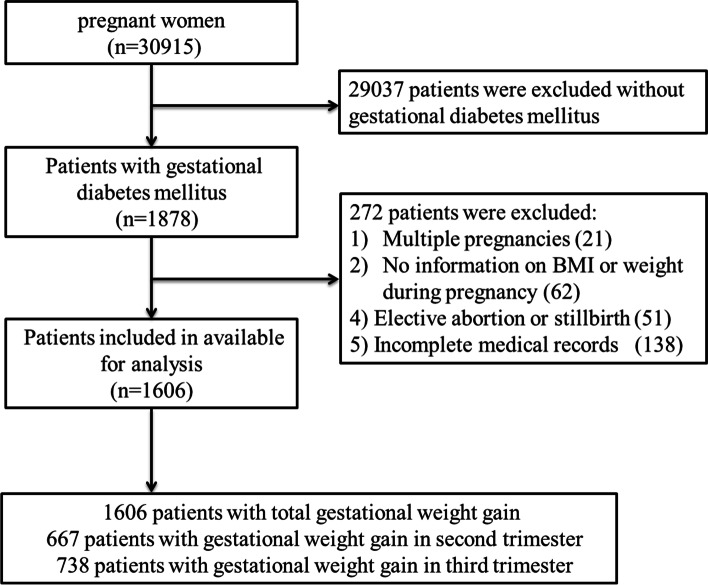
- Retrospective cohort at a hospital in Changzhou, Jiangsu, China; women with GDM who delivered between January 2010 and December 2020. From 30,915 deliveries, 1,878 met inclusion criteria, 272 were excluded, and 1,606 were analyzed.
- GDM was diagnosed by IADPSG 75-g OGTT thresholds; total GWG and rates of GWG in the second and third trimesters were categorized as within, below, or above IOM guidelines.
- Univariable and multivariable logistic regression were used to estimate adjusted odds ratios (aORs) with 95% CIs; SPSS version 23.0; p < 0.05 indicated statistical significance.
Limitations
- Stated: retrospective design; unmeasured confounders including smoking, diet, and physical activity were not assessed; weight at GDM diagnosis was not recorded, so GWG after diagnosis could not be investigated.
- Evident: single-center retrospective cohort may limit generalizability; pre-gestational BMI was self-reported, and the authors note the GDM prevalence (6.1%) was lower than previous studies, possibly related to missing part of the 75-g OGTT.
Model-written summary. Check it against the paper before relying on it.
Integrity signals
Registry
Cites
Statistics
Figures
Verification
Claims the paper makes
1 Valid · 2 Not valid · 3 Not checked · 40 Own results and interpretations
The cited sources that could be checked couldn’t confirm or dispute this claim.
In the paper
“However, studies on the association of GWG with APOs in women with GDM are conflicting [15–18].”
§ Association between gestational weight gain in women with gestational diabetes mellitus and adverse pregnancy outcomes: a retrospective cohort study > Background
What the sources say
- Not matchedcites [15] Berggren EK Stuebe AM Boggess KA Excess maternal weight gain and large for gestational age risk among women with gestational diabetes Am J Perinatol 2015 32 3 251 256 24971567 PMC4701209
Its entry has no title and year that we can search by.
- Could not verifycites [16] Gante I Amaral N Dores J Almeida MC Impact of gestational weight gain on obstetric and neonatal outcomes in obese diabetic women BMC Pregnancy Childbirth 2015 15 249 10.1186/s12884-015-0692-z 26449278 PMC4599662 sourceExperimental — accuracy not yet measured
The Background and Discussion describe studies linking gestational weight gain to adverse outcomes in women with GDM, and the Discussion says this paper’s findings are consistent with earlier studies. Neither section assesses whether the studies as a whole conflict. Searches for conflicting, inconsistent, and mixed findings found no passage addressing that point. (LLM, conf=0.70)
- Not checked — no full text of the sourcecites [17] Kase BA Cormier CM Costantine MM Hutchinson M Ramin SM Saade GR Monga M Blackwell SC Excessive gestational weight gain in women with gestational and pregestational diabetes Am J Perinatol 2011 28 10 761 766 10.1055/s-0031-1280857 21698553 source
- Not checked — no full text of the sourcecites [18] Park JE Park S Daily JW Kim SH Low gestational weight gain improves infant and maternal pregnancy outcomes in overweight and obese Korean women with gestational diabetes mellitus Gynecol Endocrinol 2011 27 10 775 781 10.3109/09513590.2010.540597 21190417 source
plainstates an association- Asserted: passes — The authors put it forward as true.
- Checkable: passes — It can be checked against evidence.
- Load-bearing: passes — The paper’s conclusions depend on it.
- Based: passes — The paper gives a reason why it holds.
- Not matched
A result the paper reports from its own data — it cites no other source for it, so there is none to check. The quote shows it is in the paper.
In the paper
“This group was also associated with a significantly decreased risk of macrosomia (aOR = 0.52; 95% CI 0.39–0.63) and LGA (aOR = 0.71; 95% CI 0.51–0.82) (Table 5).”
§ Association between gestational weight gain in women with gestational diabetes mellitus and adverse pregnancy outcomes: a retrospective cohort study > Results > Association of rate of GWG in the third trimester of pregnancy with APOs among women with GDM
plainstates an associationn = 738 ·- Asserted: passes — The authors put it forward as true.
- Checkable: passes — It can be checked against evidence.
- Load-bearing: passes — The paper’s conclusions depend on it.
- Based: passes — The paper gives a reason why it holds.
- Rests on 3 assumptions not shown here.
A result the paper reports from its own data — it cites no other source for it, so there is none to check. The quote shows it is in the paper.
In the paper
“Women with total GWG below the IOM guidelines had an increased odds of preterm birth (aOR = 1.96; 95% CI 1.44–2.66) and SGA (aOR = 1.32; 95% CI 1.11–1.50).”
§ Association between gestational weight gain in women with gestational diabetes mellitus and adverse pregnancy outcomes: a retrospective cohort study > Results > Association of total GWG with APOs among women with GDM
plainstates an association- Asserted: passes — The authors put it forward as true.
- Checkable: passes — It can be checked against evidence.
- Load-bearing: passes — The paper’s conclusions depend on it.
- Based: passes — The paper gives a reason why it holds.
- Rests on 3 assumptions not shown here.
A result the paper reports from its own data — it cites no other source for it, so there is none to check. The quote shows it is in the paper.
In the paper
“Conversely, they had a decreased odds of PROM (aOR = 0.46; 95% CI 0.36–0.60) and preterm birth (aOR = 0.35; 95% CI 0.26–0.44).”
§ Association between gestational weight gain in women with gestational diabetes mellitus and adverse pregnancy outcomes: a retrospective cohort study > Results > Association of total GWG with APOs among women with GDM
plainstates an association- Asserted: passes — The authors put it forward as true.
- Checkable: passes — It can be checked against evidence.
- Load-bearing: passes — The paper’s conclusions depend on it.
- Based: passes — The paper gives a reason why it holds.
- Rests on 3 assumptions not shown here.
A result the paper reports from its own data — it cites no other source for it, so there is none to check. The quote shows it is in the paper.
In the paper
“There were no statistically significant differences in the odds ratios of postpartum hemorrhage, fetal distress, and placenta previa among all three groups (Table 3).”
§ Association between gestational weight gain in women with gestational diabetes mellitus and adverse pregnancy outcomes: a retrospective cohort study > Results > Association of total GWG with APOs among women with GDM
plain- Asserted: passes — The authors put it forward as true.
- Checkable: passes — It can be checked against evidence.
- Load-bearing: unclear — It is unclear whether the paper’s conclusions depend on it.
- Based: passes — The paper gives a reason why it holds.
- Rests on 3 assumptions not shown here.
29 more claims
Create a free account to see all 46 claims and every source verdict.
- Probably not a substantial claim. 9
- It may state two separate claims as one. 5
Claims other papers make about this one
Each is checked against this paper’s own text: does it say what the citing paper says it does?
The source backs part of the claim, not all of it — or backs it for a different population, condition or comparison.
In the citing paper
“multiple logistic regression models were used and odds ratios were obtained after adjustment for the following covariates that were the statistically significant features in Table 1 and had indeed proven influences on maternal and neonatal adverse outcomes reported by the previous literatures [21, 33]: maternal age, primiparity, gestational weeks, GWG, FBG and implementation on doctors’ advices.”
From Associations of maternal pre-pregnancy BMI and gestational weight gain with the risks of adverse pregnancy outcomes in Chinese women with gestational diabetes mellitus (2023) · cites this paper as [33]
Experimental — accuracy not yet measured
Self-check
Percentages, sums and reported differences re-computed from the paper’s own numbers.
Each contradiction between two passages listed here was confirmed by an independent check.
Rated minor: it would not touch a result — a value no result rests on, a p-value that stays on the same side of the significance level, or a conflict that is clerical, resolved elsewhere in the paper, or outside its own findings.
In the paper
§ Association between gestational weight gain in women with gestational diabetes mellitus and adverse pregnancy outcomes: a retrospective cohort study > Abstract > Results
“LGA(aOR = 0.71, 0.51–0.82; aOR = 0.67, 0.55–0.79).”
§ Association between gestational weight gain in women with gestational diabetes mellitus and adverse pregnancy outcomes: a retrospective cohort study > Results > Association of rate of GWG in the third trimester of pregnancy with APOs among women with GDM
“LGA (aOR = 0.71; 95% CI 0.51–0.82) (Table 5).”
Citations
Cites
International Association of Diabetes and Pregnancy Study Groups Consensus Panel (2010) · Diabetes Care · doi:10.2337/dc09-1848 · Cited by 5,390 · cited 1×
“This was based on the criteria of the International Association of Diabetes and Pregnancy Study Groups[23].”
MethodWeight Gain During Pregnancy: Reexamining the Guidelines
Rasmussen, K. M., & Yaktine, A. L. (2009) · Cited by 4,493
JOURNAL OF CLINICAL ENDOCRINOLOGY AND METABOLISM
HOSKINS, R. G. (1953) · The Journal of Clinical Endocrinology & Metabolism · doi:10.1210/jcem-13-4-473 · Cited by 3,780
2. Classification and Diagnosis of Diabetes: Standards of Medical Care in Diabetes—2021
American Diabetes Association (2021) · Diabetes Care · doi:10.2337/dc21-s002 · Cited by 3,116
Classification and Diagnosis of Diabetes
Fajans, S. S. (1990) · Medical Entomology and Zoology · Cited by 2,359
European Journal of Clinical Nutrition
(2019) · European Journal of Clinical Nutrition · doi:10.1038/41430.1476-5640 · Cited by 1,445
Diabetes research and clinical practice
Dunbar, J. A., Reddy, P., Namara, K. M., & Janus, E. D. (2010) · Diabetes Research and Clinical Practice · doi:10.1016/j.diabres.2010.05.015 · Cited by 1,245
Siega-Riz, A. M., Viswanathan, M., Moos, M.-K., Deierlein, A., Mumford, S., Knaack, J., Thieda, P., Lux, L. J., & Lohr, K. N. (2009) · American Journal of Obstetrics and Gynecology · doi:10.1016/j.ajog.2009.07.002 · Cited by 708
Wendland, E. M., Torloni, M. R., Falavigna, M., Trujillo, J., Dode, M. A., Campos, M. A., Duncan, B. B., & Schmidt, M. I. (2012) · BMC Pregnancy and Childbirth · doi:10.1186/1471-2393-12-23 · Cited by 626
Diabetes, Metabolic Syndrome and Obesity: Targets and Therapy
(2011) · Diabetes Metabolic Syndrome and Obesity · doi:10.2147/dmsott · Cited by 471
Saeedi, M., Cao, Y., Fadl, H., Gustafson, H., & Simmons, D. (2021) · Diabetes Research and Clinical Practice · doi:10.1016/j.diabres.2020.108642 · Cited by 234
Shin, D., & Song, W. O. (2015) · The Journal of Maternal-Fetal & Neonatal Medicine · doi:10.3109/14767058.2014.964675 · Cited by 200
Blomberg, M. (2011) · Obstetrics & Gynecology · doi:10.1097/aog.0b013e318214f1d1 · Cited by 174
Aune, D., Sen, A., Henriksen, T., Saugstad, O. D., & Tonstad, S. (2016) · European Journal of Epidemiology · doi:10.1007/s10654-016-0176-0 · Cited by 170 · cited 1×
“In China, the prevalence of GDM is ∼10% of pregnancies[5]; however, recent studies have shown that the prevalence of GDM has increased with both obesity and gestational weight gain (GWG) among pregnant women and has been correlated with APOs[6, 7].”
BackgroundRisk Factors for Excessive Gestational Weight Gain in a Healthy, Nulliparous Cohort
Restall, A., Taylor, R. S., Thompson, J. M. D., Flower, D., Dekker, G. A., Kenny, L. C., Poston, L., & McCowan, L. M. E. (2014) · Journal of Obesity · doi:10.1155/2014/148391 · Cited by 153
Spaight, C., Gross, J., Horsch, A., & Puder, J. J. (2016) · Endocrine Development · doi:10.1159/000439413 · Cited by 148
Association Between Gestational Weight Gain and Perinatal Outcomes
Kominiarek, M. A., Saade, G., Mele, L., Bailit, J., Reddy, U. M., Wapner, R. J., Varner, M. W., Thorp, J. M., Caritis, S. N., Prasad, M., et al. (2018) · Obstetrics & Gynecology · doi:10.1097/aog.0000000000002854 · Cited by 148
Carreno, C. A., Clifton, R. G., Hauth, J. C., Myatt, L., Roberts, J. M., Spong, C. Y., Varner, M. W., Thorp, J. M., Mercer, B. M., Peaceman, A. M., et al. (2012) · Obstetrics & Gynecology · doi:10.1097/aog.0b013e318256cf1a · Cited by 144
Colagiuri, S., Falavigna, M., Agarwal, M. M., Boulvain, M., Coetzee, E., Hod, M., Meltzer, S. J., Metzger, B., Omori, Y., Rasa, I., et al. (2014) · Diabetes Research and Clinical Practice · doi:10.1016/j.diabres.2014.02.012 · Cited by 132 · cited 1×
“Gestational diabetes mellitus (GDM) is de ned as glucose intolerance commencing during pregnancy and not reaching non-pregnant diabetes levels; it is one of the major risk factors of adverse pregnancy outcomes (APOs)[1, 2].”
BackgroundGestational Weight Gain and Gestational Diabetes Mellitus: Perinatal Outcomes
Cheng, Y. W., Chung, J. H., Kurbisch-Block, I., Inturrisi, M., Shafer, S., & Caughey, A. B. (2008) · Obstetrics & Gynecology · doi:10.1097/aog.0b013e31818b5dd9 · Cited by 132
Association of Second and Third Trimester Weight Gain in Pregnancy with Maternal and Fetal Outcomes
Drehmer, M., Duncan, B. B., Kac, G., & Schmidt, M. I. (2013) · PLoS ONE · doi:10.1371/journal.pone.0054704 · Cited by 128
Egan, A. M., Dennedy, M. C., Al-Ramli, W., Heerey, A., Avalos, G., & Dunne, F. (2014) · The Journal of Clinical Endocrinology & Metabolism · doi:10.1210/jc.2013-2684 · Cited by 125
A critical review of the relationship between gestational weight gain and preterm delivery
Carmichael, S. (1997) · Obstetrics & Gynecology · doi:10.1016/s0029-7844(97)00047-1 · Cited by 119
Miao, M., Dai, M., Zhang, Y., Sun, F., Guo, X., & Sun, G. (2017) · Scientific Reports · doi:10.1038/s41598-017-00441-z · Cited by 107
Pre-pregnancy Body Mass Index (BMI) and delivery outcomes in a Canadian population
Vinturache, A., Moledina, N., McDonald, S., Slater, D., & Tough, S. (2014) · BMC Pregnancy and Childbirth · doi:10.1186/s12884-014-0422-y · Cited by 107
Liu, L., Hong, Z., & Zhang, L. (2015) · Scientific Reports · doi:10.1038/srep12863 · Cited by 94
Excess Maternal Weight Gain and Large for Gestational Age Risk among Women with Gestational Diabetes
Stuebe, A., Boggess, K., & Berggren, E. (2014) · American Journal of Perinatology · doi:10.1055/s-0034-1383848 · Cited by 91
Gestational diabetes: weight gain during pregnancy and its relationship to pregnancy outcomes
Gou, B.-H., Guan, H.-M., Bi, Y.-X., & Ding, B.-J. (2019) · Chinese Medical Journal · doi:10.1097/cm9.0000000000000036 · Cited by 91
Weight gain adequacy and pregnancy outcomes in gestational diabetes: a meta‐analysis
Viecceli, C., Remonti, L. R., Hirakata, V. N., Mastella, L. S., Gnielka, V., Oppermann, M. L. R., Silveiro, S. P., & Reichelt, A. J. (2017) · Obesity Reviews · doi:10.1111/obr.12521 · Cited by 90
Huang, A., Ji, Z., Zhao, W., Hu, H., Yang, Q., & Chen, D. (2016) · Reproductive Health · doi:10.1186/s12978-016-0204-2 · Cited by 60 · cited 2×
“found that, in general, pregnant women with both insu cient and excessive GWG had a higher risk for preterm birth[13].”
BackgroundResultJournal of obstetrics and gynaecology : the journal of the Institute of Obstetrics and Gynaecology
Gynaecology Trust (1980) · Cited by 58
Bouvier, D., Forest, J., Dion-Buteau, E., Bernard, N., Bujold, E., Pereira, B., & Giguère, Y. (2019) · Journal of Clinical Medicine · doi:10.3390/jcm8122074 · Cited by 53
Impact of gestational weight gain on obstetric and neonatal outcomes in obese diabetic women
Gante, I., Amaral, N., Dores, J., & Almeida, M. C. (2015) · BMC Pregnancy and Childbirth · doi:10.1186/s12884-015-0692-z · Cited by 49
Adverse Outcomes and Potential Targets for Intervention in Gestational Diabetes and Obesity
Scifres, C., Feghali, M., Althouse, A. D., Caritis, S., & Catov, J. (2015) · Obstetrics & Gynecology · doi:10.1097/aog.0000000000000928 · Cited by 49 · cited 1×
“reported that women with both excessive GWG and insu cient GWG had a higher risk for macrosomia, which may be due to a different grouping method[30].”
MethodA Review of Research Progress on Glycemic Variability and Gestational Diabetes
Yu, W., Wu, N., Li, L., OuYang, H., Qian, M., & Shen, H. (2020) · Diabetes, Metabolic Syndrome and Obesity: Targets and Therapy · doi:10.2147/dmso.s261486 · Cited by 44
Park, J. E., Park, S., Daily, J. W., & Kim, S.-H. (2011) · Gynecological Endocrinology · doi:10.3109/09513590.2010.540597 · Cited by 42
Wu, J.-N., Gu, W.-R., Xiao, X.-R., Zhang, Y., Li, X.-T., & Yin, C.-M. (2019) · European Journal of Clinical Nutrition · doi:10.1038/s41430-018-0358-9 · Cited by 36
Mohammadi, M., Maroufizadeh, S., Omani-Samani, R., Almasi-Hashiani, A., & Amini, P. (2019) · The Journal of Maternal-Fetal & Neonatal Medicine · doi:10.1080/14767058.2018.1473366 · Cited by 36
Gestational weight gain and weight loss among women with gestational diabetes mellitus
Komem, D., Salman, L., Krispin, E., Arbib, N., Bardin, R., Wiznitzer, A., & Hadar, E. (2018) · Diabetes Research and Clinical Practice · doi:10.1016/j.diabres.2018.04.034 · Cited by 21
Shang, M., Lin, L., Ma, L., & Yin, L. (2014) · Journal of Obstetrics and Gynaecology · doi:10.3109/01443615.2013.832177 · Cited by 19 · cited 1×
“In China, the prevalence of GDM is ∼10% of pregnancies[5]; however, recent studies have shown that the prevalence of GDM has increased with both obesity and gestational weight gain (GWG) among pregnant women and has been correlated with APOs[6, 7].”
BackgroundWeight control before and during pregnancy for patients with gestational diabetes mellitus
Yasuda, S., Iuchi, T., Goto, A., Katanoda, K., Iida, S., Oikawa, Y., Namba, A., Isshiki, M., Inoue, I., Kamei, Y., et al. (2019) · Journal of Diabetes Investigation · doi:10.1111/jdi.12989 · Cited by 16 · cited 1×
“indicated that excessive GWG in women with GDM was signi cantly related to increased infant birthweight[19].”
BackgroundKashyap, H., Sharma, D. K., Gala, A. R., et al. (2018) · The Journal of Maternal-Fetal & Neonatal Medicine · doi:10.1080/14767058.2018.1482270 · Cited by 6
Gestational weight gain among nutritionally treated GDM patients
Shmueli, A., Borovich, A., Bergel, R., Ovadia, T., Hiersch, L., Ashwal, E., Yogev, Y., & Aviram, A. (2017) · The Journal of Maternal-Fetal & Neonatal Medicine · doi:10.1080/14767058.2017.1311316 · Cited by 5
Excessive Gestational Weight Gain in Women with Gestational and Pregestational Diabetes
Kase, B., Cormier, C., Costantine, M., Hutchinson, M., Ramin, S., Saade, G., Monga, M., & Blackwell, S. (2011) · American Journal of Perinatology · doi:10.1055/s-0031-1280857 · Cited by 5
Cited by
Gestational Diabetes Mellitus and Preeclampsia: Correlation and Influencing Factors
Yang, Y., & Wu, N. (2022) · Frontiers in Cardiovascular Medicine · doi:10.3389/fcvm.2022.831297 · Cited by 155
“17 times in the second and third trimesters, respectively (67).”
BackgroundAbraham, T., & Romani, A. (2022) · Cells · doi:10.3390/cells11091548 · Cited by 98
Weight gain during pregnancy: A narrative review on the recent evidences
Dalfrà, M. G., Burlina, S., & Lapolla, A. (2022) · Diabetes Research and Clinical Practice · doi:10.1016/j.diabres.2022.109913 · Cited by 95
Ke, J.-F., Liu, S., Ge, R.-L., Ma, L., & Li, M.-F. (2023) · BMC Pregnancy and Childbirth · doi:10.1186/s12884-023-05657-8 · Cited by 50
Yu, Z., Zheng, Q., Pan, Y., Jiang, X., Li, J., Liu, R., & Huang, L. (2024) · BMJ Open · doi:10.1136/bmjopen-2023-075226 · Cited by 51
Metadata
- Authors
- Shi, P., Liu, A., & Yin, X.
- Affiliations
- Jiangsu University (CN)
- Corresponding author
- Yin, Xiaoyan
- Venue
- BMC Pregnancy and Childbirth
- Published
- 2021-07-14
- Volume
- 21
- Issue
- 1
- Pages
- 508-508
- ISSN
- 1471-2393 (ISSN-L)
- PMC
- PMC8281617
- OpenAlex
- W3148372230
- Cited by
- 49
- References
- 39
- Citations by year
- 2026: 7 · 2025: 8 · 2024: 6 · 2023: 15 · 2022: 13
- FWCI
- 7.71
- Type
- journal article
- Language
- en
- Open access
- gold
- doi.org
- Licence
- cc-by
- creativecommons.org/licenses/by/4.0 (tdm)
- creativecommons.org/licenses/by/4.0 (vor)
- Locations
- BMC Pregnancy and Childbirth (publishedVersion, cc-by)
- Research Square (acceptedVersion, cc-by)
- PubMed Central (publishedVersion, cc-by)
- PubMed (publishedVersion)
- DOAJ (DOAJ: Directory of Open Access Journals) (submittedVersion, cc-by-sa)
- Topics
- Health Sciences › Medicine › Obstetrics and Gynecology › Gestational Diabetes Research and Management
- Health Sciences › Medicine › Obstetrics and Gynecology › Pregnancy and preeclampsia studies
- Health Sciences › Medicine › Pediatrics, Perinatology and Child Health › Maternal and Neonatal Healthcare
- Keywords
- gestational weight gain, gestational diabetes mellitus, adverse pregnancy outcomes, IOM weight gain guidelines, cesarean section, hypertensive disorders of pregnancy, preeclampsia, macrosomia, large for gestational age, preterm birth, small for gestational age, premature rupture of membranes
- MeSH terms
- Gestational Weight Gain, Adult, China, Female, Fetal Macrosomia, Humans, Infant, Small for Gestational Age, Pregnancy, Pregnancy Complications, Pregnancy Outcome, Pregnancy Trimesters, Retrospective Studies, United States, Cohort Studies, National Academies of Science, Engineering, and Medicine, U.S., Health and Medicine Division, Odds Ratio, Diabetes, Gestational, Guidelines as Topic, Premature Birth
About these checks
Registry, retraction, Cites and statistics results are computed, not judged, with one exception: a printed reference that no index lists is read once by a model before it counts as a citation error. Claims are extracted by a model and kept only when their quote appears verbatim in the text; each cited source is then checked, with a model’s help, for whether it says what the claim relies on. Those verdicts can be wrong — read the claim’s quote and the cited source before relying on one.
The claim verdicts this report counts are experimental: their accuracy is not yet measured.
A language model drew the claims from the paper on 2026-10-10, under version 3 of the claim definition (model deepseek-v4.1-flash, prompt extract-v3).
A second model labelled each claim on 2026-10-10 (model jev-1.13-20260917, definition revision gold-guideline-v0.2).
Cited sources are checked with a language model’s help (gpt-6-sol).
Statistics and arithmetic are recomputed, not judged.
Confidence bands are shown only for fields calibrated on our annotated test set. None is calibrated yet, so no band is shown.
What counts as a claim ›How we measure confidence ›How we check this ›
Are you an author, or do you see a problem with this page? Request a review
Data sources
Bibliographic data: Semantic Scholar, OpenAlex, Crossref.
Contains information from the Semantic Scholar Academic Graph Datasets, made available under the ODC Attribution License (ODC-BY 1.0).
Semantic Scholar’s data is described in: Kinney, R., et al. (2023). The Semantic Scholar Open Data Platform. arXiv:2301.10140.
