

Making the cut on caesarean section: a logistic regression analysis on factors favouring caesarean sections without medical indication in comparison to spontaneous vaginal birth
Open accessThe DOI matches its Crossref record; 32 of the 32 references it cites were found in a registry or an index.
Abstract
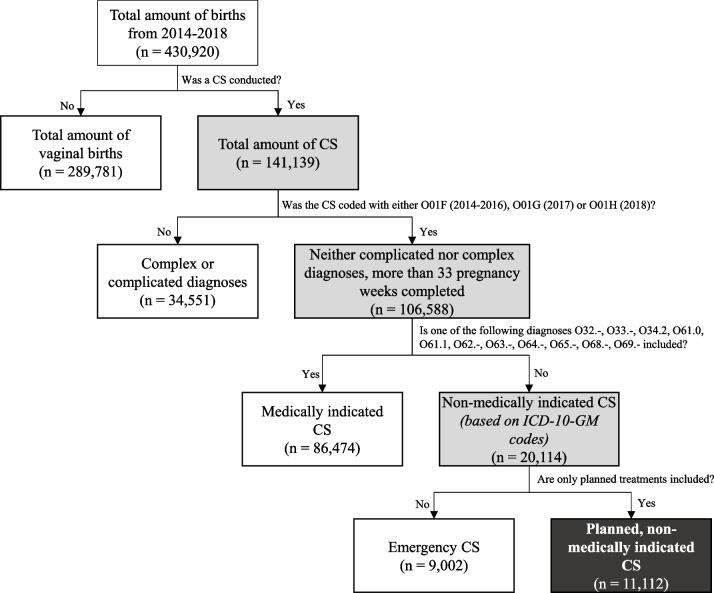
Background: In the absence of medical necessity, opting for caesarean sections exposes mothers and neonates to increased risks of enduring long-term health problems and mortality. This ultimately results in greater economic burden when compared to the outcomes of spontaneous vaginal births. In Switzerland around 33% of all births are by caesarean section. However, the rate of caesarean sections without medical indication is still unknown. Therefore, we devise an identification strategy to differentiate caesarean sections without medical indication using routine data. In addition, we aim to categorize the influencing factors for women who undergo spontaneous vaginal births as opposed to those with caesarean sections without medical indication. Method: We use Swiss Federal Statistics data including 98.3% of all women giving birth from 2014 to 2018. To determine non-medically indicated caesarean sections in our dataset, we base our identification strategy on diagnosis-related groups, diagnosis codes, and procedure classifications. Subsequently, we compare characteristics of women who give birth by non-medically CS and external factors such as the density of practicing midwives to women with spontaneous vaginal birth. Logistic regression analysis measures the effect of factors, such as age, insurance class, income, or density of practicing midwives on non-medically indicated caesarean sections. Results: Around 8% of all Swiss caesarean sections have no medical indication. The regression analysis shows that higher age, supplemental insurance, higher income, and living in urban areas are associated with non-medically indicated caesarean sections, whereas a higher density of midwives decreases the likelihood of caesarean sections without medical indication. Conclusions: By identifying non-medically indicated caesarean sections using routine data, it becomes feasible to gain insights into the characteristics of impacted mothers as well as the external factors involved. Illustrating these results, our recommendation is to revise the incentive policies directed towards healthcare professionals. Among others, future research may investigate the potential of midwife-assisted pregnancy programs on strengthening spontaneous vaginal births in absence of medical complications.
Overview
The claims and statistics of this paper haven’t been checked yet.
Free: it reads the open-access text and checks the first 5 claims that cite a source we can check. Create a free account to check every claim.
Integrity signals
Registry
Cites
Statistics
Figures
Verification
Claims the paper makes
The claims and statistics of this paper haven’t been checked yet.
Free: it reads the open-access text and checks the first 5 claims that cite a source we can check. Create a free account to check every claim.
Claims other papers make about this one
Each is checked against this paper’s own text: does it say what the citing paper says it does?
The source backs part of the claim, not all of it — or backs it for a different population, condition or comparison.
In the citing paper
“Other studies support this trend, noting that such decisions can be misinformed due to gaps in women′s understanding of delivery modes [16–19].”
From Determinants of Delivery Mode Preferences and Decision‐Making Among Jordanian Women: A Cross‐Sectional Study (2025) · cites this paper as [16]
Experimental — accuracy not yet measured
Self-check
Percentages, sums and reported differences re-computed from the paper’s own numbers.
The self-check needs the paper’s full text.
Citations
Cites
Short-term and long-term effects of caesarean section on the health of women and children
Sandall, J., Tribe, R. M., Avery, L., Mola, G., Visser, G. H., Homer, C. S., Gibbons, D., Kelly, N. M., Kennedy, H. P., Kidanto, H., et al. (2018) · The Lancet · doi:10.1016/s0140-6736(18)31930-5 · Cited by 1,394 · cited 5×
“The mother faces higher risks such as higher blood loss [18], increased probability of a stillbirth [19], or negative implications for future pregnancies [16, 19], whereas the neonate is confronted by increased respiratory morbidity [19], and higher risks of short-and long-term morbidity in general…”
BackgroundInfluential(2019) · doi:10.1787/4dd50c09-en · Cited by 1,324
Global epidemiology of use of and disparities in caesarean sections
Boerma, T., Ronsmans, C., Melesse, D. Y., Barros, A. J. D., Barros, F. C., Juan, L., Moller, A.-B., Say, L., Hosseinpoor, A. R., Yi, M., et al. (2018) · The Lancet · doi:10.1016/s0140-6736(18)31928-7 · Cited by 1,267
WHO Statement on Caesarean Section Rates
Betran, A., Torloni, M., Zhang, J., Gülmezoglu, A., & the WHO Working Group on Caesarean Section (2016) · BJOG: An International Journal of Obstetrics & Gynaecology · doi:10.1111/1471-0528.13526 · Cited by 1,238
Midwife-led continuity models versus other models of care for childbearing women
Sandall, J., Soltani, H., Gates, S., Shennan, A., & Devane, D. (2013) · Cochrane Database of Systematic Reviews · doi:10.1002/14651858.cd004667.pub3 · Cited by 1,226
the WHO Global Survey on Maternal and Perinatal Health Research Group, Souza, J., Gülmezoglu, A., Lumbiganon, P., Laopaiboon, M., Carroli, G., Fawole, B., & Ruyan, P. (2010) · BMC Medicine · doi:10.1186/1741-7015-8-71 · Cited by 721
Interventions to reduce unnecessary caesarean sections in healthy women and babies
Betrán, A. P., Temmerman, M., Kingdon, C., Mohiddin, A., Opiyo, N., Torloni, M. R., Zhang, J., Musana, O., Wanyonyi, S. Z., Gülmezoglu, A. M., et al. (2018) · The Lancet · doi:10.1016/s0140-6736(18)31927-5 · Cited by 600
OECD (2019) · OECD Pensions at a Glance · doi:10.1787/b6d3dcfc-en · Cited by 514
Robson, M., Murphy, M., & Byrne, F. (2015) · International Journal of Gynecology & Obstetrics · doi:10.1016/j.ijgo.2015.04.026 · Cited by 508
Ye, J., Zhang, J., Mikolajczyk, R., Torloni, M., Gülmezoglu, A., & Betran, A. (2016) · BJOG: An International Journal of Obstetrics & Gynaecology · doi:10.1111/1471-0528.13592 · Cited by 402
Searching for the Optimal Rate of Medically Necessary Cesarean Delivery
Ye, J., Betrán, A. P., Guerrero Vela, M., Souza, J. P., & Zhang, J. (2014) · Birth · doi:10.1111/birt.12104 · Cited by 351
Non‐clinical interventions for reducing unnecessary caesarean section
Chen, I., Opiyo, N., Tavender, E., Mortazhejri, S., Rader, T., Petkovic, J., Yogasingam, S., Taljaard, M., Agarwal, S., Laopaiboon, M., et al. (2018) · Cochrane Database of Systematic Reviews · doi:10.1002/14651858.cd005528.pub3 · Cited by 259
Non-clinical interventions for reducing unnecessary caesarean section
Khunpradit, S., Tavender, E., Lumbiganon, P., Laopaiboon, M., Wasiak, J., & Gruen, R. L. (2011) · Cochrane Database of Systematic Reviews · doi:10.1002/14651858.cd005528.pub2 · Cited by 236
MacDorman, M. F., Declercq, E., Menacker, F., & Malloy, M. H. (2008) · Birth · doi:10.1111/j.1523-536x.2007.00205.x · Cited by 130
Changed indications for cesarean sections
STJERNHOLM, Y. V., PETERSSON, K., & ENEROTH, E. (2010) · Acta Obstetricia et Gynecologica Scandinavica · doi:10.3109/00016340903418777 · Cited by 119
Maternal reasons for requesting planned cesarean section in Norway: a qualitative study
Eide, K. T., Morken, N.-H., & Bærøe, K. (2019) · BMC Pregnancy and Childbirth · doi:10.1186/s12884-019-2250-6 · Cited by 119
O'Donovan, C., & O'Donovan, J. (2018) · Birth · doi:10.1111/birt.12319 · Cited by 116
Using Administrative Data to Identify Indications for Elective Primary Cesarean Delivery
Gregory, K. D., Korst, L. M., Gornbein, J. A., & Platt, L. D. (2002) · Health Services Research · doi:10.1111/1475-6773.10762 · Cited by 113
Henry, O. A., Gregory, K. D., Hobel, C. J., & Platt, L. D. (1995) · American Journal of Public Health · doi:10.2105/ajph.85.8_pt_1.1143 · Cited by 111
Lin, H., & Xirasagar, S. (2005) · American Journal of Obstetrics and Gynecology · doi:10.1016/j.ajog.2004.09.133 · Cited by 109
Fatores associados à preferência por cesareana
Faisal‐Cury, A., & Menezes, P. R. (2006) · Revista de Saúde Pública · doi:10.1590/s0034-89102006000200007 · Cited by 100
Herstad, L., Klungsøyr, K., Skjærven, R., Tanbo, T. G., Forsén, L., Åbyholm, T., & Vangen, S. (2016) · BMC Pregnancy and Childbirth · doi:10.1186/s12884-016-1028-3 · Cited by 99
Cesarean Section without Medical Reason, 1997 to 2006: A Swedish Register Study
Karlström, A., Rådestad, I., Eriksson, C., Rubertsson, C., Nystedt, A., & Hildingsson, I. (2010) · Birth · doi:10.1111/j.1523-536x.2009.00373.x · Cited by 87
Elective primary caesarean delivery: accuracy of administrative data
Korst, L. M., Gregory, K. D., & GORNBEIN, J. A. (2004) · Paediatric and Perinatal Epidemiology · doi:10.1111/j.1365-3016.2003.00540.x · Cited by 74
Googling caesarean section: a survey on the quality of the information available on the Internet
Fioretti, B., Reiter, M., Betrán, A., & Torloni, M. (2015) · BJOG: An International Journal of Obstetrics & Gynaecology · doi:10.1111/1471-0528.13081 · Cited by 65
Dahlquist, K., Stuart, A., & Källén, K. (2022) · Acta Obstetricia Et Gynecologica Scandinavica · doi:10.1111/aogs.14408 · Cited by 58
Variation in elective primary cesarean delivery by patient and hospital factors
Gregory, K. D., Korst, L. M., & Platt, L. D. (2001) · American Journal of Obstetrics and Gynecology · doi:10.1067/mob.2001.115496 · Cited by 57
Räisänen, S., Gissler, M., Kramer, M. R., & Heinonen, S. (2014) · BMC Pregnancy and Childbirth · doi:10.1186/1471-2393-14-120 · Cited by 55
Geburtshilfe. Kaiserschnitt vs. Natürliche Geburt
Wacker, J. (2010) · Geburtshilfe und Frauenheilkunde · doi:10.1055/s-0030-1250563 · Cited by 15
Maternal and Hospital Characteristics of Non-Medically Indicated Deliveries Prior to 39 Weeks
Womack, L. S., Sappenfield, W. M., Clark, C. L., Hill, W. C., Yelverton, R. W., Curran, J. S., Detman, L. A., & Bettegowda, V. R. (2014) · Maternal and Child Health Journal · doi:10.1007/s10995-014-1433-z · Cited by 13
Berg, J., Källén, K., Andolf, E. G., Hellström-Westas, L. K., Ekéus, C., Alvan, J., & Vitols, S. (2022) · Value in Health · doi:10.1016/j.jval.2022.10.003 · Cited by 9
The effect of midwifery care on rates of cesarean delivery
LAWTON, B. A., Koch, A., Stanley, J., & GELLER, S. E. (2013) · International Journal of Gynecology & Obstetrics · doi:10.1016/j.ijgo.2013.06.033 · Cited by 6
Cited by
Risk factors for labour induction and augmentation: a multicentre prospective cohort study in India
Cheng, T. S., Zahir, F., Solomi, C. V., Verma, A., Rao, S., Choudhury, S. S., Deka, G., Mahanta, P., Kakoty, S. D., Medhi, R., et al. (2024) · The Lancet Regional Health - Southeast Asia · doi:10.1016/j.lansea.2024.100417 · Cited by 10
Velebil, P., Durox, M., Zeitlin, J. A., & Mahmood, T. A. (2025) · European Journal of Obstetrics & Gynecology and Reproductive Biology · doi:10.1016/j.ejogrb.2025.02.056 · Cited by 7
Optimizing energy, downtime, and throughput in footwear production through machine learning
Sudhakar, P. K., & Muthucumaraswamy, R. (2025) · Scientific Reports · doi:10.1038/s41598-025-30082-6 · Cited by 2
Bawadi, H., Hamdan, Z., Shaqra, N. A., Maaitah, M., Suleimat, A., Basha, A., Saleh, S., El -Zibdah, M., Khater, R., & Abdulla, A. (2025) · Journal of Pregnancy · doi:10.1155/jp/8395387 · Cited by 1
“Other studies support this trend, noting that such decisions can be misinformed due to gaps in women's understanding of delivery modes [16 – 19].”
Vaginale Geburt – Vor- und Nachteile für Mutter und Kind
Schrey-Petersen, S., & Härtel, C. (2024) · Die Gynäkologie · doi:10.1007/s00129-024-05197-y · Cited by 1
Metadata
- Authors
- Bischof, A. Y., & Geissler, A.
- Affiliations
- University of St.Gallen (CH)
- Corresponding author
- Bischof, Anja Y.
- Venue
- BMC Pregnancy and Childbirth
- Published
- 2023-10-27
- Volume
- 23
- Issue
- 1
- Pages
- 759-759
- ISSN
- 1471-2393 (ISSN-L)
- PMC
- PMC10605562
- OpenAlex
- W4387996189
- Cited by
- 13
- References
- 31
- Citations by year
- 2026: 4 · 2025: 6 · 2024: 3
- FWCI
- 4.06
- Type
- journal article
- Language
- en
- Open access
- gold
- doi.org
- Licence
- cc-by
- creativecommons.org/licenses/by/4.0 (tdm)
- creativecommons.org/licenses/by/4.0 (vor)
- Locations
- BMC Pregnancy and Childbirth (publishedVersion, cc-by)
- PubMed Central (publishedVersion, cc-by)
- PubMed (publishedVersion)
- Alexandria (UniSG) (University of St.Gallen) (submittedVersion)
- DOAJ (DOAJ: Directory of Open Access Journals) (submittedVersion, cc-by-sa)
- Topics
- Health Sciences › Medicine › Obstetrics and Gynecology › Maternal and Perinatal Health Interventions
- Health Sciences › Medicine › Public Health, Environmental and Occupational Health › Reproductive Health and Contraception
- Social Sciences › Economics, Econometrics and Finance › Economics and Econometrics › Healthcare Policy and Management
- Keywords
- cesarean section, normal delivery, risk factors, maternal age, maternal income, urban residence
- MeSH terms
- Cesarean Section, Female, Humans, Income, Infant, Newborn, Midwifery, Mothers, Pregnancy, Logistic Models
About these checks
Registry, retraction, Cites and statistics results are computed, not judged, with one exception: a printed reference that no index lists is read once by a model before it counts as a citation error. Claims are extracted by a model and kept only when their quote appears verbatim in the text; each cited source is then checked, with a model’s help, for whether it says what the claim relies on. Those verdicts can be wrong — read the claim’s quote and the cited source before relying on one.
Statistics and arithmetic are recomputed, not judged.
Confidence bands are shown only for fields calibrated on our annotated test set. None is calibrated yet, so no band is shown.
What counts as a claim ›How we measure confidence ›How we check this ›
Are you an author, or do you see a problem with this page? Request a review
Data sources
Bibliographic data: Semantic Scholar, OpenAlex, Crossref.
Contains information from the Semantic Scholar Academic Graph Datasets, made available under the ODC Attribution License (ODC-BY 1.0).
Semantic Scholar’s data is described in: Kinney, R., et al. (2023). The Semantic Scholar Open Data Platform. arXiv:2301.10140.
