

Long-term efficacy and cost-effectiveness of blended cognitive behavior therapy for high fear of recurrence in breast, prostate and colorectal Cancer survivors: follow-up of the SWORD randomized controlled trial
Open accessThe DOI matches its Crossref record; 58 of the 59 references it cites were found in a registry or an index.
Abstract
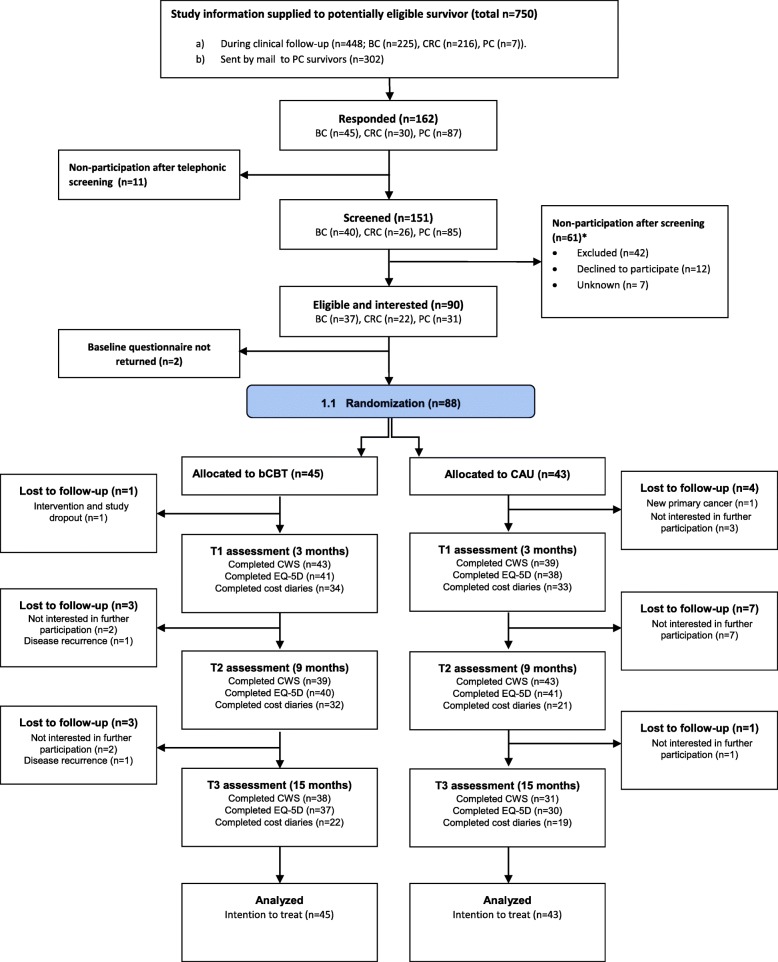
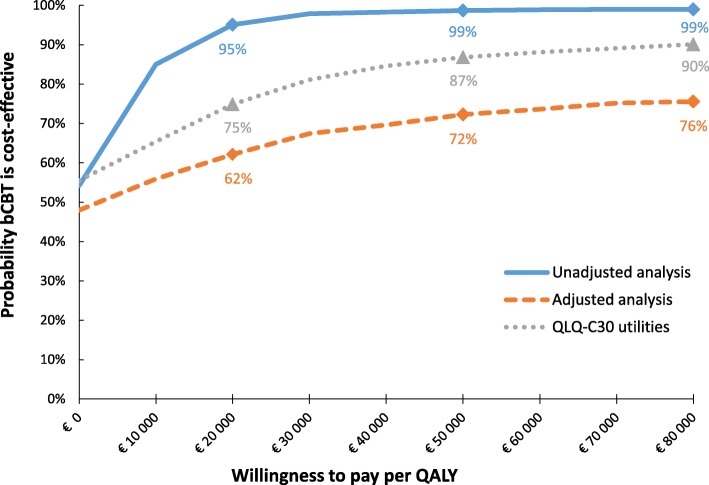
BACKGROUND: Blended cognitive behaviour therapy (bCBT) is an effective treatment for fear of cancer recurrence (FCR) in curatively-treated breast, colorectal and prostate cancer survivors with high FCR. However, long-term outcomes are unknown. This study investigated the long-term efficacy and cost-effectiveness of bCBT compared with care as usual (CAU). METHODS: Eighty-eight cancer survivors with high FCR (Cancer Worry Scale ≥14) were randomly assigned to bCBT (n = 45) or CAU (n = 43). Data were collected at baseline and at three, nine and fifteen months from baseline and analysed by modified intention-to-treat. Efficacy was investigated with linear mixed-effects models. Cost-effectiveness was investigated from a societal perspective by comparing costs with quality-adjusted life-years (QALYs). RESULTS: Participants who received bCBT reported significantly lower FCR compared with CAU (mean difference of - 1.787 [95% CI -3.251 to - 0.323, p = 0.017] at 15 months follow-up), and proportionally greater self-rated and clinically significant improvement at each follow-up measurement. Total QALYs were non-significantly different between conditions when adjusted for utility score baseline differences (0.984 compared to 0.957, p = 0.385), while total costs were €631 lower (95% CI -1737 to 2794, p = 0.587). Intervention costs of bCBT were €466. The incremental cost-effectiveness ratio amounted to an additional €2049 per QALY gained, with a 62% probability that bCBT is cost-effective at a willingness to pay (WTP) threshold of €20,000 per QALY. Results were confirmed in sensitivity analyses. CONCLUSIONS: bCBT for cancer survivors with FCR is clinically and statistically more effective than CAU on the long-term. In addition, bCBT is a relatively inexpensive intervention with similar costs and QALYs as CAU. TRIAL REGISTRATION: The RCT was registered in the Dutch National Trial Register ( NTR4423 ) on 12-Feb-2014. This abstract was previously presented at the International Psycho-Oncology Society conference of 2018 and published online. (Psycho-oncology, 27(S3):8-55; 2018).
Overview
The claims and statistics of this paper haven’t been checked yet.
Free: it reads the open-access text and checks the first 5 claims that cite a source we can check. Create a free account to check every claim.
Integrity signals
Registry
Cites
Statistics
Figures
Verification
Claims the paper makes
The claims and statistics of this paper haven’t been checked yet.
Free: it reads the open-access text and checks the first 5 claims that cite a source we can check. Create a free account to check every claim.
Claims other papers make about this one
Each is checked against this paper’s own text: does it say what the citing paper says it does?
The source backs part of the claim, not all of it — or backs it for a different population, condition or comparison.
In the citing paper
“SWORD study found to significantly reduce long-term (15 weeks) FCR [37, 38].”
From Web-based interventions for fear of cancer recurrence: A scoping review with a focus on suggestions for the development and evaluation of future interventions (2024) · cites this paper as [38]
Experimental — accuracy not yet measured
Self-check
Percentages, sums and reported differences re-computed from the paper’s own numbers.
The self-check needs the paper’s full text.
Citations
Cites
The Hospital Anxiety and Depression Scale
Zigmond, A. S., & Snaith, R. P. (1983) · Acta Psychiatrica Scandinavica · doi:10.1111/j.1600-0447.1983.tb09716.x · Cited by 47,139 · cited 1×
“Secondary outcomes were FCR severity (Fear of Cancer Recurrence Inventory [FCRI] severity subscale) [30], cancer-specific distress (Impact of Events Scale [IES]) [31, 32], distress (Hospital Anxiety and Depression Scale [HADS]) [33], fatigue (Checklist Individual Strength 8R [CIS-8R]) [34], and health-related quality…”
MethodAaronson, N. K., Ahmedzai, S., Bergman, B., Bullinger, M., Cull, A., Duez, N. J., Filiberti, A., Flechtner, H., Fleishman, S. B., Haes, J. C. J. M. D., et al. (1993) · JNCI Journal of the National Cancer Institute · doi:10.1093/jnci/85.5.365 · Cited by 16,005 · cited 1×
“Secondary outcomes were FCR severity (Fear of Cancer Recurrence Inventory [FCRI] severity subscale) [30], cancer-specific distress (Impact of Events Scale [IES]) [31, 32], distress (Hospital Anxiety and Depression Scale [HADS]) [33], fatigue (Checklist Individual Strength 8R [CIS-8R]) [34], and health-related quality…”
MethodEuroQol: a new facility for the measurement of health-related quality of life
(1990) · Health Policy · doi:10.1016/0168-8510(90)90421-9 · Cited by 15,736 · cited 1×
“To calculate QALYs, utility scores were obtained by using the EuroQol five dimensions three-level questionnaire (EQ-5D-3 L) and by applying the Dutch EQ-5D tariff [36, 37].”
MethodDepression and quality of life in older persons: A review
Sivertsen, H., Bjørkløf, G. H., Engedal, K., Selbæk, G., & Helvik, A.-S. (2015) · Dementia and Geriatric Cognitive Disorders · doi:10.1159/000437299 · Cited by 14,152
Methods for the Economic Evaluation of Health Care Programmes
Drummond, M. E., Sculpher, M. J., Torrance, G. W., O’Brien, B. J., & Stoddart, G. L. (2005) · doi:10.1093/oso/9780198529446.001.0001 · Cited by 13,648
Impact of Event Scale: A Measure of Subjective Stress
Horowitz, M., Wilner, N., & Alvarez, W. (1979) · Psychosomatic Medicine · doi:10.1097/00006842-197905000-00004 · Cited by 7,813 · cited 1×
“Secondary outcomes were FCR severity (Fear of Cancer Recurrence Inventory [FCRI] severity subscale) [30], cancer-specific distress (Impact of Events Scale [IES]) [31, 32], distress (Hospital Anxiety and Depression Scale [HADS]) [33], fatigue (Checklist Individual Strength 8R [CIS-8R]) [34], and health-related quality…”
MethodJacobson, N. S., & Truax, P. (1991) · Journal of Consulting and Clinical Psychology · doi:10.1037/0022-006x.59.1.12 · Cited by 7,770 · cited 1×
“96) [41] and a decrease of CWS scores to the normal range (clinically significant change, CWS < 14) [27].”
BackgroundInternet-based cognitive behaviour therapy for symptoms of depression and anxiety: A meta-analysis
SPEK, V., CUIJPERS, P., NYKLÍČEK, I., RIPER, H., KEYZER, J., & POP, V. (2007) · Psychological Medicine · doi:10.1017/s0033291706008944 · Cited by 1,586
Multiple imputation in health‐are databases: An overview and some applications
Rubin, D. B., & Schenker, N. (1991) · Statistics in Medicine · doi:10.1002/sim.4780100410 · Cited by 1,550 · cited 1×
“Twenty imputed datasets were created and pooled according to Rubin’s rules [44].”
MethodAndrews, G., Cuijpers, P., Craske, M. G., McEvoy, P., & Titov, N. (2010) · PLoS ONE · doi:10.1371/journal.pone.0013196 · Cited by 1,311
Research works printed but not linked: 1
- Humphris G Rogers S AFTER and beyond: cancer recurrence fears and a test of an intervention in oral and oropharyngeal patients Soc Sci Dent 2012 2 29 38
Cited by
Williams, J. T. W., Pearce, A., & Smith, A. '. (2021) · Psycho-Oncology · doi:10.1002/pon.5673 · Cited by 95
“Three studies conducted a cost‐utility analysis (CUA) and reported the ICER per quality‐adjusted life year (QALY) gained.(32,34,35) QALYs were measured using the AQol‐8D(32,35) or EQ‐5D‐3L.”
MethodInfluentialLyu, M., Siah, R. C., Lam, A. S. L., & Cheng, K. K. F. (2022) · Journal of Advanced Nursing · doi:10.1111/jan.15321 · Cited by 77
Hardiman, K. M., Felder, S. I., Friedman, G., Migaly, J., Paquette, I. M., & Feingold, D. L. (2021) · Diseases of the Colon & Rectum · doi:10.1097/dcr.0000000000001984 · Cited by 84
van Beek, F. E., Wijnhoven, L. M. A., Holtmaat, K., Custers, J. A. E., Prins, J. B., Leeuw, I. M. V., & Jansen, F. (2021) · Psycho-Oncology · doi:10.1002/pon.5753 · Cited by 79
Self-citationPark, S.-Y., & Lim, J.-W. (2022) · BMC Cancer · doi:10.1186/s12885-021-08909-y · Cited by 53
“Although the theoretical foundations, formats and delivery methods of these interventions differ, the available interventions are based on CBT [25].”
BackgroundLleras de Frutos, M., Medina, J. C., Vives, J., Casellas‐Grau, A., Marzo, J. L., Borràs, J. M., & Ochoa‐Arnedo, C. (2020) · Psycho-Oncology · doi:10.1002/pon.5457 · Cited by 50
Skrabal Ross, X., Gunn, K. M., Olver, I., Willems, R. A., Lechner, L., Mesters, I., & Bolman, C. A. W. (2020) · Current Opinion in Supportive & Palliative Care · doi:10.1097/spc.0000000000000478 · Cited by 42
Mundle, R. S., Afenya, E., & Agarwal, N. (2021) · Prostate Cancer and Prostatic Diseases · doi:10.1038/s41391-021-00342-3 · Cited by 49
Fear of cancer recurrence and PSA anxiety in patients with prostate cancer: a systematic review
James, C., Brunckhorst, O., Eymech, O., Stewart, R. J., Dasgupta, P., & Ahmed, K. (2022) · Supportive Care in Cancer · doi:10.1007/s00520-022-06876-z · Cited by 53
Remote Psychological Interventions for Fear of Cancer Recurrence: Scoping Review.
Cincidda, C., Pizzoli, S. F. M., & Pravettoni, G. (2022) · JMIR Cancer · doi:10.2196/29745 · Cited by 34
“The SWORD study: 7 F2F therapy sessions and 1 telephone session based on traditional CBT Case studySurvivors of BCvan de Wal et al [41] • CBT reduced FCR over time (last follow-up at 12 months after therapy).”
BackgroundMethodInfluentialChu, Q., Wong, C. C. Y., Chen, L., Shin, L. J., Chen, L., & Lu, Q. (2021) · Psycho-Oncology · doi:10.1002/pon.5590 · Cited by 33
“For example, cognitive– behavioral therapy has shown promise for reducing cancer survivors' concerns and improving self‐efficacy.(37,38) In addition, healthcare providers may devote more time to inquiring about survivors' con-”
BackgroundPaperák, P., Javůrková, A., & Raudenská, J. (2023) · Journal of Cancer Survivorship · doi:10.1007/s11764-022-01277-x · Cited by 31
Bai, P. (2023) · Journal of Cancer · doi:10.7150/jca.82632 · Cited by 25
“Data were collected at baseline, three months, nine months, and 15 months, with results demonstrating significant improvements in FCR in the CBT group at all time points compared to the control group that received conventional care[68].”
ResultYu, S., Liu, Y., Cao, M., Tian, Q., Xu, M., Yu, L., Yang, S., & Zhang, W. (2025) · Cancer Nursing · doi:10.1097/ncc.0000000000001274 · Cited by 22
Xie, J., Qi, W., Cao, L., Tan, Y., Huang, J., Gu, X., Chen, B., Shen, P., Zhao, Y., Zhang, Y., et al. (2021) · Frontiers in Oncology · doi:10.3389/fonc.2021.650766 · Cited by 23
Kang, N., & Yu, E. (2023) · Psycho-Oncology · doi:10.1002/pon.6199 · Cited by 20
Ankersmid, J. W., Rotgerink, F. K. L., Strobbe, L. J. A., van Uden‐Kraan, C. F., Siesling, S., & Drossaert, C. H. C. (2022) · Breast Cancer Research and Treatment · doi:10.1007/s10549-022-06684-3 · Cited by 19
“Only then, patients with high levels of FCR can be advised on managing worry or if necessary be referred to suitable (existing) interventions or supportive care [23, 24].”
BackgroundDeuning‐Smit, E., Kolsteren, E. E. M., Kwakkenbos, L., Custers, J. A. E., Hermens, R., & Prins, J. B. (2022) · Journal of Cancer Survivorship · doi:10.1007/s11764-022-01285-x · Cited by 25
Self-citationVyas, N., Brunckhorst, O., Fox, L., Hemelrijck, M. V., Muir, G., Stewart, R., Dasgupta, P., & Ahmed, K. (2022) · PLoS ONE · doi:10.1371/journal.pone.0279250 · Cited by 20
Lin, L., Lin, H., Zhou, R., Liu, B., Liu, K., & Jiang, R. (2024) · Asian Journal of Surgery · doi:10.1016/j.asjsur.2024.11.048 · Cited by 28
The gut-brain axis in the context of colorectal cancer
Wu, H., He, K., Wang, H., Li, W., Huo, R., Jiang, S., & Xue, J. (2025) · Pharmacological Research · doi:10.1016/j.phrs.2025.107816 · Cited by 17
van Beek, F. E., Wijnhoven, L. M. A., Jansen, F., Custers, J. A. E., Aukema, E. J., Coupé, V. M. H., Cuijpers, P., van der Lee, M. L., Lissenberg-Witte, B. I., Wijnen, B., et al. (2019) · BMC Psychology · doi:10.1186/s40359-019-0368-y · Cited by 13
Self-citationBrain, D., & Jadambaa, A. (2021) · International Journal of Environmental Research and Public Health · doi:10.3390/ijerph182111558 · Cited by 13
van Bommel, M. H. D., Steenbeek, M. P., IntHout, J., Hermens, R., Hoogerbrugge, N., Harmsen, M. G., van Doorn, H. C., Mourits, M. J. E., van Beurden, M., Zweemer, R. P., et al. (2022) · Supportive Care in Cancer · doi:10.1007/s00520-021-06726-4 · Cited by 9
“Blended cognitive behaviour therapy was proved efficacious for high fear of cancer recurrence in survivors of various types of cancer [40–42].”
BackgroundSelf-citationWei, L., Yang, X., Sun, S., Yu, Y., Xie, J., Zhao, J., Wang, X., Zhu, L., & Yao, J. (2022) · Frontiers in Psychiatry · doi:10.3389/fpsyt.2022.941459 · Cited by 12
Savard, J., Filion, C., Brearty, C. M., Caplette‐Gingras, A., Chiquette, J., & Dorval, M. (2024) · Cancer Medicine · doi:10.1002/cam4.6889 · Cited by 11
“29,30 The addition of therapist time may help create a therapeutic alliance 31 and reinforce motivation to initiate and maintain engagement in the process.”
BackgroundDeuning‐Smit, E., Custers, J. A. E., Braam, C. I. W., Hermens, R., & Prins, J. B. (2024) · Psycho-Oncology · doi:10.1002/pon.6297 · Cited by 11
Self-citationLate and Long-term Symptom Management in Colorectal Cancer Survivorship
Shaw, R. D., & Ivatury, S. J. (2021) · Diseases of the Colon & Rectum · doi:10.1097/dcr.0000000000002262 · Cited by 8
Feng, M., Wang, H., Zhu, Z., Yao, B., Li, Y., Xue, J., Cao, S., Shao, X., Xu, Y., Sohn, K. C., et al. (2021) · Frontiers in Oncology · doi:10.3389/fonc.2021.677939 · Cited by 9
Adeberg, S., Sauer, C., Lambert, L., Regnery, S., Windisch, P. Y., Zaoui, K., Freudlsperger, C., Moratin, J., Farnia, B., Nikendei, C., et al. (2021) · Frontiers in Psychology · doi:10.3389/fpsyg.2021.760024 · Cited by 12
Zibaite, S., Tripathee, S., Moffat, H., Elsberger, B., & Maclennan, S. (2024) · PLOS ONE · doi:10.1371/journal.pone.0312769 · Cited by 5
Bruin, J., van Rood, Y. R., Peeters, K. C. M. J., de Roos, C., Tanious, R., Portielje, J. E. A., Gelderblom, H. A. J., & Hinnen, C. (2023) · European Journal of Psychotraumatology · doi:10.1080/20008066.2023.2203427 · Cited by 9
“These interventions generally focus on maladaptive thoughts, rumination, and inappropriate monitoring and screening behaviours (Burm et al., 2019; Sharpe et al., 2019).”
BackgroundNot out of the woods: perspectives from patients with triple-negative breast cancer
Post, K. E., Aribindi, S., Traeger, L. N., Hall, D. L., Jacobs, J. M., Temel, J. S., & Greer, J. A. (2024) · Supportive Care in Cancer · doi:10.1007/s00520-024-09084-z · Cited by 7
Jansen, F., Molenaar, D., Zarsat, Ö., Lissenberg-Witte, B. I., Takes, R. P., de Bree, R., Langendijk, J. A., Hardillo, J. A., Lamers, F., Leemans, C. R., et al. (2025) · Psycho-Oncology · doi:10.1002/pon.70276 · Cited by 4
“HNC survivorship care might benefit from further attention for these SCNs, for example by providing tailored information and self‐care advice regarding experienced SCNs or by better referral of HNC survivors to certain types of supportive care (e.g. psychological care) [26, 27, 29].”
Walsh, E. A., Popok, P., Ream, M. E., Bainter, S. A., Perdomo, D. M., Taub, C. J., Saez-Flores, E., Kesmodel, S. B., Blomberg, B. B., & Antoni, M. H. (2023) · Supportive Care in Cancer · doi:10.1007/s00520-023-07939-5 · Cited by 5
Factors affecting the fear of recurrence in Breast cancer patients
Kussainova, D., Tursynbekova, A., Аимбетова, Г. Е., Bagiyarova, F., & Kaidarova, D. (2024) · Research Journal of Pharmacy and Technology · doi:10.52711/0974-360x.2024.00049 · Cited by 4
Qi, Z., Dai, Y., Hou, S., Zhu, B., & Wang, W. (2024) · Asia-Pacific Journal of Oncology Nursing · doi:10.1016/j.apjon.2024.100651 · Cited by 8
Patient Engagement in Breast Cancer Survivorship Care
Post, K. E., Berry, D. L., Shindul-Rothschild, J. A., & Flanagan, J. M. (2020) · Cancer Nursing · doi:10.1097/ncc.0000000000000853 · Cited by 4
Dong, F., Yang, D., Dong, N., Li, Y., Wan, H., & Gao, J. (2024) · Journal of Psychosomatic Research · doi:10.1016/j.jpsychores.2024.111970 · Cited by 4
Cheng, Y., Liu, A., Dai, J. C., Zhuo, Y., Liu, P., Wu, Q., Li, Z., & Yang, Q. (2025) · Stress and Health · doi:10.1002/smi.70052 · Cited by 4
Lee, A. E., McLoone, J. K., Touyz, L. M., Wakefield, C. E., Cohn, R. J., & Signorelli, C. (2022) · Palliative & Supportive Care · doi:10.1017/s1478951522001328 · Cited by 3
Lu, J., Mao, H., & Luo, G. (2024) · OMEGA - Journal of Death and Dying · doi:10.1177/00302228241297413 · Cited by 2
“…2018; Park et al., 2020), online mindfulness-based intervention (one study) (Peng et al., 2022), blended cognitive behavior therapy (two studies) (Burm et al., 2019; van de Wal et al., 2017), internet-delivered cognitive behaviour therapy (two studies) (Akkol-Solakoglu & Hevey, 2023; Murphy et…”
Yan, X., Wang, Y., Ma, A., & Li, H. (2025) · Journal of Comparative Effectiveness Research · doi:10.57264/cer-2024-0226 · Cited by 1
Interventions to Reduce Fear of Cancer Recurrence Among People With Cancer: Scoping Review
Li, N., Wensley, C. J., Reynolds, L., Baraza, W., Leyton, T. O., & Jull, A. (2026) · JMIR Cancer · doi:10.2196/81579 · Cited by 2
“%) delivered both in-person and online [38,51,84,144, 145].”
InfluentialBeyond tumor biology: nursing interventions for psychological and immune health in cancer patients
Gou, Y. R., Gu, H., & Wang, L. (2026) · Supportive Care in Cancer · doi:10.1007/s00520-026-10574-5 · Cited by 2
“Blended CBT for fear of cancer recurrence delivers cost-effective, long-lasting benefits, with sustained effects at 15 months [152, 153].”
Manne, S. L., Virtue, S. M., Kashy, D. A., Frederick, S., Jim, H., Leiser, A., & Studts, C. R. (2023) · Journal of Psychosocial Oncology Research and Practice · doi:10.1097/or9.0000000000000121 · Cited by 2
“When this study is compared with the existing blended web-based and telehealth coaching interventions evaluated for individuals diagnosed with other types of cancers, our findings are consistent with those of Burm et al, 37 who illustrated a significant impact on distress and quality-of-life outcomes and consistent wi…”
BackgroundResultRudi, R., Afiyanti, Y., & Allenidekania, A. (2022) · Journal of Telenursing (JOTING) · doi:10.31539/joting.v4i1.3329 · Cited by 1
Eficacia de los tratamientos psicológicos para el miedo a la recurrencia del cáncer de mama
Reyes, A. V., & Cruzado, J. A. (2023) · Psicooncología · doi:10.5209/psic.91524
Telehealth group session on body image for young breast cancer survivors: a pilot study
Dieguez, K. A., Smith, T. M., Lohmann, A. F., & Bowyer, P. (2025) · Supportive Care in Cancer · doi:10.1007/s00520-025-09955-z · Cited by 1
“Advantages of delivering CBT remotely include decreased physical, geographic, or time constraints, improved accessibility, and greater opportunities for collaborative care [28, 29].”
Park, S., & Park, S. (2025) · Asian Social Work and Policy Review · doi:10.1111/aswp.70018
Fujisawa, D., Yoshikawa, E., Fujimori, M., 幸子, 荒., Kobayakawa, M., Kurata, A., Kayano, A., Ichikura, K., Igarashi, Y., Otani, H., et al. (2025) · Japanese Journal of Clinical Oncology · doi:10.1093/jjco/hyaf209 · Cited by 1
Qian, J., Wang, R., Jevitt, C., Sun, S., Wang, M., Sun, Y., Sun, X., & Yu, X. (2026) · Cancer Nursing · doi:10.1097/ncc.0000000000001565 · Cited by 1
Neves, M. C., Custers, J. A. E., Prins, J. B., Nunes, F., Monteiro, S. O. M., & Sales, C. (2026) · Journal of Adolescent and Young Adult Oncology · doi:10.1177/21565333261451809
Self-citationXu, F., & Xu, S. (2026) · Psycho-Oncologie · doi:10.18282/po3631
Metadata
- Authors
- Burm, R., Thewes, B., Rodwell, L., Kievit, W., Speckens, A., van de Wal, M., & Prins, J.
- Affiliations
- Radboud University Medical Center (NL)
- Corresponding author
- Burm, Rens
- Venue
- BMC Cancer
- Published
- 2019-05-16
- Volume
- 19
- Issue
- 1
- Pages
- 462-462
- ISSN
- 1471-2407 (ISSN-L)
- PMC
- PMC6524293
- OpenAlex
- W2947157965
- Cited by
- 55
- References
- 59
- Citations by year
- 2026: 5 · 2025: 7 · 2024: 9 · 2023: 7 · 2022: 13 · 2021: 9 · 2020: 3 · 2019: 2
- FWCI
- 2.82
- Type
- journal article
- Language
- en
- Open access
- gold
- doi.org
- Licence
- cc-by
- creativecommons.org/licenses/by/4.0/ (tdm)
- creativecommons.org/licenses/by/4.0/ (vor)
- Locations
- BMC Cancer (publishedVersion, cc-by)
- Europe PMC (PubMed Central) (publishedVersion, cc-by)
- PubMed Central (publishedVersion, cc-by)
- PubMed (publishedVersion)
- DOAJ (DOAJ: Directory of Open Access Journals) (submittedVersion, cc-by-sa)
- Radboud Repository (Radboud University) (submittedVersion)
- Radboud Repository (Radboud University) (submittedVersion, other-oa)
- Funders
- KWF Kankerbestrijding (KUN 2012–5545)
- Topics
- Health Sciences › Medicine › Oncology › Cancer survivorship and care
- Social Sciences › Psychology › Experimental and Cognitive Psychology › Anxiety, Depression, Psychometrics, Treatment, Cognitive Processes
- Health Sciences › Medicine › Pediatrics, Perinatology and Child Health › Childhood Cancer Survivors' Quality of Life
- Keywords
- fear of cancer recurrence, cancer survivors, breast cancer, prostate cancer, colorectal cancer, long-term efficacy, cost-effectiveness, quality-adjusted life years, incremental cost-effectiveness ratio, psycho-oncology, intervention costs, willingness-to-pay threshold, societal perspective
- MeSH terms
- Cancer Survivors, Aged, Breast Neoplasms, Cost-Benefit Analysis, Fear, Female, Follow-Up Studies, Humans, Male, Middle Aged, Neoplasm Recurrence, Local, Neoplasms, Prostatic Neoplasms, Colorectal Neoplasms, Cognitive Behavioral Therapy, Treatment Outcome
About these checks
Registry, retraction, Cites and statistics results are computed, not judged, with one exception: a printed reference that no index lists is read once by a model before it counts as a citation error. Claims are extracted by a model and kept only when their quote appears verbatim in the text; each cited source is then checked, with a model’s help, for whether it says what the claim relies on. Those verdicts can be wrong — read the claim’s quote and the cited source before relying on one.
Statistics and arithmetic are recomputed, not judged.
Confidence bands are shown only for fields calibrated on our annotated test set. None is calibrated yet, so no band is shown.
What counts as a claim ›How we measure confidence ›How we check this ›
Are you an author, or do you see a problem with this page? Request a review
Data sources
Bibliographic data: Semantic Scholar, OpenAlex, Crossref.
Contains information from the Semantic Scholar Academic Graph Datasets, made available under the ODC Attribution License (ODC-BY 1.0).
Semantic Scholar’s data is described in: Kinney, R., et al. (2023). The Semantic Scholar Open Data Platform. arXiv:2301.10140.
