

Long-term efficacy and cost-effectiveness of blended cognitive behavior therapy for high fear of recurrence in breast, prostate and colorectal Cancer survivors: follow-up of the SWORD randomized controlled trial
Open accessThe DOI matches its Crossref record; 58 of the 59 references it cites were found in a registry or an index.
Abstract
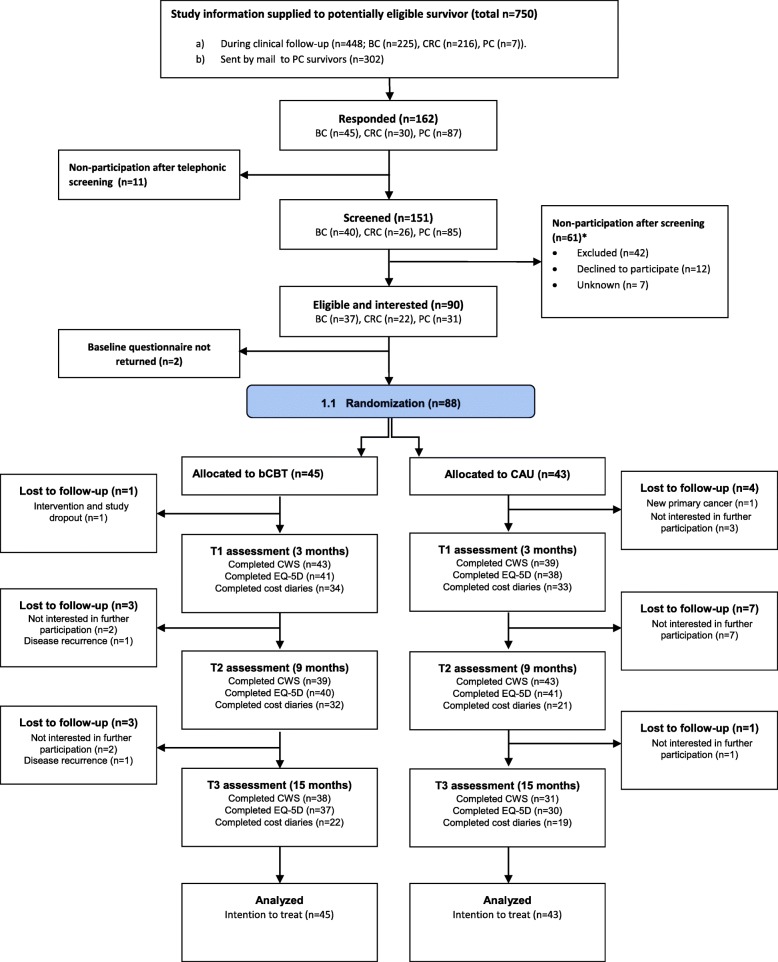
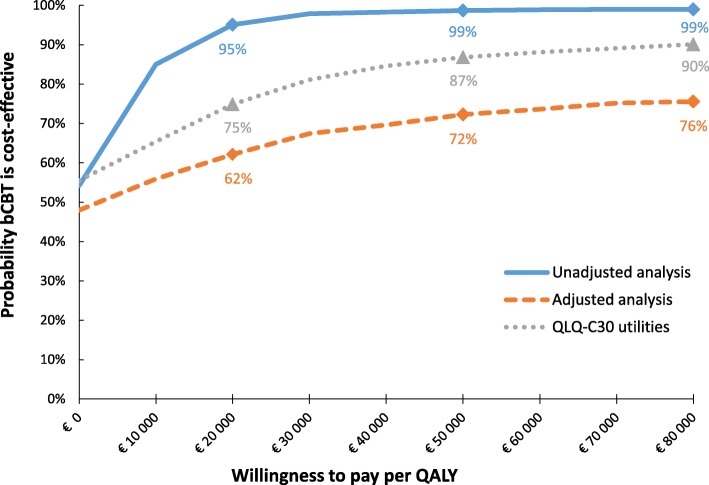
BACKGROUND: Blended cognitive behaviour therapy (bCBT) is an effective treatment for fear of cancer recurrence (FCR) in curatively-treated breast, colorectal and prostate cancer survivors with high FCR. However, long-term outcomes are unknown. This study investigated the long-term efficacy and cost-effectiveness of bCBT compared with care as usual (CAU). METHODS: Eighty-eight cancer survivors with high FCR (Cancer Worry Scale ≥14) were randomly assigned to bCBT (n = 45) or CAU (n = 43). Data were collected at baseline and at three, nine and fifteen months from baseline and analysed by modified intention-to-treat. Efficacy was investigated with linear mixed-effects models. Cost-effectiveness was investigated from a societal perspective by comparing costs with quality-adjusted life-years (QALYs). RESULTS: Participants who received bCBT reported significantly lower FCR compared with CAU (mean difference of - 1.787 [95% CI -3.251 to - 0.323, p = 0.017] at 15 months follow-up), and proportionally greater self-rated and clinically significant improvement at each follow-up measurement. Total QALYs were non-significantly different between conditions when adjusted for utility score baseline differences (0.984 compared to 0.957, p = 0.385), while total costs were €631 lower (95% CI -1737 to 2794, p = 0.587). Intervention costs of bCBT were €466. The incremental cost-effectiveness ratio amounted to an additional €2049 per QALY gained, with a 62% probability that bCBT is cost-effective at a willingness to pay (WTP) threshold of €20,000 per QALY. Results were confirmed in sensitivity analyses. CONCLUSIONS: bCBT for cancer survivors with FCR is clinically and statistically more effective than CAU on the long-term. In addition, bCBT is a relatively inexpensive intervention with similar costs and QALYs as CAU. TRIAL REGISTRATION: The RCT was registered in the Dutch National Trial Register ( NTR4423 ) on 12-Feb-2014. This abstract was previously presented at the International Psycho-Oncology Society conference of 2018 and published online. (Psycho-oncology, 27(S3):8-55; 2018).
Overview
The claims and statistics of this paper haven’t been checked yet.
Free: it reads the open-access text and checks the first 5 claims that cite a source we can check. Create a free account to check every claim.
Integrity signals
Registry
Cites
Statistics
Figures
Verification
Claims the paper makes
The claims and statistics of this paper haven’t been checked yet.
Free: it reads the open-access text and checks the first 5 claims that cite a source we can check. Create a free account to check every claim.
Claims other papers make about this one
Each is checked against this paper’s own text: does it say what the citing paper says it does?
The source backs part of the claim, not all of it — or backs it for a different population, condition or comparison.
In the citing paper
“SWORD study found to significantly reduce long-term (15 weeks) FCR [37, 38].”
From Web-based interventions for fear of cancer recurrence: A scoping review with a focus on suggestions for the development and evaluation of future interventions (2024) · cites this paper as [38]
Experimental — accuracy not yet measured
Self-check
Percentages, sums and reported differences re-computed from the paper’s own numbers.
The self-check needs the paper’s full text.
Citations
Cites
The Hospital Anxiety and Depression Scale
Zigmond, A. S., & Snaith, R. P. (1983) · Acta Psychiatrica Scandinavica · doi:10.1111/j.1600-0447.1983.tb09716.x · Cited by 47,139 · cited 1×
“Secondary outcomes were FCR severity (Fear of Cancer Recurrence Inventory [FCRI] severity subscale) [30], cancer-specific distress (Impact of Events Scale [IES]) [31, 32], distress (Hospital Anxiety and Depression Scale [HADS]) [33], fatigue (Checklist Individual Strength 8R [CIS-8R]) [34], and health-related quality…”
MethodAaronson, N. K., Ahmedzai, S., Bergman, B., Bullinger, M., Cull, A., Duez, N. J., Filiberti, A., Flechtner, H., Fleishman, S. B., Haes, J. C. J. M. D., et al. (1993) · JNCI Journal of the National Cancer Institute · doi:10.1093/jnci/85.5.365 · Cited by 16,005 · cited 1×
“Secondary outcomes were FCR severity (Fear of Cancer Recurrence Inventory [FCRI] severity subscale) [30], cancer-specific distress (Impact of Events Scale [IES]) [31, 32], distress (Hospital Anxiety and Depression Scale [HADS]) [33], fatigue (Checklist Individual Strength 8R [CIS-8R]) [34], and health-related quality…”
MethodEuroQol: a new facility for the measurement of health-related quality of life
(1990) · Health Policy · doi:10.1016/0168-8510(90)90421-9 · Cited by 15,736 · cited 1×
“To calculate QALYs, utility scores were obtained by using the EuroQol five dimensions three-level questionnaire (EQ-5D-3 L) and by applying the Dutch EQ-5D tariff [36, 37].”
MethodDepression and quality of life in older persons: A review
Sivertsen, H., Bjørkløf, G. H., Engedal, K., Selbæk, G., & Helvik, A.-S. (2015) · Dementia and Geriatric Cognitive Disorders · doi:10.1159/000437299 · Cited by 14,152
Methods for the Economic Evaluation of Health Care Programmes
Drummond, M. E., Sculpher, M. J., Torrance, G. W., O’Brien, B. J., & Stoddart, G. L. (2005) · doi:10.1093/oso/9780198529446.001.0001 · Cited by 13,648
Impact of Event Scale: A Measure of Subjective Stress
Horowitz, M., Wilner, N., & Alvarez, W. (1979) · Psychosomatic Medicine · doi:10.1097/00006842-197905000-00004 · Cited by 7,813 · cited 1×
“Secondary outcomes were FCR severity (Fear of Cancer Recurrence Inventory [FCRI] severity subscale) [30], cancer-specific distress (Impact of Events Scale [IES]) [31, 32], distress (Hospital Anxiety and Depression Scale [HADS]) [33], fatigue (Checklist Individual Strength 8R [CIS-8R]) [34], and health-related quality…”
MethodJacobson, N. S., & Truax, P. (1991) · Journal of Consulting and Clinical Psychology · doi:10.1037/0022-006x.59.1.12 · Cited by 7,770 · cited 1×
“96) [41] and a decrease of CWS scores to the normal range (clinically significant change, CWS < 14) [27].”
BackgroundInternet-based cognitive behaviour therapy for symptoms of depression and anxiety: A meta-analysis
SPEK, V., CUIJPERS, P., NYKLÍČEK, I., RIPER, H., KEYZER, J., & POP, V. (2007) · Psychological Medicine · doi:10.1017/s0033291706008944 · Cited by 1,586
Multiple imputation in health‐are databases: An overview and some applications
Rubin, D. B., & Schenker, N. (1991) · Statistics in Medicine · doi:10.1002/sim.4780100410 · Cited by 1,550 · cited 1×
“Twenty imputed datasets were created and pooled according to Rubin’s rules [44].”
MethodAndrews, G., Cuijpers, P., Craske, M. G., McEvoy, P., & Titov, N. (2010) · PLoS ONE · doi:10.1371/journal.pone.0013196 · Cited by 1,311
Fear of cancer recurrence in adult cancer survivors: a systematic review of quantitative studies
Simard, S., Thewes, B., Humphris, G., Dixon, M., Hayden, C., Mireskandari, S., & Ozakinci, G. (2013) · Journal of Cancer Survivorship · doi:10.1007/s11764-013-0272-z · Cited by 1,217 · cited 2×
“The decrease in FCR over time in the CAU condition is inconsistent with previous literature reviews stating that high FCR remains stable over time without intervention [3, 5, 51, 52].”
BackgroundResultSelf-citationThe friction cost method for measuring indirect costs of disease
Koopmanschap, M. A., Rutten, F. F. H., van Ineveld, B. M., & van Roijen, L. (1995) · Journal of Health Economics · doi:10.1016/0167-6296(94)00044-5 · Cited by 1,137 · cited 1×
“The economic impact of absence from paid work was calculated using the friction cost method [38], which was set at 12 weeks in 2014 in the Netherlands [29].”
MethodMethods for the economic evaluation of health care programmes, 3rd ed
Adamiak, G. T. (2006) · PubMed Central · Cited by 953
Briggs, A. H., Wonderling, D. E., & Mooney, C. Z. (1997) · Health Economics · doi:10.1002/(sici)1099-1050(199707)6:4<327::aid-hec282>3.0.co;2-w · Cited by 882 · cited 1×
“Non-parametric percentile bootstrapping with 1000 replications was performed to estimate 95% confidence intervals [46].”
MethodHow should cost data in pragmatic randomised trials be analysed?
Thompson, S. G. (2000) · BMJ · doi:10.1136/bmj.320.7243.1197 · Cited by 772 · cited 1×
“First of all, incremental costs and incremental QALYs between the CAU and bCBT strategies were calculated and statistical differences in non-normally distributed costs and QALYs were tested with bootstrapped t-tests [45].”
Method[Measuring the quality of life in economic evaluations: the Dutch EQ-5D tariff].
Lamers, L. M., Stalmeier, P. F. M., McDonnell, J., Krabbe, P. F. M., & Busschbach, J. J. V. (2005) · PubMed · Cited by 697
Faria, R., Gomes, M., Epstein, D., & White, I. R. (2014) · PharmacoEconomics · doi:10.1007/s40273-014-0193-3 · Cited by 673 · cited 1×
“Missing total cost and utility score data per measurement were imputed at the aggregated level separately per treatment arm, by using multiple imputation (MI) by chained equations with predictive mean-matching [42, 43].”
MethodSimard, S., & Savard, J. (2009) · Supportive Care in Cancer · doi:10.1007/s00520-008-0444-y · Cited by 608 · cited 1×
“Secondary outcomes were FCR severity (Fear of Cancer Recurrence Inventory [FCRI] severity subscale) [30], cancer-specific distress (Impact of Events Scale [IES]) [31, 32], distress (Hospital Anxiety and Depression Scale [HADS]) [33], fatigue (Checklist Individual Strength 8R [CIS-8R]) [34], and health-related quality…”
MethodLebel, S., Ozakinci, G., Humphris, G., Mutsaers, B., Thewes, B., Prins, J., Dinkel, A., Butow, P., & on behalf of the University of Ottawa Fear of Cancer Recurrence Colloquium attendees (2016) · Supportive Care in Cancer · doi:10.1007/s00520-016-3272-5 · Cited by 586 · cited 1×
“Background Fear of cancer recurrence (FCR), the “fear, worry, or concern relating to the possibility that cancer will come back or progress” [1, 2], is highly prevalent amongst cancer survivors.”
BackgroundSelf-citationKoch, L., Jansen, L., Brenner, H., & Arndt, V. (2013) · Psycho-Oncology · doi:10.1002/pon.3022 · Cited by 511 · cited 1×
“The decrease in FCR over time in the CAU condition is inconsistent with previous literature reviews stating that high FCR remains stable over time without intervention [3, 5, 51, 52].”
ResultVickberg, S. M. J. (2003) · Annals of Behavioral Medicine · doi:10.1207/s15324796abm2501_03 · Cited by 468 · cited 1×
“Background Fear of cancer recurrence (FCR), the “fear, worry, or concern relating to the possibility that cancer will come back or progress” [1, 2], is highly prevalent amongst cancer survivors.”
BackgroundFactors reported to influence fear of recurrence in cancer patients: a systematic review
Crist, J. V., & Grunfeld, E. A. (2013) · Psycho-Oncology · doi:10.1002/pon.3114 · Cited by 431 · cited 1×
“The decrease in FCR over time in the CAU condition is inconsistent with previous literature reviews stating that high FCR remains stable over time without intervention [3, 5, 51, 52].”
ResultTreatment of panic disorder: live therapy vs. self-help via the Internet
Carlbring, P., Nilsson-Ihrfelt, E., Waara, J., Kollenstam, C., Buhrman, M., Kaldo, V., Söderberg, M., Ekselius, L., & Andersson, G. (2005) · Behaviour Research and Therapy · doi:10.1016/j.brat.2004.10.002 · Cited by 372
Goossens, M. E. J. B., Mölken, M. P. M. H. R.-V., Vlaeyen, J. W. S., & van der Linden, S. M. J. P. (2000) · Journal of Clinical Epidemiology · doi:10.1016/s0895-4356(99)00177-8 · Cited by 338 · cited 1×
“Self-reported cost diaries are considered to be feasible and valid for collecting cost data [58], although in the current study it was not possible to distinguish between routine follow-up consultations and consultations due to reassurance-seeking behaviour related to FCR, which may have influenced results.”
BackgroundEconomic evaluations of Internet interventions for mental health: a systematic review
Donker, T., Blankers, M., Hedman, E., Ljótsson, B., Petrie, K., & Christensen, H. (2015) · Psychological Medicine · doi:10.1017/s0033291715001427 · Cited by 316
Construct Validation of the Dutch Version of the Impact of Event Scale.
van der Ploeg, E., Mooren, T. T. M., Kleber, R. J., van der Velden, P. G., & Brom, D. (2004) · Psychological Assessment · doi:10.1037/1040-3590.16.1.16 · Cited by 294 · cited 1×
“Secondary outcomes were FCR severity (Fear of Cancer Recurrence Inventory [FCRI] severity subscale) [30], cancer-specific distress (Impact of Events Scale [IES]) [31, 32], distress (Hospital Anxiety and Depression Scale [HADS]) [33], fatigue (Checklist Individual Strength 8R [CIS-8R]) [34], and health-related quality…”
MethodCost Effectiveness of Internet Interventions: Review and Recommendations
Tate, D. F., Finkelstein, E. A., Khavjou, O., & Gustafson, A. (2009) · Annals of Behavioral Medicine · doi:10.1007/s12160-009-9131-6 · Cited by 261 · cited 1×
“Nonetheless, as costs of eHealth interventions are partly dependant on the number of users [54], it is envisaged that when implemented in routine care, the intervention will probably become more cost-effective than demonstrated here.”
BackgroundThe Cancer Worry Scale: Detecting Fear of Recurrence in Breast Cancer Survivors
Custers, J. A. E., van den Berg, S. W., van Laarhoven, H. W. M., Bleiker, E. M. A., Gielissen, M. F. M., & Prins, J. B. (2014) · Cancer Nursing · doi:10.1097/ncc.0b013e3182813a17 · Cited by 243 · cited 2×
“Total scores range between 8 and 32 and a cut-off score of ≤13 versus ≥14 differentiates between low and high FCR [10].”
BackgroundSelf-citationUsing evidence-based internet interventions to reduce health disparities worldwide.
Muñoz, R. F. (2010) · Journal of Medical Internet Research · doi:10.2196/jmir.1463 · Cited by 242 · cited 1×
“Online CBT may reduce waiting lists, travel time and costs [26], productivity losses [20, 26], and improve accessibility [20].”
BackgroundButow, P. N., Turner, J., Gilchrist, J., Sharpe, L., Smith, A. B., Fardell, J. E., Tesson, S., O’Connell, R., Girgis, A., Gebski, V. J., et al. (2017) · Journal of Clinical Oncology · doi:10.1200/jco.2017.73.1257 · Cited by 228 · cited 1×
“Efficacy at 6 and 11months post-treatment has been demonstrated for two other FCR interventions [13, 16], however efficacy beyond the first year after treatment has received little attention.”
BackgroundSelf-citationDoes fear of cancer recurrence predict cancer survivors' health care use?
Lebel, S., Tomei, C., Feldstain, A., Beattie, S., & McCallum, M. (2013) · Supportive Care in Cancer · doi:10.1007/s00520-012-1685-3 · Cited by 211
van den Berg, S. W., Gielissen, M. F. M., Custers, J. A. E., van der Graaf, W. T. A., Ottevanger, P. B., & Prins, J. B. (2015) · Journal of Clinical Oncology · doi:10.1200/jco.2013.54.9386 · Cited by 201 · cited 1×
“Although the theoretical foundations, formats and delivery methods of these interventions differ, all available treatments are based on cognitive behaviour therapy (CBT) and some are delivered online via the internet (eHealth) [14, 17, 18].”
BackgroundSelf-citationvan de Wal, M., Thewes, B., Gielissen, M., Speckens, A., & Prins, J. (2017) · Journal of Clinical Oncology · doi:10.1200/jco.2016.70.5301 · Cited by 195 · cited 4×
“More detailed methodology and results are reported elsewhere [14, 27].”
BackgroundResultInfluentialSelf-citationLeykin, Y., Thekdi, S. M., Shumay, D. M., Muñoz, R. F., Riba, M., & Dunn, L. B. (2012) · Psycho-Oncology · doi:10.1002/pon.1993 · Cited by 192 · cited 1×
“Possible disadvantages of online therapy include a lack of personal interaction, poorer adherence and less engagement [19].”
BackgroundRandomized pilot of a self-guided internet coping group for women with early-stage breast cancer
Owen, J. E., Klapow, J. C., Roth, D. L., Shuster, J. L., Bellis, J., Meredith, R., & Tucker, D. C. (2005) · Annals of Behavioral Medicine · doi:10.1207/s15324796abm3001_7 · Cited by 192 · cited 1×
“Although the theoretical foundations, formats and delivery methods of these interventions differ, all available treatments are based on cognitive behaviour therapy (CBT) and some are delivered online via the internet (eHealth) [14, 17, 18].”
BackgroundHow to measure costs and benefits of ehealth interventions: An overview of methods and frameworks
Bergmo, T. S. (2015) · Journal of Medical Internet Research · doi:10.2196/jmir.4521 · Cited by 181 · cited 1×
“Intervention program costs included bottom-up calculated costs of psychologist training, supervision and consultations, in addition to costs of website development, updates and user licences divided by a conservative amount of potential annual users in a regional implementation scenario (Additional file 1: Appendix 2)…”
BackgroundHoch, J. S., Rockx, M. A., & Krahn, A. D. (2006) · BMC Health Services Research · doi:10.1186/1472-6963-6-68 · Cited by 163 · cited 1×
“Cost-effectiveness acceptability curves (CEACs) were constructed which display the probability that bCBT would be cost-effective given specific WTP thresholds [48].”
BackgroundFear of cancer recurrence in colorectal cancer survivors
Custers, J. A. E., Gielissen, M. F. M., Janssen, S. H. V., de Wilt, J. H. W., & Prins, J. B. (2016) · Supportive Care in Cancer · doi:10.1007/s00520-015-2808-4 · Cited by 141
Self-citationWilhelmsen, M., Lillevoll, K., Risør, M. B., Høifødt, R., Johansen, M.-L., Waterloo, K., Eisemann, M., & Kolstrup, N. (2013) · BMC Psychiatry · doi:10.1186/1471-244x-13-296 · Cited by 133 · cited 1×
“Online CBT may reduce waiting lists, travel time and costs [26], productivity losses [20, 26], and improve accessibility [20].”
BackgroundSavard, J., & Ivers, H. (2013) · Journal of Psychosomatic Research · doi:10.1016/j.jpsychores.2012.12.013 · Cited by 131 · cited 1×
“The decrease in FCR over time in the CAU condition is inconsistent with previous literature reviews stating that high FCR remains stable over time without intervention [3, 5, 51, 52].”
ResultHaug, T., Nordgreen, T., Öst, L. G., & Havik, O. E. (2012) · Clinical Psychology Review · doi:10.1016/j.cpr.2012.04.002 · Cited by 128
Condition-Specific Preference-Based Measures: Benefit or Burden?
Versteegh, M., Leunis, A., Groot, C. A. U., & Stolk, E. A. (2012) · Value in Health · doi:10.1016/j.jval.2011.12.003 · Cited by 123 · cited 2×
“A sensitivity analysis was conducted which used condition-specific utility scores calculated from the EORTC QLQ-C30 instead of utility scores calculated from the EQ-5D-3 L [49].”
MethodResultDieng, M., Butow, P. N., Costa, D. S. J., Morton, R. L., Menzies, S. W., Mireskandari, S., Tesson, S., Mann, G. J., Cust, A. E., & Kasparian, N. A. (2016) · Journal of Clinical Oncology · doi:10.1200/jco.2016.68.2278 · Cited by 123 · cited 1×
“Efficacy at 6 and 11months post-treatment has been demonstrated for two other FCR interventions [13, 16], however efficacy beyond the first year after treatment has received little attention.”
Backgroundmembers of the Conquer Fear Authorship Group, Butow, P. N., Bell, M. L., Smith, A. B., Fardell, J. E., Thewes, B., Turner, J., Gilchrist, J., Beith, J., Girgis, A., et al. (2013) · BMC Cancer · doi:10.1186/1471-2407-13-201 · Cited by 117
Self-citationvan de Willige, G., Wiersma, D., Nienhuis, F. J., & Jenner, J. A. (2005) · Quality of Life Research · doi:10.1007/s11136-004-0689-y · Cited by 107 · cited 1×
“However, the EQ-5D has been previously reported to be less sensitive to changes in psychological well-being due to dominance of physical health domains [59].”
BackgroundFatigue after breast cancer and in chronic fatigue syndrome
Servaes, P., Prins, J. B., Verhagen, S. C. A. H. H. V. M., & Bleijenberg, G. (2002) · Journal of Psychosomatic Research · doi:10.1016/s0022-3999(02)00300-8 · Cited by 104 · cited 1×
“Secondary outcomes were FCR severity (Fear of Cancer Recurrence Inventory [FCRI] severity subscale) [30], cancer-specific distress (Impact of Events Scale [IES]) [31, 32], distress (Hospital Anxiety and Depression Scale [HADS]) [33], fatigue (Checklist Individual Strength 8R [CIS-8R]) [34], and health-related quality…”
MethodSelf-citationvan de Wal, M., van de Poll‐Franse, L., Prins, J., & Gielissen, M. (2016) · Psycho-Oncology · doi:10.1002/pon.4002 · Cited by 102 · cited 1×
“FCR seems to be a universal concern of cancer survivors rather than a cancer type-specific problem, estimates of FCR did not differ by cancer types [12].”
Self-citationSimons, C., Rivero‐Arias, O., Yu, L., & Simon, J. (2014) · Quality of Life Research · doi:10.1007/s11136-014-0837-y · Cited by 102 · cited 1×
“Missing total cost and utility score data per measurement were imputed at the aggregated level separately per treatment arm, by using multiple imputation (MI) by chained equations with predictive mean-matching [42, 43].”
MethodSarkar, S., Sautier, L., Schilling, G., Bokemeyer, C., Koch, U., & Mehnert, A. (2015) · Journal of Cancer Survivorship · doi:10.1007/s11764-015-0434-2 · Cited by 101
Fear of cancer recurrence in prostate cancer survivors
van de Wal, M., van Oort, I., Schouten, J., Thewes, B., Gielissen, M., & Prins, J. (2016) · Acta Oncologica · doi:10.3109/0284186x.2016.1150607 · Cited by 72
Self-citationHoch, J. S., & Dewa, C. S. (2014) · Journal of Occupational and Environmental Medicine · doi:10.1097/jom.0000000000000130 · Cited by 51 · cited 1×
“Due to substantial differences in EQ-5D baseline utility scores between conditions, regression-based adjustment was performed within the net monetary benefit framework, which values both benefits and costs in monetary terms and therefore enables the use of regression methods [47].”
MethodSabariego, C., Brach, M., Herschbach, P., Berg, P., & Stucki, G. (2010) · The European Journal of Health Economics · doi:10.1007/s10198-010-0266-y · Cited by 45
van de Wal, M. A., Gielissen, M. F., Servaes, P., Knoop, H., Speckens, A. E., & Prins, J. B. (2015) · BMC Psychology · doi:10.1186/s40359-015-0068-1 · Cited by 43 · cited 3×
“96) [41] and a decrease of CWS scores to the normal range (clinically significant change, CWS < 14) [27].”
BackgroundSelf-citationvan Helmondt, S. J., van der Lee, M. L., & de Vries, J. (2016) · BMC Cancer · doi:10.1186/s12885-016-2562-0 · Cited by 33
Worry about Breast Cancer Recurrence: A Population-based Analysis
Tewari, A., & Chagpar, A. B. (2014) · The American Surgeon™ · doi:10.1177/000313481408000716 · Cited by 31
Dieng, M., Cust, A. E., Kasparian, N. A., Butow, P. N., Costa, D. S. J., Menzies, S. W., Mann, G. J., & Morton, R. L. (2016) · BMJ Open · doi:10.1136/bmjopen-2016-012153 · Cited by 6
(2018) · Psycho-Oncology · doi:10.1002/pon.4877 · Cited by 3
Lee-Jones, C., Humphris, G., Dixon, R., & Bebbington Hatcher, M. (1997) · Psycho-Oncology · doi:10.1002/(sici)1099-1611(199706)6:2 · Cited by 1
Research works printed but not linked: 1
- Humphris G Rogers S AFTER and beyond: cancer recurrence fears and a test of an intervention in oral and oropharyngeal patients Soc Sci Dent 2012 2 29 38
Cited by
Williams, J. T. W., Pearce, A., & Smith, A. '. (2021) · Psycho-Oncology · doi:10.1002/pon.5673 · Cited by 95
“Three studies conducted a cost‐utility analysis (CUA) and reported the ICER per quality‐adjusted life year (QALY) gained.(32,34,35) QALYs were measured using the AQol‐8D(32,35) or EQ‐5D‐3L.”
MethodInfluentialLyu, M., Siah, R. C., Lam, A. S. L., & Cheng, K. K. F. (2022) · Journal of Advanced Nursing · doi:10.1111/jan.15321 · Cited by 77
Hardiman, K. M., Felder, S. I., Friedman, G., Migaly, J., Paquette, I. M., & Feingold, D. L. (2021) · Diseases of the Colon & Rectum · doi:10.1097/dcr.0000000000001984 · Cited by 84
van Beek, F. E., Wijnhoven, L. M. A., Holtmaat, K., Custers, J. A. E., Prins, J. B., Leeuw, I. M. V., & Jansen, F. (2021) · Psycho-Oncology · doi:10.1002/pon.5753 · Cited by 79
Self-citationPark, S.-Y., & Lim, J.-W. (2022) · BMC Cancer · doi:10.1186/s12885-021-08909-y · Cited by 53
“Although the theoretical foundations, formats and delivery methods of these interventions differ, the available interventions are based on CBT [25].”
Background
Metadata
- Authors
- Burm, R., Thewes, B., Rodwell, L., Kievit, W., Speckens, A., van de Wal, M., & Prins, J.
- Affiliations
- Radboud University Medical Center (NL)
- Corresponding author
- Burm, Rens
- Venue
- BMC Cancer
- Published
- 2019-05-16
- Volume
- 19
- Issue
- 1
- Pages
- 462-462
- ISSN
- 1471-2407 (ISSN-L)
- PMC
- PMC6524293
- OpenAlex
- W2947157965
- Cited by
- 55
- References
- 59
- Citations by year
- 2026: 5 · 2025: 7 · 2024: 9 · 2023: 7 · 2022: 13 · 2021: 9 · 2020: 3 · 2019: 2
- FWCI
- 2.82
- Type
- journal article
- Language
- en
- Open access
- gold
- doi.org
- Licence
- cc-by
- creativecommons.org/licenses/by/4.0/ (tdm)
- creativecommons.org/licenses/by/4.0/ (vor)
- Locations
- BMC Cancer (publishedVersion, cc-by)
- Europe PMC (PubMed Central) (publishedVersion, cc-by)
- PubMed Central (publishedVersion, cc-by)
- PubMed (publishedVersion)
- DOAJ (DOAJ: Directory of Open Access Journals) (submittedVersion, cc-by-sa)
- Radboud Repository (Radboud University) (submittedVersion)
- Radboud Repository (Radboud University) (submittedVersion, other-oa)
- Funders
- KWF Kankerbestrijding (KUN 2012–5545)
- Topics
- Health Sciences › Medicine › Oncology › Cancer survivorship and care
- Social Sciences › Psychology › Experimental and Cognitive Psychology › Anxiety, Depression, Psychometrics, Treatment, Cognitive Processes
- Health Sciences › Medicine › Pediatrics, Perinatology and Child Health › Childhood Cancer Survivors' Quality of Life
- Keywords
- fear of cancer recurrence, cancer survivors, breast cancer, prostate cancer, colorectal cancer, long-term efficacy, cost-effectiveness, quality-adjusted life years, incremental cost-effectiveness ratio, psycho-oncology, intervention costs, willingness-to-pay threshold, societal perspective
- MeSH terms
- Cancer Survivors, Aged, Breast Neoplasms, Cost-Benefit Analysis, Fear, Female, Follow-Up Studies, Humans, Male, Middle Aged, Neoplasm Recurrence, Local, Neoplasms, Prostatic Neoplasms, Colorectal Neoplasms, Cognitive Behavioral Therapy, Treatment Outcome
About these checks
Registry, retraction, Cites and statistics results are computed, not judged, with one exception: a printed reference that no index lists is read once by a model before it counts as a citation error. Claims are extracted by a model and kept only when their quote appears verbatim in the text; each cited source is then checked, with a model’s help, for whether it says what the claim relies on. Those verdicts can be wrong — read the claim’s quote and the cited source before relying on one.
Statistics and arithmetic are recomputed, not judged.
Confidence bands are shown only for fields calibrated on our annotated test set. None is calibrated yet, so no band is shown.
What counts as a claim ›How we measure confidence ›How we check this ›
Are you an author, or do you see a problem with this page? Request a review
Data sources
Bibliographic data: Semantic Scholar, OpenAlex, Crossref.
Contains information from the Semantic Scholar Academic Graph Datasets, made available under the ODC Attribution License (ODC-BY 1.0).
Semantic Scholar’s data is described in: Kinney, R., et al. (2023). The Semantic Scholar Open Data Platform. arXiv:2301.10140.
