

PRIME-HCC: phase Ib study of neoadjuvant ipilimumab and nivolumab prior to liver resection for hepatocellular carcinoma
Open accessThe DOI matches its Crossref record; 33 of the 33 references it cites were found in a registry or an index.
Abstract
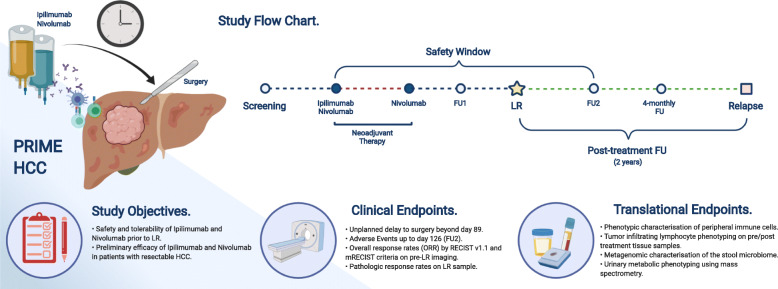
Background: After liver resection (LR), patients with hepatocellular cancer (HCC) are at high risk of recurrence. There are no approved anti-cancer therapies known to affect such risk, highlighting the acute need for novel systemic therapies to control the probability of disease relapse. Immunotherapy is expanding as a novel treatment option for HCC. Emerging data from cohort 4 of the CA209–040 study, which investigated the safety and preliminary efficacy of nivolumab/ipilimumab co-administration in advanced HCC, suggest that the combination can be delivered safely with an acceptable proportion of reversible grade 3–4 toxicities (27.1%) and a low discontinuation rate (2%) in patients with HCC. Here, we describe the design and rationale of PRIME-HCC, a two-part, multi-centre, phase Ib study to assess safety and bioactivity of the nivolumab/ipilimumab combination prior to LR in early-stage HCC. Methods: The study involves an initial safety run-in phase (Part 1) to allow for preliminary safety characterisation within the first 6 patients enrolled and a subsequent expansion (Part 2). Ipilimumab will be administered once only on Day 1. Nivolumab will be administered on Day 1 and Day 22 (± 3 days) for a total of two 21-day cycles (i.e. 6 weeks of treatment). The primary objective of the study is to determine the safety and tolerability of the nivolumab/ipilimumab combination prior to LR. The secondary objective is to preliminarily characterize the efficacy of the combination prior to LR, including objective response rate (ORR) and pathologic response rates. Additional exploratory objectives include preliminary evidence of long-term disease control and to identify predictive correlates of response to the nivolumab/ipilimumab combination in HCC. Discussion: The results of this study will help define the positioning of neoadjuvant nivolumab/ipilimumab combination in the perioperative management of HCC, with potential to improve survival outcomes in this patient population. Trial registration: EudraCT Number: 2018–000987-27 Clinical trial registry & ID: ClinicalTrials.gov: NCT03682276.
Overview
The claims and statistics of this paper haven’t been checked yet.
Free: it reads the open-access text and checks the first 5 claims that cite a source we can check. Create a free account to check every claim.
Integrity signals
Registry
Cites
Statistics
Figures
Verification
Claims the paper makes
The claims and statistics of this paper haven’t been checked yet.
Free: it reads the open-access text and checks the first 5 claims that cite a source we can check. Create a free account to check every claim.
Claims other papers make about this one
Each is checked against this paper’s own text: does it say what the citing paper says it does?
The source backs part of the claim, not all of it — or backs it for a different population, condition or comparison.
In the citing paper
“However, none of these studies were individually powered to robustly investigate predictive factors of efficacy from neoadjuvant ICI therapy, particularly with regards to long-term survival outcomes, including relapse-free survival.”
From Pathological response following neoadjuvant immune checkpoint inhibitors in patients with hepatocellular carcinoma: a cross-trial, patient-level analysis (2024) · cites this paper as [11]
Experimental — accuracy not yet measuredThe source backs part of the claim, not all of it — or backs it for a different population, condition or comparison.
In the citing paper
“Collectively, these pioneering studies have shown the safety and feasibility of a perioperative ICI treatment approach.7–12,25”
From Pathological response following neoadjuvant immune checkpoint inhibitors in patients with hepatocellular carcinoma: a cross-trial, patient-level analysis (2024) · cites this paper as [11]
Experimental — accuracy not yet measuredThe source backs part of the claim, not all of it — or backs it for a different population, condition or comparison.
In the citing paper
“The use of ICIs as a neoadjuvant treatment before liver resection for patients with hepatocellular carcinoma has been explored in several single-centre phase 1 and 2 clinical trials.”
From Pathological response following neoadjuvant immune checkpoint inhibitors in patients with hepatocellular carcinoma: a cross-trial, patient-level analysis (2024) · cites this paper as [11]
Experimental — accuracy not yet measuredThe cited source says what the claim attributes to it.
In the citing paper
“Each clinical trial mandated the assessment of a pathological response as part of their primary7 or secondary efficacy endpoints,9,11 and this assessment was prospectively collected and reported as part of the exploratory aims for all cohorts.12,18”
From Pathological response following neoadjuvant immune checkpoint inhibitors in patients with hepatocellular carcinoma: a cross-trial, patient-level analysis (2024) · cites this paper as [11]
The cited source says what the claim attributes to it.
In the citing paper
“Preoperative use of ICIs in patients with hepatocellular carcinoma has been explored in several small, early-phase studies, in which heterogeneous therapeutic combinations were tested, mainly with safety and feasibility being the primary endpoints assessed.7–12”
From Pathological response following neoadjuvant immune checkpoint inhibitors in patients with hepatocellular carcinoma: a cross-trial, patient-level analysis (2024) · cites this paper as [11]
1 more claim about this paper
Create a free account to see every claim other papers make about this one.
Self-check
Percentages, sums and reported differences re-computed from the paper’s own numbers.
The self-check needs the paper’s full text.
Citations
Cites
Jemal, A., Bray, F., Center, M. M., Ferlay, J., Ward, E., & Forman, D. (2011) · CA: A Cancer Journal for Clinicians · doi:10.3322/caac.20107 · Cited by 54,679
Global Cancer Statistics, 2002
Parkin, D. M., Bray, F., Ferlay, J., & Pisani, P. (2005) · CA: A Cancer Journal for Clinicians · doi:10.3322/canjclin.55.2.74 · Cited by 18,196
Management of Hepatocellular Carcinoma *
Bruix, J., & Sherman, M. (2005) · Hepatology · doi:10.1002/hep.20933 · Cited by 5,857
Overall Survival with Combined Nivolumab and Ipilimumab in Advanced Melanoma
Wolchok, J. D., Chiarion-Sileni, V., Gonzalez, R., Rutkowski, P., Grob, J.-J., Cowey, C. L., Lao, C. D., Wagstaff, J., Schadendorf, D., Ferrucci, P. F., et al. (2017) · New England Journal of Medicine · doi:10.1056/nejmoa1709684 · Cited by 5,357
El-Khoueiry, A. B., Sangro, B., Yau, T., Crocenzi, T. S., Kudo, M., Hsu, C., Kim, T.-Y., Choo, S.-P., Trojan, J., Welling, T. H., et al. (2017) · The Lancet · doi:10.1016/s0140-6736(17)31046-2 · Cited by 4,280
Five-Year Survival with Combined Nivolumab and Ipilimumab in Advanced Melanoma
Larkin, J., Chiarion-Sileni, V., Gonzalez, R., Grob, J.-J., Rutkowski, P., Lao, C. D., Cowey, C. L., Schadendorf, D., Wagstaff, J., Dummer, R., et al. (2019) · New England Journal of Medicine · doi:10.1056/nejmoa1910836 · Cited by 3,723
Nivolumab plus ipilimumab in advanced non-small-cell lung cancer
Hellmann, M. D., Paz-Ares, L., Bernabe Caro, R., Zurawski, B., Kim, S.-W., Carcereny Costa, E., Park, K., Alexandru, A., Lupinacci, L., de la Mora Jimenez, E., et al. (2019) · New England Journal of Medicine · doi:10.1056/nejmoa1910231 · Cited by 2,823
Zhu, A. X., Finn, R. S., Edeline, J., Cattan, S., Ogasawara, S., Palmer, D., Verslype, C., Zagonel, V., Fartoux, L., Vogel, A., et al. (2018) · The Lancet Oncology · doi:10.1016/s1470-2045(18)30351-6 · Cited by 2,479
Finn, R. S., Ryoo, B.-Y., Merle, P., Kudo, M., Bouattour, M., Lim, H. Y., Breder, V., Edeline, J., Chao, Y., Ogasawara, S., et al. (2020) · Journal of Clinical Oncology · doi:10.1200/jco.19.01307 · Cited by 1,789
Antonia, S. J., López-Martin, J. A., Bendell, J., Ott, P. A., Taylor, M., Eder, J. P., Jäger, D., Pietanza, M. C., Le, D. T., de Braud, F., et al. (2016) · The Lancet Oncology · doi:10.1016/s1470-2045(16)30098-5 · Cited by 1,244
Cited by
Immunotherapies for hepatocellular carcinoma
Llovet, J. M., Castet, F., Heikenwalder, M., Maini, M. K., Mazzaferro, V., Pinato, D. J., Pikarsky, E., Zhu, A. X., & Finn, R. S. (2022) · Nature Reviews Clinical Oncology · doi:10.1038/s41571-021-00573-2 · Cited by 1,843
Self-citationHaber, P. K., Puigvehí, M., Castet, F., Lourdusamy, V., Montal, R., Tabrizian, P., Buckstein, M., Kim, E., Villanueva, A., Schwartz, M., et al. (2021) · Gastroenterology · doi:10.1053/j.gastro.2021.06.008 · Cited by 248
Chen, S., Wu, Z., Shi, F., Mai, Q., Wang, L., Wang, F., Zhuang, W., Chen, X., Chen, H., Xu, B., et al. (2021) · Journal of Cancer Research and Clinical Oncology · doi:10.1007/s00432-021-03767-4 · Cited by 125
Lisi, L., Lacal, P. M., Martire, M., Navarra, P., & Graziani, G. (2021) · Pharmacological Research · doi:10.1016/j.phrs.2021.105997 · Cited by 115
D'Alessio, A., Stefanini, B., Blanter, J., Adegbite, B., Crowley, F., Yip, V., Slater, S., Fulgenzi, C. A. M., Celsa, C., Manfredi, G. F., et al. (2024) · The Lancet Oncology · doi:10.1016/s1470-2045(24)00457-1 · Cited by 90
“…Mount Sinai Hospital, New York, NY, USA (43 patients [39%]); Imperial College London, London, UK (27 [24%]); Taiwan Cooperative Oncology Group, Taiwan (23 [21%]); Johns Hopkins University, Baltimore, MD, USA (12 [11%]), and St Bartholomew’s Hospital, London, UK (six [5%]; figure 1; appendix p 13).”
InfluentialSelf-citationGreten, T. F., Abou-Alfa, G. K., Cheng, A.-L., Duffy, A. G., El-Khoueiry, A. B., Finn, R. S., Galle, P. R., Goyal, L., He, A. R., Kaseb, A. O., et al. (2021) · Journal for ImmunoTherapy of Cancer · doi:10.1136/jitc-2021-002794 · Cited by 80
Self-citationJagatia, R., Doornebal, E. J., Rastovic, U., Harris, N., Feyide, M., Lyons, A. M., Miquel, R., Zen, Y., Zamalloa, A., Malik, F., et al. (2023) · EBioMedicine · doi:10.1016/j.ebiom.2023.104826 · Cited by 46
“49,50 Again, given the nature of the tissue utilised to obtain slices (tumour and surrounding at resection), studies in PCTS will allow in vitro testing of the ef fi cacy of treatments planned after surgery or investigation into the effects of immuno-therapy on tumour aggressiveness, or lastly,…”
Immunotherapy in Hepatocellular Carcinoma
Fulgenzi, C. A. M., Talbot, T., Murray, S. M., Silletta, M., Vincenzi, B., Cortellini, A., & Pinato, D. J. (2021) · Current Treatment Options in Oncology · doi:10.1007/s11864-021-00886-5 · Cited by 44
Self-citationGao, Q., Anwar, I. J., Abraham, N., & Barbas, A. S. (2021) · Cancers · doi:10.3390/cancers13246307 · Cited by 42
Chinese expert consensus on neoadjuvant and conversion therapies for hepatocellular carcinoma
Zhao, H., & Cai, J. (2021) · World Journal of Gastroenterology · doi:10.3748/wjg.v27.i47.8069 · Cited by 40
Immune Checkpoint Therapy: Tumor Draining Lymph Nodes in the Spotlights
Fransen, M. F., van Hall, T., & OSSENDORP, F. A. (2021) · International Journal of Molecular Sciences · doi:10.3390/ijms22179401 · Cited by 45
“However, the immune contexture of TDLN was not studied or discussed [53,55–62].”
BackgroundThe Treatment Landscape of Advanced Hepatocellular Carcinoma
Wong, K. M., King, G. G., & Harris, W. P. (2022) · Current Oncology Reports · doi:10.1007/s11912-022-01247-7 · Cited by 37
The Emerging Factors and Treatment Options for NAFLD-Related Hepatocellular Carcinoma
Zhang, C., & Yang, M. J. (2021) · Cancers · doi:10.3390/cancers13153740 · Cited by 37
Predictive biomarkers for systemic therapy of hepatocellular carcinoma
Moldogazieva, N. T., Zavadskiy, S. P., Sologova, S. S., Mokhosoev, I. M., & Terentiev, A. A. (2021) · Expert Review of Molecular Diagnostics · doi:10.1080/14737159.2021.1987217 · Cited by 33
Shannon, A. H., Ruff, S. M., & Pawlik, T. M. (2022) · Journal of Hepatocellular Carcinoma · doi:10.2147/jhc.s383922 · Cited by 39
“The PRIME-HCC is an ongoing phase IB clinical trial that is examining ipilimumab plus nivolumab in the neoadjuvant setting for early-stage HCC prior to liver resection.(90) While the results of this study are pending, hopefully the data will help delineate the role of neoadjuvant therapy in the perioperative managemen…”
BackgroundImmunotherapies for advanced hepatocellular carcinoma
Sun, L., Zhang, K.-J., Xie, Y.-M., Liu, J., & Xiao, Z. (2023) · Frontiers in Pharmacology · doi:10.3389/fphar.2023.1138493 · Cited by 32
Enhancing HCC Treatment: innovatively combining HDAC2 inhibitor with PD-1/PD-L1 inhibition
Han, R., Ling, C., Wang, Y., & Lu, L. (2023) · Cancer Cell International · doi:10.1186/s12935-023-03051-0 · Cited by 34
“In pancreatic cancer cell models, a class I and II HDAC inhibitor, Trichostatin A, has been found to suppress the transcriptional activity of STAT1 by blocking IFN-γinduced STAT1 phosphorylation [33].”
BackgroundNeoadjuvant systemic therapy for hepatocellular carcinoma
Chick, R. C., Ruff, S. M., & Pawlik, T. M. (2024) · Frontiers in Immunology · doi:10.3389/fimmu.2024.1355812 · Cited by 32
“The PRIME-HCC trial using both nivolumab and ipilimumab will provide interesting insight from this standpoint (38).”
BackgroundMethodPD-1 Blockade for Hepatocellular Carcinoma: Current Research and Future Prospects
D’Alessio, A., Rimassa, L., Cortellini, A., & Pinato, D. J. (2021) · Journal of Hepatocellular Carcinoma · doi:10.2147/jhc.s284440 · Cited by 33
Self-citationNeoadjuvant Therapy for Hepatocellular Carcinoma
Zongyi, Y., Chen, D., Liang, S., & Li, X. (2022) · Journal of Hepatocellular Carcinoma · doi:10.2147/jhc.s357313 · Cited by 31
“Several clinical studies are currently focusing on this issue.(174,175) An ongoing randomized Phase II pilot trial showed that treatment for 6 weeks with nivolumab + ipilimumab led to a pathologic complete response rate of 25% in patients with resectable HCC; the NIT regimen was safe, and surgical resection was not de…”
BackgroundPhotodynamic and Photothermal Therapy of Hepatocellular Carcinoma
Fan, Z., Zhuang, C., Wang, S., & Zhang, Y. (2021) · Frontiers in Oncology · doi:10.3389/fonc.2021.787780 · Cited by 29
Immunotherapy Use Prior to Liver Transplant in Patients with Hepatocellular Carcinoma
Woo, S. M.-L., Kimchy, A. V., Sequeira, L. M., Dorris, C. S., He, A. R., & Rangnekar, A. S. (2022) · Current Oncology · doi:10.3390/curroncol29120771 · Cited by 26
“Interest in immunotherapy as bridging therapy has grown, and while most data are derived from case reports and limited case series, early findings are promising [6].”
BackgroundImproving surgical treatments for hepatocellular carcinoma
Malik, A. K., Geh, D., Evans, T. R. J., Chow, P. K. H., Mann, D. A., & White, S. A. (2025) · Nature Reviews Gastroenterology & Hepatology · doi:10.1038/s41575-025-01143-y · Cited by 34
“Ongoing randomized trials (for example, MORPHEUS-NEO HCC and PRIME-HCC) 211,212 will be crucial in determining whether the immunological gains of the neoadjuvant setting outweigh the oncological risks and toxicity profile.”
Emerging treatment modalities for systemic therapy in hepatocellular carcinoma
Qing, X., Xu, W., Zong, J., Du, X., Peng, H., & Zhang, Y. (2021) · Biomarker Research · doi:10.1186/s40364-021-00319-3 · Cited by 28
Neoadjuvant immune checkpoint inhibitors for hepatocellular carcinoma
Akula, V., Chen, L., Açıkgöz, Y., Klein, K., Yavuz, B. G., Cevik, L., Demir, T., Manne, A., Şahin, İ., Kaseb, A. O., et al. (2025) · npj Precision Oncology · doi:10.1038/s41698-025-00846-4 · Cited by 28
“Inaddition,therewas a marked post-treatment decrease in intratumoral FOXP3 + /CD4 + Tregs within resection samples 28 .”
InfluentialImmunotherapy in hepatocellular carcinoma: how will it reshape treatment sequencing?
Cammarota, A., Zanuso, V., Manfredi, G. F., Murphy, R., Pinato, D. J., & Rimassa, L. (2023) · Therapeutic Advances in Medical Oncology · doi:10.1177/17588359221148029 · Cited by 23
Self-citationMarzi, L., Mega, A., Gitto, S., Pelizzaro, F., Seeber, A., & Spizzo, G. (2022) · Cancers · doi:10.3390/cancers14143332 · Cited by 21
“Moreover, there are some attempts for combining immunotherapy with surgical and locoregional therapies in a neoadjuvant approach [41].”
BackgroundResultInfluentialZeng, F., Zhang, Q., Tsui, Y., Ma, H., Tian, L., Husain, A., Lu, J., Lee, J. M., Zhang, V. X., Li, P.-M., et al. (2025) · Molecular Cancer · doi:10.1186/s12943-025-02314-w · Cited by 20
“Despite substantial evidence supporting ICI treatment benefits, reports on its use as a neoadjuvant therapy are limited [7–9], and the landscape of its tumor microenvironment (TME) remains largely unexplored.”
Zhu, C., Dai, B., Zhan, H., & Deng, R. (2022) · Irish Journal of Medical Science (1971 -) · doi:10.1007/s11845-022-03131-6 · Cited by 17
“In terms of the safety profile, previous studies investigating AEs of PD-1 inhibitor or TACE as neoadjuvant therapy in HCC patients disclose that the most common AEs include declined live function, diarrhea fever, pneumonitis, diabetes mellitus, colitis, hypophysis, and diarrhea [19, 20].”
BackgroundZhou, Y., Gu, H., Shao, B., Zhang, S., Pall, H., Peixoto, R. D., Mok, S. R. S., & Zhu, G. (2022) · Annals of Translational Medicine · doi:10.21037/atm-22-5272 · Cited by 16
“In terms of radiological and pathological remission, Nivo + Ipi has good anti-tumor efficacy (NCT03682276) (32) .”
Hepatocellular Carcinoma: Beyond the Border of Advanced Stage Therapy
Zarlashat, Y., Abbas, S., & Ghaffar, A. (2024) · Cancers · doi:10.3390/cancers16112034 · Cited by 17
“The demonstrated a significantly improved OS and PFS [94].”
Monoclonal Antibodies to CTLA-4 with Focus on Ipilimumab
Graziani, G., Lisi, L., Tentori, L., & Navarra, P. (2022) · Experientia supplementum · doi:10.1007/978-3-030-91311-3_10 · Cited by 21
Zhou, R., Chen, Y., Yao, S., Zhang, W., & Ye, D. (2025) · Pharmaceutics · doi:10.3390/pharmaceutics17091178 · Cited by 18
“Treatment options encompass radical surgery [191], molecular-targeted therapy [192], and neoadjuvant therapy [193].”
Fulgenzi, C. A. M., D’Alessio, A., Ogunbiyi, O., Demirtaş, C. Ö., Gennari, A., Cortellini, A., Sharma, R., & Pinato, D. J. (2022) · Expert Opinion on Investigational Drugs · doi:10.1080/13543784.2022.2072726 · Cited by 17
Self-citationTrial design and end points in hepatocellular carcinoma: an EASL–AASLD–ILCA consensus statement
Llovet, J. M., Mauro, E., Rimassa, L., Mazzaferro, V., Pinter, M., Kelley, R. K., Chan, S. L., Kulik, L., Pillai, A. A., Roberts, L. R., et al. (2026) · Nature Reviews Clinical Oncology · doi:10.1038/s41571-026-01160-z · Cited by 16
Nevola, R., Femine, A. D., Rosato, V., Kondili, L. A., Alfano, M., Mastrocinque, D., Imbriani, S., Perillo, P., Beccia, D., Villani, A., et al. (2023) · Cancers · doi:10.3390/cancers15112950 · Cited by 15
“[56], for example, are evaluating safety and bioactivity of the neoadiuvant nivolumab/ipilimumab combination before LR in early-stage HCC (trial registration number: NCT03682276).”
BackgroundHuang, Y., Zhang, Y., Zhang, M., Zhao, K., Feng, L., Guan, J., Dong, R., Liu, J., Tian, D., Liu, M., et al. (2023) · Critical Reviews in Oncology/Hematology · doi:10.1016/j.critrevonc.2023.104070 · Cited by 16
Chinese Expert Consensus on the Whole-Course Management of Hepatocellular Carcinoma (2023 Edition)
Yu, Y., Sun, J., Cai, J., Chen, M., Dai, C., Wen, T., Xia, J., Ying, M., Zhang, Z., Zhang, X., et al. (2024) · Liver Cancer · doi:10.1159/000541622 · Cited by 19
“…arterial infusion chemotherapy (HAIC), radiotherapy and ablation (Recommendation 8 – 11), conversion therapy (Recommendation 12), management in speci fi c groups (Recommendation 13 – 16), symptomatic support treatment (Recommendation 17), and follow-up management (Recommendation18) (online suppl.”
Urquijo-Ponce, J. J., Mateu, C. A., Sánchez, M. L., Castelló-Miralles, I., & Diago, M. (2024) · World Journal of Gastroenterology · doi:10.3748/wjg.v30.i19.2512 · Cited by 15
“Nivolumab + ipilimumab: Phase Ib CT in resectable HCC[59].”
InfluentialAdvancing Adjuvant Immunotherapy in Hepatocellular Carcinoma: A Comprehensive Review
Akabane, M., Chatzipanagiotou, O. P., Imaoka, Y., Schenk, A. D., & Pawlik, T. M. (2025) · ImmunoTargets and Therapy · doi:10.2147/itt.s528709 · Cited by 10
“63,64 The NIVOLVE trial, a phase II multicenter study, assessed the safety and efficacy of adjuvant nivolumab in patients undergoing surgical resection or radiofrequency ablation.”
Zheng, X., Xu, Y., Huang, J., Cai, S., & Wang, W. (2023) · Medical Physics · doi:10.1002/mp.16597 · Cited by 10
Ma, Y., Jiang, X., Song, P., & Tang, W. (2024) · BioScience Trends · doi:10.5582/bst.2023.01436 · Cited by 11
Cammarota, A., Zanuso, V., Pressiani, T., Personeni, N., & Rimassa, L. (2022) · Journal of Hepatocellular Carcinoma · doi:10.2147/jhc.s268293 · Cited by 12
Role of immunotherapy in downsizing hepatocellular carcinoma prior to liver transplantation
Ouranos, K., Chatziioannou, A., Goulis, I., & Sinakos, E. (2022) · World Journal of Transplantation · doi:10.5500/wjt.v12.i11.331 · Cited by 9
Granzyme B PET Imaging Stratifies Immune Checkpoint Inhibitor Response in Hepatocellular Carcinoma
Goggi, J., Ramasamy, B., Tan, Y. X., Hartimath, S. V., Tang, J. R., Cheng, P. K. C., Msallam, R., Chacko, A., Hwang, Y. Y., & Robins, E. G. (2021) · Molecular Imaging · doi:10.1155/2021/9305277 · Cited by 8
Recent advances in surgical management strategies for hepatocellular carcinoma
Ding, Z., Shi, Y., Chen, J., Fan, J., & Zhou, J. (2024) · hLife · doi:10.1016/j.hlife.2024.06.007 · Cited by 10
Delivering adjuvant and neoadjuvant treatments in the early stages of hepatocellular carcinoma
Stefanini, B., Manfredi, G. F., D’Alessio, A., Fulgenzi, C. A. M., Awosika, N. O., Celsa, C., Pirisi, M., Rigamonti, C., Burlone, M. E., Vincenzi, F., et al. (2024) · Expert Review of Gastroenterology & Hepatology · doi:10.1080/17474124.2024.2419519 · Cited by 9
“Encouragingly, further evidence supporting PD-1/CTLA-4 blockade has been highlighted by D’Alessio et al., who reported the preliminary results of PRIME-HCC [83], a phase Ib study of neoadjuvant ipilimumab (1 mg/kg, day one only) and nivolumab (3 mg/kg, day 1 and day 22) [84].”
Self-citationPourbagheri‐Sigaroodi, A., Momeny, M., Rezaei, N., Fallah, F., & Bashash, D. (2024) · Cell Biochemistry and Function · doi:10.1002/cbf.4098 · Cited by 7
“226,227 Unfortunately, the exact mechanism of irAEs remains unknown but they could be due to the presence of an impaired self ‐ tolerance.”
Goodsell, K. E., Tao, A. J., & Park, J. O. (2025) · Frontiers in Surgery · doi:10.3389/fsurg.2025.1531852 · Cited by 8
Future perspectives on immunotherapy for hepatocellular carcinoma
Chan, L. L., & Chan, S. L. (2025) · Therapeutic Advances in Medical Oncology · doi:10.1177/17588359251323199 · Cited by 9
“21 Given the limited number of patients in neoadjuvant studies, a recent systematic review and meta-analysis aimed to summarize outcomes and safety data.”
Hou, J., Wang, Y., Wu, J., Ding, G.-S., Wu, Y., Wei, L., Wang, F., & Zhang, Z.-M. (2023) · World Journal of Gastrointestinal Surgery · doi:10.4240/wjgs.v15.i9.1995 · Cited by 7
Ali, F. E. M., Ibrahim, I. M., Althagafy, H. S., & Hassanein, E. H. M. (2024) · International Immunopharmacology · doi:10.1016/j.intimp.2024.112011 · Cited by 7
Dual Immune Checkpoint Blockade in Hepatocellular Carcinoma: Where do we Stand?
Carloni, R., Rizzo, A., Ricci, A. D., Frega, G., Federico, A. D., Palloni, A., Marco, M. D., Gadaleta‐Caldarola, G., & Brandi, G. (2022) · Future Oncology · doi:10.2217/fon-2021-0905 · Cited by 7
Wu, X., Wang, Y., Wang, S., Chen, Y., Han, J., Wang, C., Zhang, M., Hu, X., Song, B., Wan, X., et al. (2024) · Journal of Cancer · doi:10.7150/jca.94539 · Cited by 6
“Preoperative adjuvant therapy for HCC patients with macrovascular invasion may increase the rate of radical surgical resection, reduce the risk of postoperative recurrence, and prolong OS [10-12].”
BackgroundLaPelusa, M. B., Chamseddine, S., Cao, H. S. T., Xiao, L., Hasanov, E., Bhosale, P., Amin, H. M., Mohamed, Y. I., Yavuz, B. G., Sakr, Y., et al. (2024) · Oncology · doi:10.1159/000541250 · Cited by 10
“Another phase Ib trial of patients with early-stage HCC who received neoadjuvant nivolumab and ipilimumab showed that 7 of 17 patients who underwent resection had a pathologic response [17].”
Tong, L.-W., Hu, Y.-S., Yu, S.-J., Li, C., & Shao, J. (2024) · Nanotechnology · doi:10.1088/1361-6528/ad5f33 · Cited by 6
“Furthermore, the combination treatment of ipilimumab with nivolumab and tremelimumab have been also studied in HCC patients, and the results indicate a promising potential of CTLA-4 combination therapy to boost survival outcomes for the patients with liver cancer [63, 64].”
Fan, B., Zhang, Y., Zhou, L., Xie, Z., Liu, J., Zhang, C., & Dou, C. (2024) · Journal of Cellular and Molecular Medicine · doi:10.1111/jcmm.70241 · Cited by 7
“Previous studies have demonstrated that the reprogramming of glucose metabolism from mitochondrial respiration to aerobic glycolysis is essential for the rapid growth, metastasis and EMT phenotype observed in cancer cells [26–29].”
An Overview of Clinical Trials in the Treatment of Resectable Hepatocellular Carcinoma
Nevarez, N. M., Chang, G. Y., & Yopp, A. C. (2022) · Surgical Oncology Clinics of North America · doi:10.1016/j.soc.2022.07.008 · Cited by 6
Tuersun, A., Mohetaer, M., Hou, G., & Cheng, G. (2025) · Frontiers in Medicine · doi:10.3389/fmed.2024.1511511 · Cited by 5
Liu, X. Z., Li, H., Wang, F., Su, K., He, B., He, J., Zhong, J., Han, Y., & Li, Z. (2023) · BMC Gastroenterology · doi:10.1186/s12876-023-02886-1 · Cited by 5
Cammarota, A., Zanuso, V., D’Alessio, A., Pressiani, T., Bozzarelli, S., Personeni, N., & Rimassa, L. (2022) · Expert Opinion on Investigational Drugs · doi:10.1080/13543784.2022.2042253 · Cited by 4
“With respect to the dual immune checkpoint blockade regimens, the combination of nivolumab plus ipilimumab has been evaluated as perioperative strategy in a pilot phase II study and is being tested as neoadjuvant strategy in the phase I/II PRIME-HCC trial, with promising results in terms of safety and feasibility [82,…”
BackgroundBrown, Z. J., Gregory, S., Hewitt, D. B., Iacono, S. A., Choe, J. K., Labiner, H. E., & Pawlik, T. M. (2022) · Surgical Oncology · doi:10.1016/j.suronc.2022.101748 · Cited by 4
Hepatocellular carcinoma and liver transplant: What about neo- and adjuvant immunotherapy
Khalaf, M. H., Tran, B. V., Krendl, F. J., Doan, T., Rachko, J., Marino, R., & Tabrizian, P. (2025) · Hepatobiliary & pancreatic diseases international · doi:10.1016/j.hbpd.2025.10.004 · Cited by 8
Gu, M., Zhang, S., Zou, W., Zhao, X., Chen, H., He, R., Jia, N., Song, K., Liu, W., & Wang, P. (2024) · Abdominal Radiology · doi:10.1007/s00261-024-04463-w · Cited by 4
“Previous studies demonstrated that enlarging the surgical margin can reduce tumor recurrence rates for M2 patients, and preoperative neoadjuvant therapy may be a beneficial selection for them [36, 37].”
Neoadjuvant and adjuvant systemic treatment for hepatocellular carcinoma
Mathias-Machado, M. C., & da Fonseca, L. G. (2021) · Hepatoma Research · doi:10.20517/2394-5079.2021.84 · Cited by 2
Neoadjuvant Dovitinib in Early- and Intermediate-Stage Hepatocellular Carcinoma
Rizzo, A., Ricci, A. D., & Brandi, G. (2022) · The Oncologist · doi:10.1093/oncolo/oyac168 · Cited by 2
Sukowati, C. H. C., Cabral, L. K. D., & Tiribelli, C. (2022) · Annals of Hepatology · doi:10.1016/j.aohep.2022.100740 · Cited by 2
Li, K. (2026) · Frontiers in Medicine · doi:10.3389/fmed.2026.1811918 · Cited by 2
Integrating systemic therapy in the earlier stages of liver cancer
Edeline, J., Kuang, M., Reig, M., & Vilgrain, V. (2026) · Journal of Hepatology · doi:10.1016/j.jhep.2026.03.024 · Cited by 1
Zheng, K., Luo, Z., Zhou, Y., Zhang, L., Wang, Y., Chen, X., Yao, S., Xiong, H., Yuan, X., Zou, Y., et al. (2022) · Computational and Mathematical Methods in Medicine · doi:10.1155/2022/4635806 · Cited by 1
“In recent years, immunotherapy using checkpoint blockades have proven to generate unprecedented and durable responses in patients suffering from diverse cancers [43, 45].”
D’Alessio, A., & Rimassa, L. (2022) · HepatoBiliary Surgery and Nutrition · doi:10.21037/hbsn-22-123
The New Perspectives Journal of Medicine
(2024) · The New Perspectives Journal of Medicine · doi:10.5582/npjm.2023.01227
Biosimilars in Hepatocellular Carcinoma
Yadav, S., Singh, A., Palei, N. N., Dhar, A. K., & Dinda, S. C. (2024) · Springer eBooks · doi:10.1007/978-981-97-3001-8_11
Present and future of systemic therapy for early and intermediate stages of hepatocellular carcinoma
Mateu, C. A., & Ponce, J. J. U. (2025) · Revisiones en cáncer · doi:10.20960/revcancer.00104
Research advances in dual-conversion therapy for hepatocellular carcinoma
邵景仁, Han, C., & Peng, T. (2026) · Critical Reviews in Oncology/Hematology · doi:10.1016/j.critrevonc.2026.105404
Perioperative strategies for the treatment of HCC
D’Alessio, A., Krendl, F. J., Parente, A., Marino, R., Veloz, M. G., & Tabrizian, P. (2026) · JHEP Reports · doi:10.1016/j.jhepr.2026.102021
Timing matters: neoadjuvant and adjuvant immunotherapy in hepatocellular carcinoma
Patel, R., Khare, S., & Sharma, R. (2026) · Frontline Gastroenterology · doi:10.1136/flgastro-2026-103810
Self-citationLaw, J. H., Xie, K., Yang, J., Kudo, M., Muthiah, M., Mehta, N. J., Bhoori, S., Pinato, D. J., Chee, C. E., Hatano, E., et al. (2026) · Liver Cancer · doi:10.1159/lic/admag012
“A growing body of ongoing and recently completed clinical trials is actively investigating neoadjuvant strategies in resectable but high-risk HCC, with the aims of refining patient selection, interrogating tumour biology prior to surgery, and ultimately reducing recurrence risk [40–47].”
Self-citationXiang, B., Xu, L., Shan, J., Chang, R., Ge, Q., Wang, C., Song, J., Chen, X., Zhou, Q., & Chen, L. (2026) · Journal of Hepatocellular Carcinoma · doi:10.2147/jhc.s653805
The Landmark Series: Perioperative Management of Hepatocellular Carcinoma
Nahi, S. L., & Yopp, A. C. (2026) · Annals of Surgical Oncology · doi:10.1245/s10434-026-20690-5
Metadata
- Authors
- Pinato, D. J., Cortellini, A., Sukumaran, A., Cole, T., Pai, M., Habib, N., Spalding, D., Sodergren, M. H., Martinez, M., Dhillon, T., Tait, P., Thomas, R., Ward, C., Kocher, H., Yip, V., Slater, S., & Sharma, R.
- Affiliations
- Università degli Studi del Piemonte Orientale “Amedeo Avogadro” (IT)
- University of L'Aquila (IT)
- Hammersmith Hospital (GB)
- Imperial College London (GB)
- University of Surrey (GB)
- Queen Mary University of London (GB)
- Barts Health NHS Trust (GB)
- National Health Service (GB)
- Corresponding author
- Pinato, David J.
- ORCID
- Venue
- BMC Cancer
- Published
- 2021-03-23
- Volume
- 21
- Issue
- 1
- Pages
- 301-301
- ISSN
- 1471-2407 (ISSN-L)
- PMC
- PMC7988931
- OpenAlex
- W3136958029
- Cited by
- 79
- References
- 32
- Citations by year
- 2026: 8 · 2025: 10 · 2024: 17 · 2023: 9 · 2022: 19 · 2021: 16
- FWCI
- 8.47
- Type
- journal article
- Language
- en
- Open access
- gold
- doi.org
- Licence
- cc-by
- creativecommons.org/licenses/by/4.0/ (tdm)
- creativecommons.org/licenses/by/4.0/ (vor)
- Locations
- BMC Cancer (publishedVersion, cc-by)
- PubMed Central (publishedVersion, cc-by)
- PubMed (publishedVersion)
- DOAJ (DOAJ: Directory of Open Access Journals) (submittedVersion, cc-by-sa)
- Spiral (Imperial College London) (submittedVersion, cc-by)
- Funders
- Bristol-Myers Squibb
- Topics
- Health Sciences › Medicine › Hepatology › Hepatocellular Carcinoma Treatment and Prognosis
- Health Sciences › Medicine › Oncology › Cancer Immunotherapy and Biomarkers
- Health Sciences › Medicine › Epidemiology › Hepatitis B Virus Studies
- Keywords
- hepatocellular carcinoma, neoadjuvant immunotherapy, ipilimumab, nivolumab, combination immunotherapy, hepatectomy, early-stage HCC, safety and tolerability, objective response rate, pathological response, predictive biomarkers, recurrence
- MeSH terms
- Ipilimumab, Nivolumab, Immune Checkpoint Inhibitors, Antineoplastic Combined Chemotherapy Protocols, Hepatectomy, Carcinoma, Hepatocellular, Humans, Liver Neoplasms, Outcome Assessment, Health Care, Neoadjuvant Therapy
About these checks
Registry, retraction, Cites and statistics results are computed, not judged, with one exception: a printed reference that no index lists is read once by a model before it counts as a citation error. Claims are extracted by a model and kept only when their quote appears verbatim in the text; each cited source is then checked, with a model’s help, for whether it says what the claim relies on. Those verdicts can be wrong — read the claim’s quote and the cited source before relying on one.
Statistics and arithmetic are recomputed, not judged.
Confidence bands are shown only for fields calibrated on our annotated test set. None is calibrated yet, so no band is shown.
What counts as a claim ›How we measure confidence ›How we check this ›
Are you an author, or do you see a problem with this page? Request a review
Data sources
Bibliographic data: Semantic Scholar, OpenAlex, Crossref.
Contains information from the Semantic Scholar Academic Graph Datasets, made available under the ODC Attribution License (ODC-BY 1.0).
Semantic Scholar’s data is described in: Kinney, R., et al. (2023). The Semantic Scholar Open Data Platform. arXiv:2301.10140.
