

The association between organised colorectal cancer screening strategies and reduction of its related mortality: a systematic review and meta-analysis
Open accessThe DOI matches its Crossref record; 26 of the 26 references it cites were found in a registry or an index.
Abstract
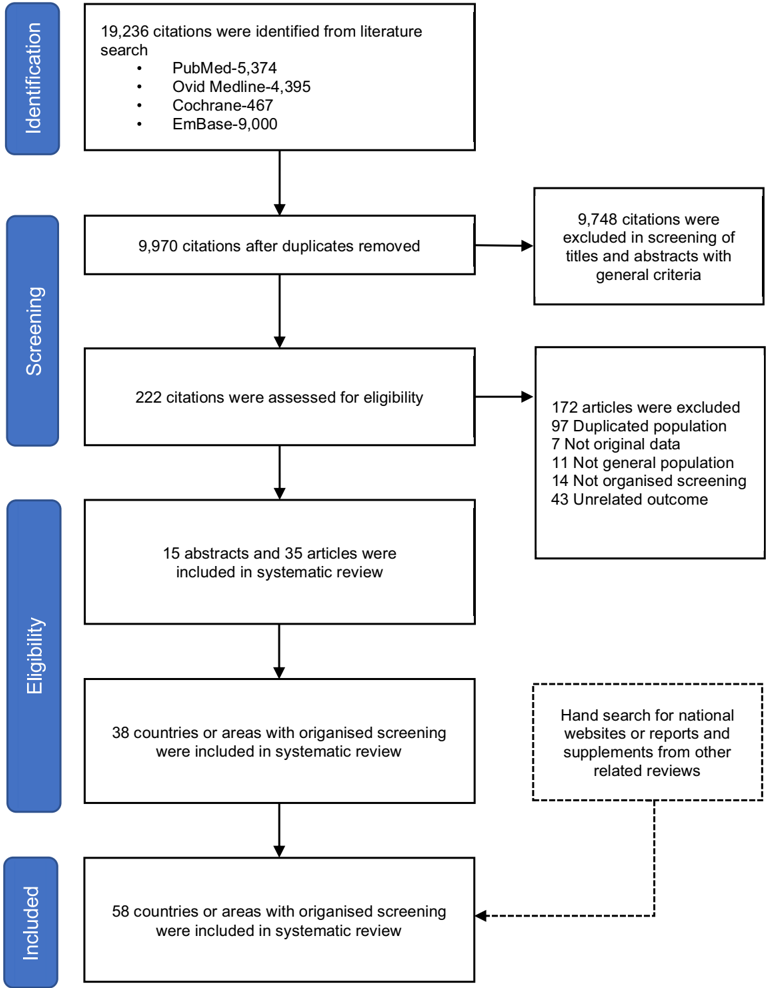
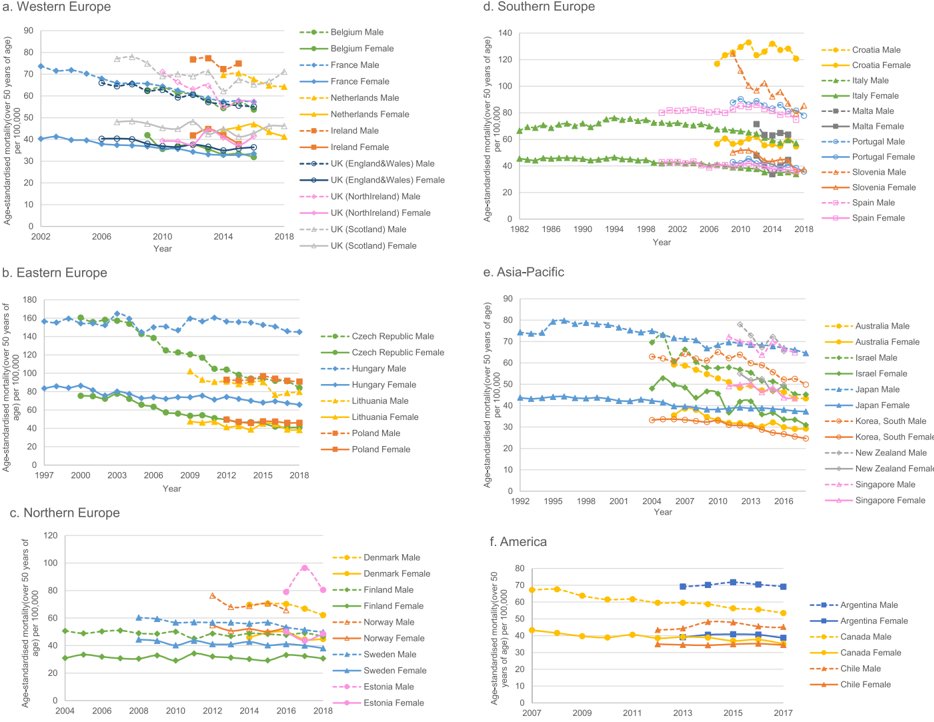
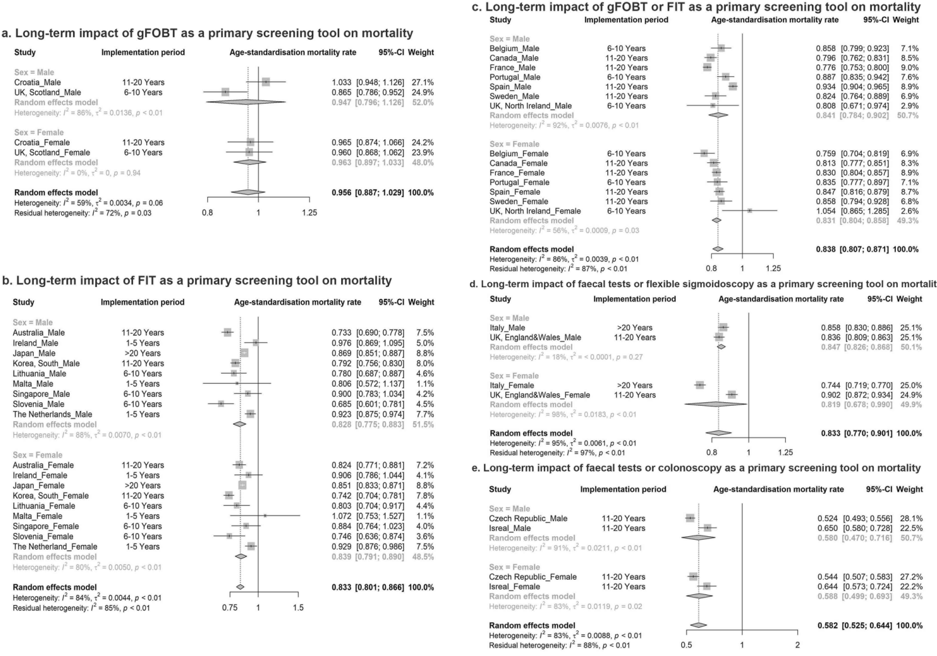
Background: To assess the long-term association between organised colorectal cancer (CRC) screening strategies and CRC-relate mortality. Methods: We systematically reviewed studies on organised CRC screening through PubMed, Ovid Medline, Embase and Cochrane from the inception. We retrieved characteristics of organised CRC screening from included literature and matched mortality (over 50 years) of those areas from the International Agency for Research on Cancer in May 2023. The variations of mortality were reported via the age-standardised mortality ratio. A random-effects model was used to synthesis results. Results: We summarised 58 organised CRC screening programmes and recorded > 2.7 million CRC-related deaths from 22 countries where rollout screening programmes were performed. The CRC screening strategy with faecal tests (guaiac faecal occult blood test (gFOBT) or faecal immunochemical tests (FIT)) or colonoscopy as the primary screening offer was associated with a 41.8% reduction in mortality, which was higher than those offered gFOBT (4.4%), FIT (16.7%), gFOBT or FIT (16.2%), and faecal tests (gFOBT or FIT) or flexible sigmoidoscopy (16.7%) as primary screening test. The longer duration of screening was associated with a higher reduction in the pooled age-standardised mortality ratio. In particular, the pooled age-standardised mortality ratio became non-significant when the screening of FIT was implemented for less than 5 years. Conclusions: A CRC screening programme running for > 5 years was associated with a reduction of CRC-related mortality. Countries with a heavy burden of CRC should implement sustainable, organised screening providing a choice between faecal tests and colonoscopy as a preferred primary test.
Overview
The claims and statistics of this paper haven’t been checked yet.
Free: it reads the open-access text and checks the first 5 claims that cite a source we can check. Create a free account to check every claim.
Integrity signals
Registry
Cites
Statistics
Figures
Verification
Claims the paper makes
The claims and statistics of this paper haven’t been checked yet.
Free: it reads the open-access text and checks the first 5 claims that cite a source we can check. Create a free account to check every claim.
Claims other papers make about this one
Each is checked against this paper’s own text: does it say what the citing paper says it does?
The source backs part of the claim, not all of it — or backs it for a different population, condition or comparison.
In the citing paper
“A modern meta-analysis demonstrates that the reduction in mortality as a result of CRC screening increases with a screening duration of more than 5 years[41].”
From Risk factors, prevention and screening of colorectal cancer: A rising problem (2025) · cites this paper as [41]
Experimental — accuracy not yet measured
Self-check
Percentages, sums and reported differences re-computed from the paper’s own numbers.
The self-check needs the paper’s full text.
Citations
Cites
International Agency for Research on Cancer
National Cancer Institute (2020) · Definitions · doi:10.32388/pfg7jq · Cited by 9,435
Assessing heterogeneity in meta-analysis: Q statistic or I² index?
Huedo-Medina, T. B., Sánchez-Meca, J., Marín-Martínez, F., & Botella, J. (2006) · Psychological Methods · doi:10.1037/1082-989x.11.2.193 · Cited by 4,256 · cited 1×
“I 2 was reported to evaluate the heterogeneity, and I 2 of 25%, 50%, and 75% indicated low, medium, and high heterogeneity, respectively [11].”
BackgroundEdwards, B. K., Ward, E., Kohler, B. A., Eheman, C., Zauber, A. G., Anderson, R. N., Jemal, A., Schymura, M. J., Lansdorp‐Vogelaar, I., Seeff, L. C., et al. (2010) · Cancer · doi:10.1002/cncr.24760 · Cited by 2,002 · cited 1×
“These include people’s attitude to CRC screening, changes in lifestyle habits over time, and the development of novel cancer treatments that were not able to be accounted for, although a study from the US suggested that only 12% of mortality decline was attributed to treatment [29].”
BackgroundScreening for Colorectal Cancer: U.S. Preventive Services Task Force Recommendation Statement
U.S. Preventive Services Task Force* (2008) · Annals of Internal Medicine · doi:10.7326/0003-4819-149-9-200811040-00243 · Cited by 1,959 · cited 1×
“The United States Preventive Services Task Force indicated that it should take at least seven years to observe the benefit of CRC screening [22].”
BackgroundColorectal cancer screening: a global overview of existing programmes
Schreuders, E. H., Ruco, A., Rabeneck, L., Schoen, R. E., Sung, J. J. Y., Young, G. P., & Kuipers, E. J. (2015) · Gut · doi:10.1136/gutjnl-2014-309086 · Cited by 1,328 · cited 2×
“Nevertheless, the traditional opportunistic screening approach is largely performed only when a patient visits a physician, which may lead to under-or over-screening, uncertain quality, or health inequity [2].”
BackgroundResultBrenner, H., Stock, C., & Hoffmeister, M. (2014) · BMJ · doi:10.1136/bmj.g2467 · Cited by 866 · cited 1×
“Faecal tests and colonoscopy subgroup involved Czech Republic and Israel Besides these two screening strategies, colonoscopy was found to be associated with a 61–68% decline in CRC-related mortality [14, 17, 18].”
MethodLevin, T. R., Corley, D. A., Jensen, C. D., Schottinger, J. E., Quinn, V. P., Zauber, A. G., Lee, J. K., Zhao, W. K., Udaltsova, N., Ghai, N. R., et al. (2018) · Gastroenterology · doi:10.1053/j.gastro.2018.07.017 · Cited by 554 · cited 1×
“The higher rates of screening were associated with a reduction from 30.9 to 14.7 deaths/100,000 [7].”
BackgroundInfluentialHol, L., van Leerdam, M. E., van Ballegooijen, M., van Vuuren, A. J., van Dekken, H., Reijerink, J. C. I. Y., van der Togt, A. C. M., Habbema, J. D. F., & Kuipers, E. J. (2010) · Gut · doi:10.1136/gut.2009.177089 · Cited by 481 · cited 1×
“Existing evidence suggests that FIT had better performance than gFOBT due to the higher participation rate and higher detection rate of CRC [12, 13].”
BackgroundCardoso, R., Guo, F., Heisser, T., Hackl, M., Ihle, P., De Schutter, H., Van Damme, N., Valerianova, Z., Atanasov, T., Májek, O., et al. (2021) · The Lancet Oncology · doi:10.1016/s1470-2045(21)00199-6 · Cited by 480 · cited 1×
“The average annual percentage changes were employed by Cardoso et al. to compare the epidemiological changes of CRC in relation to screening implementation across Europe [9].”
MethodAn updated Asia Pacific Consensus Recommendations on colorectal cancer screening
Sung, J. J. Y., Ng, S. C., Chan, F. K. L., Chiu, H. M., Kim, H. S., Matsuda, T., Ng, S. S. M., Lau, J. Y. W., Zheng, S., Adler, S., et al. (2015) · Gut · doi:10.1136/gutjnl-2013-306503 · Cited by 411
Cited by
Risk factors, prevention and screening of colorectal cancer: A rising problem
Tsukanov, V. V., Vasyutin, A. V., & Tonkikh, J. L. (2025) · World Journal of Gastroenterology · doi:10.3748/wjg.v31.i5.98629 · Cited by 42
Global colorectal cancer screening programs and coverage rate estimation: an evidence synthesis
Chen, Y., Zhang, Y., Yan, Y., Han, J., Zhang, L., Cheng, X., Lü, B., Li, N., Luo, C., Zhou, Y., et al. (2025) · Journal of Translational Medicine · doi:10.1186/s12967-025-06887-4 · Cited by 44
“There is clear evidence that organized screening programs can significantly reduce CRC mortality [49].”
Surgical Emergencies in Rectal Cancer: A Narrative Review
Pajola, M., Fugazzola, P., Cobianchi, L., Frassini, S., Ghaly, A., Bianchi, C. M., & Ansaloni, L. (2024) · Journal of Clinical Medicine · doi:10.3390/jcm14010126 · Cited by 13
Zeng, X., Wang, J., Liu, N., Chen, L., Liang, L., Zhuo, L., Zhang, X., & Lin, M. (2025) · Frontiers in Oncology · doi:10.3389/fonc.2025.1673341 · Cited by 11
Wang, Z., Sun, Z., Lv, H., Wu, W., Li, H., & Jiang, T. (2024) · Scientific Reports · doi:10.1038/s41598-024-75270-y · Cited by 10
Organized Colorectal Cancer Screening Programs in Switzerland – Quo Vadis?
Albers, B., Auer, R., Selby, K. J., & Clack, L. (2025) · International Journal of Public Health · doi:10.3389/ijph.2025.1608183 · Cited by 7
“While the superiority of organized over opportunistic screening is not fully established [11 – 14], strong arguments have been made for organized programs to increase the accessibility of screening to broader populations, making it more likely for more people to be screened and for CRC to be…”
Silva, J. C., Dinis-Ribeiro, M. J., Tavares, F., & Libânio, D. (2024) · Digestive and Liver Disease · doi:10.1016/j.dld.2024.11.027 · Cited by 6
Çelik, B., & Akın, B. (2025) · Journal of Evaluation in Clinical Practice · doi:10.1111/jep.70162 · Cited by 3
“In our country, the mortality rate from cervical cancer is 0.49% according to data from the World Health Organization in 2020 [14].”
InfluentialJulbø, F. M. I., Henriksen, A. L., Pradhan, M., Lindstrøm, E. K., KOSTOLOMOV, I., Oukrif, D., van der Schee, L., Isaksen, M. X., Manet, A., Skrede, O.-J., et al. (2026) · EClinicalMedicine · doi:10.1016/j.eclinm.2026.103826 · Cited by 4
Sakar, B., Öner, O. Z., Celik, A., Çelik, Ö., Yıldız, T. C., Dogan, U., & Dinçer, O. İ. (2025) · Journal of Laparoendoscopic & Advanced Surgical Techniques · doi:10.1089/lap.2025.0071 · Cited by 2
Sun, Y., Zhu, G., Lian, D., Amin, B., Xu, G., Wang, J., Zhang, N., & Wang, D. (2025) · PLoS ONE · doi:10.1371/journal.pone.0337216 · Cited by 2
Chen, H., Si, J., Luo, C., Tian, J., Xin, J., Yu, C., Sun, D., Pei, P., Yang, L., Millwood, I. Y., et al. (2026) · Genome Medicine · doi:10.1186/s13073-026-01623-z · Cited by 2
“In countries where population-based CRC screening programs have been widely implemented, both the incidence and mortality of CRC have steadily declined [2, 3].”
Díez‐Martín, A. I., Castro, M., Santiago, M. I., Almazan, R., Gómez-Amorín, Á., Regueiro, C., Dávila-Piñón, P., & Cubiella, J. (2026) · Cancers · doi:10.3390/cancers18081313 · Cited by 4
“A recent systematic review and meta-analysis [11] highlighted that relatively few evaluated programmes were exclusively FIT-based from inception.”
InfluentialSilva, J. C., Leite‐Silva, P., Tavares, F., Bento, M. J., Libânio, D., & Dinis-Ribeiro, M. J. (2025) · The American Journal of Gastroenterology · doi:10.14309/ajg.0000000000003797 · Cited by 1
Limited Diagnostic Yield of Routine Gastroscopy in FIT-Positive Patients
Khader, M., Baker, F. A., Delgado, J., Yitzhak, A., Guterman, R., Elhayany, R., Bakshi, O., Klaitman, V., Braun, T., Abu‐Freha, N., et al. (2025) · Diagnostics · doi:10.3390/diagnostics15212781 · Cited by 1
“In Israel, FIT has been the primary CRC screening tool since approximately 2016 [8].”
Protein tyrosine phosphatase 1B in solid tumors: Unraveling its clinical significance
Esparza‐López, J., Aranda-Gutierrez, A., Escobar-Arriaga, E., Frayde-Aguilar, C., Jaramillo, M. A., León‐Rodríguez, E., & Ibarra-Sánchez, M. D. J. (2026) · Revista de investigaci�n Cl�nica · doi:10.1016/j.ric.2026.100035 · Cited by 2
Guthmuller, S., Carrieri, V., & Wübker, A. (2025) · Research Square · doi:10.21203/rs.3.rs-7891986/v1
García-Arango, C., Reynoso‐Noverón, N., Ceballos, L. F. S., Islas, E. P., Guerrero, F. A., & Ríos, J. N. (2026) · Cancer Causes & Control · doi:10.1007/s10552-025-02120-1
“This pattern aligns with international evidence showing that screening programs are most effective in reducing mortality among adults aged 50–74 years, the age group that concentrates a substantial proportion of CRC deaths [21].”
Primary healthcare staffs’ willingness to conduct colorectal cancer screening: a South African study
Magwaza, S. (2026) · Cancer Nursing Practice · doi:10.7748/cnp.2026.e1907
Hoeck, S., & Tran, T. N. (2026) · Gastrointestinal Disorders · doi:10.3390/gidisord8010014
“Population-based CRC screening using fecal occult blood testing is effective in reducing CRC incidence and disease-specific mortality [6,7].”
Detección precoz del cáncer colorrectal
Zárate, A. J., Samtani, S., Salas, R., & Leiva, C. (2026) · Revista Médica Clínica Las Condes · doi:10.1016/j.rmclc.2026.04.004
Nagtegaal, I. D., Montgomery, E. A., Polydorides, A. D., Gill, A. J., Kojima, M., & Arends, M. J. (2026) · The Journal of Pathology · doi:10.1002/path.70089
“Insights into aetiology and pathogenesis may lead to preventative actions, risk reduction and early detection, as evident from colorectal cancer screening programmes [2 – 4].”
Li, Q., Liu, H., Qiu, W., Lü, Y., Li, X., Zhuang, M., Zhu, Y., & Shi, J. (2026) · Future Science OA · doi:10.1080/20565623.2026.2697986
Brenner, D. R., Warkentin, M. T., Tilley, D., Sheth, P., & Hilsden, R. J. (2026) · JCO Global Oncology · doi:10.1200/go-25-00732
Chen, M.-W., Lin, P.-J., Ou, J., & Chang, C. C. (2026) · Diagnostics · doi:10.3390/diagnostics16142151
Karim, K., Puspadewi, D., Irawati, R., & Pana, H. S. (2026) · The International Journal of Medical Science and Health Research · doi:10.70070/c9ev3758
Suchánek, Š., Ambrožová, M., Grega, T., Chloupková, R., Májek, O., Seifert, B., Kocna, P., Bureš, J., Dušek, L., & Zavoral, M. (2026) · Cancers · doi:10.3390/cancers18193082
“…of 58 organized programs, the largest pooled mortality reduction, 41.8%, was recorded in the heterogeneous group of programs offering a choice between fecal occult blood testing and colonoscopy, and programs operating for more than five years were associated with lower CRC mortality [19].”
InfluentialWan, K., Tang, K., Wang, L., Tian, Q., Zheng, M., Qian, C., & 刘丽梅 (2026) · MedComm · doi:10.1002/mco2.71028
“In many high-income countries, the implementation of screening programs—particularly colonoscopy and fecal-based testing—has led to substantial reductions in incidence and mortality among older adults, primarily through early detection and removal of precancerous lesions [ 1, 11, 54 ].”
InfluentialJolidon, V., Smit, F., Delaruelle, K., Wagner, C., van der Linden, B. W. A., Bracke, P., Toma, S., Burton‐Jeangros, C., & Cullati, S. (2026) · International Journal of Epidemiology · doi:10.1093/ije/dyag222
Metadata
- Authors
- Ding, H., Lin, J., Xu, Z., Wang, H. H. X., Huang, L., Huang, J., & Wong, M. C. S.
- Affiliations
- Chinese University of Hong Kong (HK)
- Corresponding author
- Wong, Martin C. S.
- Venue
- BMC Cancer
- Published
- 2024-03-21
- Volume
- 24
- Issue
- 1
- Pages
- 365-365
- ISSN
- 1471-2407 (ISSN-L)
- OpenAlex
- W4393040387
- Semantic Scholar
- 9911dd3d93a44a963cb410ec9aea46bc2597e9f9
- Cited by
- 28
- References
- 26
- Citations by year
- 2026: 15 · 2025: 9 · 2024: 4
- FWCI
- 1.50
- Type
- journal article
- Language
- en
- Open access
- gold
- doi.org
- Licence
- cc-by
- creativecommons.org/licenses/by/4.0 (tdm)
- creativecommons.org/licenses/by/4.0 (vor)
- Locations
- BMC Cancer (publishedVersion, cc-by)
- PubMed (publishedVersion)
- DOAJ (DOAJ: Directory of Open Access Journals) (submittedVersion)
- Topics
- Health Sciences › Medicine › Oncology › Colorectal Cancer Screening and Detection
- Health Sciences › Medicine › Oncology › Global Cancer Incidence and Screening
- Health Sciences › Medicine › Oncology › Colorectal Cancer Surgical Treatments
- Keywords
- colorectal cancer screening, organized screening programs, colorectal cancer mortality, fecal immunochemical test, guaiac fecal occult blood test, colonoscopy, flexible sigmoidoscopy
- MeSH terms
- Child, Preschool, Colonoscopy, Guaiac, Humans, Mass Screening, Middle Aged, Occult Blood, Colorectal Neoplasms, Early Detection of Cancer
About these checks
Registry, retraction, Cites and statistics results are computed, not judged, with one exception: a printed reference that no index lists is read once by a model before it counts as a citation error. Claims are extracted by a model and kept only when their quote appears verbatim in the text; each cited source is then checked, with a model’s help, for whether it says what the claim relies on. Those verdicts can be wrong — read the claim’s quote and the cited source before relying on one.
Statistics and arithmetic are recomputed, not judged.
Confidence bands are shown only for fields calibrated on our annotated test set. None is calibrated yet, so no band is shown.
What counts as a claim ›How we measure confidence ›How we check this ›
Are you an author, or do you see a problem with this page? Request a review
Data sources
Bibliographic data: Semantic Scholar, OpenAlex, Crossref.
Contains information from the Semantic Scholar Academic Graph Datasets, made available under the ODC Attribution License (ODC-BY 1.0).
Semantic Scholar’s data is described in: Kinney, R., et al. (2023). The Semantic Scholar Open Data Platform. arXiv:2301.10140.
