

Aromatase inhibitors for short stature in male children and adolescents treated with growth hormone: a meta-analysis of randomized controlled trials
Open accessThe DOI matches its Crossref record; 33 of the 33 references it cites were found in a registry or an index; none of the 19 sources its claims cite is checked for support yet.
Abstract
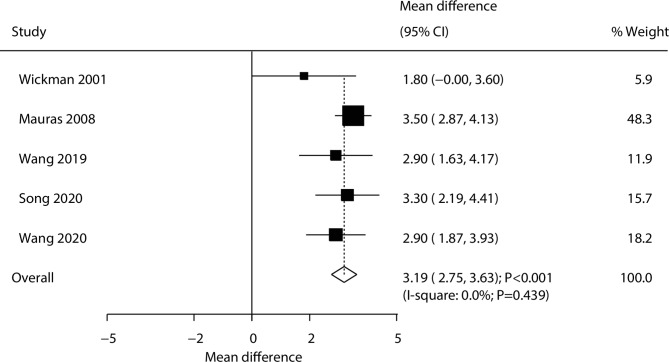
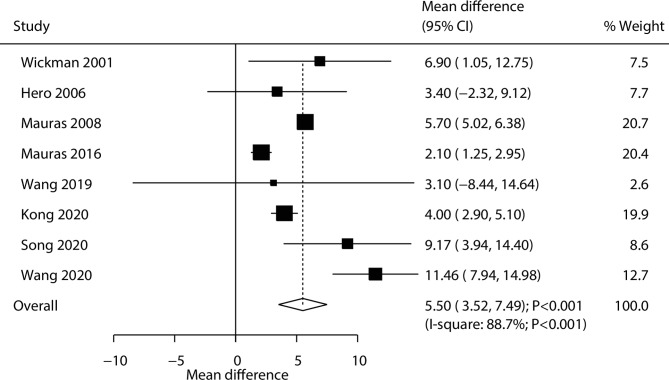
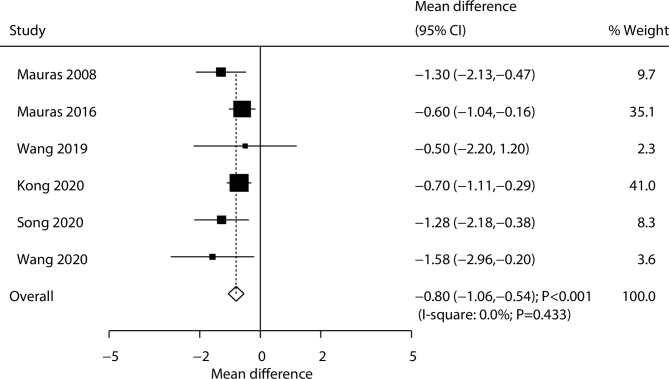
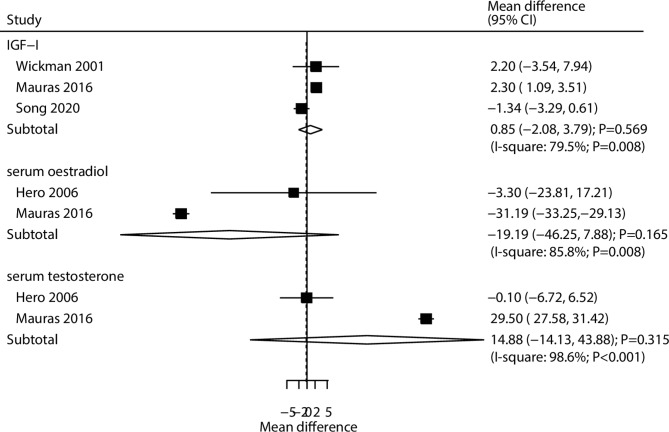
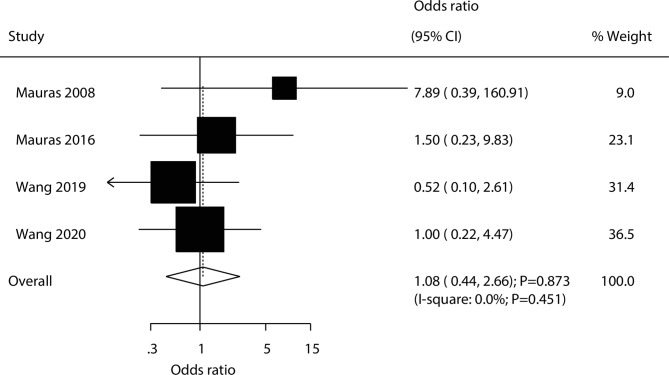
Whether the addition of aromatase inhibitors (AIs) to recombinant human growth hormone (rhGH) could yield additional benefit for short stature is controversial. We aimed to assess the effects of combined AIs and rhGH versus those of rhGH alone for short stature using a meta-analytic approach. The PubMed, Embase, and the Cochrane library electronic databases were searched systematically for eligible randomized controlled trials (RCTs) from inception until December 2021. The pooled effect estimates (weighted mean difference [WMD] and odds ratio [OR]) with 95% confidence intervals (CIs) were calculated using a random-effects model. Eight RCTs that provided data on 433 participants were selected. The addition of AIs to rhGH, compared with rhGH alone, resulted in higher growth velocity (WMD: 3.19 cm/year; 95% CI: 2.75–3.63; P < 0.001), higher predicted adult height (WMD: 5.50 cm; 95% CI: 3.52–7.49; P < 0.001), and younger bone age (WMD: -0.80 years; 95% CI: -1.06–-0.54; P < 0.001). There were no significant differences between the groups for insulin-like growth factor I (WMD: 0.85 nmol/L; 95% CI: -2.08–3.79; P = 0.569), serum estradiol level (WMD: -19.19 pmol/L; 95% CI: -46.25–7.88; P = 0.165), and serum testosterone level (WMD: 14.88 nmol/L; 95% CI: -14.13–43.88; P = 0.315). There was no significant difference between the groups for the risk of adverse events (OR: 1.08; 95% CI: 0.44–2.66; P = 0.873). This study found that the addition of AIs to rhGH had greater benefits for growth velocity, predicted adult height, and bone age. The safety profiles were comparable.
Overview
CoChat Summary
TL;DR
In this meta-analysis of 8 RCTs (433 male children/adolescents with short stature), adding aromatase inhibitors to rhGH improved growth velocity, predicted adult height, and bone age compared with rhGH alone. IGF-I, estradiol, testosterone, and adverse-event risks did not differ significantly.
Key findings
- Across 8 RCTs (433 participants), AIs plus rhGH versus rhGH alone increased growth velocity (WMD 3.19 cm/year, 95% CI 2.75–3.63; P < 0.001; I² = 0.0%), increased predicted adult height (WMD 5.50 cm, 95% CI 3.52–7.49; P < 0.001; I² = 88.7%), and resulted in younger bone age (WMD −0.80 years, 95% CI −1.06 to −0.54; P < 0.001; I² = 0.0%).
- No significant differences were found for IGF-I (WMD 0.85 nmol/L, 95% CI −2.08–3.79; P = 0.569), serum estradiol (WMD −19.19 pmol/L, 95% CI −46.25–7.88; P = 0.165), or serum testosterone (WMD 14.88 nmol/L, 95% CI −14.13–43.88; P = 0.315); heterogeneity was high for IGF-I (I² = 79.5%), estradiol (I² = 85.8%), and testosterone (I² = 98.6%).
- Adverse-event risk did not differ significantly (OR 1.08, 95% CI 0.44–2.66; P = 0.873; I² = 0.0%).
- Subgroup analyses suggested predicted adult height effects may be modified by publication year and intervention type (interaction P < 0.001); Egger test suggested potential publication bias for growth velocity (P = 0.031), while Begg test did not (P = 0.221), and no significant publication bias was found for predicted adult height or bone age.
Methods
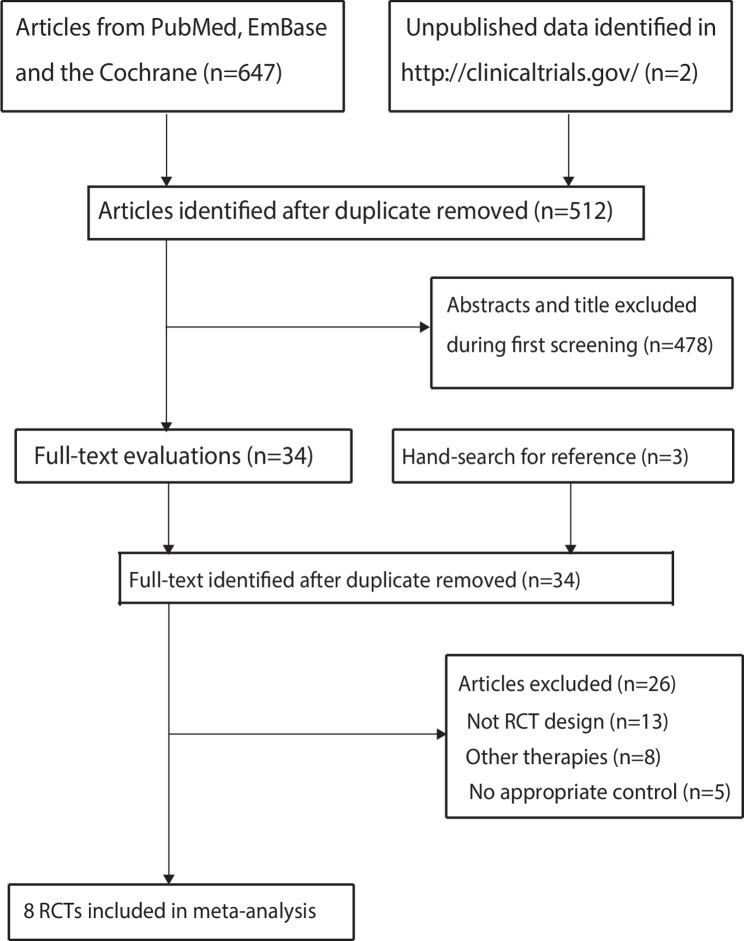
- Systematic review and meta-analysis of RCTs; PubMed, Embase, and Cochrane Library were searched through December 2021, plus ClinicalTrials.gov and reference lists, for males younger than 18 years with short stature comparing AIs plus rhGH versus rhGH alone.
- Eight RCTs with 433 participants were included (sample sizes 17–151); trials were from Finland (2), USA (2), and China (4); interventions were letrozole + rhGH (5 trials), anastrozole or letrozole + rhGH (2 trials), and anastrozole + rhGH (1 trial); treatment durations ranged from 12.0 to 36.0 months.
- Random-effects models pooled WMD for continuous outcomes and OR for categorical outcomes with 95% CIs; heterogeneity was assessed with I² and Cochran Q; sensitivity, subgroup, and publication-bias analyses were performed; trial quality was assessed with the Jadad scale.
Limitations
- Stated by the paper: included RCTs were low to moderate quality (Jadad scores: three trials scored 4, three scored 3, two scored 2); several metabolic parameters were reported in few trials and pooled conclusions were variable; heterogeneity was not fully explained by sensitivity and subgroup analyses and may reflect dose or type of intervention and treatment duration.
- Stated by the paper: no included study reported adult height, and increases in predicted height may not translate into equivalent adult height; meta-analyses of published articles have inherent publication bias and restricted detailed analyses.
- Evident from the text: the total sample was small (433 participants; individual trial sizes 17–151), all participants were male, some outcomes had high heterogeneity (predicted adult height I² = 88.7%; IGF-I 79.5%; estradiol 85.8%; testosterone 98.6%), and Egger testing suggested potential publication bias for growth velocity (P = 0.031).
Model-written summary. Check it against the paper before relying on it.
Integrity signals
Registry
Cites
Statistics
Figures
Verification
Claims the paper makes
0 Valid · 0 Not valid · 15 Not checked · 35 Own results and interpretations
A result the paper reports from its own data — it cites no other source for it, so there is none to check. The quote shows it is in the paper.
In the paper
“serum estradiol (I2 = 85.8%; P = 0.008)”
§ Aromatase inhibitors for short stature in male children and adolescents treated with growth hormone: a meta-analysis of randomized controlled trials > Results > Other outcomes
plain- Asserted: passes — The authors put it forward as true.
- Checkable: passes — It can be checked against evidence.
- Load-bearing: unclear — It is unclear whether the paper’s conclusions depend on it.
- Based: passes — The paper gives a reason why it holds.
A result the paper reports from its own data — it cites no other source for it, so there is none to check. The quote shows it is in the paper.
In the paper
“and there was no evidence of heterogeneity across the included trials (I2 = 0.0%; P = 0.433).”
§ Aromatase inhibitors for short stature in male children and adolescents treated with growth hormone: a meta-analysis of randomized controlled trials > Results > Bone age
plain- Asserted: passes — The authors put it forward as true.
- Checkable: passes — It can be checked against evidence.
- Load-bearing: unclear — It is unclear whether the paper’s conclusions depend on it.
- Based: passes — The paper gives a reason why it holds.
A result the paper reports from its own data — it cites no other source for it, so there is none to check. The quote shows it is in the paper.
In the paper
“and significant heterogeneity was observed among the included trials (I2 = 88.7%; P < 0.001).”
§ Aromatase inhibitors for short stature in male children and adolescents treated with growth hormone: a meta-analysis of randomized controlled trials > Results > Predicted adult height
plainstates an association- Asserted: passes — The authors put it forward as true.
- Checkable: passes — It can be checked against evidence.
- Load-bearing: unclear — It is unclear whether the paper’s conclusions depend on it.
- Based: passes — The paper gives a reason why it holds.
A result the paper reports from its own data — it cites no other source for it, so there is none to check. The quote shows it is in the paper.
In the paper
“No significant publication bias for bone age was observed (P value for Egger: 0.155; P value for Begg: 0.707; S6 Fig).”
§ Aromatase inhibitors for short stature in male children and adolescents treated with growth hormone: a meta-analysis of randomized controlled trials > Results > Bone age
plain- Asserted: passes — The authors put it forward as true.
- Checkable: passes — It can be checked against evidence.
- Load-bearing: unclear — It is unclear whether the paper’s conclusions depend on it.
- Based: passes — The paper gives a reason why it holds.
A result the paper reports from its own data — it cites no other source for it, so there is none to check. The quote shows it is in the paper.
In the paper
“There were no significant differences between the groups for insulin-like growth factor I (WMD: 0.85 nmol/L; 95% CI: -2.08–3.79; P = 0.569)”
- Also stated in: § Other outcomes · plain
“There were no significant differences between the addition of AIs to rhGH and rhGH alone in the changes of IGF-I (WMD: 0.85 nmol/L; 95% CI: -2.08–3.79; P = 0.569)”
§ Aromatase inhibitors for short stature in male children and adolescents treated with growth hormone: a meta-analysis of randomized controlled trials > Abstract
plain- Asserted: passes — The authors put it forward as true.
- Checkable: passes — It can be checked against evidence.
- Load-bearing: passes — The paper’s conclusions depend on it.
- Based: passes — The paper gives a reason why it holds.
- Rests on an assumption not shown here.
- Also stated in: § Other outcomes · plain
21 more claims
Create a free account to see all 50 claims and to verify the 19 references still open.
- It may state two separate claims as one. 18
- Probably not a substantial claim. 13
Self-check
Percentages, sums and reported differences re-computed from the paper’s own numbers.
Each contradiction between two passages listed here was confirmed by an independent check.
Rated minor: it would not touch a result — a value no result rests on, a p-value that stays on the same side of the significance level, or a conflict that is clerical, resolved elsewhere in the paper, or outside its own findings.
In the paper
§ Aromatase inhibitors for short stature in male children and adolescents treated with growth hormone: a meta-analysis of randomized controlled trials > Discussion
“First, all of the included studies were designed as RCTs; however, the trials had low to moderate quality.”
§ Aromatase inhibitors for short stature in male children and adolescents treated with growth hormone: a meta-analysis of randomized controlled trials > Results > Characteristics of included studies
“three trials had a score of four scores and were considered to be of high quality.”
Citations
Cites
Preferred Reporting Items for Systematic Reviews and Meta-Analyses: The PRISMA Statement
Moher, D., Liberati, A., Tetzlaff, J., Altman, D. G., & The PRISMA Group (2009) · PLoS Medicine · doi:10.1371/journal.pmed.1000097 · Cited by 64,042
Measuring inconsistency in meta-analyses
Higgins, J. P. T., Thompson, S. G., Deeks, J. J., & Altman, D. G. (2003) · BMJ · doi:10.1136/bmj.327.7414.557 · Cited by 63,139
Bias in meta-analysis detected by a simple, graphical test
Egger, M., Smith, G. D., Schneider, M., & Minder, C. (1997) · BMJ · doi:10.1136/bmj.315.7109.629 · Cited by 56,722
Preferred reporting items for systematic reviews and meta-analyses: the PRISMA Statement.
(2009) · PubMed Central · Cited by 44,859
Meta-analysis in clinical trials
DerSimonian, R., & Laird, N. (1986) · Controlled Clinical Trials · doi:10.1016/0197-2456(86)90046-2 · Cited by 39,552
Assessing the quality of reports of randomized clinical trials: Is blinding necessary?
Jadad, A. R., Moore, R. A., Carroll, D., Jenkinson, C., Reynolds, D. J. M., Gavaghan, D. J., & McQuay, H. J. (1996) · Controlled Clinical Trials · doi:10.1016/0197-2456(95)00134-4 · Cited by 17,582
Operating characteristics of a rank correlation test for publication bias
Begg, C. B., & Mazumdar, M. (1994) · Biometrics · doi:10.2307/2533446 · Cited by 16,955
Interaction revisited: the difference between two estimates.
Altman, D. G., & Bland, J. M. (2003) · BMJ · doi:10.1136/bmj.326.7382.219 · Cited by 3,203
Analysing Data and Undertaking Meta‐Analyses
Deeks, J. J., Higgins, J. P., & Altman, D. G. (2008) · Cochrane Handbook for Systematic Reviews of Interventions · doi:10.1002/9780470712184.ch9 · Cited by 1,800
Morishima, A., Grumbach, M. M., Simpson, E. R., Fisher, C., & Qin, K. (1995) · The Journal of Clinical Endocrinology & Metabolism · doi:10.1210/jcem.80.12.8530621 · Cited by 1,416
Research works printed but not linked: 2
- Song J, Dong Y. Effect of AI combined with rhGH on growth rate, bone mineral density and bone metabolism of children with idiopathic dwarfism. Med Recap. 2020;26:4952–6.
- Wang H, Zhuang ZM. Efficacy and safety of recombinant human growth hormone combined with aromatase inhibitor in the treatment of idiopathic dwarfism. Chin Foreign Med Res. 2020;18:32–4.
Cited by
Liu, X., Liu, F., Qi, Y., Han, X., Ma, S., & Zheng, R. (2025) · BMC Pediatrics · doi:10.1186/s12887-025-05703-8 · Cited by 6
“The third-generation aromatase inhibitors, Letrozole and Anastrozole, have been shown to be safe and effective in treating short stature in children [32, 33].”
İmre, E., Akçay, S., & Yavuz, D. G. (2025) · HORMONES · doi:10.1007/s42000-025-00640-8 · Cited by 6
Abalı, Z. Y., Yıldız, M., Abalı, S., Moniri, A., Baş, F., Önal, H., Çilsaat, G., Toksoy, G., Turan, S., Poyrazoğlu, Ş., et al. (2025) · The Journal of Clinical Endocrinology & Metabolism · doi:10.1210/clinem/dgaf612 · Cited by 5
Ting, T. L., & Chen, S.-C. (2026) · The Journal of Clinical Endocrinology & Metabolism · doi:10.1210/clinem/dgag028 · Cited by 1
Bandura, A., Ďurina, P., Cambal, E., & Kečkéš, Š. (2026) · The Journal of Steroid Biochemistry and Molecular Biology · doi:10.1016/j.jsbmb.2026.107121
Metadata
- Authors
- Wang, K., Ye, F., Wang, D.-Y., Lai, P.-J., & Zhang, L.-Q.
- Affiliations
- Jinhua Central Hospital (CN)
- Corresponding author
- Wang, Kan
- Ye, Fei
- Venue
- BMC Pediatrics
- Published
- 2024-12-18
- Volume
- 24
- Issue
- 1
- Pages
- 813-813
- ISSN
- 1471-2431 (ISSN-L)
- PMC
- PMC11656550
- OpenAlex
- W4405561089
- Semantic Scholar
- 1e7ab8b2d5e375e1b6e2e61d03e77675bcb8dcbc
- Cited by
- 7
- References
- 32
- Citations by year
- 2026: 3 · 2025: 4
- FWCI
- 0.28
- Type
- journal article
- Language
- en
- Open access
- gold
- doi.org
- Licence
- cc-by
- creativecommons.org/licenses/by/4.0 (tdm)
- creativecommons.org/licenses/by/4.0 (vor)
- Locations
- BMC Pediatrics (publishedVersion, cc-by)
- PubMed Central (publishedVersion, cc-by)
- PubMed (publishedVersion)
- DOAJ (DOAJ: Directory of Open Access Journals) (submittedVersion)
- Topics
- Health Sciences › Medicine › Endocrinology, Diabetes and Metabolism › Growth Hormone and Insulin-like Growth Factors
- Health Sciences › Medicine › Reproductive Medicine › Hypothalamic control of reproductive hormones
- Health Sciences › Medicine › Endocrinology, Diabetes and Metabolism › Pituitary Gland Disorders and Treatments
- Keywords
- aromatase inhibitors, short stature, growth hormone therapy, growth rate, predicted adult height, bone age, insulin-like growth factor I, serum estradiol, serum testosterone, adverse events
- MeSH terms
- Adolescent, Body Height, Child, Drug Therapy, Combination, Growth Disorders, Humans, Male, Randomized Controlled Trials as Topic, Human Growth Hormone, Aromatase Inhibitors
About these checks
Registry, retraction, Cites and statistics results are computed, not judged, with one exception: a printed reference that no index lists is read once by a model before it counts as a citation error. Claims are extracted by a model and kept only when their quote appears verbatim in the text; each cited source is then checked, with a model’s help, for whether it says what the claim relies on. Those verdicts can be wrong — read the claim’s quote and the cited source before relying on one.
A language model drew the claims from the paper on 2026-11-28, under version 3 of the claim definition (model deepseek-v4.1-flash, prompt extract-v3).
A second model labelled each claim on 2026-11-28 (model jev-1.13-20260917, definition revision gold-guideline-v0.2).
Statistics and arithmetic are recomputed, not judged.
Confidence bands are shown only for fields calibrated on our annotated test set. None is calibrated yet, so no band is shown.
What counts as a claim ›How we measure confidence ›How we check this ›
Are you an author, or do you see a problem with this page? Request a review
How to cite
Cite CoChat for the checks on this page, and the paper for its own findings.
- This page
- CoChat. (2026). Citation check: Aromatase inhibitors for short stature in male children and adolescents treated with growth hormone: a meta-analysis of randomized controlled trials. https://app.cochat.ai/papers/10.1186/s12887-024-05301-0
- The paper
- Wang, K., Ye, F., Wang, D.-Y., Lai, P.-J., & Zhang, L.-Q. (2024). Aromatase inhibitors for short stature in male children and adolescents treated with growth hormone: a meta-analysis of randomized controlled trials. BMC Pediatrics. https://doi.org/10.1186/s12887-024-05301-0
Data sources
Bibliographic data: Semantic Scholar, OpenAlex, Crossref.
Contains information from the Semantic Scholar Academic Graph Datasets, made available under the ODC Attribution License (ODC-BY 1.0).
Semantic Scholar’s data is described in: Kinney, R., et al. (2023). The Semantic Scholar Open Data Platform. arXiv:2301.10140.
