

Preferred intensity exercise for adolescents receiving treatment for depression: a pragmatic randomised controlled trial
Open accessThe DOI matches its Crossref record; 50 of the 50 references it cites were found in a registry or an index.
Abstract
BACKGROUND: Exercise has been shown to be effective in treating depression, but trials testing the effect of exercise for depressed adolescents utilising mental health services are rare. The aim of this study was to determine the effectiveness of a preferred intensity exercise intervention on the depressive symptoms of adolescents with depression. METHODS: We randomly assigned 87 adolescents who were receiving treatment for depression to either 12 sessions of aerobic exercise at preferred intensity alongside treatment as usual or treatment as usual only. The primary outcome was depressive symptom change using the Children's Depression Inventory 2(nd) Version (CDI-2) at post intervention. Secondary outcomes were health-related quality of life and physical activity rates. Outcomes were taken at baseline, post intervention and at six month follow up. RESULTS: CDI-2 score reduction did not differ significantly between groups at post-intervention (est. 95% CI -6.82, 1.68, p = 0.23). However, there was a difference in CDI-2 score reduction at six month follow-up in favour of the intervention of -4.81 (est. 95% CI -9.49, -0.12, p = 0.03). Health-related quality of life and physical activity rates did not differ significantly between groups at post-intervention and follow-up. CONCLUSIONS: There was no additional effect of preferred intensity exercise alongside treatment as usual on depressive reduction immediately post intervention. However, effects were observed at six months post-intervention, suggesting a delayed response. However, further trials, with larger samples are required to determine the validity of this finding. TRIAL REGISTRATION: ClinicalTrials.gov NCT01474837, March 16 2011.
Overview
The claims and statistics of this paper haven’t been checked yet.
Free: it reads the open-access text and checks the first 5 claims that cite a source we can check. Create a free account to check every claim.
Integrity signals
Registry
Cites
Statistics
Figures
Verification
Claims the paper makes
The claims and statistics of this paper haven’t been checked yet.
Free: it reads the open-access text and checks the first 5 claims that cite a source we can check. Create a free account to check every claim.
Claims other papers make about this one
Each is checked against this paper’s own text: does it say what the citing paper says it does?
In the citing paper
“Light-intensity interventions may also have the capacity to be delivered by a range of professionals across different settings,66 be less reliant on group-based formats and may also be a good basis on which to develop self-efficacy for PA/exercise,67 which might then lead to uptake of more intensive types of PA/exercise,68 providing impetus to examine these interventions.”
From Physical activity and exercise in youth mental health promotion: a scoping review (2020) · cites this paper as [68]
Self-check
Percentages, sums and reported differences re-computed from the paper’s own numbers.
The self-check needs the paper’s full text.
Citations
Cites
Statistical Power Analysis for the Behavioral Sciences
Muller, K. (1989) · Technometrics · doi:10.1080/00401706.1989.10488618 · Cited by 99,167
Statistical power analysis for the behavioral sciences
(1990) · Computers, Environment and Urban Systems · doi:10.1016/0198-9715(90)90050-4 · Cited by 65,269
Development and preliminary testing of the new five-level version of EQ-5D (EQ-5D-5L)
Herdman, M., Gudex, C., Lloyd, A., Janssen, M., Kind, P., Parkin, D., Bonsel, G., & Badia, X. (2011) · Quality of Life Research · doi:10.1007/s11136-011-9903-x · Cited by 9,795
(2006) · Technometrics · doi:10.1198/tech.2006.s417 · Cited by 4,950
A simple method to assess exercise behavior in the community.
Godin, G., & Shephard, R. J. (1985) · PubMed · Cited by 4,760
Borg's Perceived Exertion and Pain Scales
Borg, G. A. V. (1998) · Cited by 3,366
Borg's Perceived Exertion and Pain Scales
Heath, E. M. (1998) · Medicine& Science in Sports & Exercise · doi:10.1097/00005768-199809000-00018 · Cited by 3,037
Penedo, F. J., & Dahn, J. R. (2005) · Current Opinion in Psychiatry · doi:10.1097/00001504-200503000-00013 · Cited by 2,851 · cited 1×
“In adults, exercise has been shown to improve mood, self-esteem, self-worth, anxiety and depression [4–8].”
BackgroundA simple method to assess exercise behavior in the community.
Godin, G., & Shephard, R. J. (1969) · Cited by 2,835
Analysing controlled trials with baseline and follow up measurements
Vickers, A. J., & Altman, D. G. (2001) · BMJ · doi:10.1136/bmj.323.7321.1123 · Cited by 2,116 · cited 1×
“The following were included as explanatory variables: binary treatment status; actual follow up time; interaction term of treatment by time; baseline CDI-2; and time lag (weeks) between baseline and start of the intervention [30].”
Cooney, G. M., Dwan, K., Greig, C. A., Lawlor, D. A., Rimer, J., Waugh, F. R., McMurdo, M., & Mead, G. E. (2013) · Cochrane Database of Systematic Reviews · doi:10.1002/14651858.cd004366.pub6 · Cited by 1,834 · cited 1×
“A recent Cochrane review suggests that exercise is likely to decrease depressive symptoms by the end of treatment and at long-term follow up [9].”
Improving the reporting of pragmatic trials: An extension of the CONSORT statement
Zwarenstein, M., Treweek, S., Gagnier, J. J., Altman, D. G., Tunis, S., Haynes, B., Oxman, A. D., Moher, D., & groups, F. T. C. A. P. T. I. H. (. (2008) · BMJ · doi:10.1136/bmj.a2390 · Cited by 1,813 · cited 1×
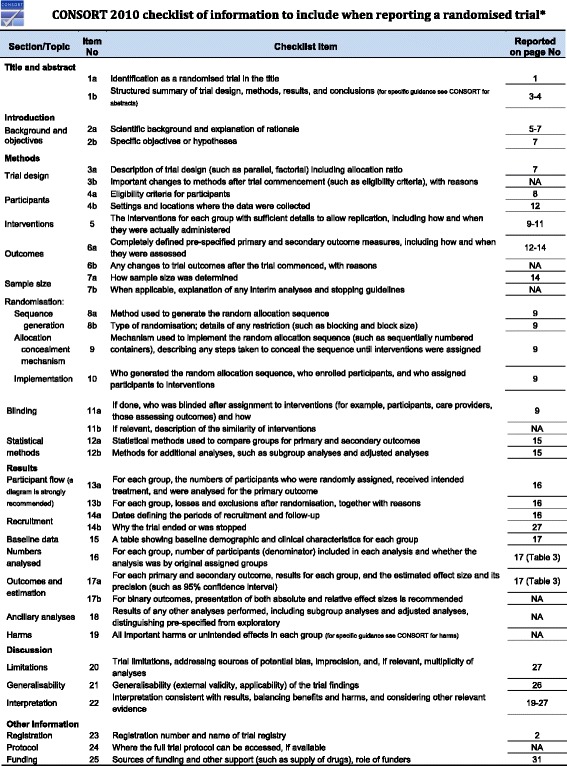
“The extended CONSORT statement for the reporting of pragmatic trials [18] was adhered to in the reporting of this trial.”
MethodPhysical Activity and Mental Health: Current Concepts
Paluska, S. A., & Schwenk, T. L. (2000) · Sports Medicine · doi:10.2165/00007256-200029030-00003 · Cited by 1,722 · cited 1×
“Numerous theories attempt to explain the exercise/depression relationship ranging from psychological theories such as the distraction hypothesis, the self-efficacy hypothesis and the mastery hypothesis [10] to more biochemical based theories such as the monoamine hypothesis, the endorphin response and the transient hy…”
A simultaneous evaluation of 10 commonly used physical activity questionnaires
JACOBS, D. R., AINSWORTH, B. E., HARTMAN, T. J., & LEON, A. S. (1993) · Medicine & Science in Sports & Exercise · doi:10.1249/00005768-199301000-00012 · Cited by 1,675
Goldstein, H. (2010) · Wiley Series in Probability and Statistics · doi:10.1002/9780470973394 · Cited by 1,568
Lewinsohn, P. M., Hops, H., Roberts, R. E., Seeley, J. R., & Andrews, J. A. (1993) · Journal of Abnormal Psychology · doi:10.1037/0021-843x.102.1.133 · Cited by 1,547 · cited 1×
“Additionally, 12 % of children and adolescents may have sub threshold symptoms of depression [2] and 20 % of young people experience at least one episode of major depression before they reach 18 years of age [3].”
BackgroundThe Godin-Shephard Leisure-Time Physical Activity Questionnaire
Godin, G. (2011) · Health & fitness journal of Canada · doi:10.14288/hfjc.v4i1.82 · Cited by 922 · cited 1×
“The LTEQ is a self-report questionnaire of leisure time physical activity asking respondents to report the number of times they engage in mild, moderate or strenuous physical activity for at least 15 min over the course of a week [26].”
Cooney, G. M., Dwan, K., Greig, C. A., Lawlor, D. A., Rimer, J., Waugh, F. R., McMurdo, M., & Mead, G. E. (2014) · Advances in Psychiatric Treatment · doi:10.1192/apt.20.1.2 · Cited by 895
Strategy for intention to treat analysis in randomised trials with missing outcome data
White, I. R., Horton, N. J., Carpenter, J., statistics, R. I. M. A. S., & Pocock, S. J. (2011) · BMJ · doi:10.1136/bmj.d40 · Cited by 849
The Ziggurat Method for Generating Random Variables
Marsaglia, G., & Tsang, W. W. (2000) · Journal of Statistical Software · doi:10.18637/jss.v005.i08 · Cited by 568
Exercise in prevention and treatment of anxiety and depression among children and young people
Larun, L., Nordheim, L. V., Ekeland, E., Hagen, K. B., & Heian, F. (2006) · Cochrane Database of Systematic Reviews · doi:10.1002/14651858.cd004691.pub2 · Cited by 492 · cited 2×
“The findings of a similar systematic review of clinical trials up to 2005 [13] reported only three trials investigating the antidepressant effect of exercise on a clinical population.”
BackgroundSingh, N. A., Stavrinos, T. M., Scarbek, Y., Galambos, G., Liber, C., & Fiatarone Singh, M. A. (2005) · The Journals of Gerontology Series A: Biological Sciences and Medical Sciences · doi:10.1093/gerona/60.6.768 · Cited by 470 · cited 1×
“In adults, exercise has been shown to improve mood, self-esteem, self-worth, anxiety and depression [4–8].”
BackgroundThe link between depression and physical symptoms.
Trivedi, M. H. (2004) · PubMed Central · Cited by 419
REALCOM-IMPUTE Software for Multilevel Multiple Imputation with Mixed Response Types
Carpenter, J. R., Goldstein, H., & Kenward, M. G. (2011) · Journal of Statistical Software · doi:10.18637/jss.v045.i05 · Cited by 395 · cited 1×
“Although Multilevel modelling is able to take into account missing data to give sensible results under the missing at random (MAR) assumption [31], sensitivity analysis was also conducted whereby missing values were additionally imputed using an analytical model; the Markov chain Monte Carlo approach [32].”
MethodLong-Term Effects of Aerobic Exercise on Psychological Outcomes
DiLorenzo, T. M., Bargman, E. P., Stucky-Ropp, R., Brassington, G. S., Frensch, P. A., & LaFontaine, T. (1999) · Preventive Medicine · doi:10.1006/pmed.1998.0385 · Cited by 361
Brown, H. E., Pearson, N., Braithwaite, R. E., Brown, W. J., & Biddle, S. J. H. (2013) · Sports Medicine · doi:10.1007/s40279-012-0015-8 · Cited by 313 · cited 1×
“In a recent systematic review investigating the impact of physical activity on depression scores in children and adolescents, a small, statistically significant treatment effect was observed for the physical activity intervention group over the non-physical comparison [12].”
JEONG, Y.-J., HONG, S.-C., LEE, M. S., PARK, M.-C., KIM, Y.-K., & SUH, C.-M. (2005) · International Journal of Neuroscience · doi:10.1080/00207450590958574 · Cited by 298 · cited 1×
“Previous trials investigating the impact of exercise on depressive symptoms in adolescents have reported mixed results, with some reporting statistically significant treatment effects for depressive symptoms [34–36] and other studies reporting no such treatment effects [37–39].”
ResultKhalsa, S. B. S., Hickey-Schultz, L., Cohen, D., Steiner, N., & Cope, S. (2012) · The Journal of Behavioral Health Services & Research · doi:10.1007/s11414-011-9249-8 · Cited by 271 · cited 1×
“Previous trials investigating the impact of exercise on depressive symptoms in adolescents have reported mixed results, with some reporting statistically significant treatment effects for depressive symptoms [34–36] and other studies reporting no such treatment effects [37–39].”
ResultCollishaw, S., Maughan, B., Natarajan, L., & Pickles, A. (2010) · Journal of Child Psychology and Psychiatry · doi:10.1111/j.1469-7610.2010.02252.x · Cited by 267 · cited 1×
“Background The prevalence of depression in adolescents has doubled between the mid-1980’s and 2000’s [1] with major Depressive Disorder (MDD) now ranging from four to eight %.”
BackgroundRose, E. A., & Parfitt, G. (2007) · Journal of Sport and Exercise Psychology · doi:10.1123/jsep.29.3.281 · Cited by 224 · cited 1×
“However, observational studies in both adults and young people report that prescribed (fixed) intensity exercise results in less favourable affective responses and effort perceptions in comparison to preferred intensity exercise [14, 15].”
BackgroundPsychology of Physical Activity
Biddle, S., & Mutrie, N. (2007) · Routledge eBooks · doi:10.4324/9780203019320 · Cited by 221 · cited 1×
“Numerous theories attempt to explain the exercise/depression relationship ranging from psychological theories such as the distraction hypothesis, the self-efficacy hypothesis and the mastery hypothesis [10] to more biochemical based theories such as the monoamine hypothesis, the endorphin response and the transient hy…”
Subthreshold depression in children and adolescents – a systematic review
Wesselhoeft, R., Sørensen, M. J., Heiervang, E. R., & Bilenberg, N. (2013) · Journal of Affective Disorders · doi:10.1016/j.jad.2013.06.010 · Cited by 214 · cited 1×
“Additionally, 12 % of children and adolescents may have sub threshold symptoms of depression [2] and 20 % of young people experience at least one episode of major depression before they reach 18 years of age [3].”
BackgroundPromoting Healthy Lifestyles in High School Adolescents
Melnyk, B. M., Jacobson, D., Kelly, S., Belyea, M., Shaibi, G., Small, L., O’Haver, J., & Marsiglia, F. F. (2013) · American Journal of Preventive Medicine · doi:10.1016/j.amepre.2013.05.013 · Cited by 183 · cited 2×
“Previous trials investigating the impact of exercise on depressive symptoms in adolescents have reported mixed results, with some reporting statistically significant treatment effects for depressive symptoms [34–36] and other studies reporting no such treatment effects [37–39].”
[Effects of exercise on anxiety, depression and mood].
Guszkowska, M. (2004) · PubMed · Cited by 164
Tillmann, V., Darlington, A., Eiser, C., Bishop, N. J., & Davies, H. A. (2002) · Journal of Bone and Mineral Research · doi:10.1359/jbmr.2002.17.6.1073 · Cited by 159 · cited 1×
“The LTEQ is short, easily administered, reliable, has demonstrated concurrent validity with other self-report physical activity tools [27] and has been used with both adult and paediatric participants [28].”
BackgroundPsychology of Physical Activity
Biddle, S., Mutrie, N., & Gorely, T. (2015) · Routledge eBooks · doi:10.4324/9780203123492 · Cited by 158
Schmitz, N., Kruse, J., & Kügler, J. (2004) · Preventive Medicine · doi:10.1016/j.ypmed.2004.04.034 · Cited by 147
Hughes, C. W., Barnes, S., Barnes, C., DeFina, L. F., Nakonezny, P., & Emslie, G. J. (2013) · Mental Health and Physical Activity · doi:10.1016/j.mhpa.2013.06.006 · Cited by 132 · cited 3×
“[35] investigated the impact of a 12 week exercise intervention on the depressive symptoms of adolescents diagnosed with MDD, and included follow ups at 26 and 52 weeks.”
Functioning and Quality of Life in the Treatment for Adolescents With Depression Study (TADS)
Vitiello, B., Rohde, P., Silva, S. G., Wells, K., Casat, C. D., WASLICK, B. D., Simons, A. D., Reinecke, M. A., Weller, E. B., Kratochvil, C. J., et al. (2006) · Journal of the American Academy of Child & Adolescent Psychiatry · doi:10.1097/01.chi.0000242229.52646.6e · Cited by 125 · cited 1×
“[43], found through a large RCT comparing CBT, fluoxetine and a placebo on adolescent depression, a positive effect on QOL for combined CBT and fluoxetine.”
BackgroundCallaghan, P., Khalil, E., Morres, I., & Carter, T. (2011) · BMC Public Health · doi:10.1186/1471-2458-11-465 · Cited by 105 · cited 3×
“Such findings have been replicated in a trial comparing preferred intensity exercise against prescribed intensity exercise for depressed adults [16].”
BackgroundSelf-citationAerobic Exercise in the Psychological Treatment of Adolescents
Brown, S. W., Welsh, M. C., Labbé, E. E., Vitulli, W. F., & Kulkarni, P. (1992) · Perceptual and Motor Skills · doi:10.2466/pms.1992.74.2.555 · Cited by 84 · cited 1×
“Previous trials investigating the impact of exercise on depressive symptoms in adolescents have reported mixed results, with some reporting statistically significant treatment effects for depressive symptoms [34–36] and other studies reporting no such treatment effects [37–39].”
ResultPhysical fitness training and counseling as treatment for youthful offenders.
Hilyer, J. C., Wilson, D. G., Dillon, C., Caro, L., Jenkins, C., Spencer, W. A., Meadows, M. E., & Booker, W. (1982) · Journal of Counseling Psychology · doi:10.1037/0022-0167.29.3.292 · Cited by 72 · cited 1×
“Previous trials investigating the impact of exercise on depressive symptoms in adolescents have reported mixed results, with some reporting statistically significant treatment effects for depressive symptoms [34–36] and other studies reporting no such treatment effects [37–39].”
ResultUse of the Rating of Perceived Exertion to Control Exercise Intensity in Children
Williams, J. G., Eston, R. G., & Stretch, C. (1991) · Pediatric Exercise Science · doi:10.1123/pes.3.1.21 · Cited by 59 · cited 1×
“It is reported to be readily learned by adolescents and is a useful frame of reference for self-regulating exercise intensity [21].”
BackgroundHamlyn-Williams, C. C., Freeman, P., & Parfitt, G. (2014) · BMC Sports Science, Medicine and Rehabilitation · doi:10.1186/2052-1847-6-35 · Cited by 58 · cited 1×
“However, observational studies in both adults and young people report that prescribed (fixed) intensity exercise results in less favourable affective responses and effort perceptions in comparison to preferred intensity exercise [14, 15].”
BackgroundThe impact of exercise on Quality of Life within exercise and depression trials: A systematic review
Schuch, F. B., Vasconcelos-Moreno, M. P., & Fleck, M. P. D. A. (2011) · Mental health and physical activity · doi:10.1016/j.mhpa.2011.06.002 · Cited by 58 · cited 1×
“In a recent systematic review [42] on the impact of exercise on QOL for depressed adults and older adults, exercise was found to improve some QOL domains; primarily the Physical and Psychological domains.”
BackgroundA prospective evaluation of the Transtheoretical Model of Change applied to exercise in young people
Callaghan, P., Khalil, E., & Morres, I. D. (2009) · International Journal of Nursing Studies · doi:10.1016/j.ijnurstu.2009.06.013 · Cited by 50 · cited 1×
“[41].”
Self-citationExercise for adolescents with depression: valued aspects and perceived change
Carter, T., Morres, I., Repper, J., & Callaghan, P. (2016) · Journal of Psychiatric and Mental Health Nursing · doi:10.1111/jpm.12261 · Cited by 47 · cited 3×
“As such, it is likely that the mechanism of action may be the additional positive experiences of the intervention reported in the concomitant qualitative study [40] as opposed to increased exercise.”
BackgroundInfluentialSelf-citationGerhards, S. A. H., Huibers, M. J. H., Theunissen, K., de Graaf, L. E., Widdershoven, G. A. M., & Evers, S. (2011) · Value in Health · doi:10.1016/j.jval.2010.12.004 · Cited by 42
Byford, S. (2013) · Journal of Mental Health · doi:10.3109/09638237.2013.779366 · Cited by 36 · cited 1×
“The EQ-5D-3 L was found to be responsive to changes in depression [23], and mean EQ-5D-3 L scores have significantly correlated with a number of clinical outcome measures relating to major depression in adolescents [24].”
BackgroundKhalil, E., Callaghan, P., Carter, T., & Morres, I. D. (2012) · Psychology · doi:10.4236/psych.2012.311147 · Cited by 14 · cited 1×
“Here, the authors reported increased antidepressant effects, lower effort perception and decreased attrition rates for those in the preferred intensity condition [16, 17].”
BackgroundSelf-citation
Research works printed but not linked: 1
- Kovacs M Children's Depression Inventory 2nd Edition (CDI 2) Technical manual 2011 Multi-Health Systems Canada
Cited by
Morres, I. D., Hatzigeorgiadis, A., Stathi, A., Comoutos, N., Arpin-Cribbie, C., Krommidas, C., & Theodorakis, Y. (2019) · Depression and Anxiety · doi:10.1002/da.22842 · Cited by 350
Self-citationBailey, A. P., Hetrick, S. E., Rosenbaum, S., Purcell, R., & Parker, A. G. (2018) · Psychological Medicine · doi:10.1017/s0033291717002653 · Cited by 338
“1), of which 17 trials were eligible for inclusion (McCann & Holmes, 1984; Woolery et al. 2004; Jeong et al. 2005; Nabkasorn et al. 2006; Yavari, 2008; Chu et al. 2009; Mohammadi, 2011; Roshan et al. 2011; Hemat-Far et al. 2012; Moghaddam et al. 2012; Hughes et al. 2013; Noorbakhsh & Alijani, 2013; Legrand, 2014; Cart…”
BackgroundMethodPhysical activity and exercise in youth mental health promotion: a scoping review
Pascoe, M., Bailey, A. P., Craike, M., Carter, T., Patten, R., Stepto, N., & Parker, A. (2020) · BMJ Open Sport & Exercise Medicine · doi:10.1136/bmjsem-2019-000677 · Cited by 332
Self-citationDauwan, M., Begemann, M. J. H., Slot, M. I. E., Lee, E. H. M., Scheltens, P., & Sommer, I. E. C. (2021) · Journal of Neurology · doi:10.1007/s00415-019-09493-9 · Cited by 239
Philippot, A., Dubois, V., Lambrechts, K., Grogna, D., Robert, A., Jonckheer, U., Chakib, W., Beine, A., Bleyenheuft, Y., & De Volder, A. G. (2022) · Journal of Affective Disorders · doi:10.1016/j.jad.2022.01.011 · Cited by 216
Metadata
- Authors
- Carter, T., Guo, B., Turner, D., Morres, I., Khalil, E., Brighton, E., Armstrong, M., & Callaghan, P.
- Affiliations
- University of Nottingham (GB)
- University of East Anglia (GB)
- University of Thessaly (GR)
- Nottinghamshire Healthcare NHS Foundation Trust (GB)
- Corresponding author
- Carter, Tim
- Venue
- BMC Psychiatry
- Published
- 2015-10-14
- Volume
- 15
- Issue
- 1
- Pages
- 247-247
- ISSN
- 1471-244X (ISSN-L)
- PMC
- PMC4605143
- OpenAlex
- W2171327296
- Semantic Scholar
- bc4a7f9b23e141d9983d26cda574b41d201ad78c
- Cited by
- 93
- References
- 50
- Citations by year
- 2026: 7 · 2025: 10 · 2024: 12 · 2023: 11 · 2022: 13 · 2021: 9 · 2020: 13 · 2019: 7 · 2018: 3 · 2017: 5 · 2016: 3
- FWCI
- 2.70
- Type
- journal article
- Language
- en
- Open access
- gold
- doi.org
- Licence
- Locations
- BMC Psychiatry (publishedVersion, cc-by)
- Europe PMC (PubMed Central) (publishedVersion, cc-by)
- PubMed Central (publishedVersion, cc-by)
- PubMed (publishedVersion)
- UEA Digital Repository (University of East Anglia) (acceptedVersion)
- Research Open (London South Bank University) (acceptedVersion, cc-by)
- Repository@Nottingham (University of Nottingham) (submittedVersion, cc-by)
- Nottingham ePrints (University of Nottingham) (submittedVersion, cc-by)
- University of Thessaly Institutional Repository (University of Thessaly) (submittedVersion)
- Funders
- National Institute for Health and Care Research (PB-PG-1208-18097)
- Research for Patient Benefit Programme
- National Institute of Mental Health
- Topics
- Health Sciences › Medicine › Public Health, Environmental and Occupational Health › Physical Activity and Health
- Health Sciences › Medicine › Pharmacology (medical) › Treatment of Major Depression
- Social Sciences › Psychology › Experimental and Cognitive Psychology › Anxiety, Depression, Psychometrics, Treatment, Cognitive Processes
- Keywords
- adolescent depression, exercise therapy, aerobic exercise, depressive symptoms, health-related quality of life, physical activity, delayed treatment response, mental health services
- MeSH terms
- Adolescent, Depression, Exercise Therapy, Female, Humans, Male, Mental Health Services, Quality of Life, Outcome Assessment, Health Care
About these checks
Registry, retraction, Cites and statistics results are computed, not judged, with one exception: a printed reference that no index lists is read once by a model before it counts as a citation error. Claims are extracted by a model and kept only when their quote appears verbatim in the text; each cited source is then checked, with a model’s help, for whether it says what the claim relies on. Those verdicts can be wrong — read the claim’s quote and the cited source before relying on one.
Statistics and arithmetic are recomputed, not judged.
Confidence bands are shown only for fields calibrated on our annotated test set. None is calibrated yet, so no band is shown.
What counts as a claim ›How we measure confidence ›How we check this ›
Are you an author, or do you see a problem with this page? Request a review
Data sources
Bibliographic data: Semantic Scholar, OpenAlex, Crossref.
Contains information from the Semantic Scholar Academic Graph Datasets, made available under the ODC Attribution License (ODC-BY 1.0).
Semantic Scholar’s data is described in: Kinney, R., et al. (2023). The Semantic Scholar Open Data Platform. arXiv:2301.10140.
