

The DOI matches its Crossref record; 189 of the 192 references it cites were found in a registry or an index.
Mental health literacy measures evaluating knowledge, attitudes and help-seeking: a scoping review
Open accessAbstract
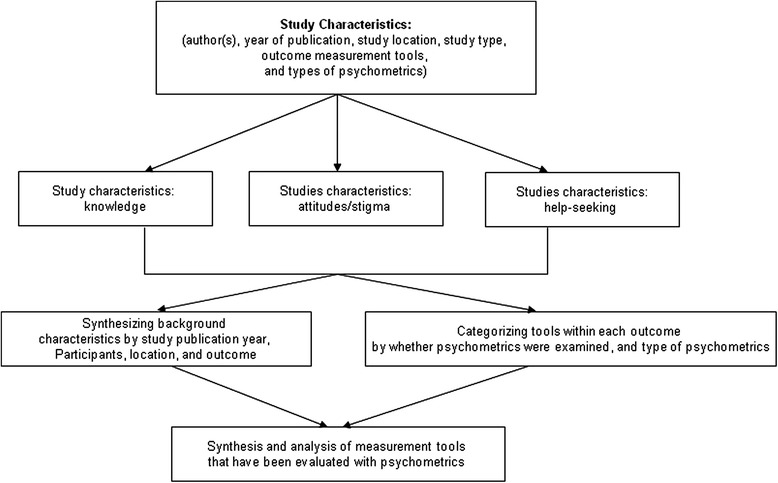
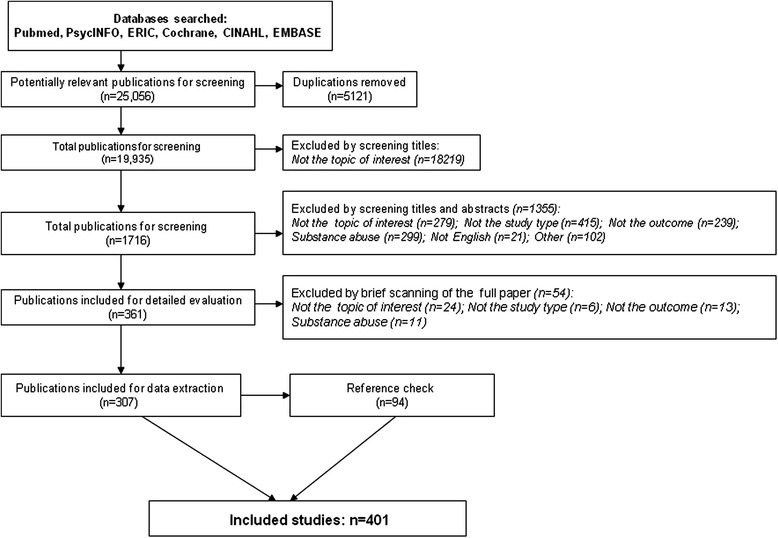
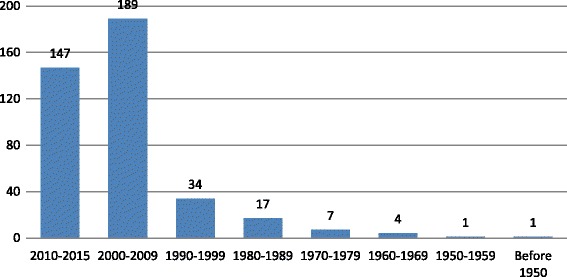
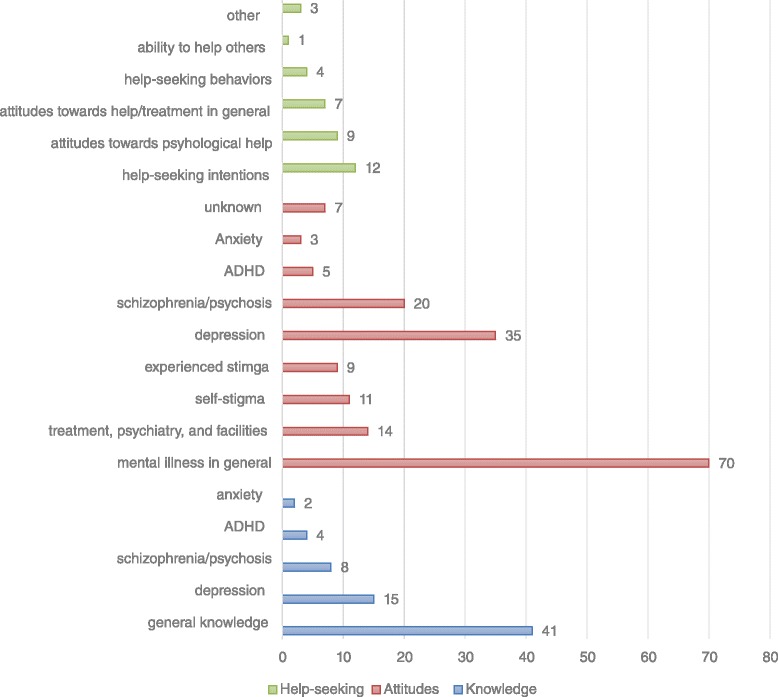
BACKGROUND: Mental health literacy has received increasing attention as a useful strategy to promote early identification of mental disorders, reduce stigma and enhance help-seeking behaviors. However, despite the abundance of research on mental health literacy interventions, there is the absence of evaluations of current available mental health literacy measures and related psychometrics. We conducted a scoping review to bridge the gap. METHODS: We searched PubMed, PsycINFO, Embase, CINAHL, Cochrane Library, and ERIC for relevant studies. We only focused on quantitative studies and English publications, however, we didn't limit study participants, locations, or publication dates. We excluded non-English studies, and did not check the grey literature (non peer-reviewed publications or documents of any type) and therefore may have missed some eligible measures. RESULTS: We located 401 studies that include 69 knowledge measures (14 validated), 111 stigma measures (65 validated), and 35 help-seeking related measures (10 validated). Knowledge measures mainly investigated the ability of illness identification, and factual knowledge of mental disorders such as terminology, etiology, diagnosis, prognosis, and consequences. Stigma measures include those focused on stigma against mental illness or the mentally ill; self-stigma ; experienced stigma; and stigma against mental health treatment and help-seeking. Help-seeking measures included those of help-seeking attitudes, intentions to seek help, and actual help-seeking behaviors. CONCLUSIONS: Our review provides a compendium of available mental health literacy measures to facilitate applying existing measures or developing new measures. It also provides a solid database for future research on systematically assessing the quality of the included measures.
Overview
The claims and statistics of this paper haven’t been checked yet.
Run the check — free, no account needed. It reads the open-access text and checks the sources it cites.
Integrity signals
Registry
Cites
Statistics
Figures
Verification
Claims the paper makes
The claims and statistics of this paper haven’t been checked yet.
Run the check — free, no account needed. It reads the open-access text and checks the sources it cites.
Claims other papers make about this one
Each is checked against this paper’s own text: does it say what the citing paper says it does?
The source backs part of the claim, not all of it — or backs it for a different population, condition or comparison.
In the citing paper
“Mental health knowledge and literacy will be evaluated using the mental health knowledge questionnaire (MHKQ) [27].”
From Promoting the mental health of university students in China: Protocol for contextual assessment to inform intervention design and adaptation (2021) · cites this paper as [28]
Experimental — accuracy not yet measuredThe cited source says what the claim attributes to it.
In the citing paper
“The stigma associated with mental illness presents a barrier to seeking help for their mental health.”
From Promoting the mental health of university students in China: Protocol for contextual assessment to inform intervention design and adaptation (2021) · cites this paper as [13]
Self-check
Percentages, sums and reported differences re-computed from the paper’s own numbers.
The self-check needs the paper’s full text.
Citations
Cites
Scoping studies: towards a methodological framework
Arksey, H., & O'Malley, L. (2005) · International Journal of Social Research Methodology · doi:10.1080/1364557032000119616 · Cited by 36,742
(1980) · Medical Entomology and Zoology · Cited by 25,810
Kessler, R. C., Berglund, P., Demler, O., Jin, R., Merikangas, K. R., & Walters, E. E. (2005) · Archives of General Psychiatry · doi:10.1001/archpsyc.62.6.593 · Cited by 20,391
Stigma: Notes on the Management of Spoiled Identity
(1969) · Postgraduate Medical Journal · doi:10.1136/pgmj.45.527.642 · Cited by 14,255
Quality criteria were proposed for measurement properties of health status questionnaires
Terwee, C. B., Bot, S. D. M., de Boer, M. R., van der Windt, D. A. W. M., Knol, D. L., Dekker, J., Bouter, L. M., & de Vet, H. C. W. (2007) · Journal of Clinical Epidemiology · doi:10.1016/j.jclinepi.2006.03.012 · Cited by 10,764
Stigma: Notes on the Management of Spoiled Identity.
Seeman, M. S., & Goffman, E. (1964) · American Sociological Review · doi:10.2307/2091442 · Cited by 10,716
Qualitative data analysis for applied policy research
(2002) · Analyzing Qualitative Data · doi:10.4324/9780203413081-14 · Cited by 4,964
Qualitative data analysis for applied policy research
Ritchie, J., & Spencer, L. (2010) · Analyzing qualitative data · doi:10.4324/9780203413081_chapter_9 · Cited by 4,800
Gulliver, A., Griffiths, K. M., & Christensen, H. (2010) · BMC Psychiatry · doi:10.1186/1471-244x-10-113 · Cited by 3,292
Jorm, A. F., Korten, A. E., Jacomb, P. A., Christensen, H., Rodgers, B., & Pollitt, P. (1997) · Medical Journal of Australia · doi:10.5694/j.1326-5377.1997.tb140071.x · Cited by 2,585
Research works printed but not linked: 4
- RefWorks-COS PL, ProQuest LLC. RefWorks. 2nd ed. Ann Arbour, MI: ProQuest LLC; 2001.
- Bogardus E. Measuring social distance. J Appl Sociol. 1925;9:299–308.
- Granello DH, Pauley PS. Television viewing habits and their relationship to tolerance toward people with mental illness. J Ment Health Couns. 2000;22(2):162–75.
- Fischer EH, Farina A. Attitudes toward seeking professional psychological help: a shortened form and considerations for research. J Coll Stud Dev. 1995;36(4):368–73.
Cited by
Sorted by citations
OECD (2021) · OECD Health Policy Studies · doi:10.1787/4ed890f6-en · Cited by 407
Mental Health Literacy: A Review of What It Is and Why It Matters
Furnham, A. F., & Swami, V. (2018) · International Perspectives in Psychology · doi:10.1037/ipp0000094 · Cited by 284
Milin, R., Kutcher, S., Lewis, S. P., Walker, S., Wei, Y., Ferrill, N., & Armstrong, M. A. (2016) · Journal of the American Academy of Child & Adolescent Psychiatry · doi:10.1016/j.jaac.2016.02.018 · Cited by 244
Self-citationBjørnsen, H. N., Espnes, G. A., Eilertsen, M. B., Ringdal, R., & Moksnes, U. K. (2017) · The Journal of School Nursing · doi:10.1177/1059840517732125 · Cited by 203
Castaldelli-Maia, J. M., & Bhugra, D. K. (2022) · International Review of Psychiatry · doi:10.1080/09540261.2022.2040450 · Cited by 221
Metadata
- Authors
- Wei, Y., McGrath, P. J., Hayden, J., & Kutcher, S.
- Affiliations
- Dalhousie University (CA)
- Corresponding author
- Wei, Yifeng
- Venue
- BMC Psychiatry
- Published
- 2015-11-17
- Volume
- 15
- Issue
- 1
- Pages
- 291-291
- ISSN
- 1471-244X (ISSN-L)
- PMC
- PMC4650294
- OpenAlex
- W2181127550
- Cited by
- 500
- References
- 192
- Citations by year
- 2026: 58 · 2025: 74 · 2024: 59 · 2023: 64 · 2022: 69 · 2021: 51 · 2020: 40 · 2019: 36 · 2018: 29 · 2017: 17 · 2016: 3
- FWCI
- 2.55
- Type
- journal article
- Language
- en
- Open access
- gold
- doi.org
- Licence
- cc-by
- Locations
- BMC Psychiatry (publishedVersion, cc-by)
- PubMed Central (publishedVersion, cc-by)
- PubMed (publishedVersion)
- Funders
- Canadian Institutes of Health Research (CA) (237816)
- Topics
- Health Sciences › Medicine › Psychiatry and Mental health › Mental Health Treatment and Access
- Health Sciences › Nursing › Research and Theory › Health Education and Validation
- Social Sciences › Psychology › Clinical Psychology › Suicide and Self-Harm Studies
- Keywords
- mental health literacy, psychometric properties, mental illness knowledge, mental health stigma, help-seeking, help-seeking attitudes, self-stigma
- MeSH terms
- Adolescent, Adult, Mental Disorders, Child, Female, Humans, Health Knowledge, Attitudes, Practice, Male, Mental Health, Middle Aged, Patient Acceptance of Health Care, Psychotherapy, Persons with Psychiatric Disorders, Intention, Young Adult, Health Literacy, Social Stigma
About these checks
Registry, retraction, Cites and statistics results are computed, not judged, with one exception: a printed reference that no index lists is read once by a model before it counts as a citation error. Claims are extracted by a model and kept only when their quote appears verbatim in the text; each cited source is then checked, with a model’s help, for whether it says what the claim relies on. Those verdicts can be wrong — read the claim’s quote and the cited source before relying on one.
Statistics and arithmetic are recomputed, not judged.
Confidence bands are shown only for fields calibrated on our annotated test set. None is calibrated yet, so no band is shown.
What counts as a claim ›How we measure confidence ›How we check this ›
Are you an author, or do you see a problem with this page? Request a review
