

A history of childhood trauma is associated with slower improvement rates: Findings from a one-year follow-up study of patients with a first-episode psychosis
Open accessThe DOI matches its Crossref record; 41 of the 43 references it cites were found in a registry or an index.
Abstract
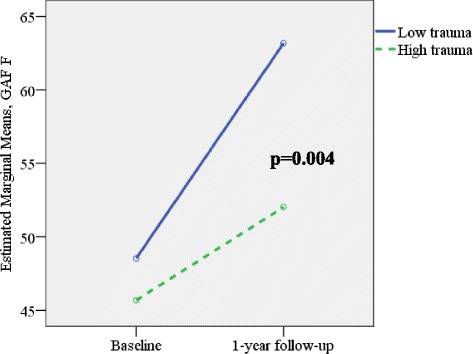
BACKGROUND: The aim of this study was to investigate whether childhood trauma was associated with more severe clinical features in patients with first-episode psychosis, both at the initial assessment and after one year. METHODS: Ninety-six patients with a first-episode of a DSM-IV diagnosis of psychosis, in addition to 264 healthy controls from the same catchment area, were recruited to the TOP NORMENT study. A history of childhood trauma was obtained using the Childhood Trauma Questionnaire (CTQ). Function and symptom severity were measured using the Global Assessment of Functioning (GAF) Scale divided into function (GAF-F) and symptoms (GAF-S), the Positive and Negative Syndrome Scale (PANSS) and the Young Mania Rating Scale (YMRS). All clinical assessments were completed at two time points: At an initial assessment within the first year of initiating treatment for psychosis and after one year. RESULTS: Childhood trauma was associated with significantly reduced global functioning and more severe clinical symptoms at both baseline and follow-up, whereas emotional neglect was associated with a significantly reduced improvement rate for global functioning (GAF-F) over the follow-up period. CONCLUSION: Our data indicate that patients with first-episode psychosis who report a history of childhood trauma constitute a subgroup characterized by more severe clinical features over the first year of treatment, as well as slower improvement rates.
Overview
The claims and statistics of this paper haven’t been checked yet.
Free: it reads the open-access text and checks the first 5 claims that cite a source we can check. Create a free account to check every claim.
Integrity signals
Registry
Cites
Statistics
Figures
Verification
Claims the paper makes
The claims and statistics of this paper haven’t been checked yet.
Free: it reads the open-access text and checks the first 5 claims that cite a source we can check. Create a free account to check every claim.
Claims other papers make about this one
Each is checked against this paper’s own text: does it say what the citing paper says it does?
The cited source says what the claim attributes to it.
In the citing paper
“Previous studies have found more negative outcomes for those individuals with psychotic disorders (PDs) and a history of adverse events (AEs), both in terms of course of illness (e.g., more distressing hallucinations, greater risk of suicide) [1, 2] and treatment outcomes (e.g., fewer treatment goals met, slower improvement) [3, 4].”
Self-check
Percentages, sums and reported differences re-computed from the paper’s own numbers.
The self-check needs the paper’s full text.
Citations
Cites
Child abuse: Adolescent records vs. adult recall
Femina, D. D., Yeager, C. A., & Lewis, D. O. (1990) · Child Abuse & Neglect · doi:10.1016/0145-2134(90)90033-p · Cited by 8,820
A Rating Scale for Mania: Reliability, Validity and Sensitivity
Young, R. C., Biggs, J. T., Ziegler, V. E., & Meyer, D. A. (1978) · British Journal of Psychiatry · doi:10.1192/bjp.133.5.429 · Cited by 8,744 · cited 4×
“Current manic symptoms were measured with the Young Mania Rating Scale (YMRS) [17].”
MethodInfluentialDevelopment and validation of a brief screening version of the Childhood Trauma Questionnaire
Bernstein, D. P., Stein, J. A., Newcomb, M. D., Walker, E., Pogge, D., Ahluvalia, T., Stokes, J., Handelsman, L., Medrano, M., Desmond, D., et al. (2003) · Child Abuse & Neglect · doi:10.1016/s0145-2134(02)00541-0 · Cited by 6,419 · cited 2×
“This is a self-report questionnaire with 28 items [22], yielding scores on five subscales of trauma: emotional abuse (EA), physical abuse (PA), sexual abuse (SA), physical neglect (PN) and emotional neglect (EN), as well as a total score; for more detailed information, see [21, 23].”
BackgroundMethodVarese, F., Smeets, F., Drukker, M., Lieverse, R., Lataster, T., Viechtbauer, W., Read, J., van Os, J., & Bentall, R. P. (2012) · Schizophrenia Bulletin · doi:10.1093/schbul/sbs050 · Cited by 2,436 · cited 1×
“31) [1].”
Read, J., van Os, J., Morrison, A. P., & Ross, C. A. (2005) · Acta Psychiatrica Scandinavica · doi:10.1111/j.1600-0447.2005.00634.x · Cited by 1,534 · cited 1×
“Here, we replicated former reports of more prevalent childhood trauma experiences in first-episode psychosis compared to healthy controls [6, 25, 26].”
ResultMeasurement of Premorbid Adjustment in Chronic Schizophrenia
Cannon-Spoor, H. E., Potkin, S. G., & Wyatt, R. J. (1982) · Schizophrenia Bulletin · doi:10.1093/schbul/8.3.470 · Cited by 1,201 · cited 6×
“For the CTQ and the clinical data that were not normally distributed, the data were log transformed before being added into the following parametric analysis (this included CTQ, PANSS items, DUP and a premorbid adjustment score in childhood from the PAS; the CTQ and the PAS were still skewed after transformation, and…”
MethodInfluentialDevelopmental traumatology part II: brain development∗∗See accompanying Editorial, in this issue.
De Bellis, M. D., Keshavan, M. S., Clark, D. B., Casey, B. J., Giedd, J. N., Boring, A. M., Frustaci, K., & Ryan, N. D. (1999) · Biological Psychiatry · doi:10.1016/s0006-3223(99)00045-1 · Cited by 974
Wallwork, R. S., Fortgang, R., Hashimoto, R., Weinberger, D. R., & Dickinson, D. (2012) · Schizophrenia Research · doi:10.1016/j.schres.2012.01.031 · Cited by 839 · cited 1×
“A recent five-factor model for the PANSS was conducted [15] and used in this study.”
MethodAbsolute Risk of Suicide After First Hospital Contact in Mental Disorder
Nordentoft, M. (2011) · Archives of General Psychiatry · doi:10.1001/archgenpsychiatry.2011.113 · Cited by 689 · cited 1×
“Depression is common in first-episode psychosis [27], with an increased risk of suicide during the early phases of psychotic illness, in addition to a reduced quality of life [28, 29].”
BackgroundTraining and quality assurance with the structured clinical interview for DSM-iV (SCID-I/P)
Ventura, J., Liberman, R. P., Green, M. F., Shaner, A., & Mintz, J. (1998) · Psychiatry Research · doi:10.1016/s0165-1781(98)00038-9 · Cited by 591 · cited 1×
“All clinicians who performed the clinical assessments were trained and supervised by the UCLA training programme [14].”
Method
Research works printed but not linked: 1
- Alberson CL. Applied Power Analysis for the Behavioural Sciences. Routledge: Taylor and Francis group, LLC; 2010.
Cited by
Pruessner, M., Cullen, A. E., Aas, M., & Walker, E. F. (2017) · Neuroscience & Biobehavioral Reviews · doi:10.1016/j.neubiorev.2016.12.013 · Cited by 315
Self-citationBloomfield, M. A. P., Chang, T., Woodl, M. J., Lyons, L. M., Cheng, Z., Bauer‐Staeb, C., Hobbs, C., Bracke, S., Kennerley, H., Isham, L., et al. (2021) · World Psychiatry · doi:10.1002/wps.20841 · Cited by 155
Childhood Trauma and Psychosis
Stanton, K. J., Denietolis, B., Goodwin, B. J., & Dvir, Y. (2020) · Child and Adolescent Psychiatric Clinics of North America · doi:10.1016/j.chc.2019.08.004 · Cited by 149
The prevalence of childhood trauma in psychiatric outpatients
Devi, F., Shahwan, S., Teh, W. L., Sambasivam, R., Zhang, Y. J., Lau, Y. W., Ong, S. H., Fung, D. S. S., Gupta, B., Chong, S. A., et al. (2019) · Annals of General Psychiatry · doi:10.1186/s12991-019-0239-1 · Cited by 110
“Childhood trauma has been well documented as a potential risk factor for psychosis [20, 21].”
BackgroundAas, M., Pizzagalli, D. A., Laskemoen, J. F., Reponen, E. J., Ueland, T., Melle, I., Agartz, I., Steen, N. E., & Andreassen, O. A. (2019) · Schizophrenia Research · doi:10.1016/j.schres.2019.01.011 · Cited by 102
“This is supported by our recent study of patients with first-episode psychosis who reported a history of childhood trauma experiences had more severe symptoms at baseline and after 12months (Aas et al., 2016a, 2016b), compared to patients who did not report childhood trauma.”
BackgroundResultSelf-citation
Metadata
- Authors
- Aas, M., Andreassen, O. A., Aminoff, S. R., Færden, A., Romm, K. L., Nesvåg, R., Berg, A. O., Simonsen, C., Agartz, I., & Melle, I.
- Affiliations
- Oslo University Hospital (NO)
- Norwegian Institute of Public Health (NO)
- Corresponding author
- Aas, Monica
- ORCID
- Venue
- BMC Psychiatry
- Published
- 2016-05-04
- Volume
- 16
- Issue
- 1
- Pages
- 126-126
- ISSN
- 1471-244X (ISSN-L)
- PMC
- PMC4855869
- OpenAlex
- W2345956444
- Cited by
- 88
- References
- 43
- Citations by year
- 2026: 3 · 2025: 13 · 2024: 7 · 2023: 12 · 2022: 12 · 2021: 13 · 2020: 12 · 2019: 8 · 2018: 4 · 2017: 3 · 2016: 1
- FWCI
- 4.74
- Type
- journal article
- Language
- en
- Open access
- gold
- doi.org
- Licence
- cc-by
- Locations
- BMC Psychiatry (publishedVersion, cc-by)
- PubMed Central (publishedVersion, cc-by)
- PubMed (publishedVersion)
- Research Portal (King's College London) (publishedVersion, other-oa)
- BIBSYS Brage (BIBSYS (Norway)) (submittedVersion)
- NORA - Norwegian Open Research Archives (submittedVersion, other-oa)
- NORA - Norwegian Open Research Archives (submittedVersion, cc-by)
- Funders
- National Alliance for Research on Schizophrenia and Depression (22388)
- Universitetet i Oslo
- Norges Forskningsråd (223273, 213837, 190311/V 50)
- Diakonhjemmet
- Akershus Universitetssykehus
- Norwegian Institute of Public Health
- Topics
- Health Sciences › Medicine › Psychiatry and Mental health › Schizophrenia research and treatment
- Social Sciences › Psychology › Clinical Psychology › Child Abuse and Trauma
- Social Sciences › Psychology › Clinical Psychology › Psychoanalysis and Psychopathology Research
- Keywords
- childhood trauma, first-episode psychosis, emotional neglect, global functioning, symptom severity, treatment response, clinical improvement, childhood abuse
- MeSH terms
- Adolescent, Adult, Child Behavior Disorders, Female, Follow-Up Studies, Humans, Male, Psychotic Disorders, Risk Factors, Severity of Illness Index
About these checks
Registry, retraction, Cites and statistics results are computed, not judged, with one exception: a printed reference that no index lists is read once by a model before it counts as a citation error. Claims are extracted by a model and kept only when their quote appears verbatim in the text; each cited source is then checked, with a model’s help, for whether it says what the claim relies on. Those verdicts can be wrong — read the claim’s quote and the cited source before relying on one.
Statistics and arithmetic are recomputed, not judged.
Confidence bands are shown only for fields calibrated on our annotated test set. None is calibrated yet, so no band is shown.
What counts as a claim ›How we measure confidence ›How we check this ›
Are you an author, or do you see a problem with this page? Request a review
Data sources
Bibliographic data: Semantic Scholar, OpenAlex, Crossref.
Contains information from the Semantic Scholar Academic Graph Datasets, made available under the ODC Attribution License (ODC-BY 1.0).
Semantic Scholar’s data is described in: Kinney, R., et al. (2023). The Semantic Scholar Open Data Platform. arXiv:2301.10140.
