

Web-Based Acceptance and Commitment Therapy for Depressive Symptoms With Minimal Support: A Randomized Controlled Trial
Open accessThe DOI matches its Crossref record; 94 of the 94 references it cites were found in a registry or an index.
Abstract
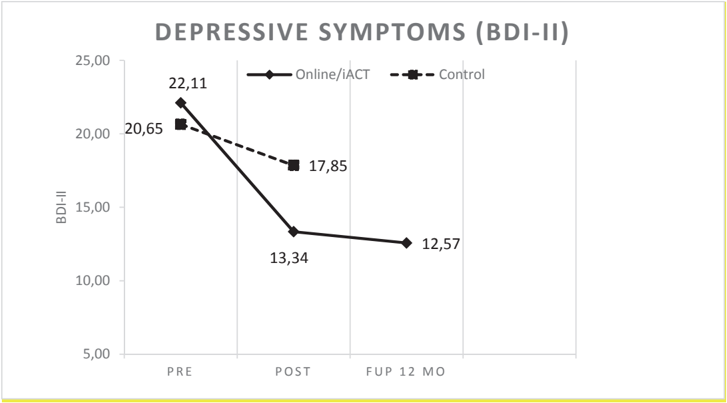
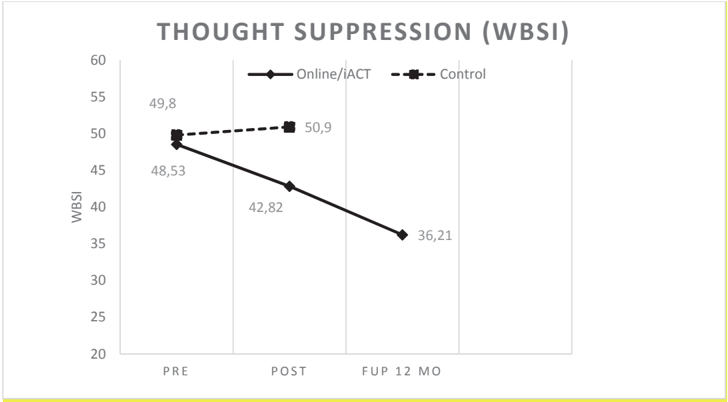
Low-intensity interventions for people suffering from depressive symptoms are highly desirable. The aim of the present study was to investigate the outcomes of a web-based acceptance and commitment therapy (ACT)–based intervention without face-to-face contact for people suffering from depressive symptoms. Participants ( N = 39) with depressive symptoms were randomly assigned to an Internet-delivered acceptance and commitment therapy (iACT) intervention or a waiting list control condition (WLC). Participants were evaluated with standardized self-reporting measures (Beck Depression Inventory [BDI-II], Symptom Checklist–90 [SCL-90], Acceptance and Action Questionnaire [AAQ-2], Five Facet Mindfulness Questionnaire [FFMQ], Automatic Thoughts Questionnaire [ATQ], and White Bear Suppression Inventory [WBSI]) at pre- and post-measurement. Long-term effects in the iACT group were examined using a 12-month follow-up. The iACT program comprised home assignments, online feedback given by master’s-level students of psychology over a 7-week intervention period, and automated email-based reminders. Significant effects were observed in favor of the iACT group on depression symptomatology (between effect sizes [ESs] at post-treatment, iACT/WLC, g = .83), psychological and physiological symptoms (g = .60), psychological flexibility (g = .67), mindfulness skills (g = .53), and frequency of automatic thoughts (g = .57) as well as thought suppression (g = .53). The treatment effects in the iACT group were maintained over the 12-month follow-up period (within-iACT ES: BDI-II, g = 1.33; SCL-90, g = 1.04; ATQF/B [Frequency/Believability], FFMQ, WBSI, AAQ-II, g = .74-1.08). The iACT participants stated that they would be happy to recommend the same intervention to others with depressive symptoms. We conclude that an ACT-based guided Internet-delivered treatment with minimal contact can be effective for people with depressive symptoms.
Overview
The claims and statistics of this paper haven’t been checked yet.
Free: it reads the open-access text and checks the first 5 claims that cite a source we can check. Create a free account to check every claim.
Integrity signals
Registry
Cites
Statistics
Figures



Verification
Claims the paper makes
The claims and statistics of this paper haven’t been checked yet.
Free: it reads the open-access text and checks the first 5 claims that cite a source we can check. Create a free account to check every claim.
Claims other papers make about this one
Each is checked against this paper’s own text: does it say what the citing paper says it does?
The cited source doesn’t support the claim as written.
In the citing paper
“One intervention [46] allowed participant’s free navigation of the system, meaning participants could access and complete modules in any order they decided.”
From Effectiveness of Web-Delivered Acceptance and Commitment Therapy in Relation to Mental Health and Well-Being: A Systematic Review and Meta-Analysis. (2016) · cites this paper as [46]
Checked by a reasoning model — may be wrong.
Experimental — accuracy not yet measuredThe source backs part of the claim, not all of it — or backs it for a different population, condition or comparison.
In the citing paper
“Relevant studies have shown that acceptance and commitment therapy can improve the negative emotions of college students, such as anxiety and depression, promote their mental health, and enhance their self-identity [6, 7].”
From Effect of Acceptance and Commitment Therapy Combined with Music Relaxation Therapy on the Self-Identity of College Students (2022) · cites this paper as [7]
Experimental — accuracy not yet measuredThe source backs part of the claim, not all of it — or backs it for a different population, condition or comparison.
In the citing paper
“Web-based ACT has also been found to be effective in addressing health challenges such as distress related to trauma, anxiety, depression, and chronic pain [20-22].”
From Implementation of an internet-based acceptance and commitment therapy for promoting mental health among migrant live-in caregivers in canada: Protocol (2021) · cites this paper as [22]
Experimental — accuracy not yet measuredThe source backs part of the claim, not all of it — or backs it for a different population, condition or comparison.
In the citing paper
“Previous research consistently shows the effectiveness of ACT in managing the core components of HB, including anger, depression, somatic symptoms, and emotional distress [6, 23-27].”
From User Experience and Clinical Utility of a Smartphone-Based Application for Hwa-Byung Treatment: a protocol for a single-arm prospective pilot study. (2026) · cites this paper as [26]
Experimental — accuracy not yet measuredThe source backs part of the claim, not all of it — or backs it for a different population, condition or comparison.
In the citing paper
“Of the 10 studies included, 4 (40%) were judged to be of low risk of bias [29,46,49,52], one (10%) of high risk [36], and an unclear risk of bias was assigned to 5 (50%) [45,47,48,50,51] of the included studies.”
From Effectiveness of Web-Delivered Acceptance and Commitment Therapy in Relation to Mental Health and Well-Being: A Systematic Review and Meta-Analysis. (2016) · cites this paper as [46]
Experimental — accuracy not yet measured
10 more claims about this paper
Create a free account to see every claim other papers make about this one.
Self-check
Percentages, sums and reported differences re-computed from the paper’s own numbers.
The self-check needs the paper’s full text.
Citations
Cites
Diagnostic and Statistical Manual of Mental Disorders.
Widiger, T. A. (2000) · Encyclopedia of Psychology, Vol. 3. · doi:10.1037/10518-009 · Cited by 19,744
Kessler, R. C. (1994) · Archives of General Psychiatry · doi:10.1001/archpsyc.1994.03950010008002 · Cited by 12,370 · cited 1×
“It is not only highly prevalent but is also associated with poor life quality, higher mortality rate, increased need for health services, and high economic costs (Alonso et al., 2004; Kessler et al., 1994).”
BackgroundProjections of Global Mortality and Burden of Disease from 2002 to 2030
Mathers, C. D., & Loncar, D. (2006) · PLoS Medicine · doi:10.1371/journal.pmed.0030442 · Cited by 11,386 · cited 1×
“Depressive disorders are projected to be one of the three leading causes of disease burden by the year 2030 (Mathers & Loncar, 2006).”
BackgroundStatistical Methods for Meta-Analysis
Wasserman, S., Hedges, L. V., & Olkin, I. (1988) · Journal of Educational Statistics · doi:10.2307/1164953 · Cited by 10,326
Jacobson, N. S., & Truax, P. (1991) · Journal of Consulting and Clinical Psychology · doi:10.1037/0022-006x.59.1.12 · Cited by 7,770 · cited 1×
“Clinical significance (Jacobson & Truax, 1991) of depressive mood based on the BDI-II (Beck et al., 2004) was examined at post-intervention and follow-up using the following four categories: (a) Recovered, (b) Improved, (c) Unchanged, (d) Deteriorated.”
MethodUsing Self-Report Assessment Methods to Explore Facets of Mindfulness
Baer, R. A., Smith, G. T., Hopkins, J., Krietemeyer, J., & Toney, L. (2006) · Assessment · doi:10.1177/1073191105283504 · Cited by 7,511
Acceptance and commitment therapy: model, processes and outcomes
Hayes, S. C., Luoma, J. B., Bond, F. W., Masuda, A., & Lillis, J. (2006) · Behaviour Research and Therapy · doi:10.1016/j.brat.2005.06.006 · Cited by 6,587 · cited 1×
“The online intervention consisted of six modules, based on the core processes of ACT, which promote psychological flexibility (see, for example, Hayes et al., 2006).”
MethodComparison of Beck Depression Inventories -IA and -II in psychiatric outpatients
Beck, A. T., Steer, R. A., Ball, R., & Ranieri, W. F. (1996) · Journal of Personality Assessment · doi:10.1207/s15327752jpa6703_13 · Cited by 5,965
Distribution Theory for Glass's Estimator of Effect Size and Related Estimators
Hedges, L. V. (1981) · Journal of Educational Statistics · doi:10.2307/1164588 · Cited by 5,695 · cited 1×
“Because of the small sample size, the possible bias of d was corrected by an unbiased estimate of Hedges’s g (Hedges, 1981; Hedges & Olkin, 1985).”
MethodBond, F. W., Hayes, S. C., Baer, R. A., Carpenter, K. M., Guenole, N., Orcutt, H. K., Waltz, T., & Zettle, R. D. (2011) · Behavior Therapy · doi:10.1016/j.beth.2011.03.007 · Cited by 3,950 · cited 9×
“We hypothesized that the ACT-based intervention would show positive effects on the symptoms of depression (Beck Depression Inventory [BDI-II], Symptom Checklist–90 [SCL-90]) and in the ACT-related process measures of psychological flexibility (Acceptance and Action Questionnaire [AAQ-II]), mindfulness (Five Facet Mind…”
MethodInfluential
Research works printed but not linked: 14
- 10.1037/0022-006X.64.6.1417 · DOI · Paper page
- Alonso J., 2004, Acta Psychiatrica Scandinavica. Supplementum, 420, 38
- Beck A. T., 2004, BDI II—Beckin depressioasteikko
- 10.1037/0022-006X.51.5.721 · DOI · Paper page
- Hayes S. C., 2008, Vapaudu mielesi vallasta ja ala elää: Hyväksymis- ja omistautumisterapian avulla
- Hayes S. C., 1999, Acceptance and commitment therapy: An experimental approach to behavior change
- 10.3102/10769986006002107 · doi:10.3102/10769986006002107 · Paper page
- Kohtala A., 2013, Behavioral and Cognitive Psychotherapies, 11, 1
- Lappalainen R., 2004, Hyväksymis- ja omistautumisterapia käytännön terapiatyössä
- Muthén L. K., 1998, Mplus user’s guide
- Öst L. G., 2006, KBT: Kognitiv beteendeterapi inom psykiatrin
- Ruiz F., 2010, International Journal of Psychology and Psychological Therapy, 10, 125
- Ruiz F., 2012, International Journal of Psychology and Psychological Therapy, 12, 333
- Twohig M. P., 2008, ACT verbatim for depression & anxiety
Cited by
Digital interventions for the treatment of depression: a meta-analytic review
Moshe, I., Terhorst, Y., Philippi, P., Domhardt, M., Cuijpers, P., Cristea, I., Pulkki-Råback, L., Baumeister, H., & Sander, L. B. (2021) · Psychological Bulletin · doi:10.1037/bul0000334 · Cited by 390
Acceptance and Commitment Therapy as a Treatment for Anxiety and Depression
Twohig, M. P., & Levin, M. E. (2017) · Psychiatric Clinics of North America · doi:10.1016/j.psc.2017.08.009 · Cited by 268
“One additional RCT, excluded from the table due to not including a non-ACT condition, compared ACT delivered through an online program (with minimal therapist contact) versus face-to-face therapy among 38 depressed adults from Finland.(76) Participants receiving an online”
MethodPersuasive technology in mobile applications promoting physical activity: a systematic review
Matthews, J., Win, K. T., Oinas-Kukkonen, H., & Freeman, M. (2016) · Journal of Medical Systems · doi:10.1007/s10916-015-0425-x · Cited by 239
“For instance, previous research has identified reminders as an important category for users to continue adherence to targeted behavior [46,47], however, not all reviewed research included the reminders as a persuasive feature.”
Räsänen, P., Lappalainen, P., Muotka, J., Tolvanen, A., & Lappalainen, R. (2016) · Behaviour Research and Therapy · doi:10.1016/j.brat.2016.01.001 · Cited by 221
“The Student Life Compass was created based on our earlier experiences of both brief face-to-face (Kohtala et al., 2015; Lappalainen et al., 2007), and online ACT interventions (Lappalainen et al., 2014, 2015).”
MethodSelf-citationBrown, M., Glendenning, A., Hoon, A. E., & John, A. (2016) · Journal of Medical Internet Research · doi:10.2196/jmir.6200 · Cited by 198
“Medical examination and telephone screening [49], computerized screening interview combined with a structured telephone interview [50-52], computerized screening followed by telephone interview and face-to-face meeting plus a medical confirmation of tinnitus [29], self-assessment questionnaires [36], structured clinic…”
BackgroundMethodInfluential
Metadata
- Authors
- Lappalainen, P., Langrial, S., Oinas-Kukkonen, H., Tolvanen, A., & Lappalainen, R.
- Affiliations
- University of Jyväskylä (FI)
- University of Oulu (FI)
- University of Oulu, Finland
- Corresponding author
- Lappalainen, Päivi
- Venue
- Behavior Modification
- Publisher
- SAGE Publications
- Published
- 2015-08-06
- Volume
- 39
- Issue
- 6
- Pages
- 805-834
- ISSN
- 0145-4455 (ISSN-L)
- 1552-4167
- OpenAlex
- W2222088826
- Semantic Scholar
- 25c774220ecaca3bf1b42e37ffbe460937433f01
- Cited by
- 115
- References
- 69
- Citations by year
- 2026: 2 · 2025: 8 · 2024: 16 · 2023: 10 · 2022: 11 · 2021: 15 · 2020: 13 · 2019: 11 · 2018: 8 · 2017: 10 · 2016: 9 · 2015: 2
- FWCI
- 15.73
- Type
- journal article
- Language
- en
- Open access
- green
- urn.fi
- Licence
- cc-by
- journals.sagepub.com/page/policies/text-and-data-mining-license (tdm)
- Locations
- Behavior Modification (publishedVersion)
- PubMed (publishedVersion)
- Jyväskylä University Digital Archive (University of Jyväskylä) (submittedVersion, cc-by)
- Funders
- Tekes
- Topics
- Social Sciences › Psychology › Applied Psychology › Digital Mental Health Interventions
- Social Sciences › Psychology › Clinical Psychology › Mindfulness and Compassion Interventions
- Social Sciences › Psychology › Experimental and Cognitive Psychology › Anxiety, Depression, Psychometrics, Treatment, Cognitive Processes
- Keywords
- acceptance and commitment therapy, online intervention, depressive symptoms, psychological flexibility, mindfulness, automatic thoughts, thought suppression, medication adherence, long-term treatment outcomes
- MeSH terms
- Adult, Depression, Depressive Disorder, Female, Humans, Male, Middle Aged, Psychiatric Status Rating Scales, Surveys and Questionnaires, Cognitive Behavioral Therapy, Treatment Outcome, Internet, Self Report, Mindfulness, Acceptance and Commitment Therapy
About these checks
Registry, retraction, Cites and statistics results are computed, not judged, with one exception: a printed reference that no index lists is read once by a model before it counts as a citation error. Claims are extracted by a model and kept only when their quote appears verbatim in the text; each cited source is then checked, with a model’s help, for whether it says what the claim relies on. Those verdicts can be wrong — read the claim’s quote and the cited source before relying on one.
Statistics and arithmetic are recomputed, not judged.
Confidence bands are shown only for fields calibrated on our annotated test set. None is calibrated yet, so no band is shown.
What counts as a claim ›How we measure confidence ›How we check this ›
Are you an author, or do you see a problem with this page? Request a review
How to cite
Cite CoChat for the checks on this page, and the paper for its own findings.
- This page
- CoChat. (2026). Citation check: Web-Based Acceptance and Commitment Therapy for Depressive Symptoms With Minimal Support: A Randomized Controlled Trial. https://app.cochat.ai/papers/10.1177/0145445515598142
- The paper
- Lappalainen, P., Langrial, S., Oinas-Kukkonen, H., Tolvanen, A., & Lappalainen, R. (2015). Web-Based Acceptance and Commitment Therapy for Depressive Symptoms With Minimal Support: A Randomized Controlled Trial. Behavior Modification. https://doi.org/10.1177/0145445515598142
Data sources
Bibliographic data: Semantic Scholar, OpenAlex, Crossref.
Contains information from the Semantic Scholar Academic Graph Datasets, made available under the ODC Attribution License (ODC-BY 1.0).
Semantic Scholar’s data is described in: Kinney, R., et al. (2023). The Semantic Scholar Open Data Platform. arXiv:2301.10140.
