

The DOI matches its Crossref record; 79 of the 80 references it cites were found in a registry or an index.
Gut to brain interaction in Autism Spectrum Disorders: a randomized controlled trial on the role of probiotics on clinical, biochemical and neurophysiological parameters
Open accessAbstract
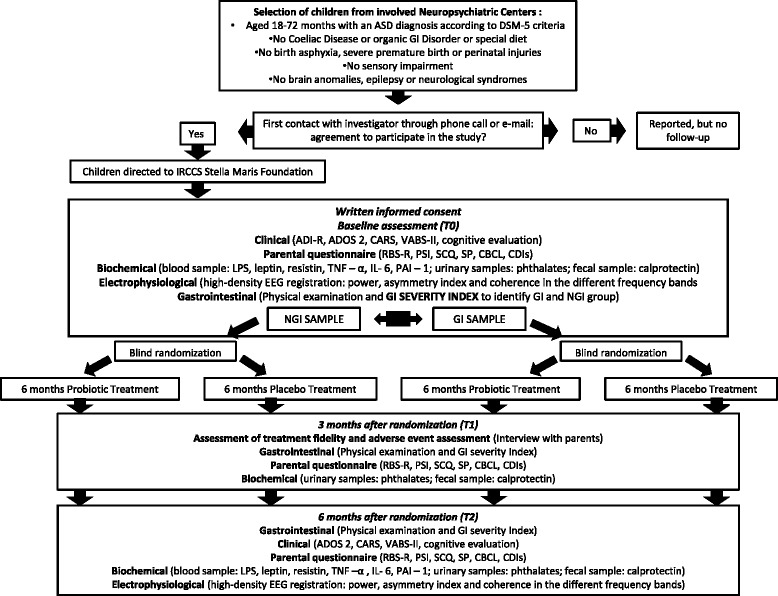
BACKGROUND: A high prevalence of a variety of gastrointestinal (GI) symptoms is frequently reported in patients with Autism Spectrum Disorders (ASD). The GI disturbances in ASD might be linked to gut dysbiosis representing the observable phenotype of a "gut-brain axis" disruption. The exploitation of strategies which can restore normal gut microbiota and reduce the gut production and absorption of toxins, such as probiotics addition/supplementation in a diet, may represent a non-pharmacological option in the treatment of GI disturbances in ASD. The aim of this randomized controlled trial is to determine the effects of supplementation with a probiotic mixture (Vivomixx®) in ASD children not only on specific GI symptoms, but also on the core deficits of the disorder, on cognitive and language development, and on brain function and connectivity. An ancillary aim is to evaluate possible effects of probiotic supplementation on urinary concentrations of phthalates (chemical pollutants) which have been previously linked to ASD. METHODS: A group of 100 preschoolers with ASD will be classified as belonging to a GI group or to a Non-GI (NGI) group on the basis of a symptom severity index specific to GI disorders. In order to obtain four arms, subjects belonging to the two groups (GI and NGI) will be blind randomized 1:1 to regular diet with probiotics or with placebo for 6 months. All participants will be assessed at baseline, after three months and after six months from baseline in order to evaluate the possible changes in: (1) GI symptoms; (2) autism symptoms severity; (3) affective and behavioral comorbid symptoms; (4) plasmatic, urinary and fecal biomarkers related to abnormal intestinal function; (5) neurophysiological patterns. DISCUSSION: The effects of treatments with probiotics on children with ASD need to be evaluated through rigorous controlled trials. Examining the impact of probiotics not only on clinical but also on neurophysiological patterns, the current trial sets out to provide new insights into the gut-brain connection in ASD patients. Moreover, results could add information to the relationship between phthalates levels, clinical features and neurophysiological patterns in ASD. TRIAL REGISTRATION: ClinicalTrials.gov Identifier: NCT02708901 . Retrospectively registered: March 4, 2016.
Overview
The claims and statistics of this paper haven’t been checked yet.
Run the check — free, no account needed. It reads the open-access text and checks the sources it cites.
Integrity signals
Registry
Cites
Statistics
Figures
Verification
Claims the paper makes
The claims and statistics of this paper haven’t been checked yet.
Run the check — free, no account needed. It reads the open-access text and checks the sources it cites.
Claims other papers make about this one
Each is checked against this paper’s own text: does it say what the citing paper says it does?
The source backs part of the claim, not all of it — or backs it for a different population, condition or comparison.
In the citing paper
“In the case of impaired BBB, which can be observed in certain (but not all) autistic subjects [37,254], LPS or SCFAs may cause brain inflammation and thus, further facilitate access to the brain for harmful substances, like heavy metals, that can accumulate there [228,246,255].”
From The Role of Microbiota-Gut-Brain Axis in Neuropsychiatric and Neurological Disorders (2021) · cites this paper as [255]
Experimental — accuracy not yet measured
Self-check
Percentages, sums and reported differences re-computed from the paper’s own numbers.
The self-check needs the paper’s full text.
Citations
Cites
Diagnostic and Statistical Manual of Mental Disorders
American Psychiatric Association (2013) · doi:10.1176/appi.books.9780890425596 · Cited by 116,369
Diagnostic and Statistical Manual of Mental Disorders
Williams, J. B. W., & First, M. B. (2013) · Oxford University Press eBooks · doi:10.1093/acrefore/9780199975839.013.104 · Cited by 109,845
Changes of Intestinal Functions in Liver Cirrhosis
Fukui, H., & Wiest, R. (2016) · Inflammatory Intestinal Diseases · doi:10.1159/000444436 · Cited by 6,820
Mind-altering microorganisms: the impact of the gut microbiota on brain and behaviour
Cryan, J. F., & Dinan, T. G. (2012) · Nature Reviews Neuroscience · doi:10.1038/nrn3346 · Cited by 4,572
Gut microbiota in health and disease
Sekirov, I., Russell, S. L., Antunes, L. C. M., & Finlay, B. B. (2010) · Physiological Reviews · doi:10.1152/physrev.00045.2009 · Cited by 4,182
Normal gut microbiota modulates brain development and behavior
Heijtz, R. D., Wang, S., Anuar, F., Qian, Y., Björkholm, B., Samuelsson, A., Hibberd, M. L., Forssberg, H., & Pettersson, S. (2011) · Proceedings of the National Academy of Sciences · doi:10.1073/pnas.1010529108 · Cited by 3,228
Cyclosporine in Severe Ulcerative Colitis Refractory to Steroid Therapy
Lichtiger, S., Present, D. H., Kornbluth, A. A., Gelernt, I. M., Bauer, J. J., Galler, G. W., Michelassi, F., & Hanauer, S. B. (1994) · New England Journal of Medicine · doi:10.1056/nejm199406303302601 · Cited by 1,715
Autism Diagnostic Observation Schedule
Lord, C., Rutter, M. L., Goode, S., Heemsbergen, J., Jordan, H., Mawhood, L., & Schopler, E. (1989) · PsycTESTS Dataset · doi:10.1037/t54175-000 · Cited by 1,697
Standardizing ADOS Scores for a Measure of Severity in Autism Spectrum Disorders
Gotham, K., Pickles, A., & Lord, C. (2009) · Journal of Autism and Developmental Disorders · doi:10.1007/s10803-008-0674-3 · Cited by 1,605
Gut/brain axis and the microbiota
Mayer, E. A., Tillisch, K., & Gupta, A. (2015) · Journal of Clinical Investigation · doi:10.1172/jci76304 · Cited by 1,503
Research works printed but not linked: 5
- Lord C, Rutter M, Di Lavore PC, Risi S, Gotham K, Bishop SL. Autism and Diagnostic Observation Schedule, Second Edition (ADOS-2) Manual (Part I): Modules 1–4. Torrance, CA: Western Psychological Services; 2012.
- Rutter M, Le Couteur A, Lord C. ADI-R: The autism diagnostic interview-revised. Los Angeles, CA: Western Psychological Services; 2003.
- Rutter M, Bailey A, Lord C. Social communication questionnaire (SCQ). Los Angeles: Western Psychological Services; 2003.
- Abidin RR. Parenting Stress Index - Short Form (3rd edition). Odessa, FL: Psychological Assessment Resources Inc; 1995.
- Fenson L, Dale PS, Reznick JS, Thal D, Bates E, Hartung JP, Pethick S, Reilly JS. MacArthur Communicative Development Inventories: User’s guide and technical manual. San Diego, CA: Singular Press; 1993.
Cited by
Sorted by citations
Items 101–200 of 213
Kumar, H., Diwan, V., & Sharma, B. (2022) · Clinical Psychopharmacology and Neuroscience · doi:10.9758/cpn.2022.20.4.725 · Cited by 13
He, X., Yang, Y., Zhou, S., Wei, Q., Zhou, H., Tao, J., Yang, G., & You, M. (2024) · Ecotoxicology and Environmental Safety · doi:10.1016/j.ecoenv.2024.117060 · Cited by 13
Modafinil Improves Autism-like Behavior in Rats by Reducing Neuroinflammation
Bağcıoğlu, E., Solmaz, V., Erbaş, O., Özkul, B., Çakar, B., Uyanıkgil, Y., & Söğüt, İ. (2023) · Journal of Neuroimmune Pharmacology · doi:10.1007/s11481-023-10061-2 · Cited by 16
Mamun, A. A., Geng, P., Wang, S., Shao, C., & Xiao, J. (2024) · Pharmacological Research · doi:10.1016/j.phrs.2024.107559 · Cited by 15
Guiducci, L., Vassalle, C., Prosperi, M., Santocchi, E., Morales, M. A., Muratori, F., & Calderoni, S. (2022) · Metabolites · doi:10.3390/metabo12070611 · Cited by 12
Self-citationAutism and neuro-immune-gut link
Siniscalco, D., Brigida, A. L., Antonucci, N., & 2 Italian Group for Studying Autism – GISA – 25018 Brescia, I. (2018) · AIMS molecular science · doi:10.3934/molsci.2018.2.166 · Cited by 12
Banerjee, A., Pradhan, L. K., Sahoo, P. K., Jena, K. K., Chauhan, N. R., Chauhan, S., & Das, S. K. (2021) · Archives of Microbiology · doi:10.1007/s00203-021-02276-9 · Cited by 13
Genomics as a Clinical Decision Support Tool: Successful Proof of Concept for Improved ASD Outcomes
Way, H., Williams, G. E., Hausman-Cohen, S., & Reeder, J. (2021) · Journal of Personalized Medicine · doi:10.3390/jpm11070596 · Cited by 12
Liu, Y., Ou, Y., Zhao, J., & Guo, W. (2021) · Journal of Psychiatric Research · doi:10.1016/j.jpsychires.2021.10.016 · Cited by 12
Probiotics in autism spectrum disorder: Recent insights from animal models
Golbaghi, N., Naeimi, S., Darvishi, A., Najari, N., & Cussotto, S. (2024) · Autism · doi:10.1177/13623613241246911 · Cited by 11
Devason, A. S., Thaiss, C. A., & de la Fuente‐Núñez, C. (2024) · ACS Chemical Neuroscience · doi:10.1021/acschemneuro.4c00307 · Cited by 11
Campanale, A., Siniscalco, D., & Marzo, V. D. (2025) · Journal of Biomedical Science · doi:10.1186/s12929-025-01145-7 · Cited by 13
Zarezadeh, M., Mahmoudinezhad, M., Hosseini, B., Khorraminezhad, L., Razaghi, M., Alvandi, E., & Saedisomeolia, A. (2023) · Clinical Nutrition · doi:10.1016/j.clnu.2023.06.014 · Cited by 12
Barba-Vila, O., García‐Mieres, H., & Ramos, B. (2024) · Nutrition Reviews · doi:10.1093/nutrit/nuae010 · Cited by 10
Salehi, M., Jaka, S., Lotfi, A., Ahmad, A., Saeidi, M., & Gunturu, S. (2025) · Children · doi:10.3390/children12030297 · Cited by 14
Yadav, A., Tadas, M., Kale, M. B., Wankhede, N. L., Umekar, M. J., Kotagale, N. R., & Taksande, B. G. (2025) · Physiology & Behavior · doi:10.1016/j.physbeh.2025.114989 · Cited by 11
Plaza‐Díaz, J., Radar, A. M., Baig, A. T., Leyba, M. F., Costabel, M. M., Zavala-Crichton, J. P., Sanchez‐Martinez, J., MacKenzie, A., & Solis‐Urra, P. (2022) · Children · doi:10.3390/children9121834 · Cited by 12
Immune Modulatory Treatments for Autism Spectrum Disorder
Thom, R. P., & McDougle, C. J. (2020) · Seminars in Pediatric Neurology · doi:10.1016/j.spen.2020.100836 · Cited by 9
Sabatini, G., Boccadoro, I., Prete, R., Battista, N., & Corsetti, A. (2025) · Nutrients · doi:10.3390/nu17152470 · Cited by 9
Tsujiguchi, H., Hara, A., Miyagi, S., Pham, K.-O., Suzuki, K., Nguyen, T. T. T., Ono, Y., Kambayashi, Y., Shimizu, Y., Nakamura, H., et al. (2022) · Autism · doi:10.1177/13623613221097487 · Cited by 8
Lee, Y.-F., Wu, M., Sheng‐Kai, K., Huang, J., & Wei, J. C. (2023) · Frontiers in Psychiatry · doi:10.3389/fpsyt.2023.1116239 · Cited by 8
Impact of Bacillus licheniformis from yaks following antibiotic therapy in mouse model
Zeng, Z., Gong, S., Quan, C., Zhou, S., Kulyar, M. F., Iqbal, M., Li, Y., Li, X. O., & Li, J. (2024) · Applied Microbiology and Biotechnology · doi:10.1007/s00253-023-12866-w · Cited by 7
Gut microbiota and its metabolism in autism spectrum disorder: from pathogenesis to therapy
Bu, W., Chen, Z., Liu, B., & Jia, X. (2026) · Frontiers in Cellular and Infection Microbiology · doi:10.3389/fcimb.2025.1687691 · Cited by 10
Ghodsi, R., & Kheirouri, S. (2019) · Current Pediatric Reviews · doi:10.2174/1573396315666190628141333 · Cited by 7
Zhang, X., Liu, L., Bai, W., Han, Y., & Hou, X. (2021) · Frontiers in Pediatrics · doi:10.3389/fped.2021.690339 · Cited by 8
O AUTISMO E SUAS CONEXÕES: QUAL MEDICAÇÃO PARA O AUTISTA?
Lopes, A. M. C. D. S. (2020) · Psicologia em Revista · doi:10.5752/p.1678-9563.2019v25n3p1343-1352 · Cited by 6
Age of machine learning: new trends in autism spectrum disorder prediction
Xu, W., Li, H., Li, J., & Jin, M. (2025) · Frontiers in Microbiology · doi:10.3389/fmicb.2025.1492484 · Cited by 6
Cauli, O., Guevara-González, J., Guevara-Campos, J., & González, L. (2021) · Current Clinical Pharmacology · doi:10.2174/2772432816666210805141257 · Cited by 9
Manokaran, R. K., & Gulati, S. (2021) · Elsevier eBooks · doi:10.1016/b978-0-12-823733-5.00017-9 · Cited by 6
Kim, M., Chung, S., Yang, J.-C., Park, J., Nam, S. H., & Park, T. W. (2020) · Journal of korean Academy of Child and Adolescent Psychiatry · doi:10.5765/jkacap.200013 · Cited by 7
Diet, Microbiome, and Neuropsychiatric Disorders
Javitt, G. A., & Javitt, D. C. (2018) · Elsevier eBooks · doi:10.1016/b978-0-12-811440-7.00013-2 · Cited by 6
Exploring the gut microbiota-hippocampus-metabolites axis dysregulation in sepsis mice
Song, F., Li, Q., Cui, J., Wang, J., Xiao, S., Yu, B., Sun, Y., Song, W., Wu, L., & Yongqin, Z. (2024) · Frontiers in Microbiology · doi:10.3389/fmicb.2024.1302907 · Cited by 7
Microbiota-Gut-Brain-Axis and Autism Spectrum DisordersPreprint
Srikantha, P., & Mohajeri, M. H. (2018) · Preprints.org · doi:10.20944/preprints201811.0171.v1 · Cited by 4
Rocchetti, M. T., Chiano, M. D., Elouardi, I., & Fiocco, D. (2025) · Global Pediatrics · doi:10.1016/j.gpeds.2025.100266 · Cited by 6
Liu, D., Ruan, M., Tong, C., & Huang, R. (2022) · Computational and Mathematical Methods in Medicine · doi:10.1155/2022/8286146 · Cited by 4
RetractedPsychobiotics: a new way in psychopharmacology, or How do bacteria manage our brain?
Andreeva, I. V., Tolpygo, A. V., Andreev, V. А., Azyzov, I. S., Golman, I. A., Osipova, N. N., Privolnev, V. V., Stetsiouk, О. U., & Sokolovskaya, V. V. (2022) · Clinical Microbiology and Antimicrobial Chemotherapy · doi:10.36488/cmac.2022.2.108-133 · Cited by 5
Tanaka, T., Matsumura, K., Tsuchida, A., Hamazaki, K., Kasamatsu, H., Hirai, H., Kusabiraki, S., Hiraiwa, A., Miya, K., Adachi, Y., et al. (2024) · PubMed Central · doi:10.6133/apjcn.202401_33(1).0008 · Cited by 4
Could Gut Modulation through Probiotic Supplementation Be Beneficial in Autism Spectrum Disorder?
Khatib, R. E., Karam‐Sarkis, D., Waligora‐Dupriet, A., & Butel, M. (2019) · IntechOpen eBooks · doi:10.5772/intechopen.89375 · Cited by 5
Guiducci, L., Cabiati, M., Santocchi, E., Prosperi, M., Morales, M. A., Muratori, F., Randazzo, E., Federico, G., Calderoni, S., & Ry, S. D. (2023) · Journal of Clinical Medicine · doi:10.3390/jcm12227162 · Cited by 4
Self-citationLakshmi, B. A., Buddolla, V., Gubbiyappa, K. S., Suneetha, M., & Kim, Y. J. (2026) · Progress in Neuro-Psychopharmacology and Biological Psychiatry · doi:10.1016/j.pnpbp.2026.111636 · Cited by 3
Psychobiotics in Health, Longevity, and Neurological Disorders
Mohankumar, A., Kalaiselvi, D., Thiruppathi, G., Patteswari, D., Tawata, S., & Sundararaj, P. (2022) · Nutritional neurosciences · doi:10.1007/978-981-16-8158-5_2 · Cited by 3
Hirai, H., Tanaka, T., Matsumura, K., Tsuchida, A., Hamazaki, K., Adachi, Y., Inadera, H., & the Japan Environment and Children’s Study Group (2024) · PLoS ONE · doi:10.1371/journal.pone.0305535 · Cited by 3
Sahebi, K., Arianejad, M., Azadi, S., Hosseinpour-Soleimani, F., Kazemi, R., Tajbakhsh, A., & Negahdaripour, M. (2025) · European Journal of Pharmacology · doi:10.1016/j.ejphar.2025.177630 · Cited by 3
Targeting gut microbiota as a possible therapeutic intervention in autism
El-Ansary, A. K., & Bhat, R. S. (2020) · Elsevier eBooks · doi:10.1016/b978-0-12-818466-0.00017-4 · Cited by 3
The Impacts of Probiotics on Microbiota in Patients With Autism Spectrum Disorder
Chen, H.-J., & Liu, Y.-W. (2021) · Elsevier eBooks · doi:10.1016/b978-0-12-819265-8.00101-7 · Cited by 3
O’Brien, K., & Blair, P. (2021) · Springer eBooks · doi:10.1007/978-3-030-78559-8_10 · Cited by 4
Мальцев, Д. (2021) · Men’s Health Gender and Psychosomatic Medicine · doi:10.37321/ujmh.2021.1-2-04 · Cited by 3
Lactic acid bacteria and Bifidobacterium as potential psychotherapeutics
Dey, G. (2023) · Elsevier eBooks · doi:10.1016/b978-0-323-91930-2.00004-3 · Cited by 2
Influence of intestinal dysbiosis on the course of authistic spectrum: literature review
Григорьянц, Э. О., Chervinets, Y. V., Chervinets, V. M., & Rumyantseva, E. S. (2024) · ASTRAKHAN MEDICAL JOURNAL · doi:10.17021/1992-6499-2024-4-16-30 · Cited by 2
A RELAÇÃO DA APLICAÇÃO DA CIRURGIA DE CONTROLE DE DANOS E SEUS EFEITOS CLÍNICOS
Nunes, E. D., Guimarães, A. L. O. S. D., GUIMARÃES, R. O. S. D., & França, D. S. (2020) · Amplamente Cursos e Formação Continuada eBooks · doi:10.47538/ac-2020.04-01 · Cited by 2
Balikji, J., Hoogbergen, M. M., Garssen, J., & Verster, J. C. (2022) · Brain Sciences · doi:10.3390/brainsci12080961 · Cited by 2
Bakhshi, A., Saberi, A., Norouzi, N., & Sedighi-Pirsaraei, N. (2023) · Romanian Journal of Neurology · doi:10.37897/rjn.2023.1.2 · Cited by 2
A terapia nutricional como estratégia na seletividade alimentar em crianças autistas
Bonfim, N. M., de Jesus, L. D., & da Silva, M. C. (2024) · Research Society and Development · doi:10.33448/rsd-v13i6.46121 · Cited by 4
Neonate gut colonization: The rise of a social brain
Karaivazoglou, K., Konstantakis, C., Assimakopoulos, S. F., & Triantos, C. K. (2019) · Neurogastroenterology & Motility · doi:10.1111/nmo.13767 · Cited by 2
ANÁLISE DOS EFEITOS GASTROINTESTINAIS NO TRANSTORNO DO ESPECTRO AUTISTA (TEA)
Leite, M. C., MORAIS, S. A. D., Ribeiro, C. C. F., SOUZA, V. V. S., Oliveira, C. S., & DUARTE, M. S. A. (2020) · Amplamente Cursos e Formação Continuada eBooks · doi:10.47538/ac-2020.04-04 · Cited by 2
Karley, D., Nayak, K. K., & Kolla, V. (2024) · CRC Press eBooks · doi:10.1201/9781003160663-17 · Cited by 1
Integrated analysis of metabolome and microbiome in a mouse model of sodium valproate-induced autism
Zhao, S., Zhang, X., Miao, Y., Gao, X., Wan, Q., Qiu, W., Si, H., Han, Y., Du, X., Feng, Y., et al. (2025) · Experimental Biology and Medicine · doi:10.3389/ebm.2025.10452 · Cited by 1
Srivastava, A. K., Singh, A., Yadav, D. P., Nath, G., & Ganju, L. (2025) · Elsevier eBooks · doi:10.1016/b978-0-443-34039-0.00009-3 · Cited by 1
Agrawal, S., Rao, S. C., Whitehouse, A., Alvares, G. A., Kulkarni, A., Taylor, J. A., Conway, P. L., Thomas, T., & Patole, S. (2026) · Nutrients · doi:10.3390/nu18132079 · Cited by 2
Zeng, Y., Wang, F., Li, S., Liu, Q., Liu, L., & Song, B. (2026) · Frontiers in Neuroscience · doi:10.3389/fnins.2026.1873864 · Cited by 1
The effect of intestinal microbiome on autism spectrum disorder
Γώγου, Μ., & Gogou, C. (2016) · Journal of Pediatric Sciences · doi:10.17334/jps.96721 · Cited by 1
Neurodevelopment, Intestinal Function, and Autism
Yu, E. C.-L. (2018) · Neonatal and Pediatric Medicine · doi:10.4172/2572-4983.1000166 · Cited by 1
BRITO, N. M. M., tobias, C. Q., Nogueira, J. D. C., Guimarães, T. F. D. S., & Paranhos, C. N. (2020) · Amplamente Cursos e Formação Continuada eBooks · doi:10.47538/ac-2020.04-06 · Cited by 1
Shah, F., & Dwivedi, M. (2022) · Springer eBooks · doi:10.1007/978-981-16-6760-2_4 · Cited by 1
Gastrointestinal Disturbances in Autism Spectrum Disorder
Gottesman-Katz, L., Miller, J. D., & Margolis, K. G. (2022) · Springer eBooks · doi:10.1007/978-3-031-15229-0_28 · Cited by 1
El-Ansary, A. K., & AL-Ayadhi, L. Y. (2023) · Nutrients · doi:10.3390/nu15214564 · Cited by 1
Dedgaonkar, S. G., & Sachdeo, R. (2024) · Intelligent Decision Technologies · doi:10.3233/idt-220215 · Cited by 1
Greydanus, D. E., Gregoire-Bottex, M., & Merrick, J. (2016) · International Journal of Adolescent Medicine and Health · doi:10.1515/ijamh-2016-0127 · Cited by 1
Headache in Autism Spectrum Disorders
Canitano, R., & Schroder, C. M. (2017) · Headache · doi:10.1007/978-3-319-54726-8_14 · Cited by 1
Therapeutic dietary approach to children with autistic spectrum disorder
Torres, F. C. I., Medina, A. C. D. G., Toribio, S. L. G., Guevara, K. K. J., Risco, K. B. L., & Huamán-Saavedra, J. J. (2022) · Revista de la Facultad de Medicina Humana · doi:10.25176/rfmh.v22i4.4729 · Cited by 6
Suchkov, S. (2023) · Immunology Research and Immunotherapy · doi:10.59462/irit.1.1.103
What Have Proteomic Studies Taught Us About Novel Drug Targets in Autism?
Guest, P. C., & Martins‐de‐Souza, D. (2017) · Advances in experimental medicine and biology · doi:10.1007/978-3-319-52479-5_3
Miyao, M. (2018) · リハビリテーション医学 : 日本リハビリテーション医学会誌 · doi:10.2490/jjrmc.55.989
de Freitas, D. L. R., Paiva, L. L. G., & Fernandes, C. R. D. F. (2020) · Amplamente Cursos e Formação Continuada eBooks · doi:10.47538/ac-2020.04
Autism Spectrum Disorder and Co-morbidities: A Closer Look at Pathogenesis and Clinical Implications
Kong, X. (2020) · American Journal of Biomedical Science & Research · doi:10.34297/ajbsr.2020.07.001168
DEPRESSÃO INFANTO-JUVENIL: DIAGNÓSTICO E TRATAMENTO MULTIDISCIPLINAR
Freitas, A. O., Grangeiro, C. S., de OLIVEIRA, K. K., Pinto, L. V. D., MENDES, V. F., & França, D. S. (2020) · Amplamente Cursos e Formação Continuada eBooks · doi:10.47538/ac-2020.04-11
ANÁLISE DA TAXA DE MORTALIDADE DA POPULAÇÃO BRASILEIRA POR LEUCEMIA NA FAIXA ETÁRIA DE 0 A 14 ANOS
de Moraes, R. P. S., Timbó, S. E. S., Timbó, S. S., & Britto, L. C. A. (2020) · Amplamente Cursos e Formação Continuada eBooks · doi:10.47538/ac-2020.04-02
BENEFÍCIOS DO USO DA HIDROTERAPIA NO TRABALHO DE PARTO
Sousa, J. D. N., Resende, A. K. M., Muniz, R. K. B., Oliveira, C. P., Alves, V. K. D. M., Ferreira, R. D. S. A., & Prudêncio, F. A. (2020) · Amplamente Cursos e Formação Continuada eBooks · doi:10.47538/ac-2020.04-08
Viana, L. M., Campolina, M. C. S. B., Fonseca, M. K. S., Gontijo, C. M. V., Viana, L. M., & VIANA, G. M. (2020) · Amplamente Cursos e Formação Continuada eBooks · doi:10.47538/ac-2020.04-25
Silva, M. V. S. (2020) · Amplamente Cursos e Formação Continuada eBooks · doi:10.47538/ac-2020.04-14
CANDIDÍASE INTRA-ABDOMINAL EM PACIENTES PÓS CIRÚRGICOS
Filho, W. V. M., da Silveira, G. A., & Aoqui, I. D. S. (2020) · Amplamente Cursos e Formação Continuada eBooks · doi:10.47538/ac-2020.04-09
LÍTIO NA INSUFICIÊNCIA RENAL CRÔNICA ASSOCIADA A DIABETES INSIPIDUS
da Câmara, M. M. G. C., Araújo, C. S., Bianchi, M. W., & Machado, L. C. D. S. (2020) · Amplamente Cursos e Formação Continuada eBooks · doi:10.47538/ac-2020.04-20
AVULSÃO DENTÁRIA: CONSIDERAÇÕES DE UM PROJETO DE EXTENSÃO À COMUNIDADE
da Cruz, G. S., Rocha, M. A., Schmidt, L. S., Porto, M. G., Aderne, E. W. S., & de Oliveira, T. C. (2020) · Amplamente Cursos e Formação Continuada eBooks · doi:10.47538/ac-2020.04-07
Cardoso, B. C. D. R., Costa, L. K. C., de Oliveira, L. G., Martins, R. G., Monteiro, C. C. D. A., Bandeira, C. G., da Silva, E. C., Fagundes, L. C. M., Brito, C. E. D. S., Dantas, A. S. F., et al. (2020) · Amplamente Cursos e Formação Continuada eBooks · doi:10.47538/ac-2020.04-27
de Souza, J. C. O., Matos, L. B. S., Galvão, N. S., & de Menezes, S. S. C. (2020) · Amplamente Cursos e Formação Continuada eBooks · doi:10.47538/ac-2020.04-12
ANÁLISE E COMPARAÇÃO DO NÍVEL DE APTIDÃO FÍSICA ENTRE AS CRIANÇAS DE UMA ESCOLA PÚBLICA E PARTICULAR
Flôr, E. C. C., & de FARIA, J. A. (2020) · Amplamente Cursos e Formação Continuada eBooks · doi:10.47538/ac-2020.04-05
Alluhaim, W., Alkhulaifi, M. M., & Menezes, G. A. (2021) · Journal of Pharmaceutical Research International · doi:10.9734/jpri/2021/v33i931222
STRUCTURAL CHANGES IN RESISTANCE HEATERS BASED ON ZIRCONIUM DIOXIDE.
Rutman, D. C., Taksis, G. A., & Perepelitsin, V. A. (1971) · OSTI OAI (U.S. Department of Energy Office of Scientific and Technical Information)
Mintál, K., Tóth, A., Hormay, E., Kovács, A., László, K., Bufa, A., Marosvölgyi, T., Kocsis, B., Varga, A., Vizvári, Z., et al. (2022) · Research Square · doi:10.21203/rs.3.rs-1235045/v1
Micronutrients and Autism Spectrum Disorder
Dzulkifli, M. A. (2022) · Nutritional neurosciences · doi:10.1007/978-981-16-6467-0_12
Ofei, S. Y., & Fuchs, G. J. (2019) · Autism and child psychopathology series · doi:10.1007/978-3-030-13027-5_16
Humanização em terapia intensiva - Aspectos iniciais
Ferreira, F. H. (2021) · Editora Conhecimento Livre eBooks · doi:10.37423/210403979
O TRANSTORNO DO ESPECTRO AUTISTA E A DISBIOSE INTESTINAL: UMA REVISÃO DE LITERATURA
Alves, A. K. R., da Silva, B. B. L., Machado, L. F. C. B., VILELA, N. G. B., Noronha, F. M. C., Ibiapina, M. D. L. P., Melo, P. D. S., Santos, V. R., Bucar, L. E. Q., da Silva, G. B., et al. (2022) · Editora Pasteur eBooks · doi:10.29327/562655.4-1
Microbiota intestinal e sua relação com o autismo: uma revisão integrativa
Martins, H. A., Molina, B. M., & Santiago, A. C. (2022) · Concilium · doi:10.53660/clm-623-686 · Cited by 1
赵, 君. (2022) · Advances in Clinical Medicine · doi:10.12677/acm.2022.12121607
Role of microbiota-gut-brain axis on neurotransmitter modulation
Anitha, K., Bhatt, S., Chikatipalli, R., & Ravula, P. (2025) · Elsevier eBooks · doi:10.1016/b978-0-443-21680-0.00016-x
Diseases Deriving from Alterations of the Ecological Niche—Part II: Regarding the Holobiont
Libertini, G., Corbi, G., Shubernetskaya, O. S., Komici, K., & Ferrara, N. (2024) · Advances in studies of aging and health · doi:10.1007/978-3-031-84877-3_4
Enlightenment of ESCAP Autism Practice Guidelines for Autism Intervention Education in China
陶, 朝. (2025) · Vocational Education · doi:10.12677/ve.2025.142096
Yañez-Flores, K., Castillo-Tapia, J., Alegría-Villablanca, M., & López-Espinoza, M. Á. (2025) · Salud Ciencia y Tecnología - Serie de Conferencias · doi:10.56294/sctconf20251456
Metadata
- Authors
- Santocchi, E., Guiducci, L., Fulceri, F., Billeci, L., Buzzigoli, E., Apicella, F., Calderoni, S., Grossi, E., Morales, M. A., & Muratori, F.
- Affiliations
- Fondazione Stella Maris (IT)
- Istituto di Fisiologia Clinica (IT)
- University of Pisa (IT)
- Corresponding author
- Santocchi, Elisa
- ORCID
- Venue
- BMC Psychiatry
- Published
- 2016-06-04
- Volume
- 16
- Issue
- 1
- Pages
- 183-183
- ISSN
- 1471-244X (ISSN-L)
- PMC
- PMC4893248
- OpenAlex
- W2415115978
- Cited by
- 213
- References
- 80
- Citations by year
- 2026: 11 · 2025: 20 · 2024: 25 · 2023: 16 · 2022: 30 · 2021: 21 · 2020: 33 · 2019: 21 · 2018: 14 · 2017: 14 · 2016: 7
- FWCI
- 11.88
- Type
- journal article
- Language
- en
- Open access
- gold
- doi.org
- Licence
- Locations
- BMC Psychiatry (publishedVersion, cc-by)
- Europe PMC (PubMed Central) (publishedVersion, cc-by)
- PubMed Central (publishedVersion, cc-by)
- PubMed (publishedVersion)
- CINECA IRIS Institutial research information system (University of Pisa) (submittedVersion, cc-by)
- Funders
- Ministero della Salute (GR-2011-02348280, Ricerca Corrente, and the “5x1000” voluntary contributions)
- Tuscany Region (GR- 2010-2317873, Bando FAS Salute Sviluppo Toscana (ARIANNA Project))
- Topics
- Life Sciences › Neuroscience › Cognitive Neuroscience › Autism Spectrum Disorder Research
- Life Sciences › Biochemistry, Genetics and Molecular Biology › Molecular Biology › Gut microbiota and health
- Life Sciences › Agricultural and Biological Sciences › Food Science › Probiotics and Fermented Foods
- Keywords
- autism spectrum disorder, probiotics, gut-brain axis, gut dysbiosis, gastrointestinal symptoms, probiotic supplementation, phthalates, urinary biomarkers, autism severity, behavioral comorbidities, preschool children, language and cognitive development, fecal biomarkers
- MeSH terms
- Autism Spectrum Disorder, Gastrointestinal Microbiome, Brain, Child, Child, Preschool, Female, Gastrointestinal Diseases, Humans, Male, Comorbidity, Prevalence, Dietary Supplements, Probiotics
About these checks
Registry, retraction, Cites and statistics results are computed, not judged, with one exception: a printed reference that no index lists is read once by a model before it counts as a citation error. Claims are extracted by a model and kept only when their quote appears verbatim in the text; each cited source is then checked, with a model’s help, for whether it says what the claim relies on. Those verdicts can be wrong — read the claim’s quote and the cited source before relying on one.
Statistics and arithmetic are recomputed, not judged.
Confidence bands are shown only for fields calibrated on our annotated test set. None is calibrated yet, so no band is shown.
What counts as a claim ›How we measure confidence ›How we check this ›
Are you an author, or do you see a problem with this page? Request a review
