

The incidence of post-traumatic stress disorder among survivors after earthquakes:a systematic review and meta-analysis
Open accessThe DOI matches its Crossref record; 66 of the 66 references it cites were found in a registry or an index.
Abstract
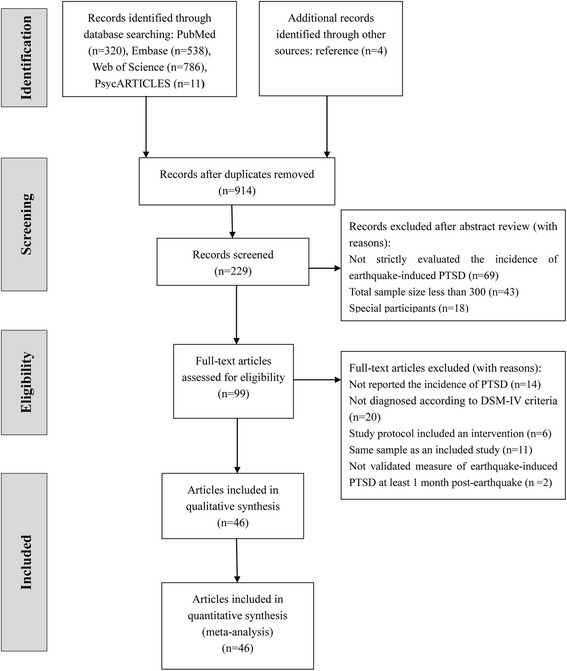
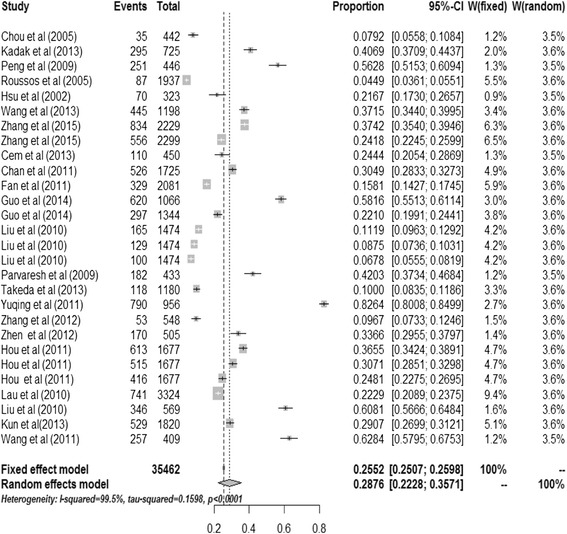
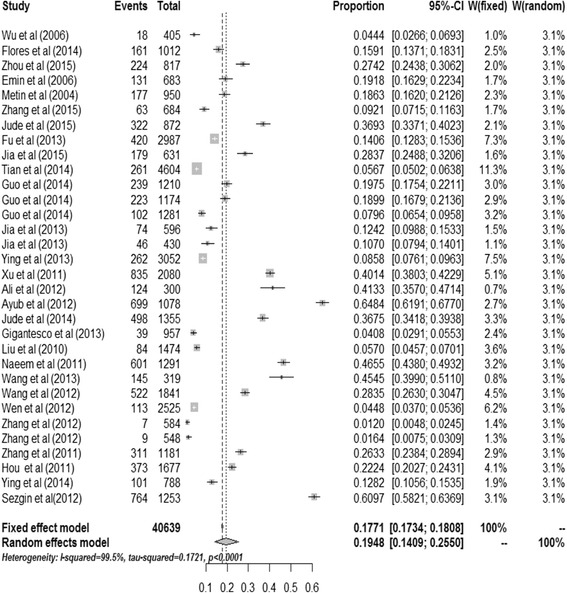
BACKGROUND: Post-traumatic stress disorder (PTSD) is a common psychological disorder caused by unusual threats or catastrophic events. Little is known about the combined incidence of PTSD after earthquakes. This study aimed at evaluating the combined incidence of PTSD among survivors after earthquakes using systematic review and meta-analysis. METHODS: The electronic databases of PubMed, Embase, Web of Science and PsycARTICLES were searched for relevant articles in this study. Loney criteria were used to assess the quality of eligible articles. The combined incidence of PTSD was estimated by using the Freeman-Tukey double arcsine transformation method. Subgroup analyses were conducted using the following variables: the time of PTSD assessment, gender, educational level, marital status, damage to one's house, bereavement, injury of body and witnessing death. RESULTS: Forty-six eligible articles containing 76,101 earthquake survivors met the inclusion criteria, of which 17,706 were diagnosed as having PTSD. Using a random effects model, the combined incidence of PTSD after earthquakes was 23.66 %. Moreover, the combined incidence of PTSD among survivors who were diagnosed at not more than 9 months after earthquake was 28.76 %, while for survivors who were diagnosed at over nine months after earthquake the combined incidence was 19.48 %. A high degree of heterogeneity (I(2) = 99.5 %, p<0.001) was observed in the results, with incidence ranging from 1.20 to 82.64 %. The subgroup analyses showed that the incidence of PTSD after earthquake varied significantly across studies in relation to the time of PTSD assessment, gender, educational level, damage to one's house, bereavement, injury of body and witnessing death. However, stratified analyses could not entirely explain the heterogeneity in the results. CONCLUSIONS: Given the high heterogeneity observed in this study, future studies should aim at exploring more possible risk factors for PTSD after earthquakes, especially genetic factors. In spite of that, the results of this study suggest that nearly 1 in 4 earthquake survivors are diagnosed as having PTSD. Therefore, the local government should plan effective psychological interventions for earthquake survivors.
Overview
The claims and statistics of this paper haven’t been checked yet.
Free: it reads the open-access text and checks the first 5 claims that cite a source we can check. Create a free account to check every claim.
Integrity signals
Registry
Cites
Statistics
Figures
Verification
Claims the paper makes
The claims and statistics of this paper haven’t been checked yet.
Free: it reads the open-access text and checks the first 5 claims that cite a source we can check. Create a free account to check every claim.
Claims other papers make about this one
Each is checked against this paper’s own text: does it say what the citing paper says it does?
The cited source says what the claim attributes to it.
In the citing paper
“meta-analyses of past earthquakes have found somewhat lower average PTSD prevalence (on the order of ~15–25% of survivors)”
From Coping strategies and psychological outcomes following the 2023 Kahramanmaraş earthquakes: a systematic review with meta-analytic synthesis (2026) · cites this paper as [5]
The check wasn’t confident either way, so it gives no verdict — never disputed.
In the citing paper
“Earthquake studies indicate that survivors who feel connected to family, friends, and community tend to report less distress, likely because social support provides opportunities to confide, obtain help, and rebuild a sense of safety (5).”
From Coping strategies and psychological outcomes following the 2023 Kahramanmaraş earthquakes: a systematic review with meta-analytic synthesis (2026) · cites this paper as [5]
Experimental — accuracy not yet measured
Self-check
Percentages, sums and reported differences re-computed from the paper’s own numbers.
The self-check needs the paper’s full text.
Citations
Cites
Tolin, D. F., & Foa, E. B. (2006) · Psychological Bulletin · doi:10.1037/0033-2909.132.6.959 · Cited by 2,197 · cited 1×
“Those findings were consistent with conclusions of many studies in disaster psychology [17, 18].”
ResultPost-traumatic stress disorder following disasters: a systematic review
Neria, Y., Nandi, A., & Galea, S. (2008) · Psychological Medicine · doi:10.1017/s0033291707001353 · Cited by 1,429 · cited 1×
“It has been regarded as the most prevalent type of psychiatric disorder after disasters [4], including earthquake, tsunami, flood, etc.”
BackgroundThe Epidemiology of Post-Traumatic Stress Disorder after Disasters
Galea, S., Nandi, A., & Vlahov, D. (2005) · Epidemiologic Reviews · doi:10.1093/epirev/mxi003 · Cited by 1,287 · cited 1×
“The incidence of PTSD symptoms were higher in the immediate aftermath of the earthquake [14].”
BackgroundCritical appraisal of the health research literature: prevalence or incidence of a health problem.
Loney, P., Chambers, L. W., BENNETT, K. J., Roberts, J. G., & Stratford, P. W. (1998) · PubMed · Cited by 550
Roussos, A., Goenjian, A. K., Steinberg, A. M., Sotiropoulou, C., Kakaki, M., Kabakos, C., Karagianni, S., & Manouras, V. (2005) · American Journal of Psychiatry · doi:10.1176/appi.ajp.162.3.530 · Cited by 389 · cited 1×
“Roussos et al [31] 2005 Cross-sectional Ano Liosia, Greece 5.”
BackgroundFan, F., Zhang, Y., Yang, Y., Mo, L., & Liu, X. (2011) · Journal of Traumatic Stress · doi:10.1002/jts.20599 · Cited by 310 · cited 2×
“Fan et al [41] 2011 Cross-sectional Wenchuan, China 8.”
BackgroundInfluentialBaşoǧlu, M., Kiliç, C., Şalcioǧlu, E., & Livanou, M. (2004) · Journal of Traumatic Stress · doi:10.1023/b:jots.0000022619.31615.e8 · Cited by 283 · cited 1×
“Metin et al [28] 2004 Cross-sectional Marma, Turkey 7.”
BackgroundArmenian, H. K., Morikawa, M., Melkonian, A. K., Hovanesian, A. P., Haroutunian, N., Saigh, P. A., Akiskal, K., & Akiskal, H. S. (2000) · Acta Psychiatrica Scandinavica · doi:10.1034/j.1600-0447.2000.102001058.x · Cited by 234 · cited 1×
“In line with some previous studies [15], the subgroup analyses also indicated that damage to one’s house, bereavement, injury of body and witnessing death would contribute to the different incidences of PTSD, suggesting that those who suffered more property loss or personal injury or had witnessed death or had experie…”
ResultPosttraumatic Stress Disorder Among Adolescent Earthquake Victims in Taiwan
HSU, C.-C., CHONG, M.-Y., YANG, P., & YEN, C.-F. (2002) · Journal of the American Academy of Child & Adolescent Psychiatry · doi:10.1097/00004583-200207000-00022 · Cited by 198 · cited 1×
“Hsu et al [34] 2002 Cross-sectional Chi-Chi,Taiwan 7.”
Dell’Osso, L., Carmassi, C., Massimetti, G., Daneluzzo, E., Tommaso, S. D., & Rossi, A. (2011) · Journal of Affective Disorders · doi:10.1016/j.jad.2010.11.023 · Cited by 188 · cited 1×
“Background Earthquakes are one of the most destructive and frequently occurring natural disasters [1].”
Background
Cited by
Items 201–300 of 308
Assessment of Post-Traumatic Stress Disorder in Survivors of the Al Haouz Earthquake
Amara, Y., Hanine, I., Salim, J., Gartoum, M., Mouhadi, K., & Kadiri, M. (2024) · SAS Journal of Medicine · doi:10.36347/sasjm.2024.v10i09.028 · Cited by 2
Examining the earthquake-related experiences of people who experienced the earthquake in Turkey
Cemali, M., Arslan, B., Öztürk, D., Sari, M. E., Alataş, D. M., Cimilli, E., & Karaduman, A. A. (2024) · International Journal of Social Psychiatry · doi:10.1177/00207640241306067 · Cited by 2
“It is known that after an earthquake, survivors often seek to engage in a variety of supportive activities as part of their coping strategy and recovery (Dai et al., 2016).”
Bayram, H. M., İpek, R., Sancak, B. N., & Eroğlu, M. S. (2025) · Online Türk Sağlık Bilimleri Dergisi · doi:10.26453/otjhs.1555533 · Cited by 2
Çokluk, G. F., & Savaş, E. (2025) · Gaziantep Islam Science and Technology University · doi:10.46871/eams.1564013 · Cited by 2
Lök, N., Bademli, K., Uzun, G., & Tosun, A. S. (2025) · Current Psychology · doi:10.1007/s12144-025-08217-9 · Cited by 2
“Although numerous studies have identified general PTSD risk factors following earthquakes—such as gender, socio-economic status, and prior trauma (Başoğlu et al., 2002; Dai et al., 2016 ; Tang et al., 2017)—less attention has been given to the subjective, existential dimensions of trauma.”
InfluentialKim, E., Yeo, J., Kim, Y., & Ha, I. (2022) · Journal of Epidemiology · doi:10.2188/jea.je20220171 · Cited by 2
Prevalence and risk factors of posttraumatic stress disorder in COVID-19
Medina, Ó., Gil, A. O., Arenas-Villamizar, V. V., Ortega, Á., Rojas, M., Chávez-Castillo, M., & Araque-Castellanos, F. (2023) · F1000Research · doi:10.12688/f1000research.128811.1 · Cited by 3
Moderated mediation role of trust in authorities by the Kahramanmaras earthquake survivors
Mavruk, C., Çam, S., & Şengül, S. (2024) · Environmental Hazards · doi:10.1080/17477891.2024.2419021 · Cited by 2
“Consistent with Salcioglu et al. (2003), Sumer et al. (2005) and Dai et al. (2016), women’s PDS was higher than men and women had better knowledge about earthquake precautions.”
Çınaroğlu, M., & Yılmazer, E. (2026) · Frontiers in Public Health · doi:10.3389/fpubh.2026.1776931 · Cited by 1
Novianti, N., Supriatna, M., & Nadhirah, N. A. (2023) · Indonesian Journal of Educational Counseling · doi:10.30653/001.202372.280 · Cited by 2
Arifah, N., Ismunandar, I., Gustini, Sukmawati, S., Yuwono, D. K., Galenso, N., & Pangaribuan, H. (2024) · Psychiatry Nursing Journal (Jurnal Keperawatan Jiwa) · doi:10.20473/pnj.v6i2.48029 · Cited by 1
Büyükbodur, A. Ç., Kılıçlı, A., Genç, M., & Erkan, Ü. (2024) · OPUS Toplum Araştırmaları Dergisi · doi:10.26466/opusjsr.1529740 · Cited by 1
Öztürk, E. N. Y., & Karataş, V. (2024) · Sakarya Üniversitesi Holistik Sağlık Dergisi · doi:10.54803/sauhsd.1489266 · Cited by 2
Ergenler için Deprem Sonrası Bilişler Ölçeği’nin Geliştirilmesi: Geçerlik ve Güvenirlik Çalışmaları
Demir, S., & Koçtürk, N. (2025) · Erzincan Üniversitesi Eğitim Fakültesi Dergisi · doi:10.17556/erziefd.1543374 · Cited by 1
Deprem Sonrası Travma Belirtilerinin Hatay İli Özelinde İncelenmesi
Urnek, S., & Kara, B. (2025) · Selçuk Üniversitesi Sosyal Bilimler Enstitüsü Dergisi · doi:10.52642/susbed.1468368 · Cited by 2
Küçükkelepçe, O., Konyalıoğlu, F. S., Kurt, O., & Öz, E. (2025) · Disaster Medicine and Public Health Preparedness · doi:10.1017/dmp.2025.10078 · Cited by 1
Yürümez, Y., Eren, M. G., Pelın, M., Üçgül, K., & Sert, H. (2025) · Psychology Health & Medicine · doi:10.1080/13548506.2025.2519242 · Cited by 2
Post Traumatic Stress Disorder and Food Preferences: Earthquake Disaster of The Century
Ustaoğlu, T., Özer, Z. P., Öztürk, H. İ., & Berk, İ. (2025) · Gümüşhane Üniversitesi Sağlık Bilimleri Dergisi · doi:10.37989/gumussagbil.1559606 · Cited by 2
PTSD, Anxiety, and Depressive Reactions Among Iranian Adolescent Girls After Community Trauma
Azimisefat, P., Glass, P., Kanske, P., & Herzog, P. (2025) · Journal of Loss and Trauma · doi:10.1080/15325024.2025.2552262 · Cited by 1
“…traumatic experiences, including age, female gender, previous and subsequent traumatic experiences, exposure to violence, acute distress during the event, and family or community violence (Armenian et al., 2000; Cénat et al., 2020; Dai et al., 2016; Groome & Soureti, 2004; Street et al., 2005).”
Najem, Y., Saad, H., Malaeb, D. N., Dabbous, M., Sakr, F., Hallit, R. R., Fekih‐Romdhane, F., Obeïd, S., & Hallit, S. R. (2025) · Journal of Child & Adolescent Trauma · doi:10.1007/s40653-025-00777-z · Cited by 1
“However, other studies have shown a signifi - cant difference in the incidence of PTSD, ranging from 1.20 to 82.64% in earthquake survivors (Acharya Pandey et al., 2023; Dai et al., 2016; Guo et al., 2014; Kun et al., 2009; Zhang et al., 2015).”
InfluentialExperiences and Biopsychosocial Needs of Women in an Earthquake During the Postpartum Period
Öztürk, R., & Erdogan, R. A. (2025) · Disaster Medicine and Public Health Preparedness · doi:10.1017/dmp.2025.10236 · Cited by 1
“7,43 Therefore, post-earthquake disaster logistics procedures are an essential stage of disaster management.”
Taşdemir, T. (2025) · Tarih okulu · doi:10.29228/joh.80129 · Cited by 1
Arpacı, R., Çalışkan, A., & Tanrıverdi, D. (2025) · Journal of Psychosocial Nursing and Mental Health Services · doi:10.3928/02793695-20251104-03 · Cited by 1
Gültekin, M. H., & Bulut, Y. (2025) · Discover Psychology · doi:10.1007/s44202-025-00538-x · Cited by 1
“Natural disasters such as earthquakes may pose a threat to well-being because they involve intense traumatic experiences [20].”
Effects of disasters on children’s fear, stress, insomnia, and wellbeing in Türkiye
Ceylan, S. S. (2026) · Current Psychology · doi:10.1007/s12144-025-08524-1 · Cited by 1
“Similarly, Çelik et al. (2024) found that the rates of PTSD and ASD were higher in the adolescent age group than in children after the Kahramanmaraş earthquake.”
InfluentialShui, A., van den Berg, G. J., Mierau, J. O., & Viluma, L. (2026) · Journal of Health Economics · doi:10.1016/j.jhealeco.2026.103118 · Cited by 1
Future Expectations and Psychiatric Symptoms in Earthquake Victim Adolescents
Çolak, M., & Şireli, Ö. (2026) · OSMANGAZİ JOURNAL OF MEDICINE · doi:10.20515/otd.1680832 · Cited by 1
Aldaş, Ş., Ersoy, M., Tosun, M. D., Tunç, A., Gökulu, G., Vatansever, E., Aynacı, F. S., Katlan, B., Özdem, S., Özmen, B. Ö., et al. (2026) · Journal of Evaluation in Clinical Practice · doi:10.1111/jep.70379 · Cited by 1
Temporal Trends and Epidemiological Profile of Disasters in Oceania: 2000–2023
García, A. F., Martínez, J. A. C., & González, P. I. A. (2026) · Public Health Nursing · doi:10.1111/phn.70097 · Cited by 1
Child-centred nursing education in disaster preparedness: Strengthening knowledge and awareness
Özarslan, S., Yayan, E. H., & Günay, U. (2026) · International Emergency Nursing · doi:10.1016/j.ienj.2026.101822 · Cited by 1
Bekiroğlu, S., Özden, S. A., & Çakmak, E. (2026) · Geopsychiatry · doi:10.1016/j.geopsy.2026.100076 · Cited by 2
Özmaya, E., Erkoç, B. H., & Uzun, S. (2026) · Karamanoğlu Mehmetbey Üniversitesi Sosyal Ve Ekonomik Araştırmalar Dergisi · doi:10.18493/kmusekad.1632900 · Cited by 1
Coşkun-Toker, A., Kurt, G., Malkoç, G., & Acartürk, C. (2026) · BJPsych Open · doi:10.1192/bjo.2026.12016 · Cited by 1
Zhou, J., & Wei, J. (2026) · Frontiers in Public Health · doi:10.3389/fpubh.2026.1894225 · Cited by 1
Posttraumatic Stress Disorder: Children and Psychological Trauma
Çeri, V. (2018) · Advances in psychology, mental health, and behavioral studies (APMHBS) book series · doi:10.4018/978-1-5225-7513-9.ch001 · Cited by 1
THE PRESENCE OF POST-TRAUMATIC STRESS DISORDER (PTSD) LEVEL AT LOMBOK EARTHQUAKE SURVIVORS
Estiadewi, P. S., Devy, S. R., Nihayati, H. E., & Yusuf, A. (2019) · International Journal of Nursing and Health Services (IJNHS) · doi:10.35654/ijnhs.v2i4.162 · Cited by 1
“According to the study by Dai et al. (2016), the incidence of PTSD among women who survived after the earthquake was higher than that of men.”
BackgroundPosttraumatic Stress Disorder: Children and Psychological Trauma
Çeri, V. (2021) · IGI Global eBooks · doi:10.4018/978-1-7998-8544-3.ch004 · Cited by 1
García-Vega, M., Marqueses, J. M. S., de Marina, A. G., Morán, N., & Sanz, J. (2022) · Anuario Internacional de Revisiones en Psicología · doi:10.14635/revpsy.2.4 · Cited by 1
CBT Intervention Post-2023 Southeast Türkiye Quake: A Case Study
Çınaroğlu, M. (2024) · Aksaray Üniversitesi Sosyal Bilimler Enstitüsü Dergisi · doi:10.38122/ased.1474770 · Cited by 1
Mavruk, C. (2025) · Yönetim ve Ekonomi Araştırmaları Dergisi · doi:10.11611/yead.1575134 · Cited by 1
The Influence of Urban Safety on Housing Choices
Itma, M., & Khayyat, L. (2025) · International Review for Spatial Planning and Sustainable Development · doi:10.14246/irspsd.13.1_112 · Cited by 1
Ünal, G. A., Avcı, U. K., & Özdemir, E. (2025) · Neuropsychiatric Disease and Treatment · doi:10.2147/ndt.s514707 · Cited by 2
Shui, A., van den Berg, G. J., Mierau, J. O., & Viluma, L. (2025) · SSRN Electronic Journal · doi:10.2139/ssrn.5262276 · Cited by 1
Artoni, V. (2018) · DSpaceUnipr (University of Parma)
Sepúlveda, C. M. (2018) · RIO (Universidad Pablo de Olavide)
Cerna-Turoff, I. (2020) · LSHTM Research Online (London School of Hygiene and Tropical Medicine) · doi:10.17037/pubs.04658954 · Cited by 1
Kao, C.-Y., Bradshaw, T., & Mazarakis, T. (2021) · Tzu Chi Medical Journal · doi:10.4103/tcmj.tcmj_123_20
“Posttraumatic stress disorder in Taiwan adolescents The few previous studies in Taiwan assessing the role of gender in adolescent PTSD tend to find higher prevalence rates among females [19].”
BackgroundBacker, H. D. (2021) · Springer Publishing Company eBooks · doi:10.1891/9780826149039.0008
Lam, L. T., & Reddy, P. (2023) · Frontiers research topics · doi:10.3389/978-2-83252-136-6
Oh, S. K., Kang, B., Song, J., Iijima, Y., Hikichi, H., Park, E., & Kawachi, I. I. (2024) · SSRN Electronic Journal · doi:10.2139/ssrn.4822464
Şirin, Y. E., Uluer, T., & Tiyekli, E. (2024) · Lecture notes in civil engineering · doi:10.1007/978-3-031-57357-6_48
İlkokul Çağı Çocuklarının Depreme Yönelik Görüşlerinin İncelenmesi
Bilmez, B., Sultaoğlu, S. Ç., Vural, S., BOĞA, E., & ALAGÖZ, N. (2023) · Bartın University Journal of Educational Research
Öney, T., Eryılmaz, İ., Dinç, M., & Bayrakçı, E. (2024) · İş ve İnsan Dergisi · doi:10.18394/iid.1531145
Matsuki, N., Kadowaki, T., & Yorifuji, T. (2025) · Medical Acupuncture · doi:10.1089/acu.2025.0010
Ergenlerde Deprem Sonrası Travma Tepkisinin İnternet ve Dijital Oyun Bağımlılığı İle İlişkisi
Güler, M., & Şenses, N. G. (2025) · TRT Akademi · doi:10.37679/trta.1660863
Crisis and Trauma Theoretical Framework and Applications in Psychological Counseling
Mukba, G., & Canoğulları, Ö. (2025) · Akademisyen Kitabevi eBooks · doi:10.37609/akya.3661
Ayık, Y., Kaya, H., Sarışahin, S., Öztürk, B., & Kayıhan, H. (2025) · British Journal of Occupational Therapy · doi:10.1177/03080226251347192 · Cited by 1
“%) are diagnosed with PTSD (Dai et al., 2016).”
Yan, D., Tang, T., & Liu, Y. (2025) · Scientific Reports · doi:10.1038/s41598-025-09905-z · Cited by 1
Önder, D., & Keskin, G. (2025) · International Journal of Social Psychiatry · doi:10.1177/00207640251356721
“Nonetheless, consistent with findings from Dai et al. (2016) and Tang et al. (2017), our results underscore the role of educational attainment as a proxy for resilience-related variables, reinforcing the need to consider structural inequalities in both research and intervention strategies targeting…”
Oh, S. S., Kang, B., Okuzono, S. S., Song, I. H., Park, E., & Kawachi, I. I. (2025) · doi:10.2196/preprints.81583
Keenan, O., Murphy, J., Dunlop, P., Doherty, E., Hugh, R. M., & Kirby, K. (2025) · Journal of Traumatic Stress · doi:10.1002/jts.70011
Aka, P., Kaplan, İ., & Akış, G. (2025) · Çukurova Üniversitesi Sosyal Bilimler Enstitüsü Dergisi · doi:10.35379/cusosbil.1595638
Acharya Pandey, R., Chalise, P., Khadka, S., Chaulagain, B., Maharjan, B., Pandey, J., Nepal, J., & Pandey, C. (2024) · Figshare · doi:10.6084/m9.figshare.26589456
Afectividad negativa y rendimiento académico en estudiantes universitarios
Taveras-Pichardo, L. C. (2024) · Universidad de Córdoba Insitutional Repository (Universidad de Córdoba) · Cited by 3
Freschi, G. (2020) · Adelaide Research & Scholarship (AR&S) (University of Adelaide)
Kurudirek, F., Kadiroğlu, T., Demirdöğen, E. Y., & Barbak, Z. D. (2023) · Fenerbahçe Üniversitesi Sağlık Bilimleri Dergisi
Depreme Maruz Kalan Bireylerin Psikolojik Durumlarının Aile Planlaması Tutumları Üzerine Etkisi
Şenol, D. K., Öztürk, A., & Akdemir, İ. (2024) · Mersin üniversitesi sağlık bilimleri dergisi/Mersin üniversitesi sağlık bilimleri dergisi · Cited by 2
Nina Estrella, R. (2023) · Dialnet (Universidad de la Rioja) · Cited by 1
Missier, F. D., Savadori, L., Galvagni, A., Pezzi, E., Scurci, G., Patacca, A., Dolce, M., & Bucci, D. D. (2026) · Journal of Risk Research · doi:10.1080/13669877.2025.2611957 · Cited by 1
“…consequences of earthquakes, such as depression (e.g. Cénat and Derivois 2014; Önder et al. 2006), anxiety (e.g. Yıldırım et al. 2025), PtSD (Dai et al. 2016; naeem et al. 2011), fear for the future (e.g. Salcioglu, ozden, and Ari 2018), lower life satisfaction and perceived quality of…”
InfluentialÇetindaş, K. (2024) · Hasan Kalyoncu University Institutional Repository (Hasan Kalyoncu University)
Güler, M., & Şenses, N. G. (2025) · TRT Akademi
Yılmaz, H. Y., & BAHADIR, E. (2025) · Cumhuriyet Tıp Dergisi/Cumhuriyet Üniversitesi Tıp Fakültesi dergisi
Hayashi, F., Ohira, T., Takahashi, A., Ueda, Y., Nakano, H., Okazaki, K., Nagao, M., Sato, S., Maeda, M., Miura, I., et al. (2026) · Scientific Reports · doi:10.1038/s41598-026-41265-0
“A subgroup analysis of one meta-analysis study also showed that those with lower levels of education were more likely to develop PTSD after an earthquake 50 .”
Kappan, E., & Thiagarajan, V. S. (2026) · Discover Psychology · doi:10.1007/s44202-026-00667-x
Turgut, D., Künüroğlu, F., & Erismis, H. (2026) · Psychiatric Quarterly · doi:10.1007/s11126-026-10276-5
Özyürek, A., & Atalay, D. (2026) · Sosyal Politika Çalışmaları Dergisi · doi:10.21560/spcd.vi.1597016
Yanardağ, R. (2026) · Adıyaman üniversitesi sosyal bilimler enstitüsü dergisi/Adıyaman üniversitesi sosyal bilimler enstitisü dergisi · doi:10.14520/adyusbd.1854133
Karadağ, M., Çalıkoğlu, E. O., Bulucu, B. B., Ruhm, F., Çalışgan, B., Coban, G. B., Erk, İ., Otucu, E., Kurt, U. B., Chaban, Z., et al. (2026) · Journal of Emergency and Disaster Medicine · doi:10.1007/s44467-026-00013-0
Rahman, M. M., Hossain, S., Ahmed, I., IRIBE, T., Hossain, M. S., Arafat, K. M. I. U., & Alam, E. (2026) · Progress in Disaster Science · doi:10.1016/j.pdisas.2026.100594
Remote EMDR versus CBT for PTSD after the Kahramanmaraş earthquakes: a randomized trial
Çınaroğlu, M., Yılmazer, E., Ülker, S. V., & Sayar, G. H. (2026) · Frontiers in Psychiatry · doi:10.3389/fpsyt.2026.1779057 · Cited by 1
Baskiran, D. Y., & Bayır, B. (2026) · BMC Psychology · doi:10.1186/s40359-026-04855-1
“…results align with previous research showing that fear, exposure to material and life losses, gender (e.g., being female), prior trauma, traumatic dis‑ tress, lack of social support, age extremes, and low edu‑ cational level are associated with PTSD, depression, and anxiety symptoms [22, 24–26].”
Cansel, N., Kurt, O., Gürbüz, A. E. S., Bulut, M., Melez, Ş. N. İ., & Tetik, B. K. (2026) · Healthcare · doi:10.3390/healthcare14121599
“Previous studies have reported inconsistent findings regarding socioeconomic indicators and occupational mental health outcomes [45,46].”
Sarıoğlu, G. (2026) · Discover Psychology · doi:10.1007/s44202-026-00779-4
Öğretmen Adaylarında Deprem Sonrası Travma ve Başa Çıkma Stratejileri Arasındaki İlişki
Çetintaş, A., Özdemir, S., Karabatak, S., & Alanoğlu, M. (2026) · Avrasya Beşeri Bilim Araştırmaları Dergisi · doi:10.7596/abbad.1926130
Post-disaster psychological effects: identifying earthquake-induced trauma in athletes
UĞURLU, F. M., GÜLER, M., ALBAYRAK, V., & Aygören, C. (2026) · Frontiers in Psychology · doi:10.3389/fpsyg.2026.1804335
“A meta-analysis of 46 studies found that the prevalence of post-traumatic stress disorder (PTSD) resulting from earth-quakes was 23.66% (Dai et al., 2016).”
InfluentialAlbuaini, S., Najjar, M., Mustafa, Y., Hasan, M., Tawfik, M. I. Y., & Saeed, L. (2026) · Journal of International Medical Research · doi:10.1177/03000605261464268
“6,9,69 Experiencing suicidal thoughts was associated with signi fi cantly increased odds of developing PTSD compared with participants who did not have such thoughts (OR: 2.159; p < 0.001).”
InfluentialFukunaga, A., Nagaya, M., Chimed-Ochir, O., Yumiya, Y., Sakata, T., Taji, A., Akahoshi, K., Mimura, S., Wakai, A., Kondo, H., et al. (2026) · Progress in Disaster Science · doi:10.1016/j.pdisas.2026.100661
Kadınlarda Deprem Sonrası Travma Düzeyi ile Cinsel Yaşam Kalitesi Arasındaki İlişki
Baş, Y. Ç., Yücetürk, S., & Çuvadar, A. (2025) · DSpace-Sinop (Sinop University)
Can, I., Çimşir, E., & Çapan, B. E. (2026) · European Journal of Psychotraumatology · doi:10.1080/20008066.2026.2708410
“Meta-analytic evidence further suggests that nearly one in four earthquake survivors meets diagnostic criteria for posttraumatic stress disorder (Dai et al., 2016), underscoring the substantial psychological burden associated with such disasters.”
Bozak, A., & Beyaztunç, O. (2026) · Natural Hazards Review · doi:10.1061/nhrefo.nheng-2496
Paira, K., & Ao, M. (2026) · International Journal of Geography Geology and Environment · doi:10.22271/27067483.2026.v8.i8a.845
Atli, A., & ALPDOĞAN, F. F. (2026) · Japanese Psychological Research · doi:10.1111/jpr.70047
GEÇİM, G. Y. D., & Okuyucu, K. (2026) · Revista da Escola de Enfermagem da USP · doi:10.1590/1980-220x-reeusp-2026-0270en
“Similarly, a systematic review and meta-analysis on post-traumatic stress disorder highlighted the necessity for local governments to implement effective psychological interventions for individuals affected by earthquakes (17) .”
GEÇİM, G. Y. D., & Okuyucu, K. (2026) · Revista da Escola de Enfermagem da USP · doi:10.1590/1980-220x-reeusp-2026-0270es
Temperament and posttraumatic stress disorder symptoms
Cyniak‐Cieciura, M. (2017) · ReIn UW (University of Warsaw)
Omoge, A. O., Omoge, M. O., AHMAD, A.-R. F., Onifade, P. B., & Arogundade, A. O. (2026) · Mental Wellness · doi:10.4081/mw.2026.67
“5 In contrast, Nigerian studies, particularly those involving IDPs, report substantially higher estimates, with some studies documenting depression rates exceeding 60% and PTSD prevalence approaching 45%.”
The experience of motherhood in a container city: the effects of the earthquake and changing needs
ÇABUK, F. U., Meral, S. E., Engin, K., Aksoy, M. K., Ulutaş, İ., & Şahin, F. T. (2026) · Frontiers in Psychology · doi:10.3389/fpsyg.2026.1924330
“Earthquakes are considered a traumatic disaster in terms of loss and severity (Dai et al., 2016).”
Metadata
- Authors
- Dai, W., Chen, L., Lai, Z., Li, Y., Wang, J., & Liu, A.
- Affiliations
- Central South University (CN)
- Corresponding author
- Liu, Aizhong
- Venue
- BMC Psychiatry
- Published
- 2016-06-07
- Volume
- 16
- Issue
- 1
- Pages
- 188-188
- ISSN
- 1471-244X (ISSN-L)
- PMC
- PMC4895994
- OpenAlex
- W2415716286
- Cited by
- 281
- References
- 66
- Citations by year
- 2026: 40 · 2025: 56 · 2024: 54 · 2023: 28 · 2022: 13 · 2021: 24 · 2020: 15 · 2019: 23 · 2018: 16 · 2017: 10 · 2016: 2
- FWCI
- 2.52
- Type
- journal article
- Language
- en
- Open access
- gold
- doi.org
- Licence
- cc-by
- Locations
- BMC Psychiatry (publishedVersion, cc-by)
- Europe PMC (PubMed Central) (publishedVersion, cc-by)
- PubMed Central (publishedVersion, cc-by)
- PubMed (publishedVersion)
- D-Scholarship@Pitt (University of Pittsburgh) (acceptedVersion)
- Funders
- the Specialized Research Fund for the Doctoral Program of Higher Education (20130162110054)
- the Fundamental Research Funds for the postgraduates of Central South University (2015zzts282)
- Topics
- Social Sciences › Psychology › Clinical Psychology › Posttraumatic Stress Disorder Research
- Social Sciences › Psychology › Clinical Psychology › Migration, Health and Trauma
- Social Sciences › Geography, Planning and Development › Earthquake and Disaster Impact Studies
- Keywords
- post-traumatic stress disorder, earthquakes, earthquake survivors, PTSD incidence, disaster mental health, bereavement, witnessing death, risk factors, psychological intervention
- MeSH terms
- Bereavement, Disasters, Female, Grief, Humans, Male, Risk Factors, Stress Disorders, Post-Traumatic, Incidence, Survivors, Earthquakes
About these checks
Registry, retraction, Cites and statistics results are computed, not judged, with one exception: a printed reference that no index lists is read once by a model before it counts as a citation error. Claims are extracted by a model and kept only when their quote appears verbatim in the text; each cited source is then checked, with a model’s help, for whether it says what the claim relies on. Those verdicts can be wrong — read the claim’s quote and the cited source before relying on one.
Statistics and arithmetic are recomputed, not judged.
Confidence bands are shown only for fields calibrated on our annotated test set. None is calibrated yet, so no band is shown.
What counts as a claim ›How we measure confidence ›How we check this ›
Are you an author, or do you see a problem with this page? Request a review
Data sources
Bibliographic data: Semantic Scholar, OpenAlex, Crossref.
Contains information from the Semantic Scholar Academic Graph Datasets, made available under the ODC Attribution License (ODC-BY 1.0).
Semantic Scholar’s data is described in: Kinney, R., et al. (2023). The Semantic Scholar Open Data Platform. arXiv:2301.10140.
