

External validation of the international risk prediction algorithm for major depressive episode in the US general population: the PredictD-US study
Open accessThe DOI matches its Crossref record; 33 of the 33 references it cites were found in a registry or an index.
Abstract
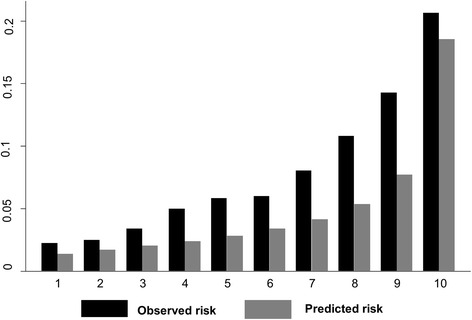
BACKGROUND: Multivariable risk prediction algorithms are useful for making clinical decisions and for health planning. While prediction algorithms for new onset of major depression in the primary care attendees in Europe and elsewhere have been developed, the performance of these algorithms in different populations is not known. The objective of this study was to validate the PredictD algorithm for new onset of major depressive episode (MDE) in the US general population. METHODS: Longitudinal study design was conducted with approximate 3-year follow-up data from a nationally representative sample of the US general population. A total of 29,621 individuals who participated in Wave 1 and 2 of the US National Epidemiologic Survey on Alcohol and Related Conditions (NESARC) and who did not have an MDE in the past year at Wave 1 were included. The PredictD algorithm was directly applied to the selected participants. MDE was assessed by the Alcohol Use Disorder and Associated Disabilities Interview Schedule, based on the DSM-IV criteria. RESULTS: Among the participants, 8 % developed an MDE over three years. The PredictD algorithm had acceptable discriminative power (C-statistics = 0.708, 95 % CI: 0.696, 0.720), but poor calibration (p < 0.001) with the NESARC data. In the European primary care attendees, the algorithm had a C-statistics of 0.790 (95 % CI: 0.767, 0.813) with a perfect calibration. CONCLUSIONS: The PredictD algorithm has acceptable discrimination, but the calibration capacity was poor in the US general population despite of re-calibration. Therefore, based on the results, at current stage, the use of PredictD in the US general population for predicting individual risk of MDE is not encouraged. More independent validation research is needed.
Overview
The claims and statistics of this paper haven’t been checked yet.
Free: it reads the open-access text and checks the first 5 claims that cite a source we can check. Create a free account to check every claim.
Integrity signals
Registry
Cites
Statistics
Figures


Verification
Claims the paper makes
The claims and statistics of this paper haven’t been checked yet.
Free: it reads the open-access text and checks the first 5 claims that cite a source we can check. Create a free account to check every claim.
Claims other papers make about this one
Each is checked against this paper’s own text: does it say what the citing paper says it does?
The source backs part of the claim, not all of it — or backs it for a different population, condition or comparison.
In the citing paper
“1,732 (47.0, Chile); 0.71(C-index) 300 29,621 (43.8 US); 0.71(AUC) 301”
From Preventive psychiatry: a blueprint for improving the mental health of young people (2021) · cites this paper as [301]
Experimental — accuracy not yet measured
Self-check
Percentages, sums and reported differences re-computed from the paper’s own numbers.
The self-check needs the paper’s full text.
Citations
Cites
Diagnostic and Statistical Manual of Mental Disorders
Williams, J. B. W., & First, M. (2013) · Encyclopedia of Social Work · doi:10.1093/acrefore/9780199975839.013.104 · Cited by 109,519
Zhang, Q., Wang, C., Zheng, M., Li, Y., Li, J., Zhang, L., Shang, X., & Yan, C. (2015) · Cerebrovascular Diseases · doi:10.1159/000369778 · Cited by 11,533
Projections of Global Mortality and Burden of Disease from 2002 to 2030
Mathers, C. D., & Loncar, D. (2006) · PLoS Medicine · doi:10.1371/journal.pmed.0030442 · Cited by 11,386
Diagnostic and Statistical Manual of Mental Disorders
(2010) · Handbook of Disease Burdens and Quality of Life Measures · doi:10.1007/978-0-387-78665-0_5485 · Cited by 10,169
Whiteford, H. A., Degenhardt, L., Rehm, J., Baxter, A. J., Ferrari, A. J., Erskine, H. E., Charlson, F. J., Norman, R. E., Flaxman, A. D., Johns, N., et al. (2013) · The Lancet · doi:10.1016/s0140-6736(13)61611-6 · Cited by 6,006
Clinical Prediction Models: A Practical Approach to Development, Validation, and Updating
Steyerberg, E. W. (2019) · Statistics for Biology and Health · doi:10.1007/978-3-030-16399-0 · Cited by 3,281
Antlanger, M., Aschauer, S., Kopecky, C., Hecking, M., Kovarik, J. J., Werzowa, J., Mascherbauer, J., Genser, B., Säemann, M. D., & Bonderman, D. (2017) · Kidney and Blood Pressure Research · doi:10.1159/000473868 · Cited by 2,808
The Epidemiology of Depression Across Cultures
Kessler, R. C., & Bromet, E. J. (2013) · Annual Review of Public Health · doi:10.1146/annurev-publhealth-031912-114409 · Cited by 2,657 · cited 1×
“5 % in high-income income countries, respectively [5].”
Cross-national epidemiology of DSM-IV major depressive episode
Bromet, E., Andrade, L. H., Hwang, I., Sampson, N. A., Alonso, J., de Girolamo, G., de Graaf, R., Demyttenaere, K., Hu, C., Iwata, N., et al. (2011) · BMC Medicine · doi:10.1186/1741-7015-9-90 · Cited by 2,221 · cited 1×
“In the US general population, the lifetime prevalence of major depression was 16 % [3].”
BackgroundTowards better clinical prediction models: seven steps for development and an ABCD for validation
Steyerberg, E. W., & Vergouwe, Y. (2014) · European Heart Journal · doi:10.1093/eurheartj/ehu207 · Cited by 1,928
Cited by
Preventive psychiatry: a blueprint for improving the mental health of young people
Fusar‐Poli, P., Correll, C. U., Arango, C., Berk, M., Patel, V., & Ioannidis, J. P. A. (2021) · World Psychiatry · doi:10.1002/wps.20869 · Cited by 497
Treatment selection in depression.
Cohen, Z. D., & DeRubeis, R. J. (2018) · Annual Review of Clinical Psychology · doi:10.1146/annurev-clinpsy-050817-084746 · Cited by 435
“Similarly, models predicting the onset of major depressive episodes in European primary care (King et al. 2008) have not generalized to the US general population (Nigatu et al. 2016).”
BackgroundEbert, D. D., Cuijpers, P., Muñoz, R. F., & Baumeister, H. (2017) · Frontiers in Psychiatry · doi:10.3389/fpsyt.2017.00116 · Cited by 244
“There have been first studies in the mental health field predicting MDD onset (94, 95) in the general population, general anxiety and panic onset in general practice attendees (96) panic recurrence (97), or recurrence of suicidal ideation (97).”
BackgroundSalazar de Pablo, G., Studerus, E., Vaquerizo-Serrano, J., Irving, J., Catalan, A., Oliver, D., Baldwin, H., Danese, A., Fazel, S., Steyerberg, E. W., et al. (2021) · Schizophrenia Bulletin · doi:10.1093/schbul/sbaa120 · Cited by 219
The Science of Prognosis in Psychiatry: A Review
Fusar-Poli, P., Hijazi, Z., Stahl, D., & Steyerberg, E. W. (2018) · JAMA Psychiatry · doi:10.1001/jamapsychiatry.2018.2530 · Cited by 197
Metadata
- Authors
- Nigatu, Y. T., Liu, Y., & Wang, J.
- Affiliations
- University of Calgary (CA)
- Corresponding author
- Nigatu, Yeshambel T.
- Venue
- BMC Psychiatry
- Published
- 2016-07-22
- Volume
- 16
- Issue
- 1
- Pages
- 256-256
- ISSN
- 1471-244X (ISSN-L)
- PMC
- PMC4957334
- OpenAlex
- W2499474258
- Cited by
- 18
- References
- 33
- Citations by year
- 2022: 1 · 2021: 4 · 2020: 4 · 2019: 2 · 2018: 5 · 2017: 2
- FWCI
- 4.72
- Type
- journal article
- Language
- en
- Open access
- gold
- doi.org
- Licence
- Locations
- BMC Psychiatry (publishedVersion, cc-by)
- PubMed Central (publishedVersion, cc-by)
- PubMed (publishedVersion)
- Funders
- Canadian Institutes of Health Research (114970_1)
- National Institute on Alcohol Abuse and Alcoholism
- National Institute on Drug Abuse
- Topics
- Health Sciences › Medicine › Psychiatry and Mental health › Mental Health Treatment and Access
- Health Sciences › Medicine › Pharmacology (medical) › Treatment of Major Depression
- Social Sciences › Psychology › Experimental and Cognitive Psychology › Anxiety, Depression, Psychometrics, Treatment, Cognitive Processes
- Keywords
- major depressive episode, depression risk prediction, external validation, algorithm calibration, discrimination (statistics), NESARC, cross-population generalizability
- MeSH terms
- Adult, Algorithms, Major Depressive Disorder, Depressive Disorder, Major, Female, Humans, Longitudinal Studies, Male, Middle Aged, Predictive Value of Tests, Primary Health Care, Risk Factors, United States, Prevalence, Risk Assessment, Diagnostic and Statistical Manual of Mental Disorders
About these checks
Registry, retraction, Cites and statistics results are computed, not judged, with one exception: a printed reference that no index lists is read once by a model before it counts as a citation error. Claims are extracted by a model and kept only when their quote appears verbatim in the text; each cited source is then checked, with a model’s help, for whether it says what the claim relies on. Those verdicts can be wrong — read the claim’s quote and the cited source before relying on one.
Statistics and arithmetic are recomputed, not judged.
Confidence bands are shown only for fields calibrated on our annotated test set. None is calibrated yet, so no band is shown.
What counts as a claim ›How we measure confidence ›How we check this ›
Are you an author, or do you see a problem with this page? Request a review
How to cite
Cite CoChat for the checks on this page, and the paper for its own findings.
- This page
- CoChat. (2026). Citation check: External validation of the international risk prediction algorithm for major depressive episode in the US general population: the PredictD-US study. https://app.cochat.ai/papers/10.1186/s12888-016-0971-x
- The paper
- Nigatu, Y. T., Liu, Y., & Wang, J. (2016). External validation of the international risk prediction algorithm for major depressive episode in the US general population: the PredictD-US study. BMC Psychiatry. https://doi.org/10.1186/s12888-016-0971-x
Data sources
Bibliographic data: Semantic Scholar, OpenAlex, Crossref.
Contains information from the Semantic Scholar Academic Graph Datasets, made available under the ODC Attribution License (ODC-BY 1.0).
Semantic Scholar’s data is described in: Kinney, R., et al. (2023). The Semantic Scholar Open Data Platform. arXiv:2301.10140.
