

The global prevalence of postpartum psychosis: a systematic review
Open accessThe DOI matches its Crossref record; 46 of the 48 references it cites were found in a registry or an index; 15 of the 57 sources its claims cite were checked for support.
Abstract
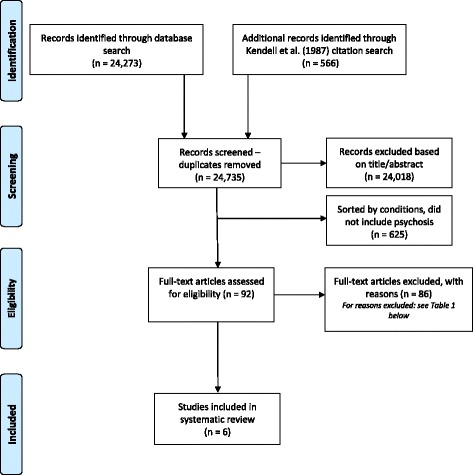
BACKGROUND: Mental health is a significant contributor to global burden of disease and the consequences of perinatal psychiatric morbidity can be substantial. We aimed to obtain global estimates of puerperal psychosis prevalence based on population-based samples and to understand how postpartum psychosis is assessed and captured among included studies. METHODS: In June 2014, we searched PubMed, CiNAHL, EMBASE, PsycINFO, Sociological Collections, and Global Index Medicus for publications since the year 1990. Criteria for inclusion in the systematic review were: use of primary data relevant to pre-defined mental health conditions, specified dates of data collection, limited to data from 1990 onwards, sample size >200 and a clear description of methodology. Data were extracted from published peer reviewed articles. RESULTS: The search yielded 24,273 publications, of which six studies met the criteria. Five studies reported incidence of puerperal psychosis (ranging from 0.89 to 2.6 in 1000 women) and one reported prevalence of psychosis (5 in 1000). Due to the heterogeneity of methodologies used across studies in definitions and assessments used to identify cases, data was not pooled to calculate a global estimate of risk. CONCLUSIONS: This review confirms the relatively low rate of puerperal psychosis; yet given the potential for serious consequences, this morbidity is significant from a global public health perspective. Further attention to consistent detection of puerperal psychosis can help provide appropriate treatment to prevent harmful consequences for both mother and baby.
Overview
CoChat Summary
TL;DR
This systematic review aimed to estimate the global prevalence/incidence of postpartum (puerperal) psychosis using population-based studies published from 1990 onward. It found only 6 eligible studies out of 24,273 records, with incidence ranging from 0.89 to 2.6 per 1,000 women and one prevalence estimate of 5 per 1,000, but it could not pool results because methods and definitions varied too much.
Key findings
- The search identified 24,273 publications, but only 6 studies met inclusion criteria.
- Among the 5 studies reporting incidence, estimates ranged from 0.89 to 2.6 per 1,000 women; 1 study reported prevalence of 5 per 1,000 women.
- The lowest incidence was 0.89 per 1,000 in Terp et al., based on a study with over 1.25 million women and assessment within 3 months postpartum.
- The highest incidence was 2.6 per 1,000 in Bang et al.; the paper notes this study had the smallest sample size (N = 772).
Methods
- Systematic review of published peer-reviewed studies, searched in June 2014 across PubMed, CiNAHL, EMBASE, PsycINFO, Sociological Collections, and Global Index Medicus, plus citation searching of a key article.
- Included studies had to use primary data, have specified data-collection dates, be from 1990 onward, have sample size >200, and provide a clear methodology; study designs could include cross-sectional, cohort/longitudinal, controlled trial, incidence/prevalence survey, or case-control studies with cases arm >200.
- Two reviewers independently screened, extracted data, and assessed study quality; because of heterogeneity in designs, measures, and definitions, no meta-analysis/pooling was performed.
Limitations
- The paper states that heterogeneity in definitions, instruments, and timeframes used to identify postpartum psychosis prevented pooling and a global summary estimate.
- The authors state they did not conduct a grey literature search, and they note possible publication bias despite the citation search.
- The text makes evident that the evidence base is very small (6 studies) and spans different countries, settings, and postpartum windows; the authors also state that some included studies assessed psychosis beyond the usual first month postpartum, which may mean some cases were not true postpartum psychosis.
Model-written summary. Check it against the paper before relying on it.
Integrity signals
Registry
Cites
Statistics
Figures
Verification
Claims the paper makes
13 Valid · 2 Not valid · 34 Not checked · 88 Own results and interpretations
The sources with a verdict support this claim; the rest weren’t checked yet, have no full text we could read, or their verdicts aren’t rated yet.
In the paper
“is a critical indicator of an underlying diagnosis of bipolar disorder [16, 19]”
§ The global prevalence of postpartum psychosis: a systematic review > Background
What the sources say
- Supportedcites [16] Sit D Rothschild AJ Wisner KL A Review of Postpartum Psychosis J Women's Health. 2006 15 352 68 10.1089/jwh.2006.15.352 PMC3109493 16724884 source
The Conclusions say that bipolar disorder is the primary psychiatric diagnosis to consider in early-onset postpartum psychosis. They also describe postpartum psychosis as most likely an overt presentation of bipolar illness, supporting the claim that it is an important indicator of underlying bipolar disorder. (LLM, conf=0.92)
- Not checked — no full text of the sourcecites [19] Reich T Winokur G Postpartum psychoses in patients with manic depressive disease J Nerv Ment Dis 1970 151 1 60 68 10.1097/00005053-197007000-00008 5426650 source
plainstates an association- Asserted: passes — The authors put it forward as true.
- Checkable: passes — It can be checked against evidence.
- Load-bearing: unclear — It is unclear whether the paper’s conclusions depend on it.
- Based: passes — The paper gives a reason why it holds.
- Supported
Every source the paper cites for this claim was checked and supports it.
In the paper
“As psychosis during the perinatal period typically occurs within the first 4 weeks of the postpartum period [16]”
§ The global prevalence of postpartum psychosis: a systematic review > Background
What the sources say
- Supportedcites [16] Sit D Rothschild AJ Wisner KL A Review of Postpartum Psychosis J Women's Health. 2006 15 352 68 10.1089/jwh.2006.15.352 PMC3109493 16724884 source
The Clinical Problem section states that postpartum psychosis occurs within the first 2–4 weeks after delivery. This supports the citing sentence’s timing claim. (LLM, conf=0.91)
plain- Asserted: passes — The authors put it forward as true.
- Checkable: passes — It can be checked against evidence.
- Load-bearing: passes — The paper’s conclusions depend on it.
- Based: passes — The paper gives a reason why it holds.
- Supported
The cited sources support only part of this claim — read each source’s verdict below.
In the paper
“While this review focused on estimates among a general population, prevalence among at-risk populations may be greater and also clinically meaningful.”
§ The global prevalence of postpartum psychosis: a systematic review > Discussion
What the sources say
- Not checked — no full text of the sourcecites [38] Mitsuhiro SS Chalem E Moraes Barros MC Guinsburg R Laranjeira R Brief report: prevalence of psychiatric disorders in pregnant teenagers J Adolesc 2009 32 3 747 752 10.1016/j.adolescence.2008.12.001 19349073 source
- Partly supportedcites [39] Di Florio A Jones L Forty L Gordon-Smith K Blackmore ER Heron J Craddock N Jones I Mood disorders and parity - a clue to the aetiology of the postpartum trigger J Affect Disord 2014 152-154 334 339 10.1016/j.jad.2013.09.034 24446553 PMC4025607 sourceExperimental — accuracy not yet measured
The Results (Sample characteristics; page unavailable) report substantial rates of perinatal mood episodes in women with mood disorders and say these rates exceeded those in a previous, less selectively recruited sample. The paper does not compare its at-risk sample with the general population, so it does not establish that specific comparison. (LLM, conf=0.82)
hedgedstates an association- Asserted: passes — The authors put it forward as true.
- Checkable: passes — It can be checked against evidence.
- Load-bearing: unclear — It is unclear whether the paper’s conclusions depend on it.
- Based: passes — The paper gives a reason why it holds.
The sources with a verdict support this claim; the rest weren’t checked yet, have no full text we could read, or their verdicts aren’t rated yet.
In the paper
“prevalence among at-risk populations may be greater and also clinically meaningful.”
§ The global prevalence of postpartum psychosis: a systematic review > Discussion
What the sources say
- Not checked — no full text of the sourcecites [38] Mitsuhiro SS Chalem E Moraes Barros MC Guinsburg R Laranjeira R Brief report: prevalence of psychiatric disorders in pregnant teenagers J Adolesc 2009 32 3 747 752 10.1016/j.adolescence.2008.12.001 19349073 source
- Supportedcites [39] Di Florio A Jones L Forty L Gordon-Smith K Blackmore ER Heron J Craddock N Jones I Mood disorders and parity - a clue to the aetiology of the postpartum trigger J Affect Disord 2014 152-154 334 339 10.1016/j.jad.2013.09.034 24446553 PMC4025607 source
The Results > Parity section reports higher rates of perinatal mood episodes after first pregnancies in women with bipolar I disorder. The Discussion > Implications for clinical practice section says this risk information can help guide decisions about pregnancy and childbirth, supporting its clinical relevance for this at-risk group. Page numbers are unavailable in our copy. (LLM, conf=0.86)
hedged- Asserted: passes — The authors put it forward as true.
- Checkable: passes — It can be checked against evidence.
- Load-bearing: unclear — It is unclear whether the paper’s conclusions depend on it.
- Based: passes — The paper gives a reason why it holds.
Every source the paper cites for this claim was checked and supports it.
In the paper
“Postpartum psychosis can also serve as a valuable first indicator of an underlying diagnosis of bipolar disorder [16]”
§ The global prevalence of postpartum psychosis: a systematic review > Discussion
What the sources say
- Supportedcites [16] Sit D Rothschild AJ Wisner KL A Review of Postpartum Psychosis J Women's Health. 2006 15 352 68 10.1089/jwh.2006.15.352 PMC3109493 16724884 source
The Conclusions say bipolar disorder is the primary diagnosis to consider in early-onset postpartum psychosis and report that half of the cases in a follow-up study were misdiagnosed at first presentation. The Prognosis passage also describes postpartum psychosis as most likely an overt presentation of bipolar illness. Page numbers were not provided. (LLM, conf=0.91)
plainstates an association- Asserted: passes — The authors put it forward as true.
- Checkable: passes — It can be checked against evidence.
- Load-bearing: unclear — It is unclear whether the paper’s conclusions depend on it.
- Based: passes — The paper gives a reason why it holds.
- Supported
58 more claims · 1 with their cited sources checked
Create a free account to see all 137 claims and every source verdict.
- Probably not a substantial claim. 68
- It may state two separate claims as one. 22
- The quote only partly states this claim. 1
Self-check
Percentages, sums and reported differences re-computed from the paper’s own numbers.
Each contradiction between two passages listed here was confirmed by an independent check.
Rated minor: it would not touch a result — a value no result rests on, a p-value that stays on the same side of the significance level, or a conflict that is clerical, resolved elsewhere in the paper, or outside its own findings.
In the paper
§ The global prevalence of postpartum psychosis: a systematic review > Abstract > Methods
“In June 2014, we searched PubMed, CiNAHL, EMBASE, PsycINFO, Sociological Collections, and Global Index Medicus for publications since the year 1990.”
§ The global prevalence of postpartum psychosis: a systematic review > Discussion
“First, we conducted a search of literature published within the past 15 years according to established WHO systematic review guidelines with the aim of including only the most recent studies.”
Citations
Cites
Preferred Reporting Items for Systematic Reviews and Meta-Analyses: the PRISMA statement
Moher, D., Liberati, A., Tetzlaff, J., Altman, D. G., & for the PRISMA Group (2009) · BMJ · doi:10.1136/bmj.b2535 · Cited by 83,823
Preferred Reporting Items for Systematic Reviews and Meta-Analyses: The PRISMA Statement
Moher, D., Liberati, A., Tetzlaff, J., Altman, D. G., & The PRISMA Group (2009) · PLoS Medicine · doi:10.1371/journal.pmed.1000097 · Cited by 64,042
Preferred reporting items for systematic reviews and meta-analyses: the PRISMA Statement.
(2009) · PubMed Central · Cited by 44,859
Kessler, R. C., Berglund, P., Demler, O., Jin, R., Merikangas, K. R., & Walters, E. E. (2005) · Archives of General Psychiatry · doi:10.1001/archpsyc.62.6.593 · Cited by 20,391 · cited 1×
“Across all regions, girls and women are disproportionately affected compared to boys or men; the prevalence of depression among women is approximately two times greater than among men [8].”
BackgroundWhiteford, H. A., Degenhardt, L., Rehm, J., Baxter, A. J., Ferrari, A. J., Erskine, H. E., Charlson, F. J., Norman, R. E., Flaxman, A. D., Johns, N., et al. (2013) · The Lancet · doi:10.1016/s0140-6736(13)61611-6 · Cited by 6,006
Diagnostic and Statistical Manual of Mental Disorders ( DSM ‐ IV ‐ TR )
Segal, D. L. (2010) · The Corsini Encyclopedia of Psychology · doi:10.1002/9780470479216.corpsy0271 · Cited by 4,666
Rates and risk of postpartum depression – a meta-analysis
O'hara, M. W., & Swain, A. M. (1996) · International Review of Psychiatry · doi:10.3109/09540269609037816 · Cited by 3,116
Fisher, J., Cabral de Mello, M., Patel, V., Rahman, A., Tran, T., Holton, S., & Holmes, W. (2012) · Bulletin of the World Health Organization · doi:10.2471/blt.11.091850 · Cited by 1,798
Treatment gap in mental health care.
Abramowitz, M. Z., Greenberg, D., & Levav, I. (2008) · PubMed · Cited by 1,484
The treatment gap in mental health care.
(2004) · Europe PMC (PubMed Central) · Cited by 1,419
Whiteford, H. A., Ferrari, A. J., Degenhardt, L., Feigin, V., & Vos, T. (2015) · PLOS ONE · doi:10.1371/journal.pone.0116820 · Cited by 1,175 · cited 1×
“As described above, postpartum psychosis is a key marker for the risk of future affective disorder, which is significant contributor to the global burden of disease [7, 43].”
BackgroundEpidemiology of Puerperal Psychoses
Kendell, R. E., Chalmers, J. C., & Platz, C. (1987) · British Journal of Psychiatry · doi:10.1192/bjp.150.5.662 · Cited by 1,119 · cited 6×
“These incidence estimates appear to be relatively consistent with the frequently cited prevalence of 1–2 in 1000 births for postpartum psychosis in the general population [26].”
BackgroundResultInfluentialPsychiatric Disorders in Pregnant and Postpartum Women in the United States
Vesga-López, O., Blanco, C., Keyes, K., Olfson, M., Grant, B. F., & Hasin, D. S. (2008) · Archives of General Psychiatry · doi:10.1001/archpsyc.65.7.805 · Cited by 1,065 · cited 1×
“Most studies included only the postpartum period, but this timeframe varied across studies from a 2–32 day range [31], to up to a year postpartum [32].”
BackgroundDepressive Symptoms among Pregnant Women Screened in Obstetrics Settings
Marcus, S. M., Flynn, H. A., Blow, F. C., & Barry, K. L. (2003) · Journal of Women's Health · doi:10.1089/154099903765448880 · Cited by 742 · cited 1×
“For example, less than 15% of women in an obstetrics clinic who scored above a cut-off for depression reported receiving any formal treatment [23].”
BackgroundNew Parents and Mental Disorders: A Population-Based Register Study
Munk-Olsen, T., Laursen, T. M., Pedersen, C. B., Mors, O., & Mortensen, P. B. (2006) · JAMA · doi:10.1001/jama.296.21.2582 · Cited by 727 · cited 3×
“Postpartum psychosis can also serve as a valuable first indicator of an underlying diagnosis of bipolar disorder [16] and can increase risk for future non-pregnancy related psychotic episodes [18].”
BackgroundSuzuki, E., Mathers, C. D., Moller, A., Alkema, L., Say, L., Gemmill, A., Mills, S. L., Chou, D., & Hogan, D. R. (2014) · Cited by 680
Self-citationBipolar disorder, affective psychosis, and schizophrenia in pregnancy and the post-partum period
Jones, I., Chandra, P. S., Dazzan, P., & Howard, L. M. (2014) · The Lancet · doi:10.1016/s0140-6736(14)61278-2 · Cited by 644 · cited 2×
“As discussed previously, there can be tragic consequences such as suicide or infanticide [17].”
BackgroundPrenatal depression effects on early development: A review
Field, T. (2011) · Infant Behavior and Development · doi:10.1016/j.infbeh.2010.09.008 · Cited by 592 · cited 1×
“Perinatal mental disorders are also associated with maternal complications and an increased risk of adverse neonatal and developmental outcomes for the child [12].”
BackgroundSay, L., Pattinson, R. C., & Gülmezoglu, A. M. (2004) · Reproductive Health · doi:10.1186/1742-4755-1-3 · Cited by 468 · cited 1×
“Both the search strategy and inclusion criteria, which have been described elsewhere, were tailored for the purposes of this review [27, 28].”
MethodSelf-citationA Review of Postpartum Psychosis
Sit, D., Rothschild, A. J., & Wisner, K. L. (2006) · Journal of Women's Health · doi:10.1089/jwh.2006.15.352 · Cited by 454 · cited 3×
“Postpartum psychosis can also serve as a valuable first indicator of an underlying diagnosis of bipolar disorder [16] and can increase risk for future non-pregnancy related psychotic episodes [18].”
BackgroundPerinatal psychiatric disorders: a leading cause of maternal morbidity and mortality
Oates, M. (2003) · British Medical Bulletin · doi:10.1093/bmb/ldg011 · Cited by 317 · cited 1×
“Suicide has been identified as a leading cause of maternal death in some developed countries [41] and is also a leading cause of death in reproductive-aged women in the world’s two most populous countries, India and China [42].”
BackgroundObstetric transition: the pathway towards ending preventable maternal deaths
Souza, J., Tunçalp, Ö., Vogel, J., Bohren, M., Widmer, M., Oladapo, O., Say, L., Gülmezoglu, A., & Temmerman, M. (2014) · BJOG: An International Journal of Obstetrics & Gynaecology · doi:10.1111/1471-0528.12735 · Cited by 303 · cited 1×
“The severity of consequences can be heightened in the presence of comorbidities for the mother [13]; and comorbidities are increasing in pregnancy [14].”
BackgroundSelf-citationDepression and treatment among U.S. pregnant and nonpregnant women of reproductive age, 2005–2009
Ko, J. Y., Farr, S. L., Dietz, P. M., & Robbins, C. L. (2012) · Journal of Women's Health · doi:10.1089/jwh.2011.3466 · Cited by 289
Measuring maternal health: focus on maternal morbidity
Firoz, T., Chou, D., von Dadelszen, P., Agrawal, P., Vanderkruik, R., Tunçalp, O., Magee, L. A., van Den Broek, N., Say, L., & for the Maternal Morbidity Working Group (2013) · Bulletin of the World Health Organization · doi:10.2471/blt.13.117564 · Cited by 286
Self-citationPreferences and perceived barriers to treatment for depression during the perinatal period
O'Mahen, H. A., & Flynn, H. A. (2008) · Journal of Women s Health · doi:10.1089/jwh.2007.0631 · Cited by 277 · cited 1×
“Barriers to treatment can include factors such as limited resources or insurance to cover costs of treatment, time demands, transportation, stigma associated with treatment, or lack of knowledge regarding where to seek treatment [22, 24].”
BackgroundPostpartum Psychosis: Detection of Risk and Management
Spinelli, M. G. (2009) · American Journal of Psychiatry · doi:10.1176/appi.ajp.2008.08121899 · Cited by 194 · cited 1×
“Improved detection of puerperal psychosis, a likely first indicator of an underlying diagnosis of bipolar disorder, could lead to proper diagnosis and treatment of bipolar disorder for perinatal women [20, 21].”
BackgroundPOSTPARTUM PSYCHOSES IN PATIENTS WITH MANIC DEPRESSIVE DISEASE
REICH, T., & WINOKUR, G. (1970) · The Journal of Nervous and Mental Disease · doi:10.1097/00005053-197007000-00008 · Cited by 181 · cited 2×
“However, this excluded a number of rigorously conducted studies on puerperal psychosis that were published prior to this date [19, 26, 36].”
BackgroundNo health without perinatal mental health
Howard, L. M., Piot, P., & Stein, A. (2014) · The Lancet · doi:10.1016/s0140-6736(14)62040-7 · Cited by 180 · cited 1×
“The severity of consequences can be heightened in the presence of comorbidities for the mother [13]; and comorbidities are increasing in pregnancy [14].”
BackgroundSmith, C., Vannak, U., Sokhey, L., Ngo, T. D., Gold, J., & Free, C. (2015) · Reproductive Health · doi:10.1186/s12978-015-0112-x · Cited by 179
Achieving the Millennium Development Goals: Does Mental Health Play a Role?
Miranda, J. J., & Patel, V. (2005) · PLoS Medicine · doi:10.1371/journal.pmed.0020291 · Cited by 178 · cited 2×
“For example, considering a country such as China where there are approximately 16 million births a year, there could potentially be up to 32,000 cases of puerperal psychosis within that same time period in just this country alone, at the incidence rate of 2 cases per 1000 childbirths among the general population.”
BackgroundPost-partum psychoses: Clinical diagnoses and relative risk of admission after parturition
Terp, I. M., & Mortensen, P. B. (1998) · British Journal of Psychiatry · doi:10.1192/bjp.172.6.521 · Cited by 171
Puerperal Psychoses: A Long Term Study 1927—1961
Protheroe, C. (1969) · British Journal of Psychiatry · doi:10.1192/bjp.115.518.9 · Cited by 163
Valdimarsdóttir, U., Hultman, C. M., Harlow, B., Cnattingius, S., & Sparén, P. (2009) · PLoS Medicine · doi:10.1371/journal.pmed.1000013 · Cited by 136 · cited 1×
“One study compared incidence rates between two different postpartum time periods, breaking postpartum psychosis incidence down into two categories: within 90 days postpartum and after 90 days postpartum [33].”
BackgroundBang, R. A., Bang, A. T., Reddy, M. H., Deshmukh, M. D., Baitule, S. B., & Filippi, V. (2004) · BJOG: An International Journal of Obstetrics & Gynaecology · doi:10.1111/j.1471-0528.2004.00063.x · Cited by 116
WHO systematic review of maternal mortality and morbidity: methodological issues and challenges
Gülmezoglu, A. M., Say, L., Betrán, A. P., Villar, J., & Piaggio, G. (2004) · BMC Medical Research Methodology · doi:10.1186/1471-2288-4-16 · Cited by 105 · cited 5×
“Methods The protocol for all the systematic reviews associated with the maternal morbidity initiative was adapted from the peer-reviewed methodology established for the WHO Systematic Review of Maternal Morbidity and Mortality [27].”
MethodInfluentialSelf-citationMood disorders and parity – A clue to the aetiology of the postpartum trigger
Di Florio, A., Jones, L., Forty, L., Gordon-Smith, K., Robertson Blackmore, E., Heron, J., Craddock, N., & Jones, I. (2014) · Journal of Affective Disorders · doi:10.1016/j.jad.2013.09.034 · Cited by 86
Evaluation of mental health and depression during pregnancy: position paper.
Hendrick, V. C., Altshuler, L. L., Cohen, L., & Stowe, Z. N. (1998) · PubMed · Cited by 81
Self-citationAn epidemiological and clinical investigation of postpartum psychiatric illness in Japanese mothers.
Okano, T. (1998) · Journal of Affective Disorders · doi:10.1016/s0165-0327(97)00158-4 · Cited by 64
Infanticide: contrasting views
Spinelli, M. G. (2005) · Archives of Women’s Mental Health · doi:10.1007/s00737-005-0067-y · Cited by 61 · cited 1×
“Improved detection of puerperal psychosis, a likely first indicator of an underlying diagnosis of bipolar disorder, could lead to proper diagnosis and treatment of bipolar disorder for perinatal women [20, 21].”
BackgroundFraming maternal morbidity: WHO scoping exercise
Vanderkruik, R. C., Tunçalp, Ö., Chou, D., & Say, L. (2013) · BMC Pregnancy and Childbirth · doi:10.1186/1471-2393-13-213 · Cited by 57 · cited 1×
“While the onset of postpartum psychosis typically occurs within the first month after delivery, there is inconsistency in the field of what constitutes the postpartum timeframe for maternal morbidities [29], so the search included any articles referencing the “postpartum” period.”
BackgroundSelf-citationNager, A., Sundquist, K., Ramírez‐León, V., & Johansson, L. (2007) · Acta Psychiatrica Scandinavica · doi:10.1111/j.1600-0447.2007.01096.x · Cited by 54
Maternal morbidity measurement tool pilot: study protocol
Say, L., Barreix, M., Chou, D., Tunçalp, Ö., Cottler, S., McCaw-Binns, A., Gichuhi, G. N., Taulo, F., & Hindin, M. (2016) · Reproductive Health · doi:10.1186/s12978-016-0164-6 · Cited by 47 · cited 1×
“To address this gap, the World Health Organization’s (WHO) Department of Reproductive Health and Research (RHR) introduced an initiative, led by a Maternal Morbidity Working Group (MMWG), composed of technical experts in maternal and women’s health, epidemiology, public health (including researchers and clinicians), p…”
MethodSelf-citationNew parents and mental disorders. A population-based register study
Munk-Olsen, T., Laursen, T. M., Pedersen, C. B., Mors, O., & Mortensen, P. B. (2006) · Cited by 37
Brief report: Prevalence of psychiatric disorders in pregnant teenagers
Mitsuhiro, S. S., Chalem, E., Moraes Barros, M. C., Guinsburg, R., & Laranjeira, R. (2009) · Journal of Adolescence · doi:10.1016/j.adolescence.2008.12.001 · Cited by 36 · cited 1×
“5% prevalence [38] and another found a significantly higher rate (15%) for women with history of major affective disorder [39].”
BackgroundDepressive Disorders in Japanese Primary Care Patients
Mino, Y., Aoyama, H., & FROOM, J. (1994) · Family Practice · doi:10.1093/fampra/11.4.363 · Cited by 30 · cited 1×
“Alternatively, some believe that the relatively high stigma associated with mental illness in Japan may result in lower rates of diagnosis [40].”
Background(2014) · The Psychiatric times · Cited by 19
(2008) · PubMed · Cited by 11
Untitled work
Moher (2009) · doi:10.1371/journal.pmed1000097
Research works printed but not linked: 2
- United Nations Secretary-General The Global Strategy for Women’s, Children’s and Adolescents’ Health (2016-2030) 2015 New York United Nations
- Vanderkruik R, Tuncalp O, Chou D, Say L. Framing maternal morbidity: WHO scoping exercise. BMC Pregnancy Childbirth. 2013;13(213). PMC3840647 24252359 · DOI · Paper page
Cited by
Postpartum depression in India: a systematic review and meta-analysis
Upadhyay, R. P., Chowdhury, R., Salehi, A., Sarkar, K., Singh, S. K., Sinha, B., Pawar, A., Rajalakshmi, A. K., & Kumar, A. (2017) · Bulletin of the World Health Organization · doi:10.2471/blt.17.192237 · Cited by 363
Barba-Müller, E., Craddock, S., Carmona, S., & Hoekzema, E. (2019) · Archives of Women's Mental Health · doi:10.1007/s00737-018-0889-z · Cited by 235
Aktar, E., Qu, J., Lawrence, P. J., Tollenaar, M. S., Elzinga, B. M., & Bögels, S. M. (2019) · Frontiers in Psychiatry · doi:10.3389/fpsyt.2019.00391 · Cited by 140
Shorey, S., Chee, C. Y. I., Ng, E. D., Lau, Y., Dennis, C.-L., & Chan, Y. H. (2019) · Journal of Medical Internet Research · doi:10.2196/12410 · Cited by 125
“As one of the leading causes of maternal morbidity [2], postnatal depression (PND) has an approximate global prevalence of 10% to 15% [3], with less than 1% of this population diagnosed with postpartum psychosis [4].”
Gribble, K. D., Bewley, S., Bartick, M., Mathisen, R., Walker, S., Gamble, J. A., Bergman, N., Gupta, A. K., Hocking, J. J., & Dahlen, H. G. (2022) · Frontiers in Global Women s Health · doi:10.3389/fgwh.2022.818856 · Cited by 144
“Puerperal psychosis affects 1–2 in every 1,000 mothers often in the first few days after birth (19) and is a leading cause of maternal death through suicide, as well as infanticide (20).”
Background
Metadata
- Authors
- on behalf of the Maternal Morbidity Working Group, VanderKruik, R., Barreix, M., Chou, D., Allen, T., Say, L., & Cohen, L. S.
- Affiliations
- University of Colorado Boulder (US)
- World Health Organization (CH)
- Massachusetts General Hospital (US)
- Corresponding author
- VanderKruik, Rachel
- Venue
- BMC Psychiatry
- Published
- 2017-07-28
- Volume
- 17
- Issue
- 1
- Pages
- 272-272
- ISSN
- 1471-244X (ISSN-L)
- PMC
- PMC5534064
- OpenAlex
- W2742151539
- Cited by
- 238
- References
- 47
- Citations by year
- 2026: 23 · 2025: 29 · 2024: 34 · 2023: 31 · 2022: 31 · 2021: 27 · 2020: 19 · 2019: 30 · 2018: 12 · 2017: 2
- FWCI
- 2.80
- Type
- journal article
- Language
- en
- Open access
- gold
- doi.org
- Licence
- cc-by
- creativecommons.org/licenses/by/4.0/ (tdm)
- creativecommons.org/licenses/by/4.0/ (vor)
- Locations
- BMC Psychiatry (publishedVersion, cc-by)
- PubMed Central (publishedVersion, cc-by)
- PubMed (publishedVersion)
- DOAJ (DOAJ: Directory of Open Access Journals) (submittedVersion, cc-by-sa)
- Research Portal (King's College London) (submittedVersion, other-oa)
- UTS ePRESS (University of Technology Sydney) (submittedVersion)
- Funders
- Bill and Melinda Gates Foundation (OPP1033805)
- Topics
- Health Sciences › Medicine › Public Health, Environmental and Occupational Health › Maternal Mental Health During Pregnancy and Postpartum
- Social Sciences › Sociology and Political Science › Homicide, Infanticide, and Child Abuse
- Health Sciences › Medicine › Psychiatry and Mental health › Schizophrenia research and treatment
- Keywords
- postpartum psychosis, prevalence, incidence, perinatal mental health, global burden of disease, case finding
- MeSH terms
- Female, Humans, Pregnancy, Psychotic Disorders, Puerperal Disorders, Global Health, Incidence, Prevalence, Postpartum Period
About these checks
Registry, retraction, Cites and statistics results are computed, not judged, with one exception: a printed reference that no index lists is read once by a model before it counts as a citation error. Claims are extracted by a model and kept only when their quote appears verbatim in the text; each cited source is then checked, with a model’s help, for whether it says what the claim relies on. Those verdicts can be wrong — read the claim’s quote and the cited source before relying on one.
The claim verdicts this report counts are experimental: their accuracy is not yet measured.
A language model drew the claims from the paper on 2026-10-10, under version 3 of the claim definition (model deepseek-v4.1-flash, prompt extract-v3).
A second model labelled each claim on 2026-10-10 (model jev-1.13-20260917, definition revision gold-guideline-v0.2).
Cited sources are checked with a language model’s help (gpt-6-sol).
Statistics and arithmetic are recomputed, not judged.
Confidence bands are shown only for fields calibrated on our annotated test set. None is calibrated yet, so no band is shown.
What counts as a claim ›How we measure confidence ›How we check this ›
Are you an author, or do you see a problem with this page? Request a review
Data sources
Bibliographic data: Semantic Scholar, OpenAlex, Crossref.
Contains information from the Semantic Scholar Academic Graph Datasets, made available under the ODC Attribution License (ODC-BY 1.0).
Semantic Scholar’s data is described in: Kinney, R., et al. (2023). The Semantic Scholar Open Data Platform. arXiv:2301.10140.
