

Emotion regulation individual therapy for adolescents with nonsuicidal self-injury disorder: a feasibility study
Open accessThe DOI matches its Crossref record; 70 of the 70 references it cites were found in a registry or an index.
Abstract
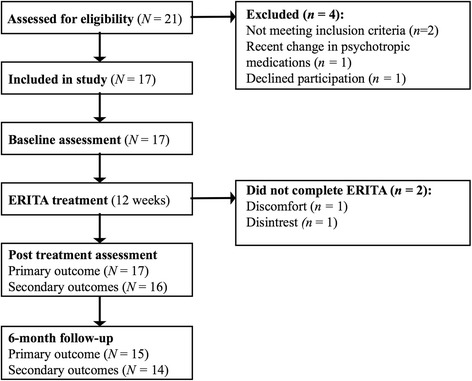
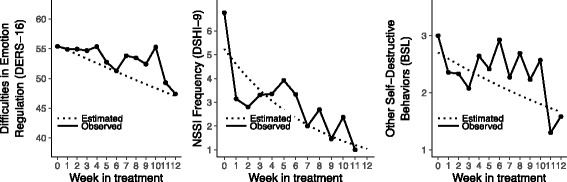
BACKGROUND: Nonsuicidal self-injury (NSSI) is a serious health risk behavior that forms the basis of a tentative diagnosis in DSM-5, NSSI Disorder (NSSID). To date, established treatments specific to NSSI or NSSID are scarce. As a first step in evaluating the feasibility, acceptability, and utility of a novel treatment for adolescents with NSSID, we conducted an open trial of emotion regulation individual therapy for adolescents (ERITA): a 12-week, behavioral treatment aimed at directly targeting both NSSI and its proposed underlying mechanism of emotion regulation difficulties. METHODS: Seventeen girls (aged 13-17; mean = 15.31) with NSSID were enrolled in a study adopting an uncontrolled open trial design with self-report and clinician-rated assessments of NSSI and other self-destructive behaviors, emotion regulation difficulties, borderline personality features, and global functioning administered at pre-treatment, post-treatment, and 6-month follow-up. Measures of NSSI and emotion regulation difficulties were also administered weekly during treatment. RESULTS: Ratings of treatment credibility and expectancy and the treatment completion rate (88%) were satisfactory, and both therapeutic alliance and treatment attendance were strong. Intent-to-treat analyses revealed significant improvements associated with large effect sizes in past-month NSSI frequency, emotion regulation difficulties, self-destructive behaviors, and global functioning, as well as a medium effect size in past-month NSSI versatility, from pre- to post-treatment. Further, all of these improvements were either maintained or further improved upon at 6-month follow-up. Finally, change in emotion regulation difficulties mediated improvements in NSSI over the course of treatment. CONCLUSIONS: Results suggest the acceptability, feasibility, and utility of this treatment for adolescents with NSSID. TRIAL REGISTRATION: ClinicalTrials.gov (NCT02326012, December 22, 2014, retrospectively registered).
Overview
The claims and statistics of this paper haven’t been checked yet.
Free: it reads the open-access text and checks the first 5 claims that cite a source we can check. Create a free account to check every claim.
Integrity signals
Registry
Cites
Statistics
Figures
Verification
Claims the paper makes
The claims and statistics of this paper haven’t been checked yet.
Free: it reads the open-access text and checks the first 5 claims that cite a source we can check. Create a free account to check every claim.
Claims other papers make about this one
Each is checked against this paper’s own text: does it say what the citing paper says it does?
The cited source says what the claim attributes to it.
In the citing paper
“and it is sensitive to changes following treatment [56-60].”
From A Virtual Reality-Assisted Cognitive Behavioral Therapy for and With Inuit in Québec: Protocol for a Proof-of-Concept Randomized Controlled Trial (2023) · cites this paper as [58]
The cited source says what the claim attributes to it.
In the citing paper
“During the last decade, other emotion regulation interventions for adolescents have been developed, such as Emotion Regulation Individual Therapy for Adolescents [ERITA (17, 18)] consisting of 12 weeks treatment, for example, and Unified Protocol for Adolescents [UP-A (19)] for approximately 16 weeks.”
From An emotion regulation skills training for adolescents and parents: perceptions and acceptability of methodological aspects (2024) · cites this paper as [17]
The cited source says what the claim attributes to it.
In the citing paper
“These findings are consistent with a previous study of the ERIC intervention with acutely vulnerable young people in residential drug rehabilitation (Sloan et al., 2018) and emotion regulation intervention studies in other cohorts of vulnerable young people including those with BPD and non-suicidal self-injury (NSSI; Bjureberg et al., 2017) and aggressive behaviors (Goldstein et al., 2018).”
From An Emotion Regulation and Impulse Control (ERIC) Intervention for Vulnerable Young People: A Multi-Sectoral Pilot Study (2021) · cites this paper as Bjureberg et al., 2017
Self-check
Percentages, sums and reported differences re-computed from the paper’s own numbers.
The self-check needs the paper’s full text.
Citations
Cites
Diagnostic and Statistical Manual of Mental Disorders
American Psychiatric Association (2013) · doi:10.1176/appi.books.9780890425596 · Cited by 116,369
(1998) · The Journal of Clinical Psychiatry · Cited by 19,139
(1998) · PubMed · Cited by 10,216
Gratz, K. L., & Roemer, L. (2004) · Journal of Psychopathology and Behavioral Assessment · doi:10.1023/b:joba.0000007455.08539.94 · Cited by 8,942 · cited 2×
“The Difficulties in Emotion Regulation Scale (DERS; [37]) is a 36- item self-report measure that assesses individuals’ typical levels of emotion regulation difficulties on a 5-point Likert-type scale across six domains: nonacceptance of negative emotions, inability to engage in goal-directed behaviors when distressed,…”
BackgroundSelf-citation(1993) · Cited by 7,136
Cognitive-Behavioral Treatment of Borderline Personality Disorder
Cary, G. L. (1994) · American Journal of Psychotherapy · doi:10.1176/appi.psychotherapy.1994.48.1.155 · Cited by 6,283
MacKinnon, D. P., Fairchild, A. J., & Fritz, M. S. (2007) · Annual Review of Psychology · doi:10.1146/annurev.psych.58.110405.085542 · Cited by 5,688 · cited 1×
“Specifically, this analysis was performed in four steps that investigated the different paths of mediation [59]: (1) the “c-path”, i.”
MethodA Children's Global Assessment Scale (CGAS)
Shaffer, D. (1983) · Archives of General Psychiatry · doi:10.1001/archpsyc.1983.01790100074010 · Cited by 3,716 · cited 1×
“The Children’s Global Assessment Scale (CGAS; [47]) was used to assess global functioning.”
MethodPreacher, K. J., & Kelley, K. (2011) · Psychological Methods · doi:10.1037/a0022658 · Cited by 3,060 · cited 1×
“We also calculated the proportion of the total relation of time in treatment to NSSI improvement that was accounted for by change in emotion regulation, PM, using the formula ab / c [60].”
Method(1997) · American Psychiatric Press eBooks · Cited by 3,056
Research works printed but not linked: 2
- Ougrin D, Tranah T, Stahl D, Moran P, Asarnow JR. Therapeutic interventions for suicide attempts and self-harm in adolescents: systematic review and meta-analysis. J Am Acad Child Adolesc Psychiatry 2015;54. 97–107:e2. 25617250 · DOI · Paper page
- Gratz KL Tull MT Levy R Randomized controlled trial and uncontrolled 9-month follow-up of an adjunctive emotion regulation group therapy for deliberate self-harm among women with borderline personality disorder Psychol Med 2014 44 2099 2112 10.1017/S0033291713002134 23985088 · DOI · Paper page
Cited by
Psychological therapies for women who experience intimate partner violence
Hameed, M., O'Doherty, L., Gilchrist, G., Tirado-Muñoz, J., Taft, A., Chondros, P., Feder, G., Tan, M., & Hegarty, K. (2020) · Cochrane Database of Systematic Reviews · doi:10.1002/14651858.cd013017.pub2 · Cited by 146
Hossain, M. M., Purohit, N., Sultana, A., Ma, P., McKyer, E. L. J., & Ahmed, H. U. (2020) · Asian Journal of Psychiatry · doi:10.1016/j.ajp.2020.102041 · Cited by 115
Bjureberg, J., Sahlin, H., Hedman-Lagerlöf, E., Gratz, K. L., Tull, M. T., Jokinen, J., Hellner, C., & Ljótsson, B. (2018) · BMC Psychiatry · doi:10.1186/s12888-018-1885-6 · Cited by 96
Self-citationA Meta-Analytic Review of Emotion Regulation Focused Psychosocial Interventions for Adolescents
Eadeh, H., Breaux, R., & Nikolas, M. A. (2021) · Clinical Child and Family Psychology Review · doi:10.1007/s10567-021-00362-4 · Cited by 126
Psychotherapeutic interventions specifically developed for NSSI in adolescence: A systematic review
Calvo, N., García-González, S., Pérez-Galbarro, C., Regales-Peco, C., Lugo‐Marín, J., Ramos‐Quiroga, J. A., & Ferrer, M. (2022) · European Neuropsychopharmacology · doi:10.1016/j.euroneuro.2022.02.009 · Cited by 102
Metadata
- Authors
- Bjureberg, J., Sahlin, H., Hellner, C., Hedman-Lagerlöf, E., Gratz, K. L., Bjärehed, J., Jokinen, J., Tull, M. T., & Ljótsson, B.
- Affiliations
- Karolinska Institutet (SE)
- University of Toledo (US)
- Lund University (SE)
- Corresponding author
- Bjureberg, Johan
- ORCID
- Venue
- BMC Psychiatry
- Published
- 2017-12
- Volume
- 17
- Issue
- 1
- Pages
- 411-411
- ISSN
- 1471-244X (ISSN-L)
- PMC
- PMC5745918
- OpenAlex
- W2778770268
- Cited by
- 84
- References
- 70
- Citations by year
- 2026: 9 · 2025: 9 · 2024: 7 · 2023: 13 · 2022: 9 · 2021: 16 · 2020: 8 · 2019: 8 · 2018: 4 · 2017: 1
- FWCI
- 7.11
- Type
- journal article
- Language
- en
- Open access
- gold
- doi.org
- Licence
- cc-by
- Locations
- BMC Psychiatry (publishedVersion, cc-by)
- Europe PMC (PubMed Central) (publishedVersion, cc-by)
- PubMed Central (publishedVersion, cc-by)
- PubMed (publishedVersion)
- KTH Publication Database DiVA (KTH Royal Institute of Technology) (submittedVersion, other-oa)
- DOAJ (DOAJ: Directory of Open Access Journals) (submittedVersion, cc-by-sa)
- Lund University Publications (Lund University) (submittedVersion)
- Funders
- Kempe-Carlgrenska Foundation
- L. J., Boëthius stiftelse
- Fredik och Ingrid Thurings Stiftelse
- Swedish Research Council (2014-1008)
- Markus och Amelia Wallenberg Foundation (MAW 2014.0021)
- Topics
- Social Sciences › Psychology › Clinical Psychology › Suicide and Self-Harm Studies
- Social Sciences › Psychology › Clinical Psychology › Personality Disorders and Psychopathology
- Social Sciences › Psychology › Clinical Psychology › Psychotherapy Techniques and Applications
- Keywords
- non-suicidal self-injury, emotion regulation, individual psychotherapy, adolescents, behavior therapy, treatment feasibility, treatment acceptability, self-destructive behavior, borderline personality traits, therapeutic relationship, mediation
- MeSH terms
- Adolescent, Adolescent Behavior, Emotions, Feasibility Studies, Female, Humans, Psychotherapy, Retrospective Studies, Self-Injurious Behavior, Self Report
About these checks
Registry, retraction, Cites and statistics results are computed, not judged, with one exception: a printed reference that no index lists is read once by a model before it counts as a citation error. Claims are extracted by a model and kept only when their quote appears verbatim in the text; each cited source is then checked, with a model’s help, for whether it says what the claim relies on. Those verdicts can be wrong — read the claim’s quote and the cited source before relying on one.
Statistics and arithmetic are recomputed, not judged.
Confidence bands are shown only for fields calibrated on our annotated test set. None is calibrated yet, so no band is shown.
What counts as a claim ›How we measure confidence ›How we check this ›
Are you an author, or do you see a problem with this page? Request a review
How to cite
Cite CoChat for the checks on this page, and the paper for its own findings.
- This page
- CoChat. (2026). Citation check: Emotion regulation individual therapy for adolescents with nonsuicidal self-injury disorder: a feasibility study. https://app.cochat.ai/papers/10.1186/s12888-017-1527-4
- The paper
- Bjureberg, J., Sahlin, H., Hellner, C., Hedman-Lagerlöf, E., Gratz, K. L., Bjärehed, J., Jokinen, J., Tull, M. T., & Ljótsson, B. (2017). Emotion regulation individual therapy for adolescents with nonsuicidal self-injury disorder: a feasibility study. BMC Psychiatry. https://doi.org/10.1186/s12888-017-1527-4
Data sources
Bibliographic data: Semantic Scholar, OpenAlex, Crossref.
Contains information from the Semantic Scholar Academic Graph Datasets, made available under the ODC Attribution License (ODC-BY 1.0).
Semantic Scholar’s data is described in: Kinney, R., et al. (2023). The Semantic Scholar Open Data Platform. arXiv:2301.10140.
