

Accuracy of risk scales for predicting repeat self-harm and suicide: a multicentre, population-level cohort study using routine clinical data
Open accessThe DOI matches its Crossref record; 33 of the 33 references it cites were found in a registry or an index.
Abstract
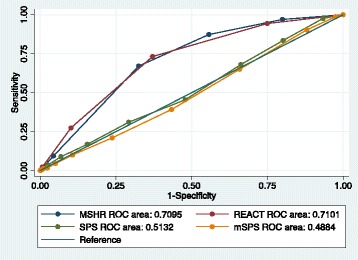
BACKGROUND: Risk scales are used widely in the management of patients presenting to hospital following self-harm. However, there is evidence that their diagnostic accuracy in predicting repeat self-harm is limited. Their predictive accuracy in population settings, and in identifying those at highest risk of suicide is not known. METHOD: We compared the predictive accuracy of the Manchester Self-Harm Rule (MSHR), ReACT Self-Harm Rule (ReACT), SAD PERSONS Scale (SPS) and Modified SAD PERSONS Scale (MSPS) in an unselected sample of patients attending hospital following self-harm. Data on 4000 episodes of self-harm presenting to Emergency Departments (ED) between 2010 and 2012 were obtained from four established monitoring systems in England. Episodes were assigned a risk category for each scale and followed up for 6 months. RESULTS: The episode-based repeat rate was 28% (1133/4000) and the incidence of suicide was 0.5% (18/3962). The MSHR and ReACT performed with high sensitivity (98% and 94% respectively) and low specificity (15% and 23%). The SPS and the MSPS performed with relatively low sensitivity (24-29% and 9-12% respectively) and high specificity (76-77% and 90%). The area under the curve was 71% for both MSHR and ReACT, 51% for SPS and 49% for MSPS. Differences in predictive accuracy by subgroup were small. The scales were less accurate at predicting suicide than repeat self-harm. CONCLUSIONS: The scales failed to accurately predict repeat self-harm and suicide. The findings support existing clinical guidance not to use risk classification scales alone to determine treatment or predict future risk.
Overview
The claims and statistics of this paper haven’t been checked yet.
Free: it reads the open-access text and checks the first 5 claims that cite a source we can check. Create a free account to check every claim.
Integrity signals
Registry
Cites
Statistics
Figures
Verification
Claims the paper makes
The claims and statistics of this paper haven’t been checked yet.
Free: it reads the open-access text and checks the first 5 claims that cite a source we can check. Create a free account to check every claim.
Claims other papers make about this one
Each is checked against this paper’s own text: does it say what the citing paper says it does?
The source backs part of the claim, not all of it — or backs it for a different population, condition or comparison.
In the citing paper
“Other studies, including a systematic review, confirmed that there is no evidence to support the use of risk assessment instruments as predictors of suicidal behaviour among patients with a psychiatric disorder 208,209 .”
From Suicide and suicide risk (2019) · cites this paper as [209]
Experimental — accuracy not yet measuredIn the citing paper
“Although, consistent with other research in this area (Quinlivan et al., 2017; Steeg et al., 2018), the sensitivity of the individual volitional phase variables is relatively low, therefore limiting their utility in assessing risk at an individual level.”
From From ideation to action: Differentiating between those who think about suicide and those who attempt suicide in a national study of young adults (2018) · cites this paper as Steeg et al., 2018
Self-check
Percentages, sums and reported differences re-computed from the paper’s own numbers.
The self-check needs the paper’s full text.
Citations
Cites
Multiple Imputation for Nonresponse in Surveys
Rubin, D. B. (1987) · Wiley Series in Probability and Statistics · doi:10.1002/9780470316696 · Cited by 20,701
Basic principles of ROC analysis
Metz, C. E. (1978) · Seminars in Nuclear Medicine · doi:10.1016/s0001-2998(78)80014-2 · Cited by 6,026 · cited 1×
“8 [28], likelihood ratios had weak predictive ability [29] and performance did not exceed that of clinicians’ ratings (measured at 0.”
BackgroundMultiple Imputation by Chained Equations (MICE): Implementation in Stata
Royston, P., & White, I. (2011) · Journal of Statistical Software · doi:10.18637/jss.v045.i04 · Cited by 1,248 · cited 1×
“Imputation was conducted using the ‘chained equations’ approach [22] in Stata to generate 50 imputations.”
MethodStatistics Notes: Diagnostic tests 3: receiver operating characteristic plots
Altman, D. G., & Bland, J. M. (1994) · BMJ · doi:10.1136/bmj.309.6948.188 · Cited by 599 · cited 1×
“Receiver operator characteristic (ROC) curves, which show sensitivity on the y-axis and 1 minus specificity on the x-axis for all possible scale thresholds were plotted [24].”
BackgroundCarroll, R., Metcalfe, C., & Gunnell, D. (2014) · PLoS ONE · doi:10.1371/journal.pone.0089944 · Cited by 586 · cited 1×
“People who have selfharmed are at greater risk of suicide [2], other causes of premature mortality [3] and comorbid conditions such as alcohol misuse [4] compared to the general population.”
BackgroundSelf-citationPredicting Risk of Suicide Attempts Over Time Through Machine Learning
Walsh, C. G., Ribeiro, J. D., & Franklin, J. C. (2017) · Clinical Psychological Science · doi:10.1177/2167702617691560 · Cited by 567 · cited 1×
“Machine learning techniques utilising medical databases are also becoming more common in the pursuit of accurate detection of suicide risk [27].”
Self-harm in England: a tale of three cities: Multicentre study of self-harm
Hawton, K., Bergen, H., Casey, D., Simkin, S., Palmer, B., Cooper, J., Kapur, N., Horrocks, J., House, A., Lilley, R., et al. (2007) · Social Psychiatry and Psychiatric Epidemiology · doi:10.1007/s00127-007-0199-7 · Cited by 419 · cited 1×
“Background Emergency Departments (EDs) in England treat over 200,000 presentations for self-harm (intentional selfpoisoning or self-injury) each year [1], and the appropriate management of these individuals is important.”
BackgroundSelf-citationSuicide Prevention in an Emergency Department Population: The ED-SAFE Study
Miller, I. W., Camargo, C. A., Arias, S. A., Sullivan, A. F., Allen, M. H., Goldstein, A. B., Manton, A. P., Espinola, J. A., Jones, R., Hasegawa, K., et al. (2017) · JAMA Psychiatry · doi:10.1001/jamapsychiatry.2017.0678 · Cited by 418 · cited 1×
“A study carried out recently in the United States found that screening in the ED combined with a brief intervention consisting of a number of components (including safety planning and followup telephone calls), was associated with reductions in repeat suicide attempts and overall number of repeat attempts [33].”
BackgroundCarter, G., Milner, A., McGill, K., Pirkis, J., Kapur, N., & Spittal, M. J. (2017) · British Journal of Psychiatry · doi:10.1192/bjp.bp.116.182717 · Cited by 361 · cited 4×
“There is evidence that risk classification scales remain in widespread use despite growing evidence about their poor predictive abilities [8, 10].”
BackgroundMethodSelf-citationEvaluation of suicidal patients: The SAD PERSONS scale
Patterson, W. M., Dohn, H. H., Bird, J., & Patterson, G. A. (1983) · Psychosomatics · doi:10.1016/s0033-3182(83)73213-5 · Cited by 333
Psychosocial interventions for self-harm in adults
Hawton, K., Witt, K. G., Taylor Salisbury, T. L., Arensman, E., Gunnell, D., Hazell, P., Townsend, E., & van Heeringen, K. (2016) · Cochrane Database of Systematic Reviews · doi:10.1002/14651858.cd012189 · Cited by 310 · cited 1×
“These have been identified as factors which may influence the assessment of risk [21].”
BackgroundSelf-citationPremature death after self-harm: a multicentre cohort study
Bergen, H., Hawton, K., Waters, K., Ness, J., Cooper, J., Steeg, S., & Kapur, N. (2012) · The Lancet · doi:10.1016/s0140-6736(12)61141-6 · Cited by 300 · cited 1×
“People who have selfharmed are at greater risk of suicide [2], other causes of premature mortality [3] and comorbid conditions such as alcohol misuse [4] compared to the general population.”
BackgroundSelf-citationCross-Validation of the Suicidal Intent Scale
Beck, R. W., Morris, J. B., & Beck, A. T. (1974) · Psychological Reports · doi:10.2466/pr0.1974.34.2.445 · Cited by 253 · cited 2×
“For example, suicidal intent was derived from the Suicide Intent Scale in three centres and from a binary variable in another centre.”
MethodRuneson, B., Odeberg, J., Pettersson, A., Edbom, T., Jildevik Adamsson, I., & Waern, M. (2017) · PLOS ONE · doi:10.1371/journal.pone.0180292 · Cited by 250 · cited 1×
“The use of risk scales may act as ‘aide memoires’ for less experienced clinicians and may help in eliciting the relevant information, provided the patient’s narrative is not lost [30].”
BackgroundThe Repetition of Suicidal Behavior: A Multicenter Cohort Study
Kapur, N., Cooper, J., King-Hele, S., Webb, R., Lawlor, M., Rodway, C., & Appleby, L. (2006) · The Journal of Clinical Psychiatry · doi:10.4088/jcp.v67n1016 · Cited by 174 · cited 1×
“We chose 6 months as the follow-up period as the majority of repeat episodes occur within this time-frame [20].”
MethodSelf-citationKapur, N., Murphy, E., Cooper, J., Bergen, H. A., Hawton, K. E., Simkin, S., Casey, D., Horrocks, J. A., Lilley, R., Noble, R., et al. (2007) · Journal of Affective Disorders · doi:10.1016/j.jad.2007.07.010 · Cited by 132 · cited 1×
“While the previous study recruited patients after they had been referred to liaison psychiatry for assessment, the present study also included non-referred episodes, typically just under half of all episodes [13, 25].”
ResultSelf-citationPredictive accuracy of risk scales following self-harm: multicentre, prospective cohort study
Quinlivan, L., Cooper, J., Meehan, D., Longson, D., Potokar, J., Hulme, T., Marsden, J., Brand, F., Lange, K., Riseborough, E., et al. (2017) · British Journal of Psychiatry · doi:10.1192/bjp.bp.116.189993 · Cited by 130 · cited 3×
“The scales were also included in a previous study that compared their predictive accuracy when administered by a mental health clinician as part of the psychosocial assessment [12].”
BackgroundMethodSelf-citationA Clinical Tool for Assessing Risk After Self-Harm
Cooper, J., Kapur, N., Dunning, J., Guthrie, E., Appleby, L., & Mackway-Jones, K. C. (2006) · Annals of Emergency Medicine · doi:10.1016/j.annemergmed.2006.07.944 · Cited by 122 · cited 1×
“[14], the ReACT Self-Harm Rule (ReACT) [15], the SAD PERSONS Scale (SPS) [16] and the Modified SAD PERSONS Scale (MSPS) [17].”
MethodSelf-citationCooper, J., Steeg, S., Bennewith, O., Lowe, M., Gunnell, D., House, A., Hawton, K., & Kapur, N. (2013) · BMJ Open · doi:10.1136/bmjopen-2013-003444 · Cited by 117 · cited 2×
“While the previous study recruited patients after they had been referred to liaison psychiatry for assessment, the present study also included non-referred episodes, typically just under half of all episodes [13, 25].”
BackgroundResultSelf-citationKapur, N., Steeg, S., Webb, R., Haigh, M., Bergen, H., Hawton, K., Ness, J., Waters, K., & Cooper, J. (2013) · PLoS ONE · doi:10.1371/journal.pone.0070434 · Cited by 114 · cited 2×
“However, the study only recruited individuals receiving a psychosocial assessment from mental health clinician (typically only around 55% of all self-harm patients who present to the ED receive a psychosocial assessment) [6, 13].”
BackgroundSelf-citationHunter, C., Chantler, K., Kapur, N., & Cooper, J. (2012) · Journal of Affective Disorders · doi:10.1016/j.jad.2012.08.009 · Cited by 106 · cited 1×
“There is evidence that assessment itself may be beneficial at reducing the risk of a repeat self-harm episode [6, 7], with patients valuing a positive therapeutic alliance that promotes hope and encouragement [32].”
BackgroundSelf-citationPredicting Suicide Attempts With the SAD PERSONS Scale: A Longitudinal Analysis
Bolton, J. M., Spiwak, R., & Sareen, J. (2012) · The Journal of Clinical Psychiatry · doi:10.4088/jcp.11m07362 · Cited by 91 · cited 2×
“However, the measures of diagnostic accuracy are in line with a previous study which showed the area under the curve to be no better than chance for the SPS [17].”
MethodResultQuinlivan, L., Cooper, J., Davies, L., Hawton, K., Gunnell, D., & Kapur, N. (2016) · BMJ Open · doi:10.1136/bmjopen-2015-009297 · Cited by 89 · cited 2×
“accuracy of predicting repeat self-harm of a number of scales [9].”
BackgroundMethodSelf-citationSteeg, S., Kapur, N., Webb, R., Applegate, E., Stewart, S. L. K., Hawton, K., Bergen, H., Waters, K., & Cooper, J. (2012) · Psychological Medicine · doi:10.1017/s0033291712000347 · Cited by 82 · cited 2×
“[14], the ReACT Self-Harm Rule (ReACT) [15], the SAD PERSONS Scale (SPS) [16] and the Modified SAD PERSONS Scale (MSPS) [17].”
BackgroundMethodSelf-citationScales for predicting risk following self-harm: an observational study in 32 hospitals in England
Quinlivan, L., Cooper, J., Steeg, S., Davies, L., Hawton, K., Gunnell, D., & Kapur, N. (2014) · BMJ Open · doi:10.1136/bmjopen-2013-004732 · Cited by 79 · cited 2×
“There is evidence that risk classification scales remain in widespread use despite growing evidence about their poor predictive abilities [8, 10].”
BackgroundSelf-citationCarroll, R., Metcalfe, C., & Gunnell, D. (2014) · Journal of Affective Disorders · doi:10.1016/j.jad.2014.06.027 · Cited by 69 · cited 1×
“This was selected because it is a marker for continued distress and need for ongoing clinical care, and has been an outcome in many previous studies [19].”
ResultSelf-citationNess, J., Hawton, K., Bergen, H., Cooper, J., Steeg, S., Kapur, N., Clarke, M., & Waters, K. (2015) · Emergency Medicine Journal · doi:10.1136/emermed-2013-202753 · Cited by 61
Self-citationHawes, M., Yaseen, Z., Briggs, J., & Galynker, I. (2017) · Comprehensive Psychiatry · doi:10.1016/j.comppsych.2016.10.002 · Cited by 50 · cited 1×
“A comparatively small study of psychiatric inpatients recently reported a modular multi-informant approach, resulting in promising levels of accuracy for predicting further suicidal behaviour [26].”
BackgroundSteeg, S., Emsley, R., Carr, M., Cooper, J., & Kapur, N. (2018) · Psychological Medicine · doi:10.1017/s0033291717001702 · Cited by 48 · cited 2×
“This approach has been taken in a previous study with similar data [7].”
BackgroundResultSelf-citationHancock, M. J., & Kent, P. M. (2016) · Journal of physiotherapy · doi:10.1016/j.jphys.2016.02.016 · Cited by 37 · cited 1×
“8 [28], likelihood ratios had weak predictive ability [29] and performance did not exceed that of clinicians’ ratings (measured at 0.”
BackgroundPredicting suicide with the SAD PERSONS scale
Katz, C., Randall, J. R., Sareen, J., Chateau, D., Walld, R., Leslie, W. D., Wang, J., & Bolton, J. M. (2017) · Depression and Anxiety · doi:10.1002/da.22632 · Cited by 35 · cited 1×
“Another study measured the accuracy of the SAD PERSONS Scale (SPS) for predicting suicide following an emergency department presentation, using administrative data to identify suicide deaths [11].”
MethodSuicide risk assessment: where are we now?
Ryan, C. J., & Large, M. M. B. (2013) · The Medical Journal of Australia · doi:10.5694/mja13.10437 · Cited by 28
Suicide risk assessment: where are we now?
Ryan, C. J., Large, M. M. B., & Callaghan, S. (2013) · The Medical Journal of Australia · doi:10.5694/mja13.10840 · Cited by 23
Cited by
Turecki, G., Brent, D. A., Gunnell, D., O’Connor, R. C., Oquendo, M. A., Pirkis, J., & Stanley, B. H. (2019) · Nature Reviews Disease Primers · doi:10.1038/s41572-019-0121-0 · Cited by 1,074
Self-citationHawton, K., Lascelles, K., Pitman, A., Gilbert, S., & Silverman, M. (2022) · The Lancet Psychiatry · doi:10.1016/s2215-0366(22)00232-2 · Cited by 196
Self-citationWetherall, K., Cleare, S., Eschle, S., Ferguson, E., O'Connor, D. B., O'Carroll, R. E., & O'Connor, R. C. (2018) · Journal of Affective Disorders · doi:10.1016/j.jad.2018.07.074 · Cited by 131
“Our study adds to the recent research on sensitivities and specificities in the context of risk assessments, showing that the latter fail to accurately predict suicidal behaviour over time (Quinlivan et al., 2017; Steeg et al., 2018).”
ResultSelf-citationTsui, F. R., Shi, L., Ruiz, V., Ryan, N. D., Biernesser, C., Iyengar, S., Walsh, C. G., & Brent, D. A. (2021) · JAMIA Open · doi:10.1093/jamiaopen/ooab011 · Cited by 103
Seiferth, C., Vogel, L., Aas, B., Brandhorst, I., Carlbring, P., Conzelmann, A., Esfandiari, N., Finkbeiner, M., Hollmann, K., Lautenbacher, H., et al. (2023) · Nature Mental Health · doi:10.1038/s44220-023-00085-1 · Cited by 122
Metadata
- Authors
- Steeg, S., Quinlivan, L., Nowland, R., Carroll, R., Casey, D., Clements, C., Cooper, J., Davies, L., Knipe, D., Ness, J., O’Connor, R. C., Hawton, K., Gunnell, D., & Kapur, N.
- Affiliations
- Manchester Academic Health Science Centre (GB)
- University of Bristol (GB)
- Warneford Hospital (GB)
- University of Manchester (GB)
- University of Glasgow (GB)
- Corresponding author
- Steeg, Sarah
- ORCID
- Venue
- BMC Psychiatry
- Published
- 2018-04-25
- Volume
- 18
- Issue
- 1
- Pages
- 113-113
- ISSN
- 1471-244X (ISSN-L)
- PMC
- PMC5921289
- OpenAlex
- W2801446378
- Semantic Scholar
- 5c765b55723fdfe96ee5b08795e79b82f5ba3b7a
- Cited by
- 91
- References
- 33
- Citations by year
- 2026: 5 · 2025: 9 · 2024: 13 · 2023: 14 · 2022: 13 · 2021: 16 · 2020: 11 · 2019: 8 · 2018: 2
- FWCI
- 10.87
- Type
- journal article
- Language
- en
- Open access
- gold
- doi.org
- Licence
- cc-by
- creativecommons.org/licenses/by/4.0/ (tdm)
- Locations
- BMC Psychiatry (publishedVersion, cc-by)
- Europe PMC (PubMed Central) (publishedVersion, cc-by)
- PubMed Central (publishedVersion, cc-by)
- PubMed (publishedVersion)
- Research Explorer (The University of Manchester) (publishedVersion, other-oa)
- ENLIGHTEN (Jurnal Bimbingan dan Konseling Islam) (acceptedVersion, cc-by-sa)
- CLOK (University of Central Lancashire) (acceptedVersion)
- DOAJ (DOAJ: Directory of Open Access Journals) (submittedVersion, cc-by-sa)
- Explore Bristol Research (submittedVersion, cc-by)
- Funders
- National Institute for Health Research (Grant Reference Number RP-PG-0610-10026)
- Topics
- Social Sciences › Psychology › Clinical Psychology › Suicide and Self-Harm Studies
- Social Sciences › Sociology and Political Science › Homicide, Infanticide, and Child Abuse
- Social Sciences › Psychology › Clinical Psychology › Psychiatric care and mental health services
- Keywords
- self-harm, suicide risk prediction, risk assessment scale, repeat self-harm, diagnostic accuracy, sensitivity and specificity, emergency department presentation, hospital follow-up
- MeSH terms
- Adolescent, Adult, Aged, Emergency Service, Hospital, England, Female, Humans, Male, Middle Aged, Predictive Value of Tests, Psychiatric Status Rating Scales, Risk Factors, Sensitivity and Specificity, Suicide, Cohort Studies, Incidence, Self-Injurious Behavior, Risk Assessment, Young Adult
About these checks
Registry, retraction, Cites and statistics results are computed, not judged, with one exception: a printed reference that no index lists is read once by a model before it counts as a citation error. Claims are extracted by a model and kept only when their quote appears verbatim in the text; each cited source is then checked, with a model’s help, for whether it says what the claim relies on. Those verdicts can be wrong — read the claim’s quote and the cited source before relying on one.
Statistics and arithmetic are recomputed, not judged.
Confidence bands are shown only for fields calibrated on our annotated test set. None is calibrated yet, so no band is shown.
What counts as a claim ›How we measure confidence ›How we check this ›
Are you an author, or do you see a problem with this page? Request a review
Data sources
Bibliographic data: Semantic Scholar, OpenAlex, Crossref.
Contains information from the Semantic Scholar Academic Graph Datasets, made available under the ODC Attribution License (ODC-BY 1.0).
Semantic Scholar’s data is described in: Kinney, R., et al. (2023). The Semantic Scholar Open Data Platform. arXiv:2301.10140.
