

An internet-based intervention for adjustment disorder (TAO): study protocol for a randomized controlled trial
Open accessThe DOI matches its Crossref record; 66 of the 72 references it cites were found in a registry or an index, and 1 are not checked yet; 12 of the 36 sources its claims cite were checked for support.
Abstract
Background: Adjustment Disorder (AjD) is a common and disabling mental health problem. The lack of research on this disorder has led to the absence of evidence-based interventions for its treatment. Moreover, because the available data indicate that a high percentage of people with mental illness are not treated, it is necessary to develop new ways to provide psychological assistance. The present study describes a Randomized Controlled Trial (RCT) aimed at assessing the effectiveness and acceptance of a linear internet-delivered cognitive-behavioral therapy (ICBT) intervention for AjD. Methods: A two-armed RCT was designed to compare an intervention group to a waiting list control group. Participants from the intervention group will receive TAO, an internet-based program for AjD composed of seven modules. TAO combines CBT and Positive Psychology strategies in order to provide patients with complete support, reducing their clinical symptoms and enhancing their capacity to overcome everyday adversity. Participants will also receive short weekly telephone support. Participants in the control group will be assessed before and after a seven-week waiting period, and then they will be offered the same intervention. Participants will be randomly assigned to one of the 2 groups. Measurements will be taken at five different moments: baseline, post-intervention, and three follow-up periods (3-, 6- and 12-month). BDI-II and BAI will be used as primary outcome measures. Secondary outcomes will be symptoms of AjD, posttraumatic growth, positive and negative affect, and quality of life. Discussion: The development of ICBT programs like TAO responds to a need for evidence-based interventions that can reach most of the people who need them, reducing the burden and cost of mental disorders. More specifically, TAO targets AjD and will entail a step forward in the treatment of this prevalent but under-researched disorder. Finally, it should be noted that this is the first RCT focusing on an internet-based intervention for AjD in the Spanish population. © 2018 The Author(s).
Verified 2026-11-22 · 1 reference not checked yet
Overview
CoChat Summary
## TL;DR
This paper is a study protocol for a two-armed randomized controlled trial testing TAO, a seven-module internet-based cognitive-behavioral intervention for adjustment disorder (AjD), against a waiting list control group. It is designed to measure symptom change, acceptance, and follow-up maintenance in a Spanish-speaking sample, and the authors state it is the first RCT of an internet-based AjD intervention in the Spanish population.
## Key findings
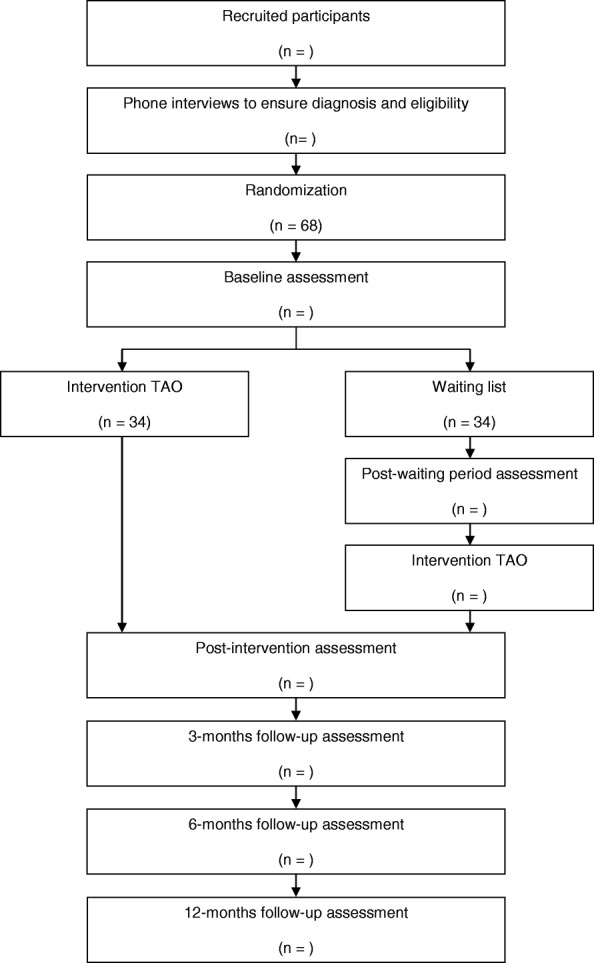
- The trial is planned as a two-armed, single-blind, parallel group RCT with random allocation to ICBT or waiting list (WL).
- The intervention, TAO, consists of 7 sequential modules and is expected to take about 7 to 10 weeks to complete; participants also receive weekly phone support with up to 10 calls over 7–10 weeks.
- The authors planned 68 participants total (34 per group), based on an assumed effect size of .70, 5% significance, and 80% power, with an anticipated 30% dropout rate.
- Primary outcomes are BDI-II and BAI; secondary outcomes include AjD symptoms, posttraumatic growth, positive and negative affect, and quality of life.
## Methods
- The study is a registered randomized controlled trial (ClinicalTrial.gov NCT02758418) using a waiting list control; assessments are scheduled at baseline, post-intervention, and 3-, 6-, and 12-month follow-ups.
- Participants are adults (18+) who meet DSM-5 criteria for AjD, can read Spanish, have internet/computer access, and an email address; exclusions include other psychological treatment for AjD, severe mental disorders, severe personality disorder/illness, and suicide risk.
- Analysis plans include t-tests and chi-square tests for baseline differences, repeated-measures ANOVAs for change over time, Cohen’s d for effect sizes, and linear regression for predictors of adherence and response; both intention-to-treat and per-protocol analyses will be reported.
## Limitations
- The paper explicitly states the main limitation is the lack of an active treatment control group.
- The authors also note that the diagnostic interview used to decide inclusion, the Diagnostic Interview for Adjustment Disorders, is not a validated instrument; they say a tool such as the ADNM-20 would have helped, but no Spanish-validated diagnostic instruments for AjD were available at the start of the RCT.
- Evident from the protocol: this is a study protocol, so the paper does not report trial results or effectiveness outcomes yet.
Model-written summary. Check it against the paper before relying on it.
Integrity signals
Registry
Cites
Statistics
Figures
Verification
Claims the paper makes
9 Valid · 1 Not valid · 9 Not checked · 18 Own results and interpretations
The cited sources support only part of this claim — read each source’s verdict below.
In the paper
“Currently, data on the efficacy of ICBT are available for a wide range of psychological disorders, including stress-related disorders [19–23].”
§ An internet-based intervention for adjustment disorder (TAO): study protocol for a randomized controlled trial > Background
What the sources say
- Not checked — no full text of the sourcecites [19] Andersson G Internet-delivered psychological treatments Annu Rev Clin Psychol 2016 12 157 179 10.1146/annurev-clinpsy-021815-093006 26652054 source
- Supportedcites [20] Knaevelsrud C Maercker A Internet-based treatment for PTSD reduces distress and facilitates the development of a strong therapeutic alliance: a randomized controlled clinical trial BMC Psychiatry. 2007 7 1 10 10.1186/1471-244X-7-13 17442125 PMC1885249 source
The Abstract (Method) describes a randomized trial of internet-based CBT for posttraumatic stress reactions. The Discussion and Conclusion reports significant reductions in PTSD symptoms in the treatment group, supporting this source as evidence for ICBT efficacy in a stress-related disorder. (LLM, conf=0.91)
- Partly supportedcites [21] Lewis CE Farewell D Groves V Kitchiner NJ Roberts NP Vick T Internet-based guided self-help for posttraumatic stress disorder (PTSD): randomized controlled trial Depress Anxiety 2017 34 555 565 10.1002/da.22645 28557299 sourceExperimental — accuracy not yet measured
The Discussion (section 4, page unavailable) reports that internet-based guided self-help reduced PTSD symptoms compared with delayed treatment, supporting the stress-related-disorder example. This trial concerns PTSD of mild to moderate severity; it does not itself establish efficacy across a wide range of psychological disorders. (LLM, conf=0.84)
- Not checked — no full text of the sourcecites [22] Wagner B Knaevelsrud C Maercker A Internet-based cognitive-behavioral therapy for complicated grief: a randomized controlled trial Death Stud 2006 30 429 453 10.1080/07481180600614385 16610157 source
- Not checked — no full text of the sourcecites [23] Zetterqvist K Maanmies J Strom L Andersson G Randomized controlled trial of internet-based stress management Cogn Behav Ther 2003 32 151 160 10.1080/16506070302316 16291546 source
plain- Asserted: passes — The authors put it forward as true.
- Checkable: passes — It can be checked against evidence.
- Load-bearing: passes — The paper’s conclusions depend on it.
- Based: passes — The paper gives a reason why it holds.
Every source the paper cites for this claim was checked and supports it.
In the paper
“However, because the literature reveals dropout rates from ICBTs of around 30% [43], a sample of 68 participants will be recruited (34 per group).”
- Also stated in: § Discussion · plain
“According to the literature, around 30% of those who start an ICBT do not complete the program.”
§ An internet-based intervention for adjustment disorder (TAO): study protocol for a randomized controlled trial > Methods/Design > Sample size
What the sources say
- Supportedcites [43] van Ballegooijen W Cuijpers P Van SA Karyotaki E Andersson G Smit JH Adherence to internet-based and face-to-face cognitive behavioural therapy for depression: a meta-analysis PLoS One 2014 9 e100674 10.1371/journal.pone.0100674 25029507 PMC4100736 source
The Results (Adherence; page unavailable) report that 65.1% of participants in guided iCBT groups completed treatment, implying 34.9% did not—approximately the claimed 30%. The Discussion repeats the 65.1% completion figure. (LLM, conf=0.88)
plain- Asserted: passes — The authors put it forward as true.
- Checkable: passes — It can be checked against evidence.
- Load-bearing: passes — The paper’s conclusions depend on it.
- Based: passes — The paper gives a reason why it holds.
- Also stated in: § Discussion · plain
Every source the paper cites for this claim was checked and supports it.
In the paper
“Because the literature shows that guided ICBT provides better results than completely unguided interventions [45], all the participants will receive weekly phone support.”
§ An internet-based intervention for adjustment disorder (TAO): study protocol for a randomized controlled trial > Methods/Design > Support
What the sources say
- Supportedcites [45] Andersson G Titov N Advantages and limitations of internet-based interventions for common mental disorders World Psychiatry 2014 13 4 11 10.1002/wps.20083 24497236 PMC3918007 source
The section 'THE ROLE OF THE THERAPIST IN INTERNET-BASED TREATMENTS' (p. 3) states that reviews of the literature consistently show treatments that include guidance lead to better outcomes than unguided treatments, and adds that any clinician contact improves outcomes (a systematic review for depression showing a linear gradient from d=0.21 with no contact to d=0.76 with contact before and during treatment). The source's accompanying caveat about 'occasional exceptions' and about no dose-response relation between amount of support and outcome (p. 3) qualifies the degree of support rather than contradicting the guided-over-unguided comparison the citing sentence attributes to it. (LLM, conf=0.88)
plainstates a cause- Asserted: passes — The authors put it forward as true.
- Checkable: passes — It can be checked against evidence.
- Load-bearing: passes — The paper’s conclusions depend on it.
- Based: passes — The paper gives a reason why it holds.
- Supported
In the paper
“However, because AjD is considered a transient condition [3], it is useful to explore whether brief interventions like TAO can prevent the chronification of this disorder and the development of more severe symptomatology.”
§ An internet-based intervention for adjustment disorder (TAO): study protocol for a randomized controlled trial > Discussion
What the sources say
- Not checked — no full text of the sourcecites [3] Casey P Adjustment Disorder: New Developments Curr Psychiatry Rep 2014 16 451 10.1007/s11920-014-0451-2 24748555 source
plain- Asserted: passes — The authors put it forward as true.
- Checkable: passes — It can be checked against evidence.
- Load-bearing: passes — The paper’s conclusions depend on it.
- Based: passes — The paper gives a reason why it holds.
In the paper
“Preliminary results on the engagement in the BADI modular intervention for AjD showed a dropout rate of more than 80% in the intervention condition [29].”
§ An internet-based intervention for adjustment disorder (TAO): study protocol for a randomized controlled trial > Discussion
What the sources say
- Not checked — no full text of the sourcecites [29] Eimontas J Rimsaite Z Gegieckaite G Zelviene P Kazlauskas E Internet-based self-help intervention for ICD-11 adjustment disorder: preliminary findings Psychiatr Q 2017 89 2 451 460 10.1007/s11126-017-9547-2 29124500 source
plain- Asserted: passes — The authors put it forward as true.
- Checkable: passes — It can be checked against evidence.
- Load-bearing: passes — The paper’s conclusions depend on it.
- Based: passes — The paper gives a reason why it holds.
5 more claims
Create a free account to see all 37 claims and to verify the 2 references still open.
- It may state two separate claims as one. 22
- Probably not a substantial claim. 15
Claims other papers make about this one
Each is checked against this paper’s own text: does it say what the citing paper says it does?
The source backs part of the claim, not all of it — or backs it for a different population, condition or comparison.
In the citing paper
“Several studies have been published assessing the effectiveness of online therapeutic interventions aimed at people with AjD. All were based on CBT principles. Their promising results show small to medium effect-size improvements in experimental groups [39–42].”
From Effectiveness and mediators of change of an online CBT intervention for students with adjustment disorder—study protocol for a randomized controlled trial (2023) · cites this paper as [41]
Experimental — accuracy not yet measured
Citations
Cites
Diagnostic and Statistical Manual of Mental Disorders
Williams, J. B. W., & First, M. (2013) · Encyclopedia of Social Work · doi:10.1093/acrefore/9780199975839.013.104 · Cited by 109,519
Faul, F., Erdfelder, E., Lang, A.-G., & Buchner, A. (2007) · Behavior Research Methods · doi:10.3758/bf03193146 · Cited by 65,971
Development and validation of brief measures of positive and negative affect: The PANAS scales.
Watson, D., Clark, L. A., & Tellegen, A. (1988) · Journal of Personality and Social Psychology · doi:10.1037/0022-3514.54.6.1063 · Cited by 32,433 · cited 3×
“Positive and Negative Affect Scale (PANAS) [57] The PANAS consists of 20 items that evaluate two independent dimensions: positive affect (PA) and negative affect (NA).”
BackgroundDiagnostic and Statistical Manual of Mental Disorders.
Widiger, T. A. (2000) · Encyclopedia of Psychology, Vol. 3. · doi:10.1037/10518-009 · Cited by 19,744
Moher, D., Hopewell, S., Schulz, K. F., Montori, V., Gotzsche, P. C., Devereaux, P. J., Elbourne, D., Egger, M., & Altman, D. G. (2010) · BMJ · doi:10.1136/bmj.c869 · Cited by 8,883
Beck, A. T., Steer, R. A., & Brown, G. (2011) · PsycTESTS Dataset · doi:10.1037/t00742-000 · Cited by 7,535
SPIRIT 2013 Statement: Defining Standard Protocol Items for Clinical Trials
Chan, A.-W., Tetzlaff, J. M., Altman, D. G., Laupacis, A., Gøtzsche, P. C., Krleža-Jerić, K., Hróbjartsson, A., Mann, H., Dickersin, K., Berlin, J. A., et al. (2013) · Annals of Internal Medicine · doi:10.7326/0003-4819-158-3-201302050-00583 · Cited by 7,363
The posttraumatic growth inventory: measuring the positive legacy of trauma
Tedeschi, R. G., & Calhoun, L. G. (1996) · Journal of Traumatic Stress · doi:10.1002/jts.2490090305 · Cited by 7,061 · cited 2×
“Posttraumatic Growth Inventory (PTGI) [56] The PTGI is a 21-item instrument that assesses positive outcomes reported by individuals who have experienced traumatic events.”
BackgroundSPIRIT 2013 explanation and elaboration: guidance for protocols of clinical trials
Chan, A.-W., Tetzlaff, J. M., Gotzsche, P. C., Altman, D. G., Mann, H., Berlin, J. A., Dickersin, K., Hrobjartsson, A., Schulz, K. F., Parulekar, W. R., et al. (2013) · BMJ · doi:10.1136/bmj.e7586 · Cited by 6,251 · cited 4×
“Protocol Items: Recommendations for Intervention Trials) [35, 36].”
MethodInfluentialInternational Statistical Classification of Diseases and Related Health Problems
(2011) · Encyclopedia of Clinical Neuropsychology · doi:10.1007/978-0-387-79948-3_3055 · Cited by 4,151
Research works printed but not linked: 5
- Marinho M Marques J Esteves M Roma-Torres A Braganca M Psychoimmunology consultation-a study on comorbidity PSILOGOS 2016 16 8 23
- First MB Spitzer RL Gibbon M JBW W Structured clinical interview for DSM-IV Axis I disorders, clinician version (SCID-CV) 1996 Washington, D.C. American Psychiatric Press, Inc.
- Di Nardo PA Brown TA Barlow DH Anxiety Disorders Interview Schedule for DSM-IV: Lifetime Version (ADIS-IV-L) 1994 Albany Graywind Publications
- Beck AT Steer RA Manual for the Beck Anxiety Inventory 1990 San Antonio Psychological Corporation
- Quero S Molés M Mor S Baños RM Botella C Spanish validation of the complicated grief inventory adapted for adjustment disorders Present ABCT 48th Annu conv 2014
Cited by
Díaz-García, A., González-Robles, A., Mor, S., Mira, A., Quero, S., García-Palacios, A., Baños, R. M., & Botella, C. (2020) · BMC Psychiatry · doi:10.1186/s12888-020-2472-1 · Cited by 207
Self-citationSvärdman, F., Sjöwall, D., & Lindsäter, E. (2022) · Internet Interventions · doi:10.1016/j.invent.2022.100553 · Cited by 47
Želvienė, P., Kazlauskas, E., & Maercker, A. (2020) · European Journal of Psychotraumatology · doi:10.1080/20008198.2019.1708617 · Cited by 44
“…Rimsaite, Gegieckaite, Zelviene, & Kazlauskas, 2018; Maercker, Bachem, Lorenz, Moser, & Berger, 2015; Moser, Bachem, Berger, & Maercker, 2019; Rachyla et al., 2018), exploring the symptom change (Lorenz, Perkonigg, & Maercker, 2018b; O’Donnell et al., 2016), and possible predictors of ICD-11…”
Kazlauskas, E., & Quero, S. (2020) · Psychological Trauma Theory Research Practice and Policy · doi:10.1037/tra0000706 · Cited by 49
Self-citationZIEL: Internet-Based Self-Help for Adjustment Problems: Results of a Randomized Controlled Trial
Moser, C., Bachem, R., Berger, T., & Maercker, A. (2019) · Journal of Clinical Medicine · doi:10.3390/jcm8101655 · Cited by 31
“Several studies have already demonstrated meaningful relation to treatment outcome [22,54].”
BackgroundManagement of work stress and burnout among community nurses arising from the COVID-19 pandemic
While, A., & Clark, L. L. (2021) · British Journal of Community Nursing · doi:10.12968/bjcn.2021.26.8.384 · Cited by 24
Kazlauskas, E., Eimontas, J., Olff, M., Želvienė, P., & Andersson, G. (2020) · Frontiers in Psychiatry · doi:10.3389/fpsyt.2020.00137 · Cited by 25
A guided Internet‐delivered intervention for adjustment disorders: A randomized controlled trial
Rachyla, I., Mor, S., Cuijpers, P. J., Botella, C., Castilla, D., & Quero, S. (2020) · Clinical Psychology & Psychotherapy · doi:10.1002/cpp.2518 · Cited by 23
“Before its adaptation to an online format, the protocol was reviewed and optimized by including additional treatment components (Rachyla et al., 2018).”
BackgroundMethodInfluentialSelf-citationShafierizi, S., Faramarzi, M., Amiri, F. N., Chehrazi, M., Basirat, Z., Kheirkhah, F., & Pasha, H. (2023) · Psychotherapy Research · doi:10.1080/10503307.2022.2158763 · Cited by 18
“Consistent with our findings, Rachyla et al. reported that 76.5% of participants with adjustment disorders received all ICBT sessions (Rachyla et al., 2018).”
ResultInfluentialEffect of an internet-based intervention for adjustment disorder on meaning in life and enjoyment
Quero, S., Palau-Batet, M., Tur, C., Mor, S., Campos, D., Rachyla, I., Grimaldos, J., & Marco, J. H. (2022) · Current Psychology · doi:10.1007/s12144-022-03177-w · Cited by 12
“Detailed summaries of the treatment content are provided in the study protocol (Rachyla et al., 2018).”
BackgroundSelf-citationJuszczyk-Kalina, A., Holas, P., & Farchione, T. J. (2023) · Trials · doi:10.1186/s13063-023-07744-9 · Cited by 4
Dailer, L., Rad, H. A., Bakouei, F., Faramarzi, M., & Khafri, S. (2024) · BMC Medical Education · doi:10.1186/s12909-024-06420-z · Cited by 4
“With advances in computer technology, computer programs offer an innovative way to improve access to psychological treatments in research clinical settings [24].”
Shafierizi, S., Basirat, Z., Amiri, F. N., Kheirkhah, F., Geraili, Z., Pasha, H., & Faramarzi, M. (2024) · BMC Psychiatry · doi:10.1186/s12888-023-05484-3 · Cited by 9
“Still, our findings were comparable to previous research reporting that around 70% of participants completed all therapist-guided ICBT sessions [25, 50].”
ResultSvärdman, F., Sjöwall, D., & Lindsäter, E. (2022) · doi:10.31234/osf.io/e7cxd · Cited by 3
Cognitive behavioral therapy and adjustment disorder
Quero, S., Fernández-Buendía, S., Baños, R., & Botella, C. (2023) · Elsevier eBooks · doi:10.1016/b978-0-323-85726-0.00038-7 · Cited by 3
Self-citationStudi meta analisis: Small effect size pada korelasi antara dukungan sosial dan penyesuaian diri
Nasruddin, D., & Yudiarso, A. (2022) · Jurnal Ilmiah Psikologi Terapan · doi:10.22219/jipt.v10i1.15667 · Cited by 2
Rachyla, I., Mor, S., Botella, C., Castilla, D., & Quero, S. (2022) · Frontiers in Virtual Reality · doi:10.3389/frvir.2022.931366 · Cited by 1
“Data regarding take-up rates, adherence, treatment expectations, satisfaction and perceived usefulness from a randomized controlled trial (RCT) on a guided internet-delivered Cognitive Behavioral Therapy (ICBT) intervention for AjD (Rachyla et al., 2018) were analyzed.”
BackgroundInfluentialSelf-citationRachyla, I. (2019) · Tesis Doctorals en Xarxa (Consorci de Serveis Universitaris de Catalunya) · doi:10.6035/14109.2019.234380 · Cited by 1
Self-citationRobles, V. A. G. (2019) · Tesis Doctorals en Xarxa (Consorci de Serveis Universitaris de Catalunya) · doi:10.6035/14109.2019.233592
Hegy, J. K., Brog, N. A., Berger, T., & Znoj, H. (2020) · JMIR Research Protocols · doi:10.2196/21200
“One of them is Trastornos Adaptivos Online [23,24].”
Paladino, D. A., Gonzalez, L. M., & Watson, J. C. (2025) · Wiley eBooks · doi:10.1002/9781394347292.ch2
Metadata
- Authors
- Rachyla, I., Pérez-Ara, M., Molés, M., Campos, D., Mira, A., Botella, C., & Quero, S.
- Affiliations
- Universitat Jaume I (ES)
- Universitat de les Illes Balears (ES)
- Corresponding author
- Quero, Soledad
- Venue
- BMC Psychiatry
- Published
- 2018-05-31
- Volume
- 18
- Issue
- 1
- Pages
- 161-161
- ISSN
- 1471-244X (ISSN-L)
- PMC
- PMC5984386
- OpenAlex
- W2805122236
- Cited by
- 22
- References
- 72
- Citations by year
- 2025: 1 · 2024: 3 · 2023: 3 · 2022: 5 · 2021: 1 · 2020: 6 · 2019: 3
- FWCI
- 3.15
- Type
- journal article
- Language
- en
- Open access
- gold
- doi.org
- Licence
- cc-by
- creativecommons.org/licenses/by/4.0/ (tdm)
- Locations
- BMC Psychiatry (publishedVersion, cc-by)
- Europe PMC (PubMed Central) (publishedVersion, other-oa)
- PubMed Central (publishedVersion, cc-by)
- PubMed (publishedVersion)
- LA Referencia (Red Federada de Repositorios Institucionales de Publicaciones Científicas) (publishedVersion, other-oa)
- Repositori UJI (Universitat Jaume I) (submittedVersion, cc-by-sa)
- DOAJ (DOAJ: Directory of Open Access Journals) (submittedVersion)
- Docusalut (Conselleria de Salut i Consum del Govern de les Illes Balears) (submittedVersion, cc-by)
- Hispana (submittedVersion, cc-by)
- Zaguan (University of Zaragoza Repository) (submittedVersion, cc-by)
- Funders
- Ministerio de Economía y Competitividad (PSI2013-41783-R)
- Generalitat Valenciana (ACIF/2015/181)
- Topics
- Social Sciences › Psychology › Applied Psychology › Digital Mental Health Interventions
- Social Sciences › Psychology › Experimental and Cognitive Psychology › Anxiety, Depression, Psychometrics, Treatment, Cognitive Processes
- Health Sciences › Medicine › Public Health, Environmental and Occupational Health › Telemedicine and Telehealth Implementation
- Keywords
- adjustment disorder, internet-based cognitive behavioral therapy, positive psychology, telephone support, posttraumatic growth, quality of life, negative affect, treatment acceptance, waitlist control
- MeSH terms
- Adjustment Disorders, Adult, Female, Humans, Male, Psychological Techniques, Quality of Life, Spain, Cognitive Behavioral Therapy, Randomized Controlled Trials as Topic, Treatment Outcome, Telemedicine, Internet
About these checks
Registry, retraction, Cites and statistics results are computed, not judged, with one exception: a printed reference that no index lists is read once by a model before it counts as a citation error. Claims are extracted by a model and kept only when their quote appears verbatim in the text; each cited source is then checked, with a model’s help, for whether it says what the claim relies on. Those verdicts can be wrong — read the claim’s quote and the cited source before relying on one.
The claim verdicts this report counts are experimental: their accuracy is not yet measured.
A language model drew the claims from the paper on 2026-10-11, under version 3 of the claim definition (model deepseek-v4.1-flash, prompt extract-v3).
A second model labelled each claim on 2026-10-11 (model jev-1.13-20260917, definition revision gold-guideline-v0.2).
Cited sources are checked with a language model’s help (gpt-6-sol and qwen3.8-omni-flash).
Statistics and arithmetic are recomputed, not judged.
Confidence bands are shown only for fields calibrated on our annotated test set. None is calibrated yet, so no band is shown.
What counts as a claim ›How we measure confidence ›How we check this ›
Are you an author, or do you see a problem with this page? Request a review
Data sources
Bibliographic data: Semantic Scholar, OpenAlex, Crossref.
Contains information from the Semantic Scholar Academic Graph Datasets, made available under the ODC Attribution License (ODC-BY 1.0).
Semantic Scholar’s data is described in: Kinney, R., et al. (2023). The Semantic Scholar Open Data Platform. arXiv:2301.10140.
