

Efficacy of an internet-based exposure treatment for flying phobia (NO-FEAR Airlines) with and without therapist guidance: a randomized controlled trial
Open accessThe DOI matches its Crossref record; 82 of the 86 references it cites were found in a registry or an index.
Abstract
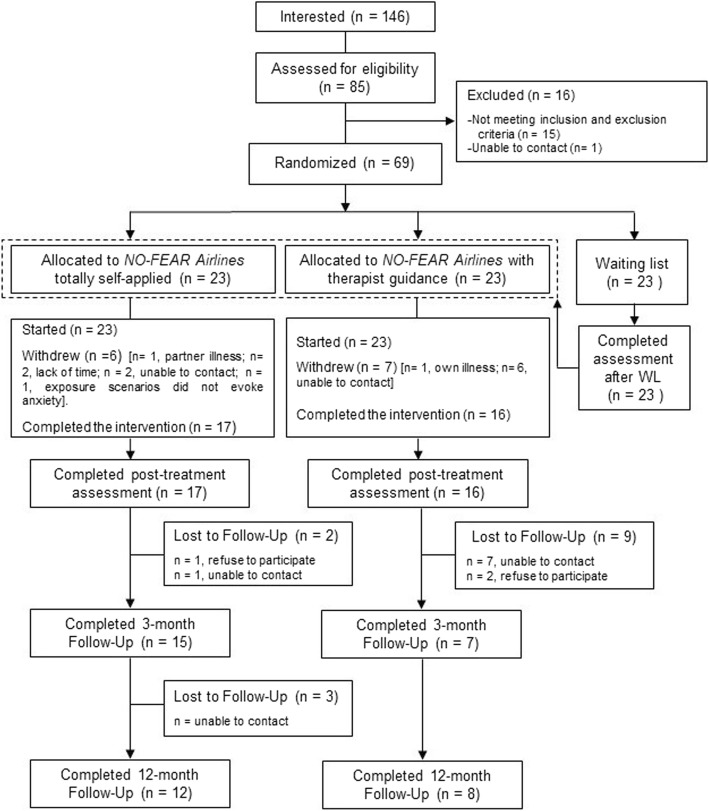
BACKGROUND: Internet-based treatments appear to be a promising way to enhance the in vivo exposure approach, specifically in terms of acceptability and access to treatment. However, the literature on specific phobias is scarce, and, as far as we know, there are no studies on Flying Phobia (FP). This study aims to investigate the effectiveness of an Internet-based exposure treatment for FP (NO-FEAR Airlines) that includes exposure scenarios composed of images and sounds, versus a waiting-list control group. A secondary aim is to explore two ways of delivering NO-FEAR Airlines, with and without therapist guidance. METHODS: A randomized controlled trial (RCT) was conducted in which 69 participants were allocated to: 1) NO-FEAR Airlines totally self-applied, 2) NO-FEAR Airlines with therapist guidance, 3) a waiting-list control group. Primary outcome measures were the Fear of Flying Questionnaire-II and the Fear of Flying Scale. Secondary outcomes included the Fear and Avoidance Scales, Clinician Severity Scale, and Patient's Improvement scale. Behavioral outcomes (post-treatment flights and safety behaviors) were also included. Mixed-model analyses with no ad hoc imputations were conducted for primary and secondary outcome measures. RESULTS: NO-FEAR Airlines (with and without therapist guidance) was significantly effective, compared to the waiting list control group, on all primary and secondary outcomes (all ps < .05), and no significant differences were found between the two ways of delivering the intervention. Significant improvements on diagnostic status and reliable change indexes were also found in both treatment groups at post-treatment. Regarding behavioral outcomes, significant differences in safety behaviors were found at post-treatment, compared to the waiting list. Treatment gains were maintained at 3- and 12-month follow-ups. CONCLUSION: FP can be treated effectively via the Internet. NO-FEAR Airlines helps to enhance the exposure technique and provide access to evidence-based psychological treatment to more people in need. These data are congruent with previous studies highlighting the usefulness of computer-assisted exposure programs for FP, and they contribute to the literature on Internet-based interventions. To the best of our knowledge, this is the first RCT to investigate the effectiveness of an Internet-based treatment for FP and explore two ways of delivering the intervention (with and without therapist guidance). TRIAL REGISTRATION: Clinicaltrials.gov: NCT02298478 ( https://clinicaltrials.gov/ct2/show/NCT02298478 ). Trial registration date 3 November 2014.
Overview
The claims and statistics of this paper haven’t been checked yet.
Free: it reads the open-access text and checks the first 5 claims that cite a source we can check. Create a free account to check every claim.
Integrity signals
Registry
Cites
Statistics
Figures

Verification
Claims the paper makes
The claims and statistics of this paper haven’t been checked yet.
Free: it reads the open-access text and checks the first 5 claims that cite a source we can check. Create a free account to check every claim.
Claims other papers make about this one
Each is checked against this paper’s own text: does it say what the citing paper says it does?
The source backs part of the claim, not all of it — or backs it for a different population, condition or comparison.
In the citing paper
“Therapist support will not be provided in this study, based on previous results showing no differences in treatment efficacy with or without therapist support (Campos et al., 2019).”
From An Internet-based treatment for Flying Phobia using 360° images: Study protocol for a feasibility pilot study (2021) · cites this paper as Campos et al., 2019
Experimental — accuracy not yet measuredThe source backs part of the claim, not all of it — or backs it for a different population, condition or comparison.
In the citing paper
“As still images have already shown its efficacy in NO-FEAR Airlines (Campos et al., 2019)”
From An Internet-based treatment for Flying Phobia using 360° images: Study protocol for a feasibility pilot study (2021) · cites this paper as Campos et al., 2019
Experimental — accuracy not yet measuredThe cited source says what the claim attributes to it.
In the citing paper
“Both experimental groups showed reductions in FP symptomatology, with no differences found between them.”
From An internet-based treatment for flying phobia using 360° images: A feasibility pilot study (2022) · cites this paper as Campos et al., 2019
The cited source says what the claim attributes to it.
In the citing paper
“This program demonstrated its effectiveness in a recent RCT (Campos et al., 2019), where two experimental conditions (a group with therapist guidance and a completely self-administered condition) were compared to a waiting list control group.”
From An internet-based treatment for flying phobia using 360° images: A feasibility pilot study (2022) · cites this paper as Campos et al., 2019
The cited source says what the claim attributes to it.
In the citing paper
“Online exposure to airplane related scenarios helps to reduce phobic symptomatology, as showed with the potential effectiveness analysis of this study and the efficacy results obtained earlier by Campos et al. (2019)”
From An internet-based treatment for flying phobia using 360° images: A feasibility pilot study (2022) · cites this paper as Campos et al., 2019
4 more claims about this paper
Create a free account to see every claim other papers make about this one.
Self-check
Percentages, sums and reported differences re-computed from the paper’s own numbers.
The self-check needs the paper’s full text.
Citations
Cites
Jacobson, N. S., & Truax, P. (1991) · Journal of Consulting and Clinical Psychology · doi:10.1037/0022-006x.59.1.12 · Cited by 7,770 · cited 2×
“Chi-square tests were performed to evaluate group differences in RCI rates, behavioral outcomes (post-treatment flights and safety behaviors), and participant diagnostic status for completers at post-treatment and two follow-ups.”
MethodEysenbach, G., & CONSORT-EHEALTH Group (2011) · Journal of Medical Internet Research · doi:10.2196/jmir.1923 · Cited by 1,863 · cited 1×
“org), the CONSORT-EHEALTH guidelines [53], the APA guidelines for the practice of telepsychology [54], the Declaration of Helsinki, and good clinical practice.”
BackgroundBrief standard self-rating for phobic patients
Marks, I. M., & Mathews, A. M. (1979) · Behaviour Research and Therapy · doi:10.1016/0005-7967(79)90041-x · Cited by 1,801 · cited 2×
“Marks IM, Mathews AM.”
MethodPersuasive Systems Design: Key Issues, Process Model, and System Features
Oinas-Kukkonen, H., & Harjumaa, M. (2009) · Communications of the Association for Information Systems · doi:10.17705/1cais.02428 · Cited by 1,663 · cited 1×
“We suggest that the use of persuasive technologies [78] to provide guidance and reinforcement after the treatment, as well as the use of short intervention packages (via web or mobile) to review or practice before taking a flight, could be useful in this endeavor.”
BackgroundInternet-based cognitive behaviour therapy for symptoms of depression and anxiety: A meta-analysis
SPEK, V., CUIJPERS, P., NYKLÍČEK, I., RIPER, H., KEYZER, J., & POP, V. (2007) · Psychological Medicine · doi:10.1017/s0033291706008944 · Cited by 1,586 · cited 1×
“Power calculations and Internet attrition rates (30%) [67, 68] indicated that a sample size of a minimum of 57 participants (19 in each group) would be sufficient to detect a large effect size (d = 1) with a power of 0.”
BackgroundGueorguieva, R., & Krystal, J. H. (2004) · Archives of General Psychiatry · doi:10.1001/archpsyc.61.3.310 · Cited by 1,529 · cited 1×
“This approach uses all available data, it does not involve any substitution of missing values with supposed or estimated values, and it does not assume that the last measurement is stable (the last observation carried forward assumption) [70, 71].”
MethodComputer-based psychological treatments for depression: A systematic review and meta-analysis
Richards, D., & Richardson, T. (2012) · Clinical Psychology Review · doi:10.1016/j.cpr.2012.02.004 · Cited by 1,442 · cited 2×
“clinicians) might be of minor importance [46], some evidence highlights the superiority of guided interventions over unguided interventions [48].”
BackgroundResultInternet-Based and Other Computerized Psychological Treatments for Adult Depression: A Meta-Analysis
Andersson, G., & Cuijpers, P. (2009) · Cognitive Behaviour Therapy · doi:10.1080/16506070903318960 · Cited by 1,368
Advantages and limitations of Internet-based interventions for common mental disorders
Andersson, G., & Titov, N. (2014) · World Psychiatry · doi:10.1002/wps.20083 · Cited by 1,160
A Guide to Treatments that Work
Nathan, P. E., & Gorman, J. M. (2007) · Oxford University Press eBooks · doi:10.1093/med/9780195304145.001.0001 · Cited by 1,082 · cited 1×
“Research to date has pointed out that the most effective treatment approach for specific phobias (including FP) is in vivo exposure, recommending it as the treatment of choice [4, 7].”
Background
Research works printed but not linked: 3
- 61. Bornas X, Tortella-Feliu M, García de la Banda G, Fullana MA, Labrés J. Validación factorial del cuestionario de miedo a volar (QPV) [The Factor Validity of the Fear of Flying Questionnaire]. Análisis y Modif. Conduct. 1999; 25:885-907.
- 65. DiNardo P, Brown TA, Barlow DH. Anxiety Disorders Interview Schedule for DSM-IV: Life Time Version: Clien Interview Schedule. Oxford: Graywind Publications; 1994.
- 66. Guy W. Clinical Global Impression Scale. ECDEU Assess. Man Psychopharmacol. 1976;76:218-22.
Cited by
Virtual reality therapy in mental health
Emmelkamp, P. M. G., & Meyerbröker, K. (2021) · Annual Review of Clinical Psychology · doi:10.1146/annurev-clinpsy-081219-115923 · Cited by 363
Musiat, P., Johnson, C., Atkinson, M., Wilksch, S., & Wade, T. (2022) · Psychological Medicine · doi:10.1017/s0033291721004621 · Cited by 166
González-Robles, A., Díaz-García, A., García-Palacios, A., Roca, P., Ramos-Quiroga, J. A., & Botella, C. (2020) · Journal of Medical Internet Research · doi:10.2196/18220 · Cited by 40
“The web platform has successfully been used in previous RCTs exploring the efficacy of internet-delivered treatments for several disorders, such as depression [94] and flying phobia [95].”
MethodSelf-citationStephenson, K. R., Zippan, N., & Brotto, L. A. (2021) · Journal of Clinical Psychology · doi:10.1002/jclp.23137 · Cited by 36
Wendt, S., Beier, D., Paquet, D., Trawinski, H., Fuchs, A., & Lübbert, C. (2021) · Deutsches Ärzteblatt international · doi:10.3238/arztebl.m2021.0127 · Cited by 26
Enrique, Á., Mooney, O., Salamanca-Sanabria, A., Lee, C. T., Farrell, S., & Richards, D. (2019) · Internet Interventions · doi:10.1016/j.invent.2019.100254 · Cited by 30
“, automated reminders or emails) may represent a more cost- and timeefficient alternative to human support and different studies have shown positive results (Baumeister et al., 2014; Campos et al., 2019; Mira et al., 2017; Titov et al., 2013), but more research is needed to support Fig.”
ResultOey, L. T., McDonald, S., McGrath, L., Dear, B. F., & Wootton, B. M. (2023) · Cognitive Behaviour Therapy · doi:10.1080/16506073.2023.2250073 · Cited by 30
“…randomised controlled trials directly comparing clinician-guided and self-guided treatments have emerged, and many have found no differences in outcomes when the two types of treatment are directly compared within one study (e.g. Botella et al., 2010; Campos et al., 2019; Dear et al., 2015, 2016).”
BackgroundHildebrand, A. S., Roesmann, K., Planert, J., Machulska, A., Otto, E., & Klucken, T. (2022) · Trials · doi:10.1186/s13063-022-06320-x · Cited by 25
“For specific phobia and smoking, self-guided digital VR therapy has proven to be effective [14, 22, 23].”
BackgroundMor, S., Grimaldos, J., Tur, C., Miguel, C., Cuijpers, P. J., Botella, C., & Quero, S. (2021) · Internet Interventions · doi:10.1016/j.invent.2021.100462 · Cited by 19
Self-citationStech, E. P., Chen, A. Z., Sharrock, M. J., Grierson, A. B., Upton, E. L., Mahoney, A., Grisham, J. R., & Newby, J. M. (2021) · Journal of Anxiety Disorders · doi:10.1016/j.janxdis.2021.102382 · Cited by 13
An internet-based treatment for flying phobia using 360° images: A feasibility pilot study
Mor, S., Botella, C., Campos, D., Carlbring, P., Tur, C., & Quero, S. (2022) · Internet Interventions · doi:10.1016/j.invent.2022.100510 · Cited by 7
Self-citationMor, S., Botella, C., Campos, D., Tur, C., Castilla, D., Soler, C., & Quero, S. (2021) · Internet Interventions · doi:10.1016/j.invent.2021.100387 · Cited by 6
Self-citationRuiz‐García, A., & Aguayo, L. V. (2021) · Clinical Case Studies · doi:10.1177/15346501211007208 · Cited by 8
“…proposals suggest technological means including photos and videos in the treatment of blood-injection-injury phobia, hospital environment, vomiting, etc. (Bados & Coronas, 2008; Campos et al., 2019; Capafons et al., 1997; Matthews et al., 2015; Quero et al., 2014; Vansteenwegen et al., 2007).”
BackgroundPlanert, J., Hildebrand, A. S., Machulska, A., Roesmann, K., Neubert, M., Pilgramm, S., Pilgramm, J., & Klucken, T. (2025) · JMIR Human Factors · doi:10.2196/60957 · Cited by 7
“By doing so, it has been demonstrated that treating acrophobia via self-guided VRET is possible [46,49].”
González-Lozoya, S. M., Meza-Kubo, V., Rodríguez, A. D., Ramírez-Fernández, C., & Morán, A. L. (2022) · TMS Proceedings 2021 · doi:10.1037/tms0000006 · Cited by 5
“The proposed therapy used by Thera was designed based on the literature (Ruiz & Valero, 2017; Flobak et al., 2019; Morán et al., 2020; Campos et al., 2019) and the multidisciplinary work of the co-authors of this work, aiming at increasing the accessibility, motivation, and acceptance of ET for rat…”
MethodMachulska, A., Roesmann, K., Eiler, T. J., Grünewald, A., Brück, R., & Klucken, T. (2021) · Psychotherapie Forum · doi:10.1007/s00729-021-00185-2 · Cited by 6
“…VRApplikationen ermöglichen sogar vollständig selbstgesteuerte Expositionsübungen ohne therapeutische Anleitung, wobei es für Patient_innenmit spezifischen Phobien erste Evidenz für die Effektivität dieses therapeutenunabhängigen Einsatzes gibt (Donker et al. 2019; Campos et al. 2019).”
BackgroundTravel anxiety and (non)pathologic phobias: a critical reflection and mitigation strategies
Azevedo, A. (2025) · Journal of Hospitality and Tourism Insights · doi:10.1108/jhti-03-2025-0364 · Cited by 5
González-Lozoya, S. M., Meza-Kubo, V., Rodríguez, A. D., Ramírez-Fernández, C., Valerio, E. B., Moreyra-Jiménez, L., & Morán, A. L. (2023) · PLoS ONE · doi:10.1371/journal.pone.0281338 · Cited by 3
Technological Interventions for Anxiety Disorders
Baños, R., Vara, M. D., Mira, A., García‐Palacios, A., & Botella, C. (2020) · Elsevier eBooks · doi:10.1016/b978-0-12-818697-8.00008-x · Cited by 2
Self-citationClinician- vs non-clinician-supported eTherapy for anxiety and depression
Lidbetter, N., Grigoroglou, C., Seccombe, N., Taxiarchi, V. P., Court, K., & Karachaliou, D. (2024) · Mental Health and Digital Technologies · doi:10.1108/mhdt-04-2024-0011 · Cited by 2
Tratamiento de un caso de fobia a las arañas mediante exposición multimedia y progresiva
Ruiz‐García, A. (2021) · Anuario de Psicología/The UB Journal of Psychology · doi:10.1344/anpsic2021.51/2.30971 · Cited by 2
“…tecnológicos con fotos y vídeos que han obtenido éxito, por ejemplo, el tratamiento de fobia a la sangre, inyecciones, ambiente hospitalario, vómitos, etc. (Bados & Coronas, 2008; Campos et al., 2019; Capafons et al., 1997; Matthews et al., 2015; Quero et al., 2014; Vansteenwegen et al., 2007).”
BackgroundBerger, T., Friedl, N., Weisel, K. K., Baumeister, H., & Ebert, D. D. (2023) · Springer eBooks · doi:10.1007/978-3-662-65816-1_4 · Cited by 1
Correia, C. M., Ventura, P. R., da Silva, H. C., Lobo, I., Paiva, J. M., Melani, M., Arantes, L., Raposo, A. B., Silva-Calpa, G. F. M., & Berger, W. (2025) · Psychiatry Research · doi:10.1016/j.psychres.2025.116784 · Cited by 1
Halıcı, Ö. Y., Coşar-Yılmaz, Z. B., Şen, E. T., & Ünsal, P. (2023) · The International Journal of Aerospace Psychology · doi:10.1080/24721840.2023.2260428 · Cited by 3
“…et al., 2017; Da Costa et al., 2008), flight simulator (Boyd et al., 2013; Trimmel et al., 2014), computer-supported/internet-based treatment (Campos et al., 2019; Tortella-Feliu et al., 2008, 2011), group intervention programs (van Gerwen et al., 2002, 2004) and eye movement desensitization…”
BackgroundYolcularda Uçuş Fobisi ve Başa Çıkmada Kullanılan Psikolojik Müdahaleler
Halıcı, Ö. Y. (2022) · Istanbul University Press eBooks · doi:10.26650/b/ss32.2022.04.24 · Cited by 1
González-Lozoya, S. M., Meza-Kubo, V., & Morán, A. L. (2021) · Avances en Interacción Humano-Computadora · doi:10.47756/aihc.y6i1.102
“…aplicación móvil llamada 0Phobia, para un tratamiento de exposición para realidad virtual autoaplicada y gamificada para fobias a las alturas; en [5] demostraron la efectividad de un tratamiento de exposición basado en Internet para tratar la fobia a volar, incluidos escenarios de exposición…”
An Internet-delivered treatment for Flying Phobia using 360º images: a feasibility study
Mor, S. (2022) · Tesis Doctorals en Xarxa (Consorci de Serveis Universitaris de Catalunya) · doi:10.6035/14109.2022.366833
Self-citationÖzgül Fobilerin Bilişsel Davranışçı Terapilerinde Sanal Gerçeklik Uygulamaları
KILIÇASLAN, Y. (2023) · Journal of Social Research and Behavioral Sciences · doi:10.52096/jsrbs.9.18.34 · Cited by 2
“Bu araştırmada MK uygulanan grupta; tanısal düzelme, uçuş fobisinde azalma, korku, kaçınma ve güvenlik davranışlarında azalma kontrol grubundan anlamlı düzeyde yüksek bulunmuştur [26].”
Mammini, C., & Manzoni, N. (2023) · IPNOSI · doi:10.3280/ipn2023-001002
Kadınlarda Uçuş Kaygısı ile İlgili Deneyimlerin Tematik Analiz ile İncelenmesi
Halıcı, Ö. Y., Sarı, S., & Arıkan, S. (2025) · Ayna Klinik Psikoloji Dergisi · doi:10.31682/ayna.1569324
Online interventions for the treatment of sexual dysfunctions: systematic review and meta-analysis
Ferreira, B. G., Lerner, T., Barbosa, G. F., Pereyra, E. A. G., Baracat, E. C., & Soares, J. M. (2026) · The Journal of Sexual Medicine · doi:10.1093/jsxmed/qdag154
Metadata
- Authors
- Campos, D., Bretón-López, J., Botella, C., Mira, A., Castilla, D., Mor, S., Baños, R., & Quero, S.
- Affiliations
- Universitat Jaume I (ES)
- Universitat de València (ES)
- Corresponding author
- Quero, Soledad
- ORCID
- Venue
- BMC Psychiatry
- Published
- 2019-03-06
- Volume
- 19
- Issue
- 1
- Pages
- 86-86
- ISSN
- 1471-244X (ISSN-L)
- PMC
- PMC6404352
- OpenAlex
- W2925308231
- Semantic Scholar
- 6bebf567a45a076be0d05276d67a4dee60f5876c
- Cited by
- 32
- References
- 86
- Citations by year
- 2026: 1 · 2025: 4 · 2024: 1 · 2023: 6 · 2022: 6 · 2021: 11 · 2020: 2 · 2019: 1
- FWCI
- 5.87
- Type
- journal article
- Language
- en
- Open access
- gold
- doi.org
- Licence
- cc-by
- creativecommons.org/licenses/by/4.0/ (tdm)
- Locations
- BMC Psychiatry (publishedVersion, cc-by)
- Europe PMC (PubMed Central) (publishedVersion, cc-by)
- PubMed Central (publishedVersion, cc-by)
- PubMed (publishedVersion)
- LA Referencia (Red Federada de Repositorios Institucionales de Publicaciones Científicas) (publishedVersion, other-oa)
- Repositori UJI (Universitat Jaume I) (submittedVersion, cc-by-sa)
- DOAJ (DOAJ: Directory of Open Access Journals) (submittedVersion, cc-by-sa)
- Zaguan (University of Zaragoza Repository) (submittedVersion, cc-by)
- Funders
- American Concrete Institute Foundation
- Ministerio de Economía y Competitividad (PSI2014–54172-R, PSI2013-41783-R, PSI2014, PSI2014-56303, PSI2014-56303-REDT)
- Generalitat Valenciana (PSI2014-56303-REDT)
- Universitat Jaume I
- Instituto de Salud Carlos III (PSI2014-56303-REDT)
- Topics
- Social Sciences › Psychology › Experimental and Cognitive Psychology › Anxiety, Depression, Psychometrics, Treatment, Cognitive Processes
- Social Sciences › Psychology › Applied Psychology › Digital Mental Health Interventions
- Physical Sciences › Computer Science › Human-Computer Interaction › Virtual Reality Applications and Impacts
- Keywords
- fear of flying, online therapy, therapist guidance, specific phobia, safety behavior, treatment efficacy
- MeSH terms
- Adult, Fear, Female, Humans, Male, Middle Aged, Patient Education as Topic, Phobic Disorders, Surveys and Questionnaires, Self Care, Therapy, Computer-Assisted, Health Behavior, Cognitive Behavioral Therapy, Treatment Outcome, Internet
About these checks
Registry, retraction, Cites and statistics results are computed, not judged, with one exception: a printed reference that no index lists is read once by a model before it counts as a citation error. Claims are extracted by a model and kept only when their quote appears verbatim in the text; each cited source is then checked, with a model’s help, for whether it says what the claim relies on. Those verdicts can be wrong — read the claim’s quote and the cited source before relying on one.
Statistics and arithmetic are recomputed, not judged.
Confidence bands are shown only for fields calibrated on our annotated test set. None is calibrated yet, so no band is shown.
What counts as a claim ›How we measure confidence ›How we check this ›
Are you an author, or do you see a problem with this page? Request a review
Data sources
Bibliographic data: Semantic Scholar, OpenAlex, Crossref.
Contains information from the Semantic Scholar Academic Graph Datasets, made available under the ODC Attribution License (ODC-BY 1.0).
Semantic Scholar’s data is described in: Kinney, R., et al. (2023). The Semantic Scholar Open Data Platform. arXiv:2301.10140.
