

Efficacy of an internet-based exposure treatment for flying phobia (NO-FEAR Airlines) with and without therapist guidance: a randomized controlled trial
Open accessThe DOI matches its Crossref record; 82 of the 86 references it cites were found in a registry or an index.
Abstract
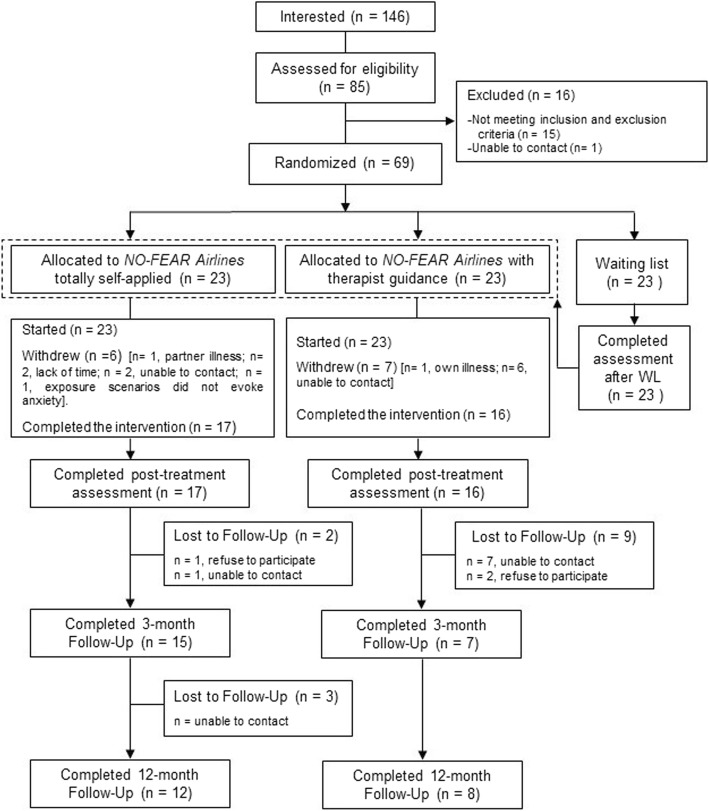
BACKGROUND: Internet-based treatments appear to be a promising way to enhance the in vivo exposure approach, specifically in terms of acceptability and access to treatment. However, the literature on specific phobias is scarce, and, as far as we know, there are no studies on Flying Phobia (FP). This study aims to investigate the effectiveness of an Internet-based exposure treatment for FP (NO-FEAR Airlines) that includes exposure scenarios composed of images and sounds, versus a waiting-list control group. A secondary aim is to explore two ways of delivering NO-FEAR Airlines, with and without therapist guidance. METHODS: A randomized controlled trial (RCT) was conducted in which 69 participants were allocated to: 1) NO-FEAR Airlines totally self-applied, 2) NO-FEAR Airlines with therapist guidance, 3) a waiting-list control group. Primary outcome measures were the Fear of Flying Questionnaire-II and the Fear of Flying Scale. Secondary outcomes included the Fear and Avoidance Scales, Clinician Severity Scale, and Patient's Improvement scale. Behavioral outcomes (post-treatment flights and safety behaviors) were also included. Mixed-model analyses with no ad hoc imputations were conducted for primary and secondary outcome measures. RESULTS: NO-FEAR Airlines (with and without therapist guidance) was significantly effective, compared to the waiting list control group, on all primary and secondary outcomes (all ps < .05), and no significant differences were found between the two ways of delivering the intervention. Significant improvements on diagnostic status and reliable change indexes were also found in both treatment groups at post-treatment. Regarding behavioral outcomes, significant differences in safety behaviors were found at post-treatment, compared to the waiting list. Treatment gains were maintained at 3- and 12-month follow-ups. CONCLUSION: FP can be treated effectively via the Internet. NO-FEAR Airlines helps to enhance the exposure technique and provide access to evidence-based psychological treatment to more people in need. These data are congruent with previous studies highlighting the usefulness of computer-assisted exposure programs for FP, and they contribute to the literature on Internet-based interventions. To the best of our knowledge, this is the first RCT to investigate the effectiveness of an Internet-based treatment for FP and explore two ways of delivering the intervention (with and without therapist guidance). TRIAL REGISTRATION: Clinicaltrials.gov: NCT02298478 ( https://clinicaltrials.gov/ct2/show/NCT02298478 ). Trial registration date 3 November 2014.
Overview
The claims and statistics of this paper haven’t been checked yet.
Free: it reads the open-access text and checks the first 5 claims that cite a source we can check. Create a free account to check every claim.
Integrity signals
Registry
Cites
Statistics
Figures

Verification
Claims the paper makes
The claims and statistics of this paper haven’t been checked yet.
Free: it reads the open-access text and checks the first 5 claims that cite a source we can check. Create a free account to check every claim.
Claims other papers make about this one
Each is checked against this paper’s own text: does it say what the citing paper says it does?
The source backs part of the claim, not all of it — or backs it for a different population, condition or comparison.
In the citing paper
“Therapist support will not be provided in this study, based on previous results showing no differences in treatment efficacy with or without therapist support (Campos et al., 2019).”
From An Internet-based treatment for Flying Phobia using 360° images: Study protocol for a feasibility pilot study (2021) · cites this paper as Campos et al., 2019
Experimental — accuracy not yet measuredThe source backs part of the claim, not all of it — or backs it for a different population, condition or comparison.
In the citing paper
“As still images have already shown its efficacy in NO-FEAR Airlines (Campos et al., 2019)”
From An Internet-based treatment for Flying Phobia using 360° images: Study protocol for a feasibility pilot study (2021) · cites this paper as Campos et al., 2019
Experimental — accuracy not yet measuredThe cited source says what the claim attributes to it.
In the citing paper
“Both experimental groups showed reductions in FP symptomatology, with no differences found between them.”
From An internet-based treatment for flying phobia using 360° images: A feasibility pilot study (2022) · cites this paper as Campos et al., 2019
The cited source says what the claim attributes to it.
In the citing paper
“This program demonstrated its effectiveness in a recent RCT (Campos et al., 2019), where two experimental conditions (a group with therapist guidance and a completely self-administered condition) were compared to a waiting list control group.”
From An internet-based treatment for flying phobia using 360° images: A feasibility pilot study (2022) · cites this paper as Campos et al., 2019
The cited source says what the claim attributes to it.
In the citing paper
“Online exposure to airplane related scenarios helps to reduce phobic symptomatology, as showed with the potential effectiveness analysis of this study and the efficacy results obtained earlier by Campos et al. (2019)”
From An internet-based treatment for flying phobia using 360° images: A feasibility pilot study (2022) · cites this paper as Campos et al., 2019
4 more claims about this paper
Create a free account to see every claim other papers make about this one.
Self-check
Percentages, sums and reported differences re-computed from the paper’s own numbers.
The self-check needs the paper’s full text.
Citations
Cites
Jacobson, N. S., & Truax, P. (1991) · Journal of Consulting and Clinical Psychology · doi:10.1037/0022-006x.59.1.12 · Cited by 7,770 · cited 2×
“Chi-square tests were performed to evaluate group differences in RCI rates, behavioral outcomes (post-treatment flights and safety behaviors), and participant diagnostic status for completers at post-treatment and two follow-ups.”
MethodEysenbach, G., & CONSORT-EHEALTH Group (2011) · Journal of Medical Internet Research · doi:10.2196/jmir.1923 · Cited by 1,863 · cited 1×
“org), the CONSORT-EHEALTH guidelines [53], the APA guidelines for the practice of telepsychology [54], the Declaration of Helsinki, and good clinical practice.”
BackgroundBrief standard self-rating for phobic patients
Marks, I. M., & Mathews, A. M. (1979) · Behaviour Research and Therapy · doi:10.1016/0005-7967(79)90041-x · Cited by 1,801 · cited 2×
“Marks IM, Mathews AM.”
MethodPersuasive Systems Design: Key Issues, Process Model, and System Features
Oinas-Kukkonen, H., & Harjumaa, M. (2009) · Communications of the Association for Information Systems · doi:10.17705/1cais.02428 · Cited by 1,663 · cited 1×
“We suggest that the use of persuasive technologies [78] to provide guidance and reinforcement after the treatment, as well as the use of short intervention packages (via web or mobile) to review or practice before taking a flight, could be useful in this endeavor.”
BackgroundInternet-based cognitive behaviour therapy for symptoms of depression and anxiety: A meta-analysis
SPEK, V., CUIJPERS, P., NYKLÍČEK, I., RIPER, H., KEYZER, J., & POP, V. (2007) · Psychological Medicine · doi:10.1017/s0033291706008944 · Cited by 1,586 · cited 1×
“Power calculations and Internet attrition rates (30%) [67, 68] indicated that a sample size of a minimum of 57 participants (19 in each group) would be sufficient to detect a large effect size (d = 1) with a power of 0.”
BackgroundGueorguieva, R., & Krystal, J. H. (2004) · Archives of General Psychiatry · doi:10.1001/archpsyc.61.3.310 · Cited by 1,529 · cited 1×
“This approach uses all available data, it does not involve any substitution of missing values with supposed or estimated values, and it does not assume that the last measurement is stable (the last observation carried forward assumption) [70, 71].”
MethodComputer-based psychological treatments for depression: A systematic review and meta-analysis
Richards, D., & Richardson, T. (2012) · Clinical Psychology Review · doi:10.1016/j.cpr.2012.02.004 · Cited by 1,442 · cited 2×
“clinicians) might be of minor importance [46], some evidence highlights the superiority of guided interventions over unguided interventions [48].”
BackgroundResultInternet-Based and Other Computerized Psychological Treatments for Adult Depression: A Meta-Analysis
Andersson, G., & Cuijpers, P. (2009) · Cognitive Behaviour Therapy · doi:10.1080/16506070903318960 · Cited by 1,368
Advantages and limitations of Internet-based interventions for common mental disorders
Andersson, G., & Titov, N. (2014) · World Psychiatry · doi:10.1002/wps.20083 · Cited by 1,160
A Guide to Treatments that Work
Nathan, P. E., & Gorman, J. M. (2007) · Oxford University Press eBooks · doi:10.1093/med/9780195304145.001.0001 · Cited by 1,082 · cited 1×
“Research to date has pointed out that the most effective treatment approach for specific phobias (including FP) is in vivo exposure, recommending it as the treatment of choice [4, 7].”
BackgroundThe impact of guidance on Internet-based mental health interventions — A systematic review
Baumeister, H., Reichler, L., Munzinger, M., & Lin, J. (2014) · Internet Interventions · doi:10.1016/j.invent.2014.08.003 · Cited by 1,037 · cited 3×
“clinicians) might be of minor importance [46], some evidence highlights the superiority of guided interventions over unguided interventions [48].”
BackgroundResultUnderstanding Equivalence and Noninferiority Testing
Walker, E., & Nowacki, A. S. (2011) · Journal of General Internal Medicine · doi:10.1007/s11606-010-1513-8 · Cited by 751
Karyotaki, E., Riper, H., Twisk, J., Hoogendoorn, A., Kleiboer, A., Mira, A., Mackinnon, A., Meyer, B., Botella, C., Littlewood, E., et al. (2017) · JAMA Psychiatry · doi:10.1001/jamapsychiatry.2017.0044 · Cited by 691 · cited 1×
“, depression) [50], this issue remains unclear.”
Self-citationHedman, E., Ljótsson, B., & Lindefors, N. (2012) · Expert Review of Pharmacoeconomics & Outcomes Research · doi:10.1586/erp.12.67 · Cited by 672
A guide to treatments that work
(2015) · Oxford Clinical Psychology · doi:10.1093/med:psych/9780195304145.001.0001 · Cited by 647
Internet-Delivered Psychological Treatments
Andersson, G. (2016) · Annual Review of Clinical Psychology · doi:10.1146/annurev-clinpsy-021815-093006 · Cited by 595
Twisk, J., de Boer, M., de Vente, W., & Heymans, M. (2013) · Journal of Clinical Epidemiology · doi:10.1016/j.jclinepi.2013.03.017 · Cited by 568
Guidelines for the practice of telepsychology.
Joint Task Force for the Development of Telepsychology Guidelines for Psychologists (2013) · American Psychologist · doi:10.1037/a0035001 · Cited by 535
Practitioner’s Guide to Empirically Based Measures of Anxiety
(2001) · AABT Clinical Assessment Series · doi:10.1007/b108176 · Cited by 513 · cited 2×
“Despite that ADIS-IV was used as diagnosis interview and exclusion criteria were assessed in the screening conducted by telephone and throughout the protocol assessment included in NO-FEAR Airlines, no other diagnostic interview was systematically used to formally assess the presence of other mental disorder different…”
MethodInternet-based psychological treatments for depression
Johansson, R., & Andersson, G. (2012) · Expert Review of Neurotherapeutics · doi:10.1586/ern.12.63 · Cited by 509
A controlled study of virtual reality exposure therapy for the fear of flying.
Rothbaum, B. O., Hodges, L., Smith, S., Lee, J. H., & Price, L. (2000) · Journal of Consulting and Clinical Psychology · doi:10.1037/0022-006x.68.6.1020 · Cited by 501
Valmaggia, L. R., Latif, L., Kempton, M. J., & Rus-Calafell, M. (2016) · Psychiatry Research · doi:10.1016/j.psychres.2016.01.015 · Cited by 500
Garcia-Palacios, A., Botella, C., Hoffman, H., & Fabregat, S. (2007) · CyberPsychology & Behavior · doi:10.1089/cpb.2007.9962 · Cited by 410 · cited 1×
“Around 25% of patients reject starting the treatment when they are informed about the procedure, or they drop-out during treatment because they consider it too aversive [11].”
BackgroundSelf-citationvan Ballegooijen, W., Cuijpers, P., van Straten, A., Karyotaki, E., Andersson, G., Smit, J. H., & Riper, H. (2014) · PLoS ONE · doi:10.1371/journal.pone.0100674 · Cited by 409 · cited 1×
“Power calculations and Internet attrition rates (30%) [67, 68] indicated that a sample size of a minimum of 57 participants (19 in each group) would be sufficient to detect a large effect size (d = 1) with a power of 0.”
BackgroundTherapist-supported Internet cognitive behavioural therapy for anxiety disorders in adults
Olthuis, J. V., Watt, M. C., Bailey, K., Hayden, J. A., & Stewart, S. H. (2016) · Cochrane Database of Systematic Reviews · doi:10.1002/14651858.cd011565.pub2 · Cited by 390
STINSON, F. S., DAWSON, D. A., PATRICIA CHOU, S., SMITH, S., GOLDSTEIN, R. B., JUNE RUAN, W., & GRANT, B. F. (2007) · Psychological Medicine · doi:10.1017/s0033291707000086 · Cited by 320 · cited 1×
“8% of people suffering from phobias seek help [12], and very few of them (8%) receive a specific treatment for their problem [13].”
BackgroundCarlbring, P., Brunt, S., Bohman, S., Austin, D., Richards, J., Öst, L.-G., & Andersson, G. (2007) · Computers in Human Behavior · doi:10.1016/j.chb.2005.05.002 · Cited by 319
Implementing a five-factor personality inventory for use on the internet
Buchanan, T., Johnson, J. A., & Goldberg, L. R. (2005) · European Journal of Psychological Assessment · doi:10.1027/1015-5759.21.2.115 · Cited by 301 · cited 1×
“Although several studies have shown the usefulness of Internet and telephone administered assessments [82–84], some authors suggest that psychometric properties may change [85].”
BackgroundChakraborty, H. (2009) · doi:10.3768/rtipress.2009.mr.0009.0903 · Cited by 298 · cited 1×
“Intent-to-treat (ITT) mixed-model analyses without any ad hoc imputations were conducted to handle missing data due to participant drop-out [69].”
MethodMeyerbröker, K., & Emmelkamp, P. M. G. (2010) · Depression and Anxiety · doi:10.1002/da.20734 · Cited by 290
The Cruelest Cure? Ethical Issues in the Implementation of Exposure-Based Treatments
Olatunji, B. O., Deacon, B. J., & Abramowitz, J. S. (2009) · Cognitive and Behavioral Practice · doi:10.1016/j.cbpra.2008.07.003 · Cited by 273 · cited 1×
“Regarding acceptance, some authors have considered in vivo exposure to be a cruel cure and ethically inappropriate [9, 10].”
BackgroundBerger, T., Caspar, F., Richardson, R., Kneubühler, B., Sutter, D., & Andersson, G. (2011) · Behaviour Research and Therapy · doi:10.1016/j.brat.2010.12.007 · Cited by 265
(2016) · Cited by 252
Rothbaum, B. O., Anderson, P., Zimand, E., Hodges, L., Lang, D., & Wilson, J. (2006) · Behavior Therapy · doi:10.1016/j.beth.2005.04.004 · Cited by 240 · cited 2×
“The efficacy of VRET has been shown in several meta-analyses and systematic reviews for the treatment of anxiety disorders [16–19], including FP [6, 14, 20].”
BackgroundMethodReger, M. A., & Gahm, G. A. (2009) · Journal of Clinical Psychology · doi:10.1002/jclp.20536 · Cited by 234
MARKS, I. M., KENWRIGHT, M., McDONOUGH, M., WHITTAKER, M., & MATAIX-COLS, D. (2004) · Psychological Medicine · doi:10.1017/s003329170300878x · Cited by 226
Salim, A., Mackinnon, A., Christensen, H., & Griffiths, K. (2008) · Psychiatry Research · doi:10.1016/j.psychres.2007.08.005 · Cited by 194 · cited 2×
“Intent-to-treat (ITT) mixed-model analyses without any ad hoc imputations were conducted, rather than using analysis of variance (ANOVA) with multiple imputations (MI), based on the authors’ recommendation and due to the large amount of missing data at follow-up [56, 57].”
MethodHesser, H. (2015) · Internet Interventions · doi:10.1016/j.invent.2015.02.003 · Cited by 192 · cited 1×
“This approach uses all available data, it does not involve any substitution of missing values with supposed or estimated values, and it does not assume that the last measurement is stable (the last observation carried forward assumption) [70, 71].”
MethodAmerican Psychiatric Association
(2014) · Cultural Sociology of Mental Illness: An A-to-Z Guide · doi:10.4135/9781483346342.n10 · Cited by 185
Noninferiority and equivalence designs: Issues and implications for mental health research
Greene, C. J., Morland, L. A., Durkalski, V. L., & Frueh, B. C. (2008) · Journal of Traumatic Stress · doi:10.1002/jts.20367 · Cited by 178
An internet-based self-help treatment for fear of public speaking: a controlled trial.
Botella, C., Gallego, M. J., Garcia-Palacios, A., Guillen, V., Baños, R. M., Quero, S., & Alcañiz, M. (2010) · Cyberpsychology, Behavior, and Social Networking · doi:10.1089/cyber.2009.0224 · Cited by 169 · cited 4×
“[43], we suggest that the combination of new technologies (i.”
BackgroundInfluentialSelf-citationVirtual reality exposure in anxiety disorders: Impact on psychophysiological reactivity
Diemer, J., Mühlberger, A., Pauli, P., & Zwanzger, P. (2014) · The World Journal of Biological Psychiatry · doi:10.3109/15622975.2014.892632 · Cited by 146
Practical guide to sample size calculations: non‐inferiority and equivalence trials
Flight, L., & Julious, S. A. (2016) · Pharmaceutical Statistics · doi:10.1002/pst.1716 · Cited by 142
McCann, R. A., Armstrong, C. M., Skopp, N. A., Edwards-Stewart, A., Smolenski, D. J., June, J. D., Metzger-Abamukong, M., & Reger, G. M. (2014) · Journal of Anxiety Disorders · doi:10.1016/j.janxdis.2014.05.010 · Cited by 134
Internet-Guided Self-Help with or without Exposure Therapy for Phobic and Panic Disorders
Schneider, A. J., Mataix-Cols, D., Marks, I. M., & Bachofen, M. (2005) · Psychotherapy and Psychosomatics · doi:10.1159/000084000 · Cited by 118
Titov, N., Andrews, G., Schwencke, G., Solley, K., Johnston, L., & Robinson, E. (2009) · Australian & New Zealand Journal of Psychiatry · doi:10.1080/00048670903179228 · Cited by 113
Lancee, J., van den Bout, J., Sorbi, M. J., & van Straten, A. (2013) · Behaviour Research and Therapy · doi:10.1016/j.brat.2013.09.004 · Cited by 113
Phobia: prevalence and risk factors
Boyd, J. H., Rae, D. S., Thompson, J. W., Burns, B. J., Bourdon, K., Locke, B. Z., & Regier, D. A. (1990) · Social Psychiatry and Psychiatric Epidemiology · doi:10.1007/bf00782887 · Cited by 112 · cited 1×
“8% of people suffering from phobias seek help [12], and very few of them (8%) receive a specific treatment for their problem [13].”
BackgroundKelders, S. M., Bohlmeijer, E. T., Pots, W. T. M., & van Gemert-Pijnen, J. E. W. C. (2015) · Behaviour Research and Therapy · doi:10.1016/j.brat.2015.06.014 · Cited by 105
Andersson, G., Waara, J., Jonsson, U., Malmaeus, F., Carlbring, P., & Öst, L. (2009) · Cognitive Behaviour Therapy · doi:10.1080/16506070902931326 · Cited by 101
Online interventions for anxiety disorders
Christensen, H., Batterham, P., & Calear, A. (2014) · Current Opinion in Psychiatry · doi:10.1097/yco.0000000000000019 · Cited by 95
Virtual Reality Versus Computer-Aided Exposure Treatments for Fear of Flying
Tortella-Feliu, M., Botella, C., Llabrés, J., Bretón-López, J. M., del Amo, A. R., Baños, R. M., & Gelabert, J. M. (2011) · Behavior Modification · doi:10.1177/0145445510390801 · Cited by 93 · cited 4×
“05, based on a similar study [22] and recent systematic reviews [32].”
BackgroundMethodResultInfluentialSelf-citationTherapist Barriers to the Dissemination of Exposure Therapy
Deacon, B. J., & Farrell, N. R. (2013) · Handbook of Treating Variants and Complications in Anxiety Disorders · doi:10.1007/978-1-4614-6458-7_23 · Cited by 91 · cited 1×
“Regarding acceptance, some authors have considered in vivo exposure to be a cruel cure and ethically inappropriate [9, 10].”
BackgroundPeople who seek help for fear of flying: Typology of flying phobics
Gerwen, L. J. V., Spinhoven, P., Diekstra, R. F. W., & van Dyck, R. (1997) · Behavior Therapy · doi:10.1016/s0005-7894(97)80045-7 · Cited by 89
Botella, C., Osma, J., Garcia‐Palacios, A., Quero, S., & Baños, R. M. (2004) · Clinical Psychology & Psychotherapy · doi:10.1002/cpp.404 · Cited by 86 · cited 2×
“The efficacy of VRET has been shown in several meta-analyses and systematic reviews for the treatment of anxiety disorders [16–19], including FP [6, 14, 20].”
BackgroundMethodHaug, T., Berntzen, D., Götestam, K.-G., Brenne, L., Johnsen, B. H., & Hugdahl, K. (1987) · Behaviour Research and Therapy · doi:10.1016/0005-7967(87)90045-3 · Cited by 82 · cited 3×
“The Fear of Flying Questionnaire-II (FFQ-II) [61]; The Fear of Flying scale (FFS) [63].”
BackgroundInfluentialPhysiological markers for anxiety: Panic disorder and phobias
Roth, W. T. (2005) · International Journal of Psychophysiology · doi:10.1016/j.ijpsycho.2005.01.015 · Cited by 76
Mira, A., Bretón-López, J., García-Palacios, A., Quero, S., Baños, R. M., & Botella, C. (2017) · Neuropsychiatric Disease and Treatment · doi:10.2147/ndt.s130994 · Cited by 71
Self-citationBoettcher, J., Berger, T., & Renneberg, B. (2012) · Behavioural and Cognitive Psychotherapy · doi:10.1017/s1352465812000501 · Cited by 61 · cited 1×
“Research has highlighted that providing brief initial human contact before starting the treatment might be sufficient to produce an effect on the treatment outcomes, reducing the need for or impact of guidance throughout the treatment [80].”
BackgroundAndersson, G., Waara, J., Jonsson, U., Malmaeus, F., Carlbring, P., & Öst, L.-G. (2013) · Cognitive Behaviour Therapy · doi:10.1080/16506073.2013.844202 · Cited by 59 · cited 4×
“Nevertheless, as the authors noted, it is important to take into account that the Internet treatments used in both studies consisted of self-administered exposure, rather than a treatment delivered through a computer [34].”
BackgroundInfluentialMewton, L., Smith, J., Rossouw, P., & Andrews, G. (2014) · Psychology Research and Behavior Management · doi:10.2147/prbm.s40879 · Cited by 57
Telepsychology and self-help: the treatment of phobias using the internet
Botella, C., Quero, S., Banos, R. M., Garcia-Palacios, A., Breton-Lopez, J., Alcaniz, M., & Fabregat, S. (2008) · CyberPsychology & Behavior · doi:10.1089/cpb.2008.0012 · Cited by 56 · cited 1×
“[35] showed preliminary data from a series of cases about a self-applied telepsychology program using an intranet to treat small animal phobia (spiders, cockroaches, and mice).”
BackgroundSelf-citationOakes, M. G., & Bor, R. J. (2010) · Travel Medicine and Infectious Disease · doi:10.1016/j.tmaid.2010.10.002 · Cited by 50 · cited 1×
“Research to date has pointed out that the most effective treatment approach for specific phobias (including FP) is in vivo exposure, recommending it as the treatment of choice [4, 7].”
BackgroundKok, R. N., van Straten, A., Beekman, A. T. F., & Cuijpers, P. (2014) · Journal of Medical Internet Research · doi:10.2196/jmir.3429 · Cited by 49 · cited 5×
“Spek V, Cuijpers P, Nyklícek I, Riper H, Keyzer J, Pop V. Internet-based cognitive behaviour therapy for symptoms of depression and anxiety: a meta-analysis.”
InfluentialInternet-Delivered Cognitive Behavior Therapy for Anxiety Disorders Is Here to Stay
Andrews, G., Newby, J. M., & Williams, A. D. (2015) · Current Psychiatry Reports · doi:10.1007/s11920-014-0533-1 · Cited by 48 · cited 1×
“05, based on a similar study [22] and recent systematic reviews [32].”
BackgroundFear of flying treatment programs for passengers: an international update
Gerwen, L. J. V., Diekstra, R. F. W., Arondeus, J. M., & Wolfger, R. (2004) · Travel Medicine and Infectious Disease · doi:10.1016/j.tmaid.2004.01.002 · Cited by 45 · cited 1×
“Given the importance of taking a flight after the treatment, outlined in several studies [8, 14, 86], further efforts are needed in this regard.”
BackgroundA meta-review of Internet computer-based psychological treatments for anxiety disorders
Peñate, W., & Fumero, A. (2016) · Journal of Telemedicine and Telecare · doi:10.1177/1357633x15586491 · Cited by 41
The New Statistics: A How‐To Guide
Cumming, G. (2013) · Australian Psychologist · doi:10.1111/ap.12018 · Cited by 39
Multicomponent standardized treatment programs for fear of flying: Description and effectiveness
Van Gerwen, L. J., Spinhoven, P., Diekstra, R. F. W., & Van Dyck, R. (2002) · Cognitive and Behavioral Practice · doi:10.1016/s1077-7229(02)80007-4 · Cited by 39 · cited 2×
“Specifically for FP, evidence indicates that more than 90% of participants whose treatment included in vivo exposure continued to fly at one- to four-year follow-up [8].”
BackgroundThe acceptability of an Internet-based self-help treatment for fear of public speaking
Botella, C., Gallego, M. J., Garcia-Palacios, A., Baños, R. M., Quero, S., & Alcañiz, M. (2009) · British Journal of Guidance & Counselling · doi:10.1080/03069880902957023 · Cited by 39 · cited 2×
“suggest that Internet-based exposure treatment is a useful alternative to in vivo exposure, providing a less frightening way for participants to confront their fears [44].”
BackgroundSelf-citationMeta-análisis en ciencias sociales y de la salud
Ausina, J. B., & Sánchez‐Meca, J. (2015) · Dialnet (Universidad de la Rioja) · Cited by 36
Efficacy of self-administered treatments for depression and anxiety.
Menchola, M., Arkowitz, H. S., & Burke, B. L. (2007) · Professional Psychology: Research and Practice · doi:10.1037/0735-7028.38.4.421 · Cited by 35 · cited 1×
“, specific phobias), they may be insufficient for more severe mental disorders [43, 81].”
BackgroundBusscher, B., Spinhoven, P., van Gerwen, L. J., & de Geus, E. J. C. (2013) · Behaviour Research and Therapy · doi:10.1016/j.brat.2012.10.009 · Cited by 34 · cited 1×
“Up to 7% of the population experience acute interference in daily and social life functioning due to FP [5].”
BackgroundAbout the effectiveness of telehealth procedures in psychological treatments
Peñate, W. (2012) · Redalyc (Universidad Autónoma del Estado de México) · Cited by 32
Schröder, J., Jelinek, L., & Moritz, S. (2017) · Journal of Behavior Therapy and Experimental Psychiatry · doi:10.1016/j.jbtep.2016.05.002 · Cited by 32 · cited 2×
“Schröder J, Jelinek L, Moritz S.”
BackgroundThe use of automated assessments in internet-based CBT: The computer will be with you shortly
Mason, E. C., & Andrews, G. (2014) · Internet Interventions · doi:10.1016/j.invent.2014.10.003 · Cited by 23
Campos, D., Bretón-López, J., Botella, C., Mira, A., Castilla, D., Baños, R., Tortella-Feliu, M., & Quero, S. (2016) · BMC Psychiatry · doi:10.1186/s12888-016-0996-1 · Cited by 13 · cited 3×
“A detailed description of the measures and sources of assessment can be found in the study protocol [55].”
BackgroundSelf-citationComputer-assisted exposure treatment for flight phobia
Tortella-Feliu, M., Bornas, X., & Llabrés, J. (2008) · International Journal of Behavioral Consultation and Therapy · doi:10.1037/h0100840 · Cited by 11 · cited 2×
“However, some authors suggest that less sophisticated and cheaper devices might be sufficient to produce satisfactory outcomes in FP [21].”
BackgroundResultFenger, M., Lindschou, J., Gluud, C. N., Winkel, P., Jørgensen, L., Kruse-Blinkenberg, S., & Lau, M. E. (2016) · Trials · doi:10.1186/s13063-016-1619-3 · Cited by 9
NO-FEAR Airlines: A Computer-aided Self-help Treatment for Flying Phobia
Soledad, Q., Daniel, C., Antonio, R. D. A., Juana, B.-L., Miquel, T.-F., Ma., B. R., & Cristina, B. (2015) · Studies in Health Technology and Informatics · doi:10.3233/978-1-61499-595-1-197 · Cited by 7
Self-citation(2015) · Tesis Psicológica · Cited by 4
Self-citation(2016) · LA Referencia (Red Federada de Repositorios Institucionales de Publicaciones Científicas) · Cited by 3
Self-citation
Research works printed but not linked: 3
- 61. Bornas X, Tortella-Feliu M, García de la Banda G, Fullana MA, Labrés J. Validación factorial del cuestionario de miedo a volar (QPV) [The Factor Validity of the Fear of Flying Questionnaire]. Análisis y Modif. Conduct. 1999; 25:885-907.
- 65. DiNardo P, Brown TA, Barlow DH. Anxiety Disorders Interview Schedule for DSM-IV: Life Time Version: Clien Interview Schedule. Oxford: Graywind Publications; 1994.
- 66. Guy W. Clinical Global Impression Scale. ECDEU Assess. Man Psychopharmacol. 1976;76:218-22.
Cited by
Virtual reality therapy in mental health
Emmelkamp, P. M. G., & Meyerbröker, K. (2021) · Annual Review of Clinical Psychology · doi:10.1146/annurev-clinpsy-081219-115923 · Cited by 363
Musiat, P., Johnson, C., Atkinson, M., Wilksch, S., & Wade, T. (2022) · Psychological Medicine · doi:10.1017/s0033291721004621 · Cited by 166
González-Robles, A., Díaz-García, A., García-Palacios, A., Roca, P., Ramos-Quiroga, J. A., & Botella, C. (2020) · Journal of Medical Internet Research · doi:10.2196/18220 · Cited by 40
“The web platform has successfully been used in previous RCTs exploring the efficacy of internet-delivered treatments for several disorders, such as depression [94] and flying phobia [95].”
MethodSelf-citationStephenson, K. R., Zippan, N., & Brotto, L. A. (2021) · Journal of Clinical Psychology · doi:10.1002/jclp.23137 · Cited by 36
Wendt, S., Beier, D., Paquet, D., Trawinski, H., Fuchs, A., & Lübbert, C. (2021) · Deutsches Ärzteblatt international · doi:10.3238/arztebl.m2021.0127 · Cited by 26
Metadata
- Authors
- Campos, D., Bretón-López, J., Botella, C., Mira, A., Castilla, D., Mor, S., Baños, R., & Quero, S.
- Affiliations
- Universitat Jaume I (ES)
- Universitat de València (ES)
- Corresponding author
- Quero, Soledad
- ORCID
- Venue
- BMC Psychiatry
- Published
- 2019-03-06
- Volume
- 19
- Issue
- 1
- Pages
- 86-86
- ISSN
- 1471-244X (ISSN-L)
- PMC
- PMC6404352
- OpenAlex
- W2925308231
- Semantic Scholar
- 6bebf567a45a076be0d05276d67a4dee60f5876c
- Cited by
- 32
- References
- 86
- Citations by year
- 2026: 1 · 2025: 4 · 2024: 1 · 2023: 6 · 2022: 6 · 2021: 11 · 2020: 2 · 2019: 1
- FWCI
- 5.87
- Type
- journal article
- Language
- en
- Open access
- gold
- doi.org
- Licence
- cc-by
- creativecommons.org/licenses/by/4.0/ (tdm)
- Locations
- BMC Psychiatry (publishedVersion, cc-by)
- Europe PMC (PubMed Central) (publishedVersion, cc-by)
- PubMed Central (publishedVersion, cc-by)
- PubMed (publishedVersion)
- LA Referencia (Red Federada de Repositorios Institucionales de Publicaciones Científicas) (publishedVersion, other-oa)
- Repositori UJI (Universitat Jaume I) (submittedVersion, cc-by-sa)
- DOAJ (DOAJ: Directory of Open Access Journals) (submittedVersion, cc-by-sa)
- Zaguan (University of Zaragoza Repository) (submittedVersion, cc-by)
- Funders
- American Concrete Institute Foundation
- Ministerio de Economía y Competitividad (PSI2014–54172-R, PSI2013-41783-R, PSI2014, PSI2014-56303, PSI2014-56303-REDT)
- Generalitat Valenciana (PSI2014-56303-REDT)
- Universitat Jaume I
- Instituto de Salud Carlos III (PSI2014-56303-REDT)
- Topics
- Social Sciences › Psychology › Experimental and Cognitive Psychology › Anxiety, Depression, Psychometrics, Treatment, Cognitive Processes
- Social Sciences › Psychology › Applied Psychology › Digital Mental Health Interventions
- Physical Sciences › Computer Science › Human-Computer Interaction › Virtual Reality Applications and Impacts
- Keywords
- fear of flying, online therapy, therapist guidance, specific phobia, safety behavior, treatment efficacy
- MeSH terms
- Adult, Fear, Female, Humans, Male, Middle Aged, Patient Education as Topic, Phobic Disorders, Surveys and Questionnaires, Self Care, Therapy, Computer-Assisted, Health Behavior, Cognitive Behavioral Therapy, Treatment Outcome, Internet
About these checks
Registry, retraction, Cites and statistics results are computed, not judged, with one exception: a printed reference that no index lists is read once by a model before it counts as a citation error. Claims are extracted by a model and kept only when their quote appears verbatim in the text; each cited source is then checked, with a model’s help, for whether it says what the claim relies on. Those verdicts can be wrong — read the claim’s quote and the cited source before relying on one.
Statistics and arithmetic are recomputed, not judged.
Confidence bands are shown only for fields calibrated on our annotated test set. None is calibrated yet, so no band is shown.
What counts as a claim ›How we measure confidence ›How we check this ›
Are you an author, or do you see a problem with this page? Request a review
Data sources
Bibliographic data: Semantic Scholar, OpenAlex, Crossref.
Contains information from the Semantic Scholar Academic Graph Datasets, made available under the ODC Attribution License (ODC-BY 1.0).
Semantic Scholar’s data is described in: Kinney, R., et al. (2023). The Semantic Scholar Open Data Platform. arXiv:2301.10140.
