

Acoustic differences between healthy and depressed people: a cross-situation study
Open accessThe DOI matches its Crossref record; 52 of the 54 references it cites were found in a registry or an index.
Abstract
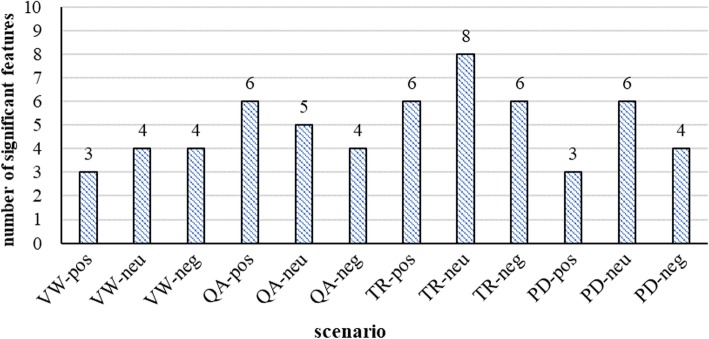
Background: Abnormalities in vocal expression during a depressed episode have frequently been reported in people with depression, but less is known about if these abnormalities only exist in special situations. In addition, the impacts of irrelevant demographic variables on voice were uncontrolled in previous studies. Therefore, this study compares the vocal differences between depressed and healthy people under various situations with irrelevant variables being regarded as covariates. Methods: To examine whether the vocal abnormalities in people with depression only exist in special situations, this study compared the vocal differences between healthy people and patients with unipolar depression in 12 situations (speech scenarios). Positive, negative and neutral voice expressions between depressed and healthy people were compared in four tasks. Multiple analysis of covariance (MANCOVA) was used for evaluating the main effects of variable group (depressed vs. healthy) on acoustic features. The significances of acoustic features were evaluated by both statistical significance and magnitude of effect size. Results: The results of multivariate analysis of covariance showed that significant differences between the two groups were observed in all 12 speech scenarios. Although significant acoustic features were not the same in different scenarios, we found that three acoustic features (loudness, MFCC5 and MFCC7) were consistently different between people with and without depression with large effect magnitude. Conclusions: Vocal differences between depressed and healthy people exist in 12 scenarios. Acoustic features including loudness, MFCC5 and MFCC7 have potentials to be indicators for identifying depression via voice analysis. These findings support that depressed people’s voices include both situation-specific and cross-situational patterns of acoustic features.
Overview
The claims and statistics of this paper haven’t been checked yet.
Free: it reads the open-access text and checks the first 5 claims that cite a source we can check. Create a free account to check every claim.
Integrity signals
Registry
Cites
Statistics
Figures
Verification
Claims the paper makes
The claims and statistics of this paper haven’t been checked yet.
Free: it reads the open-access text and checks the first 5 claims that cite a source we can check. Create a free account to check every claim.
Claims other papers make about this one
Each is checked against this paper’s own text: does it say what the citing paper says it does?
The source backs part of the claim, not all of it — or backs it for a different population, condition or comparison.
In the citing paper
“Third, it opens the door to voice or speech analysis, whereas features of the patient’s utterances can be passively monitored to derive health states [28-31].”
From Voice-Based Conversational Agents for the Prevention and Management of Chronic and Mental Health Conditions: Systematic Literature Review (2021) · cites this paper as [29]
Experimental — accuracy not yet measured
Self-check
Percentages, sums and reported differences re-computed from the paper’s own numbers.
The self-check needs the paper’s full text.
Citations
Cites
Diagnostic and Statistical Manual of Mental Disorders
American Psychiatric Association (2013) · doi:10.1176/appi.books.9780890425596 · Cited by 116,369
Diagnostic and Statistical Manual of Mental Disorders (DSM-IV)
Hu, R. J. (2003) · Encyclopedia of the Neurological Sciences · doi:10.1016/b0-12-226870-9/01070-4 · Cited by 9,117 · cited 1×
“These patients were diagnosed based on DSM-IV criteria [17] by experienced psychologists or psychiatrists.”
MethodRecent developments in openSMILE, the munich open-source multimedia feature extractor
Eyben, F., Weninger, F., Gross, F., & Schuller, B. (2013) · Proceedings of the 21st ACM international conference on Multimedia · doi:10.1145/2502081.2502224 · Cited by 1,241
A review of depression and suicide risk assessment using speech analysis
Cummins, N., Scherer, S., Krajewski, J., Schnieder, S., Epps, J., & Quatieri, T. F. (2015) · Speech Communication · doi:10.1016/j.specom.2015.03.004 · Cited by 1,003
Toward a comprehensive developmental model for major depression in women
Kendler, K. S., Gardner, C. O., & Prescott, C. A. (2002) · American Journal of Psychiatry · doi:10.1176/appi.ajp.159.7.1133 · Cited by 962
Emotion context insensitivity in major depressive disorder
Rottenberg, J., Gross, J. J., & Gotlib, I. H. (2005) · Journal of Abnormal Psychology · doi:10.1037/0021-843x.114.4.627 · Cited by 654
The Neural Correlates of Anhedonia in Major Depressive Disorder
Keedwell, P. A., Andrew, C., Williams, S. C. R., Brammer, M. J., & Phillips, M. L. (2005) · Biological Psychiatry · doi:10.1016/j.biopsych.2005.05.019 · Cited by 650
The INTERSPEECH 2010 paralinguistic challenge
Schuller, B., Steidl, S., Batliner, A., Burkhardt, F., Devillers, L., Müller, C., & Narayanan, S. S. (2010) · Interspeech 2010 · doi:10.21437/interspeech.2010-739 · Cited by 571 · cited 1×
“The F0 envelope is the envelope of the smoothed F0 contour, which is a common feature in affective computing [31].”
BackgroundDetecting depression from facial actions and vocal prosody
Cohn, J. F., Kruez, T. S., Matthews, I., Yang, Y., Nguyen, M. H., Padilla, M. T., Zhou, F., & De la Torre, F. (2009) · 2009 3rd International Conference on Affective Computing and Intelligent Interaction and Workshops · doi:10.1109/acii.2009.5349358 · Cited by 494 · cited 1×
“Researchers identified a salient correlation between F0 and severity of depression [4, 5, 7, 27].”
BackgroundMultivariate Analysis of Variance and Covariance
Huberty, C. J., & Petoskey, M. D. (2000) · Handbook of Applied Multivariate Statistics and Mathematical Modeling · doi:10.1016/b978-012691360-6/50008-2 · Cited by 492
Research works printed but not linked: 1
- Cohen J Statistical power analyses for the behavioral sciences 1988 2 Hillsdale Lawrence Erlbaum Associates
Cited by
Items 101–121 of 121
ANALYSIS OF NATURAL SPEECH FOR THE ASSESSMENT OF MOOD DISORDERS
Dikaios, K. (2021) · DalSpace (Dalhousie University) · Cited by 1
Multi-channel CNN-based emotion recognition using recurrence plot representations of speech
Pentari, A., Iosifidis, P., Kyprakis, G., Tzermia, C., Froudas, M., Skaramagkas, V., & Tsiknakis, M. (2023) · IEEE International Conference on Bioinformatics and Biomedicine (BIBM) · doi:10.1109/bibm58861.2023.10385734
“Specifically, among the most important contributions, the automatic recognition of diseases such as Parkinson’s, Alzheimer and some serious disorders such as depression, through the proper analysis of speech can provide significant insights for their early diagnosis [2], [4], [5].”
BackgroundThe Nonverbal Communication of Biological Sex and Gender
Horgan, T. G. (2024) · Springer eBooks · doi:10.1007/978-3-031-54361-6_2
Nonverbal Expression in the Voice: Impact of Select Trait, Neurologic, and Psychiatric Conditions
Horgan, T. G., Hall, J. A., & Miller, N. S. (2024) · Springer eBooks · doi:10.1007/978-3-031-70064-4_5
Stress and Depressive Symptoms: Development of Mind Monitoring System (MIMOSYS)
Shinohara, S. (2025) · Springer eBooks · doi:10.1007/978-981-96-3109-4_3
Liu, Y., Wang, Q., Zhang, S., & Zhang, W. (2025) · Lecture notes in computer science · doi:10.1007/978-981-96-6588-4_6
Automatic classification of major depressive disorder using the optimal speech feature combination
함현선 (2024) · Seoul National University Open Repository (Seoul National University)
Cooke, J. (2023) · Huddersfield Research Portal (University of Huddersfield)
Pratiwi, M., & Hayati, N. Q. (2025) · International Conference on Smart Cities, Automation & Intelligent Computing Systems (ICON-SONICS) · doi:10.1109/icon-sonics67145.2025.11309237
“Several studies have examined the feasibility and validity of automated depression assessment using bio-acoustic measures[5],[6],[7]–[9] There is emerging evidence for the use of speech analysis as an objective biomarker in artificial intelligence (AI) applications designed to complement clinical…”
Prosodiset piirteet varhaista Alzheimerin tautia sairastavilla
Häggman, A. (2024) · Tampere University Institutional Repository (Tampere University)
Betancourth–Chaves, P., Montoya–Zuluaga, J., Alvarez-Hernandez, N., Botero–Arroyave, M., Guarín–Montoya, J., Rodríguez, B., & Timarán, D. A. V. (2026) · Research Square · doi:10.21203/rs.3.rs-9002598/v1
Kulikova, E. I. (2025) · PERSONALITY IN A CHANGING WORLD HEALTH ADAPTATION DEVELOPMENT · doi:10.23888/humj2025134335-347
Recognizing anxiety and depression in cancer patients based on speech and facial expressions
Xu, N., Wu, T., Sun, L., Xin, P., Tan, X., Luo, N., & Liu, Y. (2026) · Frontiers in Psychiatry · doi:10.3389/fpsyt.2026.1813727
“In particular, we design temporal attention masking mechanism to strengthen the model ’ s attention to paused segments of speech, hesitation phenomena, and non-fl uent articulatory segments, acoustic events that are highly correlated with depressive states (34, 35).”
Xing, Y., He, R., Cao, X., Tan, P., & Chen, L. (2026) · Frontiers in Psychiatry · doi:10.3389/fpsyt.2026.1825268
“fundamental frequency, slow speech speed and prolonged pause duration (29).”
Maung, M. M., Wongpakaran, T., Lerttrakarnnon, P., Worland, S., Wongpakaran, N., & DeMaranville, J. (2026) · Narra J · doi:10.52225/narra.v6i2.3111
“Previous research on acoustic speech features has shown that vocal loudness is one of several features that consistently differ between healthy individuals and those with depression across multiple speech scenarios [14].”
The Effect of Microgravity on the Human Voice, Phonation- A Single Case StudyPreprint
Bihari, A., Schlégl, Á. T., Perlaki, T., Hermann, P., Garami, Z. F., Dabasi, E., & Hacki, T. (2026) · Research Square · doi:10.21203/rs.3.rs-9817979/v1
Menne, F., Dörr, F., Tröger, J., König, A., Schräder, J., Immel, D., Hurlemann, R., Barton, S., & Wagels, L. (2026) · Annals of General Psychiatry · doi:10.1186/s12991-026-00691-0
“Autobio-graphical narratives like this have demonstrated utility in prior research as a robust and replicable method for capturing clinically relevant vocal markers [15, 43].”
Acoustic Speech Features for Mental State Monitoring: Systematic Review (Preprint)Preprint
Stubbs, M., Thrash, J., Rahavi, S., Hartman, A., Ochieng, L., Hartman, A., Scafi, S., Devor, Y., & Shinar, Z. (2026) · doi:10.2196/preprints.113062
Ku, D. K. K., Wong, A. Y. C., Chan, K. Y., Wing, Y. K., & Li, T. M. H. (2026) · Healthcare · doi:10.3390/healthcare14193238
“Importantly, voice journaling captures a range of linguistic and acoustic features (e.g., pitch, loudness, and speech rate) that have been associated with depressive symptoms [14–20].”
Di, Y., Wang, J., Liu, X., & Zhu, T. (2021) · doi:10.3389/fgene.2021.761141.s001
Self-citationLi, N., Feng, L., Hu, J., Jiang, L., Wang, J., Han, J., Gan, L., He, Z., & Wang, G. (2023) · doi:10.3389/fpsyt.2023.1104190.s001
Self-citation
Metadata
- Authors
- Wang, J., Zhang, L., Liu, T., Pan, W., Hu, B., & Zhu, T.
- Affiliations
- Chinese Academy of Sciences (CN)
- Virginia Tech (US)
- Peking University (CN)
- Lanzhou University (CN)
- Corresponding author
- Zhu, Tingshao
- Venue
- BMC Psychiatry
- Published
- 2019-10-15
- Volume
- 19
- Issue
- 1
- Pages
- 300-300
- ISSN
- 1471-244X (ISSN-L)
- PMC
- PMC6794822
- OpenAlex
- W2980931499
- Semantic Scholar
- f2e82bbb9342b8752e46f660de1fc9e3f3c1b956
- Cited by
- 98
- References
- 54
- Citations by year
- 2026: 16 · 2025: 22 · 2024: 18 · 2023: 17 · 2022: 12 · 2021: 12 · 2020: 1
- FWCI
- 7.34
- Type
- journal article
- Language
- en
- Open access
- gold
- doi.org
- Licence
- cc-by
- creativecommons.org/licenses/by/4.0/ (tdm)
- creativecommons.org/licenses/by/4.0/ (vor)
- Locations
- BMC Psychiatry (publishedVersion, cc-by)
- PubMed Central (publishedVersion, cc-by)
- PubMed (publishedVersion)
- Lanzhou University Institutional Repository (submittedVersion)
- Institutional Repository of Institute of Psychology, Chinese Academy of Sciences (Institute of Psychology, Chinese Academy of Sciences) (submittedVersion)
- DOAJ (DOAJ: Directory of Open Access Journals) (submittedVersion)
- VTechWorks (Virginia Tech) (submittedVersion, cc-by)
- Funders
- Ministry of Science and Technology of the People's Republic of China (No. 2014CB744603)
- Chinese Academy of Sciences (No. ZDRW-XH-2019-4)
- Topics
- Physical Sciences › Computer Science › Artificial Intelligence › Emotion and Mood Recognition
- Health Sciences › Health Professions › Speech and Hearing › Voice and Speech Disorders
- Social Sciences › Psychology › Experimental and Cognitive Psychology › Phonetics and Phonology Research
- Keywords
- depression, voice analysis, acoustic features, vocal expression, major depressive disorder, loudness, Mel-frequency cepstral coefficients
- MeSH terms
- Adult, Major Depressive Disorder, Female, Humans, Male, Middle Aged, Speech Acoustics, Voice Quality, Young Adult
About these checks
Registry, retraction, Cites and statistics results are computed, not judged, with one exception: a printed reference that no index lists is read once by a model before it counts as a citation error. Claims are extracted by a model and kept only when their quote appears verbatim in the text; each cited source is then checked, with a model’s help, for whether it says what the claim relies on. Those verdicts can be wrong — read the claim’s quote and the cited source before relying on one.
Statistics and arithmetic are recomputed, not judged.
Confidence bands are shown only for fields calibrated on our annotated test set. None is calibrated yet, so no band is shown.
What counts as a claim ›How we measure confidence ›How we check this ›
Are you an author, or do you see a problem with this page? Request a review
Data sources
Bibliographic data: Semantic Scholar, OpenAlex, Crossref.
Contains information from the Semantic Scholar Academic Graph Datasets, made available under the ODC Attribution License (ODC-BY 1.0).
Semantic Scholar’s data is described in: Kinney, R., et al. (2023). The Semantic Scholar Open Data Platform. arXiv:2301.10140.
