

The DOI matches its Crossref record; 40 of the 40 references it cites were found in a registry or an index.
Temporal trends in annual incidence rates for psychiatric disorders and self-harm among children and adolescents in the UK, 2003–2018
Open accessAbstract
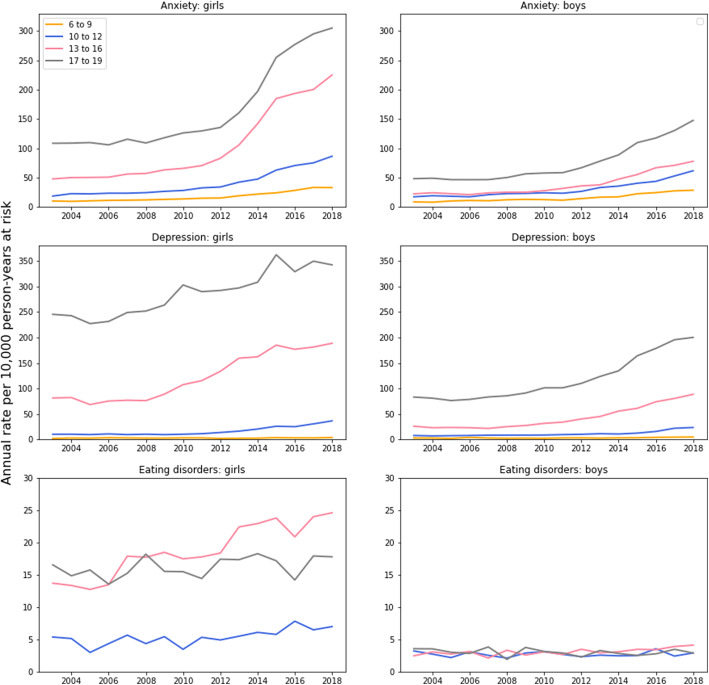
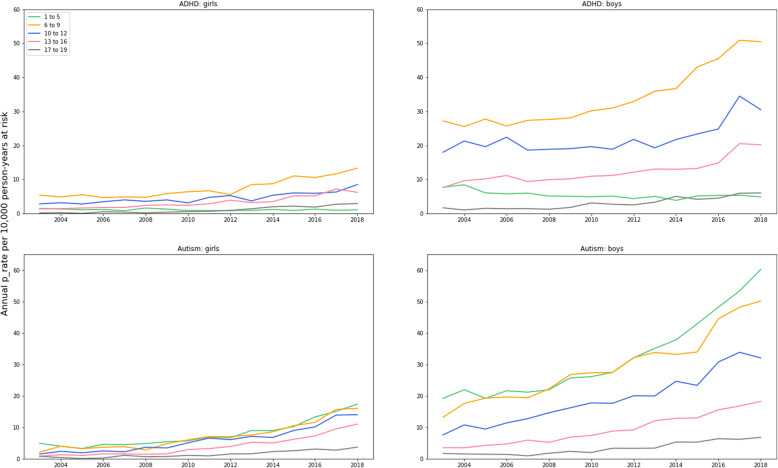
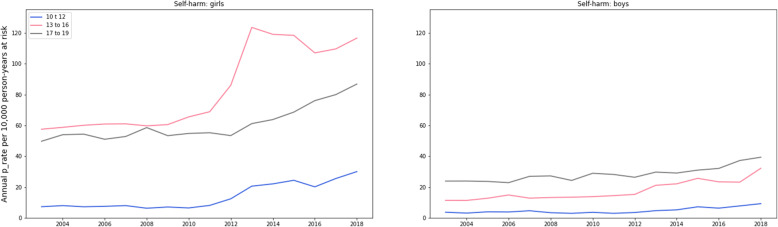
Background: There has been growing concern in the UK over recent years that a perceived mental health crisis is affecting children and adolescents, although published epidemiological evidence is limited. Methods: Two population-based UK primary care cohorts were delineated in the Aurum and GOLD datasets of the Clinical Practice Research Datalink (CPRD). We included data from 9,133,246 individuals aged 1–20 who contributed 117,682,651 person-years of observation time. Sex- and age-stratified annual incidence rates were estimated for attention-deficit/hyperactivity disorder (ADHD) and autism spectrum disorder (ASD) (age groups: 1–5, 6–9, 10–12, 13–16, 17–19), depression, anxiety disorders (6–9, 10–12, 13–16, 17–19), eating disorders and self-harm (10–12, 13–16, 17–19) during 2003–2018. We fitted negative binomial regressions to estimate incidence rate ratios (IRRs) to examine change in incidence between the first (2003) and final year (2018) year of observation and to examine sex-specific incidence. Results: The results indicated that the overall incidence has increased substantially in both boys and girls in between 2003 and 2018 for anxiety disorders (IRR 3.51 95% CI 3.18–3.89), depression (2.37; 2.03–2.77), ASD (2.36; 1.72–3.26), ADHD (2.3; 1.73–3.25), and self-harm (2.25; 1.82–2.79). The incidence for eating disorders also increased (IRR 1.3 95% CI 1.06–1.61), but less sharply. The incidence of anxiety disorders, depression, self-harm and eating disorders was in absolute terms higher in girls, whereas the opposite was true for the incidence of ADHD and ASD, which were higher among boys. The largest relative increases in incidence were observed for neurodevelopmental disorders, particularly among girls diagnosed with ADHD or ASD. However, in absolute terms, the incidence was much higher for depression and anxiety disorders. Conclusion: The number of young people seeking help for psychological distress appears to have increased in recent years. Changes to diagnostic criteria, reduced stigma, and increased awareness may partly explain our results, but we cannot rule out true increases in incidence occurring in the population. Whatever the explanation, the marked rise in demand for healthcare services means that it may be more challenging for affected young people to promptly access the care and support that they need.
Overview
The claims and statistics of this paper haven’t been checked yet.
Run the check — free, no account needed. It reads the open-access text and checks the sources it cites.
Integrity signals
Registry
Cites
Statistics
Figures
Verification
Claims the paper makes
The claims and statistics of this paper haven’t been checked yet.
Run the check — free, no account needed. It reads the open-access text and checks the sources it cites.
Claims other papers make about this one
Each is checked against this paper’s own text: does it say what the citing paper says it does?
The cited source says what the claim attributes to it.
In the citing paper
“This issue is increasingly observed in youth seeking psychiatric care [29, 45, 46].”
From Scrolling through adolescence: a systematic review of the impact of TikTok on adolescent mental health (2025) · cites this paper as [46]
Self-check
Percentages, sums and reported differences re-computed from the paper’s own numbers.
The self-check needs the paper’s full text.
Citations
Cites
Data Resource Profile: Clinical Practice Research Datalink (CPRD)
Herrett, E., Gallagher, A. M., Bhaskaran, K., Forbes, H., Mathur, R., van Staa, T., & Smeeth, L. (2015) · International Journal of Epidemiology · doi:10.1093/ije/dyv098 · Cited by 2,667 · cited 1×
“We classified incident diagnosed cases and self-harm episodes using lists of Read codes that were generated by exhaustive searching of the CPRD’s medical directory [20].”
MethodKim-Cohen, J., Caspi, A., Moffitt, T. E., Harrington, H., Milne, B. J., & Poulton, R. (2003) · Archives of General Psychiatry · doi:10.1001/archpsyc.60.7.709 · Cited by 2,025
Epidemiology of mental disorders in children and adolescents
Merikangas, K. R., Nakamura, E. F., & Kessler, R. C. (2009) · Dialogues in Clinical Neuroscience · doi:10.31887/dcns.2009.11.1/krmerikangas · Cited by 1,246
Data resource profile: Clinical Practice Research Datalink (CPRD) Aurum
Wolf, A., Dedman, D., Campbell, J., Booth, H., Lunn, D., Chapman, J., & Myles, P. (2019) · International Journal of Epidemiology · doi:10.1093/ije/dyz034 · Cited by 861
Annual Research Review: Secular trends in child and adolescent mental health
Collishaw, S. (2015) · Journal of Child Psychology and Psychiatry · doi:10.1111/jcpp.12372 · Cited by 788
The Heritability of Autism Spectrum Disorder
Sandin, S., Lichtenstein, P., Kuja-Halkola, R., Hultman, C., Larsson, H., & Reichenberg, A. (2017) · JAMA · doi:10.1001/jama.2017.12141 · Cited by 776
Social media use and adolescent mental health: Findings from the UK Millennium Cohort Study
Kelly, Y., Zilanawala, A., Booker, C., & Sacker, A. (2018) · EClinicalMedicine · doi:10.1016/j.eclinm.2018.12.005 · Cited by 740
Mental Health of Children and Young People in England, 2017
Sadler, K. E., Vizard, T., Ford, T. J., Marchesell, F., Pearce, N., Mandalia, D., Davis, J., Brodie, E., Forbes, N., Goodman, A., et al. (2018) · Digital Education Resource Archive (University College London) · Cited by 543
Xu, G., Strathearn, L., Liu, B., Yang, B., & Bao, W. (2018) · JAMA Network Open · doi:10.1001/jamanetworkopen.2018.1471 · Cited by 510
Micali, N., Hagberg, K. W., Petersen, I., & Treasure, J. L. (2013) · BMJ Open · doi:10.1136/bmjopen-2013-002646 · Cited by 432
Morgan, C., Webb, R. T., Carr, M. J., Kontopantelis, E., Green, J., Chew-Graham, C. A., Kapur, N., & Ashcroft, D. M. (2017) · BMJ · doi:10.1136/bmj.j4351 · Cited by 374
Self-citationCaldwell, D. M., Davies, S. R., Hetrick, S. E., Palmer, J. C., Caro, P., López-López, J. A., Gunnell, D., Kidger, J., Thomas, J., French, C., et al. (2019) · The Lancet Psychiatry · doi:10.1016/s2215-0366(19)30403-1 · Cited by 336
Sanchez, A. L., Cornacchio, D., Poznanski, B., Golik, A. M., Chou, T., & Comer, J. S. (2017) · Journal of the American Academy of Child & Adolescent Psychiatry · doi:10.1016/j.jaac.2017.11.022 · Cited by 331
Idring, S., Lundberg, M., Sturm, H., Dalman, C., Gumpert, C., Rai, D., Lee, B. K., & Magnusson, C. (2015) · Journal of Autism and Developmental Disorders · doi:10.1007/s10803-014-2336-y · Cited by 296 · cited 5×
“In terms of temporal change, studies from Sweden [32, 33] and Denmark [32] have reported prevalence increases in diagnosis that are of a comparable magnitude to the temporal trends that we observed.”
ResultInfluentialAtladóttir, H. Ó., Gyllenberg, D., Langridge, A., Sandin, S., Hansen, S. N., Leonard, H., Gissler, M., Reichenberg, A., Schendel, D., Bourke, J., et al. (2014) · European Child & Adolescent Psychiatry · doi:10.1007/s00787-014-0553-8 · Cited by 283
Steel, N., Ford, J. A., Newton, J. N., Davis, A. C., Vos, T., Naghavi, M., Glenn, S., Hughes, A. J., Dalton, A. M., Stockton, D., et al. (2018) · The Lancet · doi:10.1016/s0140-6736(18)32207-4 · Cited by 275
Pitchforth, J., Fahy, K., Ford, T., Wolpert, M., Viner, R. M., & Hargreaves, D. S. (2019) · Psychological Medicine · doi:10.1017/s0033291718001757 · Cited by 227
Taylor, B., Jick, H., & MacLaughlin, D. (2013) · BMJ Open · doi:10.1136/bmjopen-2013-003219 · Cited by 176
Abel, K. M., Hope, H. F., Swift, E., Parisi, R., Ashcroft, D. M., Kosidou, K., Osam, C. S., Dalman, C., & Pierce, M. (2019) · The Lancet Public Health · doi:10.1016/s2468-2667(19)30059-3 · Cited by 160
Self-citationRising suicide rates among adolescents in England and Wales
Bould, H., Mars, B., Moran, P., Biddle, L., & Gunnell, D. (2019) · The Lancet · doi:10.1016/s0140-6736(19)31102-x · Cited by 146
Renoux, C., Shin, J., Dell'Aniello, S., Fergusson, E., & Suissa, S. (2016) · British Journal of Clinical Pharmacology · doi:10.1111/bcp.13000 · Cited by 132 · cited 1×
“lar magnitudes in Denmark [32, 34], Sweden [32, 35] and the UK [36].”
BackgroundRydell, M., Lundström, S., Gillberg, C., Lichtenstein, P., & Larsson, H. (2018) · Journal of Child Psychology and Psychiatry · doi:10.1111/jcpp.12882 · Cited by 105
Mitchell, C. A., Dwyer, R., Thomas, T. H., & Mathers, N. J. (2011) · British Journal of General Practice · doi:10.3399/bjgp11x572472 · Cited by 83
John, A. M., Marchant, A. L., Fone, D. L., McGregor, J., Dennis, M., Tan, J. O. A., & Lloyd, K. R. (2016) · Psychological Medicine · doi:10.1017/s0033291716002099 · Cited by 75
Lagerberg, T., Molero, Y., D'Onofrio, B. M., de la Cruz, L. F., Lichtenstein, P., Mataix‐Cols, D., Rück, C., Hellner, C., & Chang, Z. (2019) · European Child & Adolescent Psychiatry · doi:10.1007/s00787-018-01269-2 · Cited by 67
Marchant, A. L., Turner, S. L., Balbuena, L., Peters, E. M., Williams, D., Lloyd, K. R., Lyons, R. A., & John, A. M. (2019) · Archives of Disease in Childhood · doi:10.1136/archdischild-2019-317248 · Cited by 65
Kosidou, K., Magnusson, C., Mittendorfer‐Rutz, E., Hallqvist, J., Hellner Gumpert, C., Idrizbegovic, S., Dal, H., & Dalman, C. (2010) · Acta Psychiatrica Scandinavica · doi:10.1111/j.1600-0447.2009.01487.x · Cited by 60
John, A. M., Marchant, A. L., McGregor, J., Tan, J. O. A., Hutchings, H. A., Kovess–Masféty, V., Choppin, S., Macleod, J., Dennis, M., & Lloyd, K. R. (2015) · Journal of Affective Disorders · doi:10.1016/j.jad.2015.05.002 · Cited by 60
Jensen, C. M., & Steinhausen, H. (2015) · The Journal of Clinical Psychiatry · doi:10.4088/jcp.14m09094 · Cited by 59
Kendrick, T., Stuart, B. L., Newell, C., Geraghty, A. W. A., & Moore, M. V. (2015) · Journal of Affective Disorders · doi:10.1016/j.jad.2015.03.040 · Cited by 55
Temporal trends in antidepressant prescribing to children in UK primary care, 2000–2015
Sarginson, J. E., Webb, R. T., Stocks, S. J., Esmail, A., Garg, S., & Ashcroft, D. M. (2017) · Journal of Affective Disorders · doi:10.1016/j.jad.2016.12.047 · Cited by 52
Self-citationHire, A. J., Ashcroft, D. M., Springate, D. A., & Steinke, D. T. (2015) · Journal of Attention Disorders · doi:10.1177/1087054715613441 · Cited by 42
Self-citationBorges, F. K., Bhandari, M., Patel, A., Avram, V., Guerra-Farfán, E., Sigamani, A., Umer, M., Tiboni, M. E., Adili, A. F., Neary, J., et al. (2019) · BMJ Open · doi:10.1136/bmjopen-2018-028537 · Cited by 41
Wood, S., Marchant, A. L., Allsopp, M. A., Wilkinson, K., Bethel, J., Jones, H., & John, A. M. (2019) · BMJ Open · doi:10.1136/bmjopen-2018-026691 · Cited by 39
Tideman, P. A., Taylor, A. W., Janus, E. D., Philpot, B., Clark, R. A., Peach, E., Laatikainen, T. K., Vartiainen, E. A., Tirimacco, R., Montgomerie, A., et al. (2013) · BMJ Open · doi:10.1136/bmjopen-2013-003203 · Cited by 31
Ali, O., Mohiuddin, A., Mathur, R., Dreyer, G., Hull, S., & Yaqoob, M. M. (2013) · BMJ Open · doi:10.1136/bmjopen-2012-001855 · Cited by 31
Cox, P., & March‐McDonald, J. (2018) · Journal of Child Health Care · doi:10.1177/1367493518786021 · Cited by 30
Skurtveit, S. O., Bramness, J. G., Hjellvik, V., Hartz, I., Nesvåg, R., Hauge, L. J., & Handal, M. (2018) · Acta Psychiatrica Scandinavica · doi:10.1111/acps.12877 · Cited by 29
Children and Young People’s Mental Health: State of the Nation: April 2016
Frith, E. (2016) · Digital Education Resource Archive (University College London) · Cited by 12
Kontopantelis, E., Mamas, M. A., van Marwijk, H., Buchan, I. E., Ryan, A. M., & Doran, T. (2018) · Journal of Epidemiology & Community Health · doi:10.1136/jech-2017-209895 · Cited by 12
Research works printed but not linked: 4
- World Health Organization. Mental health action plan 2013-2020. 2013.
- NHS Mental Health Taskforce. The five year forward view for mental health. The Mental Health Taskforce 2016.
- Department of Health. Transforming children and young people’s mental health provision: a green paper. 2017.
- Mclennan D, Barnes H, Noble M, Davies J, Garratt E. The English indices of deprivation 2010 the English indices of deprivation 2010; 2010.
Cited by
Sorted by citations
Incidence, prevalence and mortality of anorexia nervosa and bulimia nervosa
van Eeden, A. E., van Hoeken, D., & Hoek, H. W. (2021) · Current Opinion in Psychiatry · doi:10.1097/yco.0000000000000739 · Cited by 698
Bertuccio, P., Amerio, A., Grande, E., La Vecchia, C., Costanza, A., Aguglia, A., Berardelli, I., Serafini, G., Amore, M., Pompili, M., et al. (2024) · eClinicalMedicine · doi:10.1016/j.eclinm.2024.102506 · Cited by 212
Twenge, J. M., Haidt, J., Lozano, J., & Cummins, K. M. (2022) · Acta Psychologica · doi:10.1016/j.actpsy.2022.103512 · Cited by 191
Trafford, A. M., Carr, M., Ashcroft, D. M., Chew-Graham, C. A., Cockcroft, E., Cybulski, Ł., Garavini, E., Garg, S., Kabir, T., Kapur, N., et al. (2023) · The Lancet Child & Adolescent Health · doi:10.1016/s2352-4642(23)00126-8 · Cited by 102
Self-citationConte, G., Iorio, G. D., Esposito, D., Romano, S., Panvino, F., Maggi, S., Altomonte, B., Casini, M. P., Ferrara, M., & Terrinoni, A. (2025) · European Child & Adolescent Psychiatry · doi:10.1007/s00787-024-02581-w · Cited by 84
“This issue is increasingly observed in youth seeking psychiatric care [ 29 , 45, 46].”
Metadata
- Authors
- Cybulski, L., Ashcroft, D. M., Carr, M. J., Garg, S., Chew-Graham, C. A., Kapur, N., & Webb, R. T.
- Affiliations
- Manchester Academic Health Science Centre (GB)
- Keele University (GB)
- Venue
- BMC Psychiatry
- Published
- 2021-05-03
- Volume
- 21
- Issue
- 1
- Pages
- 229-229
- ISSN
- 1471-244X (ISSN-L)
- PMC
- PMC8092997
- OpenAlex
- W3159798238
- Cited by
- 170
- References
- 40
- Citations by year
- 2026: 29 · 2025: 46 · 2024: 40 · 2023: 31 · 2022: 19 · 2021: 5
- FWCI
- 16.20
- Type
- journal article
- Language
- en
- Open access
- gold
- doi.org
- Locations
- BMC Psychiatry (publishedVersion, cc-by)
- PubMed Central (publishedVersion, cc-by)
- PubMed (publishedVersion)
- Research Explorer (The University of Manchester) (acceptedVersion, cc-by)
- Keele Research Repository (Keele University) (submittedVersion, cc-by)
- DOAJ (DOAJ: Directory of Open Access Journals) (submittedVersion, cc-by-sa)
- Funders
- National Institute for Health and Care Research (NIHR-INF-0701)
- Department of Health and Social Care
- Patient Safety Translational Research Centre
- Topics
- Social Sciences › Psychology › Clinical Psychology › Child and Adolescent Psychosocial and Emotional Development
- Health Sciences › Medicine › Psychiatry and Mental health › Mental Health Treatment and Access
- Social Sciences › Psychology › Clinical Psychology › Suicide and Self-Harm Studies
- Keywords
- mental illness, children and adolescents, incidence trends, attention deficit hyperactivity disorder, autism spectrum disorder, depression, anxiety disorders, eating disorders, self-harm, sex differences, mental health crisis, primary care, Clinical Practice Research Datalink, neurodevelopmental disorders, incidence rate ratio, United Kingdom
- MeSH terms
- Autism Spectrum Disorder, Adolescent, Adult, Anxiety Disorders, Child, Child, Preschool, Female, United Kingdom, Humans, Infant, Male, Incidence, Self-Injurious Behavior, Young Adult
About these checks
Registry, retraction, Cites and statistics results are computed, not judged, with one exception: a printed reference that no index lists is read once by a model before it counts as a citation error. Claims are extracted by a model and kept only when their quote appears verbatim in the text; each cited source is then checked, with a model’s help, for whether it says what the claim relies on. Those verdicts can be wrong — read the claim’s quote and the cited source before relying on one.
Statistics and arithmetic are recomputed, not judged.
Confidence bands are shown only for fields calibrated on our annotated test set. None is calibrated yet, so no band is shown.
What counts as a claim ›How we measure confidence ›How we check this ›
Are you an author, or do you see a problem with this page? Request a review
