

The DOI matches its Crossref record; 17 of the 17 references it cites were found in a registry or an index.
Predictors of help-seeking behaviour in people with mental health problems: a 3-year prospective community study
Abstract
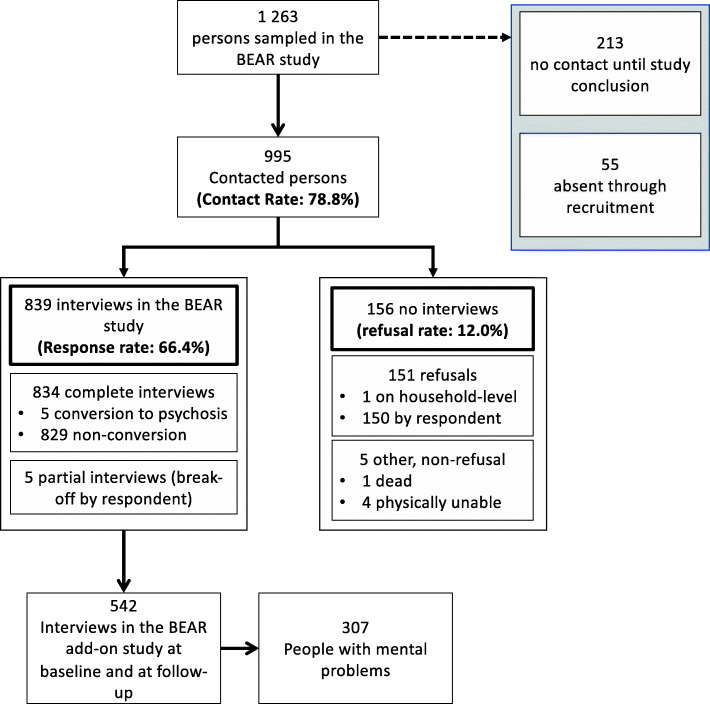
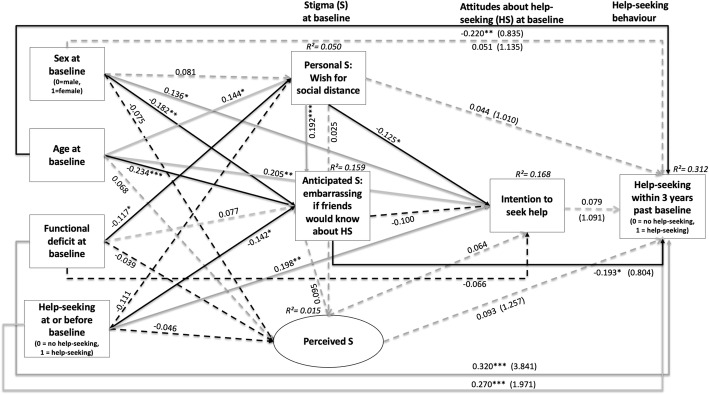
Background: The majority of people with mental illness do not seek help at all or only with significant delay. To reduce help-seeking barriers for people with mental illness, it is therefore important to understand factors predicting help-seeking. Thus, we prospectively examined potential predictors of help-seeking behaviour among people with mental health problems ( N = 307) over 3 years. Methods: Of the participants of a 3-year follow-up of a larger community study (response rate: 66.4%), data of 307 (56.6%) persons with any mental health problems (age-at-baseline: 16–40 years) entered a structural equation model of the influence of help-seeking, stigma, help-seeking attitudes, functional impairments, age and sex at baseline on subsequent help-seeking for mental health problems. Results: Functional impairment at baseline was the strongest predictor of follow-up help-seeking in the model. Help-seeking at baseline was the second-strongest predictor of subsequent help-seeking, which was less likely when help-seeking for mental health problems was assumed to be embarrassing. Personal and perceived stigma, and help-seeking intentions had no direct effect on help-seeking. Conclusions: With only 22.5% of persons with mental health problems seeking any help for these, there was a clear treatment gap. Functional deficits were the strongest mediator of help-seeking, indicating that help is only sought when mental health problems have become more severe. Earlier help-seeking seemed to be mostly impeded by anticipated stigma towards help-seeking for mental health problems. Thus, factors or beliefs conveying such anticipated stigma should be studied longitudinally in more detail to be able to establish low-threshold services in future.
Overview
The claims and statistics of this paper haven’t been checked yet.
Run the check — free, no account needed. It reads the open-access text and checks the sources it cites.
Integrity signals
Registry
Cites
Statistics
Figures
Verification
Claims the paper makes
The claims and statistics of this paper haven’t been checked yet.
Run the check — free, no account needed. It reads the open-access text and checks the sources it cites.
Claims other papers make about this one
Each is checked against this paper’s own text: does it say what the citing paper says it does?
In the citing paper
“This result is in line with a previous study, which found that help‐seeking intentions had no direct effect on help‐seeking behavior (Doll et al., 2021).”
From Research Review: Help‐seeking intentions, behaviors, and barriers in college students – a systematic review and meta‐analysis (2025) · cites this paper as Doll et al., 2021
Self-check
Percentages, sums and reported differences re-computed from the paper’s own numbers.
The self-check needs the paper’s full text.
Citations
Cites
lavaan : An R Package for Structural Equation Modeling
Rosseel, Y. (2012) · Journal of Statistical Software · doi:10.18637/jss.v048.i02 · Cited by 27,955
An Index of Factorial Simplicity
Kaiser, H. F. (1974) · Psychometrika · doi:10.1007/bf02291575 · Cited by 14,898
Structural Equation Modelling: Guidelines for Determining Model Fit
Hooper, D., Coughlan, J., & Mullen, M. R. (2008) · Dublin Institute of Technology · doi:10.21427/d7cf7r · Cited by 8,746
Gulliver, A., Griffiths, K. M., & Christensen, H. (2010) · BMC Psychiatry · doi:10.1186/1471-244x-10-113 · Cited by 3,292
Clement, S., Schauman, O., Graham, T., Maggioni, F., Evans-Lacko, S., Bezborodovs, N., Morgan, C., Rüsch, N., Brown, J. S. L., & Thornicroft, G. (2015) · Psychological Medicine · doi:10.1017/s0033291714000129 · Cited by 3,152
The global prevalence of common mental disorders: a systematic review and meta-analysis 1980–2013
Steel, Z., Marnane, C., Iranpour, C., Chey, T., Jackson, J. W., Patel, V., & Silove, D. (2014) · International Journal of Epidemiology · doi:10.1093/ije/dyu038 · Cited by 2,846
Sheeran, P., & Webb, T. L. (2016) · Social and Personality Psychology Compass · doi:10.1111/spc3.12265 · Cited by 2,185 · cited 1×
“Yet, the gap between intention and behaviour is well known [54] and clearly observable in our study, in which 84.”
BackgroundStigma and Help Seeking for Mental Health Among College Students
Eisenberg, D., Downs, M. F., Golberstein, E., & Zivin, K. (2009) · Medical Care Research and Review · doi:10.1177/1077558709335173 · Cited by 1,193 · cited 1×
“While structural stigma is defined on a macro-social level as institutional policies and practices, societal-level conditions, cultural norms, and institutional practices that constrain the opportunities, resources, and well-being for stigmatized populations [14]; perceived stigma that might be perceived as part of st…”
BackgroundMorosini, P. L., Magliano, L., Brambilla, L., Ugolini, S., & Pioli, R. (2000) · Acta Psychiatrica Scandinavica · doi:10.1034/j.1600-0447.2000.101004323.x · Cited by 1,097
2007 National Survey of Mental Health and Wellbeing: Methods and Key Findings
Slade, T., Johnston, A., Oakley Browne, M. A., Andrews, G., & Whiteford, H. (2009) · Australian & New Zealand Journal of Psychiatry · doi:10.1080/00048670902970882 · Cited by 832
Research works printed but not linked: 37
- Christensen MK, Lim CCW, Saha S, Plana-Ripoll O, Cannon D, Presley F, et al. The cost of mental disorders: a systematic review. Epidemiol Psychiatr Sci. 2020;29:e161. https://doi.org/10.1017/S204579602000075X. · DOI
- Campion J, Bhui K, Bhugra D. European psychiatric association (EPA) guidance on prevention of mental disorders. Eur Psychiatry. 2012;27(2):68–80. https://doi.org/10.1016/j.eurpsy.2011.10.004. · DOI
- Rickwood D, Thomas K. Conceptual measurement framework for help-seeking for mental health problems. Psychol Res Behav Manag. 2012. https://doi.org/10.2147/PRBM.S38707. · DOI
- Calear AL, Batterham PJ, Christensen H. Predictors of help-seeking for suicidal ideation in the community: risks and opportunities for public suicide prevention campaigns. Psychiatry Res. 2014;219(3):525–30. https://doi.org/10.1016/j.psychres.2014.06.027. · DOI
- Mackenzie CS, Heath PJ, Vogel DL, Chekay R. Age differences in public stigma, self-stigma, and attitudes toward seeking help: a moderated mediation model. J Clin Psychol. 2019;75(12):2259–72. https://doi.org/10.1002/jclp.22845. · DOI
- Tomczyk S, Schmidt S, Muehlan H, Stolzenburg S, Schomerus G. A prospective study on structural and attitudinal barriers to professional help-seeking for currently untreated mental health problems in the community. J Behav Health Serv Res. 2020;47(1):54–69. https://doi.org/10.1007/s11414-019-09662-8. · DOI
- Michel C, Schnyder N, Schmidt SJ, Groth N, Schimmelmann BG, Schultze-Lutter F. Functioning mediates help-seeking for mental problems in the general population. Eur Psychiatry. 2018;54:1–9. https://doi.org/10.1016/j.eurpsy.2018.06.009. · DOI
- Schnyder N, Michel C, Panczak R, Ochsenbein S, Schimmelmann BG, Schultze-Lutter F. The interplay of etiological knowledge and mental illness stigma on healthcare utilisation in the community: a structural equation model. Eur Psychiatry. 2018;51:48–56. https://doi.org/10.1016/j.eurpsy.2017.12.027. · DOI
- Hatzenbuehler ML, Link BG. Introduction to the special issue on structural stigma and health. Soc Sci Med. 2014;103:1–6. https://doi.org/10.1016/j.socscimed.2013.12.017. · DOI
- Corrigan PW, Sokol KA, Rüsch N. The impact of self-stigma and mutual help programs on the quality of life of people with serious mental illnesses. Community Ment Health J. 2013;49(1):1–6. https://doi.org/10.1007/s10597-011-9445-2. · DOI
- Link BG, Cullen FT, Frank J, Wozniak JF. The social rejection of former mental patients: understanding why labels matter. Am J Soc. 1987;92:1461–500. · DOI
- Jorm AF, Oh E. Desire for social distance from people with mental disorders. Aust N Z J Psychiatry. 2009;43(3):183–200. https://doi.org/10.1080/00048670802653349. · DOI
- Quinn DM, Chaudoir SR. Living with a concealable stigmatized identity: the impact of anticipated stigma, centrality, salience, and cultural stigma on psychological distress and health. J Pers Soc Psychol. 2009;97(4):634–51. https://doi.org/10.1037/a0015815. · DOI
- Schomerus G, Auer C, Rhode D, Luppa M, Freyberger HJ, Schmidt S. Personal stigma, problem appraisal and perceived need for professional help in currently untreated depressed persons. J Affect Disord. 2012;139(1):94–7. https://doi.org/10.1016/j.jad.2012.02.022. · DOI
- Schomerus G, Matschinger H, Angermeyer MC. Attitudes that determine willingness to seek psychiatric help for depression: a representative population survey applying the theory of planned behaviour. Psychol Med. 2009;39(11):1855–65. https://doi.org/10.1017/S0033291709005832. · DOI · Paper page
- Ruud N, Løvseth LT, Isaksson Ro K, Tyssen R. Comparing mental distress and help-seeking among first-year medical students in Norway: results of two cross-sectional surveys 20 years apart. BMJ Open. 2020;10(8):e036968. https://doi.org/10.1136/bmjopen-2020-036968. · DOI
- Schomerus G, Stolzenburg S, Freitag S, Speerforck S, Janowitz D, Evans-Lacko S, et al. Stigma as a barrier to recognizing personal mental illness and seeking help: a prospective study among untreated persons with mental illness. Eur Arch Psychiatry Clin Neurosci. 2019;269(4):469–79. https://doi.org/10.1007/s00406-018-0896-0. · DOI · Paper page
- Golberstein E, Eisenberg D, Gollust SE. Perceived stigma and help-seeking behavior: longitudinal evidence from the healthy minds study. Psychiatr Serv. 2009;60(9):1254–6. https://doi.org/10.1176/ps.2009.60.9.1254. · DOI
- Lin CY, Broström A, Årestedt K, Mårtensson J, Steinke EE, Pakpour AH. Using extended theory of planned behavior to determine factors associated with help-seeking behavior of sexual problems in women with heart failure: a longitudinal study. J Psychosom Obstet Gynaecol. 2020;41(1):54–61. https://doi.org/10.1080/0167482X.2019.1572743. · DOI
- Schultze-Lutter F, Michel C, Ruhrmann S, Schimmelmann BG. Prevalence and clinical relevance of interview-assessed psychosis-risk symptoms in the young adult community. Psychol Med. 2018. https://doi.org/10.1017/S0033291717002586. · DOI
- The American Association for Public Opinion Research. Standard Definitions: Final Dispositions of Case Codes and Outcome Rates for Surveys. 9th edition. AAPOR. 2016. https://www.aapor.org/AAPOR_Main/media/publications/Standard-Definitions20169theditionfinal.pdf.
- Gater R, de Almeida e Sousa B, Barrientos G, Caraveo J, Chandrashekar CR, Dhadphale M, et al. The pathways to psychiatric care: a cross-cultural study. Psychol Med. 1991. https://doi.org/10.1017/s003329170002239x. · DOI
- Gater R, Jordanova V, Maric N, Alikaj V, Bajs M, Cavic T, et al. Pathways to psychiatric care in Eastern Europe. Br J Psychiatry. 2005;186(6):529–35. https://doi.org/10.1192/bjp.186.6.529. · DOI
- Bhui K, Ullrich S, Coid JW. Which pathways to psychiatric care lead to earlier treatment and a shorter duration of first-episode psychosis? BMC Psychiatry. 2014;14(1). https://doi.org/10.1186/1471-244X-14-72. · DOI
- Sheehan DV, Lecrubier Y, Sheehan KH, Amorim P, Janavs J, Weiller E, et al. The Mini-international neuropsychiatric interview (M.I.N.I.):Tthe development and validation of a structured diagnostic psychiatric interview for DSM-IV and ICD-10. J Clin Psychiatry. 1998;59(Suppl. 20):22–33.
- Rohde P, Lewinsohn PM, Seeley JR. Comparability of telephone and face-to-face interviews in assessing axis I and II disorders. Am J Psychiatry. 1997;154(11):1593–8. https://doi.org/10.1176/ajp.154.11.1593. · DOI · Paper page
- Alexander MJ, Haugland G, Lin SP, Bertollo DN, McCorry FA. Mental health screening in addiction, corrections and social service settings: validating the MMS. Int J Ment Heal Addict. 2008;6(1):105–19. https://doi.org/10.1007/s11469-007-9100-x. · DOI · Paper page
- American Psychiatric Association. Diagnostic and statistical manual of mental disorders. 4th ed. Washington: American Psychiatric Association; 1994.
- Schimmelmann BG, Michel C, Martz-Irngartinger A, Linder C, Schultze-Lutter F. Age matters in the prevalence and clinical significance of ultra-high-risk for psychosis symptoms and criteria in the general population: findings from the BEAR and BEARS-kid studies. World Psychiatry. 2015;14(2):189–97. https://doi.org/10.1002/wps.20216. · DOI
- Schneeweiss H, Mathes H. Factor analysis and principal components. J Multivar Anal. 1995;55(1):105–24. https://doi.org/10.1006/jmva.1995.1069. · DOI
- Kline RB. Principles and practices of structural equation modelling. 3rd ed. New York: The Guilford Press; 2011.
- Green SB, Babyak MA. Control of type I errors with multiple tests of constraints in structural equation modeling. Multivariate Behav Res. 1997;32(1):39–51. https://doi.org/10.1207/s15327906mbr3201_2. · DOI
- MacCallum RC, Roznowski M, Necowitz LB. Model modifications in covariance structure analysis: the problem of capitalization on chance. Psychol Bull. 1992;11:490–504. · DOI
- Pedersen CB, Mors O, Bertelsen A, Waltoft BL, Agerbo E, McGrath JJ, et al. A comprehensive nationwide study of the incidence rate and lifetime risk for treated mental disorders. JAMA Psychiatry. 2014;71(5):573–81. https://doi.org/10.1001/jamapsychiatry.2014.16. · DOI
- Schultze-Lutter F, Michel C, Ruhrmann S, Schimmelmann BG. Prevalence and clinical significance of DSM-5 –attenuated psychosis syndrome in adolescents and young adults in the general population: the Bern epidemiological at-risk (BEAR) study. Schizophr Bull. 2014;40(6):1499–508. https://doi.org/10.1093/schbul/sbt171. · DOI
- Michel C, Schmidt SJ, Schnyder N, Flückiger R, Käufeler I, Schimmelmann BG, et al. Associations of psychosis-risk symptoms with quality of life and self-rated health in the community. Eur Psychiatry. 2019;62:116–23. https://doi.org/10.1016/j.eurpsy.2019.08.008. · DOI
- John D, Ram D, Sundarmurthy H, Rathod H, Rathod S. Study of barrier to help seeking and its relationships with disability in patients with headache. J Clin Diagn Res. 2016;10(10):VC01–VC5. https://doi.org/10.7860/JCDR/2016/22624.8621. · DOI
Cited by
Sorted by citations
Punton, G., Dodd, A. L., & McNeill, A. (2022) · PLOS ONE · doi:10.1371/journal.pone.0265542 · Cited by 167
Zhao, R., Amanvermez, Y., Pei, J., Castro‐Ramirez, F., Rapsey, C., Garcia, C., Ebert, D. D., Haro, J. M., Fodor, L. A., David, O. A., et al. (2025) · Journal of Child Psychology and Psychiatry · doi:10.1111/jcpp.14145 · Cited by 110
Metadata
- Authors
- Doll, C. M., Michel, C., Rosen, M., Osman, N., Schimmelmann, B. G., & Schultze-Lutter, F.
- ORCID
- Doll, Carolin M.
- Venue
- BMC Psychiatry
- Published
- 2021-09-03
- Volume
- 21
- Issue
- 1
- ISSN
- 1471-244X
- PMC
- PMC8414662
- Cited by
- 99
- References
- 17
- Language
- en
- Funders
- Schweizerischer Nationalfonds zur Förderung der Wissenschaftlichen Forschung (32003B_135381)
- Universitätsklinikum Düsseldorf. Anstalt öffentlichen Rechts
About these checks
Registry, retraction, Cites and statistics results are computed, not judged, with one exception: a printed reference that no index lists is read once by a model before it counts as a citation error. Claims are extracted by a model and kept only when their quote appears verbatim in the text; each cited source is then checked, with a model’s help, for whether it says what the claim relies on. Those verdicts can be wrong — read the claim’s quote and the cited source before relying on one.
Statistics and arithmetic are recomputed, not judged.
Confidence bands are shown only for fields calibrated on our annotated test set. None is calibrated yet, so no band is shown.
What counts as a claim ›How we measure confidence ›How we check this ›
Are you an author, or do you see a problem with this page? Request a review
How to cite
Cite CoChat for the checks on this page, and the paper for its own findings.
- This page
- CoChat. (2026). Citation check: Predictors of help-seeking behaviour in people with mental health problems: a 3-year prospective community study. https://app.cochat.ai/papers/10.1186/s12888-021-03435-4
- The paper
- Doll, C. M., Michel, C., Rosen, M., Osman, N., Schimmelmann, B. G., & Schultze-Lutter, F. (2021). Predictors of help-seeking behaviour in people with mental health problems: a 3-year prospective community study. BMC Psychiatry. https://doi.org/10.1186/s12888-021-03435-4
