

Efficacy and safety of fixed doses of intranasal Esketamine as an add-on therapy to Oral antidepressants in Japanese patients with treatment-resistant depression: a phase 2b randomized clinical study
Open accessThe DOI matches its Crossref record; 39 of the 39 references it cites were found in a registry or an index.
Abstract
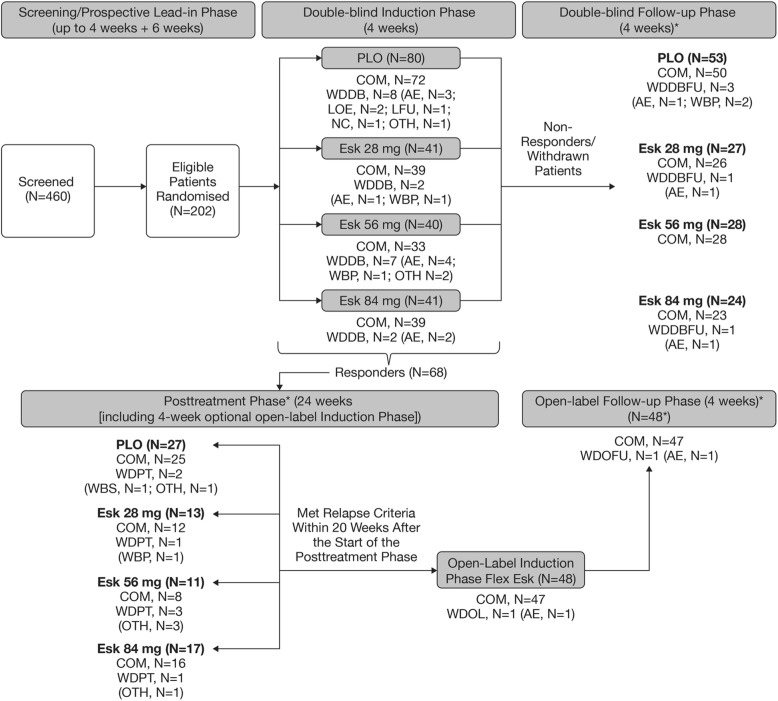
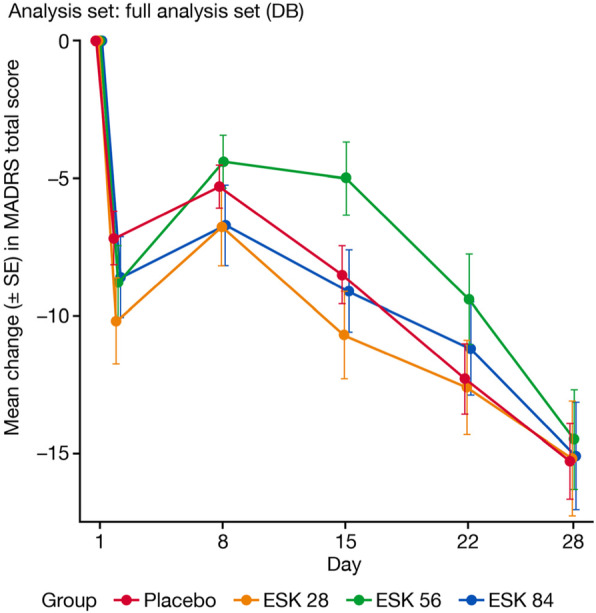
Background: Esketamine nasal spray (Spravato) in conjunction with oral antidepressants (ADs) is approved in the European Union, United States, and other markets for treatment-resistant depression (TRD). Efficacy, safety, and tolerability of esketamine nasal spray in Japanese patients with TRD needs to be assessed. Methods: This Phase 2b, randomized, double-blind (DB), placebo-controlled study was conducted in adult Japanese patients with TRD meeting the Diagnostic and Statistical Manual of Mental Disorders (fifth edition) criteria of major depressive disorder with nonresponse to ≥ 1 but < 5 different ADs in the current episode at screening. Patients were treated with a new oral AD for 6 weeks (prospective lead-in phase); nonresponders were randomized (2:1:1:1) to placebo or esketamine (28-, 56-, or 84-mg) nasal spray along with the continued use of AD for 4 weeks (DB induction phase). Responders (≥50% reduction from baseline in the Montgomery-Asberg Depression Rating Scale [MADRS] total score) from the DB induction phase continued into the 24-week posttreatment phase and patients who relapsed could participate in a 4-week open-label (OL) second induction (flexibly-dosed esketamine). The primary efficacy endpoint, change from baseline in the MADRS total score at Day 28 in the DB induction phase, was based on mixed-effects model using repeated measures pairwise comparisons using a Dunnett adjustment. Results: Of the 202 patients randomized in the DB induction phase (esketamine [n = 122] or placebo [n = 80]), the MADRS total scores decreased from baseline to Day 28 of the DB induction phase (− 15.2, − 14.5, − 15.1, and − 15.3 for esketamine 28 mg, 56 mg, 84 mg, and placebo groups, respectively), indicating an improvement in depressive symptoms; however, the difference between the esketamine and placebo groups was not statistically significant. The most common treatment-emergent adverse events during the DB induction phase in the combined esketamine group (incidences ranging from 12.3 to 41.0%) were blood pressure increased, dissociation, dizziness, somnolence, nausea, hypoaesthesia, vertigo, and headache; the incidence of each of these events was > 2-fold higher than the corresponding incidence in the placebo group. Conclusions: Efficacy of esketamine plus oral AD in Japanese TRD patients was not established; further investigation is warranted. All esketamine doses were safe and tolerated. Trial registration: ClinicalTrials.gov Identifier: NCT02918318. Registered: 28 September 2016.
Overview
The claims and statistics of this paper haven’t been checked yet.
Free: it reads the open-access text and checks the first 5 claims that cite a source we can check. Create a free account to check every claim.
Integrity signals
Registry
Cites
Statistics
Figures
Verification
Claims the paper makes
The claims and statistics of this paper haven’t been checked yet.
Free: it reads the open-access text and checks the first 5 claims that cite a source we can check. Create a free account to check every claim.
Claims other papers make about this one
Each is checked against this paper’s own text: does it say what the citing paper says it does?
The cited source says what the claim attributes to it.
In the citing paper
“Of the 3 remaining initiation trials, we confirmed the negative conclusions of NCT02918318 [41] and NCT03434041 [42].”
Self-check
Percentages, sums and reported differences re-computed from the paper’s own numbers.
The self-check needs the paper’s full text.
Citations
Cites
Diagnostic and Statistical Manual of Mental Disorders
American Psychiatric Association (2013) · doi:10.1176/appi.books.9780890425596 · Cited by 116,369
A new depression scale designed to be sensitive to change
Montgomery, S. A., & Åsberg, M. (1979) · British Journal of Psychiatry · doi:10.1192/bjp.134.4.382 · Cited by 13,962
The Brief Psychiatric Rating Scale.
Overall, J. E., & Gorham, D. R. (1962) · Psychological Reports · doi:10.2466/pr0.1962.10.3.799 · Cited by 11,090
Vos, T., Flaxman, A. D., Naghavi, M., Lozano, R., Michaud, C., Ezzati, M., Shibuya, K., Salomon, J. A., Abdalla, S., Aboyans, V., et al. (2012) · The Lancet · doi:10.1016/s0140-6736(12)61729-2 · Cited by 8,291
Walker, E. R., McGee, R. E., & Druss, B. G. (2015) · JAMA Psychiatry · doi:10.1001/jamapsychiatry.2014.2502 · Cited by 2,976
The Epidemiology of Depression Across Cultures
Kessler, R. C., & Bromet, E. J. (2013) · Annual Review of Public Health · doi:10.1146/annurev-publhealth-031912-114409 · Cited by 2,657
Sheehan, D. V., Harnett-Sheehan, K., & Raj, B. A. (1996) · International Clinical Psychopharmacology · doi:10.1097/00004850-199606003-00015 · Cited by 1,440
Diagnosis and definition of treatment-resistant depression
Fava, M. (2003) · Biological Psychiatry · doi:10.1016/s0006-3223(03)00231-2 · Cited by 1,380
Ketamine and Ketamine Metabolite Pharmacology: Insights into Therapeutic Mechanisms
Zanos, P., Moaddel, R., Morris, P. J., Riggs, L. M., Highland, J. N., Georgiou, P., Pereira, E. F. R., Albuquerque, E. X., Thomas, C. J., Zarate, C. A., et al. (2018) · Pharmacological Reviews · doi:10.1124/pr.117.015198 · Cited by 1,260
Posner, K., Oquendo, M. A., Gould, M., Stanley, B., & Davies, M. (2007) · American Journal of Psychiatry · doi:10.1176/ajp.2007.164.7.1035 · Cited by 1,025 · cited 1×
“Safety evaluations included monitoring of adverse events (AEs), vital signs measurements, clinical laboratory tests, electrocardiogram (ECG), Clinician Administered Dissociative States Scale (CADSS) to assess treatmentemergent dissociative symptoms [33], Modified Observer’s Assessment of Alertness/Sedation (MOAA/S) to…”
Method
Research works printed but not linked: 5
- Guy W ECDEU assessment manual for psychopharmacology revised. US Department of Health, education, and welfare publication (ADM) 1976 Rockville National Institute of Mental Health
- Higuchi T Murasaki M Kamijima K Clinical evaluation of duloxetine in the treatment of major depressive disorder - Superiority study of 40mg and 60mg versus 5mg Jpn J Clin Psychopharmacol 2009 12 1595 1612
- Higuchi T Murasaki M Kamijima K Clinical evaluation of duloxetine in the treatment of major depressive disorder - Placebo- and paroxetine-controlled double-blind comparative study Jpn J Clin Psychopharmacol 2009 12 1613 1634
- Hirayasu Y Sato H A dose-response study of escitalopram in patients with major depressive disorder: a placebo-controlled, double-blind study Jpn J Clin Psychopharmacol 2011 14 871 882
- Hirayasu Y A dose-response and non-inferiority study evaluating the efficacy and safety of escitalopram in patients with major depressive disorder: a placebo- and paroxetine-controlled, double-blind, comparative study Jpn J Clin Psychopharmacol 2011 14 883 899
Cited by
Ketamine for the treatment of major depression: a systematic review and meta-analysis
Nikolin, S., Rodgers, A., Schwaab, A., Bahji, A., Zarate, C., Vazquez, G., & Loo, C. (2023) · eClinicalMedicine · doi:10.1016/j.eclinm.2023.102127 · Cited by 172
The antidepressant actions of ketamine and its enantiomers
Johnston, J. N., Henter, I. D., & Zarate, C. A. (2023) · Pharmacology & Therapeutics · doi:10.1016/j.pharmthera.2023.108431 · Cited by 108
Esketamine Treatment for Depression in Adults: A PRISMA Systematic Review and Meta-Analysis
Fountoulakis, K. N., Saitis, A., & Schatzberg, A. F. (2025) · American Journal of Psychiatry · doi:10.1176/appi.ajp.20240515 · Cited by 90
Esketamine for Treatment-Resistant Depression: A Review of Clinical Evidence (Review)
Vasiliu, O. (2023) · Experimental and Therapeutic Medicine · doi:10.3892/etm.2023.11810 · Cited by 82
Glutamatergic Modulators for Major Depression from Theory to Clinical Use
McIntyre, R. S., & Jain, R. (2024) · CNS Drugs · doi:10.1007/s40263-024-01114-y · Cited by 69
Alberto, M., Paiva‐Santos, A. C., Veiga, F., & Pires, P. C. (2022) · Pharmaceutics · doi:10.3390/pharmaceutics14122742 · Cited by 75
Reporting of harms in clinical trials of esketamine in depression: a systematic review
de Laportalière, T. T., Jullien, A., Yrondi, A., Cestac, P., & Montastruc, F. (2023) · Psychological Medicine · doi:10.1017/s0033291723001058 · Cited by 58
“…AEs in the published articles were referring to only a single phase (most often induction) and did not provide any further information on AEs found in the other phases of the trial (Daly et al., 2018, 2019; Fedgchin et al., 2019; Ochs-Ross et al., 2020; Popova et al., 2019; Takahashi et al., 2021).”
BackgroundResultSeshadri, A., Prokop, L. J., & Singh, B. (2024) · Journal of Affective Disorders · doi:10.1016/j.jad.2024.03.137 · Cited by 62
Psiuk, D., Nowak, E., Dycha, N., Łopuszańska, U., Kurzepa, J., & Samardakiewicz, M. (2022) · International Journal of Molecular Sciences · doi:10.3390/ijms231911450 · Cited by 55
“In some trials, suicidal ideation and suicidal attempts were reported as severe adverse events [33,36,37,39,40] and in one they were the cause of withdrawal [39].”
BackgroundInfluentialCalder, C. N., Kwan, A. T. H., Teopiz, K. M., Wong, S., Rosenblat, J. D., Mansur, R. B., Rhee, T. G., Ho, R., Cao, B., & McIntyre, R. S. (2024) · Journal of Affective Disorders · doi:10.1016/j.jad.2024.04.039 · Cited by 42
Scotton, E., Antqueviezc, B., Vasconcelos, M., Dalpiaz, G., Géa, L. P., Goularte, J. F., Colombo, R., & Rosa, A. R. (2022) · Biochemical Pharmacology · doi:10.1016/j.bcp.2022.114963 · Cited by 40
Terao, I., Tsuge, T., Endo, K., & Kodama, W. (2024) · Journal of Affective Disorders · doi:10.1016/j.jad.2023.11.023 · Cited by 33
Jawad, M. Y., Vincenzo, J. D. D., Ceban, F., Jaberi, S., Lui, L. M. W., Gillissie, E. S., Alnefeesi, Y., Rosenblat, J. D., & McIntyre, R. S. (2022) · Expert Opinion on Drug Safety · doi:10.1080/14740338.2022.2058488 · Cited by 37
The therapeutic role of ketamine and esketamine in treating psychopathological domains of depression
Jawad, M. Y., Vincenzo, J. D. D., Badulescu, S., Teopiz, K. M., Tabassum, A., Ceban, F., Mckenzie, A., Meshkat, S., Rosenblat, J. D., Ho, R., et al. (2022) · Neuropharmacology · doi:10.1016/j.neuropharm.2022.109299 · Cited by 36
Boudieu, L., Mennetrier, M., Llorca, P., & Samalin, L. (2023) · Pharmaceutics · doi:10.3390/pharmaceutics15122773 · Cited by 32
Wang, Y., Wang, X., Lan, L., Guo, Z., Kan, F., Hu, D., Gai, C., & Zhang, Y. (2023) · European Journal of Clinical Pharmacology · doi:10.1007/s00228-023-03605-1 · Cited by 32
Humphreys, K. N., Korthuis, P. T., Stjepanović, D., & Hall, W. (2024) · Annual Review of Psychology · doi:10.1146/annurev-psych-020124-023532 · Cited by 32
Castro, M., Wilkinson, S. T., Al Jurdi, R. K., Petrillo, M. P., Zaki, N., Borentain, S., Fu, D. J., Turkoz, I., Sun, L., Brown, B., et al. (2023) · CNS Drugs · doi:10.1007/s40263-023-01026-3 · Cited by 25
“Esketamine nasal spray (ESK) is a noncompetitive N-methyl-d-aspartate (NMDA) receptor antagonist approved by the United States Food and Drug Administration, as well as health authorities in other countries, in conjunction with an oral AD, for the treatment of TRD in adults and for the treatment of depressive symptoms…”
BackgroundMatsingos, A., Wilhelm, M., Noor, L., Yildiz, C., Rief, W., Hofmann, S. G., Falkenberg, I., & Kircher, T. T. J. (2024) · Frontiers in Psychiatry · doi:10.3389/fpsyt.2024.1346697 · Cited by 27
Tsang, V. W. L., Tao, B. K.-L., Dames, S., Walsh, Z., & Kryskow, P. (2023) · Therapeutic Advances in Psychopharmacology · doi:10.1177/20451253231171512 · Cited by 21
Oraee, S., Alinejadfard, M., Golsorkh, H., Sadeghian, M., Fanaei, M., Centis, R., D’Ambrosio, L., Sotgiu, G., Goudarzi, H., Migliori, G. B., et al. (2024) · Journal of Psychiatric Research · doi:10.1016/j.jpsychires.2024.11.010 · Cited by 22
“…(Daly, 2017; Fedgchin et al., 2019; Takahashi et al., 2021), 84 mg (Canuso, 2019; Daly, 2017; Fedgchin et al., 2019; Fu et al., 2020; Ionescu, 2021; Takahashi et al., 2021), and flexible dosing initiated with 28 mg (Ochs-Ross et al., 2020) or 56 mg (Chen et al., 2023; Popova et al., 2019), with…”
Liu, P., Zhang, S., Liang, Y., Gao, Z., Gao, W., & Dong, B. (2022) · Neuropsychiatric Disease and Treatment · doi:10.2147/ndt.s388764 · Cited by 21
“After excluding the study by Takahashi et al 2021,16 the heterogeneity between the experimental group and the control group changed (P = 0.44, I2 = 0%), and the difference was significant (RR = 2.79, 95% CI 1.42 to 5.50, P = 0.003).”
MethodInfluentialBlinding Integrity in Psychedelic Randomized Clinical Trials: A Systematic Review
Orsini, D. K., Wong, S., Luch, S. D. D., Chan, B., Vasudeva, S., Lovell, G. F. M., Le, G. H., Jones, B. D. M., Chisamore, N., Mollica, A., et al. (2026) · JAMA Psychiatry · doi:10.1001/jamapsychiatry.2026.0255 · Cited by 22
Ohtani, Y., Tani, H., Nomoto‐Takahashi, K., Yatomi, T., Yonezawa, K., Tomiyama, S., Nagai, N., Kusudo, K., Honda, S., Moriyama, S., et al. (2024) · Psychiatry and Clinical Neurosciences · doi:10.1111/pcn.13734 · Cited by 20
Guo, H., Tang, L., He, M., Tang, W., Liu, J., Wu, S., Yuan, S., Wang, J., & Tang, X. (2025) · Frontiers in Pharmacology · doi:10.3389/fphar.2025.1681060 · Cited by 16
Benefits and risks of esketamine nasal spray continuation in treatment-resistant depression
Price, M. Z., & Price, R. L. (2024) · Biomarkers in Neuropsychiatry · doi:10.1016/j.bionps.2024.100104 · Cited by 16
Huang, C., Hu, L., Wu, L., Geng, F., Wong, G. T. C., Zhang, Y., Reif, A., Bao, Y., Xue, Q., & Lü, L. (2025) · Molecular Psychiatry · doi:10.1038/s41380-025-03320-6 · Cited by 17
Xiao, C., Zhou, J. L., Li, A., Zhang, L., Zhu, X., Zhou, J., Hu, Y., Zheng, Y., Liu, J., Deng, Q., et al. (2023) · JAMA Network Open · doi:10.1001/jamanetworkopen.2023.28817 · Cited by 14
Esketamine Nasal Spray in Major Depressive Disorder: A Meta‐Analysis of Randomized Controlled Trials
Wang, Z., Jiang, L., Ma, W., Li, X., Gao, Q., Lian, S., & Yu, W. (2025) · Clinical Pharmacology & Therapeutics · doi:10.1002/cpt.3555 · Cited by 15
“Among 9 studies included in the systematic review, 7 RCTs, 12–17,28 including 4 studies studies 12–14 Daly et al. 30 conducted a 2-step RCT that allowed patients in the placebo group, who still had moderate- to-severe symptoms after Week 1, to be re-randomized at Week 2, thereby differing from the…”
Floriano, I., Silvinato, A., & Bernardo, W. M. (2023) · Revista da Associação Médica Brasileira · doi:10.1590/1806-9282.2023d694 · Cited by 12
What clinicians need to know about intranasal esketamine for treatment-resistant depression?
Hope, J., Copolov, D., Tiller, J. W. G., Galbally, M., Hopwood, M., Newton, R., & Keks, N. A. (2023) · Australasian Psychiatry · doi:10.1177/10398562231211171 · Cited by 12
Floriano, I., Silvinato, A., & Bernardo, W. M. (2023) · Revista da Associação Médica Brasileira · doi:10.1590/1806-9282.2023d696 · Cited by 9
“…2020 Post hoc analysis of three studies Nijs 2020 Post hoc analysis Papakostas 2020 Review article SD Targum 2019 Pilot study Singh 2016 Does not meet eligibility criteria Takahashi 2021 Depression resistant to conventional antidepressants Turkoz 2021 Post hoc analysis of the Transform study.”
MethodNaudet, F., Pellen, C., Fodor, L. A., Gastaldon, C., Barbui, C., Turner, E. H., Le Pabic, E., & Cristea, I. A. (2025) · BMC Medicine · doi:10.1186/s12916-025-04435-x · Cited by 6
“Among these, six were initiation studies (1 with a 1-week duration [40], five with a 4-week duration [9–11, 41, 42] and one was a continuation study [12].”
Crippen, M. (2025) · Phenomenology and the Cognitive Sciences · doi:10.1007/s11097-025-10098-z · Cited by 7
Le, G. H., Wong, S., Johnson, D. E., Lu, A., Orsini, D. K., Chisamore, N., Luch, S. D. D., Rosenblat, J. D., & McIntyre, R. S. (2025) · Journal of Affective Disorders · doi:10.1016/j.jad.2025.121081 · Cited by 7
Bonaventura, J., Lam, S., Carlton, M. L., Boehm, M. A., Gomez, J. L., Solís, Ó., Sánchez‐Soto, M., Morris, P. J., Fredriksson, I., Thomas, C. J., et al. (2022) · Molecular Psychiatry · doi:10.1038/s41380-022-01480-3 · Cited by 6
“Importantly, even though FDA-approved, the efficacy of intranasal (S)-ketamine itself requires more long-term systematic studies [21, 22].”
BackgroundOhnishi, T., Wakamatsu, A., & Kobayashi, H. (2022) · Psychiatry and Clinical Neurosciences · doi:10.1111/pcn.13379 · Cited by 7
Kurosawa, K., Shibuya, M., Shimizu, H., & Pérez‐Ruixo, C. (2022) · Clinical Pharmacology in Drug Development · doi:10.1002/cpdd.1214 · Cited by 5
Self-citationLeonardi, M., Frediani, A., Angeletti, M. C., Biseo, M., Versaci, G., Castiglioni, M., Olivola, M., Vismara, M. E. M., Varinelli, A., Bosi, M. F., et al. (2025) · Journal of Clinical Medicine · doi:10.3390/jcm15010250 · Cited by 4
“Many previous trials on Esketamine prioritized depressive symptom change, using the MADRS or the HAM-D, and tracked suicidality using the C-SSRS only as a secondary or safety outcome [24–26].”
Huc, M., Siddiqi, S., Myers, M., Colman, I., Salmaso, N., Jaworska, N., & Aguilar‐Valles, A. (2026) · Molecular Psychiatry · doi:10.1038/s41380-026-03493-8 · Cited by 5
Mawere-Mubvumbi, T. P. (2023) · Trends in Anaesthesia and Critical Care · doi:10.1016/j.tacc.2023.101233 · Cited by 3
Ketamine for unipolar depression: A systematic review of efficacy and safety
Peiris, T. E., Pokhrel, A., & Paudel, Y. (2025) · Australasian Psychiatry · doi:10.1177/10398562251328805 · Cited by 3
Application of esketamine during emergency care: current status and perspectives
Wan, Y., Zhang, W., Guo, X., Zhu, C., Wang, K., & Li, M. (2025) · Anesthesiology and Perioperative Science · doi:10.1007/s44254-025-00149-8 · Cited by 6
“IN administration is more advisable for pain control in mild to moderate injuries, especially well-suited for mild to moderate combat trauma that does not require deep sedation but needs rapid treatment, such as superficial limb lacerations, contusions, and small foreign body impactions [36].”
Suizidpräventive Effekte von Ketamin und Esketamin
Plöderl, M., Hengartner, M. P., & Volkmann, C. (2022) · Nervenheilkunde · doi:10.1055/a-1761-3192 · Cited by 2
Fountoulakis, K. Ν., Tatsiopoulou, P., Saitis, A., Fountoulakis, N. K., & Schatzberg, A. F. (2025) · European Child & Adolescent Psychiatry · doi:10.1007/s00787-025-02897-1 · Cited by 4
Guglielmo, R., Olivola, M., Inuggi, A., Cavanna, E., Briasco, E., da Silva, B. P., Escelsior, A., Giacomini, G., Martinotti, G., Dell’Osso, B. M., et al. (2026) · European Psychiatry · doi:10.1192/j.eurpsy.2026.12233 · Cited by 2
“Early randomized evidence suggested potential improvement in functional burden, although between-group differences were not always statistically robust [4].”
Korean Medication Algorithm for Depressive Disorder 2025, Fifth Revision: An Executive Summary
Kim, N.-Y., Seo, J. S., Bahk, W., Choi, W.-S., Wang, S., Woo, Y. S., Kim, W., Park, S., Lee, J. G., Yang, C.-M., et al. (2025) · Clinical Psychopharmacology and Neuroscience · doi:10.9758/cpn.25.1328 · Cited by 6
“A phase 2b randomized trial in Japan failed to demonstrate a statistically significant difference in depressive symptom reduction between esketamine and placebo groups, despite both groups showing numerical improvement on the Montgomery – Åsberg Depression Rating Scale (MADRS) scale [23].”
Gowthami, B., Mehta, I., Baiju, S., Appani, A., Suvarna, T., Randhawa, K., Kakkad, A. M., Syed, A. B., Kumar, V., Ramteke, H. D., et al. (2025) · medRxiv · doi:10.1101/2025.09.22.25336317 · Cited by 2
Dormegny-Jeanjean, L. C., Lenoir, S., Humbert, I., Mainberger, O., Lozere, C., Meyer, C., Gény, B., Michel, B., Foucher, J., & de Billy, C. D. C. (2025) · Pharmacopsychiatry · doi:10.1055/a-2590-3469 · Cited by 1
“Our findings are comparable to those obtained with intravenous and subcutaneous ESK, as well as with ESK combined with traditional antide-pressants [22, 38].”
Samalin, L., Boudieu, L., & Llorca, P. (2025) · Neuromethods · doi:10.1007/978-1-0716-4599-4_14 · Cited by 1
Gurrieri, R., Hedrih, V., & Morphew-Lu, E. (2026) · Nutrients · doi:10.3390/nu18162601 · Cited by 1
Busz, A., Schmidt, E. (. J. )., van den Brink, R., Foeken, K., de Jong, M., Mertens, J. (. B. C. )., van Noorden, M. S., Olivier, E. (. J. F. L. )., Schruers, K. R. J., Schutters, S. I. J., et al. (2025) · Journal of Affective Disorders Reports · doi:10.1016/j.jadr.2025.100905 · Cited by 2
Kalkman, H. O., & Smigielski, L. (2025) · Human Psychopharmacology Clinical and Experimental · doi:10.1002/hup.70019 · Cited by 1
Plöderl, M., Cooper, R. E., Walker, T., Shah, V., Horowitz, M. A., Volkmann, C., & Moncrieff, J. (2025) · medRxiv · doi:10.1101/2025.08.19.25333796 · Cited by 2
O USO DA CETAMINA/ESCETAMINA NO TRANSTORNO DEPRESSIVO MAIOR
de Mendonça, J. C., LOUVEM, R. M., RECLA, B. M. F., & de Mendonça, T. C. (2024) · Editora Pasteur eBooks · doi:10.59290/978-65-6029-075-4.14
Anhedonia: a unifying symptom and a transdiagnostic therapeutic target
Rosso, G., Pesci, N. R., PERACCHIA, S., Garrone, C., Salvo, G. D., & Maina, G. (2025) · Minerva Psychiatry · doi:10.23736/s2724-6612.24.02572-7
Back, M. S., Santiago, P. R. B., & Pellin, G. M. (2025) · Revista Contemporânea · doi:10.56083/rcv5n2-072
Uso da cetamina em saúde mental: uma revisão bibliométrica
Viana-Ferreira, K. (2024) · Digital Library of Theses and Dissertations (Universidade de São Paulo) · doi:10.11606/d.5.2024.tde-06022025-132449
Uso de esketamina en depresión resistente al tratamiento: una revisión exploratoria sistemática
Rotta, C. E. D., Cornejo, E. S., Huayanay, L., & Vargas-Murga, H. (2025) · Revista de Neuro-Psiquiatría · doi:10.20453/rnp.v88i3.6424
Cetamina: um psicadélico em ascensão na depressão resistente ao tratamento
Santos, P. E. D. S. (2024) · Portuguese National Funding Agency for Science, Research and Technology (RCAAP Project by FCT) · doi:10.34626/4crx-c978
A Presentation of Evidence and Effectiveness of Esketamine Treatments to Psychiatric Providers
Nango, M., & Nango, M. (2024) · UA Campus Repository (The University of Arizona)
Γαρούφα, Χ.-Μ. Χ., & Γαρούφα, Χ.-Μ. Χ. (2025) · University of Thessaly Institutional Repository (University of Thessaly)
Qu, Y., Li, S., Tian, L., Tian, X., & Wu, Y. (2026) · Frontiers in Pharmacology · doi:10.3389/fphar.2026.1792570 · Cited by 1
Errors or Adaptations? A Critical Review of Predictive Processing in Psychiatry
Crippen, M. (2026) · Behavioral Sciences · doi:10.3390/bs16071116
“…physiological experiences of mental illness (Bailey et al., 2019; Crippen, 2025a; Eisenberg et al., 2008; Hankerson et al., 2011; Kirmayer, 2001; Y. Li et al., 2023; Luhrmann et al., 2015, 2024; Marazziti et al., 2021; Petrica et al., 2025; Takahashi et al., 2021; Tanaka-Matsumi & Marsella, 1976).”
Metadata
- Authors
- Takahashi, N., Yamada, A., Shiraishi, A., Shimizu, H., Goto, R., & Tominaga, Y.
- Affiliations
- Nagoya University (JP)
- Janssen Pharmaceutical K.K. (Japan) (JP)
- Corresponding author
- Tominaga, Yushin
- Venue
- BMC Psychiatry
- Published
- 2021-10-25
- Volume
- 21
- Issue
- 1
- Pages
- 526-526
- ISSN
- 1471-244X (ISSN-L)
- PMC
- PMC8547110
- OpenAlex
- W3208279447
- Semantic Scholar
- a3d83afd24f76b5876765d7a13a54b9d964de4dc
- Cited by
- 57
- References
- 39
- Citations by year
- 2026: 4 · 2025: 20 · 2024: 9 · 2023: 14 · 2022: 10
- FWCI
- 4.82
- Type
- journal article
- Language
- en
- Open access
- gold
- doi.org
- Licence
- cc-by
- creativecommons.org/licenses/by/4.0 (tdm)
- creativecommons.org/licenses/by/4.0 (vor)
- Locations
- BMC Psychiatry (publishedVersion, cc-by)
- Europe PMC (PubMed Central) (publishedVersion, other-oa)
- PubMed Central (publishedVersion, cc-by)
- PubMed (publishedVersion)
- DOAJ (DOAJ: Directory of Open Access Journals) (submittedVersion, cc-by-sa)
- Topics
- Health Sciences › Medicine › Pharmacology (medical) › Treatment of Major Depression
- Health Sciences › Medicine › Psychiatry and Mental health › Electroconvulsive Therapy Studies
- Life Sciences › Neuroscience › Biological Psychiatry › Tryptophan and brain disorders
- Keywords
- esketamine, intranasal administration, treatment-resistant depression, major depressive disorder, adjunctive therapy, oral antidepressant, Japanese patients, dose-response relationship, tolerability, adverse events, blood pressure increase, dissociation, relapse, flexible dosing, antidepressant non-response, ketamine analogues, NMDA receptor antagonists
- MeSH terms
- Adult, Antidepressive Agents, Depression, Depressive Disorder, Major, Major Depressive Disorder, Double-Blind Method, Humans, Japan, Ketamine, Prospective Studies, Treatment Outcome, Depressive Disorder, Treatment-Resistant
About these checks
Registry, retraction, Cites and statistics results are computed, not judged, with one exception: a printed reference that no index lists is read once by a model before it counts as a citation error. Claims are extracted by a model and kept only when their quote appears verbatim in the text; each cited source is then checked, with a model’s help, for whether it says what the claim relies on. Those verdicts can be wrong — read the claim’s quote and the cited source before relying on one.
Statistics and arithmetic are recomputed, not judged.
Confidence bands are shown only for fields calibrated on our annotated test set. None is calibrated yet, so no band is shown.
What counts as a claim ›How we measure confidence ›How we check this ›
Are you an author, or do you see a problem with this page? Request a review
Data sources
Bibliographic data: Semantic Scholar, OpenAlex, Crossref.
Contains information from the Semantic Scholar Academic Graph Datasets, made available under the ODC Attribution License (ODC-BY 1.0).
Semantic Scholar’s data is described in: Kinney, R., et al. (2023). The Semantic Scholar Open Data Platform. arXiv:2301.10140.
