

Efficacy and safety of fixed doses of intranasal Esketamine as an add-on therapy to Oral antidepressants in Japanese patients with treatment-resistant depression: a phase 2b randomized clinical study
Open accessThe DOI matches its Crossref record; 39 of the 39 references it cites were found in a registry or an index.
Abstract
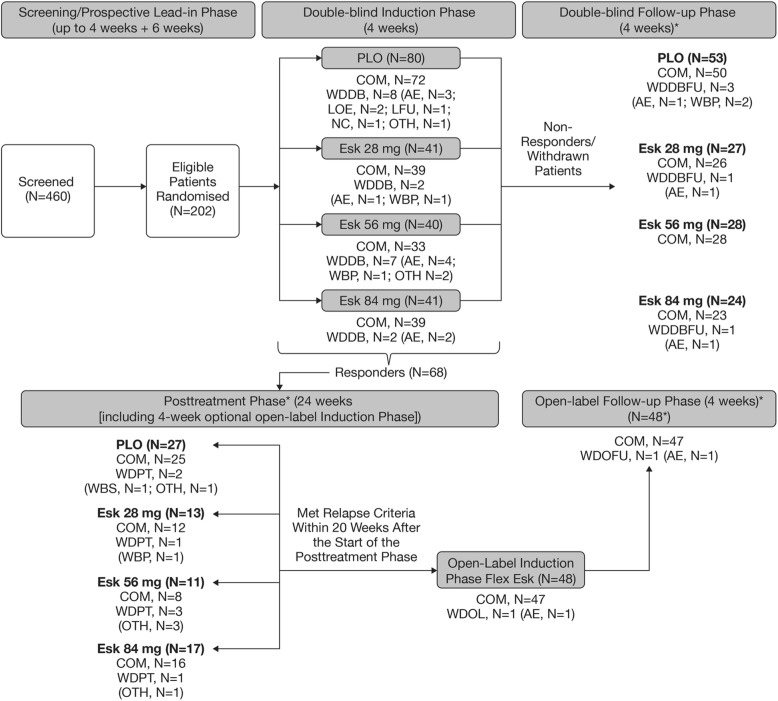
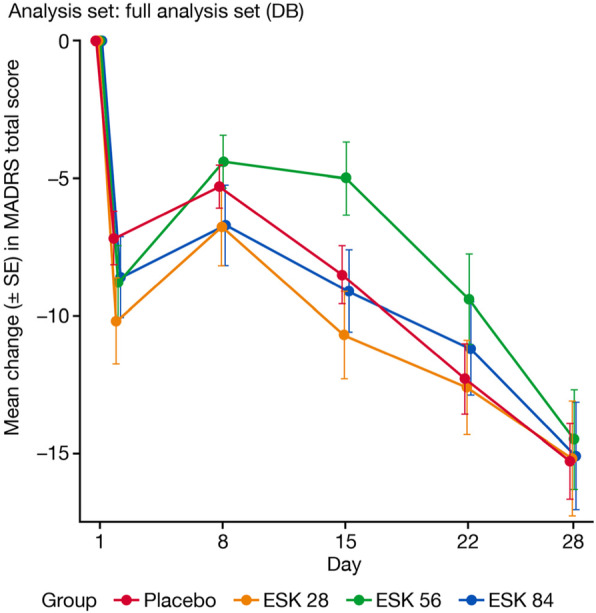
Background: Esketamine nasal spray (Spravato) in conjunction with oral antidepressants (ADs) is approved in the European Union, United States, and other markets for treatment-resistant depression (TRD). Efficacy, safety, and tolerability of esketamine nasal spray in Japanese patients with TRD needs to be assessed. Methods: This Phase 2b, randomized, double-blind (DB), placebo-controlled study was conducted in adult Japanese patients with TRD meeting the Diagnostic and Statistical Manual of Mental Disorders (fifth edition) criteria of major depressive disorder with nonresponse to ≥ 1 but < 5 different ADs in the current episode at screening. Patients were treated with a new oral AD for 6 weeks (prospective lead-in phase); nonresponders were randomized (2:1:1:1) to placebo or esketamine (28-, 56-, or 84-mg) nasal spray along with the continued use of AD for 4 weeks (DB induction phase). Responders (≥50% reduction from baseline in the Montgomery-Asberg Depression Rating Scale [MADRS] total score) from the DB induction phase continued into the 24-week posttreatment phase and patients who relapsed could participate in a 4-week open-label (OL) second induction (flexibly-dosed esketamine). The primary efficacy endpoint, change from baseline in the MADRS total score at Day 28 in the DB induction phase, was based on mixed-effects model using repeated measures pairwise comparisons using a Dunnett adjustment. Results: Of the 202 patients randomized in the DB induction phase (esketamine [n = 122] or placebo [n = 80]), the MADRS total scores decreased from baseline to Day 28 of the DB induction phase (− 15.2, − 14.5, − 15.1, and − 15.3 for esketamine 28 mg, 56 mg, 84 mg, and placebo groups, respectively), indicating an improvement in depressive symptoms; however, the difference between the esketamine and placebo groups was not statistically significant. The most common treatment-emergent adverse events during the DB induction phase in the combined esketamine group (incidences ranging from 12.3 to 41.0%) were blood pressure increased, dissociation, dizziness, somnolence, nausea, hypoaesthesia, vertigo, and headache; the incidence of each of these events was > 2-fold higher than the corresponding incidence in the placebo group. Conclusions: Efficacy of esketamine plus oral AD in Japanese TRD patients was not established; further investigation is warranted. All esketamine doses were safe and tolerated. Trial registration: ClinicalTrials.gov Identifier: NCT02918318. Registered: 28 September 2016.
Overview
The claims and statistics of this paper haven’t been checked yet.
Free: it reads the open-access text and checks the first 5 claims that cite a source we can check. Create a free account to check every claim.
Integrity signals
Registry
Cites
Statistics
Figures
Verification
Claims the paper makes
The claims and statistics of this paper haven’t been checked yet.
Free: it reads the open-access text and checks the first 5 claims that cite a source we can check. Create a free account to check every claim.
Claims other papers make about this one
Each is checked against this paper’s own text: does it say what the citing paper says it does?
The cited source says what the claim attributes to it.
In the citing paper
“Of the 3 remaining initiation trials, we confirmed the negative conclusions of NCT02918318 [41] and NCT03434041 [42].”
Self-check
Percentages, sums and reported differences re-computed from the paper’s own numbers.
The self-check needs the paper’s full text.
Citations
Cites
Diagnostic and Statistical Manual of Mental Disorders
American Psychiatric Association (2013) · doi:10.1176/appi.books.9780890425596 · Cited by 116,369
A new depression scale designed to be sensitive to change
Montgomery, S. A., & Åsberg, M. (1979) · British Journal of Psychiatry · doi:10.1192/bjp.134.4.382 · Cited by 13,962
The Brief Psychiatric Rating Scale.
Overall, J. E., & Gorham, D. R. (1962) · Psychological Reports · doi:10.2466/pr0.1962.10.3.799 · Cited by 11,090
Vos, T., Flaxman, A. D., Naghavi, M., Lozano, R., Michaud, C., Ezzati, M., Shibuya, K., Salomon, J. A., Abdalla, S., Aboyans, V., et al. (2012) · The Lancet · doi:10.1016/s0140-6736(12)61729-2 · Cited by 8,291
Walker, E. R., McGee, R. E., & Druss, B. G. (2015) · JAMA Psychiatry · doi:10.1001/jamapsychiatry.2014.2502 · Cited by 2,976
The Epidemiology of Depression Across Cultures
Kessler, R. C., & Bromet, E. J. (2013) · Annual Review of Public Health · doi:10.1146/annurev-publhealth-031912-114409 · Cited by 2,657
Sheehan, D. V., Harnett-Sheehan, K., & Raj, B. A. (1996) · International Clinical Psychopharmacology · doi:10.1097/00004850-199606003-00015 · Cited by 1,440
Diagnosis and definition of treatment-resistant depression
Fava, M. (2003) · Biological Psychiatry · doi:10.1016/s0006-3223(03)00231-2 · Cited by 1,380
Ketamine and Ketamine Metabolite Pharmacology: Insights into Therapeutic Mechanisms
Zanos, P., Moaddel, R., Morris, P. J., Riggs, L. M., Highland, J. N., Georgiou, P., Pereira, E. F. R., Albuquerque, E. X., Thomas, C. J., Zarate, C. A., et al. (2018) · Pharmacological Reviews · doi:10.1124/pr.117.015198 · Cited by 1,260
Posner, K., Oquendo, M. A., Gould, M., Stanley, B., & Davies, M. (2007) · American Journal of Psychiatry · doi:10.1176/ajp.2007.164.7.1035 · Cited by 1,025 · cited 1×
“Safety evaluations included monitoring of adverse events (AEs), vital signs measurements, clinical laboratory tests, electrocardiogram (ECG), Clinician Administered Dissociative States Scale (CADSS) to assess treatmentemergent dissociative symptoms [33], Modified Observer’s Assessment of Alertness/Sedation (MOAA/S) to…”
MethodAssessing Psychiatric Impairment in Primary Care with the Sheehan Disability Scale
Leon, A. C., Olfson, M., Portera, L., Farber, L., & Sheehan, D. V. (1997) · The International Journal of Psychiatry in Medicine · doi:10.2190/t8em-c8yh-373n-1uwd · Cited by 987
Popova, V., Daly, E. J., Trivedi, M., Cooper, K., Lane, R., Lim, P., Mazzucco, C., Hough, D., Thase, M. E., Shelton, R. C., et al. (2019) · American Journal of Psychiatry · doi:10.1176/appi.ajp.2019.19020172 · Cited by 904
Bremner, J. D., Krystal, J. H., Putnam, F. W., Southwick, S. M., Marmar, C., Charney, D. S., & Mazure, C. M. (1998) · Journal of Traumatic Stress · doi:10.1023/a:1024465317902 · Cited by 817
Daly, E. J., Trivedi, M. H., Janik, A., Li, H., Zhang, Y., Li, X., Lane, R., Lim, P., Duca, A. R., Hough, D., et al. (2019) · JAMA Psychiatry · doi:10.1001/jamapsychiatry.2019.1189 · Cited by 795
Daly, E. J., Singh, J. B., Fedgchin, M., Cooper, K., Lim, P., Shelton, R. C., Thase, M. E., Winokur, A., Van Nueten, L., Manji, H., et al. (2018) · JAMA Psychiatry · doi:10.1001/jamapsychiatry.2017.3739 · Cited by 718
Canuso, C. M., Singh, J. B., Fedgchin, M., Alphs, L., Lane, R., Lim, P., Pinter, C., Hough, D., Sanacora, G., Manji, H., et al. (2018) · American Journal of Psychiatry · doi:10.1176/appi.ajp.2018.17060720 · Cited by 676
Fedgchin, M., Trivedi, M., Daly, E. J., Melkote, R., Lane, R., Lim, P., Vitagliano, D., Blier, P., Fava, M., Liebowitz, M., et al. (2019) · International Journal of Neuropsychopharmacology · doi:10.1093/ijnp/pyz039 · Cited by 606
Treatment-Resistant Depression
(2015) · Encyclopedia of Psychopharmacology · doi:10.1007/978-3-642-36172-2_200431 · Cited by 488
Ochs-Ross, R., Daly, E. J., Zhang, Y., Lane, R., Lim, P., Morrison, R. L., Hough, D., Manji, H., Drevets, W. C., Sanacora, G., et al. (2020) · The American Journal of Geriatric Psychiatry · doi:10.1016/j.jagp.2019.10.008 · Cited by 481
Fava, M., Evins, A. E., Dorer, D. J., & Schoenfeld, D. A. (2003) · Psychotherapy and Psychosomatics · doi:10.1159/000069738 · Cited by 452
Ionescu, D. F., Fu, D.-J., Qiu, X., Lane, R., Lim, P., Kasper, S., Hough, D., Drevets, W. C., Manji, H., & Canuso, C. M. (2021) · International Journal of Neuropsychopharmacology · doi:10.1093/ijnp/pyaa068 · Cited by 418
Fu, D.-J., Ionescu, D. F., Li, X., Lane, R., Lim, P., Sanacora, G., Hough, D., Manji, H., Drevets, W. C., & Canuso, C. M. (2020) · The Journal of Clinical Psychiatry · doi:10.4088/jcp.19m13191 · Cited by 376
Wajs, E., Aluisio, L., Holder, R., Daly, E. J., Lane, R., Lim, P., George, J. E., Morrison, R. L., Sanacora, G., Young, A. H., et al. (2020) · The Journal of Clinical Psychiatry · doi:10.4088/jcp.19m12891 · Cited by 308
Treatment-resistant depression
Souery, D., Papakostas, G. I., & Trivedi, M. H. (2006) · Dépôt institutionnel de l'Université libre de Bruxelles (Université Libre de Bruxelles) · Cited by 231
Khin, N. A., Chen, Y.-F., Yang, Y., Yang, P., & Laughren, T. P. (2011) · The Journal of Clinical Psychiatry · doi:10.4088/jcp.10m06191 · Cited by 212
Ishikawa, H., Kawakami, N., Kessler, R. C., & Collaborators, T. W. M. H. J. S. (2016) · Epidemiology and Psychiatric Sciences · doi:10.1017/s2045796015000566 · Cited by 182
Ketamine as a Novel Antidepressant: From Synapse to Behavior
Murrough, J. W. (2012) · Clinical Pharmacology & Therapeutics · doi:10.1038/clpt.2011.244 · Cited by 172
Posternak, M. A., & Zimmerman, M. (2007) · British Journal of Psychiatry · doi:10.1192/bjp.bp.106.028555 · Cited by 154
Pambianco, D. J., Vargo, J. J., Pruitt, R. E., Hardi, R., & Martin, J. F. (2010) · Gastrointestinal Endoscopy · doi:10.1016/j.gie.2010.10.031 · Cited by 135
Kobak, K. A., Kane, J. M., Thase, M. E., & Nierenberg, A. A. (2007) · Journal of Clinical Psychopharmacology · doi:10.1097/jcp.0b013e31802eb4b7 · Cited by 113
MCPMod: AnRPackage for the Design and Analysis of Dose-Finding Studies
Bornkamp, B., Pinheiro, J., & Bretz, F. (2009) · Journal of Statistical Software · doi:10.18637/jss.v029.i07 · Cited by 93
Doherty, T., Wajs, E., Melkote, R., Miller, J., Singh, J. B., & Weber, M. A. (2020) · CNS Drugs · doi:10.1007/s40263-020-00699-4 · Cited by 68
Signal Detection and Placebo Response in Schizophrenia: Parallels with Depression
Mallinckrodt, C. H., Zhang, L., Prucka, W. R., & Millen, B. A. (2025) · Psychopharmacology Bulletin · doi:10.64719/pb.4282 · Cited by 64 · cited 1×
“First, placebo response has been reported to be negatively correlated with the probability of receiving placebo [39, 40].”
BackgroundMorbidity in depressive disorders
Baldessarini, R. J., Forte, A., Selle, V., Sim, K., Tondo, L., Undurraga, J., & Vázquez, G. H. (2017) · Psychotherapy and Psychosomatics · doi:10.1159/000448661 · Cited by 63
Physician Withdrawal Checklist (PWC-20)
Rickels, K., Garcia-Espana, F., Mandos, L. A., & Case, G. W. (2008) · Journal of Clinical Psychopharmacology · doi:10.1097/jcp.0b013e31817efbac · Cited by 59
Mahlich, J., Tsukazawa, S., & Wiegand, F. (2018) · Drugs - Real World Outcomes · doi:10.1007/s40801-017-0126-5 · Cited by 49
Administering the MADRS by telephone or face-to-face: a validity study.
Hermens, M. L., Adèr, H. J., van Hout, H. P., Terluin, B., van Dyck, R., & de Haan, M. (2006) · Annals of General Psychiatry · doi:10.1186/1744-859x-5-3 · Cited by 47
Inoue, T., Nishimura, A., Sasai, K., & Kitagawa, T. (2017) · Psychiatry and Clinical Neurosciences · doi:10.1111/pcn.12623 · Cited by 33
Ogasawara, K., & Ozaki, N. (2012) · PubMed · Cited by 21
Research works printed but not linked: 5
- Guy W ECDEU assessment manual for psychopharmacology revised. US Department of Health, education, and welfare publication (ADM) 1976 Rockville National Institute of Mental Health
- Higuchi T Murasaki M Kamijima K Clinical evaluation of duloxetine in the treatment of major depressive disorder - Superiority study of 40mg and 60mg versus 5mg Jpn J Clin Psychopharmacol 2009 12 1595 1612
- Higuchi T Murasaki M Kamijima K Clinical evaluation of duloxetine in the treatment of major depressive disorder - Placebo- and paroxetine-controlled double-blind comparative study Jpn J Clin Psychopharmacol 2009 12 1613 1634
- Hirayasu Y Sato H A dose-response study of escitalopram in patients with major depressive disorder: a placebo-controlled, double-blind study Jpn J Clin Psychopharmacol 2011 14 871 882
- Hirayasu Y A dose-response and non-inferiority study evaluating the efficacy and safety of escitalopram in patients with major depressive disorder: a placebo- and paroxetine-controlled, double-blind, comparative study Jpn J Clin Psychopharmacol 2011 14 883 899
Cited by
Ketamine for the treatment of major depression: a systematic review and meta-analysis
Nikolin, S., Rodgers, A., Schwaab, A., Bahji, A., Zarate, C., Vazquez, G., & Loo, C. (2023) · eClinicalMedicine · doi:10.1016/j.eclinm.2023.102127 · Cited by 172
The antidepressant actions of ketamine and its enantiomers
Johnston, J. N., Henter, I. D., & Zarate, C. A. (2023) · Pharmacology & Therapeutics · doi:10.1016/j.pharmthera.2023.108431 · Cited by 108
Esketamine Treatment for Depression in Adults: A PRISMA Systematic Review and Meta-Analysis
Fountoulakis, K. N., Saitis, A., & Schatzberg, A. F. (2025) · American Journal of Psychiatry · doi:10.1176/appi.ajp.20240515 · Cited by 90
Esketamine for Treatment-Resistant Depression: A Review of Clinical Evidence (Review)
Vasiliu, O. (2023) · Experimental and Therapeutic Medicine · doi:10.3892/etm.2023.11810 · Cited by 82
Glutamatergic Modulators for Major Depression from Theory to Clinical Use
McIntyre, R. S., & Jain, R. (2024) · CNS Drugs · doi:10.1007/s40263-024-01114-y · Cited by 69
Metadata
- Authors
- Takahashi, N., Yamada, A., Shiraishi, A., Shimizu, H., Goto, R., & Tominaga, Y.
- Affiliations
- Nagoya University (JP)
- Janssen Pharmaceutical K.K. (Japan) (JP)
- Corresponding author
- Tominaga, Yushin
- Venue
- BMC Psychiatry
- Published
- 2021-10-25
- Volume
- 21
- Issue
- 1
- Pages
- 526-526
- ISSN
- 1471-244X (ISSN-L)
- PMC
- PMC8547110
- OpenAlex
- W3208279447
- Cited by
- 57
- References
- 39
- Citations by year
- 2026: 4 · 2025: 20 · 2024: 9 · 2023: 14 · 2022: 10
- FWCI
- 4.82
- Type
- journal article
- Language
- en
- Open access
- gold
- doi.org
- Licence
- cc-by
- creativecommons.org/licenses/by/4.0 (tdm)
- creativecommons.org/licenses/by/4.0 (vor)
- Locations
- BMC Psychiatry (publishedVersion, cc-by)
- Europe PMC (PubMed Central) (publishedVersion, other-oa)
- PubMed Central (publishedVersion, cc-by)
- PubMed (publishedVersion)
- DOAJ (DOAJ: Directory of Open Access Journals) (submittedVersion, cc-by-sa)
- Topics
- Health Sciences › Medicine › Pharmacology (medical) › Treatment of Major Depression
- Health Sciences › Medicine › Psychiatry and Mental health › Electroconvulsive Therapy Studies
- Life Sciences › Neuroscience › Biological Psychiatry › Tryptophan and brain disorders
- Keywords
- esketamine, intranasal administration, treatment-resistant depression, major depressive disorder, adjunctive therapy, oral antidepressant, Japanese patients, dose-response relationship, tolerability, adverse events, blood pressure increase, dissociation, relapse, flexible dosing, antidepressant non-response, ketamine analogues, NMDA receptor antagonists
- MeSH terms
- Adult, Antidepressive Agents, Depression, Depressive Disorder, Major, Major Depressive Disorder, Double-Blind Method, Humans, Japan, Ketamine, Prospective Studies, Treatment Outcome, Depressive Disorder, Treatment-Resistant
About these checks
Registry, retraction, Cites and statistics results are computed, not judged, with one exception: a printed reference that no index lists is read once by a model before it counts as a citation error. Claims are extracted by a model and kept only when their quote appears verbatim in the text; each cited source is then checked, with a model’s help, for whether it says what the claim relies on. Those verdicts can be wrong — read the claim’s quote and the cited source before relying on one.
Statistics and arithmetic are recomputed, not judged.
Confidence bands are shown only for fields calibrated on our annotated test set. None is calibrated yet, so no band is shown.
What counts as a claim ›How we measure confidence ›How we check this ›
Are you an author, or do you see a problem with this page? Request a review
Data sources
Bibliographic data: Semantic Scholar, OpenAlex, Crossref.
Contains information from the Semantic Scholar Academic Graph Datasets, made available under the ODC Attribution License (ODC-BY 1.0).
Semantic Scholar’s data is described in: Kinney, R., et al. (2023). The Semantic Scholar Open Data Platform. arXiv:2301.10140.
