

The impact of Facebook use on self-reported eating disorders during the COVID-19 lockdown
Open accessThe DOI matches its Crossref record; 71 of the 71 references it cites were found in a registry or an index.
Abstract
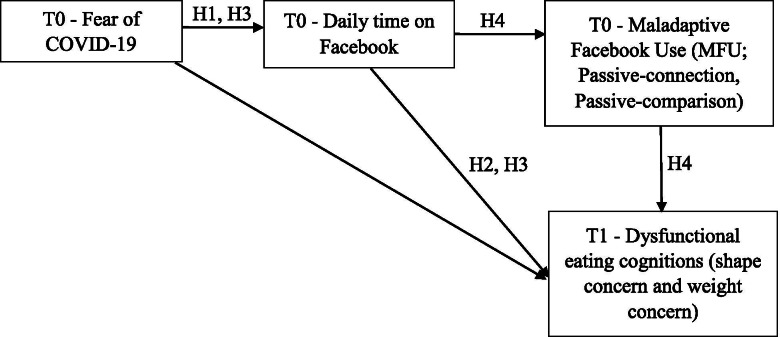
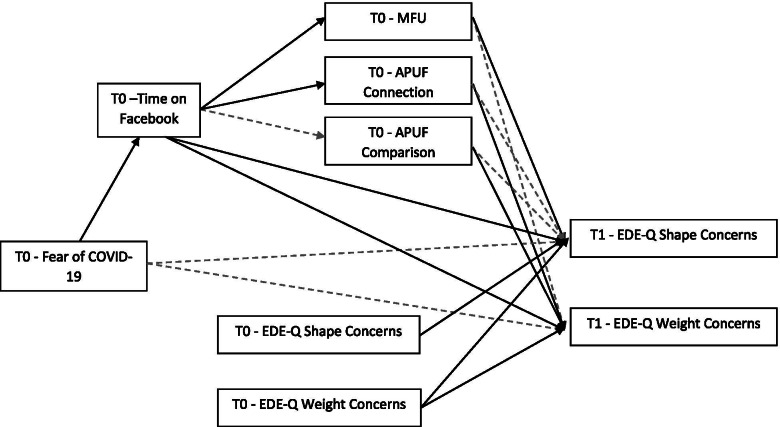
Background: The social isolation due to the COVID-19-related lockdown has had an impact on social media consumption around the world. This study examines the relationship between fear of COVID-19, Facebook use and disordered eating. Methods: Structural Equation Modeling was used to analyse two-wave survey data (T0: Italian first lockdown; T1: after two months) during the pandemic. Young adults with self-reported dysfunctional eating behaviors (N = 115; 91.3% females; mean age = 28.60 ± 7.31) were recruited to complete an online survey at T0; 66 participants (92.4% females; mean age = 28.85 ± 7.85) completed the survey at T1. They were assessed on Facebook use, dysfunctional eating cognitions, and fear of COVID-19. Results: Participants’ disordered eating cognitions increased during the pandemic. At T0, higher fear of COVID-19 was positively associated to time spent on Facebook, which in turn predicted disordered eating cognitions at T1. Moreover, maladaptive Facebook use mediated the relationship between daily time on Facebook and Shape concerns. Conclusions: The findings of this study suggest an influence of dysfunctional Facebook use in increasing disordered eating cognitions during the pandemic.
Overview
The claims and statistics of this paper haven’t been checked yet.
Free: it reads the open-access text and checks the first 5 claims that cite a source we can check. Create a free account to check every claim.
Integrity signals
Registry
Cites
Statistics
Figures
Verification
Claims the paper makes
The claims and statistics of this paper haven’t been checked yet.
Free: it reads the open-access text and checks the first 5 claims that cite a source we can check. Create a free account to check every claim.
Claims other papers make about this one
Each is checked against this paper’s own text: does it say what the citing paper says it does?
The cited source doesn’t support the claim as written.
In the citing paper
“one longitudinal study conducted during the pandemic evidenced that time spent on Facebook was associated with increased body image and weight concerns, which was explained by passive but not active use (Mannino et al., 2021).”
From Pathways of association between disordered eating in adolescence and mental health outcomes in young adulthood during the COVID-19 pandemic (2023) · cites this paper as Mannino et al., 2021
Checked by a reasoning model — may be wrong.
Experimental — accuracy not yet measured
Self-check
Percentages, sums and reported differences re-computed from the paper’s own numbers.
The self-check needs the paper’s full text.
Citations
Cites
Hu, L., & Bentler, P. M. (1999) · Structural Equation Modeling A Multidisciplinary Journal · doi:10.1080/10705519909540118 · Cited by 108,788
Tabachnick, B. G., & Fidell, L. S. (1983) · Cited by 80,054
The psychological impact of quarantine and how to reduce it: Rapid review of the evidence
Brooks, S. K., Webster, R. K., Smith, L. E., Woodland, L., Wessely, S., Greenberg, N., & Rubin, G. J. (2020) · The Lancet · doi:10.1016/s0140-6736(20)30460-8 · Cited by 16,378 · cited 1×
“COVID‐19 and eating disorders Although quarantine and social distancing are important preventive measures during major infectious disease outbreaks, there is evidence that they may be associated with negative psychological effects [11].”
Background(2007) · Cited by 10,092
A test of missing completely at random for multivariate data with missing values
Little, R. J. A. (1988) · Journal of the American Statistical Association · doi:10.1080/01621459.1988.10478722 · Cited by 8,963 · cited 2×
“Moreover, Little’s [48] MCAR test was not significant, χ2(15) = 5.622, p = .985, indicating that drop-out likely occurred at random.”
InfluentialStructural Equation Modeling: Concepts, Issues, and Applications.
Smith, M. D., & Hoyle, R. H. (1996) · The Statistician · doi:10.2307/2988418 · Cited by 6,814
Constructing validity: Basic issues in objective scale development.
Clark, L. A., & Watson, D. (1995) · Psychological Assessment · doi:10.1037/1040-3590.7.3.309 · Cited by 6,567 · cited 1×
“50 indicate adequate internal consistency [51].”
Analysis of Incomplete Multivariate Data
Schafer, J. L. (1997) · doi:10.1201/9781439821862 · Cited by 6,012
The Fear of COVID-19 Scale: Development and Initial Validation
Ahorsu, D. K., Lin, C.-Y., Imani, V., Saffari, M., Griffiths, M. D., & Pakpour, A. H. (2022) · International Journal of Mental Health and Addiction · doi:10.1007/s11469-020-00270-8 · Cited by 4,332 · cited 5×
““When watching news and stories about Coronavirus-19 on social media, I become nervous or anxious”) which showed robust psychometric properties in previous studies [1, 5] as well as in the present study (Cronbach’s α = .”
BackgroundMethodInfluentialTimely mental health care for the 2019 novel coronavirus outbreak is urgently needed
Xiang, Y.-T., Yang, Y., Li, W., Zhang, L., Zhang, Q., Cheung, T., & Ng, C. H. (2020) · The Lancet Psychiatry · doi:10.1016/s2215-0366(20)30046-8 · Cited by 3,598
Research works printed but not linked: 3
- Fioravanti G Casale S The active and passive use of Facebook: measurement and relationship to Facebook addiction J Psychopathol 2020 26 176 182 10.36148/2284-0249329 · doi:10.36148/2284-0249329
- Fairburn CG Fairburn CG Eating disorder examination (edition 16.0D) and eating disorder examination questionnaire (EDE-Q 6.0) Cognitive therapy and eating disorders 2009 New York Guildford Press 265 313
- Schermelleh-Engel K Moosbrugger H Müller H Evaluating the fit of structural equation models: tests of significance and descriptive goodness-of-fit measures Psychol Methods 2003 8 2 23 74
Cited by
Bonfanti, R. C., Melchiori, F., Teti, A., Albano, G., Raffard, S., Rodgers, R., & Lo Coco, G. (2025) · Body Image · doi:10.1016/j.bodyim.2024.101841 · Cited by 154
Self-citationOliveira, J., Pedras, S., Inman, R. A., & Ramalho, S. M. (2024) · Frontiers in Psychology · doi:10.3389/fpsyg.2024.1272643 · Cited by 48
“…because internet addiction is associated with adverse psychosocial outcomes for students, including academic difficulties (Marahatta et al., 2015) and a heightened risk for mental health issues and psychopathology [see meta-analysis of 223 studies by Mannino et al. (2021) and Cai et al. (2023)].”
BackgroundStangl, F. J., Riedl, R., Kiemeswenger, R., & Montag, C. (2023) · Frontiers in Psychology · doi:10.3389/fpsyg.2023.1141663 · Cited by 22
“, 2021), passive use of Facebook for social connection (Mannino et al., 2021), and perceived social comparison on Facebook (Puccio et al.”
BackgroundInfluential(2022) · PubMed Central · Cited by 20
A multi‐school study in England, to assess problematic smartphone usage and anxiety and depression
Carter, B., Payne, M., Rees, P., Sohn, S. Y., Brown, J. S. L., & Kalk, N. J. (2024) · Acta Paediatrica · doi:10.1111/apa.17317 · Cited by 35
“15,16 The primary pre-specified hypothesis was to assess if there was any increased risk of probable anxiety in those participants with problematic smartphone usage, compared to those without.”
Fear of COVID-19, insomnia, and eating disorder symptoms among Iranian college students
Sahlan, R. N., Kinkel‐Ram, S. S., Uzoegwu, K., & Smith, A. R. (2023) · Journal of Affective Disorders Reports · doi:10.1016/j.jadr.2023.100601 · Cited by 13
“Consistent with our first hypothesis and previous research (Hart et al., 2022; Mannino et al., 2021; Mehak et al., 2022), fear of COVID-19 uniquely related to global ED symptoms,”
Monthuy‐Blanc, J., Corno, G., & Chabake, S. A. (2023) · Frontiers in Psychology · doi:10.3389/fpsyg.2023.1139261 · Cited by 17
“, 2021) or information on the degree of confinement or the duration of confinement (Mannino et al., 2021).”
BackgroundThe relationship between social media use and pregnancy-related body image
Rosenbaum, D. L., Gillen, M. M., & Hutson, D. J. (2024) · Women s Health · doi:10.1177/17455057241309496 · Cited by 16
Bonfanti, R. C., Sideli, L., Teti, A., Musetti, A., Cella, S., Barberis, N., Borsarini, B., Fortunato, L., Sechi, C., Micali, N., et al. (2023) · Nutrients · doi:10.3390/nu15163607 · Cited by 11
Self-citationWeb-based E-learning in Elementary School: A Systematic Literature Review
Purnama, H. I., Wilujeng, İ., & Jabar, C. S. A. (2023) · JOIV International Journal on Informatics Visualization · doi:10.30630/joiv.7.3.1203 · Cited by 28
“The negative impact of web-based e-learning is found in the use of Facebook [69], [70].”
BackgroundHuan, D. V., Tuyết, N. T. B., Dung, T. M., Ha, V. T., & Duc, T. D. (2024) · Journal of Affective Disorders Reports · doi:10.1016/j.jadr.2024.100782 · Cited by 9
Coco, G. L., & Rodgers, R. F. (2025) · Addictive Behaviors Reports · doi:10.1016/j.abrep.2025.100623 · Cited by 10
“The relationship with disordered eating has shown to be both direct (likely due to emotional regulation pathways), as well as indirect via body image concerns (Imperatori et al., 2022; Mannino et al., 2021; Kircaburun et al., 2020).”
#How Can We Help You?: An Instagram-Based Online Self-Help for Eating Disorders
Albano, G., Coco, G. L., Teti, A., Semola, M., Valenti, F., Pastizzaro, C. D., Mignosi, D., & Gullo, S. (2023) · Sustainability · doi:10.3390/su15032389 · Cited by 8
Self-citationLoose, T., Geoffroy, M. C., Orri, M., Chadi, N., Scardera, S., Booij, L., Breton, E., Tremblay, R., Boivin, M., & Coté, S. (2023) · Canadian Journal of Public Health · doi:10.17269/s41997-022-00715-8 · Cited by 7
“Though empirical research is scarce, one longitudinal study conducted during the pandemic evidenced that time spent on Facebook was associated with increased body image and weight concerns, which was explained by passive but not active use (Mannino et al., 2021).”
BackgroundLuginaah, N. A., Dhillon, S., Batung, E. S., Ziegler, B. R., & Luginaah, I. (2025) · Children and Youth Services Review · doi:10.1016/j.childyouth.2025.108190 · Cited by 8
Schiera, M., Faraci, F., Mannino, G., & Vantaggiato, L. (2024) · Frontiers in Psychology · doi:10.3389/fpsyg.2024.1384388 · Cited by 12
“…free, open and dialogic thought and in the negative cases of formation of saturated, closed and prejudicial thought (Mannino and Giunta, 2015); from the very early stages of adolescence and up to young adulthood, an increasing role is assumed by the school and the peer group (Mannino et al., 2021).”
BackgroundSelf-citationKelly, N., Kosty, D. B., Williamson, G., Guidinger, C., & Cotter, E. W. (2023) · Eating Behaviors · doi:10.1016/j.eatbeh.2023.101735 · Cited by 3
Rodgers, R. F., Fischer, L., Linardon, J., Cerolini, S., Franko, D. L., Guillaume, S., Courtet, P., Omori, M., Lombardo, C., & Fuller-Tyskiewicz, M. (2025) · International Journal of Mental Health · doi:10.1080/00207411.2025.2459697 · Cited by 2
Living through the COVID-19 pandemic in Mauritius: mental well-being and dependence on Facebook
Ramdawor, S., Putteeraj, M., Moty, N., & Somanah, J. (2022) · Discover Psychology · doi:10.1007/s44202-022-00044-4
A Covid-19-pandémia hatása az evészavarokra
Babusa, B., & Túry, F. (2022) · Lege Artis Medicinae · doi:10.33616/lam.32.015 · Cited by 2
Silvers, E. R., & Erlich, K. J. (2023) · Advances in Family Practice Nursing · doi:10.1016/j.yfpn.2022.11.003 · Cited by 2
Metadata
- Authors
- Mannino, G., Salerno, L., Bonfanti, R. C., Albano, G., & Lo Coco, G.
- Affiliations
- Libera Università Maria SS. Assunta (IT)
- University of Palermo (IT)
- Corresponding author
- Salerno, Laura
- Venue
- BMC Psychiatry
- Published
- 2021-12
- Volume
- 21
- Issue
- 1
- Pages
- 611-611
- ISSN
- 1471-244X (ISSN-L)
- PMC
- PMC8651245
- OpenAlex
- W4200001061
- Semantic Scholar
- ae84c7c613bcb6bffa986d99b08d2bb3ad703275
- Cited by
- 21
- References
- 69
- Citations by year
- 2025: 3 · 2024: 6 · 2023: 8 · 2022: 4
- FWCI
- 3.07
- Type
- journal article
- Language
- en
- Open access
- gold
- doi.org
- Licence
- cc-by
- creativecommons.org/licenses/by/4.0 (tdm)
- creativecommons.org/licenses/by/4.0 (vor, 6 d)
- Locations
- BMC Psychiatry (publishedVersion, cc-by)
- PubMed Central (publishedVersion, cc-by)
- PubMed (publishedVersion)
- Nova Science Publishers (Nova Science Publishers, Inc.) (submittedVersion, other-oa)
- DOAJ (DOAJ: Directory of Open Access Journals) (submittedVersion, cc-by-sa)
- Topics
- Social Sciences › Psychology › Clinical Psychology › Eating Disorders and Behaviors
- Social Sciences › Sociology and Political Science › Impact of Technology on Adolescents
- Health Sciences › Nursing › Nutrition and Dietetics › Nutrition, Health and Food Behavior
- Keywords
- Facebook use, disordered eating, eating disorders, COVID-19 lockdown, fear of COVID-19, shape concern, social media use, young adults, social isolation
- MeSH terms
- COVID-19, SARS-CoV-2, Adult, Feeding and Eating Disorders, Communicable Disease Control, Female, Humans, Male, Young Adult, Self Report, Social Media
About these checks
Registry, retraction, Cites and statistics results are computed, not judged, with one exception: a printed reference that no index lists is read once by a model before it counts as a citation error. Claims are extracted by a model and kept only when their quote appears verbatim in the text; each cited source is then checked, with a model’s help, for whether it says what the claim relies on. Those verdicts can be wrong — read the claim’s quote and the cited source before relying on one.
Statistics and arithmetic are recomputed, not judged.
Confidence bands are shown only for fields calibrated on our annotated test set. None is calibrated yet, so no band is shown.
What counts as a claim ›How we measure confidence ›How we check this ›
Are you an author, or do you see a problem with this page? Request a review
Data sources
Bibliographic data: Semantic Scholar, OpenAlex, Crossref.
Contains information from the Semantic Scholar Academic Graph Datasets, made available under the ODC Attribution License (ODC-BY 1.0).
Semantic Scholar’s data is described in: Kinney, R., et al. (2023). The Semantic Scholar Open Data Platform. arXiv:2301.10140.
