

The relationship between climate change and mental health: a systematic review of the association between eco-anxiety, psychological distress, and symptoms of major affective disorders
Open accessThe DOI matches its Crossref record; 94 of the 96 references it cites were found in a registry or an index; 91 of the 138 sources its claims cite were checked for support.
Abstract
BACKGROUND AND OBJECTIVES: The adverse impacts of climate change on mental health is a burgeoning area, although findings are inconsistent. The emerging concept of eco-anxiety represents distress in relation to climate change and may be related to mental health. The aim of this study was to explore the relationship between eco-anxiety with validated mental health outcomes, specifically psychological distress and symptoms of major affective disorders. DESIGN: Systematic review. METHODS: EBSCO, ProQuest, and Web of Science databases were searched to February 2024 for studies of adult samples quantifying eco-anxiety (exposure, i.e. fear, worry or anxiety in relation to climate change) and symptoms of psychological distress and major affective disorders (outcomes), as assessed by validated measures. RESULTS: 31.2 years). Consistently, eco-anxiety showed small to large positive correlations with mental health outcomes of psychological distress, depression symptoms, anxiety symptoms, and stress symptoms. However, results regarding post-traumatic stress disorder symptoms and pathological worry were mixed. Stronger associations were observed where eco-anxiety was operationalised as 'anxiety' rather than 'worry'. CONCLUSIONS: Findings underscore that eco-anxiety is related to psychological burden. Greater consideration of eco-anxiety in assessment and treatment is needed in clinical practice and further policy development is warranted at the intersection of climate and health to address the mental health challenges posed by climate change.
Overview
CoChat Summary
TL;DR
This systematic review found that eco-anxiety was consistently positively associated with psychological distress, depression, anxiety, and stress symptoms, though findings for PTSD symptoms and pathological worry were mixed. The authors conclude that eco-anxiety is related to psychological burden and warrants greater consideration in clinical assessment, treatment, and policy.
Key findings
- Across 35 included studies (N = 45,667; 61% female; mean age 31.2 years), all but three of 33 correlational studies found significant positive associations between eco-anxiety and mental health symptomatology, with small-to-large associations (r = .14 to 0.60).
- Psychological distress was significantly positively associated with eco-anxiety in all nine studies examining it (r = .17 to 0.70); depression symptoms were significant in 15 of 18 studies (r = .14 to 0.49); anxiety symptoms were significant in 18 of 23 studies (r = .17 to 0.60); and stress symptoms were significant in all nine DASS-21 studies (r = .22 to 0.46).
- Associations were stronger when eco-anxiety was operationalised as “anxiety” rather than “worry”: 26 studies using climate change-related anxiety measures consistently showed significant positive small-to-large associations, whereas worry-based findings were more variable.
- One study found 5.67% of participants had both eco-anxiety and threshold PTSD symptoms; pathological worry findings were mixed, with some positive associations no longer significant after adjustment.
Methods
- Systematic review pre-registered with INPLASY202310025 and conducted according to PRISMA guidelines; EBSCO, ProQuest, and Web of Science were searched to February 2024 for English-language, peer-reviewed studies of adults aged 15+ quantifying eco-anxiety and validated mental health outcomes.
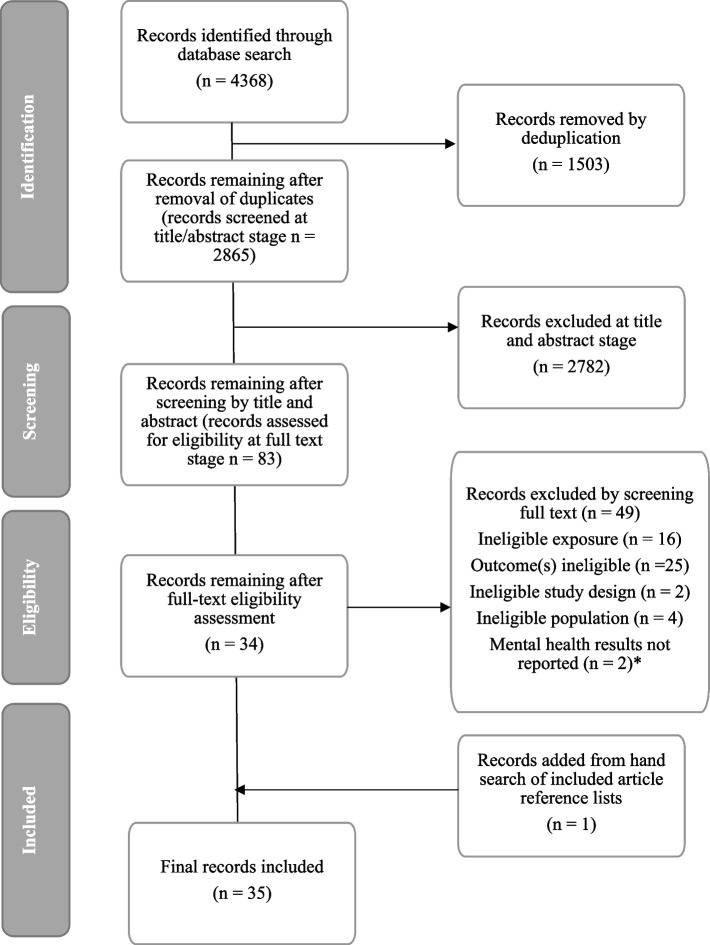
- The search yielded 4,368 articles; after duplicate removal, 2,865 remained, 83 underwent full-text review, and 35 studies were included.
- Due to anticipated methodological heterogeneity, no meta-analysis was planned; studies were grouped and synthesised by outcome, and quality was assessed with the Joanna Briggs Institute Checklist for Analytical Cross-Sectional Studies.
Limitations
- The paper states that direct experience of climate change or extreme weather events was rarely assessed or used as a covariate, so the review cannot discount direct exposure; personality traits and additional risk factors were not controlled; eco-grief and other distinct concepts were not addressed; and no meta-analysis or meta-regression for age and gender was performed.
- The paper also states that the review was restricted to peer-reviewed English-language publications, excluding grey literature and non-English studies; no formal publication bias test was conducted; and the focus on validated self-report mental health measures may have excluded qualitative studies, some cultural contexts, and cognitive processes such as rumination.
- Evident from the text: all included studies were cross-sectional, only one recruited a clinical sample, none used standardised clinical diagnostic assessments, most studies were from high-income countries (Europe, North America, Australia/New Zealand), and most analyses were unadjusted, limiting conclusions about directionality, clinical classification, and generalisability.
Model-written summary. Check it against the paper before relying on it.
Integrity signals
Registry
Cites
Statistics
Figures
Verification
Claims the paper makes
39 Valid · 5 Not valid · 19 Not checked · 63 Own results and interpretations
Some cited sources support this claim and some don’t — read each source’s verdict below.
In the paper
“A further two studies showed eco-anxiety was not significant after adjustment for covariates [53, 63].”
§ The relationship between climate change and mental health: a systematic review of the association between eco-anxiety, psychological distress, and symptoms of major affective disorders > Study and sample characteristics > Anxiety symptoms
What the sources say
- Disputedcites [53] Innocenti M, Perilli A, Santarelli G, Carluccio N, Zjalic D, Maran DA et al. How does climate change worry influence the relationship between climate change anxiety and Eco-paralysis? A moderation study. Climate. 2023;11(9):190. sourceExperimental — accuracy not yet measured
Section 2.6 says the analysis adjusted for age, gender and education. Table 5 reports that eco-anxiety was significantly associated with eco-paralysis after demographic adjustment (p < 0.001); climate change worry, not eco-anxiety, was nonsignificant (p = 0.7). The paper therefore says the contrary for its adjusted eco-paralysis analysis. (LLM, conf=0.88)
Checked by a reasoning model — may be wrong.
- Partly supportedcites [63] Stewart AE. Psychometric properties of the climate change worry scale. Int J Environ Res Public Health. 2021;18(2):494. PMC7826965 33435348 sourceExperimental — accuracy not yet measured
Study 3 Results (no page available) report that climate-change worry was no longer significantly correlated with general anxiety or depression after controlling for stress. The paper does not establish that eco-anxiety was generally nonsignificant after adjustment for covariates: its measure was climate-change worry, and its association with stress remained significant. (LLM, conf=0.82)
plain- Asserted: passes — The authors put it forward as true.
- Checkable: passes — It can be checked against evidence.
- Load-bearing: unclear — It is unclear whether the paper’s conclusions depend on it.
- Based: passes — The paper gives a reason why it holds.
- Disputed
Some cited sources support this claim and some don’t — read each source’s verdict below.
In the paper
“All nine studies investigating symptoms of psychological distress found significant small-to-large (r = .17 to 0.70) positive associations [41, 43–45, 51, 54, 55, 68, 70].”
§ The relationship between climate change and mental health: a systematic review of the association between eco-anxiety, psychological distress, and symptoms of major affective disorders > Study and sample characteristics > Psychological distress
What the sources say
- Not checked — no full text of the sourcecites [41] Clayton S, Karazsia BT. Development and validation of a measure of climate change anxiety. J Environ Psychol. 2020;69:101434. source
- Disputedcites [43] Di Fabio A, Svicher A. The Eco-generativity Scale (EGS): a New Resource to protect the Environment and Promote Health. Int J Environ Res Public Health. 2023;20(15):6474. PMC10418646 37569015 sourceExperimental — accuracy not yet measured
The Results (Section 3; page unavailable) report statistically significant *negative* correlations between eco-generativity and PANAS negative affect, rather than positive associations with a distress-related measure. The Measures section identifies negative affect with symptoms such as nervousness and fear. This paper does not establish the claimed finding across nine studies or the stated r range. (LLM, conf=0.78)
Checked by a reasoning model — may be wrong.
- Not checked — no full text of the sourcecites [44] Feather G, Williams M. The moderating effects of psychological flexibility and psychological inflexibility on the relationship between climate concern and climate-related distress. J Context Behav Sci. 2022;23:137–43. source
- Supportedcites [45] Gago T, Sá I. Environmental worry and wellbeing in young adult university students. Curr Res Environ Sustain. 2021;3:100064. source
The Results (section 3.2) report significant positive correlations between environmental worry and two psychological-distress indices: GSI (r = 0.298) and PST (r = 0.378), both within the cited range. This paper supports its place among the nine cited studies; it does not itself establish the count or full range across all nine. (LLM, conf=0.91)
- Partly supportedcites [51] Innocenti M, Santarelli G, Faggi V, Castellini G, Manelli I, Magrini G, et al. Psychometric properties of the Italian version of the climate change anxiety scale. J Clim Change Health. 2021;3:100080. sourceExperimental — accuracy not yet measured
The Results report positive associations between climate-change anxiety and psychological-distress measures; Table 2 gives a positive coefficient for K-10 total score (B = 0.437, p = 0.013). This paper reports one study, however, and gives regression coefficients rather than the cited range of correlations (r = .17 to .70), so it cannot establish the nine-study count or that range. (LLM, conf=0.84)
- Partly supportedcites [54] Larionow P, Sołtys M, Izdebski P, Mudło-Głagolska K, Golonka J, Demski M, et al. Climate change anxiety Assessment: the Psychometric properties of the Polish Version of the climate anxiety scale. Front Psychol. 2022;13:870392. 35645848 PMC9130850 sourceExperimental — accuracy not yet measured
The Results (Convergent and Divergent Validity; page unavailable) report positive associations between climate anxiety and depressive symptoms, supporting this paper’s inclusion among studies finding an association with psychological distress. The Discussion (page unavailable) also reports a positive association with combined anxiety-depressive symptoms, but says anxiety symptoms measured separately were not associated. Our copy does not provide the correlation coefficients needed to verify this study’s place in the cited r = .17–.70 range, and it cannot establish the findings of the other eight studies. (LLM, conf=0.84)
- Not checked — no full text of the sourcecites [55] Lukacs JN, Bratu A, Adams S, Logie C, Tok N, McCunn LJ et al. The concerned steward effect: exploring the relationship between climate anxiety, psychological distress, and self-reported climate related behavioural engagement. J Environ Psychol. 2023;90:102087. source
- Supportedcites [68] Wullenkord MC, Tröger J, Hamann KRS, Loy LS, Reese G. Anxiety and climate change: a validation of the climate anxiety scale in a german-speaking quota sample and an investigation of psychological correlates. Clim Change. 2021;168(3):20. source
Section 4.2 reports a positive correlation between climate anxiety and general anxiety and depressiveness (r = 0.25). Section 5.2.2 says the correlation was significant. This supports the paper's inclusion as one of the nine cited studies; the nine-study count and full range are attributed to the citations collectively. (LLM, conf=0.91)
- Supportedcites [70] Reyes MES, Carmen BPB, Luminarias MEP, Mangulabnan S, Ogunbode CA. An investigation into the relationship between climate change anxiety and mental health among Gen Z filipinos. Curr Psychol. 2023;42(9):7448–56. PMC8280276 34305362 source
The Results report a significant positive association between climate change anxiety and psychological distress among Gen Z Filipino participants (r = .39, p < .001). That coefficient falls within the citing sentence’s stated range; this paper is one of the nine studies cited, not the source of the nine-study count. (LLM, conf=0.93)
plainstates an association- Asserted: passes — The authors put it forward as true.
- Checkable: passes — It can be checked against evidence.
- Load-bearing: passes — The paper’s conclusions depend on it.
- Based: passes — The paper gives a reason why it holds.
Some cited sources support this claim and some don’t — read each source’s verdict below.
In the paper
“Eighteen studies investigated the association between eco-anxiety and symptoms of depression, with fifteen reporting a significant small-to-moderate (r = .14 to 0.49) positive association [37, 40, 42, 46, 48, 50, 51, 54, 56, 57, 62–65, 69], whereas three reported no significant relationship [49, 52, 53].”
§ The relationship between climate change and mental health: a systematic review of the association between eco-anxiety, psychological distress, and symptoms of major affective disorders > Study and sample characteristics > Depression symptoms
What the sources say
- Disputedcites [49] Hepp J, Klein SA, Horsten LK, Urbild J, Lane SP. Introduction and behavioral validation of the climate change distress and impairment scale. Sci Rep. 2023;13(1):11272. 37438436 PMC10338517 sourceExperimental — accuracy not yet measured
In Study 3, Table 2 (Results; no page given), climate change distress correlated positively with depressive symptoms (r = 0.28), contrary to the cited claim of no significant relationship. The near-zero correlation (r = 0.04) was for climate change impairment, a separate measure; the Study 3 Method reports 374 participants. (LLM, conf=0.86)
Checked by a reasoning model — may be wrong.
- Supportedcites [52] Innocenti M, Santarelli G, Faggi V, Ciabini L, Castellini G, Galassi F, et al. Psychometric properties of the Italian version of the climate change worry scale. J Clim Change Health. 2022;6:100140. source
The Results section reports no detected correlation between Climate Change Worry Scale scores and DASS-21 depression symptoms; the Discussion reiterates this finding. This supports citing the study as one of the three reporting no significant relationship, though this paper measures climate change worry specifically rather than every aspect of eco-anxiety. (LLM, conf=0.90)
- Supportedcites [53] Innocenti M, Perilli A, Santarelli G, Carluccio N, Zjalic D, Maran DA et al. How does climate change worry influence the relationship between climate change anxiety and Eco-paralysis? A moderation study. Climate. 2023;11(9):190. source
Section 3.2 reports no correlation between the Hogg Eco-Anxiety Scale and the DASS-21 depression subscale. Table 3 shows a correlation of −0.037 without a significance marker. This supports the cited paper as one of the three studies reporting no significant relationship; it does not itself establish the findings of the other two. (LLM, conf=0.93)
plain- Asserted: passes — The authors put it forward as true.
- Checkable: passes — It can be checked against evidence.
- Load-bearing: unclear — It is unclear whether the paper’s conclusions depend on it.
- Based: passes — The paper gives a reason why it holds.
- Disputed
Some cited sources support this claim and some don’t — read each source’s verdict below.
In the paper
“For example, recent multinational studies have suggested that between 49 and 59% of respondents were very or extremely worried about climate change [10, 11].”
§ The relationship between climate change and mental health: a systematic review of the association between eco-anxiety, psychological distress, and symptoms of major affective disorders > Abstract > Supplementary Information
What the sources say
- Supportedcites [10] Hickman C, Marks E, Pihkala P, Clayton S, Lewandowski RE, Mayall EE, et al. Climate anxiety in children and young people and their beliefs about government responses to climate change: a global survey. Lancet Planet Health. 2021;5(12):e863–73. 34895496 source
The Summary (p. 2) reports that 59% of respondents were very or extremely worried about climate change. This paper supports the upper end of the range attributed to the cited multinational studies; the sentence also cites another study for the range. (LLM, conf=0.92)
- Disputedcites [11] Ogunbode CA, Doran R, Hanss D, Ojala M, Salmela-Aro K, van den Broek KL et al. Climate anxiety, wellbeing and pro-environmental action: correlates of negative emotional responses to climate change in 32 countries. J Environ Psychol. 2022;84:101887. sourceExperimental — accuracy not yet measured
Section 3.1 (Preliminary observations; page unavailable) reports that 46.8% of the total sample were very or extremely worried about climate change, below the claimed 49–59% range. The paper also cautions that its samples were not nationally representative. (LLM, conf=0.90)
Checked by a reasoning model — may be wrong.
hedged- Asserted: passes — The authors put it forward as true.
- Checkable: passes — It can be checked against evidence.
- Load-bearing: unclear — It is unclear whether the paper’s conclusions depend on it.
- Based: passes — The paper gives a reason why it holds.
- Supported
Every source the paper cites for this claim was checked and supports it.
In the paper
“Only one study recruited a clinical sample [35], with an additional study utilising a sample of adults experiencing eco-anxiety [36].”
- Also stated in: § Discussion · plain
“and only one study recruited a clinical sample, both of which may limit understandings of eco-anxiety classification.”
§ The relationship between climate change and mental health: a systematic review of the association between eco-anxiety, psychological distress, and symptoms of major affective disorders > Study and sample characteristics
What the sources say
- Supportedcites [35] Gebhardt N, Schwaab L, Friederich HC, Nikendei C. The relationship of climate change awareness and psychopathology in persons with pre-existing mental health diagnoses. Front Psychiatry. 2023;14:1274523. 38090707 PMC10715411 source
The Materials and methods section (Study design, participants and procedure; page not provided) says this study recruited patients from a psychosomatic outpatient clinic. That supports its identification as a study with a clinical sample; the claim that it was the only such study concerns the citing paper's set of studies, not a finding attributed to this source. (LLM, conf=0.94)
plain- Asserted: passes — The authors put it forward as true.
- Checkable: passes — It can be checked against evidence.
- Load-bearing: passes — The paper’s conclusions depend on it.
- Based: passes — The paper gives a reason why it holds.
- Also stated in: § Discussion · plain
83 more claims · 30 with their cited sources checked
Create a free account to see all 126 claims and to verify the 5 references still open.
- It may state two separate claims as one. 24
- Probably not a substantial claim. 20
Claims other papers make about this one
Each is checked against this paper’s own text: does it say what the citing paper says it does?
In the citing paper
“Most research focuses on climate anxiety or eco-anxiety, but the questionnaires developed to assess the construct are based on different definitions and include a wide variety of partially differing symptoms [21].”
In the citing paper
“The lack of international definitions hinders research and results in varying prevalence of eco-distress and different correlations with mental health measures such as depressive or anxiety symptoms [13], [21], [22].”
Self-check
Percentages, sums and reported differences re-computed from the paper’s own numbers.
Each contradiction between two passages listed here was confirmed by an independent check.
Rated minor: it would not touch a result — a value no result rests on, a p-value that stays on the same side of the significance level, or a conflict that is clerical, resolved elsewhere in the paper, or outside its own findings.
In the paper
§ The relationship between climate change and mental health: a systematic review of the association between eco-anxiety, psychological distress, and symptoms of major affective disorders > Study and sample characteristics > Associations between eco-anxiety and mental health outcomes
“All but three of the included 33 correlational studies found eco-anxiety to be significantly positively associated with mental health symptomatology, with small-to-large associations reported (r = .14 to 0.60).”
§ The relationship between climate change and mental health: a systematic review of the association between eco-anxiety, psychological distress, and symptoms of major affective disorders > Study and sample characteristics > Psychological distress
“All nine studies investigating symptoms of psychological distress found significant small-to-large (r = .17 to 0.70) positive associations [41, 43–45, 51, 54, 55, 68, 70].”
Citations
Cites
PRISMA-P Group, Moher, D., Shamseer, L., Clarke, M., Ghersi, D., Liberati, A., Petticrew, M., Shekelle, P., & Stewart, L. A. (2015) · Systematic Reviews · doi:10.1186/2046-4053-4-1 · Cited by 26,223
Diagnostic and Statistical Manual of Mental Disorders
American Psychiatric Association (2022) · doi:10.1176/appi.books.9780890425787 · Cited by 23,476
(IPCC), I. P. O. C. C. (2023) · doi:10.1017/9781009325844 · Cited by 10,921
Diagnostic and Statistical Manual of Mental Disorders, 5th Edition
(2013) · American Psychiatric Association Publishing eBooks · doi:10.1176/appi.books.9780890425596.893619 · Cited by 4,383
JBI Manual for Evidence Synthesis
(2020) · JBI eBooks · doi:10.46658/jbimes-20-01 · Cited by 4,165
Hickman, C., Marks, E., Pihkala, P., Clayton, S., Lewandowski, R. E., Mayall, E. E., Wray, B., Mellor, C., & van Susteren, L. (2021) · The Lancet Planetary Health · doi:10.1016/s2542-5196(21)00278-3 · Cited by 2,324
Chapter 7: Systematic reviews of etiology and risk
Moola, S., Munn, Z., Tufanaru, C., Aromataris, E., Sears, K., Sfetic, R., Currie, M., Lisy, K., Qureshi, R., Mattis, P., et al. (2019) · JBI Reviewer's Manual · doi:10.46658/jbirm-17-06 · Cited by 2,114
The Effects of Climate Change on Cardiac Health
De Blois, J., Kjellstrom, T., Agewall, S., Ezekowitz, J. A., Armstrong, P. W., & Atar, D. (2015) · Cardiology · doi:10.1159/000398787 · Cited by 1,697
Climate anxiety: Psychological responses to climate change
Clayton, S. (2020) · Journal of Anxiety Disorders · doi:10.1016/j.janxdis.2020.102263 · Cited by 1,409
Solastalgia: The Distress Caused by Environmental Change
Albrecht, G., Sartore, G.-M., Connor, L., Higginbotham, N., Freeman, S., Kelly, B., Stain, H., Tonna, A., & Pollard, G. (2007) · Australasian Psychiatry · doi:10.1080/10398560701701288 · Cited by 1,369
Research works printed but not linked: 3
- Schwartz SEO, Benoit L, Clayton S, Parnes MF, Swenson L, Lowe SR. Climate change anxiety and mental health: environmental activism as buffer. Curr Psychol. 2022;42:16708–21. PMC8883014 35250241 · DOI · Paper page
- Reyes MES, Carmen BPB, Luminarias MEP, Mangulabnan S, Ogunbode CA. An investigation into the relationship between climate change anxiety and mental health among Gen Z filipinos. Curr Psychol. 2023;42(9):7448–56. PMC8280276 34305362 · DOI · Paper page
- Spielberger CD. Theory and research on anxiety. Anxiety Behav. 1966;1(3):413–28.
Cited by
Climate change anxiety: A meta-analysis
Kühner, C., Gemmecke, C., Hüffmeier, J., & Zacher, H. (2025) · Global Environmental Change · doi:10.1016/j.gloenvcha.2025.103015 · Cited by 100
Climate change anxiety and pro-environmental behaviours: disentangling gender disparities
Pinho, M. (2025) · Frontiers in Sociology · doi:10.3389/fsoc.2025.1589501 · Cited by 45
Cosh, S., Williams, S. E., Lykins, A. D., Bartik, W. J., & Tully, P. J. (2024) · BMC Psychology · doi:10.1186/s40359-024-02240-4 · Cited by 35
“Climate change anxiety has largely been conceptualised as representing an anxiety disorder or subtype [43] and, in the literature to date, climate change anxiety has most commonly been explored in relation to anxiety symptoms, showing consistently small to large associations [20].”
InfluentialSelf-citationScoping review on assessing climate-sensitive health risks
Yenew, C., Bayeh, G. M., Gebeyehu, A. A., Enawgaw, A. S., Asmare, Z. A., Ejigu, A. G., Tsega, T. D., Temesgen, A., Anteneh, R. M., Yigzaw, Z. A., et al. (2025) · BMC Public Health · doi:10.1186/s12889-025-22148-x · Cited by 43
“Indirect effects arise from long-term changes in climate, such as rising temperatures and prolonged droughts, which can exacerbate existing mental health conditions and increase the risk of suicide [97].”
KERSE, Y., & Kerse, G. (2025) · BMC Psychology · doi:10.1186/s40359-025-03501-6 · Cited by 29
“Recent studies [22, 23, 24] have shown that individuals’ awareness of the general challenges posed by global climate change has increased, accompanied by a rise in psychological distress related to this awareness.”
Eco-Anxiety and Mental Health: Correlates of Climate Change Distress
Mosca, A., Luciani, D., Chiappini, S., Miuli, A., Cianconi, P., Pettorruso, M., Janiri, L., & Martinotti, G. (2025) · International Journal of Environmental Research and Public Health · doi:10.3390/ijerph22121768 · Cited by 27
“Consistent with prior work, younger age was strongly associated with higher levels of eco-anxiety [11,29,30].”
The Influence of Eco-Anxiety on Sustainable Consumption Choices: A Brief Narrative Review
Gkargkavouzi, A., Halkos, G., & Halkou, P. (2025) · Urban Science · doi:10.3390/urbansci9070286 · Cited by 15
Marketou, M. E., Caples, N., Abela, M., Dendale, P., Gökdemir, Ö., Korzh, O., Kurpas, D., Lin, M., Mattioli, A. V., Moholdt, T. T., et al. (2026) · European Journal of Preventive Cardiology · doi:10.1093/eurjpc/zwag229 · Cited by 6
Jm, T., Barrios, I., Ventriglio, A., Castaldelli-Maia, J. M., Lashley, M., Campbell, M., Liebrenz, M., Ramachandran, P., Aggarwal, N. K., Alibudbud, R. C., et al. (2026) · Asian Journal of Psychiatry · doi:10.1016/j.ajp.2026.104859 · Cited by 5
Climate Change and Mental Health in Africa: A Scoping Review
Ndifoin, B. N., Kanmounye, U. S., Kukuia, K. K. E., Endomba, F. T., Mbonda, A., & Jumbam, D. T. (2026) · Annals of Global Health · doi:10.5334/aogh.5110 · Cited by 6
“…economic losses, displacement, food insecurity, disruption of social and community networks [18], eco-anxiety, distress, fear, and worry, especially among children and young people, as eco-anxiety is consistently associated with psychological distress, depression, and stress symptoms [19, 20].”
Marcolini, F., Rocholl, J. K., Valenta, S. T., Ferrari, B., Vincenzo, M. D., Fiorillo, A., Ronchi, D. D., & Atti, A. R. (2025) · International Journal of Social Psychiatry · doi:10.1177/00207640251380066 · Cited by 13
“…distress, which denotes the psychological stress resulting from the direct impact of climate change on daily life (Albrecht et al., 2007; Cosh, Ryan, et al., 2024; Downey & Van Willigen, 2005), eco-anxiety is not necessarily related to personal experience but primarily driven by the…”
Hadfield, K., Sulowska, M., Rasolomalala, N., Solomon, S. G., Ramaroson, S., & Mareschal, I. (2025) · The Journal of Climate Change and Health · doi:10.1016/j.joclim.2025.100438 · Cited by 12
“Similarly, Cosh and colleagues ’ systematic review on climate change worry, distress, and major affective disorders among adolescents found no studies conducted anywhere in Africa [16].”
Systematic Review of the Links between Eco-Distress and Mental Health
Gebhardt, N., Westermann, F., Kleinböhl, L., Friederich, H., & Nikendei, C. (2025) · EcoHealth · doi:10.1007/s10393-025-01769-z · Cited by 8
“However, the exact nature of the relationship between eco-distress and mental impairments remains unclear, and there is a large heterogeneity in the correlations of eco-distress with different syndromes of mental health impairments (Cosh et al., 2024).”
Trait Mindfulness and Pro-Environmental Behaviours: The Mediating Role of Eco-Emotions
Bontempo, D., Perazzini, M., Giancola, M., D’Amico, S., & Perilli, E. (2026) · Sustainability · doi:10.3390/su18052446 · Cited by 6
Understanding the Impacts of Climate Anxiety on Financial Decision Making
Coates, Z., Brown, S. D., & Kelly, M. (2025) · Sustainability · doi:10.3390/su17093815 · Cited by 6
The impact of climate change on mental health: A systematic review and meta-analysis
Niazi, Y., Farooq, S. M. Y., Moazzam, M., Yousaf, S., & Hameed, S. (2026) · Geopsychiatry · doi:10.1016/j.geopsy.2026.100067 · Cited by 4
Amjad, A. I., JAVAID, S., Saira, Akhter, S., Khasawneh, M. A. S., & Al-Kahlan, T. B. S. (2026) · Discover Psychology · doi:10.1007/s44202-026-00643-5 · Cited by 6
Matijasevich, A., Xavier, M. O., Tovo‐Rodrigues, L., Ribeiro, A. I., Henriques, A., Pastor‐Valero, M., & Santos, I. S. (2025) · Journal of Environmental Psychology · doi:10.1016/j.jenvp.2025.102792 · Cited by 4
“I have no future” - the critical need to counter climate doomism
Stuart, D. (2025) · Environmental Sociology · doi:10.1080/23251042.2025.2552388 · Cited by 7
“Doomism is also a mental health concern (Cosh et al. 2024).”
Nunnink, M., Ballester, L., Vilagut, G., Alayo, I., Mortier, P., Almenara, J., Cebrià, A. I., Gabilondo, A., Gili, M., Lagares, C., et al. (2025) · Journal of Affective Disorders · doi:10.1016/j.jad.2025.120058 · Cited by 4
Hoffmann, T. (2025) · SciComm Report · doi:10.32457/scr.v4i1.2812 · Cited by 18
Rana, S. S. J. B., Morris, P. G., Brett, C. E., Pacheco, E.-M., Demetriou, K., & Tunç, H. (2026) · Applied Psychology Health and Well-Being · doi:10.1111/aphw.70157 · Cited by 8
Mouguiama-Daouda, C., McNally, R. J., & Heeren, A. (2026) · Journal of Anxiety Disorders · doi:10.1016/j.janxdis.2026.103114 · Cited by 3
Léger‐Goodes, T., Herba, C. M., Piché, J., Smith, J., Éthier, M., Lefrançois, D., & Malboeuf‐Hurtubise, C. (2025) · BMC Psychology · doi:10.1186/s40359-025-03589-w · Cited by 7
“While existing research has begun to explore the clinical implications of eco-anxiety, particularly in adult populations [23], a better understanding of climate change emotions and how we can help children navigate these challenging times are needed [13].”
Žukauskienė, R., Bakaitytė, A., & Balundė, A. (2025) · The Journal of Climate Change and Health · doi:10.1016/j.joclim.2025.100601 · Cited by 4
Ribeiro, A. I., Morais-Vilaça, I., Henriques, A., Pastor‐Valero, M., Matijasevich, A., Severo, M., & Barros, H. (2025) · Journal of Adolescent Health · doi:10.1016/j.jadohealth.2025.07.021 · Cited by 4
Eating disorders and eco-anxiety: exploring mental health challenges in university students
Tavolacci, M., & Ladner, J. (2025) · Journal of Eating Disorders · doi:10.1186/s40337-025-01382-z · Cited by 7
“…mental health, contributing to conditions like post-traumatic stress disorder after disasters [6, 7] and may increase the risk of developing a mental illness or exacerbate existing mental health concerns [8–10], particularly among university students who often face multiple life stressors [11, 12].”
The Emergence of Ecological Consciousness: A Transformative Journey
Corvello, M. M., Benomar, C., & Maggi, S. (2025) · Youth · doi:10.3390/youth5030076 · Cited by 7
Climate change and the future of psychiatry: challenges and opportunities for the next three decades
Torales, J. C., Torres-Romero, A. D., O’Higgins, M. G., Ventriglio, A., Castaldelli-Maia, J. M., Caycho‐Rodríguez, T., Hualparuca‐Olivera, L., Liebrenz, M., Smith, A. J., & Barrios, I. (2025) · International Review of Psychiatry · doi:10.1080/09540261.2025.2523457 · Cited by 3
“Eco-anxiety, characterized by persistent worry about environmental degradation and uncertainty regarding the planet’s future, is often accompanied by symptoms of anxiety, sleep disturbances and prolonged stress responses (Cosh et al., 2024; Vakoch & Mickey, 2023).”
Popadić, S. N. (2025) · Pravni zapisi · doi:10.5937/pravzap16-58432 · Cited by 2
Cosh, S., Bartik, W. J., Ryan, R., Jefferys, A., Fallander, K., Tully, P. J., & Lykins, A. D. (2025) · JMIR Research Protocols · doi:10.2196/69005 · Cited by 3
“An emerging body of research has also routinely highlighted the deleterious impact of eco-anxiety on a range of mental health outcomes [8,9].”
Self-citationClimate Anxiety Among Undergraduates at an R1 University in the United States
Shah, J. J. F., Banerjee, D., Yeo, S. K., Brunelle, A. R., Cachelin, A., Lohani, M., Zummo, L., Nistler, A. F., & Watt, J. H. (2026) · Sustainability · doi:10.3390/su18157944 · Cited by 1
Odo, V. O., Ike, O. O., & Isife, O. G. (2026) · Global Social Welfare · doi:10.1007/s40609-026-00468-z · Cited by 1
Impacts of climate change on mental health and its underlying mechanisms: an umberella review
Davariniamotlaghquchan, A., Niazmand, Z., Shafiee, M., & Ostadtaghizadeh, A. (2026) · Annals of General Psychiatry · doi:10.1186/s12991-026-00668-z · Cited by 1
Boraghi, F., Soomro, S., Hashemi, H., Moosavi, S. H., Ghaedi, T., & Asadollahi, A. (2026) · BMC Psychology · doi:10.1186/s40359-026-04559-6 · Cited by 1
Mental health in the time of polycrisis: geopolitical determinants and modern psychiatry
Bhugra, D., Liebrenz, M., & Smith, A. J. (2026) · Frontiers in Psychiatry · doi:10.3389/fpsyt.2026.1813883 · Cited by 3
Léger‐Goodes, T., Herba, C. M., Smith, J., Lefrançois, D., Éthier, M., Piché, J., & Malboeuf‐Hurtubise, C. (2026) · Chronic Stress · doi:10.1177/24705470261442334 · Cited by 1
Cerantola, M., Masdonati, J., & Levin, N. (2026) · International Journal for Educational and Vocational Guidance · doi:10.1007/s10775-026-09796-0 · Cited by 2
Canessa-Pollard, V. (2026) · International Coaching Psychology Review · doi:10.53841/bpsicpr.2026.21.1.55 · Cited by 2
Zolotareva, A. B., Викторовна, К. Е., & Uglova, A. A. (2026) · Medico-Biological and Socio-Psychological Problems of Safety in Emergency Situations · doi:10.25016/2541-7487-2025-0-4-61-67 · Cited by 1
Gökcen, B. B., Isin, R. B., Ağagündüz, D., Esatbeyoglu, T., & Özoğul, F. (2026) · Frontiers in Psychology · doi:10.3389/fpsyg.2025.1701068 · Cited by 4
Abdallah, M. R., Ead, H. A., El-Tantawi, A. M., Swelam, E. S., Abosree, O. S., & Abdallah, E. M. (2026) · Research Square · doi:10.21203/rs.3.rs-8340234/v1 · Cited by 2
An Adolescent-Caregiver Dyad Approach to Climate Anxiety in the Pediatric Emergency Department
Assaf, R. R., Shelton, S. K., Morphew, T. L., Clayton, S., & Wu, J. (2026) · INQUIRY The Journal of Health Care Organization Provision and Financing · doi:10.1177/00469580251411470 · Cited by 2
“6,17,29,33 5-9 Longitudinal research is needed to disentangle these pathways.”
Quimby, K. R., Douglin, K. K., Whitby-Best, T., Hill, K. F.-S., Emmanuel, M. K., Harewood, H. C., & Campbell, M. H. (2025) · Geopsychiatry · doi:10.1016/j.geopsy.2025.100039 · Cited by 3
Navigating environmental stress: Climate change impacts on adults' mental health in the Middle East
Fadhel, F. H., & Seyabi, S. A. A. (2025) · Geopsychiatry · doi:10.1016/j.geopsy.2025.100031 · Cited by 2
Fleck, L., Wasmus, H., Schirmbeck, F. N., de Freitas, C., Teixeira, R., Sanna, L., de Graaff, A. M., Allegri, M. D., Nguyen, H. T., Boehnke, J. R., et al. (2025) · JMIR Research Protocols · doi:10.2196/77764 · Cited by 2
“In a second vein, candidate outcomes include climate change distress and impairment itself, as well as general psychological distress often associated with the former [30].”
Ahmed, D. R., Kakamad, K. K., Al-Taie, R. H., Ahmed, J. O., & Heun, R. (2025) · BJPsych International · doi:10.1192/bji.2025.10068 · Cited by 4
Climate anxiety impairs sustained attention: objective evidence of a cognitive cost
Denkova, E., Tardibuono, T. K., Tsukahara, J. S., Zanesco, A. P., & Jha, A. P. (2025) · Frontiers in Psychology · doi:10.3389/fpsyg.2025.1624782 · Cited by 3
Giannakopoulos, G. (2025) · Psychiatry International · doi:10.3390/psychiatryint6040119 · Cited by 7
“This distinction plays a crucial role in both research validity and how findings are interpreted in clinical and public health contexts [28].”
Gupta, A., Jaiswal, S., Purpura, S. R., Dizon, S., Buan, M., Dong, F., Forman, F., & Mishra, J. (2025) · Sustainability · doi:10.3390/su17177831 · Cited by 4
Gebhardt, N., Sutcliffe, M., Schultz, J.-H., Friedrich, H.-C., & Nikendei, C. (2025) · German Medical Science GMS Publishing House · doi:10.3205/zma001776 · Cited by 1
“Most research focuses on climate anxiety or eco-anxiety, but the questionnaires developed to assess the construct are based on different definitions and include a wide variety of partially differing symptoms [21].”
Psychological and Functional Impacts of Climate Change Exposure on Adolescents: A Systemic ReviewPreprint
Khan, H. A., Tahir, A., Chughtai, A. B. A., et al. (2026) · Research Square · doi:10.21203/rs.3.rs-11118766/v1
Nawawonganun, R., Sornlorm, K., & Mahato, R. K. (2026) · PLoS ONE · doi:10.1371/journal.pone.0358849
“Consistent with this literature, environmental concern correlates positively with distress, depression, and anxiety [8].”
Amin, M. R., Wahab, S. A., Islam, M. M., & Hossain, M. A. (2026) · Journal of Applied Research in Higher Education · doi:10.1108/jarhe-04-2026-0622
One Health – One Planet – One Mind: integrating eco-anxiety into the One Health paradigm
Umar, S. I., Maaji, S. M., Beli, I. I., & Nura, Z. M. (2026) · One Health · doi:10.1016/j.onehlt.2026.101588
Toward an integrative psychological framework of existential hope: navigating uncertain futures.
Bohlmeijer, E., Nieuwenhuis, M., Domínguez, A. R., ten Klooster, P., & Malboeuf‐Hurtubise, C. (2026) · Frontiers in Psychology · doi:10.3389/fpsyg.2026.1850611 · Cited by 1
Alisha, T. T., Romate, J., Rajkumar, E., Sruthi, K. S., Lipsa, J. M., & Manjima, M. (2026) · Frontiers in Climate · doi:10.3389/fclim.2026.1837284 · Cited by 1
Climate-driven perinatal mental health impacts: A pilot study
Premji, S., Obilor, H. N., Rae, G. M., & Forcheh, N. (2026) · Journal of Health Psychology · doi:10.1177/13591053261479994
Kwakye, J. (2026) · Mental Health Science · doi:10.1002/mhs2.70057
Planetary Health Pathways for Primary Care Providers
Nusrat, A. Z., Vatovec, C. M., Vertovec, A., Cornwall, K. J., & Barrett, B. (2026) · Primary Care Clinics in Office Practice · doi:10.1016/j.pop.2026.07.003
Zhao, D., Jiao, L., Xiao, Y., Zhang, X., & Yang, Z. (2026) · Journal of Environmental Psychology · doi:10.1016/j.jenvp.2026.103195
Halk Sağlığı Hemşireliğinin Ekofeminist Rolü
Aydın, E., & Dokuzcan, D. A. (2026) · Halk Sağlığı Hemşireliği Dergisi · doi:10.54061/jphn.1809458
Romano, L., Russo, C., Clemente, D., Marchetti, V., Rinallo, E., Fiorilli, C., Ojala, M., & Panno, A. (2026) · Frontiers in Psychology · doi:10.3389/fpsyg.2026.1878132
Rooted in Resilience: Climate Change and Mental Health Narratives of Makgobistad’s Emerging Adults
Ncango, V., Hermann, C., & Davids, E. L. (2026) · South African Journal of Psychology · doi:10.1177/00812463261479521
Güllü, A., Aloğlu, N., & Aslan, S. (2026) · Hemşirelik Bilimi Dergisi · doi:10.54189/hbd.1705769
Brimicombe, C., Runkle, J. D., Mouchtouri, B., Cattle, C., Part, C., Kalala, F., Marshall, H., Voulgaridi, I., Wan, K., Tembo, M., et al. (2026) · Dialogues in Health · doi:10.1016/j.dialog.2026.100344
“Beyond physiological strain, rising temperatures contribute to “ eco-anxiety ” , the negative emotions of worry, fear, and anxiety related to climate change and environmental degradation, further amplifying distress in young people [15 – 17].”
Martin, G., Dubois, C., Faulkner, V., Ojala, M., Treble, M., Roswell, T., Gilliland, J., Card, K. G., Gislason, M., Grewal, E., et al. (2026) · The Journal of Climate Change and Health · doi:10.1016/j.joclim.2026.100721
“Further, conceptual clarity (e.g., distinguishing between measures of internal processes, such as feelings of worry, and functional impairments) is a consideration of such instruments to avoid jingle-jangle fallacies, which is an issue in research of climate change distress [25].”
Niedzwiedz, C. L., Collery, A., Kibuchi, E., Orina, F., Meme, H., Odhiambo, M., Newton, C. R. J. C., Gray, C. M., & Kariuki, S. M. (2026) · Wellcome Open Research · doi:10.12688/wellcomeopenres.27258.1
Sharma, A., Takaro, T. K., Logie, C. H., Ibrahim, M., & Card, K. G. (2026) · Chronic Stress · doi:10.1177/24705470261472655
Unequal mental health impacts of extreme weather and climate events
Li, A., & Bentley, R. (2026) · Nature Mental Health · doi:10.1038/s44220-026-00687-5
“Scientific literature has documented the significant association between exposure to these disasters and risks of psychological distress, anxiety, depression and post-traumatic stress disorder symptoms 5–7 .”
Vahedi, L., Zaïdi, S., Pradhan, S., Smolik, J., Tikhonov, J., Gaffey, M. F., & Bhutta, Z. A. (2026) · PLOS Climate · doi:10.1371/journal.pclm.0000984 · Cited by 1
How climate change is perceived to affect current lives and future decisions in a US sample
Clayton, S., Olsen, S., & Harper, S. (2026) · Cell Reports Sustainability · doi:10.1016/j.crsus.2026.100758 · Cited by 1
Climate anxiety and responsible tourist behavior: an environmental psychology perspective
Esteves, P., Fidalgo, M., de Almeida, G. G. F., & Dias, F. (2026) · Frontiers in Sustainable Tourism · doi:10.3389/frsut.2026.1863019
Exploring the eco-anxiety continuum: calibrating scales with item response theory
Hannachi, T., & Somat, A. (2026) · Methods in Psychology · doi:10.1016/j.metip.2026.100271 · Cited by 1
Fekih‐Romdhane, F., Kheir, N., Shuwiekh, H. A. M., Helmy, M. S., Jebreen, K., Naser, A. Y., Fawaz, M. A., Laranjeira, C., Nawajah, I., RADWAN, E. S., et al. (2026) · Critical Public Health · doi:10.1080/09581596.2026.2698160
The psychosocial impact of climate change: an umbrella review and meta-analysis
Bianchi, M. L., Ahumada-Méndez, F., Cáceres, C., Serrano, C., & Díaz-Arcaño, K. (2026) · Frontiers in Public Health · doi:10.3389/fpubh.2026.1899420 · Cited by 2
“To identify the most methodologically robust findings, a specific analysis was conducted of the three systematic reviews classified as high quality according to AMSTAR 2 (35, 37, 40).”
InfluentialKannan, J. V., N.Deepa, & Devi., T. (2026) · International Conference on Smart Systems and Inventive Technology (ICSSIT) · doi:10.1109/icssit69151.2026.11656591
“It also emphasizes the importance of incorporating environmental-related mental state factors into clinical methods and regulations designed to address growing issues at the interface of the environment and public wellness [18].”
Abate, R., Punzo, G., & Velotti, P. (2026) · Journal of Public Health · doi:10.1007/s10389-026-02841-w
Harshita, & Maheshwari, N. (2026) · Journal of Religion and Health · doi:10.1007/s10943-026-02691-6
THE IMPACT OF CLIMATE ANXIETY ON PSYCHOLOGICAL RESILIENCE AMONG MENOPAUSAL WOMEN
Günaydın, Y., Kır, E., & Atilla, R. (2026) · Bozok Tıp Dergisi · doi:10.16919/bozoktip.1882838
Coelho, D. R. A., Pinsky, E. G., McKowen, J., Koh, K. A., Freudenreich, O., Salvi, J. D., Bido-Medina, R. O., & Keuroghlian, A. S. (2026) · Harvard Review of Psychiatry · doi:10.1097/hrp.0000000000000468
Behavioral eco-wellness: Definition, conceptual framework, and research agenda
Barrett, B., Cornwall, K. J., Grabow, M., & Goldberg, S. B. (2026) · Journal of Environmental Psychology · doi:10.1016/j.jenvp.2026.103095 · Cited by 1
Liu, S., Tan, Y., & Zang, L. (2026) · Healthcare · doi:10.3390/healthcare14121624
“This provides an empirical basis for examining how climate-related worry may connect with common affective symptoms among students [6].”
Simmons, B. A. (2026) · People and Nature · doi:10.1002/pan3.70365
Linkages Between Climate Change Anxiety, Mental Health, and Eco-Activism in University Students
Bettmann, J. E., Mitra, S. J., Speelman, E. A., & Conley, K. (2026) · Journal of College Student Mental Health · doi:10.1080/28367138.2026.2678825
High heat exposure and climate anxiety among rural women in Tamil Nadu: health and social impacts
Gayathri, K. G., Shanmugam, R., Venugopal, V., Vijayalakshmi, P., & Krishnan, S. (2026) · BMC Public Health · doi:10.1186/s12889-026-27397-y
“It is broadly defined as persistent worry, fear, helplessness, and emotional distress arising from awareness of environmental degradation and anticipated climate-related threats [8].”
Yan, X., Chen, Y., & Lin, Y. (2026) · Corporate Social Responsibility and Environmental Management · doi:10.1002/csr.70705 · Cited by 2
Zhang, C., Liu, Y., Suo, H., & Chen, G. (2026) · Frontiers in Physiology · doi:10.3389/fphys.2026.1825414
The causality problem in climate anxiety research
Vergunst, F. (2026) · World Psychiatry · doi:10.1002/wps.70069 · Cited by 1
From Climate Change to Nursing Diagnosis: Nurses’ Response to the Global Climate Crisis
Moreira, R. P., Freire, V. E. C. D. S., Cavalcante, T. F., et al. (2026) · International Journal of Nursing Knowledge · doi:10.1177/20473087261443263
Mental distress and climate-related coastal hazards: Evidence from national studies in Indonesia
Fajri, M., Dessyrianti, R. F., Sujarwoto, S., Susanti, H., & Maharani, A. (2026) · The Journal of Climate Change and Health · doi:10.1016/j.joclim.2026.100699 · Cited by 2
“These climate-related stressors have been consistently associated with elevated psychological distress [9,13].”
Nitschke, J. P., Todorova, B., Doell, K. C., Pronizius, E., & Lamm, C. (2026) · Journal of Environmental Psychology · doi:10.1016/j.jenvp.2026.103042 · Cited by 2
Diallo, M., Moulis, L., Badreddine, M., Carbonnel, F., & Tostain, J.-B. (2026) · JMIR Formative Research · doi:10.2196/89880
“Such counseling can contribute to exposure-based prevention strategies and may help mitigate cumulative risks from multiple substances (“cocktail effect”) [31] while balancing reduction efforts with avoidance of undue patient anxiety [32].”
Halms, T., Grimmer, J., Hindermayr, S., Leucht, S., Sonntag, N., Gensichen, J., Kumar, M., Xue, S., Luykx, J. J., & Hasan, A. (2026) · Psychiatry Research · doi:10.1016/j.psychres.2026.117190
Curating Awareness and Hope: Performing Field and Finzi as Gentle Climate Activism
Doğantan-Dack, M. (2026) · Arts · doi:10.3390/arts15040084
Mental Health Impacts of Climate Change and Resilience Among Women in Coastal and Northern GhanaPreprint
Kwakye, J. (2026) · Research Square · doi:10.21203/rs.3.rs-9149543/v1
Climate change perspectives and associations with mental health in a population-based study
Ridder, D. D., Dumont, R., Bouhet, A. R., Lamour, J., Mechoullam, S., Baysson, H., Joost, S., Stringhini, S., Guessous, I., & Nehme, M. (2026) · npj Climate Action · doi:10.1038/s44168-026-00377-z · Cited by 1
Thomas, R. L., Saghir, F., Valenzuela, F. R., & Redner, T. (2026) · Journal of Policy Practice and Research · doi:10.1007/s42972-026-00150-w
Bibliometric Analysis and Visualization of Eco-anxiety Research Trends
Mayasari, S., Abdurrahman, Mujiyati, & Z, R. R. (2026) · IOP Conference Series Earth and Environmental Science · doi:10.1088/1755-1315/1620/1/012002
“Eco-anxiety manifests in a range of psychological symptoms which also lead to physical symptoms [26].”
Metadata
- Authors
- Cosh, S. M., Ryan, R., Fallander, K., Robinson, K., Tognela, J., Tully, P. J., & Lykins, A. D.
- Affiliations
- The University of Adelaide (AU)
- University of New England (AU)
- Deakin University (AU)
- Corresponding author
- Cosh, Suzanne M.
- Venue
- BMC Psychiatry
- Published
- 2024-11-20
- Volume
- 24
- Issue
- 1
- Pages
- 833-833
- ISSN
- 1471-244X (ISSN-L)
- PMC
- PMC11577747
- OpenAlex
- W4404543050
- Cited by
- 138
- References
- 92
- Citations by year
- 2026: 90 · 2025: 47 · 2024: 1
- FWCI
- 14.39
- Type
- journal article
- Language
- en
- Open access
- gold
- doi.org
- Licence
- cc-by-nc-nd
- creativecommons.org/licenses/by-nc-nd/4.0 (tdm)
- creativecommons.org/licenses/by-nc-nd/4.0 (vor)
- Locations
- BMC Psychiatry (publishedVersion, cc-by-nc-nd)
- PubMed Central (publishedVersion, cc-by-nc-nd)
- PubMed (publishedVersion)
- RUNE (Research UNE) (submittedVersion, cc-by-nc-nd)
- DOAJ (DOAJ: Directory of Open Access Journals) (submittedVersion)
- Figshare (submittedVersion, cc-by-nc-nd)
- Funders
- Medical Research Future Fund (MRF2034737)
- Topics
- Social Sciences › Sociology and Political Science › Climate Change Communication and Perception
- Physical Sciences › Environmental Science › Health, Toxicology and Mutagenesis › Climate Change and Health Impacts
- Social Sciences › Psychology › Clinical Psychology › COVID-19 and Mental Health
- Keywords
- climate anxiety, climate change, mental health, psychological distress, depressive symptoms, anxiety symptoms, stress symptoms, post-traumatic stress disorder, pathological worry, mood disorders, climate change and health
- MeSH terms
- Psychological Distress, Adult, Anxiety, Female, Humans, Male, Mental Health, Climate Change
About these checks
Registry, retraction, Cites and statistics results are computed, not judged, with one exception: a printed reference that no index lists is read once by a model before it counts as a citation error. Claims are extracted by a model and kept only when their quote appears verbatim in the text; each cited source is then checked, with a model’s help, for whether it says what the claim relies on. Those verdicts can be wrong — read the claim’s quote and the cited source before relying on one.
The claim verdicts this report counts are experimental: their accuracy is not yet measured.
A language model drew the claims from the paper on 2026-09-28, under version 3 of the claim definition (prompt extract-v3).
A second model labelled each claim on 2026-09-28 (model jev-1.13-20260917, definition revision gold-guideline-v0.2).
Cited sources are checked with a language model’s help (gpt-6-sol).
Statistics and arithmetic are recomputed, not judged.
Confidence bands are shown only for fields calibrated on our annotated test set. None is calibrated yet, so no band is shown.
What counts as a claim ›How we measure confidence ›How we check this ›
Are you an author, or do you see a problem with this page? Request a review
Data sources
Bibliographic data: Semantic Scholar, OpenAlex, Crossref.
Contains information from the Semantic Scholar Academic Graph Datasets, made available under the ODC Attribution License (ODC-BY 1.0).
Semantic Scholar’s data is described in: Kinney, R., et al. (2023). The Semantic Scholar Open Data Platform. arXiv:2301.10140.
